Integrated Marketing
Communication and
Promotion
Roshan Paudel
Integrated Marketing Communication
•Integrated marketing communication refers to integrating all the methods
of brand promotion to promote a particular product or service among
target customers.
•In integrated marketing communication, all aspects of marketing
communication work together for increased sales and maximum cost
effectiveness.
•Integrated Marketing Communications (IMC) is an expansion of utilising
both modern and traditional marketing strategies, to optimise the
communication of a consistent message conveying the companies brand to
stakeholders (Kitchen & Burgmann, 2015)
•IMC is an approach to brand communications where the different modes
work together to create aseamless experience for the customer and are
presented with a similar tone and style that reinforces the brand’s core
message.
2
3
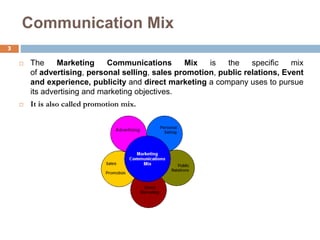
Communication Mix
 The Marketing Communications Mix is the specific mix
of advertising, personal selling, sales promotion, public relations, Event
and experience, publicity and direct marketing a company uses to pursue
its advertising and marketing objectives.
 It is also called promotion mix.
4
Communication objective
 Sales
 Education
 Retention
 Referral
 Bran Awareness
5
Factors influencing Communication
mix
• Types of product
• Use of product
• Complexity of product
• Purchase frequency and quantity
• Fund available
• Type of market
• Size of market
• Geographical area
• Stage of product life cycle
• Level of competition
• Promotional objective
• Price of product
• Desire of market Penetration
• Degree of product differentiation
6
Product life cycle and Communication
Mix.
 Pre-Introduction: Light advertising, pre-
introduction publicity
 Introduction: Heavy use of advertising, public
relations for awareness, sales promotion for trial
 Growth: Advertising, public relations, branding
and brand marketing, personal selling for
distribution
 Maturity: Advertising decreases, sales promotion,
personal selling, reminder & persuasion
 Decline: Advertising and public relations
decrease, limited sales promotion, personal selling
for distribution
Advertising
 Any paid form of nonperson presentation and
promotion of ideas, goods, or services by an identified
sponsor.
 Cost effective way to disseminate message to built
brand preference and/or educate people.
 Identifying target market and buyer motive play vital role in
advertising.
 Decision of 5M?
 Mission
 Message
 Media
 Money
 Measurement
7
Types of advertising
 Informative Advertising
 Brand Awareness
 Knowledge of product
 Persuasive Advertising
 Reminder Advertising
 Reinforcement advertising
8
9
Deciding on Advertising Budget
Factors Affecting Budget decision.
 Stage in PLC
 Marketing Share and consumer base
 Competition
 Advertising frequency
 Product substitutability
Advertising elasticity?
10
Advertising medium
 Television Ads
 Print Ads
 Radio Ads
 Film Ads
Choosing Among major Media Type
1. Target audience media habit
2. Product and message characteristics
3. cost
11
Alternative advertising options
 Place(out-of-home) Advertising
 Billboard
 Public Space
 Product placement
 Point of Purchase
12
Evaluation of Advertising Effectiveness
 Communication effect research
 Consumer feedback method.
 Portfolio test.
 Laboratory test.
 Sales effect Research
Sales Promotion
13
 Short-term incentives to encourage the
purchase or sale of a product or a service.
 Sales promotion includes a wide variety of
promotion tools designed to stimulate earlier
or stronger market response
 Advertising offer reason to buy where it offer
incentive to buy
 SP is an action-focused marketing event
whose purpose is to have impact on the
behavior of the firm’s customers
Types of sales promotion
14
 Consumer promotion
 Sample, coupon, cash refund, price off, premium,
free trial, prizes, warranty
 Trade promotion
 Price off, advertising and display allowance, free
goods, stock return
 sales force promotion
 Trade shows and conventions, specialty
advertising
CONSUMERS PROMOTION
TOOLS
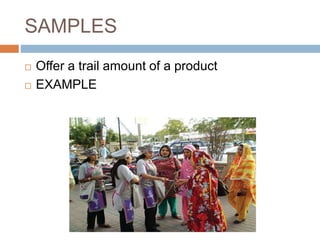
SAMPLES
 Offer a trail amount of a product
 EXAMPLE
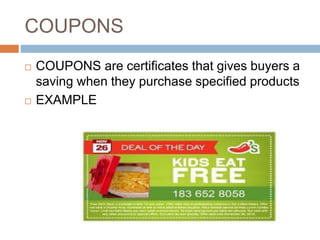
COUPONS
 COUPONS are certificates that gives buyers a
saving when they purchase specified products
 EXAMPLE
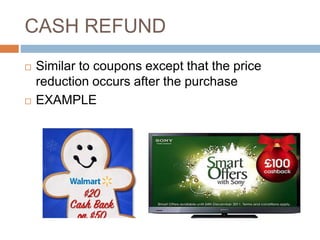
CASH REFUND
 Similar to coupons except that the price
reduction occurs after the purchase
 EXAMPLE
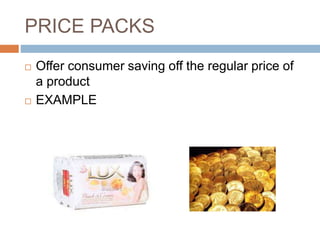
PRICE PACKS
 Offer consumer saving off the regular price of
a product
 EXAMPLE
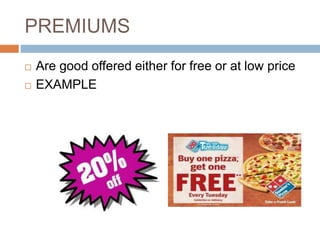
PREMIUMS
 Are good offered either for free or at low price
 EXAMPLE
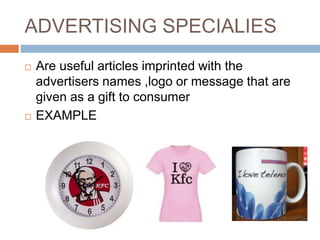
ADVERTISING SPECIALIES
 Are useful articles imprinted with the
advertisers names ,logo or message that are
given as a gift to consumer
 EXAMPLE
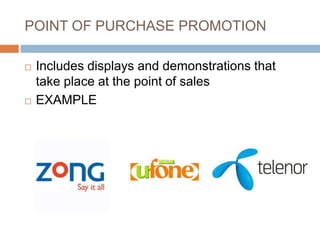
POINT OF PURCHASE PROMOTION
 Includes displays and demonstrations that
take place at the point of sales
 EXAMPLE
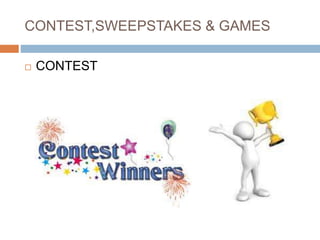
CONTEST,SWEEPSTAKES & GAMES
 CONTEST
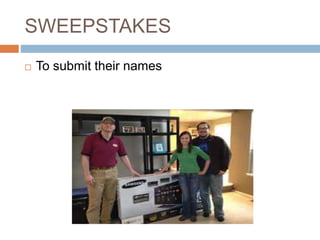
SWEEPSTAKES
 To submit their names
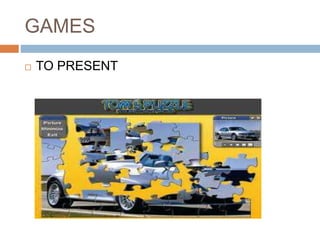
GAMES
 TO PRESENT
TRADES PROMOTION
TOOLS
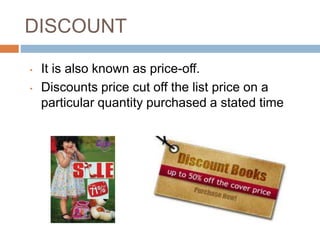
DISCOUNT
• It is also known as price-off.
• Discounts price cut off the list price on a
particular quantity purchased a stated time
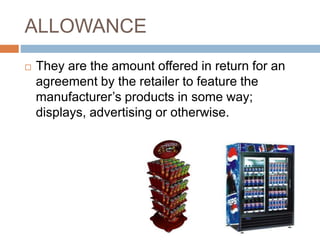
ALLOWANCE
 They are the amount offered in return for an
agreement by the retailer to feature the
manufacturer’s products in some way;
displays, advertising or otherwise.
FREE GOODS
 Free goods are the extra merchandise offered
to middlemen who buy a specific amount of a
product
 .Companies also offer push money and
specialty advertising items to the middlemen.
SALES FORCE PROMOTION
 Companies spend huge amount on promotion
focused on industrial consumers.
 Trade shows and conventions.
 Sales contests.
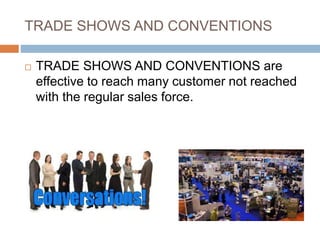
TRADE SHOWS AND CONVENTIONS
 TRADE SHOWS AND CONVENTIONS are
effective to reach many customer not reached
with the regular sales force.
SALES CONTEST
 Sales contest are effective in motivating sales
people or dealer to increase performance over
a given period.
Objective of Consumer
Promotion34
 Building product awareness
 Creating Interest
 Increase the sale volume in short term
 Attract more customer
 Encourage customer for buying
 Retain customer and maintain relationship
 Increase repurchase
 Brand and store switching
 Increase footfall
 Getting the market information
 Encourage the selling of new product
FACTORS IN GROWTH OF SALES
PROMOTIONS
 Product managers are under pressure to
increase current sales
 Companies face more competition
 Competing brands offer less differentiation to
rising cost, clutter and legal constraints
 Consumers have become more deal-oriented
36

Integrated marketing & marketing communicatio

  • 1.
  • 2.
    Integrated Marketing Communication •Integratedmarketing communication refers to integrating all the methods of brand promotion to promote a particular product or service among target customers. •In integrated marketing communication, all aspects of marketing communication work together for increased sales and maximum cost effectiveness. •Integrated Marketing Communications (IMC) is an expansion of utilising both modern and traditional marketing strategies, to optimise the communication of a consistent message conveying the companies brand to stakeholders (Kitchen & Burgmann, 2015) •IMC is an approach to brand communications where the different modes work together to create aseamless experience for the customer and are presented with a similar tone and style that reinforces the brand’s core message. 2
  • 3.
    3 Communication Mix  TheMarketing Communications Mix is the specific mix of advertising, personal selling, sales promotion, public relations, Event and experience, publicity and direct marketing a company uses to pursue its advertising and marketing objectives.  It is also called promotion mix.
  • 4.
    4 Communication objective  Sales Education  Retention  Referral  Bran Awareness
  • 5.
    5 Factors influencing Communication mix •Types of product • Use of product • Complexity of product • Purchase frequency and quantity • Fund available • Type of market • Size of market • Geographical area • Stage of product life cycle • Level of competition • Promotional objective • Price of product • Desire of market Penetration • Degree of product differentiation
  • 6.
    6 Product life cycleand Communication Mix.  Pre-Introduction: Light advertising, pre- introduction publicity  Introduction: Heavy use of advertising, public relations for awareness, sales promotion for trial  Growth: Advertising, public relations, branding and brand marketing, personal selling for distribution  Maturity: Advertising decreases, sales promotion, personal selling, reminder & persuasion  Decline: Advertising and public relations decrease, limited sales promotion, personal selling for distribution
  • 7.
    Advertising  Any paidform of nonperson presentation and promotion of ideas, goods, or services by an identified sponsor.  Cost effective way to disseminate message to built brand preference and/or educate people.  Identifying target market and buyer motive play vital role in advertising.  Decision of 5M?  Mission  Message  Media  Money  Measurement 7
  • 8.
    Types of advertising Informative Advertising  Brand Awareness  Knowledge of product  Persuasive Advertising  Reminder Advertising  Reinforcement advertising 8
  • 9.
    9 Deciding on AdvertisingBudget Factors Affecting Budget decision.  Stage in PLC  Marketing Share and consumer base  Competition  Advertising frequency  Product substitutability Advertising elasticity?
  • 10.
    10 Advertising medium  TelevisionAds  Print Ads  Radio Ads  Film Ads Choosing Among major Media Type 1. Target audience media habit 2. Product and message characteristics 3. cost
  • 11.
    11 Alternative advertising options Place(out-of-home) Advertising  Billboard  Public Space  Product placement  Point of Purchase
  • 12.
    12 Evaluation of AdvertisingEffectiveness  Communication effect research  Consumer feedback method.  Portfolio test.  Laboratory test.  Sales effect Research
  • 13.
    Sales Promotion 13  Short-termincentives to encourage the purchase or sale of a product or a service.  Sales promotion includes a wide variety of promotion tools designed to stimulate earlier or stronger market response  Advertising offer reason to buy where it offer incentive to buy  SP is an action-focused marketing event whose purpose is to have impact on the behavior of the firm’s customers
  • 14.
    Types of salespromotion 14  Consumer promotion  Sample, coupon, cash refund, price off, premium, free trial, prizes, warranty  Trade promotion  Price off, advertising and display allowance, free goods, stock return  sales force promotion  Trade shows and conventions, specialty advertising
  • 15.
  • 16.
    SAMPLES  Offer atrail amount of a product  EXAMPLE
  • 17.
    COUPONS  COUPONS arecertificates that gives buyers a saving when they purchase specified products  EXAMPLE
  • 18.
    CASH REFUND  Similarto coupons except that the price reduction occurs after the purchase  EXAMPLE
  • 19.
    PRICE PACKS  Offerconsumer saving off the regular price of a product  EXAMPLE
  • 20.
    PREMIUMS  Are goodoffered either for free or at low price  EXAMPLE
  • 21.
    ADVERTISING SPECIALIES  Areuseful articles imprinted with the advertisers names ,logo or message that are given as a gift to consumer  EXAMPLE
  • 22.
    POINT OF PURCHASEPROMOTION  Includes displays and demonstrations that take place at the point of sales  EXAMPLE
  • 23.
  • 24.
  • 25.
  • 26.
  • 27.
    DISCOUNT • It isalso known as price-off. • Discounts price cut off the list price on a particular quantity purchased a stated time
  • 28.
    ALLOWANCE  They arethe amount offered in return for an agreement by the retailer to feature the manufacturer’s products in some way; displays, advertising or otherwise.
  • 29.
    FREE GOODS  Freegoods are the extra merchandise offered to middlemen who buy a specific amount of a product  .Companies also offer push money and specialty advertising items to the middlemen.
  • 30.
  • 31.
    SALES FORCE PROMOTION Companies spend huge amount on promotion focused on industrial consumers.  Trade shows and conventions.  Sales contests.
  • 32.
    TRADE SHOWS ANDCONVENTIONS  TRADE SHOWS AND CONVENTIONS are effective to reach many customer not reached with the regular sales force.
  • 33.
    SALES CONTEST  Salescontest are effective in motivating sales people or dealer to increase performance over a given period.
  • 34.
    Objective of Consumer Promotion34 Building product awareness  Creating Interest  Increase the sale volume in short term  Attract more customer  Encourage customer for buying  Retain customer and maintain relationship  Increase repurchase  Brand and store switching  Increase footfall  Getting the market information  Encourage the selling of new product
  • 35.
    FACTORS IN GROWTHOF SALES PROMOTIONS  Product managers are under pressure to increase current sales  Companies face more competition  Competing brands offer less differentiation to rising cost, clutter and legal constraints  Consumers have become more deal-oriented
  • 36.