Roshan Paudel
1
 Monetary policy is the actions of a central bank,
currency board or other regulatory committee that
determine the size and rate of growth of the money
supply, which in turn affects interest rates.
 Monetary policy is maintained through actions such as
modifying the interest rate, buying or selling
government bonds, and changing the amount of money
banks are required to keep in the vault (bank reserves).
 Central bank is called monetary authority in the country
and RBI is monetary Authority of India.
2
Monetary Policy
 According to Prof. Harry Johnson,
"A policy employing the central banks control of the supply
of money as an instrument for achieving the objectives of
general economic policy is a monetary policy."
 According to A.G. Hart,
"A policy which influences the public stock of money
substitute of public demand for such assets of both that is
policy which influences public liquidity position is known as
a monetary policy.“
 According to Reserve Bank of India
“ Monetary policy refers to the use of instruments under the
control of the central bank to regulate the availability, cost
and use of money and credit.”
Definition
3
 Contractionary and expansionary
1. Interest rates
2. Reserve requirements
3. Money supply, directly or indirectly
Types of monetary policy
4
Secondary objective:
 Balance of Payments (BOP) Equilibrium
 Full Employment
 Neutrality of Money
 Equal Income Distribution
Objective
5
Primary objective:
 Ensuring price stability, that is, containing inflation.
 To encourage economic growth.
 To ensure stability of exchange rate of the rupee, that is,
exchange rate of rupee with the US dollar, pound sterling
and other foreign currencies.
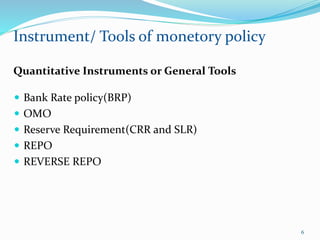
 Bank Rate policy(BRP)
 OMO
 Reserve Requirement(CRR and SLR)
 REPO
 REVERSE REPO
Instrument/ Tools of monetory policy
6
Quantitative Instruments or General Tools
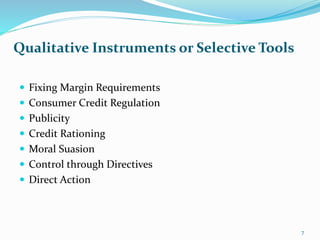
 Fixing Margin Requirements
 Consumer Credit Regulation
 Publicity
 Credit Rationing
 Moral Suasion
 Control through Directives
 Direct Action
Qualitative Instruments or Selective Tools
7
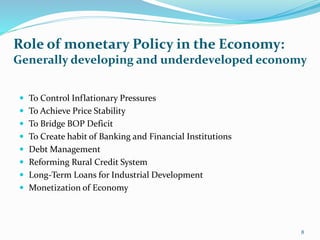
 To Control Inflationary Pressures
 To Achieve Price Stability
 To Bridge BOP Deficit
 To Create habit of Banking and Financial Institutions
 Debt Management
 Reforming Rural Credit System
 Long-Term Loans for Industrial Development
 Monetization of Economy
Role of monetary Policy in the Economy:
Generally developing and underdeveloped economy
8
Fiscal policy
9
 Fiscal policy is the means by which a government adjusts
its spending levels and tax rates to monitor and influence a
nation's economy
 It is the decisions that a government makes regarding
collection of revenue, through taxation and about spending
that revenue.
 “Fiscal policy deals with the taxation and expenditure
decisions of the government. These include, tax policy,
expenditure policy, investment or disinvestment strategies
and debt or surplus management.”- Kaushik Basu
Fiscal policy:
10
 Neutral fiscal policy
it is usually undertaken when an economy is in
equilibrium. Government spending is fully funded by tax revenue and
overall the budget outcome has a neutral effect on the level
of economic activity.
 Expansionary fiscal policy
it involves government spending exceeding tax revenue, and is usually
undertaken during recessions. It is also known as reflationary fiscal
policy.
 Contractionary fiscal policy
it occurs when government spending is lower than tax revenue, and is
usually undertaken to pay down government debt.
Types of fiscal policy
11
 Public expenditure
 Taxation
 Public Debt
 Transfer payment
Instrument of fiscal policy
12
Fiscal Policy for Full Employment
Fiscal Policy and Economic Stabilization
Fiscal Policy and Economic Growth
Fiscal Policy and Social Justice
Objective of fiscal policy
13
 Time lag
а. Recognition Lag
b. Administrative Lag
c. operational Lag
 Forecasting
 Coordination with Monetary Policy(fiscal sensitivity)
 Political Conflict
 Crowding Out(self-offsetting Effect)
 Correct Size and Nature of Fiscal Policy
 Inadequacy of Fiscal Measures
 Adverse Effect on Redistribution of Income
 Administrative Problems in Democratic Countries
Limitation of fiscal policy
14
Can we exchange ideas?
15
Can we exchange ideas?
16
Can we exchange ideas?
17
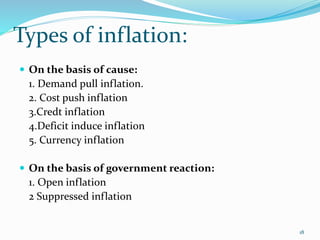
Types of inflation:
18
 On the basis of cause:
1. Demand pull inflation.
2. Cost push inflation
3.Credt inflation
4.Deficit induce inflation
5. Currency inflation
 On the basis of government reaction:
1. Open inflation
2 Suppressed inflation
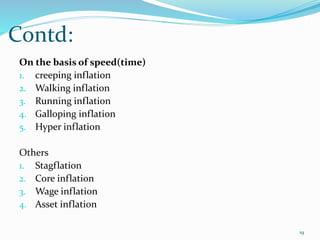
Contd:
19
On the basis of speed(time)
1. creeping inflation
2. Walking inflation
3. Running inflation
4. Galloping inflation
5. Hyper inflation
Others
1. Stagflation
2. Core inflation
3. Wage inflation
4. Asset inflation
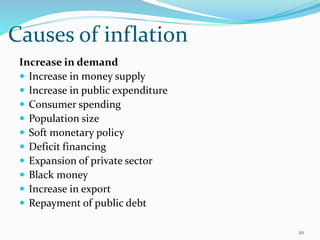
Causes of inflation
20
Increase in demand
 Increase in money supply
 Increase in public expenditure
 Consumer spending
 Population size
 Soft monetary policy
 Deficit financing
 Expansion of private sector
 Black money
 Increase in export
 Repayment of public debt
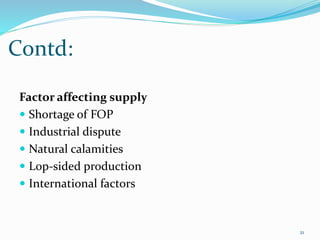
Contd:
21
Factor affecting supply
 Shortage of FOP
 Industrial dispute
 Natural calamities
 Lop-sided production
 International factors
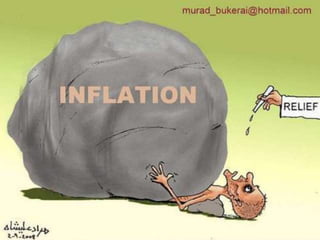
High degree of inflation has adverse effects on the economy
22
 First, inflation raises the cost of living of the people and hurts
the poor most. Therefore, inflation has been described as enemy
No. 1 of the poor. Inflation sends many people below the poverty
line.
 Secondly, inflation makes exports costlier and, therefore,
discourages them. On the other hand, due to higher prices at
home people are induced to import goods to a large extent. Thus,
inflation has an adverse effect on the balance of payments.
 Thirdly, when due to a higher rate of inflation value of money is
rapidly falling, people do not have much incentive to save. This
lowers the rate of saving on which investment and economic
growth depend.
 Fourthly, a high rate of inflation encourages businessmen to
invest in the unproductive assets such as gold, jewellery, real
estate etc.
Control/ Measure of inflation
23
Monetary measure
 Credit control
 Demonetization of currency
 Issue of new currency
Fiscal measure
 Reduction of unnecessary expenditure
 Increase taxation
 Encourage to save
 Appropriate budget
 Management of public debt.
Others
 Increase production
 Rational wage policy
 Price control or fixing price
 Management of resource
Why little inflation is better?
 A little inflation (around 3-5%) is always considered as good
for overall growth of economy.
 The consumer always expects the prices of goods to increase,
so they spend more frequently, which increases demand and
provide profitability to the manufacturers.
 A little inflation is a sign of growing and healthy economy.
 Inflation always works as a lubricant for any shock to
economy and help it to recover. For example in a recession
time cutting wages are considered more profitable than
cutting jobs, but the earlier is not accepted easier than the
later, and as we know job cuts are always bad for economy. But
if there’s inflation in economy, employers just need to provide
lesser raise than inflation rate and no one would mind.
24
THANK YOU
25

Monitary and fiscal policy

  • 1.
  • 2.
     Monetary policyis the actions of a central bank, currency board or other regulatory committee that determine the size and rate of growth of the money supply, which in turn affects interest rates.  Monetary policy is maintained through actions such as modifying the interest rate, buying or selling government bonds, and changing the amount of money banks are required to keep in the vault (bank reserves).  Central bank is called monetary authority in the country and RBI is monetary Authority of India. 2 Monetary Policy
  • 3.
     According toProf. Harry Johnson, "A policy employing the central banks control of the supply of money as an instrument for achieving the objectives of general economic policy is a monetary policy."  According to A.G. Hart, "A policy which influences the public stock of money substitute of public demand for such assets of both that is policy which influences public liquidity position is known as a monetary policy.“  According to Reserve Bank of India “ Monetary policy refers to the use of instruments under the control of the central bank to regulate the availability, cost and use of money and credit.” Definition 3
  • 4.
     Contractionary andexpansionary 1. Interest rates 2. Reserve requirements 3. Money supply, directly or indirectly Types of monetary policy 4
  • 5.
    Secondary objective:  Balanceof Payments (BOP) Equilibrium  Full Employment  Neutrality of Money  Equal Income Distribution Objective 5 Primary objective:  Ensuring price stability, that is, containing inflation.  To encourage economic growth.  To ensure stability of exchange rate of the rupee, that is, exchange rate of rupee with the US dollar, pound sterling and other foreign currencies.
  • 6.
     Bank Ratepolicy(BRP)  OMO  Reserve Requirement(CRR and SLR)  REPO  REVERSE REPO Instrument/ Tools of monetory policy 6 Quantitative Instruments or General Tools
  • 7.
     Fixing MarginRequirements  Consumer Credit Regulation  Publicity  Credit Rationing  Moral Suasion  Control through Directives  Direct Action Qualitative Instruments or Selective Tools 7
  • 8.
     To ControlInflationary Pressures  To Achieve Price Stability  To Bridge BOP Deficit  To Create habit of Banking and Financial Institutions  Debt Management  Reforming Rural Credit System  Long-Term Loans for Industrial Development  Monetization of Economy Role of monetary Policy in the Economy: Generally developing and underdeveloped economy 8
  • 9.
  • 10.
     Fiscal policyis the means by which a government adjusts its spending levels and tax rates to monitor and influence a nation's economy  It is the decisions that a government makes regarding collection of revenue, through taxation and about spending that revenue.  “Fiscal policy deals with the taxation and expenditure decisions of the government. These include, tax policy, expenditure policy, investment or disinvestment strategies and debt or surplus management.”- Kaushik Basu Fiscal policy: 10
  • 11.
     Neutral fiscalpolicy it is usually undertaken when an economy is in equilibrium. Government spending is fully funded by tax revenue and overall the budget outcome has a neutral effect on the level of economic activity.  Expansionary fiscal policy it involves government spending exceeding tax revenue, and is usually undertaken during recessions. It is also known as reflationary fiscal policy.  Contractionary fiscal policy it occurs when government spending is lower than tax revenue, and is usually undertaken to pay down government debt. Types of fiscal policy 11
  • 12.
     Public expenditure Taxation  Public Debt  Transfer payment Instrument of fiscal policy 12
  • 13.
    Fiscal Policy forFull Employment Fiscal Policy and Economic Stabilization Fiscal Policy and Economic Growth Fiscal Policy and Social Justice Objective of fiscal policy 13
  • 14.
     Time lag а.Recognition Lag b. Administrative Lag c. operational Lag  Forecasting  Coordination with Monetary Policy(fiscal sensitivity)  Political Conflict  Crowding Out(self-offsetting Effect)  Correct Size and Nature of Fiscal Policy  Inadequacy of Fiscal Measures  Adverse Effect on Redistribution of Income  Administrative Problems in Democratic Countries Limitation of fiscal policy 14
  • 15.
    Can we exchangeideas? 15
  • 16.
    Can we exchangeideas? 16
  • 17.
    Can we exchangeideas? 17
  • 18.
    Types of inflation: 18 On the basis of cause: 1. Demand pull inflation. 2. Cost push inflation 3.Credt inflation 4.Deficit induce inflation 5. Currency inflation  On the basis of government reaction: 1. Open inflation 2 Suppressed inflation
  • 19.
    Contd: 19 On the basisof speed(time) 1. creeping inflation 2. Walking inflation 3. Running inflation 4. Galloping inflation 5. Hyper inflation Others 1. Stagflation 2. Core inflation 3. Wage inflation 4. Asset inflation
  • 20.
    Causes of inflation 20 Increasein demand  Increase in money supply  Increase in public expenditure  Consumer spending  Population size  Soft monetary policy  Deficit financing  Expansion of private sector  Black money  Increase in export  Repayment of public debt
  • 21.
    Contd: 21 Factor affecting supply Shortage of FOP  Industrial dispute  Natural calamities  Lop-sided production  International factors
  • 22.
    High degree ofinflation has adverse effects on the economy 22  First, inflation raises the cost of living of the people and hurts the poor most. Therefore, inflation has been described as enemy No. 1 of the poor. Inflation sends many people below the poverty line.  Secondly, inflation makes exports costlier and, therefore, discourages them. On the other hand, due to higher prices at home people are induced to import goods to a large extent. Thus, inflation has an adverse effect on the balance of payments.  Thirdly, when due to a higher rate of inflation value of money is rapidly falling, people do not have much incentive to save. This lowers the rate of saving on which investment and economic growth depend.  Fourthly, a high rate of inflation encourages businessmen to invest in the unproductive assets such as gold, jewellery, real estate etc.
  • 23.
    Control/ Measure ofinflation 23 Monetary measure  Credit control  Demonetization of currency  Issue of new currency Fiscal measure  Reduction of unnecessary expenditure  Increase taxation  Encourage to save  Appropriate budget  Management of public debt. Others  Increase production  Rational wage policy  Price control or fixing price  Management of resource
  • 24.
    Why little inflationis better?  A little inflation (around 3-5%) is always considered as good for overall growth of economy.  The consumer always expects the prices of goods to increase, so they spend more frequently, which increases demand and provide profitability to the manufacturers.  A little inflation is a sign of growing and healthy economy.  Inflation always works as a lubricant for any shock to economy and help it to recover. For example in a recession time cutting wages are considered more profitable than cutting jobs, but the earlier is not accepted easier than the later, and as we know job cuts are always bad for economy. But if there’s inflation in economy, employers just need to provide lesser raise than inflation rate and no one would mind. 24
  • 25.

Editor's Notes