Consultant, 
Honorary Academic Editor 
Associate Director, 
Principal Investigator 
! 
Open access and open data at ! 
Nature Publishing Group: ! 
better data = better science! 
! 
Susanna-Assunta Sansone, PhD! 
! 
! 
@biosharing! 
@isatools! 
@scientificdata! 
! 
Open Access Week at Oxford, 20-24 October, 2014 
http://www.slideshare.net/SusannaSansone
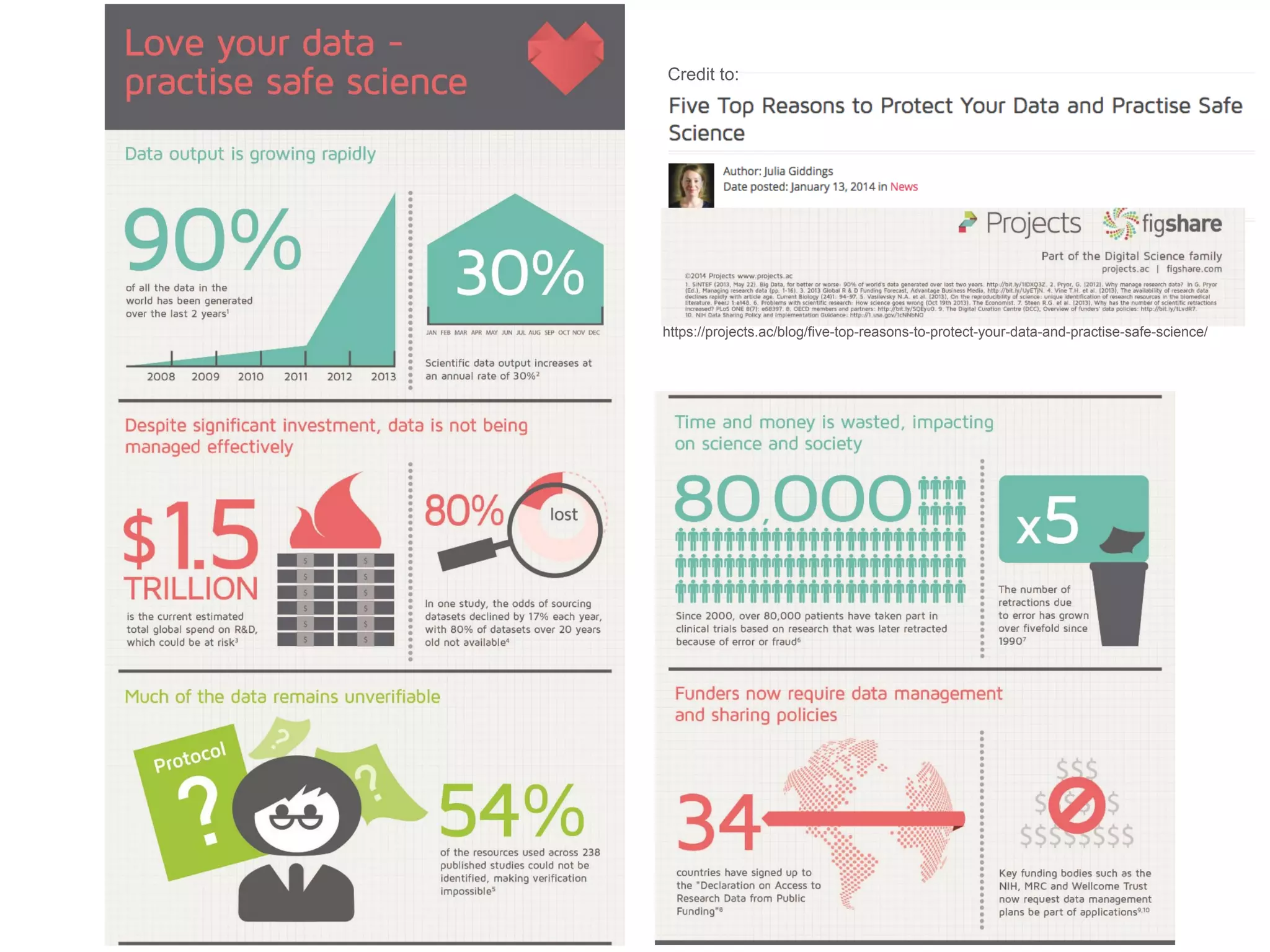
Credit to: 
https://projects.ac/blog/five-top-reasons-to-protect-your-data-and-practise-safe-science/
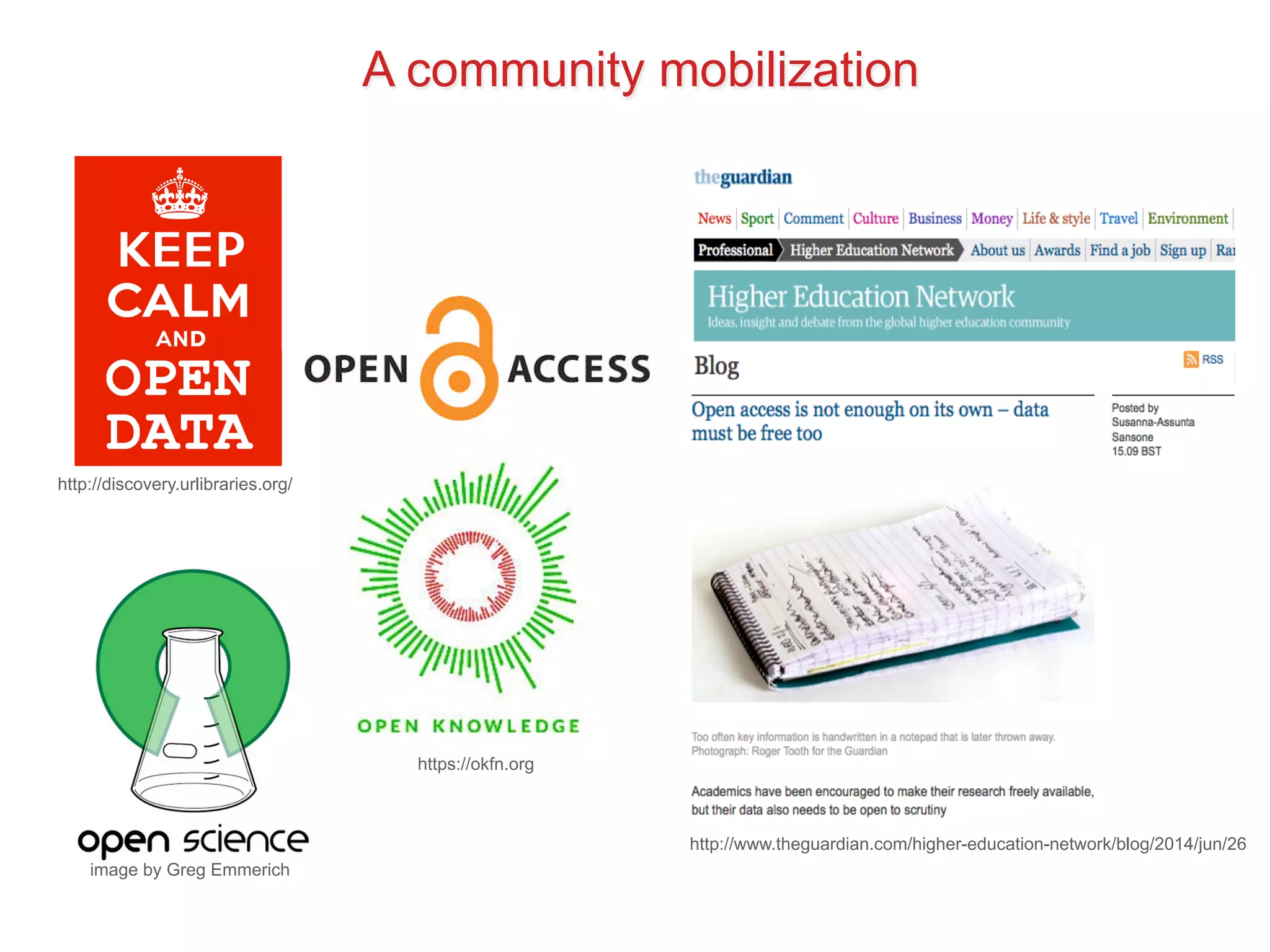
A community mobilization 
http://discovery.urlibraries.org/ 
image by Greg Emmerich 
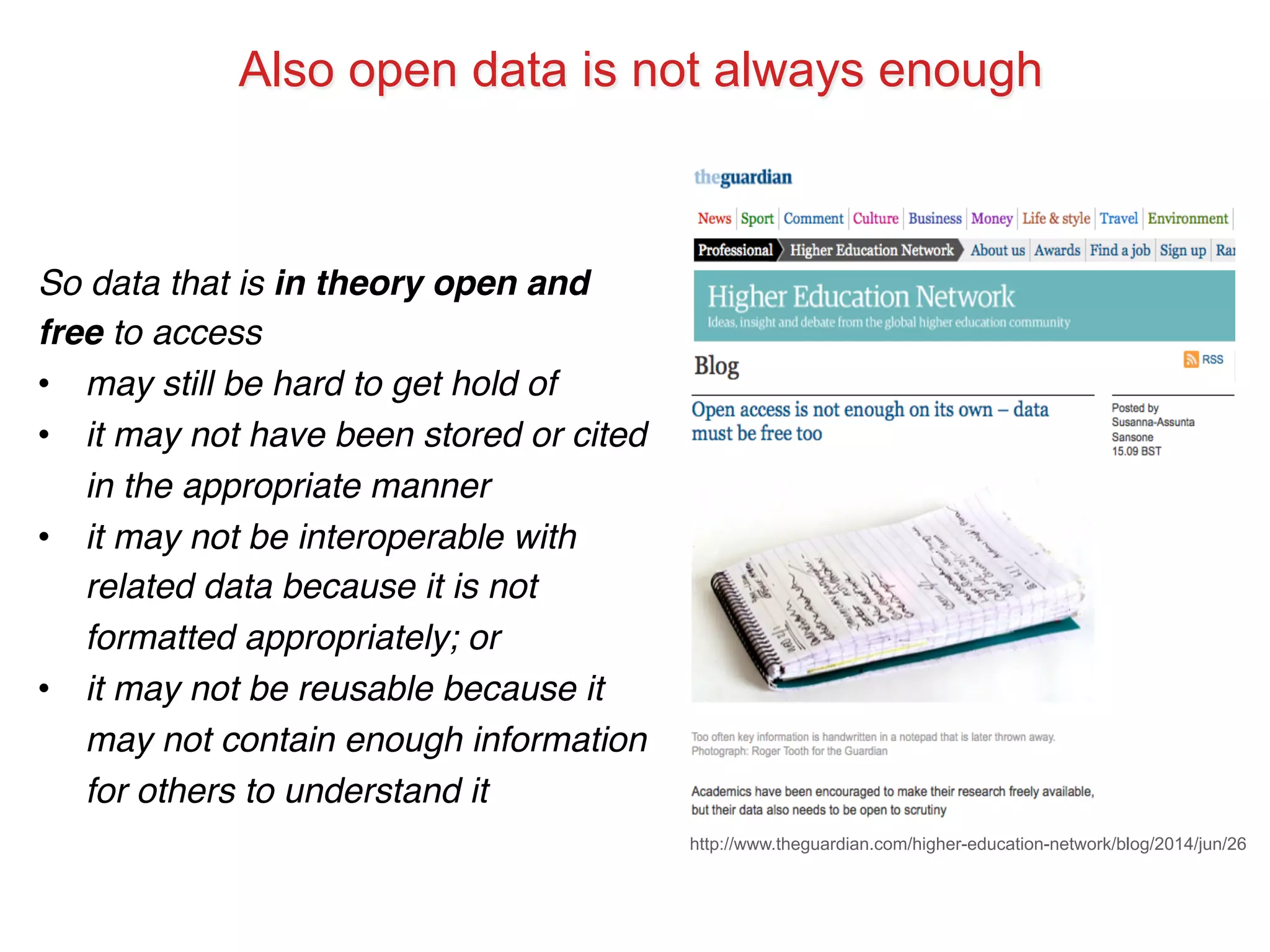
http://www.theguardian.com/higher-education-network/blog/2014/jun/26 
https://okfn.org
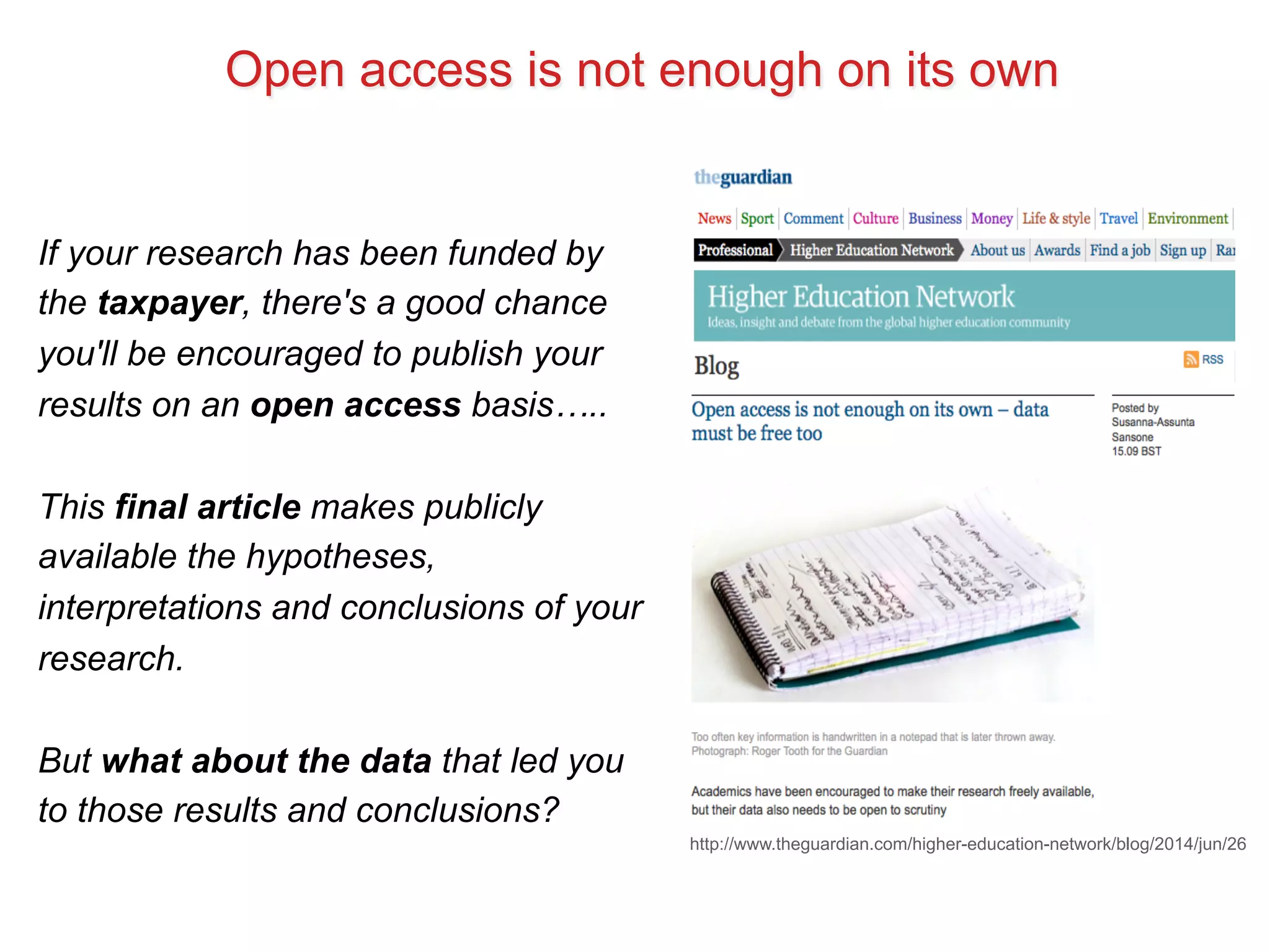
Open access is not enough on its own 
http://www.theguardian.com/higher-education-network/blog/2014/jun/26 
If your research has been funded by 
the taxpayer, there's a good chance 
you'll be encouraged to publish your 
results on an open access basis….. 
This final article makes publicly 
available the hypotheses, 
interpretations and conclusions of your 
research. 
But what about the data that led you 
to those results and conclusions?
Also open data is not always enough 
http://www.theguardian.com/higher-education-network/blog/2014/jun/26 
So data that is in theory open and 
free to access! 
• may still be hard to get hold of! 
• it may not have been stored or cited 
in the appropriate manner! 
• it may not be interoperable with 
related data because it is not 
formatted appropriately; or! 
• it may not be reusable because it 
may not contain enough information 
for others to understand it!
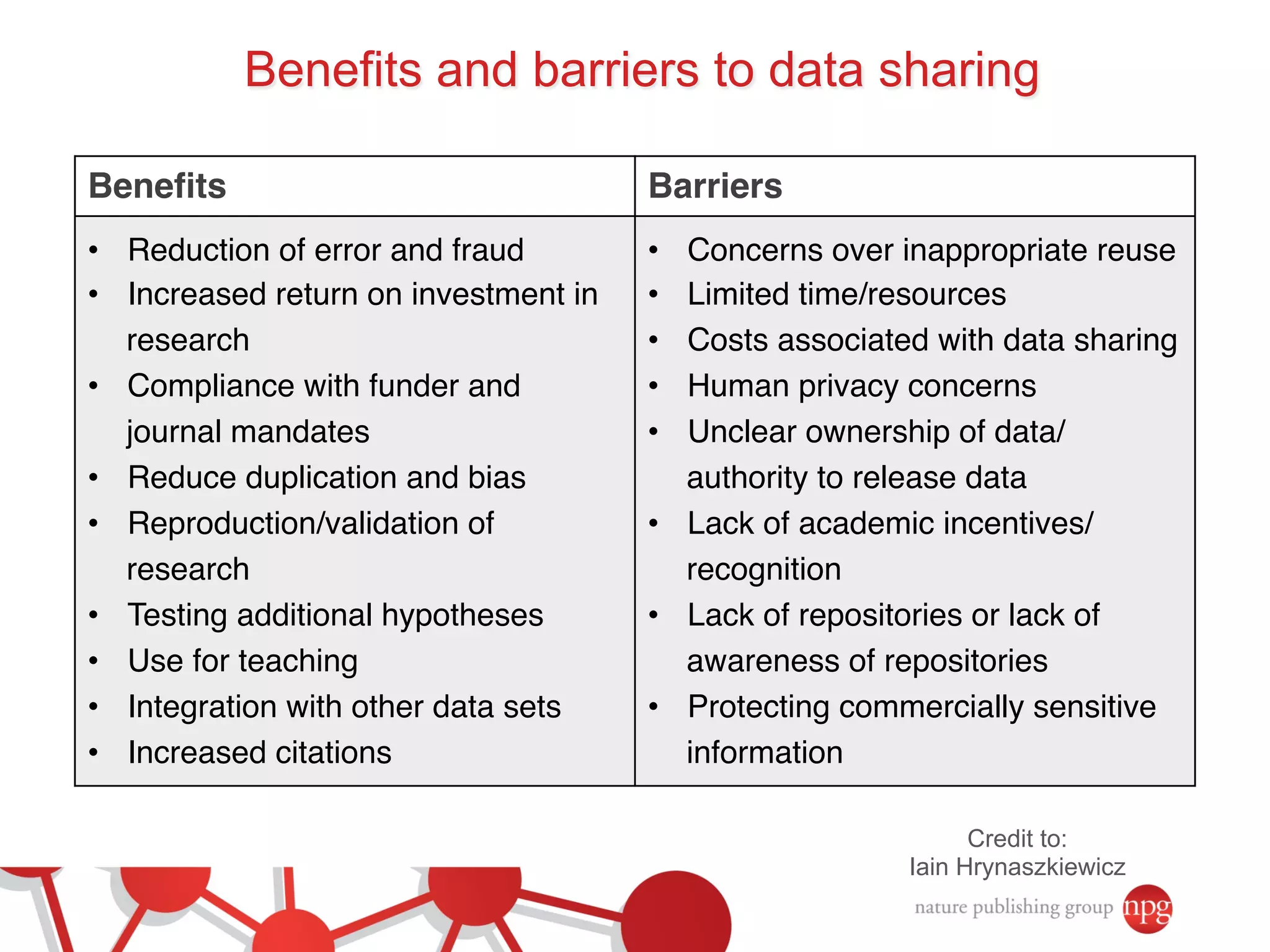
Benefits and barriers to data sharing 
Credit to: 
Iain Hrynaszkiewicz 
Benefits! Barriers! 
• Reduction of error and fraud! 
• Increased return on investment in 
research! 
• Compliance with funder and 
journal mandates! 
• Reduce duplication and bias! 
• Reproduction/validation of 
research! 
• Testing additional hypotheses! 
• Use for teaching! 
• Integration with other data sets! 
• Increased citations ! 
• Concerns over inappropriate reuse! 
• Limited time/resources! 
• Costs associated with data sharing! 
• Human privacy concerns! 
• Unclear ownership of data/ 
authority to release data! 
• Lack of academic incentives/ 
recognition! 
• Lack of repositories or lack of 
awareness of repositories! 
• Protecting commercially sensitive 
information !
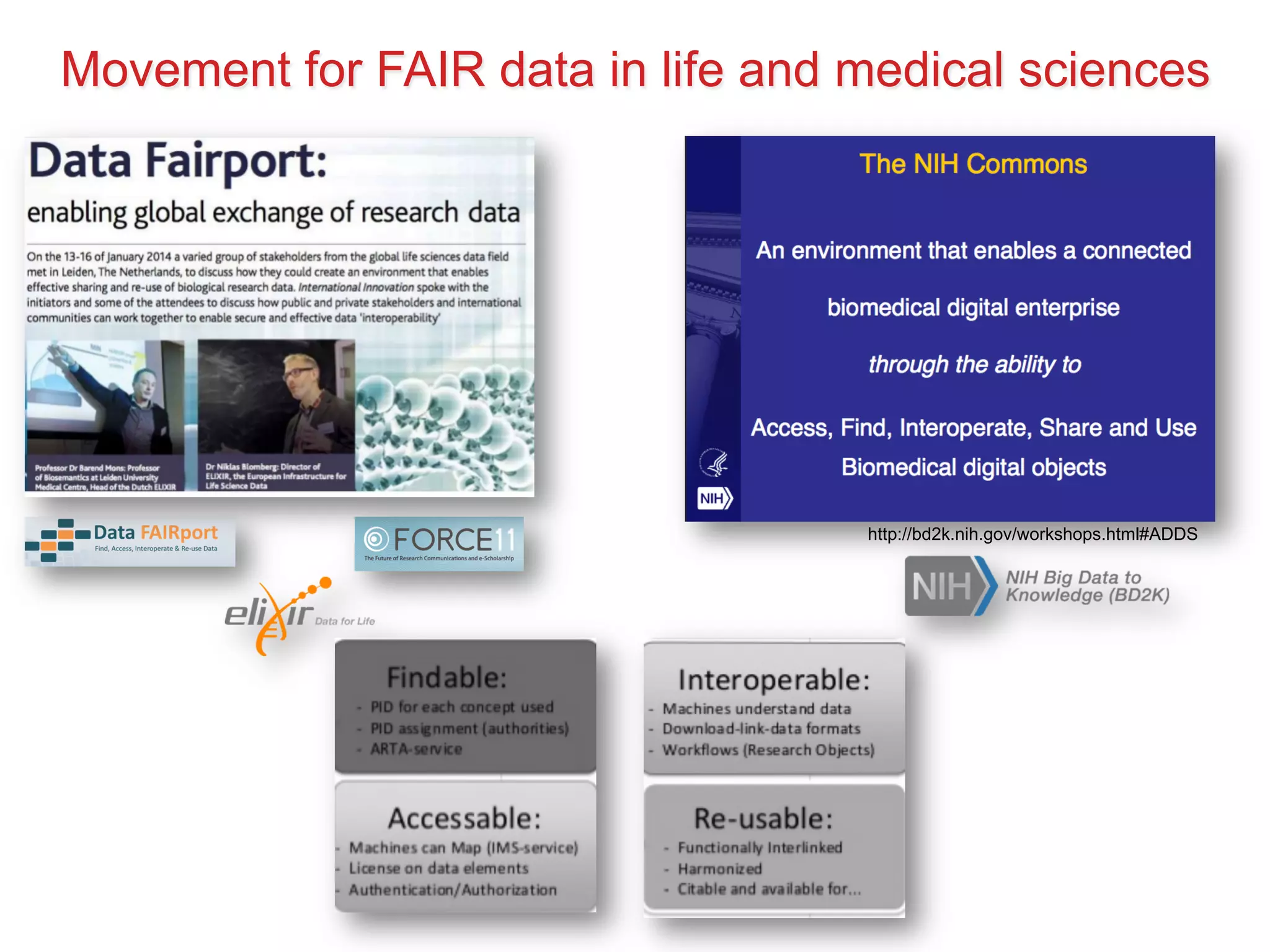
Movement for FAIR data in life and medical sciences 
http://bd2k.nih.gov/workshops.html#ADDS
The International Conference on Systems Biology (ICSB), 22-28 August, 2008 Susanna-Assunta 
Sansone www.ebi.ac.uk/net-project 
8 
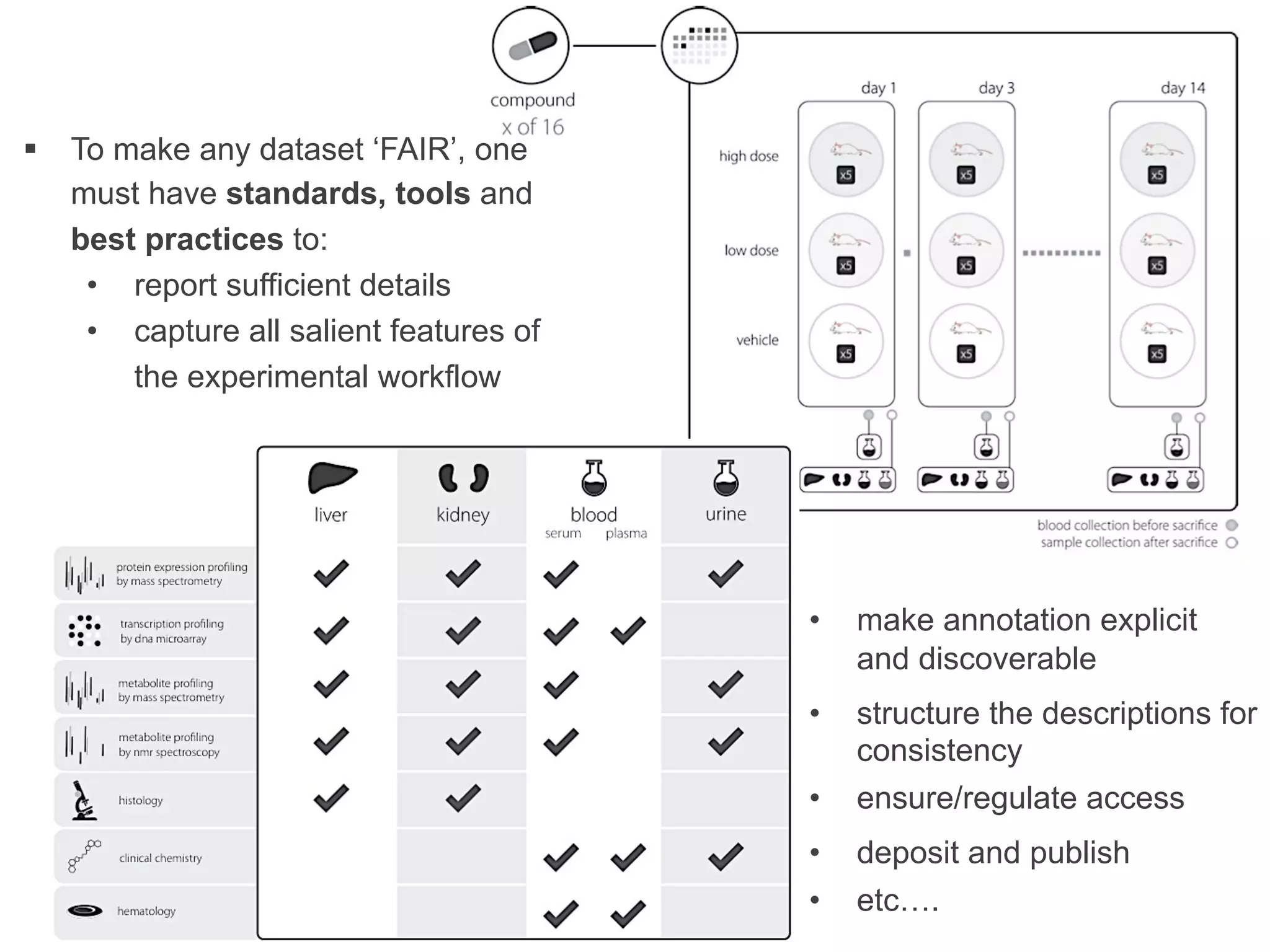
• make annotation explicit 
and discoverable 
• structure the descriptions for 
consistency 
• ensure/regulate access 
• deposit and publish 
• etc…. 
§ To make any dataset ‘FAIR’, one 
must have standards, tools and 
best practices to: 
• report sufficient details 
• capture all salient features of 
the experimental workflow
The International Conference on Systems Biology (ICSB), 22-28 August, 2008 Susanna-Assunta 
Sansone www.ebi.ac.uk/net-project 
9 
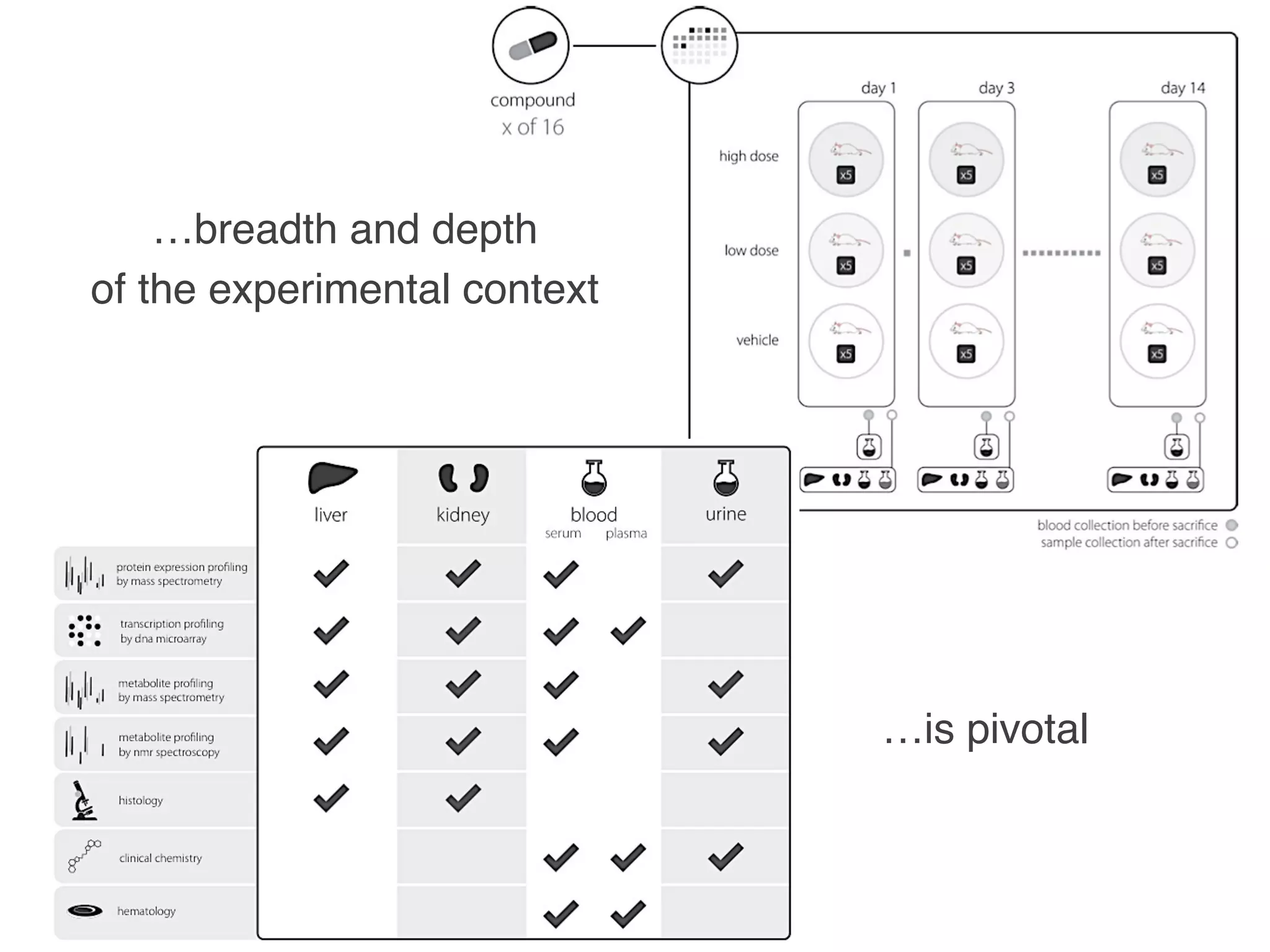
…breadth and depth ! 
of the experimental context! 
…is pivotal!
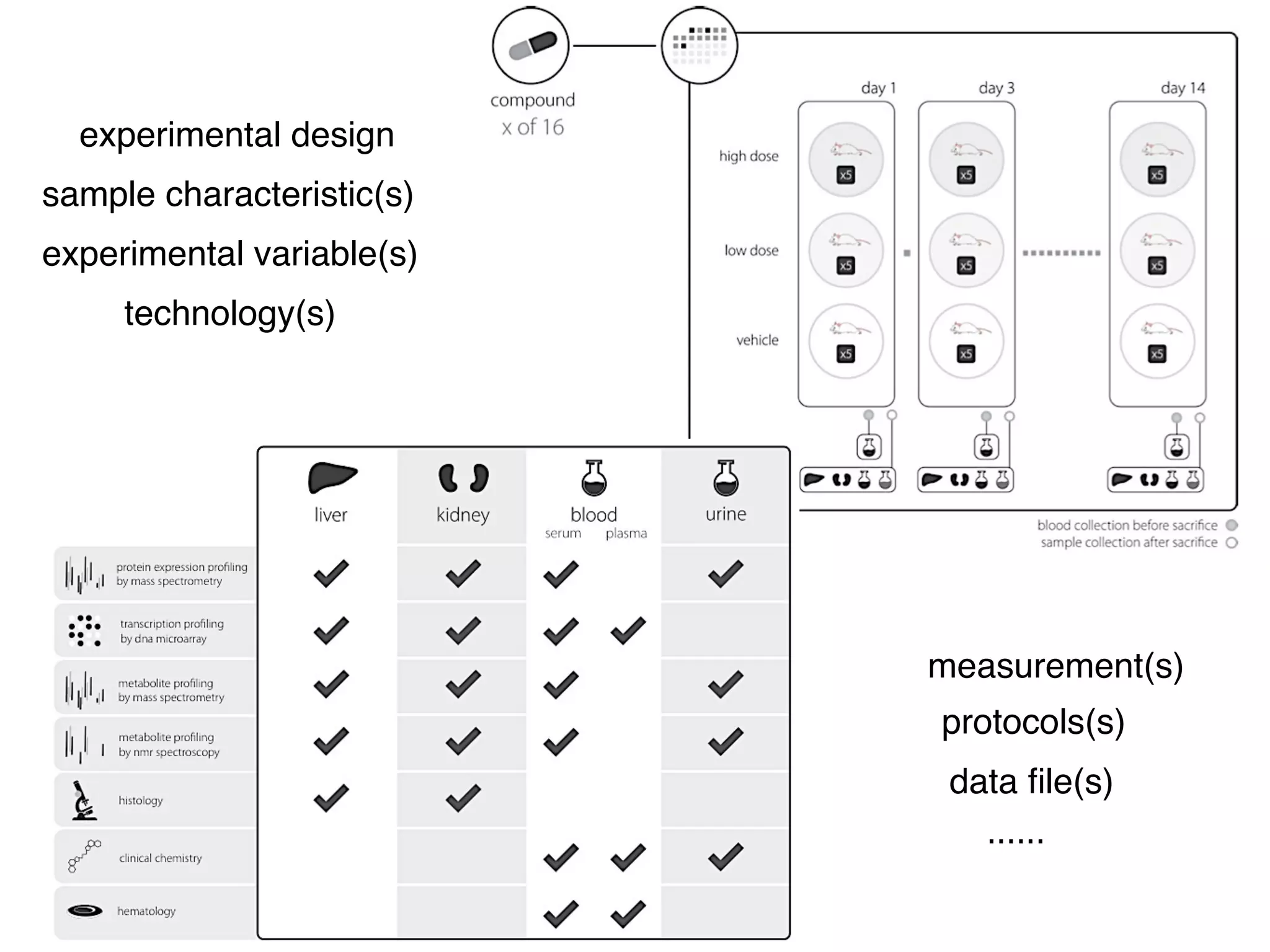
sample characteristic(s)! 
The International Conference on Systems Biology (ICSB), 22-28 August, 2008 Susanna-Assunta 
Sansone www.ebi.ac.uk/net-project 
1 
0 
experimental design! 
experimental variable(s)! 
technology(s)! 
measurement(s)! 
protocols(s)! 
data file(s)! 
......!
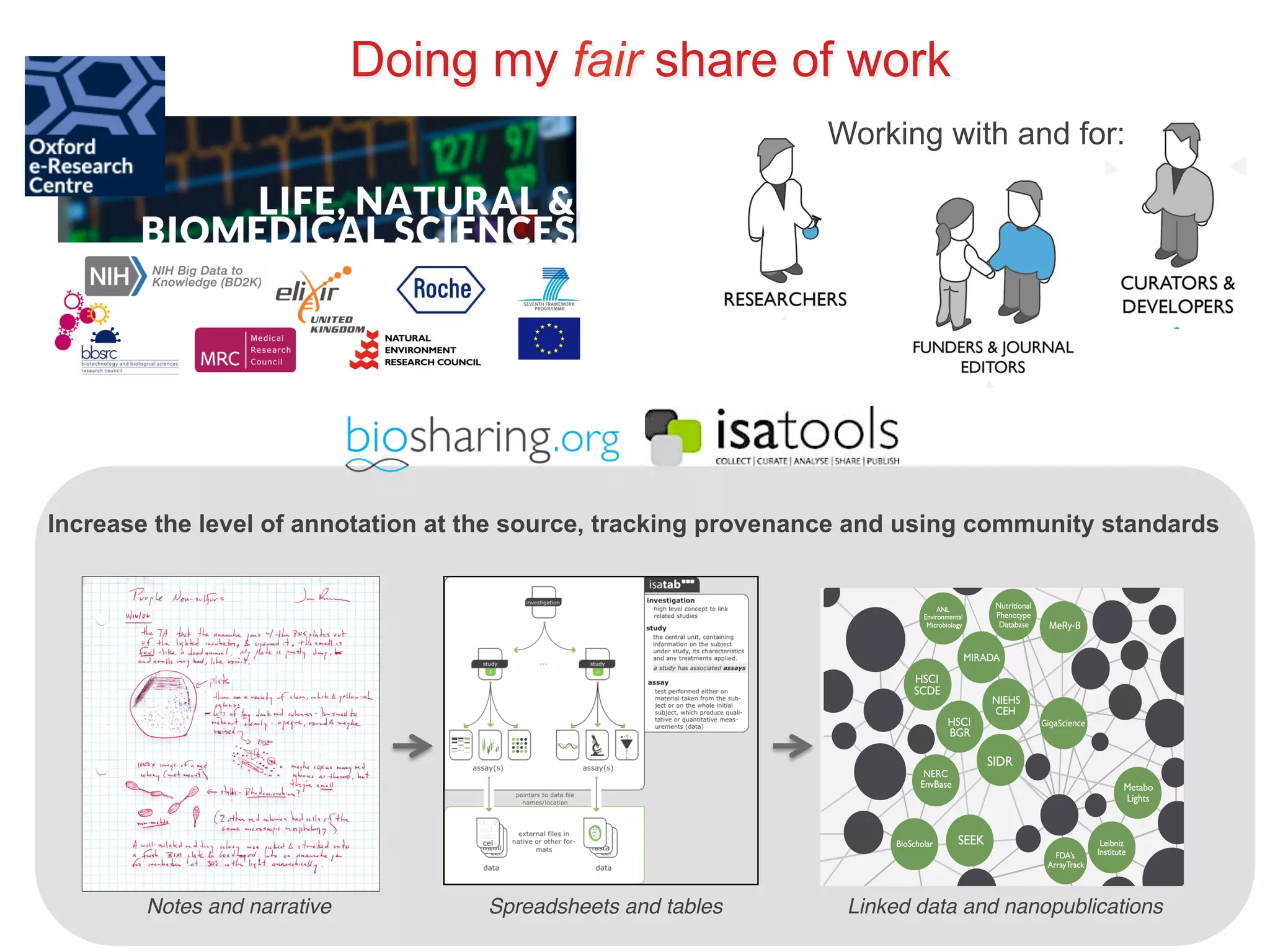
Doing my fair share of work 
Working with and for: 
Increase the level of annotation at the source, tracking provenance and using community standards 
Notes and narrative! Spreadsheets and tables! Linked data and nanopublications! 
Notes in Lab Books 
(information for humans) 
Spreadsheets and Tables 
( the compromise) 
Facts as RDF statements 
(information for machines)
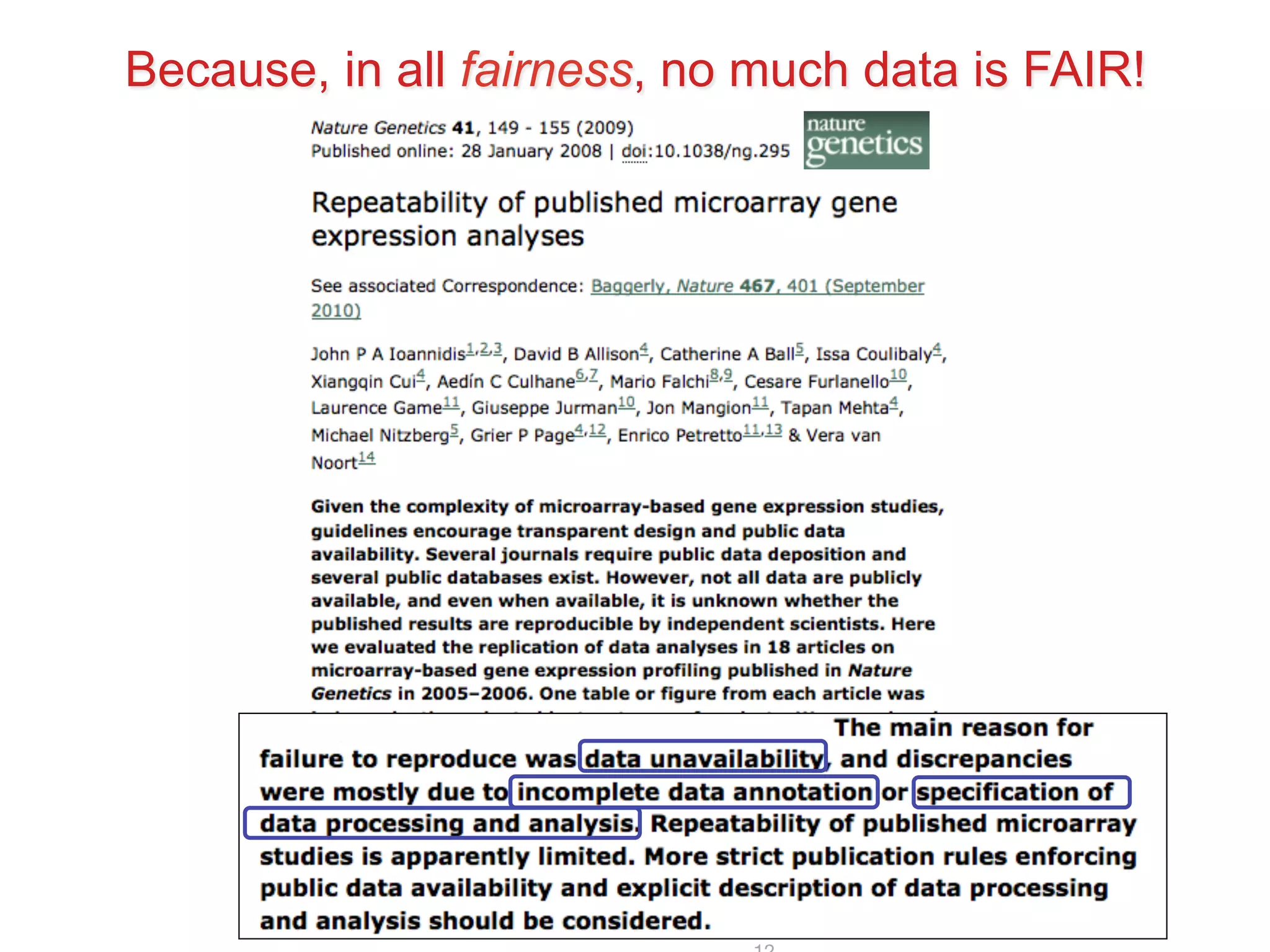
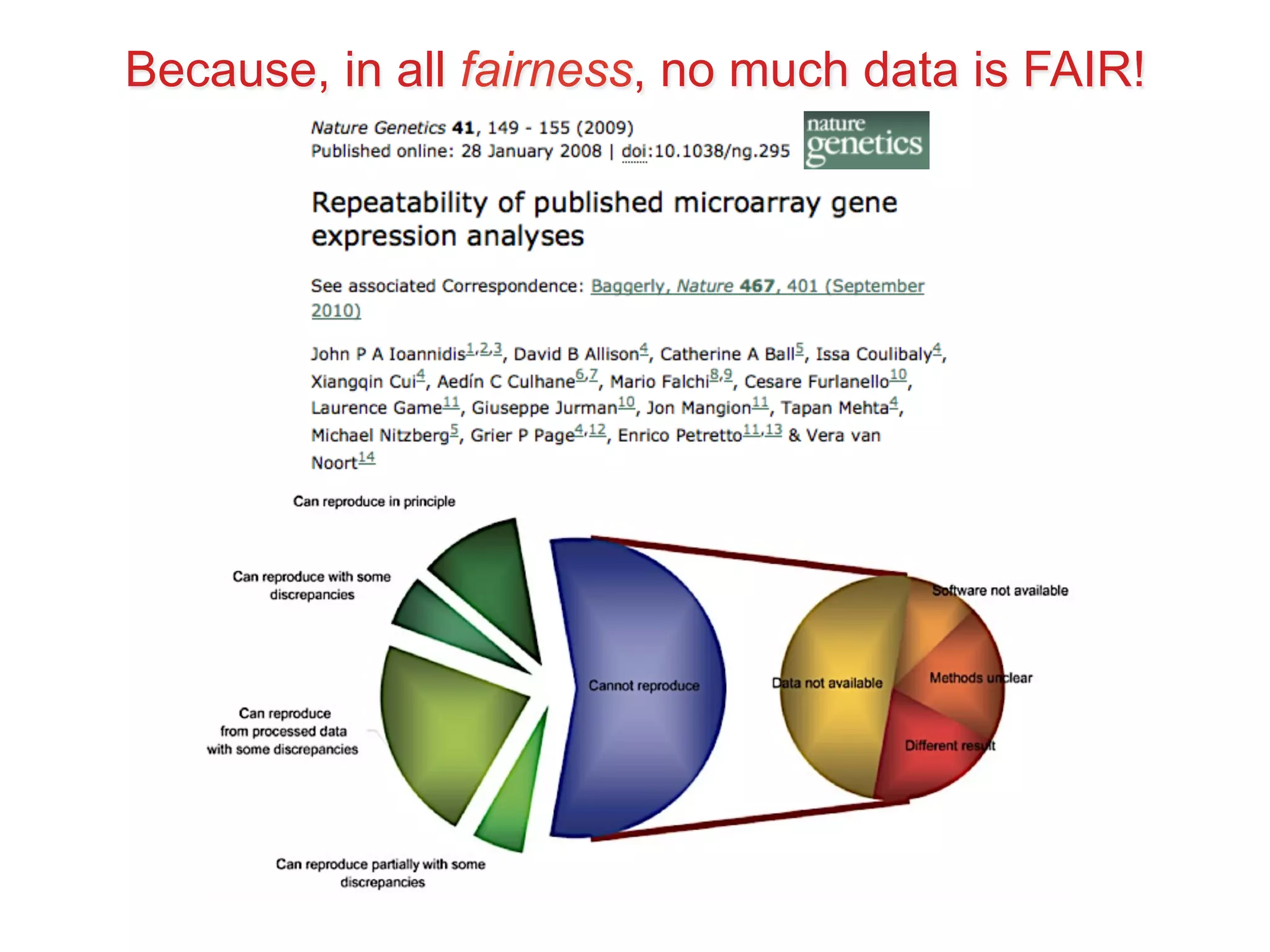
Because, in all fairness, no much data is FAIR! 
12
Because, in all fairness, no much data is FAIR!
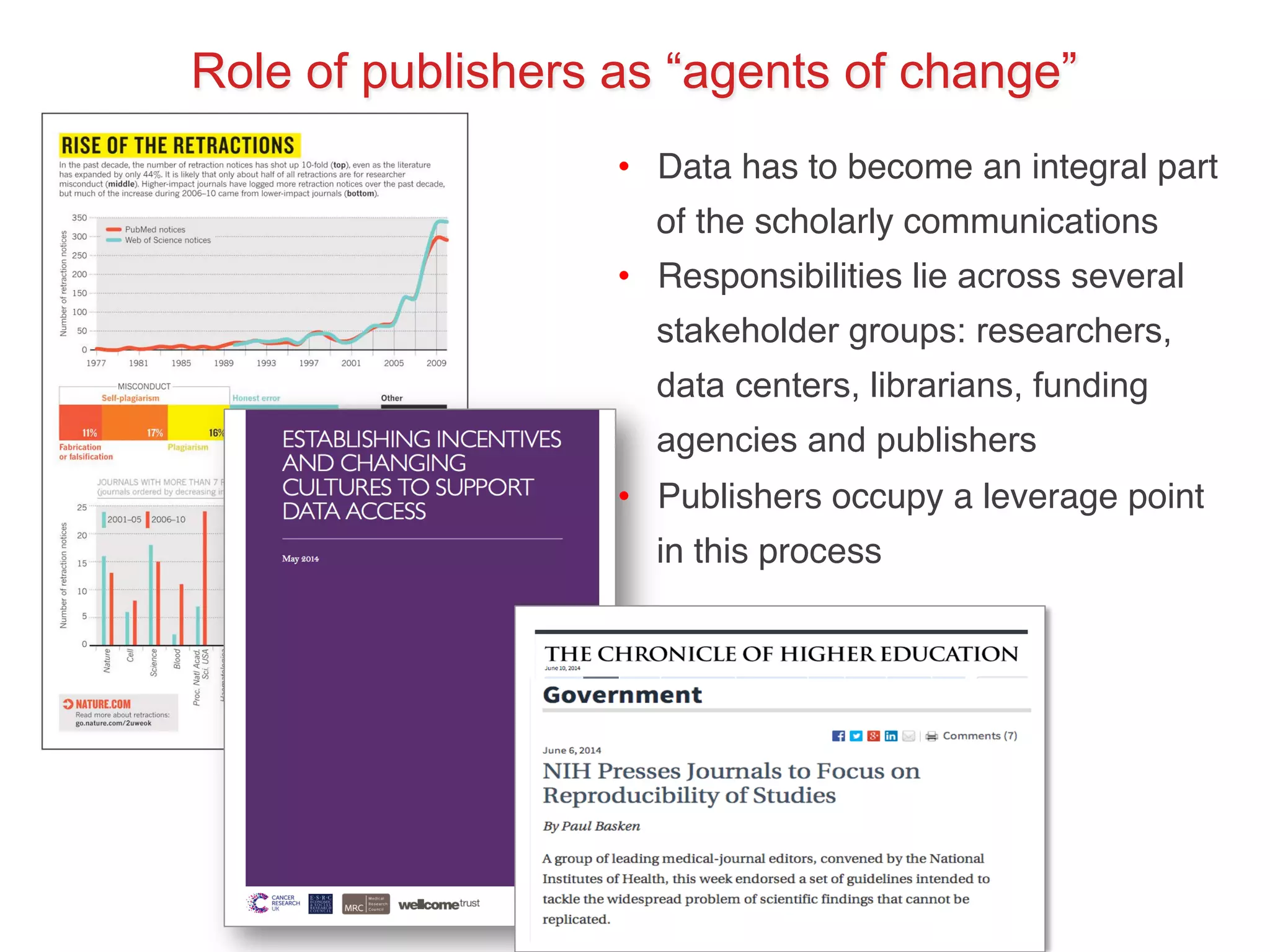
Role of publishers as “agents of change” 
• Data has to become an integral part 
of the scholarly communications! 
• Responsibilities lie across several 
stakeholder groups: researchers, 
data centers, librarians, funding 
agencies and publishers! 
• Publishers occupy a leverage point 
in this process!
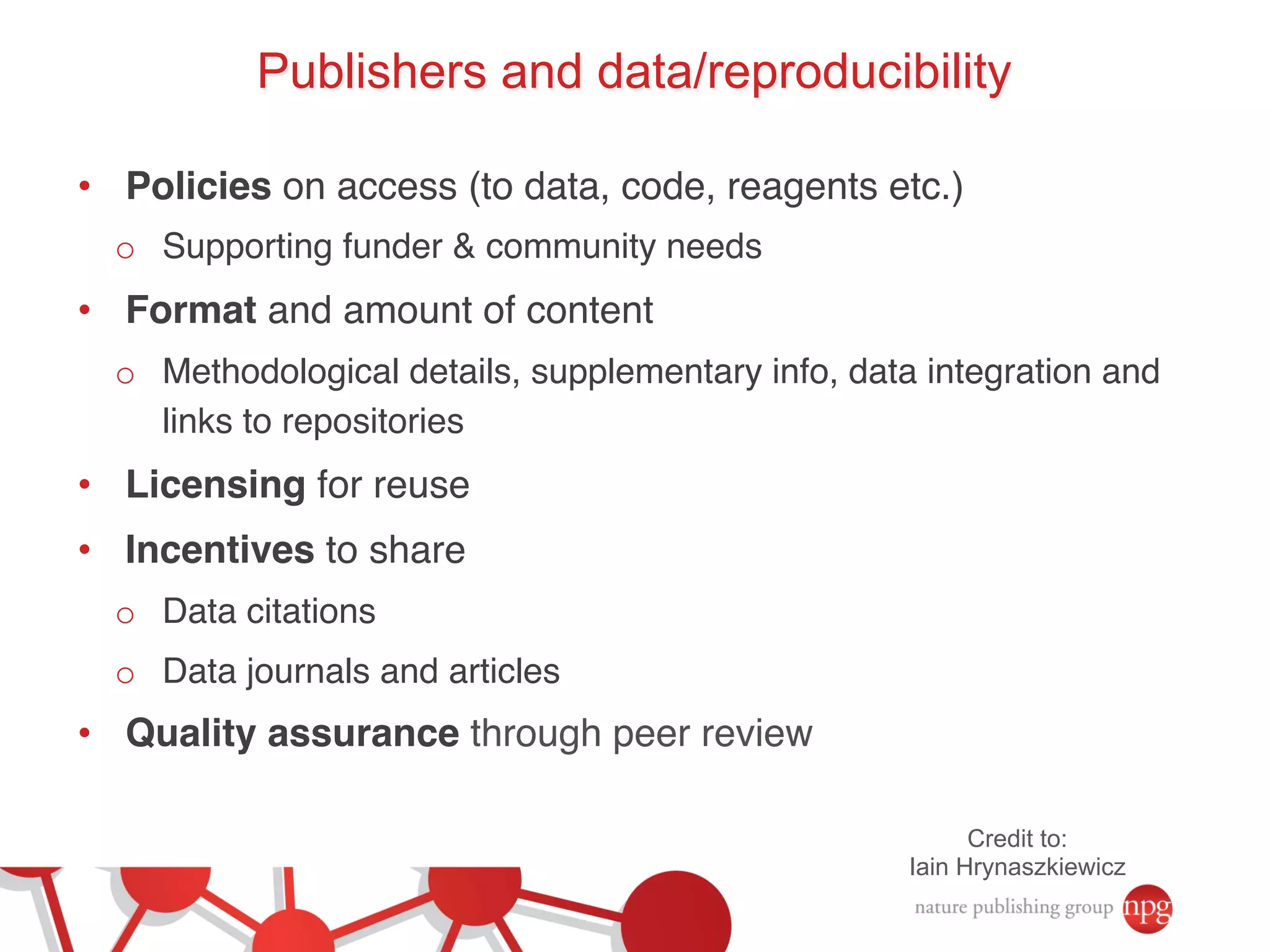
Publishers and data/reproducibility 
• Policies on access (to data, code, reagents etc.)! 
o Supporting funder & community needs! 
• Format and amount of content! 
o Methodological details, supplementary info, data integration and 
links to repositories! 
• Licensing for reuse! 
• Incentives to share! 
o Data citations! 
o Data journals and articles! 
• Quality assurance through peer review! 
Credit to: 
Iain Hrynaszkiewicz
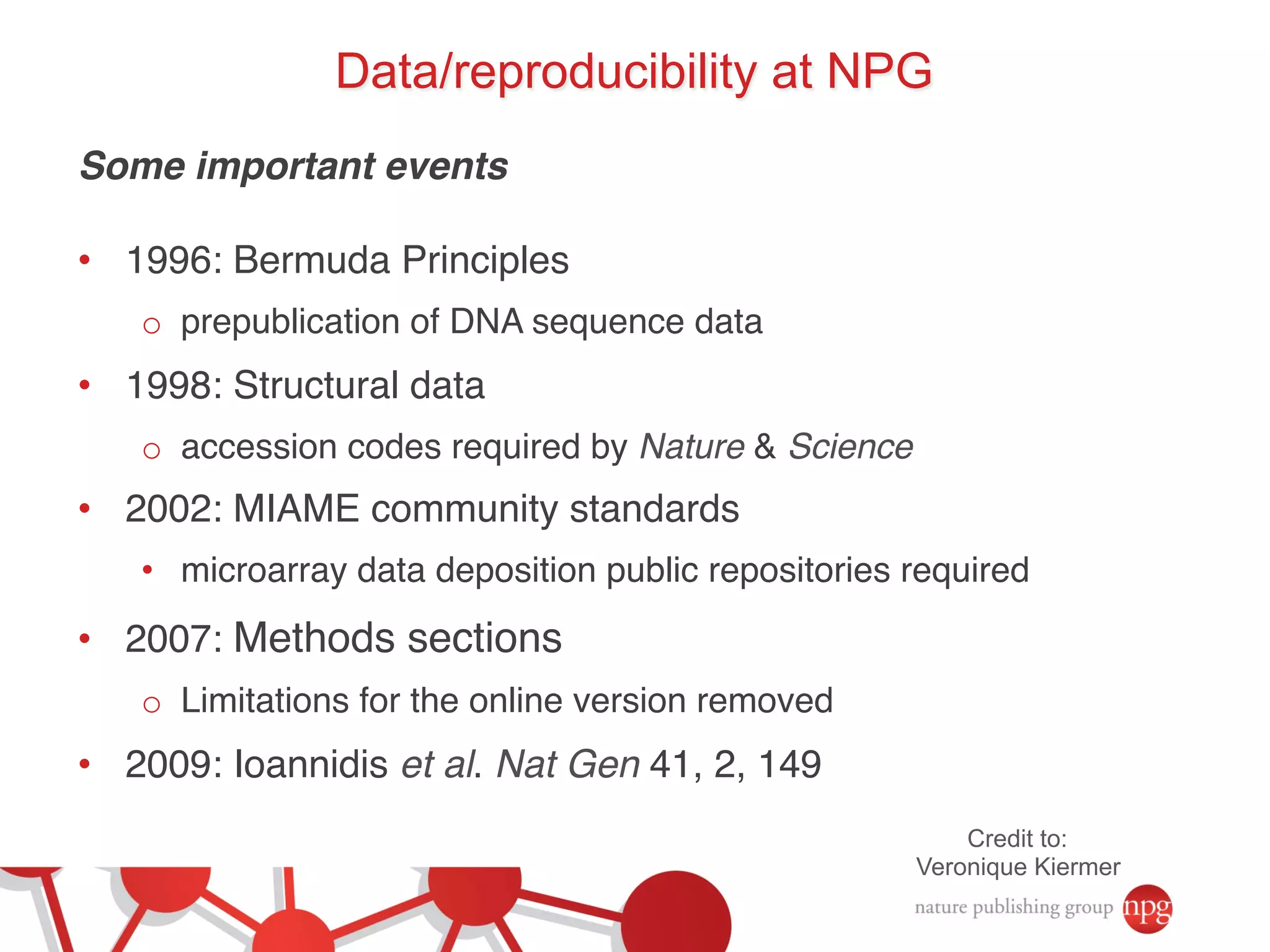
Data/reproducibility at NPG 
Some important events! 
! 
• 1996: Bermuda Principles! 
o prepublication of DNA sequence data! 
• 1998: Structural data! 
o accession codes required by Nature & Science! 
• 2002: MIAME community standards! 
• microarray data deposition public repositories required! 
• 2007: Methods sections! 
o Limitations for the online version removed! 
• 2009: Ioannidis et al. Nat Gen 41, 2, 149 ! 
Credit to: 
Veronique Kiermer
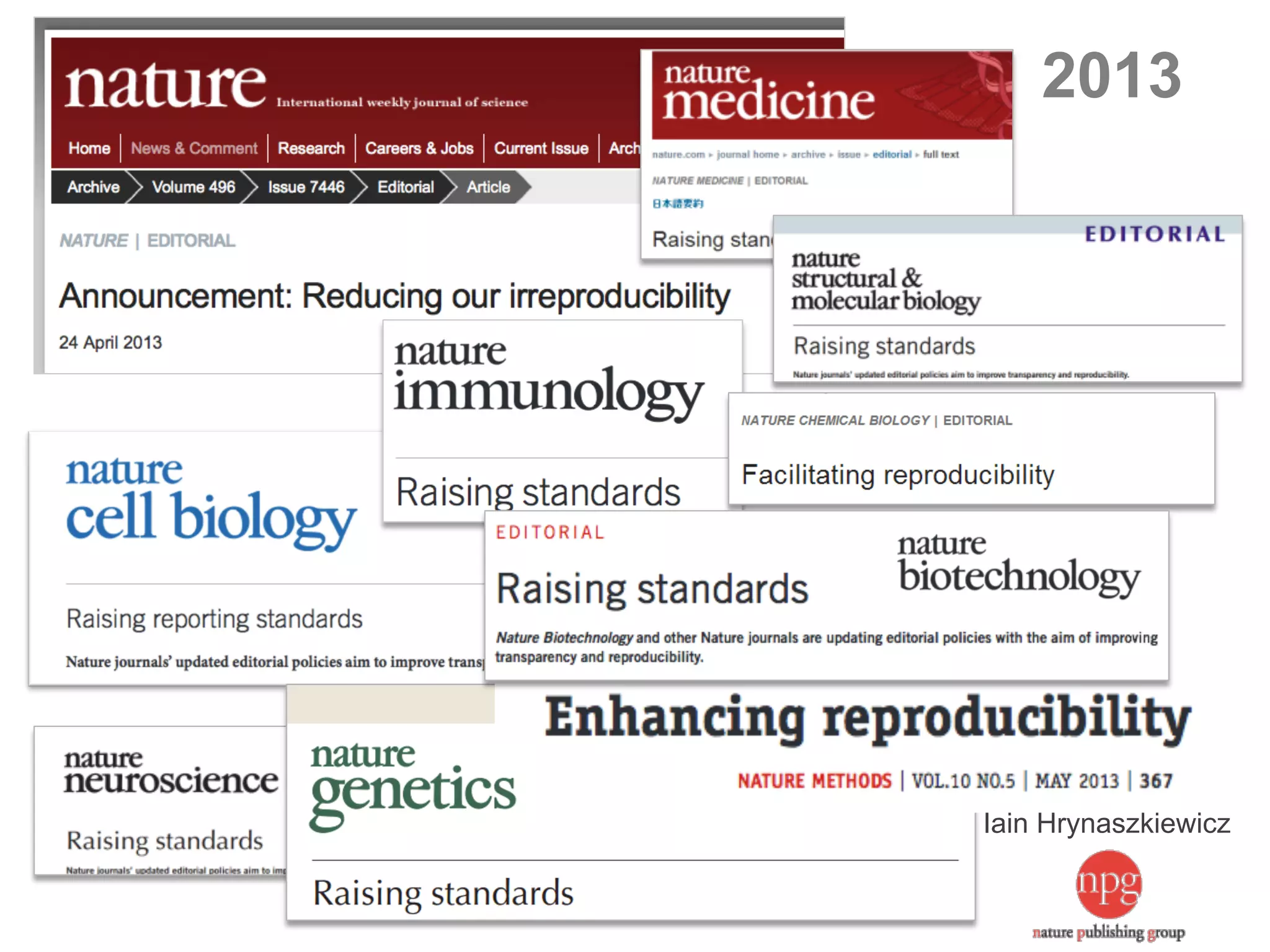
2013 
Credit to: 
Iain Hrynaszkiewicz
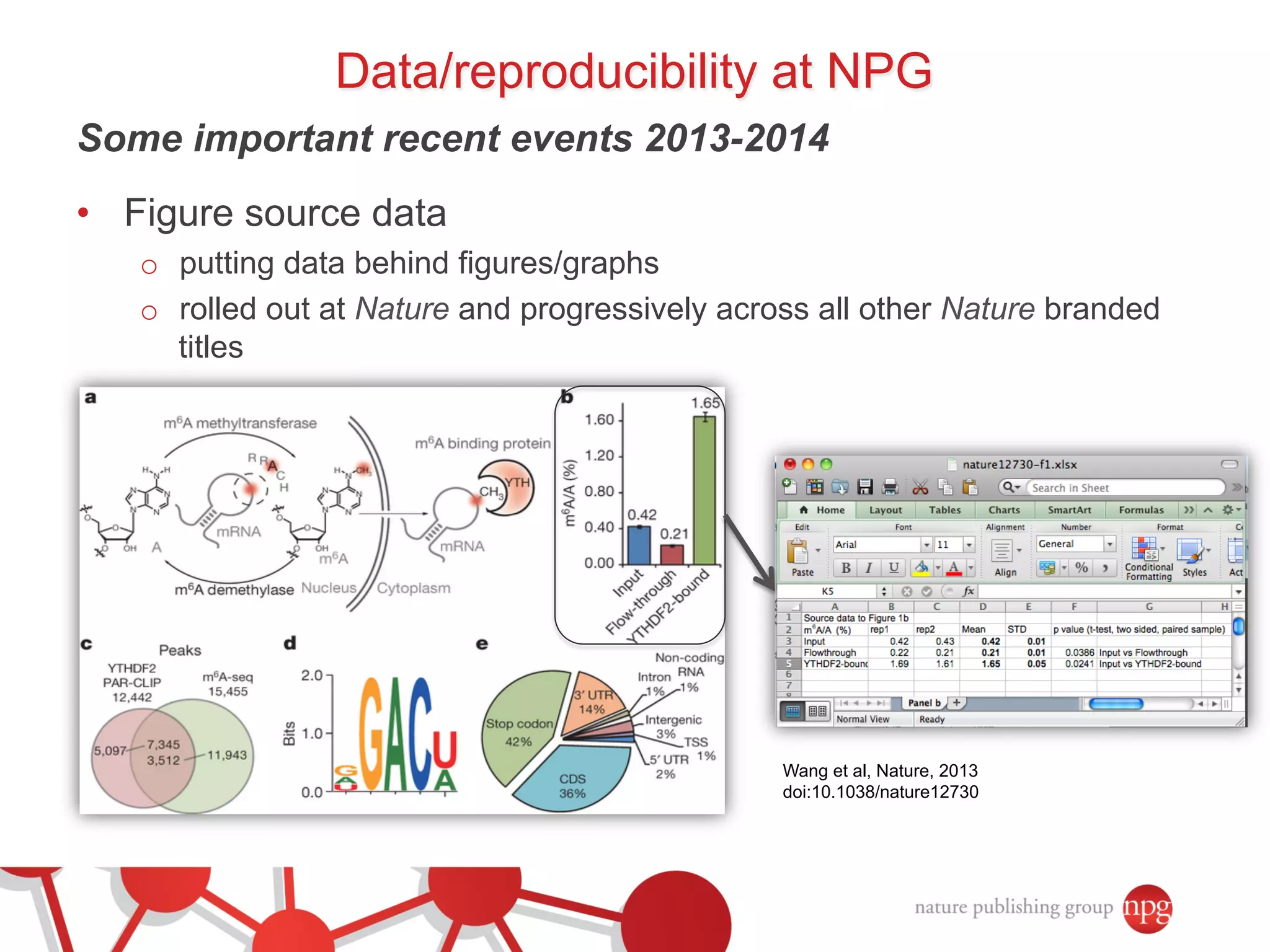
Data/reproducibility at NPG 
Some important recent events 2013-2014 
• Figure source data 
o putting data behind figures/graphs 
o rolled out at Nature and progressively across all other Nature branded 
titles 
Wang et al, Nature, 2013 
doi:10.1038/nature12730
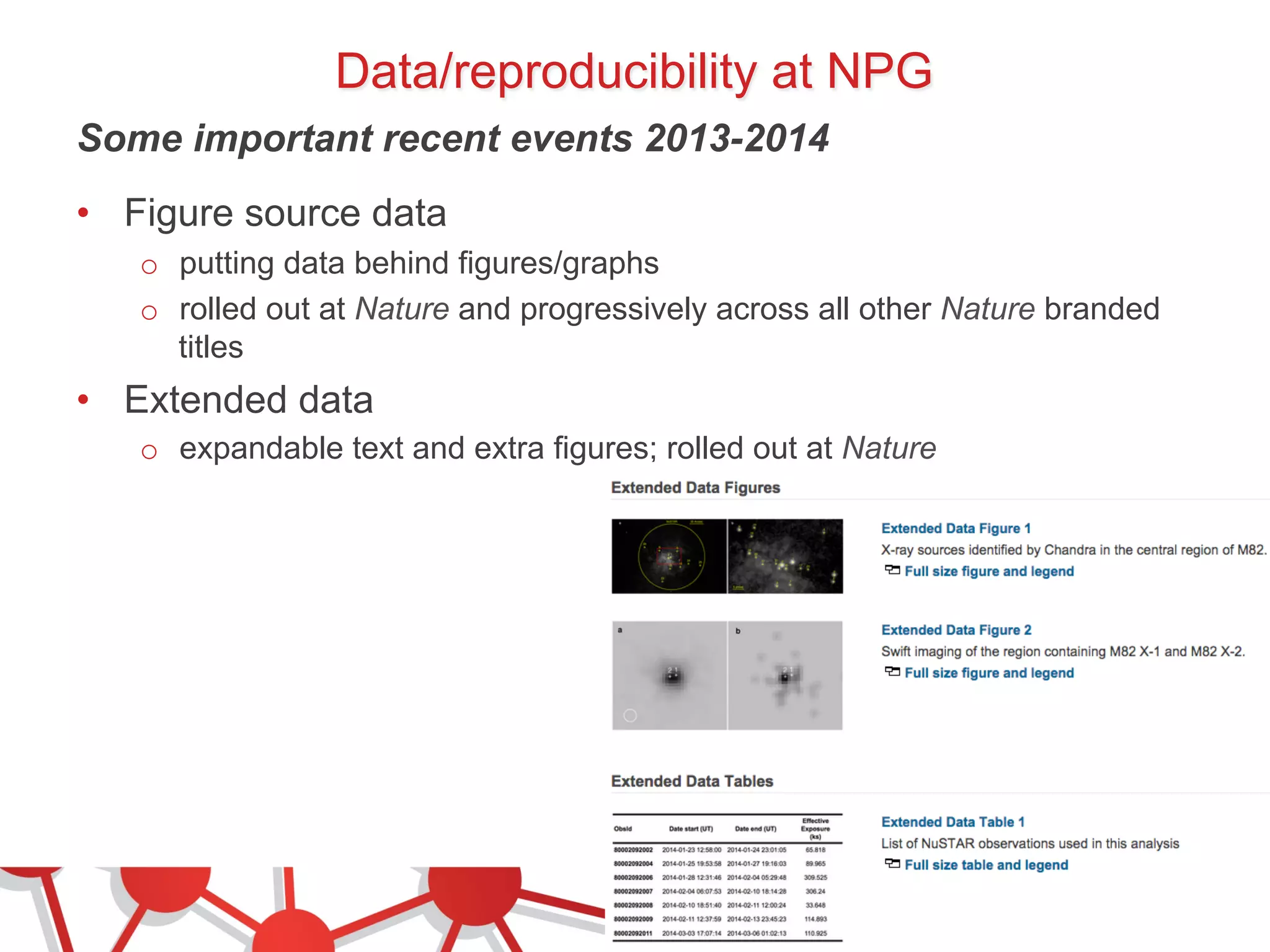
Data/reproducibility at NPG 
Some important recent events 2013-2014 
• Figure source data 
o putting data behind figures/graphs 
o rolled out at Nature and progressively across all other Nature branded 
titles 
• Extended data 
o expandable text and extra figures; rolled out at Nature
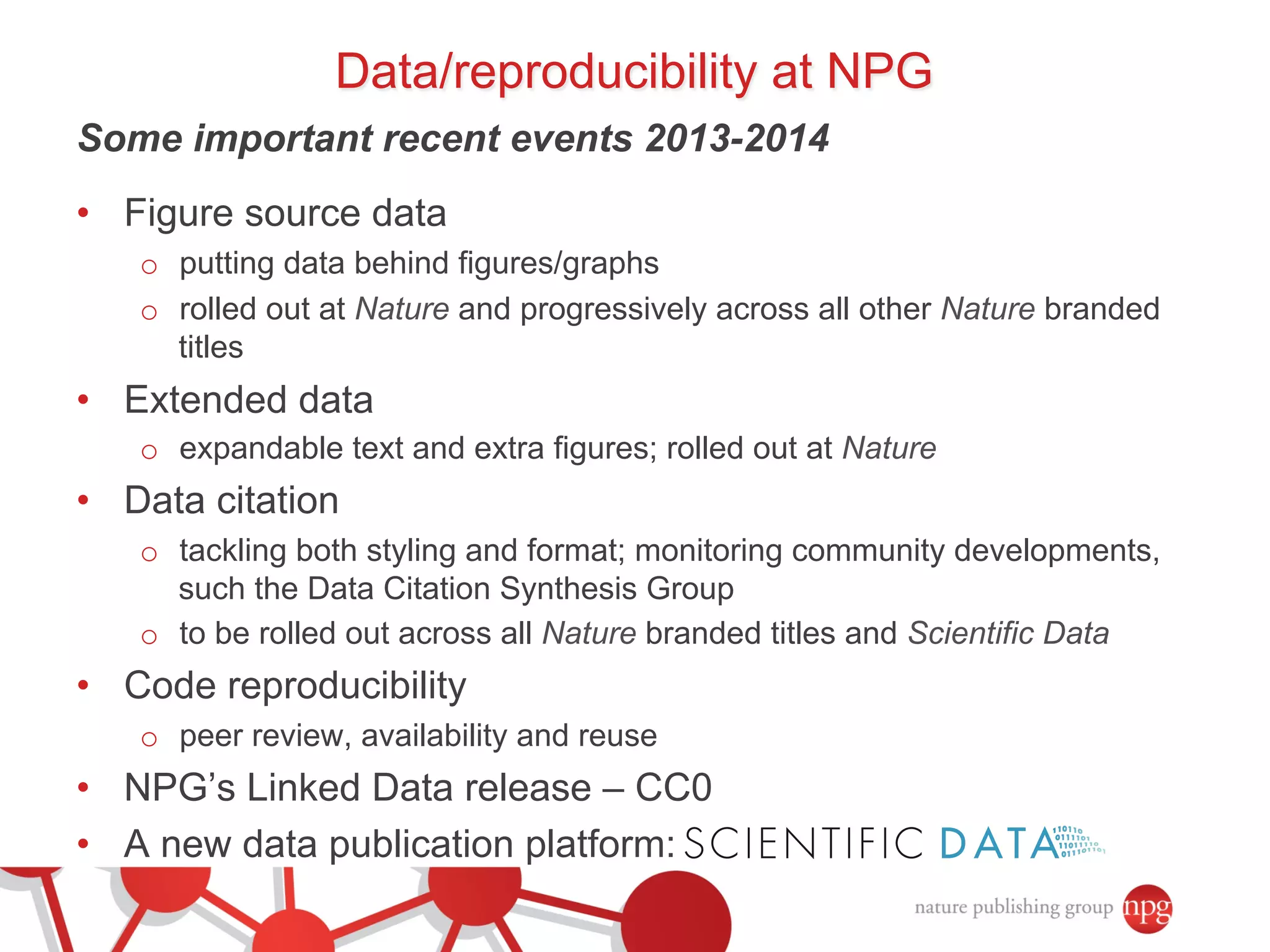
Data/reproducibility at NPG 
Some important recent events 2013-2014 
• Figure source data 
o putting data behind figures/graphs 
o rolled out at Nature and progressively across all other Nature branded 
titles 
• Extended data 
o expandable text and extra figures; rolled out at Nature 
• Data citation 
o tackling both styling and format; monitoring community developments, 
such the Data Citation Synthesis Group 
o to be rolled out across all Nature branded titles and Scientific Data 
• Code reproducibility 
o peer review, availability and reuse 
• NPG’s Linked Data release – CC0 
• A new data publication platform:
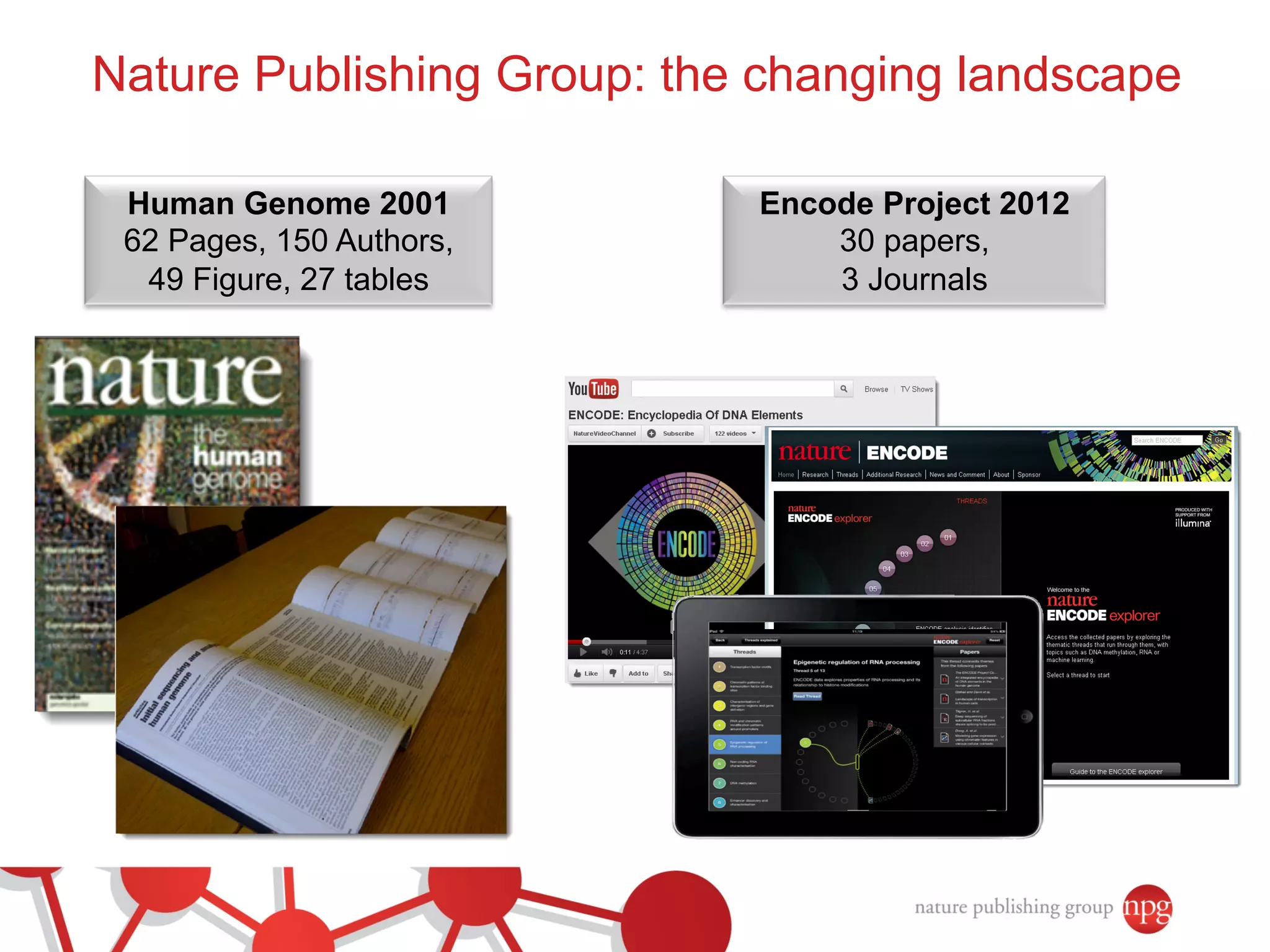
Nature Publishing Group: the changing landscape 
Human Genome 2001 
62 Pages, 150 Authors, 
49 Figure, 27 tables 
Encode Project 2012 
30 papers, 
3 Journals
The role of data journals/articles 
• Credit! 
• Unpublished data! 
• Peer review focus! 
• Value of data vs. analysis! 
• Discoverability! 
• Reusability! 
• Narrative/context! 
• “Intelligently open data”! 
Credit to: 
Iain Hrynaszkiewicz
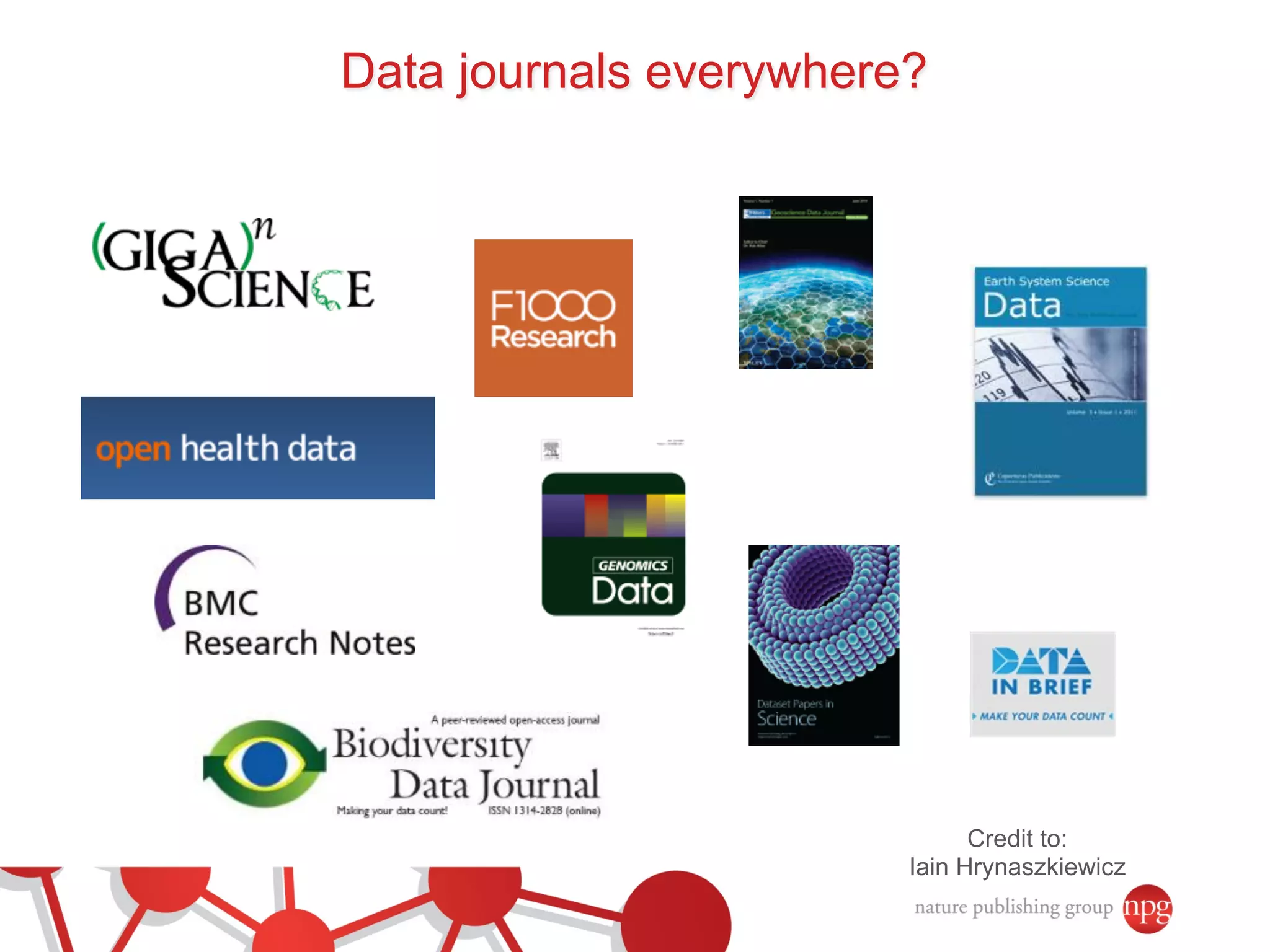
Data journals everywhere? 
Credit to: 
Iain Hrynaszkiewicz
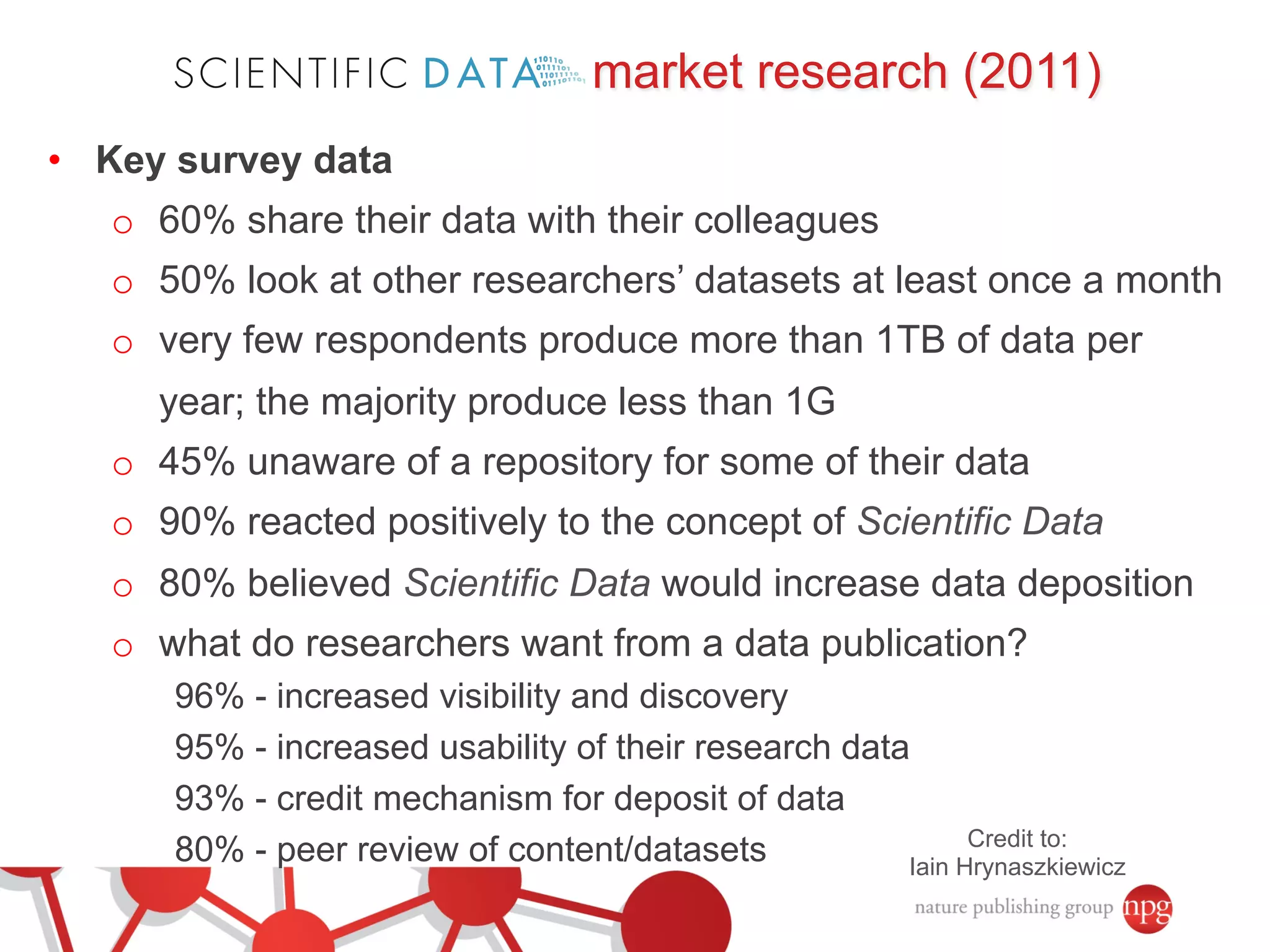
market research (2011) 
• Scope of survey! 
o How much data researchers produce, in what format and 
what they do with it! 
o Perceived availability of public repositories! 
o Perceptions of the Scientific Data concept! 
o Level/nature of data journal peer review! 
• Respondent characteristics! 
o 387 respondents (329 active researchers)! 
o Physics (24%), Earth and environmental science (21%), 
Biology (20%) Chemistry (19%) Others (16%)! 
Credit to: 
Iain Hrynaszkiewicz
market research (2011) 
• Key survey data 
o 60% share their data with their colleagues 
o 50% look at other researchers’ datasets at least once a month 
o very few respondents produce more than 1TB of data per 
year; the majority produce less than 1G 
o 45% unaware of a repository for some of their data 
o 90% reacted positively to the concept of Scientific Data 
o 80% believed Scientific Data would increase data deposition 
o what do researchers want from a data publication? 
96% - increased visibility and discovery 
95% - increased usability of their research data 
93% - credit mechanism for deposit of data 
80% - peer review of content/datasets Credit to: 
Iain Hrynaszkiewicz
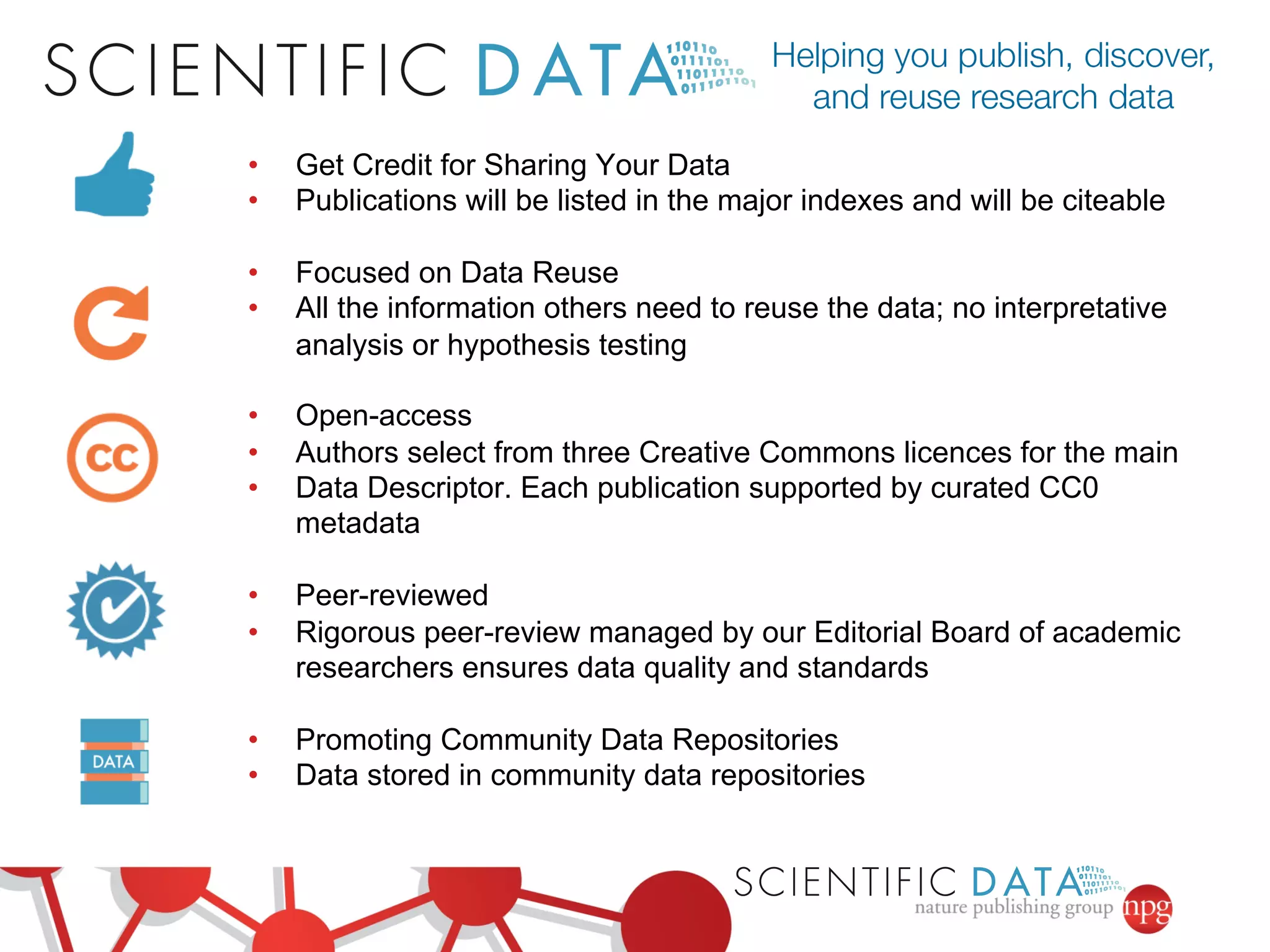
• Get Credit for Sharing Your Data 
• Publications will be listed in the major indexes and will be citeable 
• Focused on Data Reuse 
• All the information others need to reuse the data; no interpretative 
analysis or hypothesis testing 
• Open-access 
• Authors select from three Creative Commons licences for the main 
• Data Descriptor. Each publication supported by curated CC0 
metadata 
• Peer-reviewed 
• Rigorous peer-review managed by our Editorial Board of academic 
researchers ensures data quality and standards 
• Promoting Community Data Repositories 
• Data stored in community data repositories
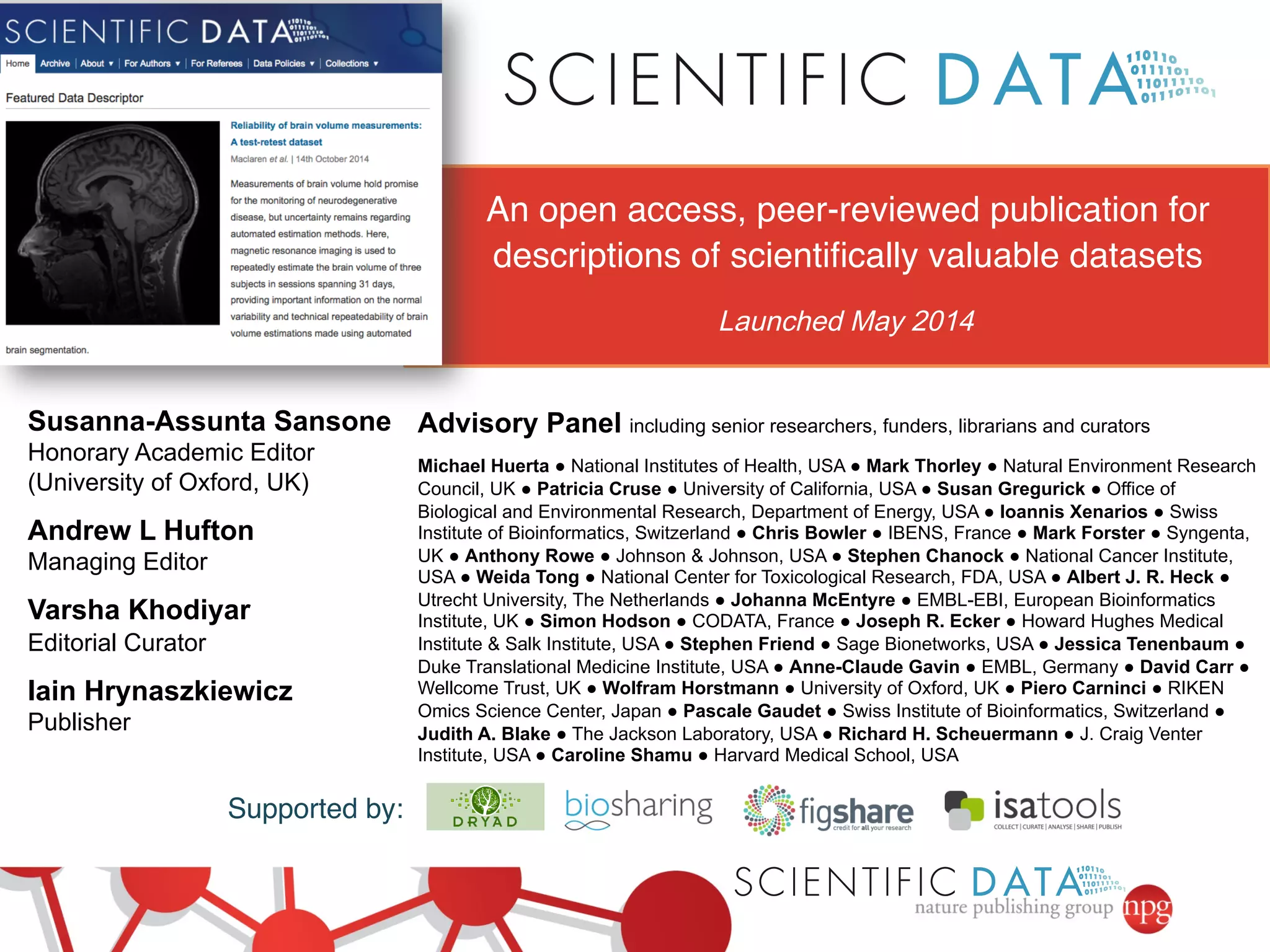
Supported by:! 
Advisory Panel including senior researchers, funders, librarians and curators 
Michael Huerta ● National Institutes of Health, USA ● Mark Thorley ● Natural Environment Research 
Council, UK ● Patricia Cruse ● University of California, USA ● Susan Gregurick ● Office of 
Biological and Environmental Research, Department of Energy, USA ● Ioannis Xenarios ● Swiss 
Institute of Bioinformatics, Switzerland ● Chris Bowler ● IBENS, France ● Mark Forster ● Syngenta, 
UK ● Anthony Rowe ● Johnson & Johnson, USA ● Stephen Chanock ● National Cancer Institute, 
USA ● Weida Tong ● National Center for Toxicological Research, FDA, USA ● Albert J. R. Heck ● 
Utrecht University, The Netherlands ● Johanna McEntyre ● EMBL-EBI, European Bioinformatics 
Institute, UK ● Simon Hodson ● CODATA, France ● Joseph R. Ecker ● Howard Hughes Medical 
Institute & Salk Institute, USA ● Stephen Friend ● Sage Bionetworks, USA ● Jessica Tenenbaum ● 
Duke Translational Medicine Institute, USA ● Anne-Claude Gavin ● EMBL, Germany ● David Carr ● 
Wellcome Trust, UK ● Wolfram Horstmann ● University of Oxford, UK ● Piero Carninci ● RIKEN 
Omics Science Center, Japan ● Pascale Gaudet ● Swiss Institute of Bioinformatics, Switzerland ● 
Judith A. Blake ● The Jackson Laboratory, USA ● Richard H. Scheuermann ● J. Craig Venter 
Institute, USA ● Caroline Shamu ● Harvard Medical School, USA 
Susanna-Assunta Sansone 
Honorary Academic Editor 
(University of Oxford, UK) 
Andrew L Hufton 
Managing Editor 
Varsha Khodiyar 
Editorial Curator 
Iain Hrynaszkiewicz 
Publisher 
An open access, peer-reviewed publication for 
descriptions of scientifically valuable datasets! 
Launched May 2014
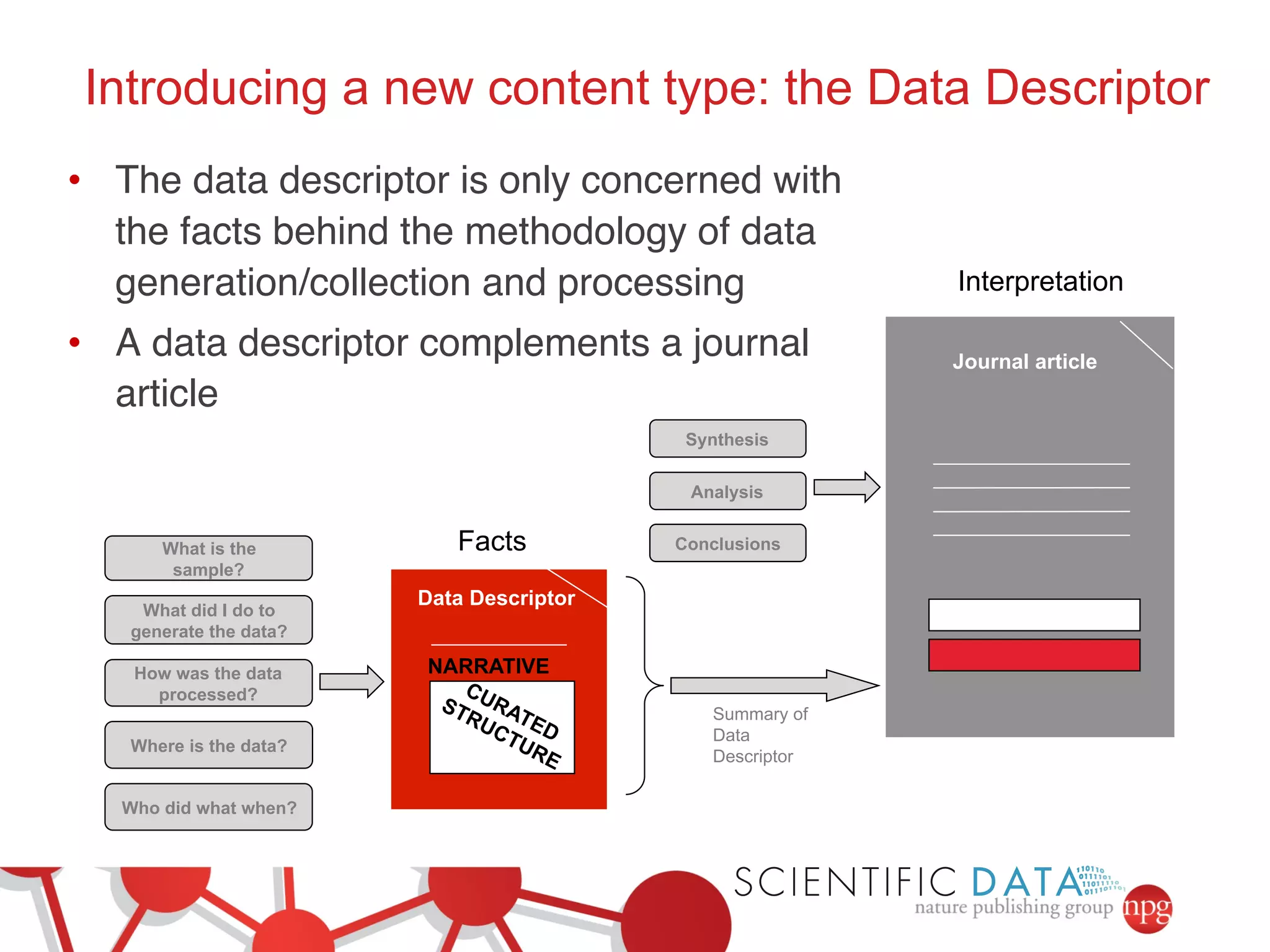
Introducing a new content type: the Data Descriptor 
• The data descriptor is only concerned with 
the facts behind the methodology of data 
generation/collection and processing! 
• A data descriptor complements a journal 
Synthesis 
Analysis 
Data Descriptor 
Conclusions 
Interpretation 
What is the 
sample? 
What did I do to 
generate the data? 
How was the data 
processed? 
Where is the data? 
Who did what when? 
Summary of 
Data 
Descriptor 
Facts 
Data Descriptor 
Journal article 
NARRATIVE 
article!
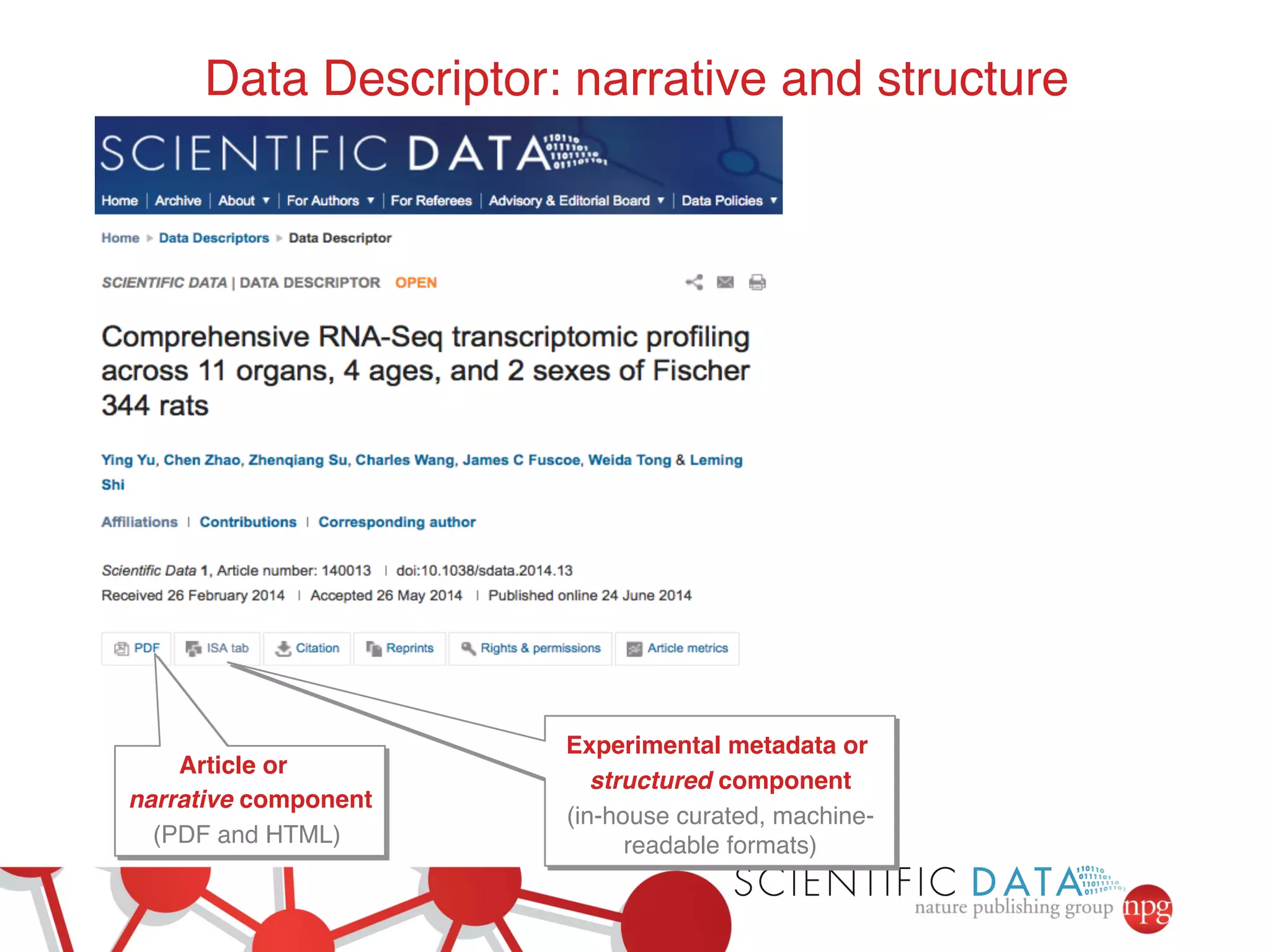
Data Descriptor: narrative and structure! 
Article or ! 
narrative component! 
(PDF and HTML) ! 
! 
! 
! 
Experimental metadata or ! 
structured component! 
(in-house curated, machine-readable 
formats)!
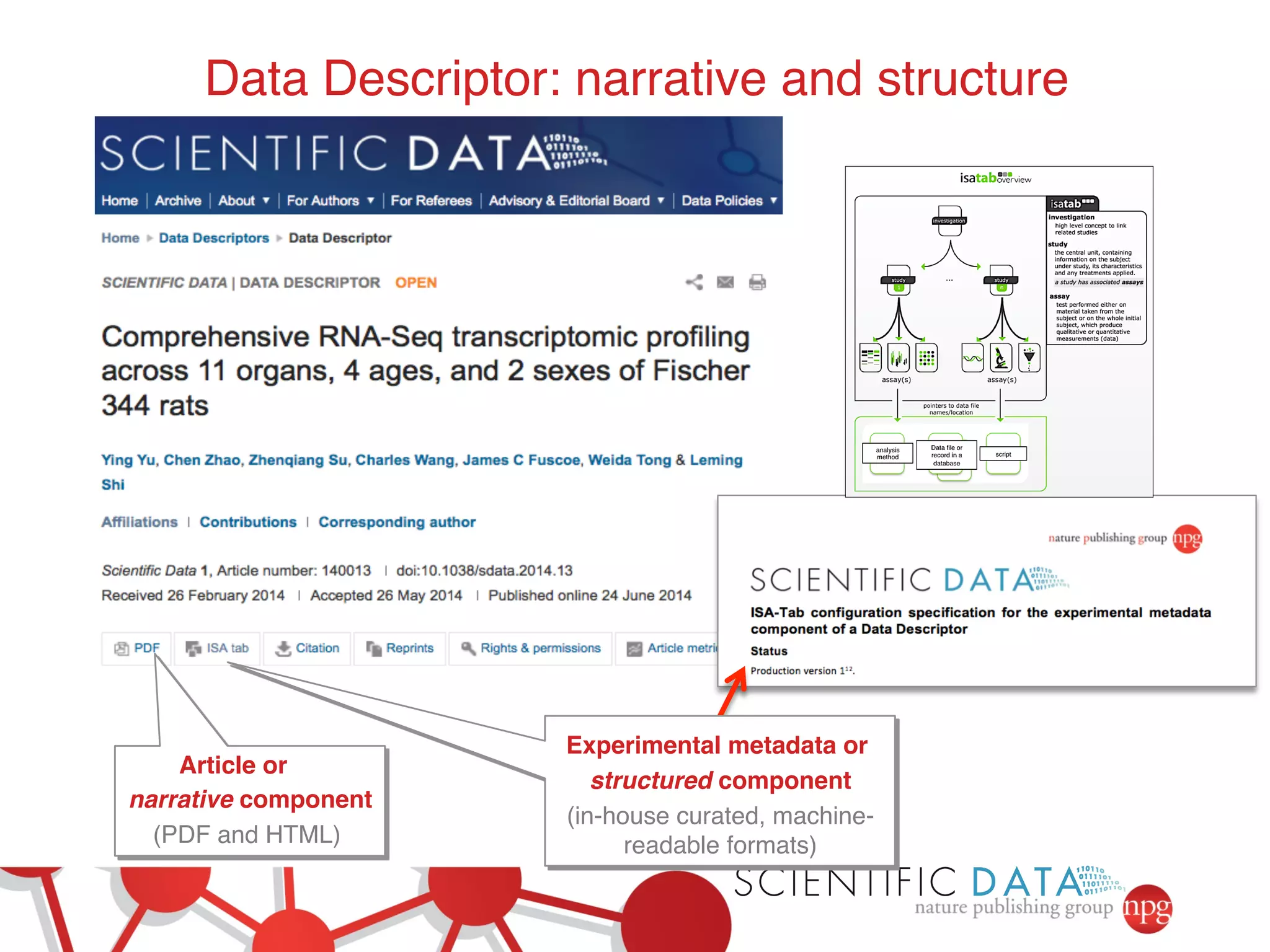
Data Descriptor: narrative and structure! 
Article or ! 
narrative component! 
(PDF and HTML) ! 
! 
! 
! 
Experimental metadata or ! 
structured component! 
(in-house curated, machine-readable 
formats)!
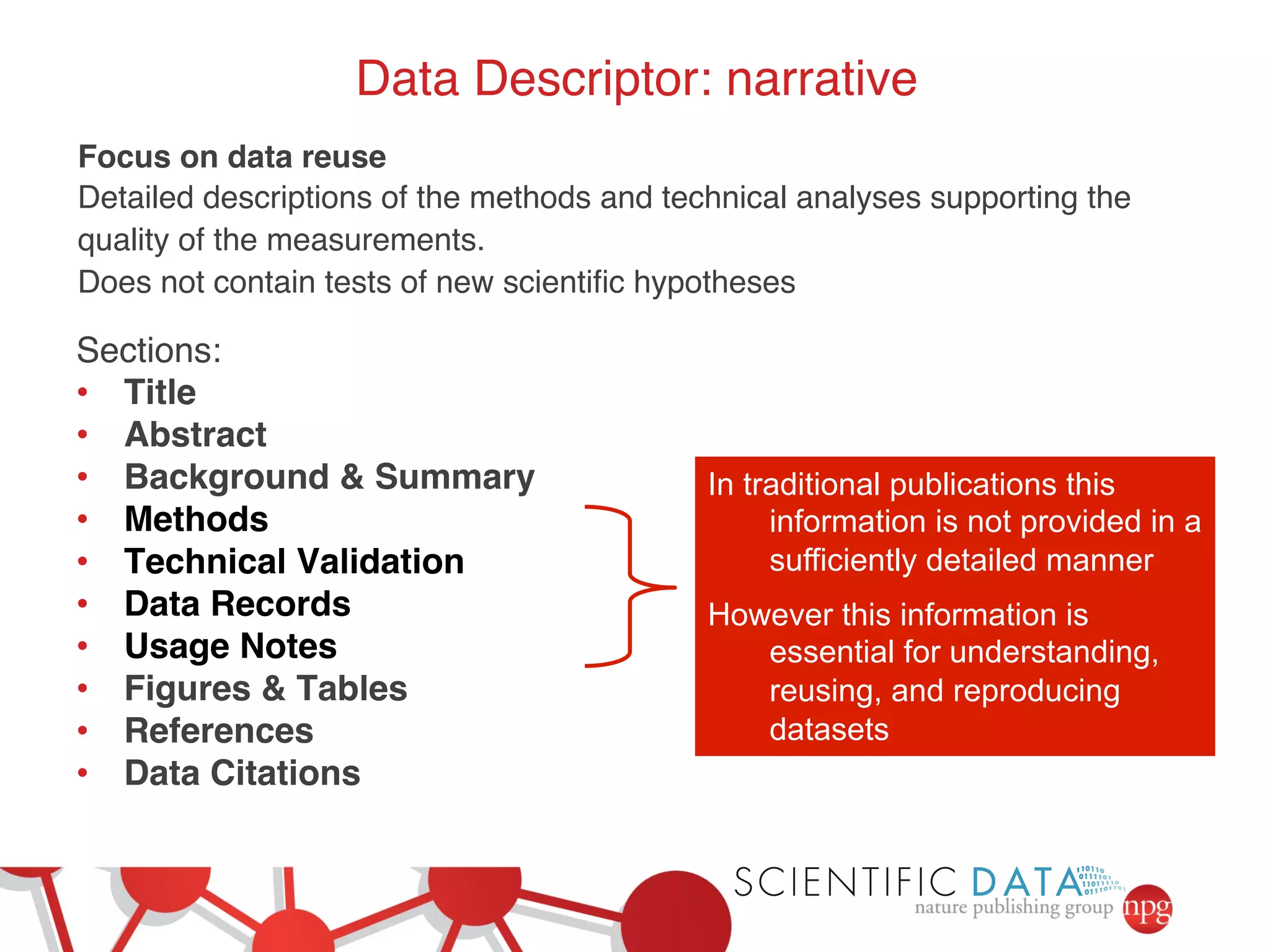
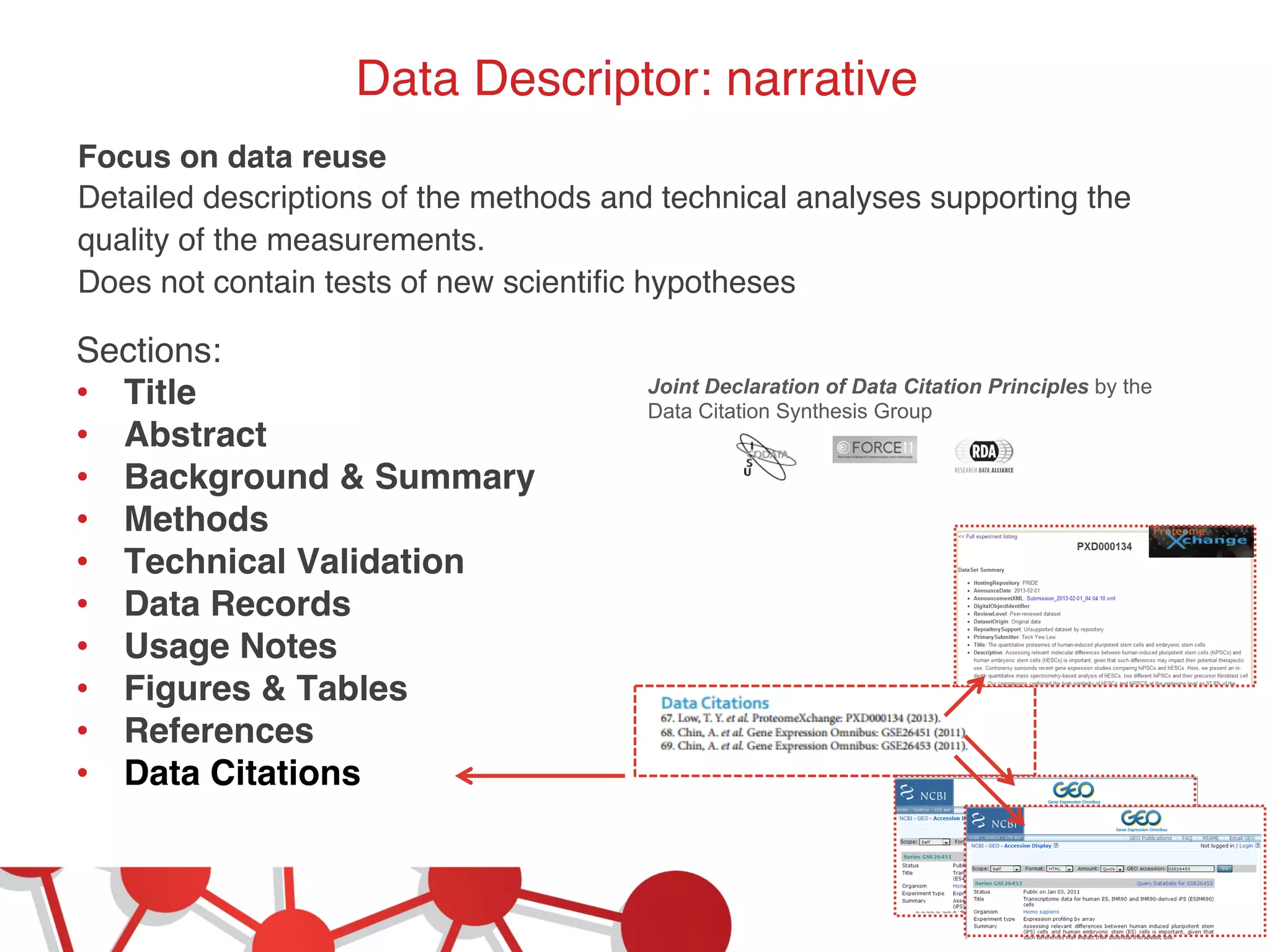
Data Descriptor: narrative! 
Focus on data reuse! 
Detailed descriptions of the methods and technical analyses supporting the 
quality of the measurements.! 
Does not contain tests of new scientific hypotheses! 
In traditional publications this 
information is not provided in a 
sufficiently detailed manner 
However this information is 
essential for understanding, 
reusing, and reproducing 
datasets 
Sections:! 
• Title! 
• Abstract! 
• Background & Summary! 
• Methods! 
• Technical Validation! 
• Data Records! 
• Usage Notes ! 
• Figures & Tables ! 
• References! 
• Data Citations! 
!
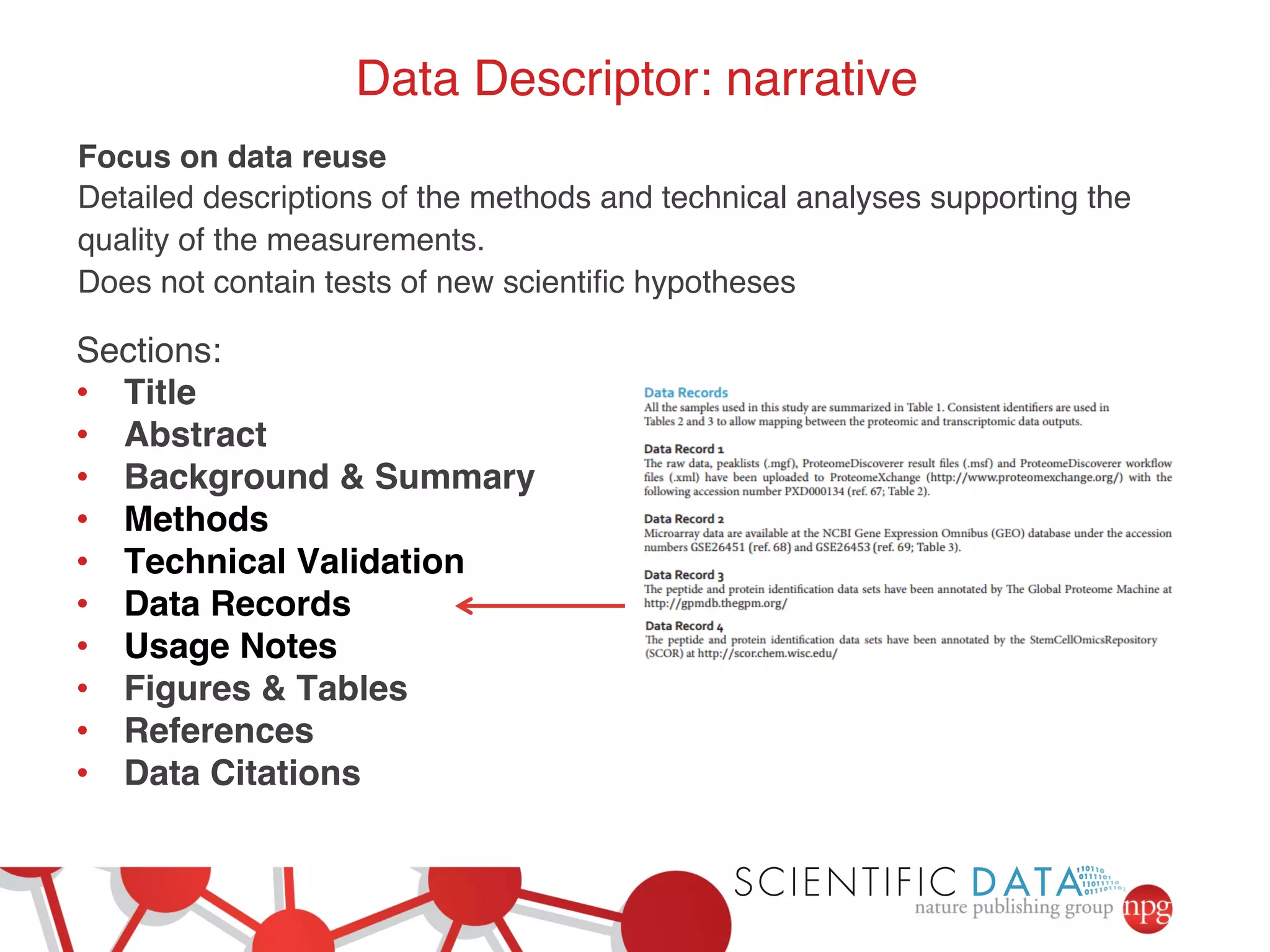
Data Descriptor: narrative! 
Focus on data reuse! 
Detailed descriptions of the methods and technical analyses supporting the 
quality of the measurements.! 
Does not contain tests of new scientific hypotheses! 
Sections:! 
• Title! 
• Abstract! 
• Background & Summary! 
• Methods! 
• Technical Validation! 
• Data Records! 
• Usage Notes ! 
• Figures & Tables ! 
• References! 
• Data Citations! 
!
Data Descriptor: narrative! 
Focus on data reuse! 
Detailed descriptions of the methods and technical analyses supporting the 
quality of the measurements.! 
Does not contain tests of new scientific hypotheses! 
Sections:! 
• Title! 
• Abstract! 
• Background & Summary! 
• Methods! 
• Technical Validation! 
• Data Records! 
• Usage Notes ! 
• Figures & Tables ! 
• References! 
• Data Citations! 
! 
Joint Declaration of Data Citation Principles by the 
Data Citation Synthesis Group
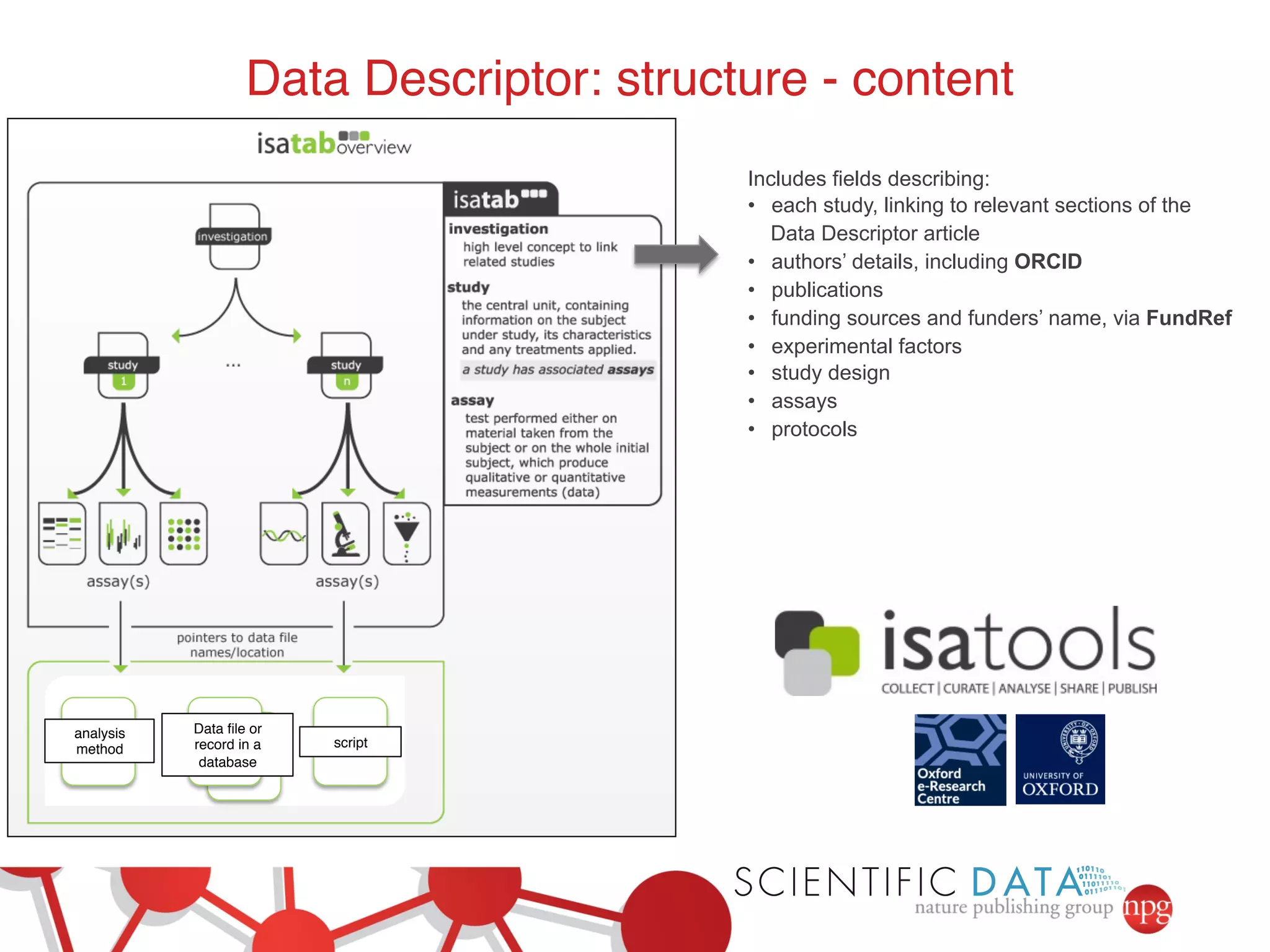
Data Descriptor: structure - content ! 
Includes fields describing: 
• each study, linking to relevant sections of the 
Data Descriptor article 
• authors’ details, including ORCID 
• publications 
• funding sources and funders’ name, via FundRef 
• experimental factors 
• study design 
• assays 
• protocols 
Data file or ! 
record in a 
database! 
analysis ! 
method! script!
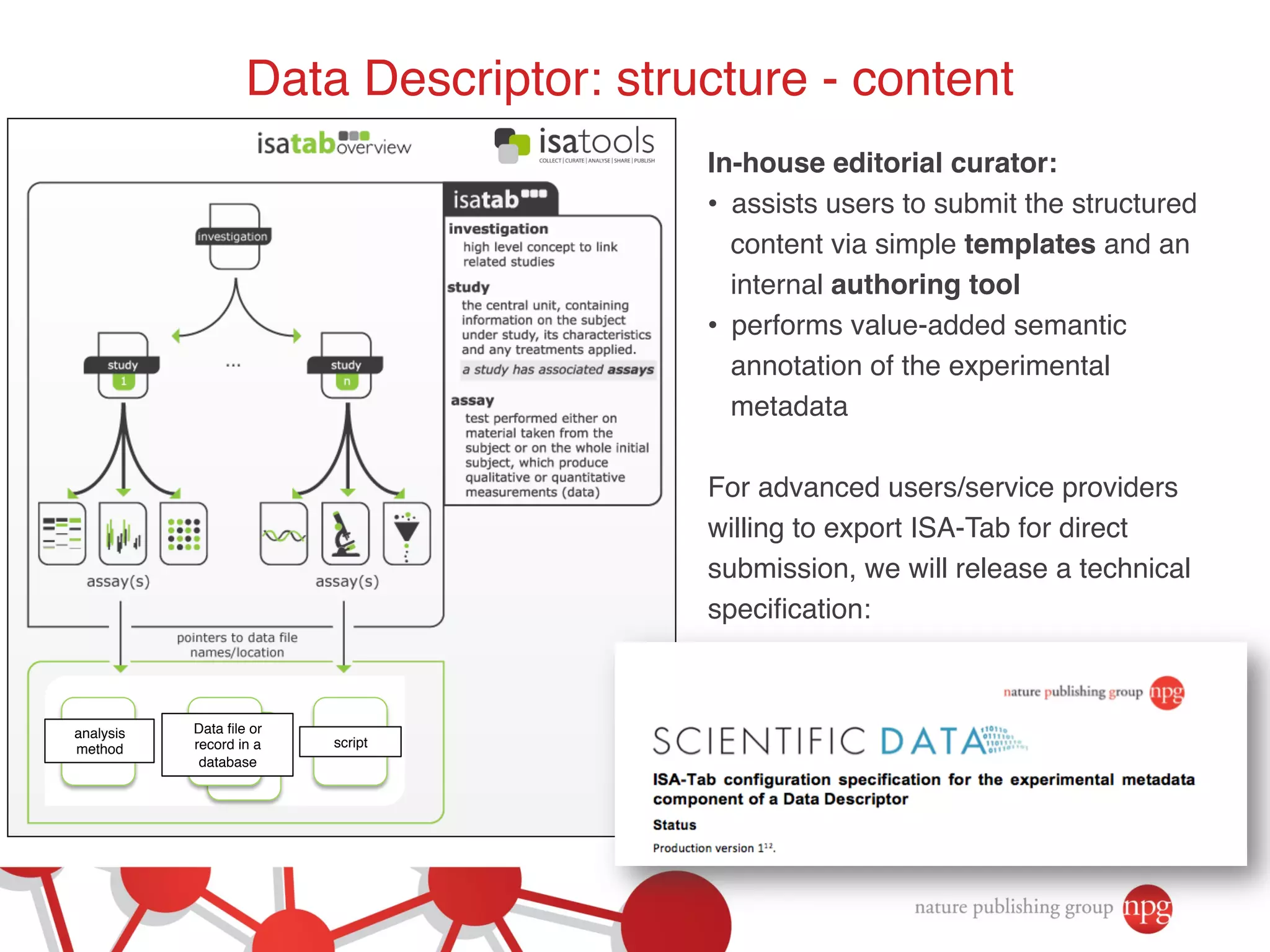
Data Descriptor: structure - content ! 
In-house editorial curator:! 
• assists users to submit the structured 
content via simple templates and an 
internal authoring tool! 
• performs value-added semantic 
annotation of the experimental 
metadata! 
For advanced users/service providers 
willing to export ISA-Tab for direct 
submission, we will release a technical 
specification:! 
Data file or ! 
record in a 
database! 
analysis ! 
method! script!
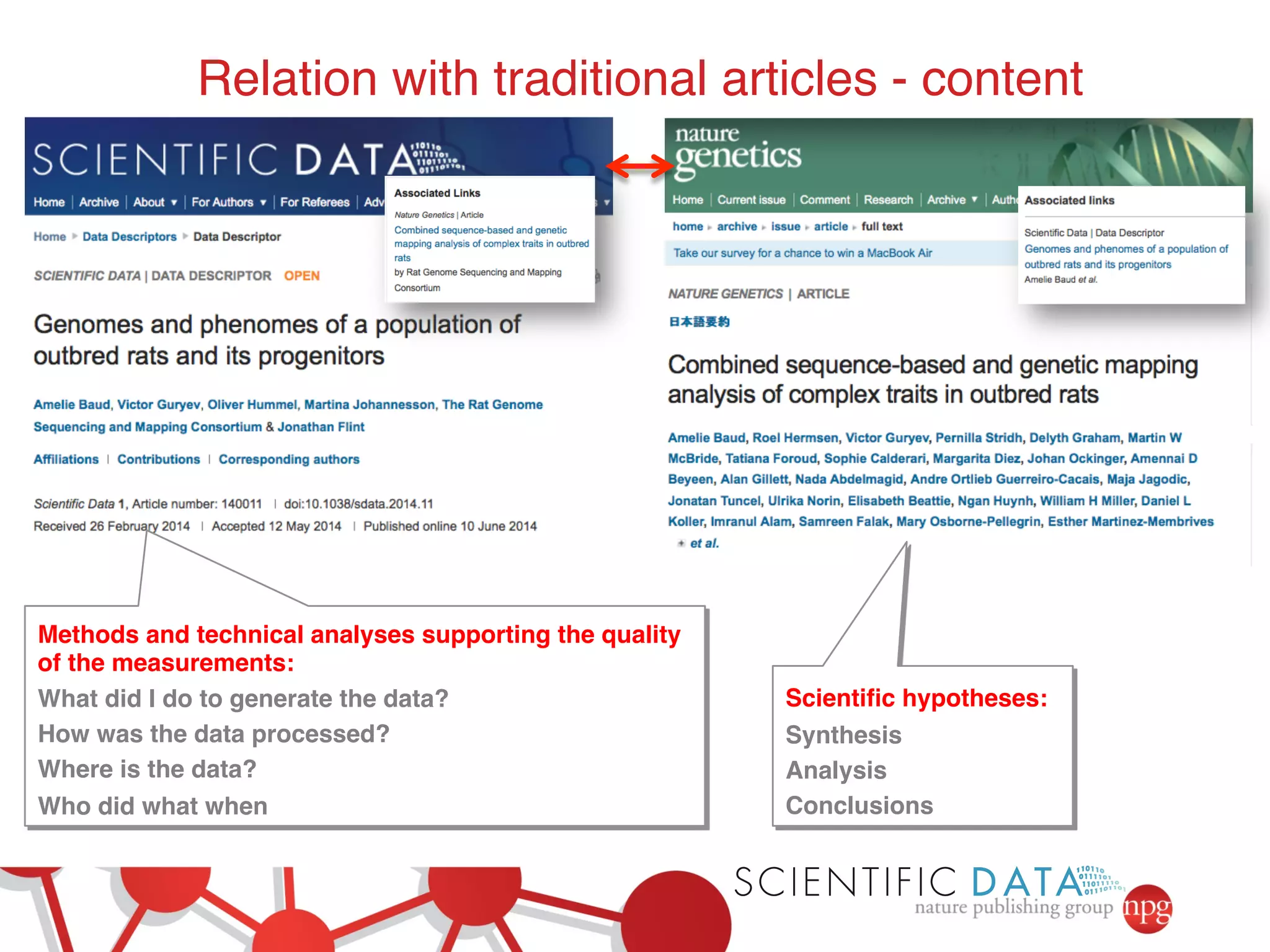
Relation with traditional articles - content! 
! 
! 
! 
! 
! 
! 
! 
! 
Scientific hypotheses:! 
Synthesis! 
Analysis! 
Conclusions! 
Methods and technical analyses supporting the quality 
of the measurements:! 
What did I do to generate the data?! 
How was the data processed?! 
Where is the data?! 
Who did what when!
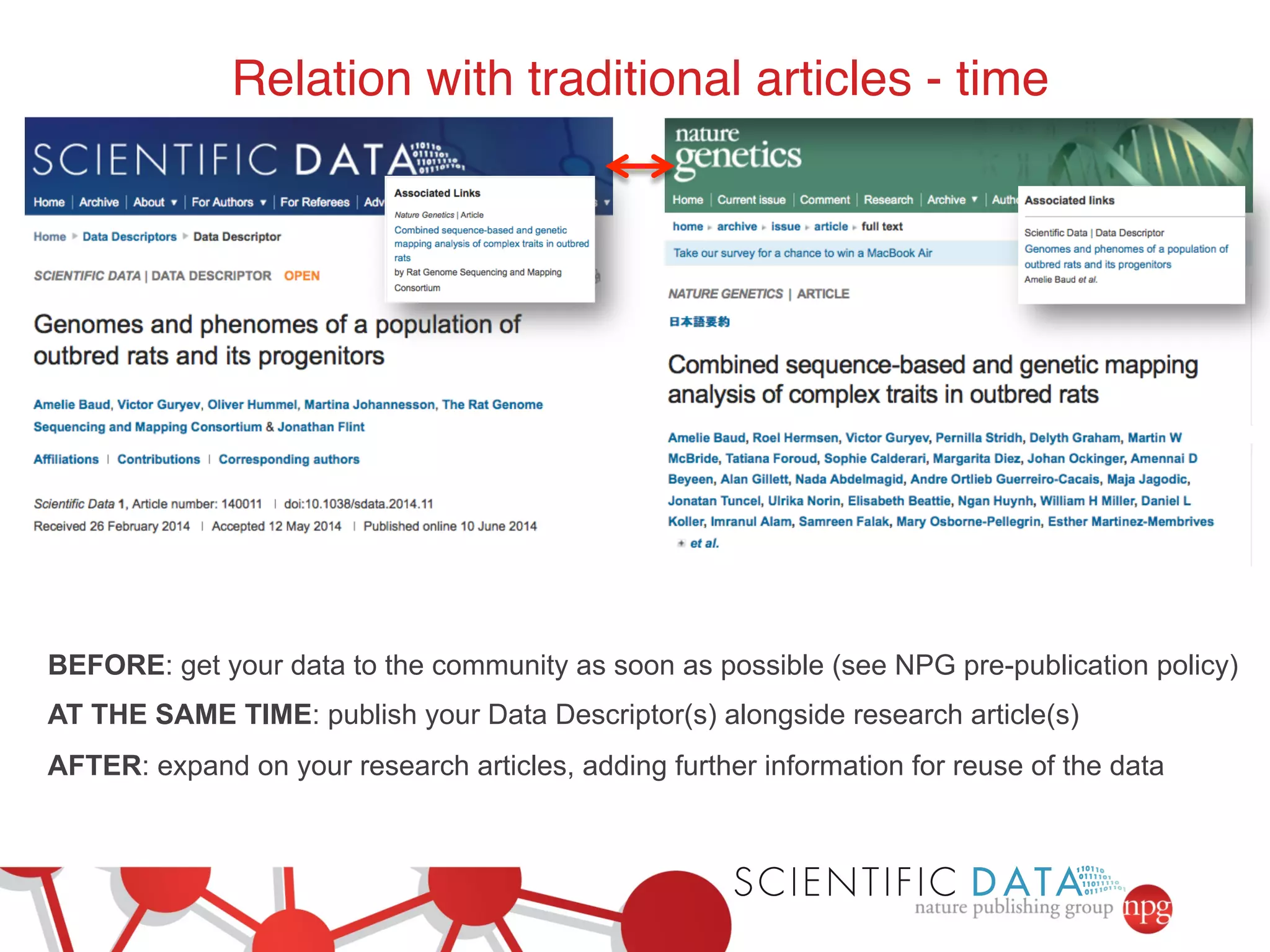
Relation with traditional articles - time! 
BEFORE: get your data to the community as soon as possible (see NPG pre-publication policy) 
AT THE SAME TIME: publish your Data Descriptor(s) alongside research article(s) 
AFTER: expand on your research articles, adding further information for reuse of the data
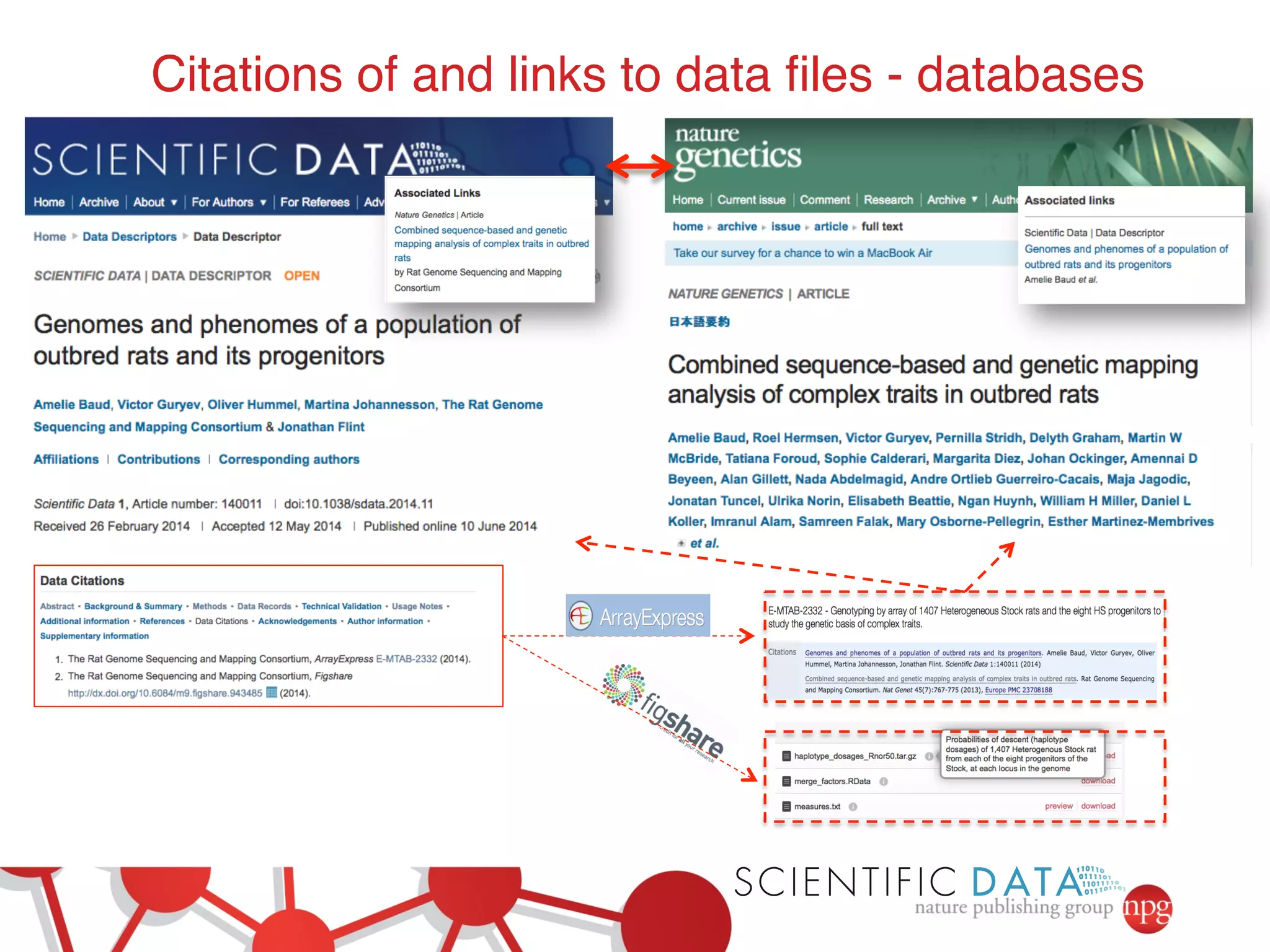
Citations of and links to data files - databases!
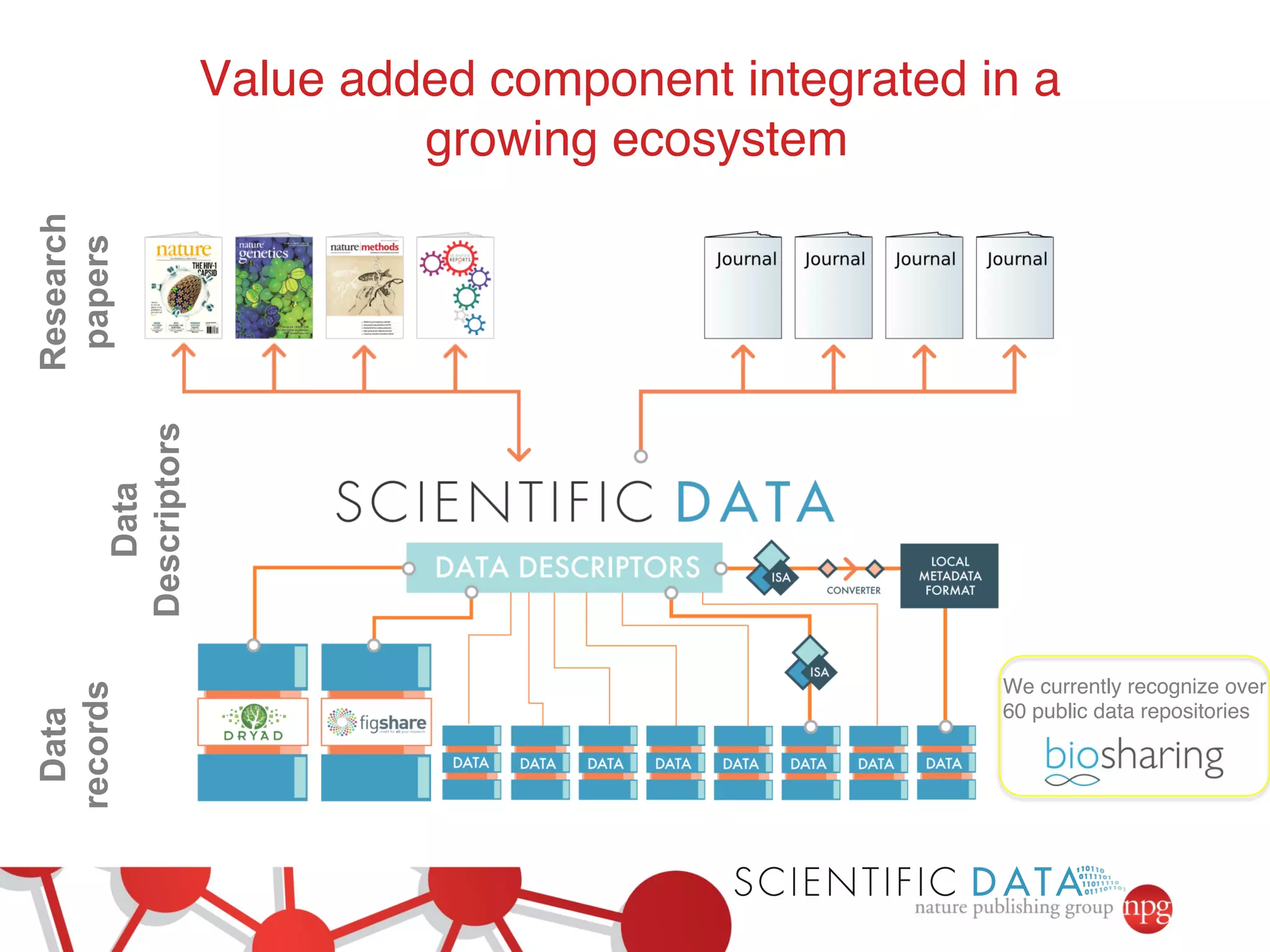
Value added component integrated in a 
growing ecosystem! 
We currently recognize over 
60 public data repositories! 
! 
Research 
papers 
Descriptors 
Data 
Data 
records
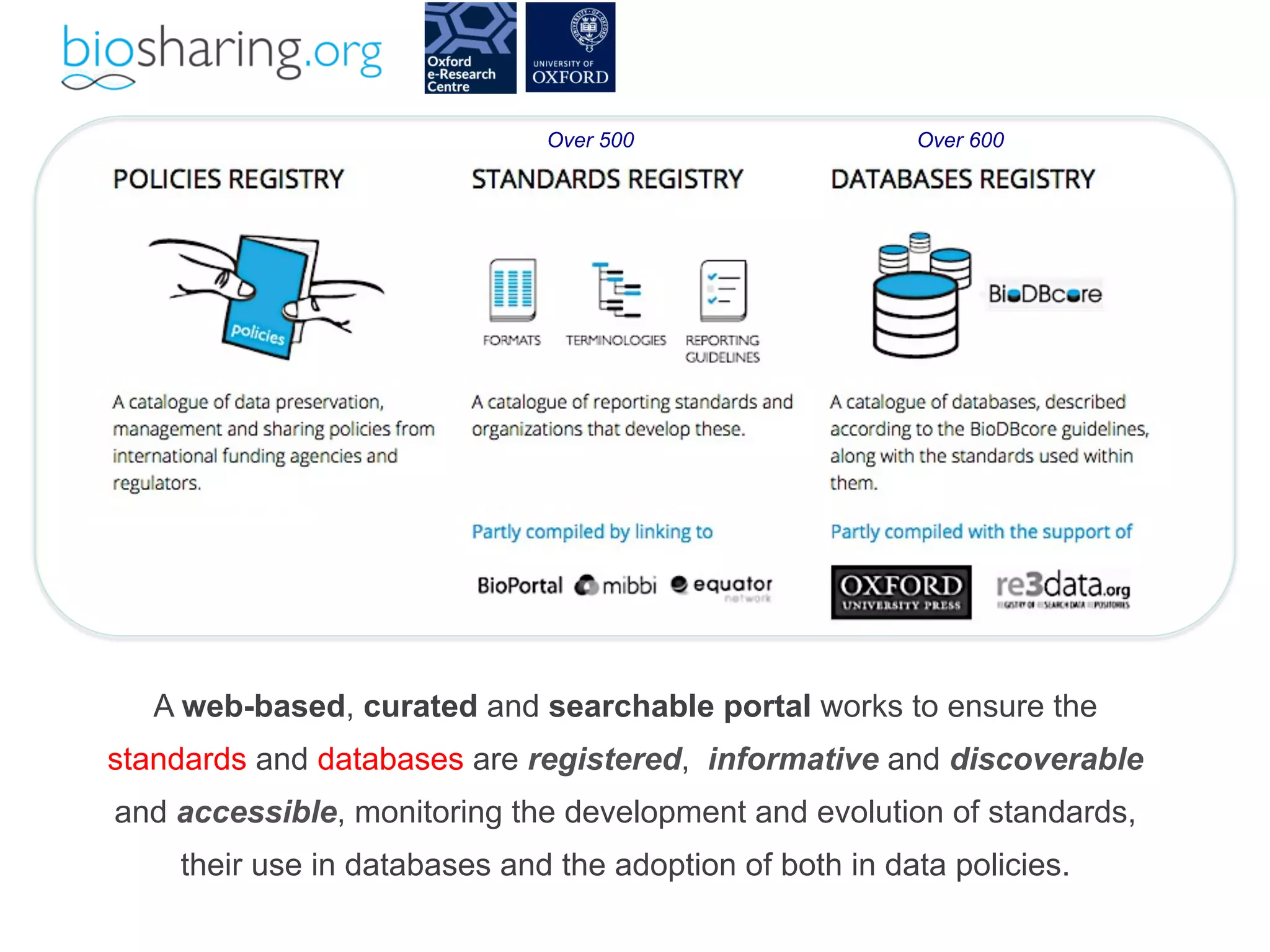
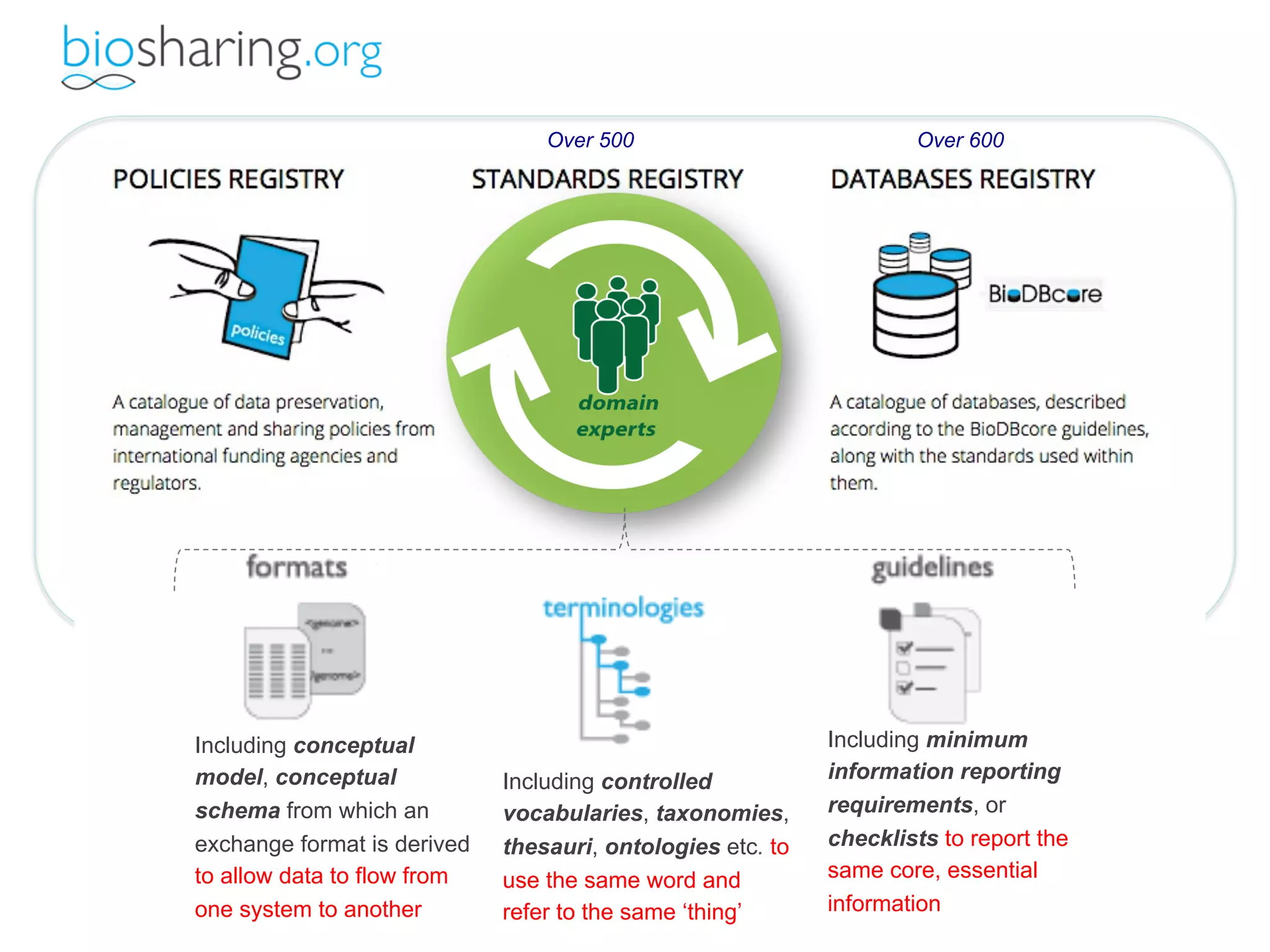
Over 500 Over 600 
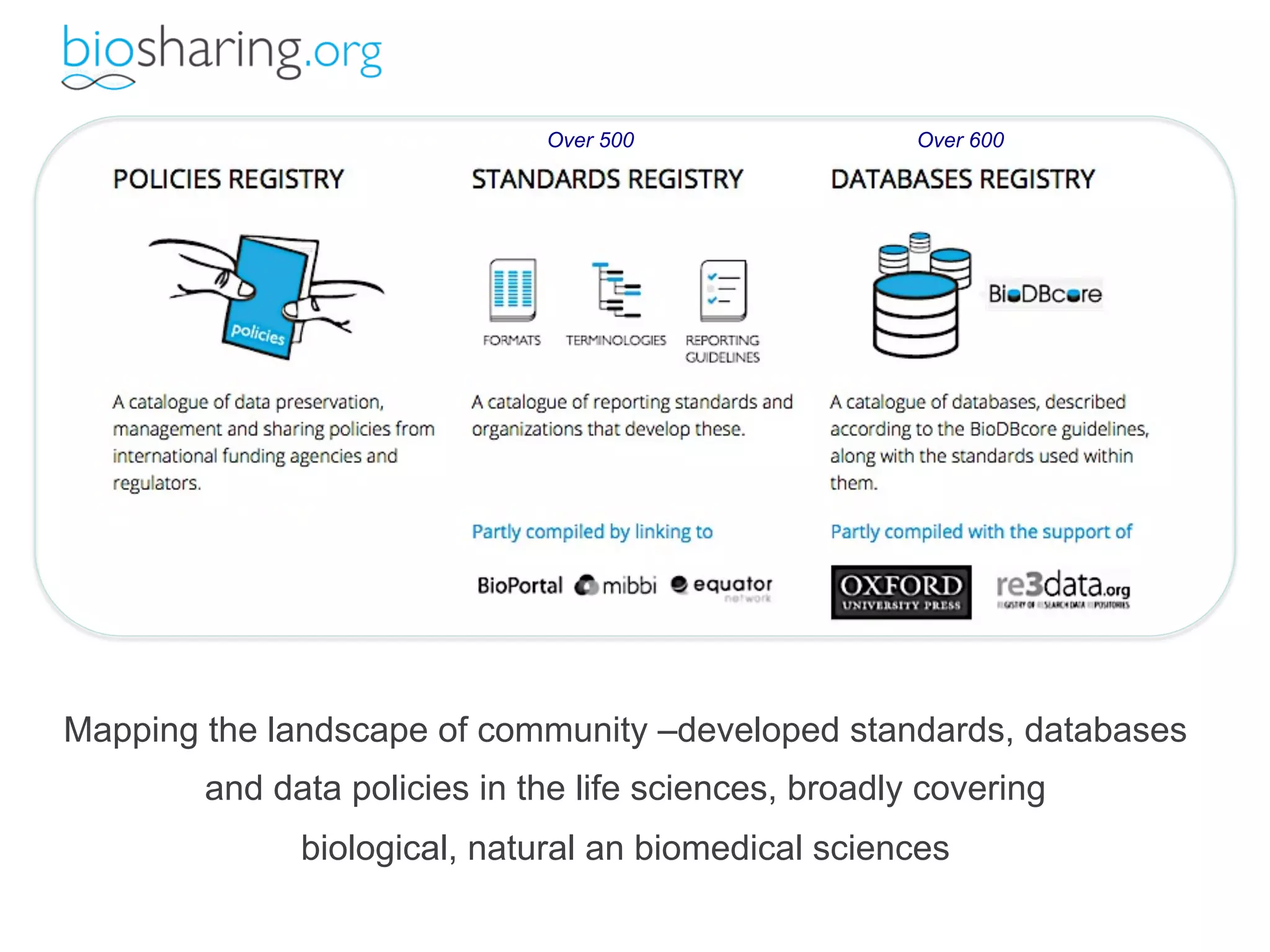
A web-based, curated and searchable portal works to ensure the 
standards and databases are registered, informative and discoverable 
and accessible, monitoring the development and evolution of standards, 
their use in databases and the adoption of both in data policies.
Over 500 Over 600 
Including minimum 
information reporting 
requirements, or 
checklists to report the 
same core, essential 
information 
Including controlled 
vocabularies, taxonomies, 
thesauri, ontologies etc. to 
use the same word and 
refer to the same ‘thing’ 
Including conceptual 
model, conceptual 
schema from which an 
exchange format is derived 
to allow data to flow from 
one system to another
Over 500 Over 600 
Mapping the landscape of community –developed standards, databases 
and data policies in the life sciences, broadly covering 
biological, natural an biomedical sciences
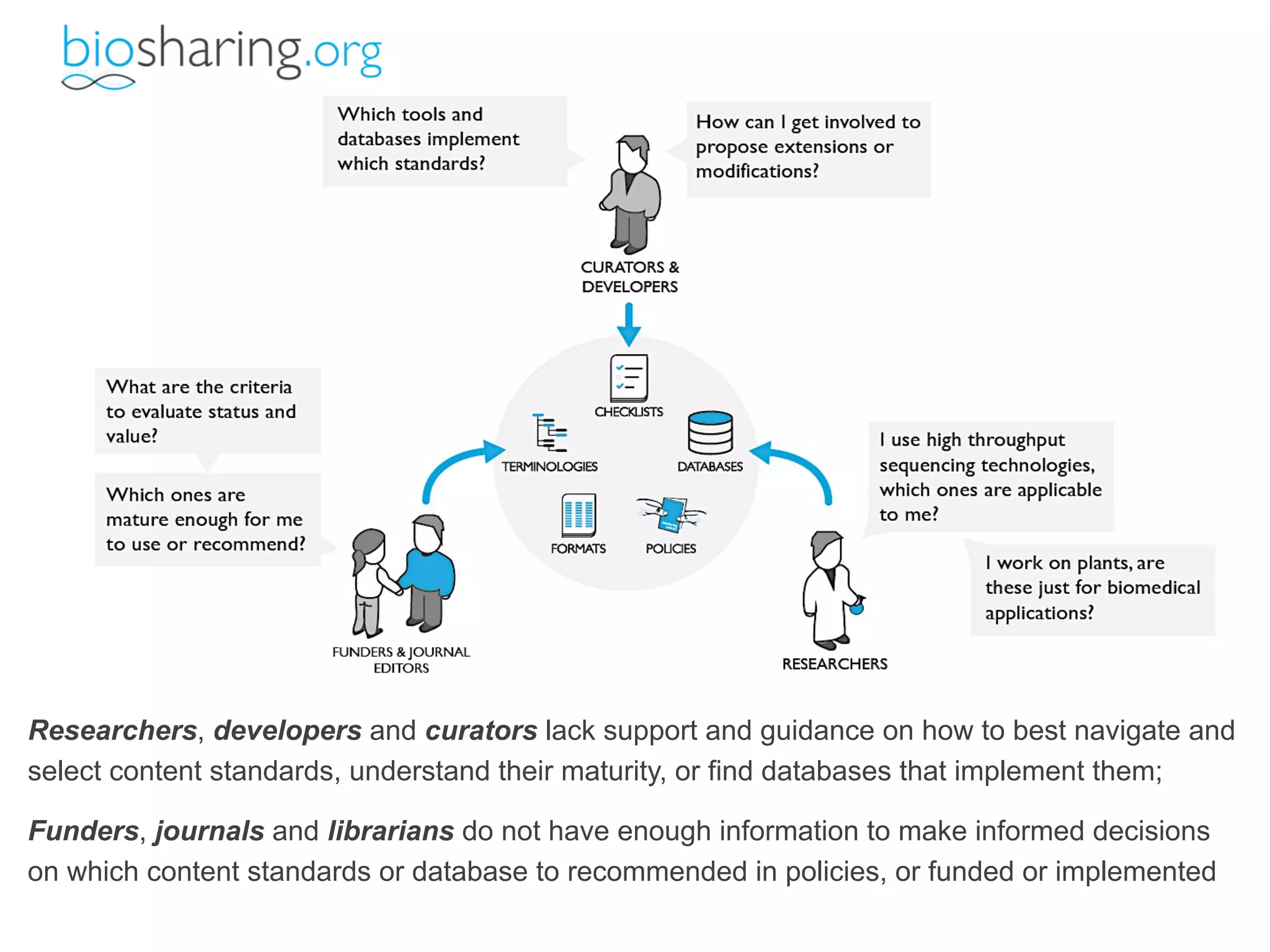
Researchers, developers and curators lack support and guidance on how to best navigate and 
select content standards, understand their maturity, or find databases that implement them; 
Funders, journals and librarians do not have enough information to make informed decisions 
on which content standards or database to recommended in policies, or funded or implemented
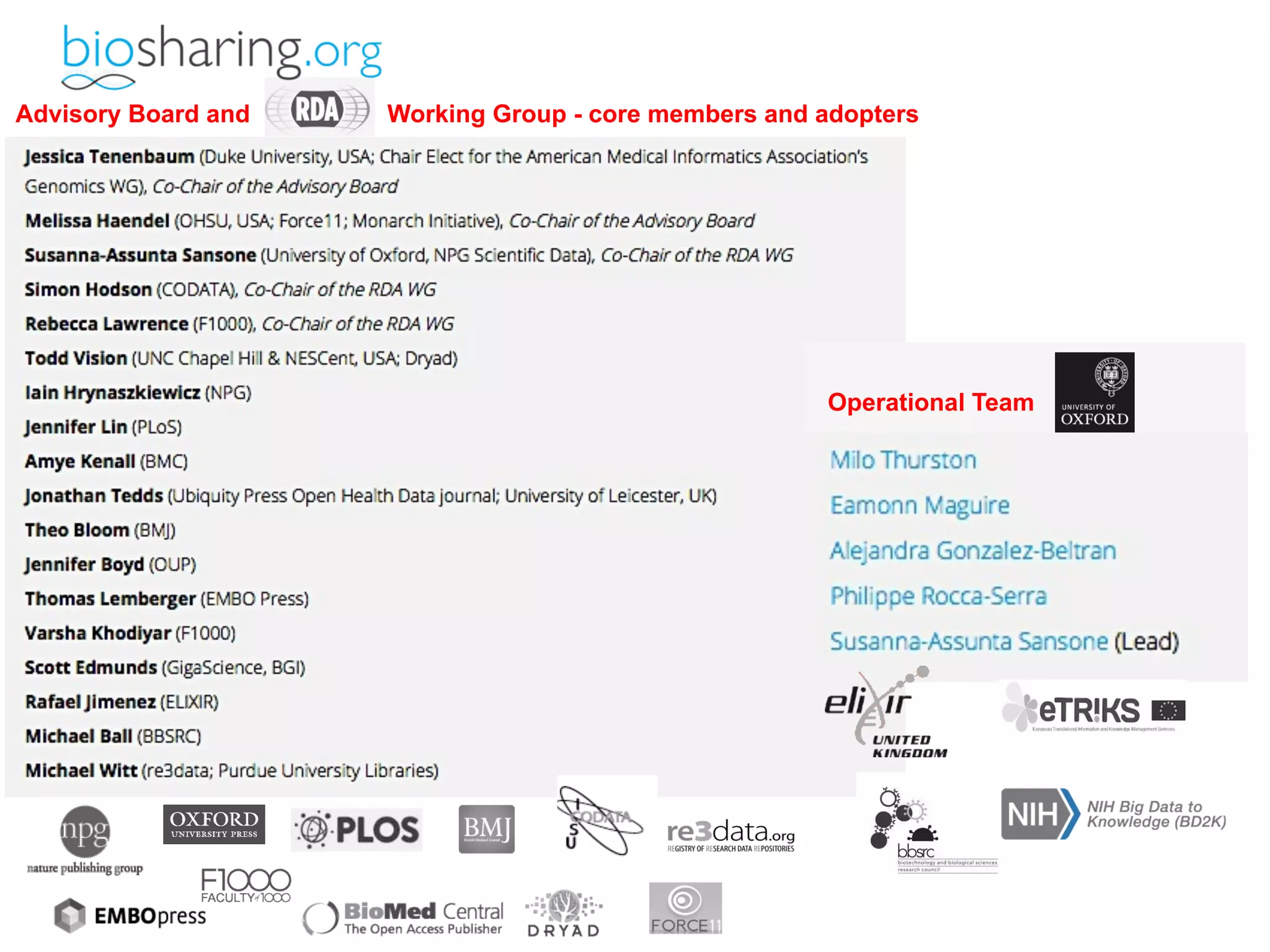
Advisory Board and Working Group - core members and adopters 
Operational Team
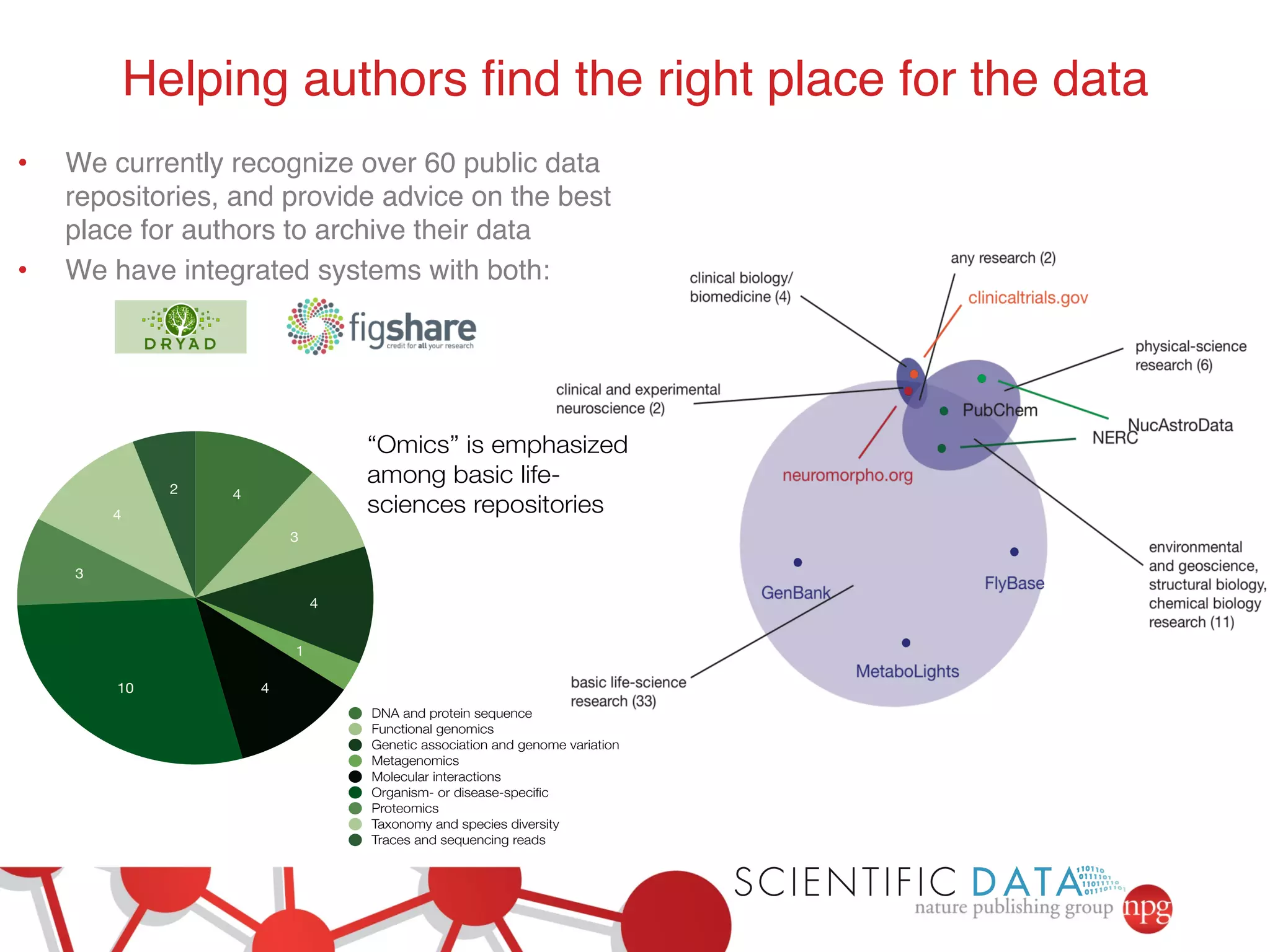
Helping authors find the right place for the data! 
• We currently recognize over 60 public data 
repositories, and provide advice on the best 
place for authors to archive their data! 
• We have integrated systems with both:! 
! 
! 
2 
4 
3 
10 4 
1 
4 
3 
4 
“Omics” is emphasized 
among basic life-sciences 
repositories 
DNA and protein sequence 
Functional genomics 
Genetic association and genome variation 
Metagenomics 
Molecular interactions 
Organism- or disease-specific 
Proteomics 
Taxonomy and species diversity 
Traces and sequencing reads
4 Big 
data 
| 
CSE 
2014 
6 
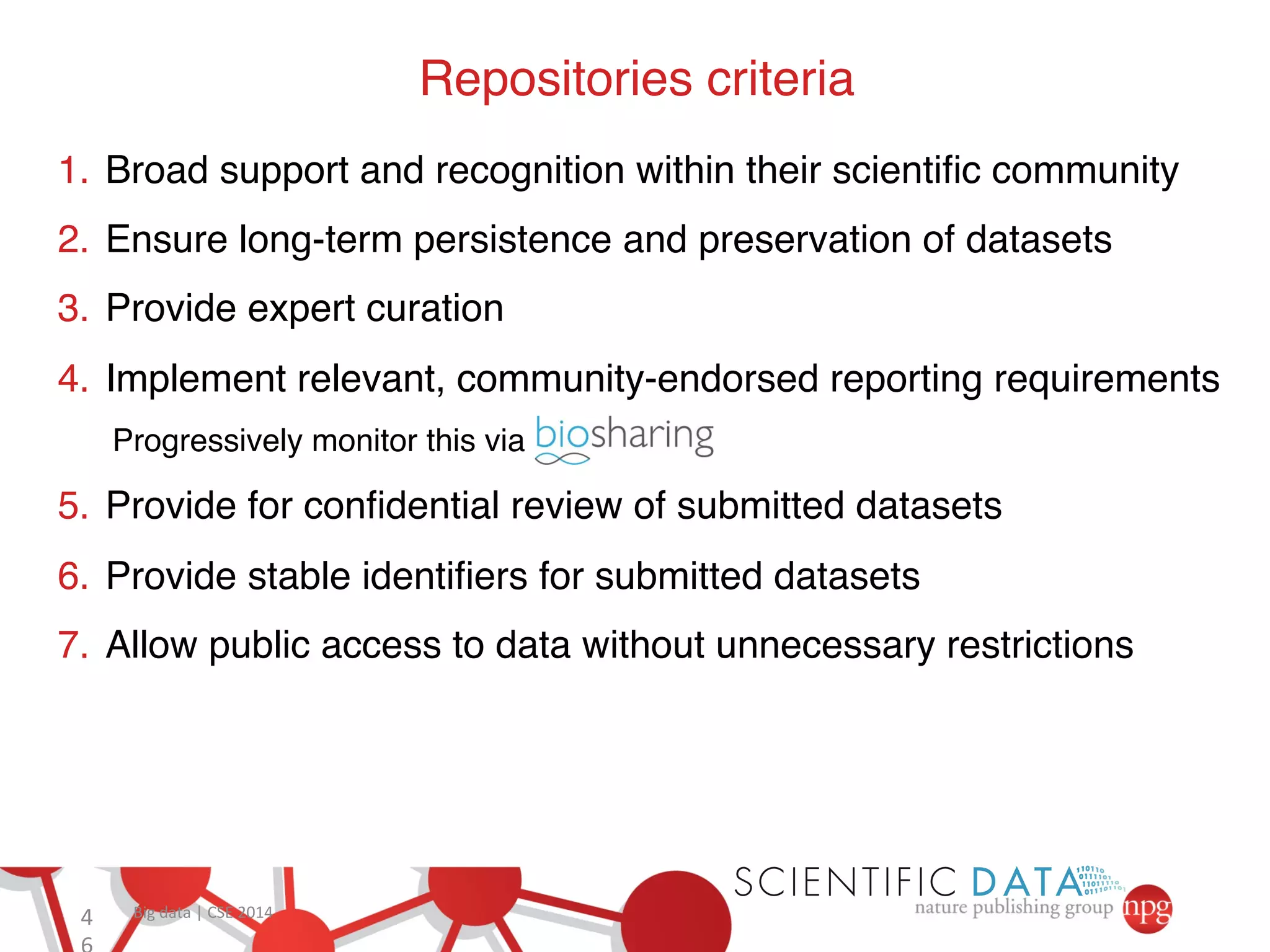
Repositories criteria! 
1. Broad support and recognition within their scientific community ! 
2. Ensure long-term persistence and preservation of datasets! 
3. Provide expert curation ! 
4. Implement relevant, community-endorsed reporting requirements ! 
Progressively monitor this via ! 
5. Provide for confidential review of submitted datasets ! 
6. Provide stable identifiers for submitted datasets ! 
7. Allow public access to data without unnecessary restrictions !
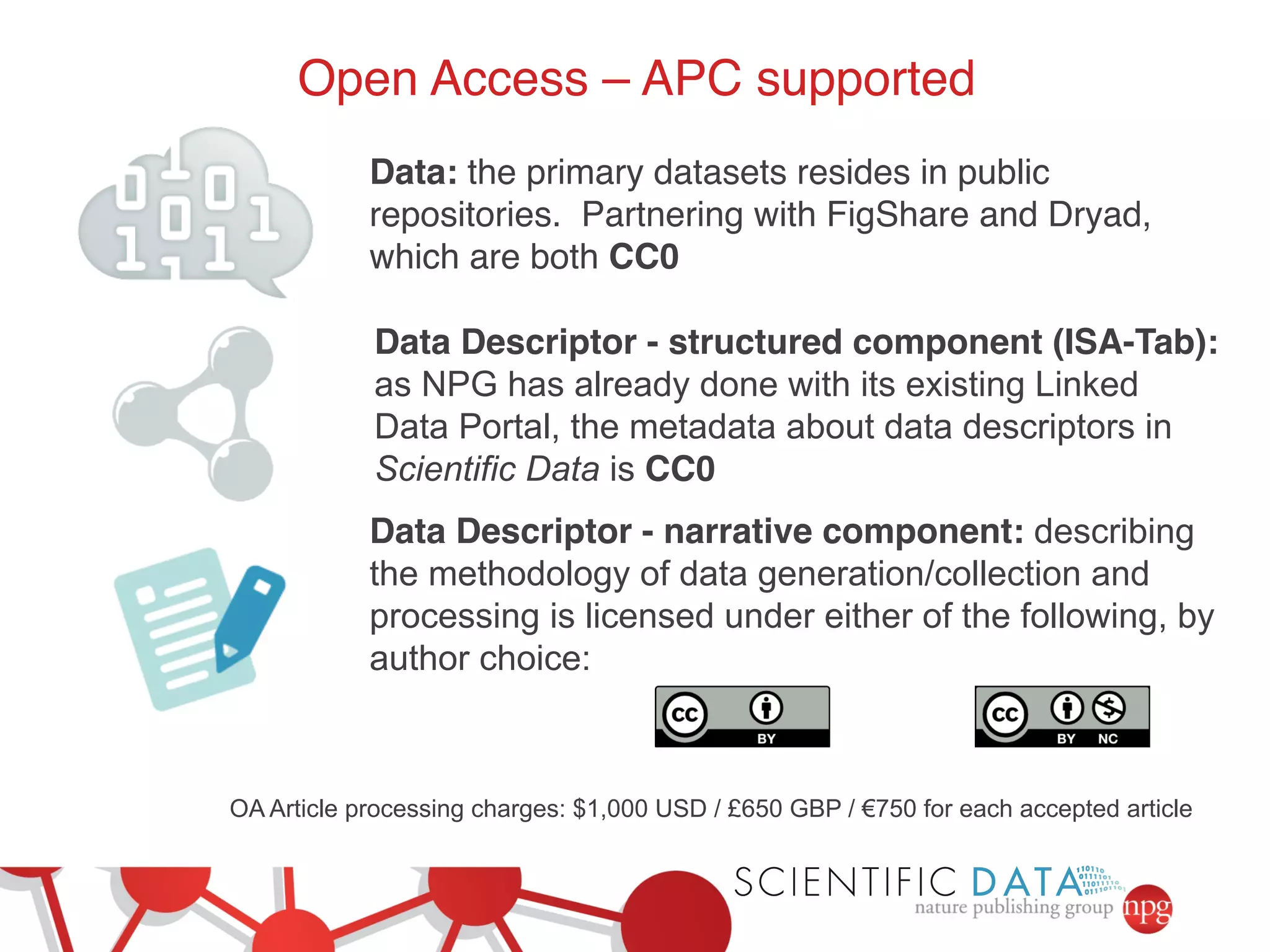
Open Access – APC supported! 
Data: the primary datasets resides in public 
repositories. Partnering with FigShare and Dryad, 
which are both CC0! 
Data Descriptor - structured component (ISA-Tab): 
as NPG has already done with its existing Linked 
Data Portal, the metadata about data descriptors in 
Scientific Data is CC0! 
Data Descriptor - narrative component: describing 
the methodology of data generation/collection and 
processing is licensed under either of the following, by 
author choice: 
OA Article processing charges: $1,000 USD / £650 GBP / €750 for each accepted article
Peer review process focused on quality and reuse! 
Evaluation is not be based on the perceived impact ! 
or novelty of the findings or size of the data! 
! 
• Experimental rigour and technical data quality! 
o Methodologically sound! 
o Technical validation experiments and statistical analyses! 
o Depth, coverage, size, and/or completeness of data sufficient for the types 
of applications! 
• Completeness of the description! 
o Sufficient details to allow others to reproduce the results, reuse or 
integrate it with other data! 
o Compliance with relevant minimum information or reporting standards! 
• Integrity of the data files and repository record! 
o Data files match the descriptions in the Data Descriptor! 
o Deposited in the most appropriate available data repository!
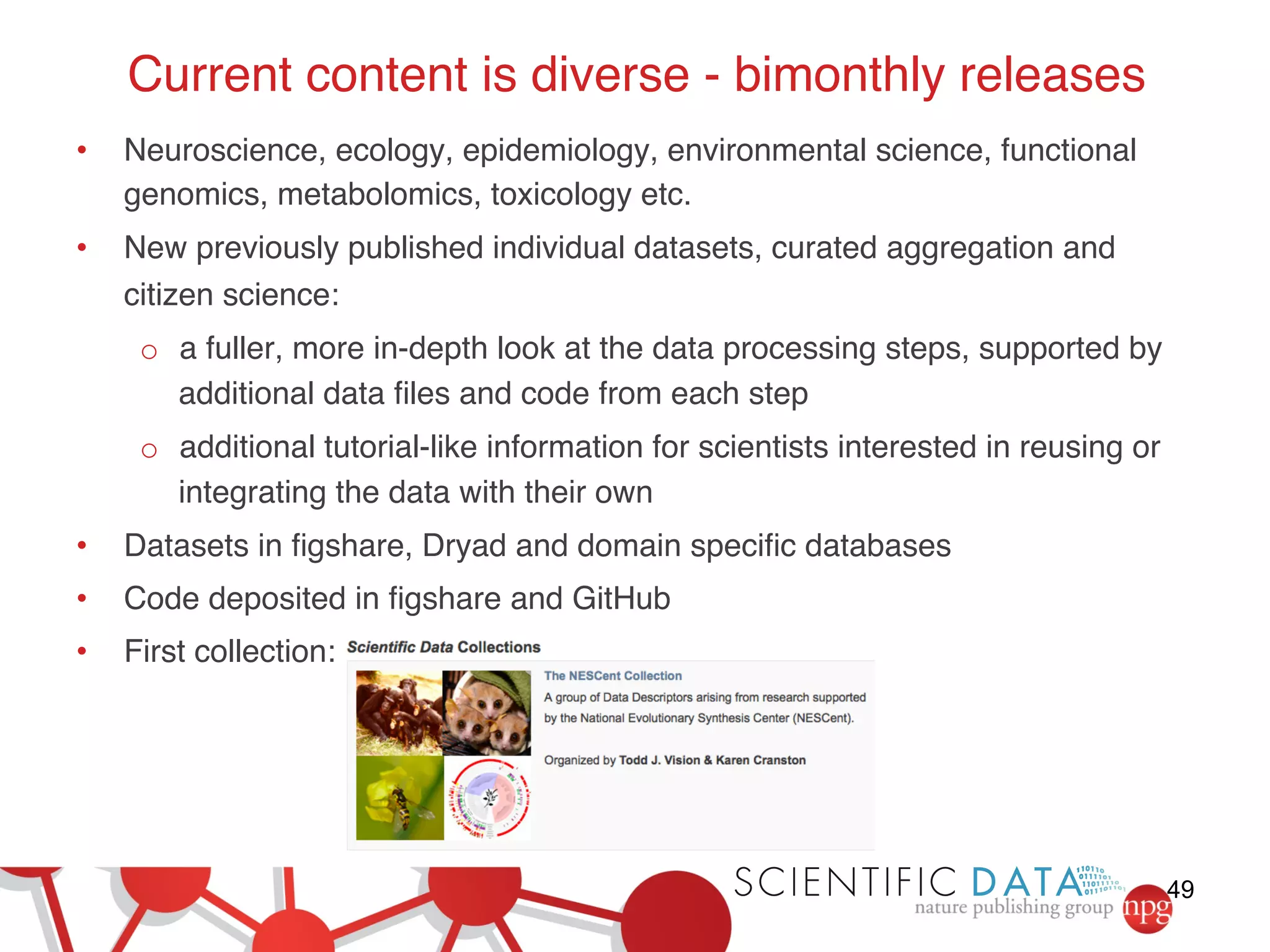
Current content is diverse - bimonthly releases ! 
• Neuroscience, ecology, epidemiology, environmental science, functional 
genomics, metabolomics, toxicology etc.! 
• New previously published individual datasets, curated aggregation and 
citizen science:! 
o a fuller, more in-depth look at the data processing steps, supported by 
additional data files and code from each step! 
o additional tutorial-like information for scientists interested in reusing or 
integrating the data with their own! 
• Datasets in figshare, Dryad and domain specific databases! 
• Code deposited in figshare and GitHub! 
• First collection:! 
49
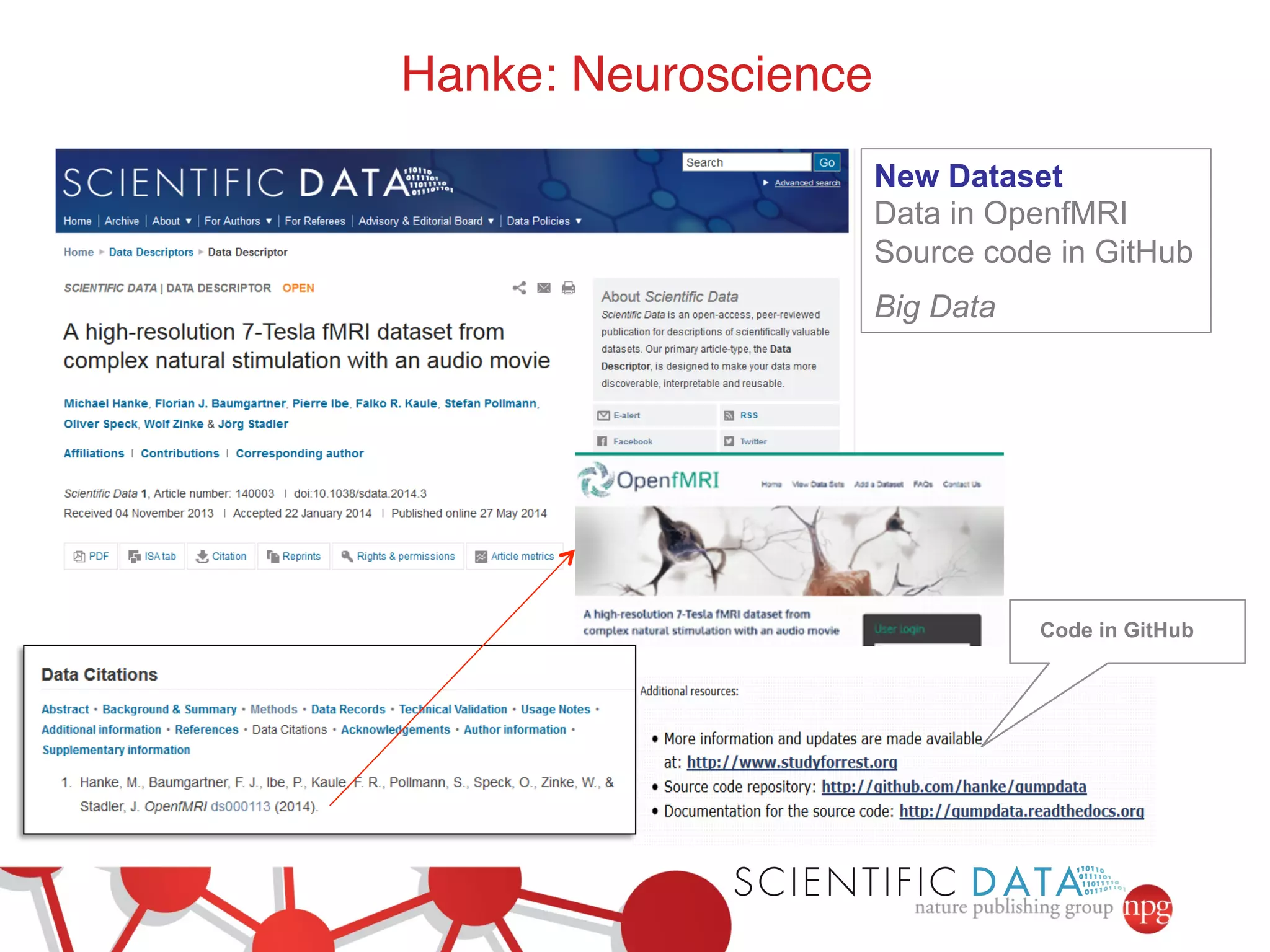
Hanke: Neuroscience ! 
New Dataset 
Data in OpenfMRI 
Source code in GitHub 
Big Data 
! 
! 
! 
! 
! 
! 
! 
! 
! 
Code in GitHub
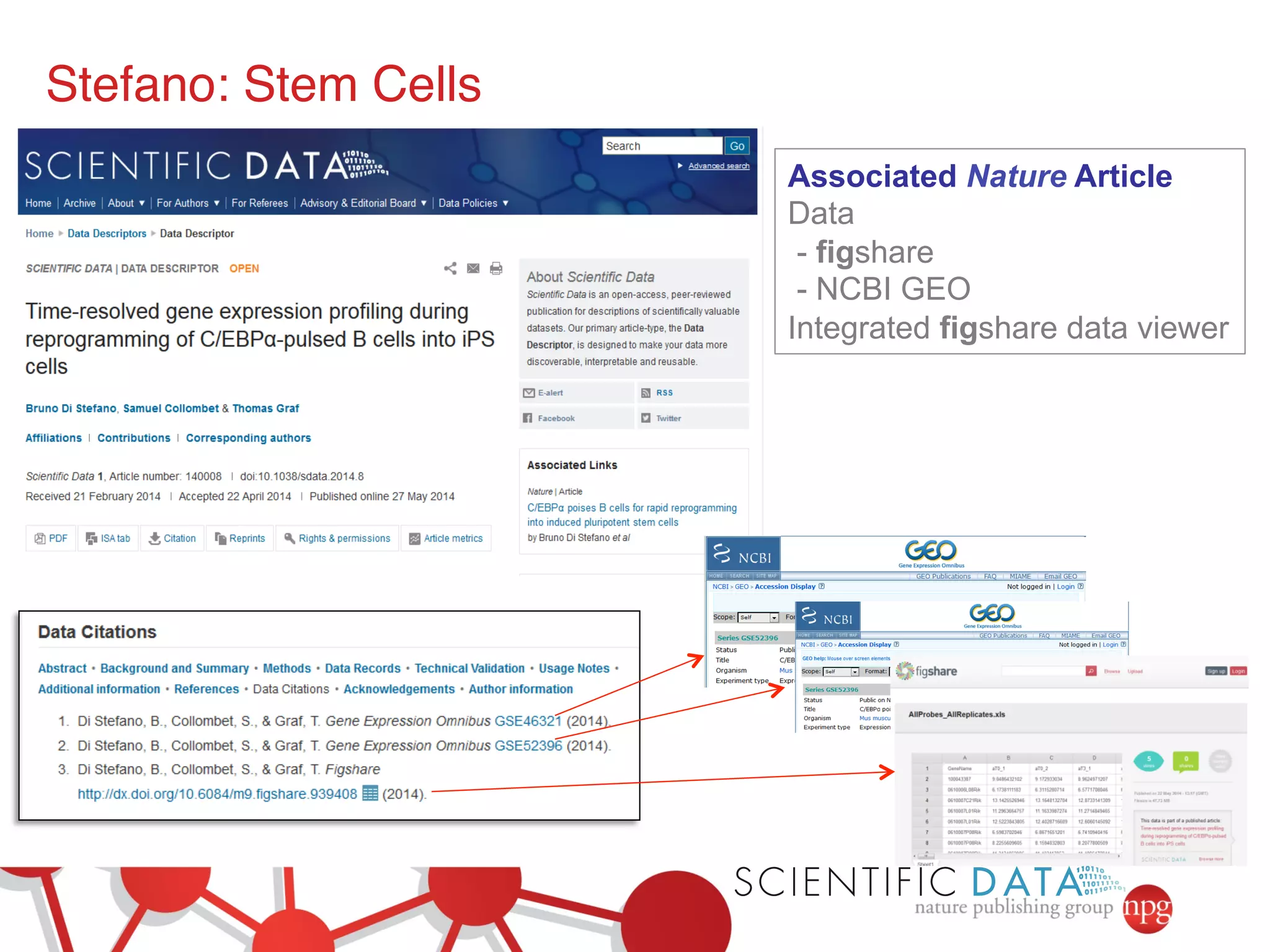
Stefano: Stem Cells! 
Associated Nature Article 
Data 
- figshare 
- NCBI GEO 
Integrated figshare data viewer
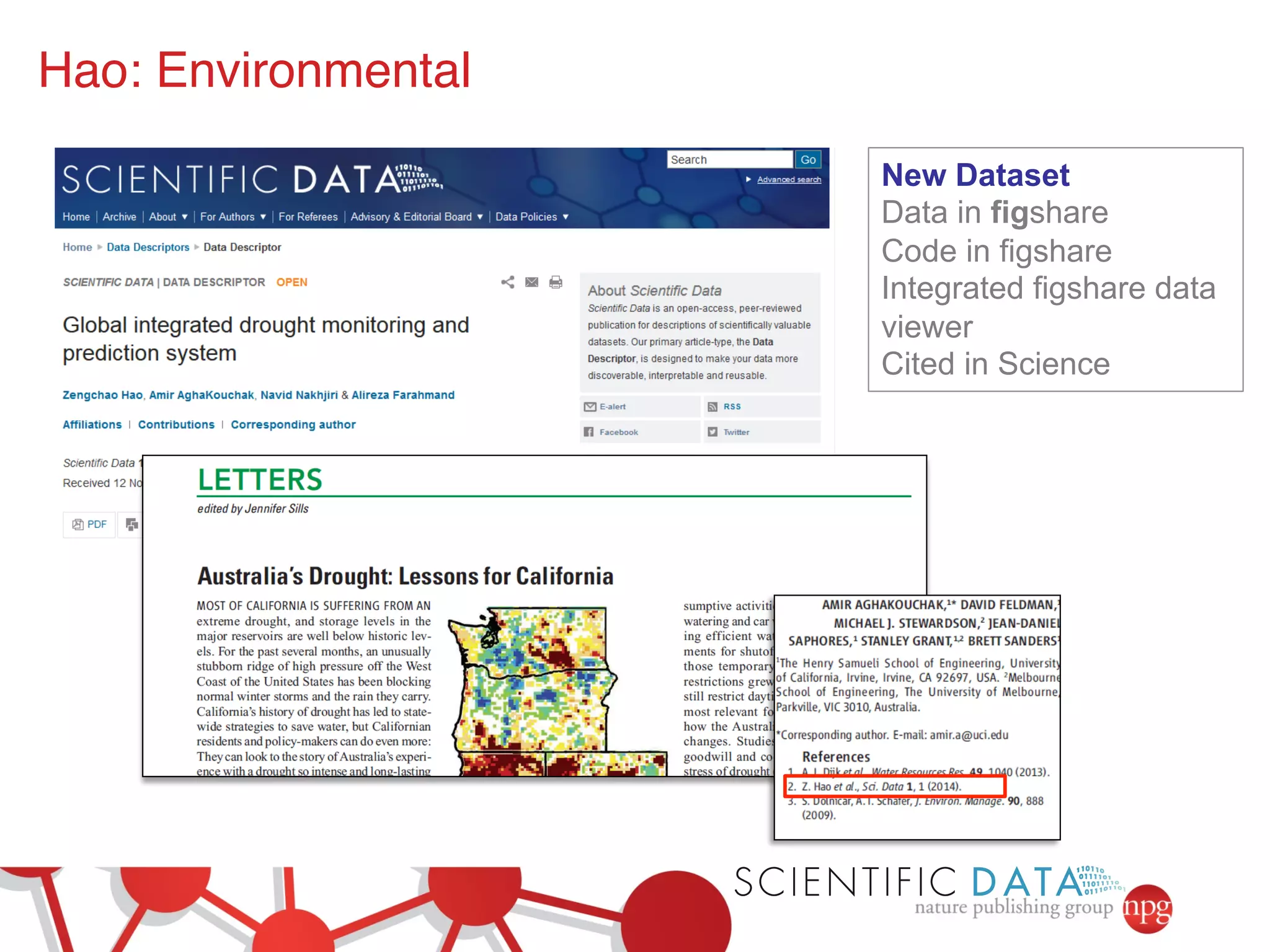
Hao: Environmental! 
New Dataset 
Data in figshare 
Code in figshare 
Integrated figshare data 
viewer 
Cited in Science
http://www.flickr.com/photos/12308429@N03/4957994485/ 
u Make sure your research outputs make an impact! 
u Open your research outputs, via the right channels to get cited and credited 
u Contribute to the reproducible research movement and to FAIR data
u Uniquely identify yourself via ORCID 
u Share identified generic research outputs, e.g. FigShare 
u Share and deposit code, e.g. GitHub, Bitbucket 
http://www.flickr.com/photos/idiolector/289490834/
u Learn about open standards in your area, via e.g. BioSharing 
u Select tools that implement relevant standards, e.g. ISA 
u Publish not just in traditional journals, but think Scientific Data 
http://www.flickr.com/photos/webhamster/2582189977/
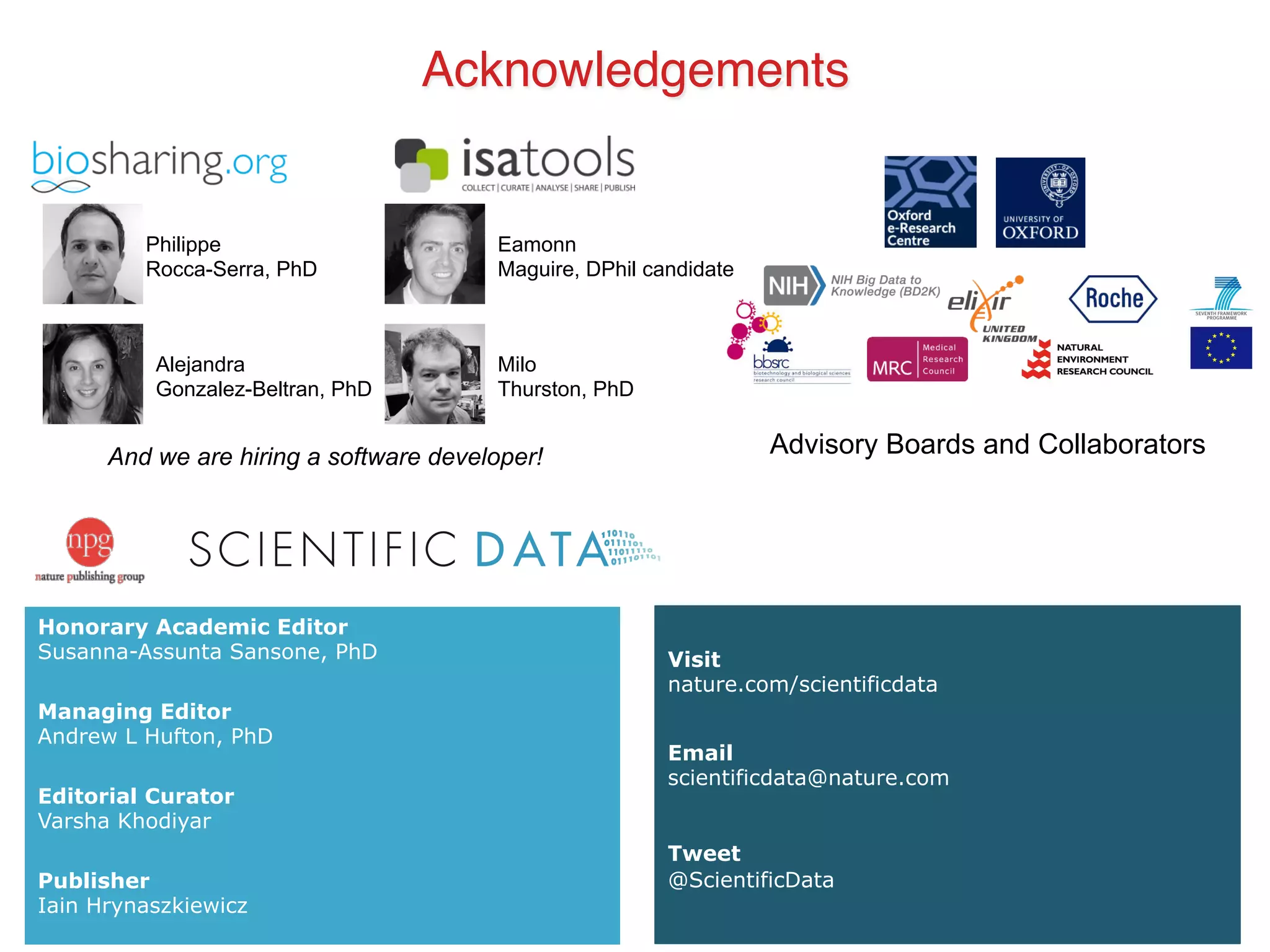
Acknowledgements! 
Advisory Boards and Collaborators 
Philippe 
Rocca-Serra, PhD 
Alejandra 
Gonzalez-Beltran, PhD 
Milo 
Thurston, PhD 
Visit 
nature.com/scientificdata 
Email 
scientificdata@nature.com 
Tweet 
@ScientificData 
Honorary Academic Editor 
Susanna-Assunta Sansone, PhD 
Managing Editor 
Andrew L Hufton, PhD 
Editorial Curator 
Varsha Khodiyar 
Publisher 
Iain Hrynaszkiewicz 
Eamonn 
Maguire, DPhil candidate 
And we are hiring a software developer!

Open Access Week - Oxford, 20-24 Oct 2014

  • 1.
    Consultant, Honorary AcademicEditor Associate Director, Principal Investigator ! Open access and open data at ! Nature Publishing Group: ! better data = better science! ! Susanna-Assunta Sansone, PhD! ! ! @biosharing! @isatools! @scientificdata! ! Open Access Week at Oxford, 20-24 October, 2014 http://www.slideshare.net/SusannaSansone
  • 2.
  • 3.
    A community mobilization http://discovery.urlibraries.org/ image by Greg Emmerich http://www.theguardian.com/higher-education-network/blog/2014/jun/26 https://okfn.org
  • 4.
    Open access isnot enough on its own http://www.theguardian.com/higher-education-network/blog/2014/jun/26 If your research has been funded by the taxpayer, there's a good chance you'll be encouraged to publish your results on an open access basis….. This final article makes publicly available the hypotheses, interpretations and conclusions of your research. But what about the data that led you to those results and conclusions?
  • 5.
    Also open datais not always enough http://www.theguardian.com/higher-education-network/blog/2014/jun/26 So data that is in theory open and free to access! • may still be hard to get hold of! • it may not have been stored or cited in the appropriate manner! • it may not be interoperable with related data because it is not formatted appropriately; or! • it may not be reusable because it may not contain enough information for others to understand it!
  • 6.
    Benefits and barriersto data sharing Credit to: Iain Hrynaszkiewicz Benefits! Barriers! • Reduction of error and fraud! • Increased return on investment in research! • Compliance with funder and journal mandates! • Reduce duplication and bias! • Reproduction/validation of research! • Testing additional hypotheses! • Use for teaching! • Integration with other data sets! • Increased citations ! • Concerns over inappropriate reuse! • Limited time/resources! • Costs associated with data sharing! • Human privacy concerns! • Unclear ownership of data/ authority to release data! • Lack of academic incentives/ recognition! • Lack of repositories or lack of awareness of repositories! • Protecting commercially sensitive information !
  • 7.
    Movement for FAIRdata in life and medical sciences http://bd2k.nih.gov/workshops.html#ADDS
  • 8.
    The International Conferenceon Systems Biology (ICSB), 22-28 August, 2008 Susanna-Assunta Sansone www.ebi.ac.uk/net-project 8 • make annotation explicit and discoverable • structure the descriptions for consistency • ensure/regulate access • deposit and publish • etc…. § To make any dataset ‘FAIR’, one must have standards, tools and best practices to: • report sufficient details • capture all salient features of the experimental workflow
  • 9.
    The International Conferenceon Systems Biology (ICSB), 22-28 August, 2008 Susanna-Assunta Sansone www.ebi.ac.uk/net-project 9 …breadth and depth ! of the experimental context! …is pivotal!
  • 10.
    sample characteristic(s)! TheInternational Conference on Systems Biology (ICSB), 22-28 August, 2008 Susanna-Assunta Sansone www.ebi.ac.uk/net-project 1 0 experimental design! experimental variable(s)! technology(s)! measurement(s)! protocols(s)! data file(s)! ......!
  • 11.
    Doing my fairshare of work Working with and for: Increase the level of annotation at the source, tracking provenance and using community standards Notes and narrative! Spreadsheets and tables! Linked data and nanopublications! Notes in Lab Books (information for humans) Spreadsheets and Tables ( the compromise) Facts as RDF statements (information for machines)
  • 12.
    Because, in allfairness, no much data is FAIR! 12
  • 13.
    Because, in allfairness, no much data is FAIR!
  • 14.
    Role of publishersas “agents of change” • Data has to become an integral part of the scholarly communications! • Responsibilities lie across several stakeholder groups: researchers, data centers, librarians, funding agencies and publishers! • Publishers occupy a leverage point in this process!
  • 15.
    Publishers and data/reproducibility • Policies on access (to data, code, reagents etc.)! o Supporting funder & community needs! • Format and amount of content! o Methodological details, supplementary info, data integration and links to repositories! • Licensing for reuse! • Incentives to share! o Data citations! o Data journals and articles! • Quality assurance through peer review! Credit to: Iain Hrynaszkiewicz
  • 16.
    Data/reproducibility at NPG Some important events! ! • 1996: Bermuda Principles! o prepublication of DNA sequence data! • 1998: Structural data! o accession codes required by Nature & Science! • 2002: MIAME community standards! • microarray data deposition public repositories required! • 2007: Methods sections! o Limitations for the online version removed! • 2009: Ioannidis et al. Nat Gen 41, 2, 149 ! Credit to: Veronique Kiermer
  • 17.
    2013 Credit to: Iain Hrynaszkiewicz
  • 18.
    Data/reproducibility at NPG Some important recent events 2013-2014 • Figure source data o putting data behind figures/graphs o rolled out at Nature and progressively across all other Nature branded titles Wang et al, Nature, 2013 doi:10.1038/nature12730
  • 19.
    Data/reproducibility at NPG Some important recent events 2013-2014 • Figure source data o putting data behind figures/graphs o rolled out at Nature and progressively across all other Nature branded titles • Extended data o expandable text and extra figures; rolled out at Nature
  • 20.
    Data/reproducibility at NPG Some important recent events 2013-2014 • Figure source data o putting data behind figures/graphs o rolled out at Nature and progressively across all other Nature branded titles • Extended data o expandable text and extra figures; rolled out at Nature • Data citation o tackling both styling and format; monitoring community developments, such the Data Citation Synthesis Group o to be rolled out across all Nature branded titles and Scientific Data • Code reproducibility o peer review, availability and reuse • NPG’s Linked Data release – CC0 • A new data publication platform:
  • 21.
    Nature Publishing Group:the changing landscape Human Genome 2001 62 Pages, 150 Authors, 49 Figure, 27 tables Encode Project 2012 30 papers, 3 Journals
  • 22.
    The role ofdata journals/articles • Credit! • Unpublished data! • Peer review focus! • Value of data vs. analysis! • Discoverability! • Reusability! • Narrative/context! • “Intelligently open data”! Credit to: Iain Hrynaszkiewicz
  • 23.
    Data journals everywhere? Credit to: Iain Hrynaszkiewicz
  • 24.
    market research (2011) • Scope of survey! o How much data researchers produce, in what format and what they do with it! o Perceived availability of public repositories! o Perceptions of the Scientific Data concept! o Level/nature of data journal peer review! • Respondent characteristics! o 387 respondents (329 active researchers)! o Physics (24%), Earth and environmental science (21%), Biology (20%) Chemistry (19%) Others (16%)! Credit to: Iain Hrynaszkiewicz
  • 25.
    market research (2011) • Key survey data o 60% share their data with their colleagues o 50% look at other researchers’ datasets at least once a month o very few respondents produce more than 1TB of data per year; the majority produce less than 1G o 45% unaware of a repository for some of their data o 90% reacted positively to the concept of Scientific Data o 80% believed Scientific Data would increase data deposition o what do researchers want from a data publication? 96% - increased visibility and discovery 95% - increased usability of their research data 93% - credit mechanism for deposit of data 80% - peer review of content/datasets Credit to: Iain Hrynaszkiewicz
  • 26.
    • Get Creditfor Sharing Your Data • Publications will be listed in the major indexes and will be citeable • Focused on Data Reuse • All the information others need to reuse the data; no interpretative analysis or hypothesis testing • Open-access • Authors select from three Creative Commons licences for the main • Data Descriptor. Each publication supported by curated CC0 metadata • Peer-reviewed • Rigorous peer-review managed by our Editorial Board of academic researchers ensures data quality and standards • Promoting Community Data Repositories • Data stored in community data repositories
  • 27.
    Supported by:! AdvisoryPanel including senior researchers, funders, librarians and curators Michael Huerta ● National Institutes of Health, USA ● Mark Thorley ● Natural Environment Research Council, UK ● Patricia Cruse ● University of California, USA ● Susan Gregurick ● Office of Biological and Environmental Research, Department of Energy, USA ● Ioannis Xenarios ● Swiss Institute of Bioinformatics, Switzerland ● Chris Bowler ● IBENS, France ● Mark Forster ● Syngenta, UK ● Anthony Rowe ● Johnson & Johnson, USA ● Stephen Chanock ● National Cancer Institute, USA ● Weida Tong ● National Center for Toxicological Research, FDA, USA ● Albert J. R. Heck ● Utrecht University, The Netherlands ● Johanna McEntyre ● EMBL-EBI, European Bioinformatics Institute, UK ● Simon Hodson ● CODATA, France ● Joseph R. Ecker ● Howard Hughes Medical Institute & Salk Institute, USA ● Stephen Friend ● Sage Bionetworks, USA ● Jessica Tenenbaum ● Duke Translational Medicine Institute, USA ● Anne-Claude Gavin ● EMBL, Germany ● David Carr ● Wellcome Trust, UK ● Wolfram Horstmann ● University of Oxford, UK ● Piero Carninci ● RIKEN Omics Science Center, Japan ● Pascale Gaudet ● Swiss Institute of Bioinformatics, Switzerland ● Judith A. Blake ● The Jackson Laboratory, USA ● Richard H. Scheuermann ● J. Craig Venter Institute, USA ● Caroline Shamu ● Harvard Medical School, USA Susanna-Assunta Sansone Honorary Academic Editor (University of Oxford, UK) Andrew L Hufton Managing Editor Varsha Khodiyar Editorial Curator Iain Hrynaszkiewicz Publisher An open access, peer-reviewed publication for descriptions of scientifically valuable datasets! Launched May 2014
  • 28.
    Introducing a newcontent type: the Data Descriptor • The data descriptor is only concerned with the facts behind the methodology of data generation/collection and processing! • A data descriptor complements a journal Synthesis Analysis Data Descriptor Conclusions Interpretation What is the sample? What did I do to generate the data? How was the data processed? Where is the data? Who did what when? Summary of Data Descriptor Facts Data Descriptor Journal article NARRATIVE article!
  • 29.
    Data Descriptor: narrativeand structure! Article or ! narrative component! (PDF and HTML) ! ! ! ! Experimental metadata or ! structured component! (in-house curated, machine-readable formats)!
  • 30.
    Data Descriptor: narrativeand structure! Article or ! narrative component! (PDF and HTML) ! ! ! ! Experimental metadata or ! structured component! (in-house curated, machine-readable formats)!
  • 31.
    Data Descriptor: narrative! Focus on data reuse! Detailed descriptions of the methods and technical analyses supporting the quality of the measurements.! Does not contain tests of new scientific hypotheses! In traditional publications this information is not provided in a sufficiently detailed manner However this information is essential for understanding, reusing, and reproducing datasets Sections:! • Title! • Abstract! • Background & Summary! • Methods! • Technical Validation! • Data Records! • Usage Notes ! • Figures & Tables ! • References! • Data Citations! !
  • 32.
    Data Descriptor: narrative! Focus on data reuse! Detailed descriptions of the methods and technical analyses supporting the quality of the measurements.! Does not contain tests of new scientific hypotheses! Sections:! • Title! • Abstract! • Background & Summary! • Methods! • Technical Validation! • Data Records! • Usage Notes ! • Figures & Tables ! • References! • Data Citations! !
  • 33.
    Data Descriptor: narrative! Focus on data reuse! Detailed descriptions of the methods and technical analyses supporting the quality of the measurements.! Does not contain tests of new scientific hypotheses! Sections:! • Title! • Abstract! • Background & Summary! • Methods! • Technical Validation! • Data Records! • Usage Notes ! • Figures & Tables ! • References! • Data Citations! ! Joint Declaration of Data Citation Principles by the Data Citation Synthesis Group
  • 34.
    Data Descriptor: structure- content ! Includes fields describing: • each study, linking to relevant sections of the Data Descriptor article • authors’ details, including ORCID • publications • funding sources and funders’ name, via FundRef • experimental factors • study design • assays • protocols Data file or ! record in a database! analysis ! method! script!
  • 35.
    Data Descriptor: structure- content ! In-house editorial curator:! • assists users to submit the structured content via simple templates and an internal authoring tool! • performs value-added semantic annotation of the experimental metadata! For advanced users/service providers willing to export ISA-Tab for direct submission, we will release a technical specification:! Data file or ! record in a database! analysis ! method! script!
  • 36.
    Relation with traditionalarticles - content! ! ! ! ! ! ! ! ! Scientific hypotheses:! Synthesis! Analysis! Conclusions! Methods and technical analyses supporting the quality of the measurements:! What did I do to generate the data?! How was the data processed?! Where is the data?! Who did what when!
  • 37.
    Relation with traditionalarticles - time! BEFORE: get your data to the community as soon as possible (see NPG pre-publication policy) AT THE SAME TIME: publish your Data Descriptor(s) alongside research article(s) AFTER: expand on your research articles, adding further information for reuse of the data
  • 38.
    Citations of andlinks to data files - databases!
  • 39.
    Value added componentintegrated in a growing ecosystem! We currently recognize over 60 public data repositories! ! Research papers Descriptors Data Data records
  • 40.
    Over 500 Over600 A web-based, curated and searchable portal works to ensure the standards and databases are registered, informative and discoverable and accessible, monitoring the development and evolution of standards, their use in databases and the adoption of both in data policies.
  • 41.
    Over 500 Over600 Including minimum information reporting requirements, or checklists to report the same core, essential information Including controlled vocabularies, taxonomies, thesauri, ontologies etc. to use the same word and refer to the same ‘thing’ Including conceptual model, conceptual schema from which an exchange format is derived to allow data to flow from one system to another
  • 42.
    Over 500 Over600 Mapping the landscape of community –developed standards, databases and data policies in the life sciences, broadly covering biological, natural an biomedical sciences
  • 43.
    Researchers, developers andcurators lack support and guidance on how to best navigate and select content standards, understand their maturity, or find databases that implement them; Funders, journals and librarians do not have enough information to make informed decisions on which content standards or database to recommended in policies, or funded or implemented
  • 44.
    Advisory Board andWorking Group - core members and adopters Operational Team
  • 45.
    Helping authors findthe right place for the data! • We currently recognize over 60 public data repositories, and provide advice on the best place for authors to archive their data! • We have integrated systems with both:! ! ! 2 4 3 10 4 1 4 3 4 “Omics” is emphasized among basic life-sciences repositories DNA and protein sequence Functional genomics Genetic association and genome variation Metagenomics Molecular interactions Organism- or disease-specific Proteomics Taxonomy and species diversity Traces and sequencing reads
  • 46.
    4 Big data | CSE 2014 6 Repositories criteria! 1. Broad support and recognition within their scientific community ! 2. Ensure long-term persistence and preservation of datasets! 3. Provide expert curation ! 4. Implement relevant, community-endorsed reporting requirements ! Progressively monitor this via ! 5. Provide for confidential review of submitted datasets ! 6. Provide stable identifiers for submitted datasets ! 7. Allow public access to data without unnecessary restrictions !
  • 47.
    Open Access –APC supported! Data: the primary datasets resides in public repositories. Partnering with FigShare and Dryad, which are both CC0! Data Descriptor - structured component (ISA-Tab): as NPG has already done with its existing Linked Data Portal, the metadata about data descriptors in Scientific Data is CC0! Data Descriptor - narrative component: describing the methodology of data generation/collection and processing is licensed under either of the following, by author choice: OA Article processing charges: $1,000 USD / £650 GBP / €750 for each accepted article
  • 48.
    Peer review processfocused on quality and reuse! Evaluation is not be based on the perceived impact ! or novelty of the findings or size of the data! ! • Experimental rigour and technical data quality! o Methodologically sound! o Technical validation experiments and statistical analyses! o Depth, coverage, size, and/or completeness of data sufficient for the types of applications! • Completeness of the description! o Sufficient details to allow others to reproduce the results, reuse or integrate it with other data! o Compliance with relevant minimum information or reporting standards! • Integrity of the data files and repository record! o Data files match the descriptions in the Data Descriptor! o Deposited in the most appropriate available data repository!
  • 49.
    Current content isdiverse - bimonthly releases ! • Neuroscience, ecology, epidemiology, environmental science, functional genomics, metabolomics, toxicology etc.! • New previously published individual datasets, curated aggregation and citizen science:! o a fuller, more in-depth look at the data processing steps, supported by additional data files and code from each step! o additional tutorial-like information for scientists interested in reusing or integrating the data with their own! • Datasets in figshare, Dryad and domain specific databases! • Code deposited in figshare and GitHub! • First collection:! 49
  • 50.
    Hanke: Neuroscience ! New Dataset Data in OpenfMRI Source code in GitHub Big Data ! ! ! ! ! ! ! ! ! Code in GitHub
  • 51.
    Stefano: Stem Cells! Associated Nature Article Data - figshare - NCBI GEO Integrated figshare data viewer
  • 52.
    Hao: Environmental! NewDataset Data in figshare Code in figshare Integrated figshare data viewer Cited in Science
  • 54.
    http://www.flickr.com/photos/12308429@N03/4957994485/ u Makesure your research outputs make an impact! u Open your research outputs, via the right channels to get cited and credited u Contribute to the reproducible research movement and to FAIR data
  • 55.
    u Uniquely identifyyourself via ORCID u Share identified generic research outputs, e.g. FigShare u Share and deposit code, e.g. GitHub, Bitbucket http://www.flickr.com/photos/idiolector/289490834/
  • 56.
    u Learn aboutopen standards in your area, via e.g. BioSharing u Select tools that implement relevant standards, e.g. ISA u Publish not just in traditional journals, but think Scientific Data http://www.flickr.com/photos/webhamster/2582189977/
  • 57.
    Acknowledgements! Advisory Boardsand Collaborators Philippe Rocca-Serra, PhD Alejandra Gonzalez-Beltran, PhD Milo Thurston, PhD Visit nature.com/scientificdata Email scientificdata@nature.com Tweet @ScientificData Honorary Academic Editor Susanna-Assunta Sansone, PhD Managing Editor Andrew L Hufton, PhD Editorial Curator Varsha Khodiyar Publisher Iain Hrynaszkiewicz Eamonn Maguire, DPhil candidate And we are hiring a software developer!