Library- What Library?  Information Services for Researchers  Michael Jubb Research Information Network Sci Tech Conference Masterclass London, 30 April 2009
The Enlightenment Ideal
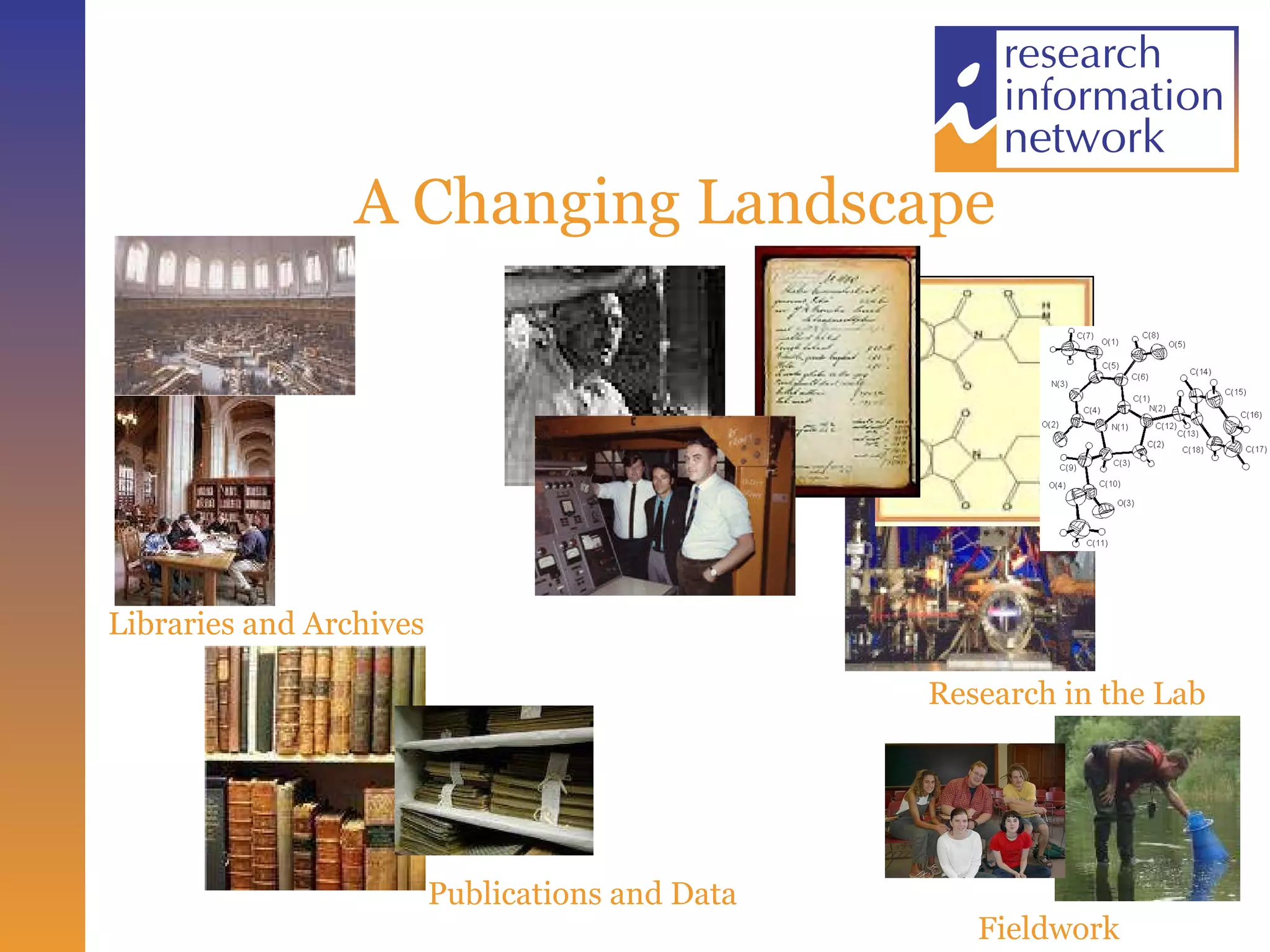
A Changing Landscape Research in the Lab Libraries and Archives Publications and Data Fieldwork
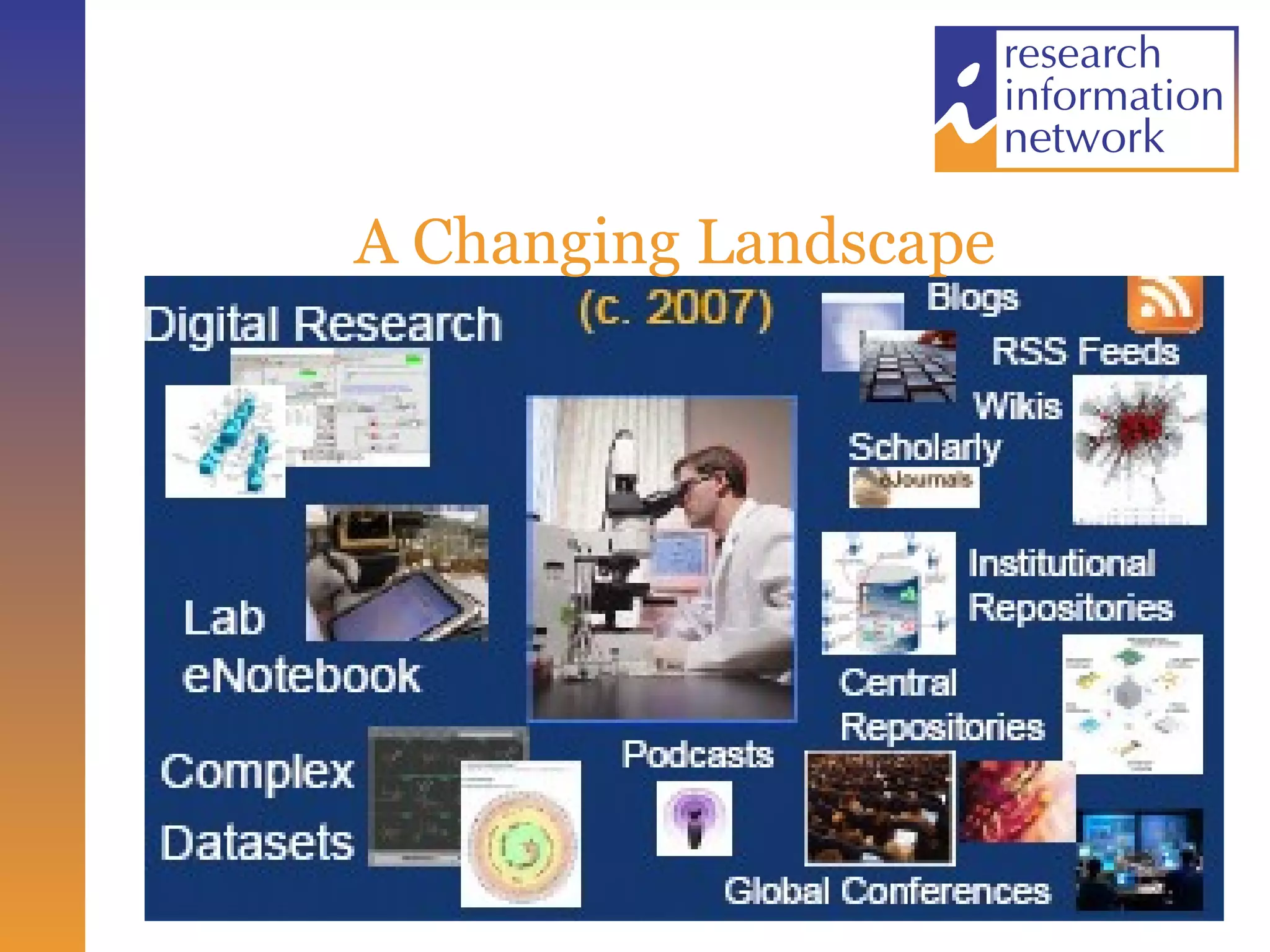
A Changing Landscape
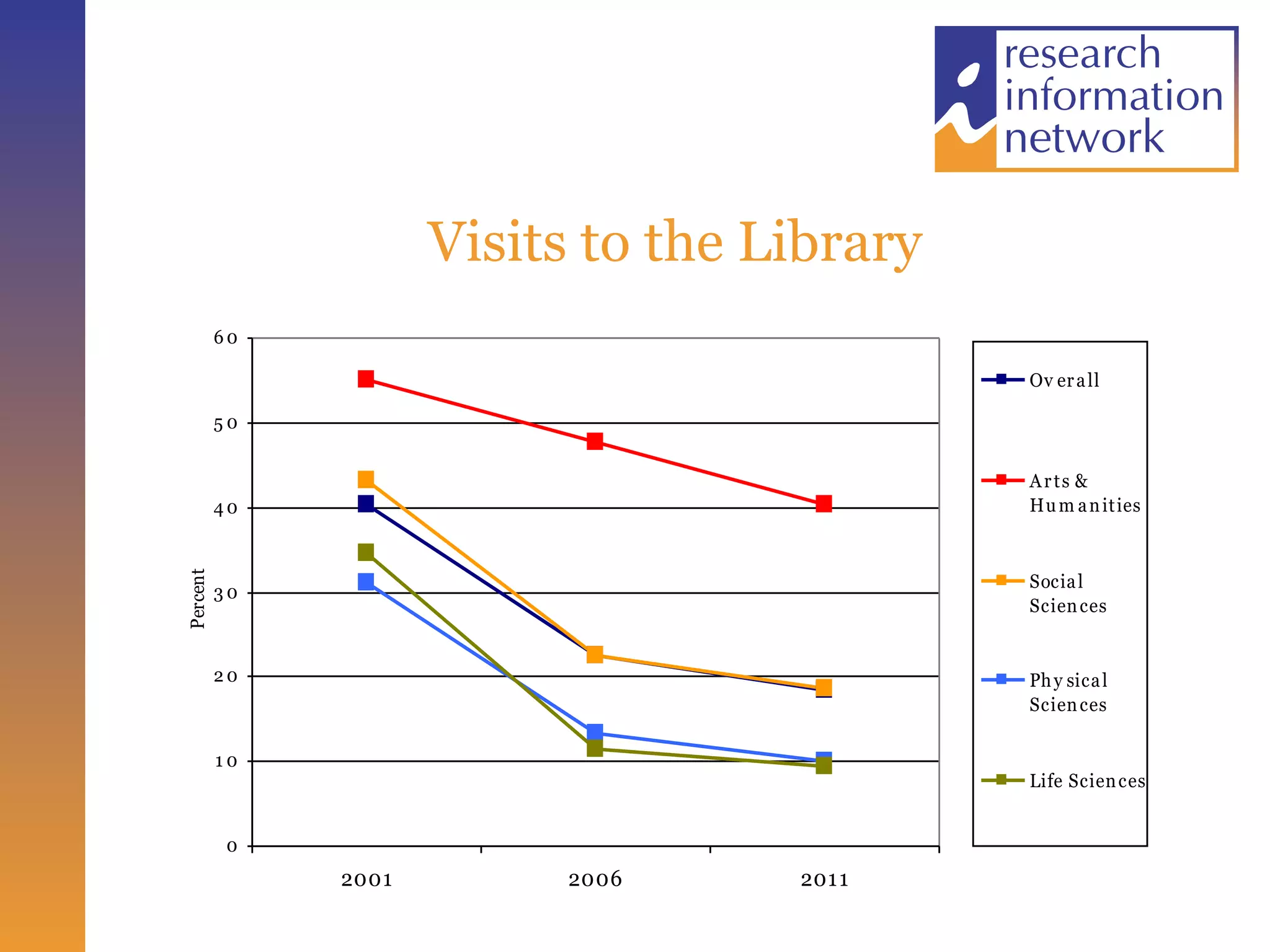
Visits to the Library
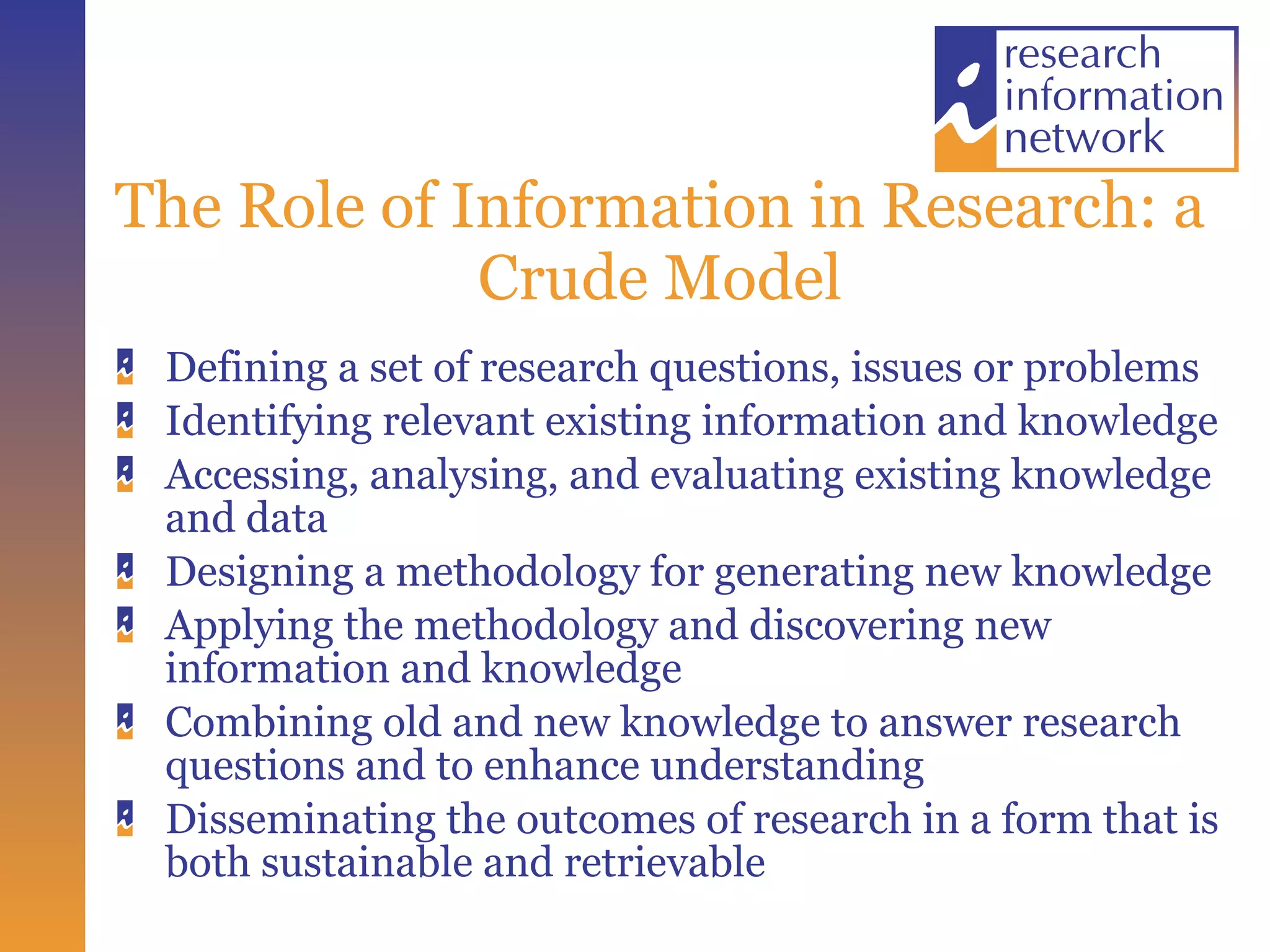
The Role of Information in Research: a Crude Model Defining a set of research questions, issues or problems Identifying relevant existing information and knowledge Accessing, analysing, and evaluating existing knowledge and data Designing a methodology for generating new knowledge Applying the methodology and discovering new information and knowledge Combining old and new knowledge to answer research questions and to enhance understanding Disseminating the outcomes of research in a form that is both sustainable and retrievable
Researchers as Users of Information
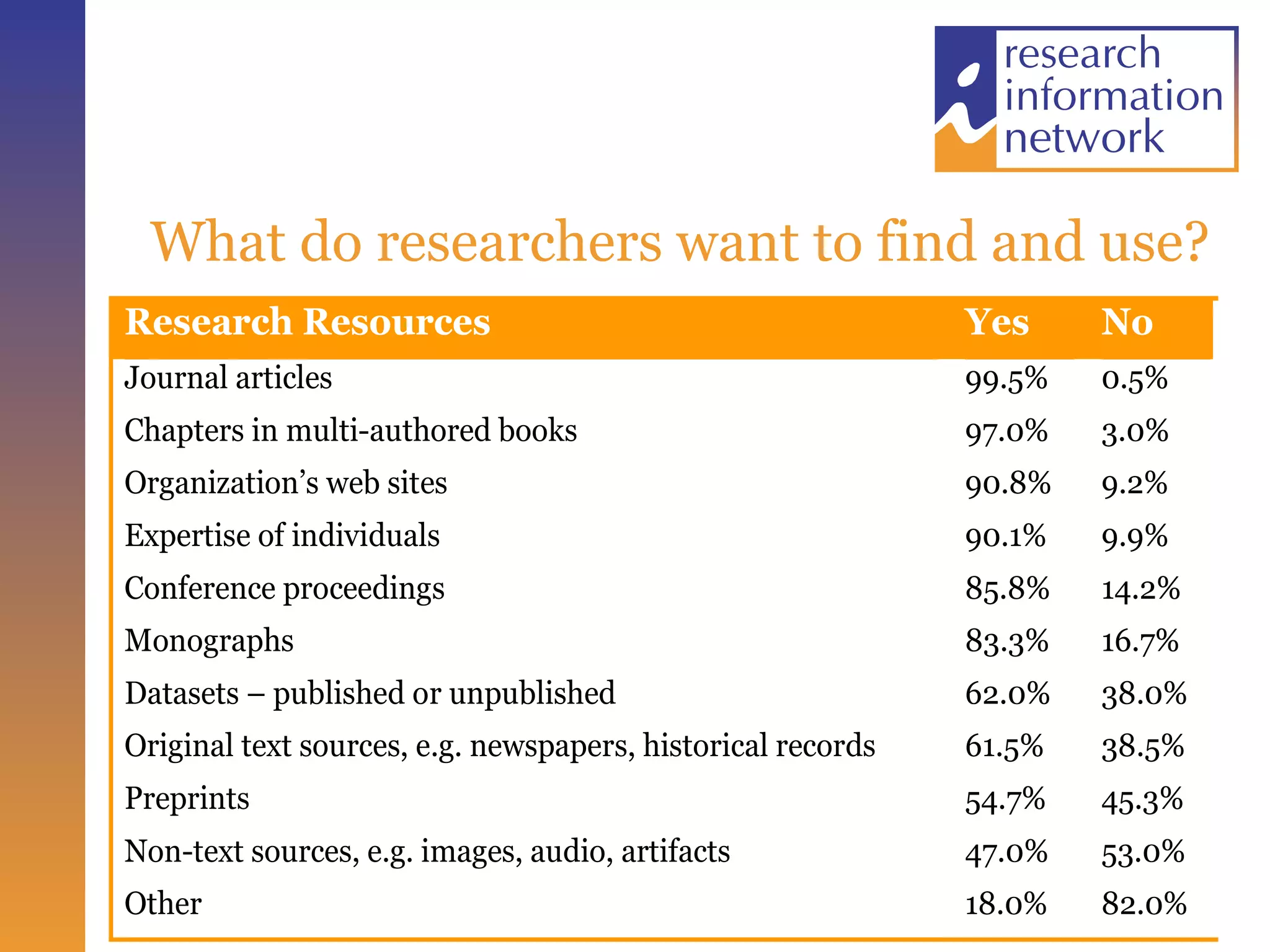
What do researchers want to find and use?
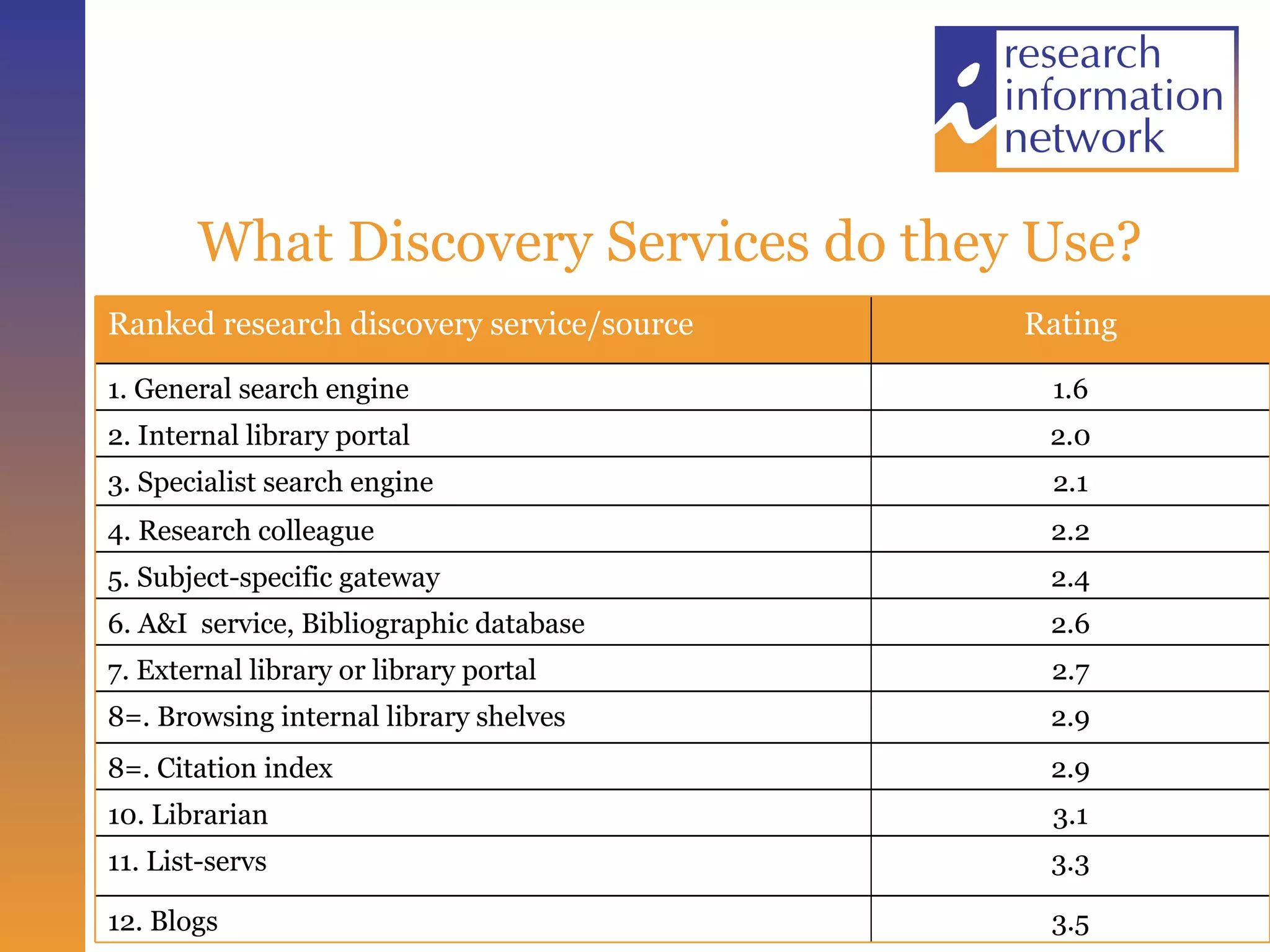
What Discovery Services do they Use? 3.5 12. Blogs 3.3 11. List-servs 3.1 10. Librarian 2.9 8=. Citation index 2.9 8=. Browsing internal library shelves 2.7 7. External library or library portal 2.6 6. A&I  service, Bibliographic database 2.4 5. Subject-specific gateway 2.2 4. Research colleague 2.1 3. Specialist search engine 2.0 2. Internal library portal 1.6 1. General search engine Rating Ranked research discovery service/source
 
 
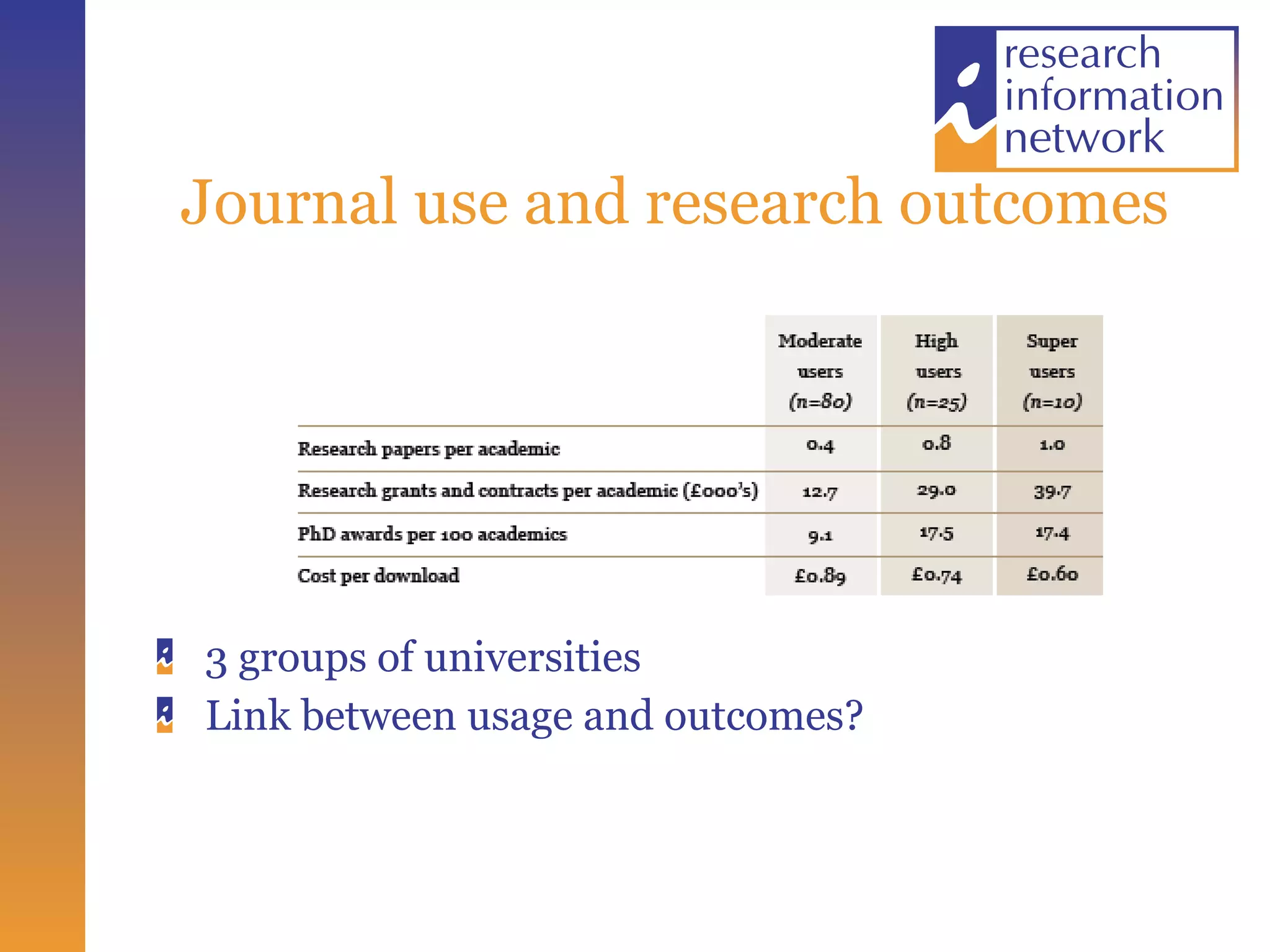
Journal use and research outcomes 3 groups of universities Link between usage and outcomes?
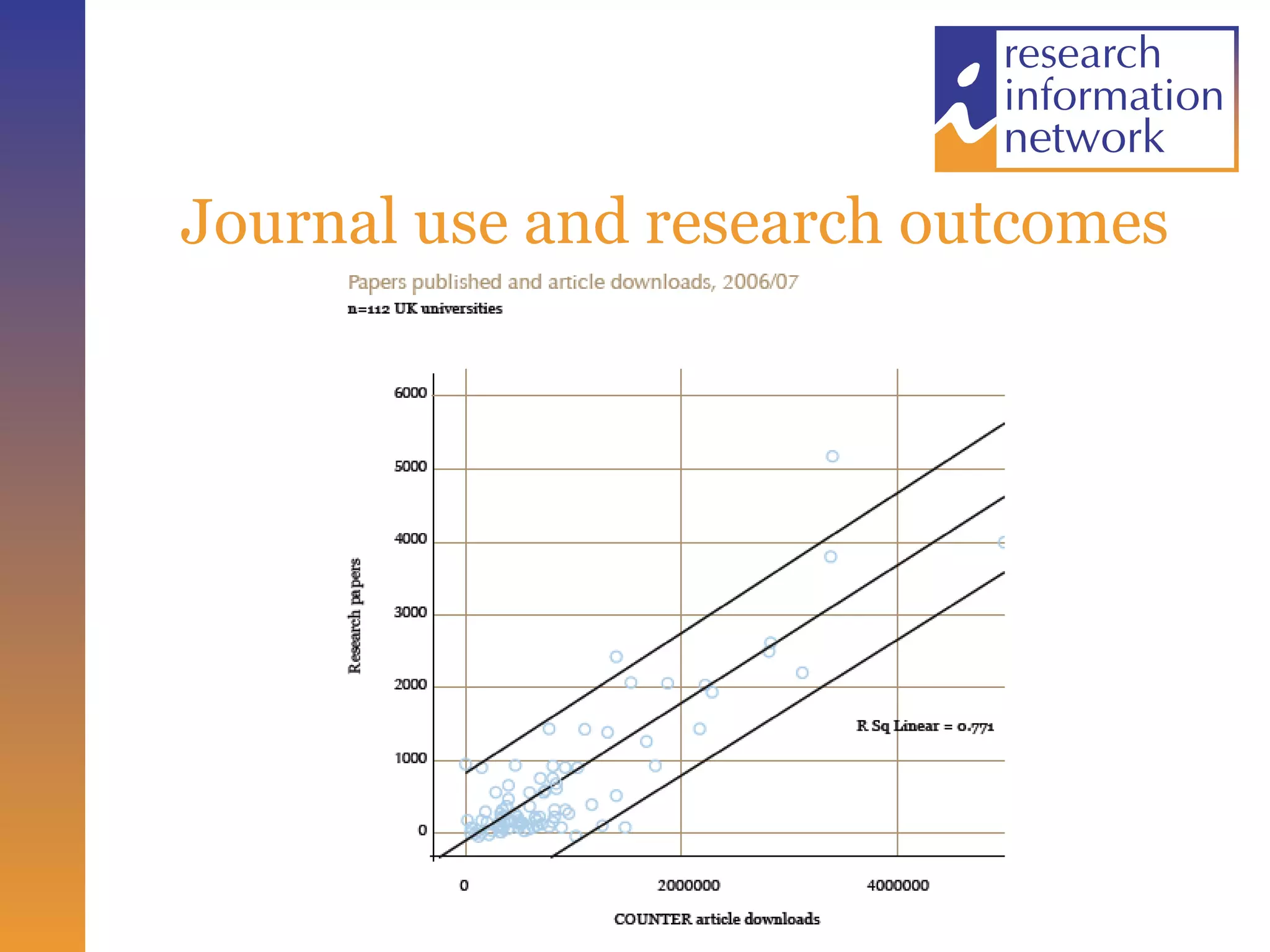
Journal use and research outcomes
Researchers as Creators and Communicators
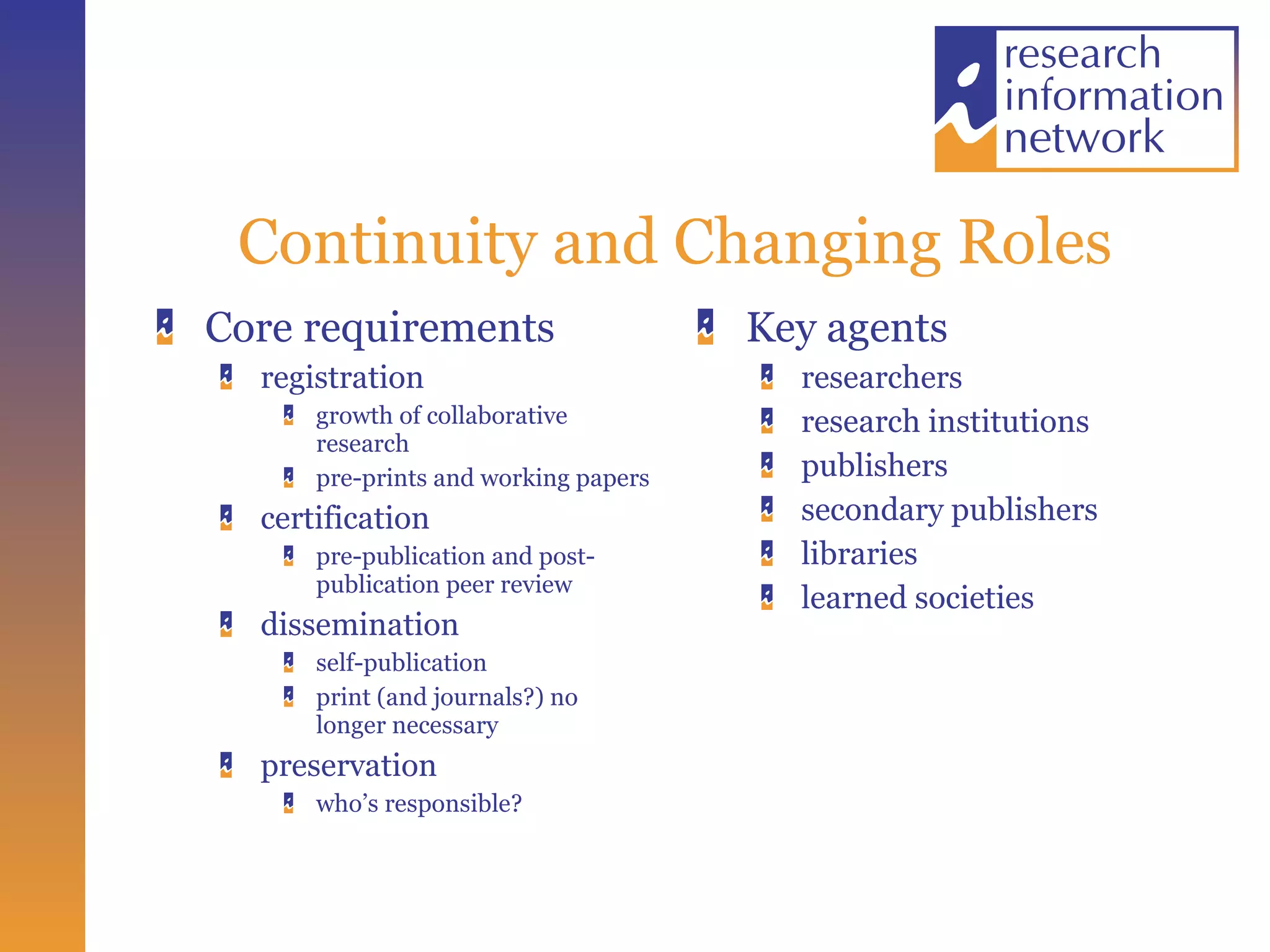
Continuity and Changing Roles Core requirements registration growth of collaborative research pre-prints and working papers certification pre-publication and post-publication peer review dissemination  self-publication print (and journals?) no longer necessary preservation  who’s responsible? Key agents researchers research institutions publishers secondary publishers libraries learned societies
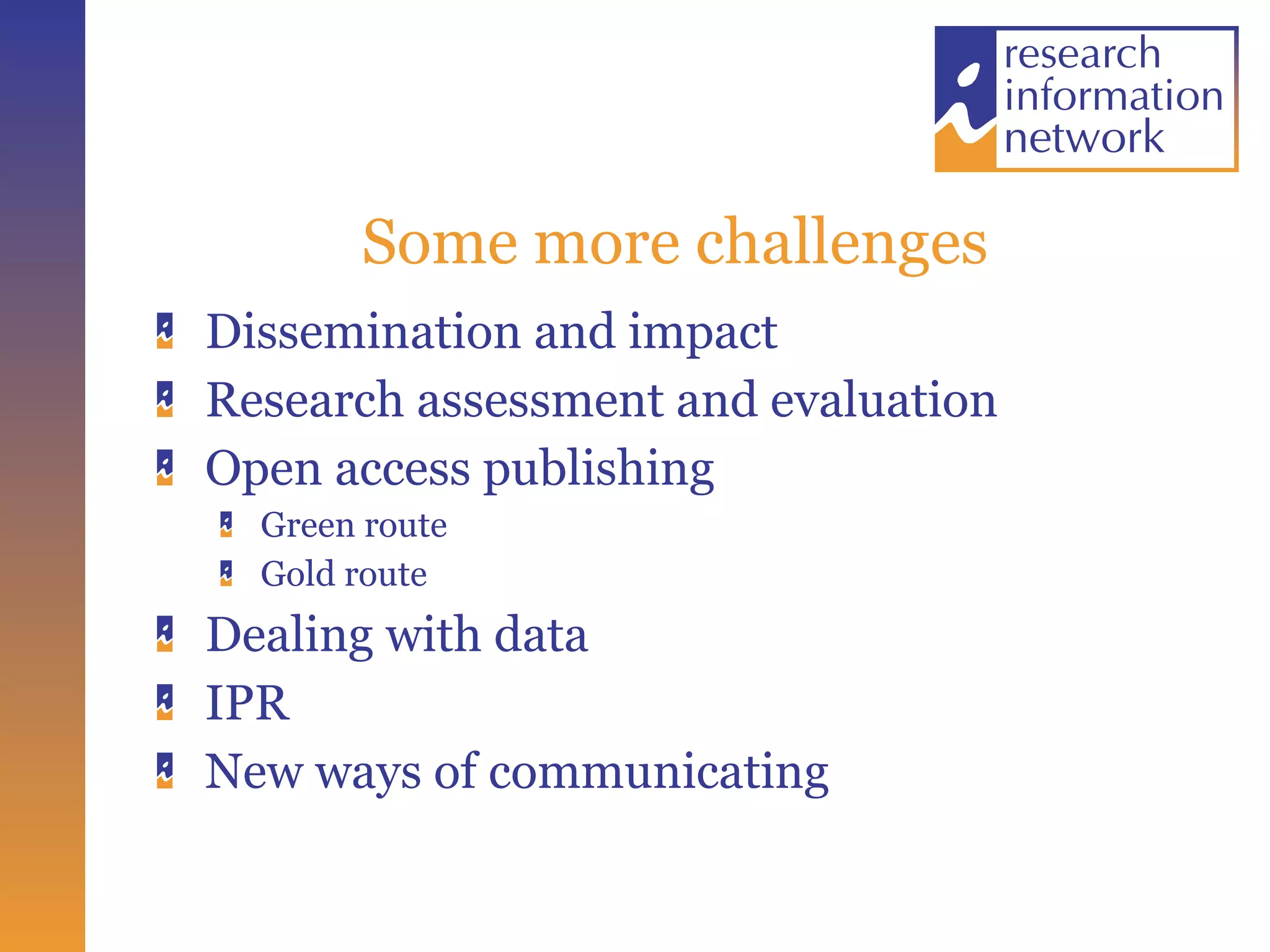
Some more challenges Dissemination and impact Research assessment and evaluation Open access publishing Green route Gold route Dealing with data IPR New ways of communicating
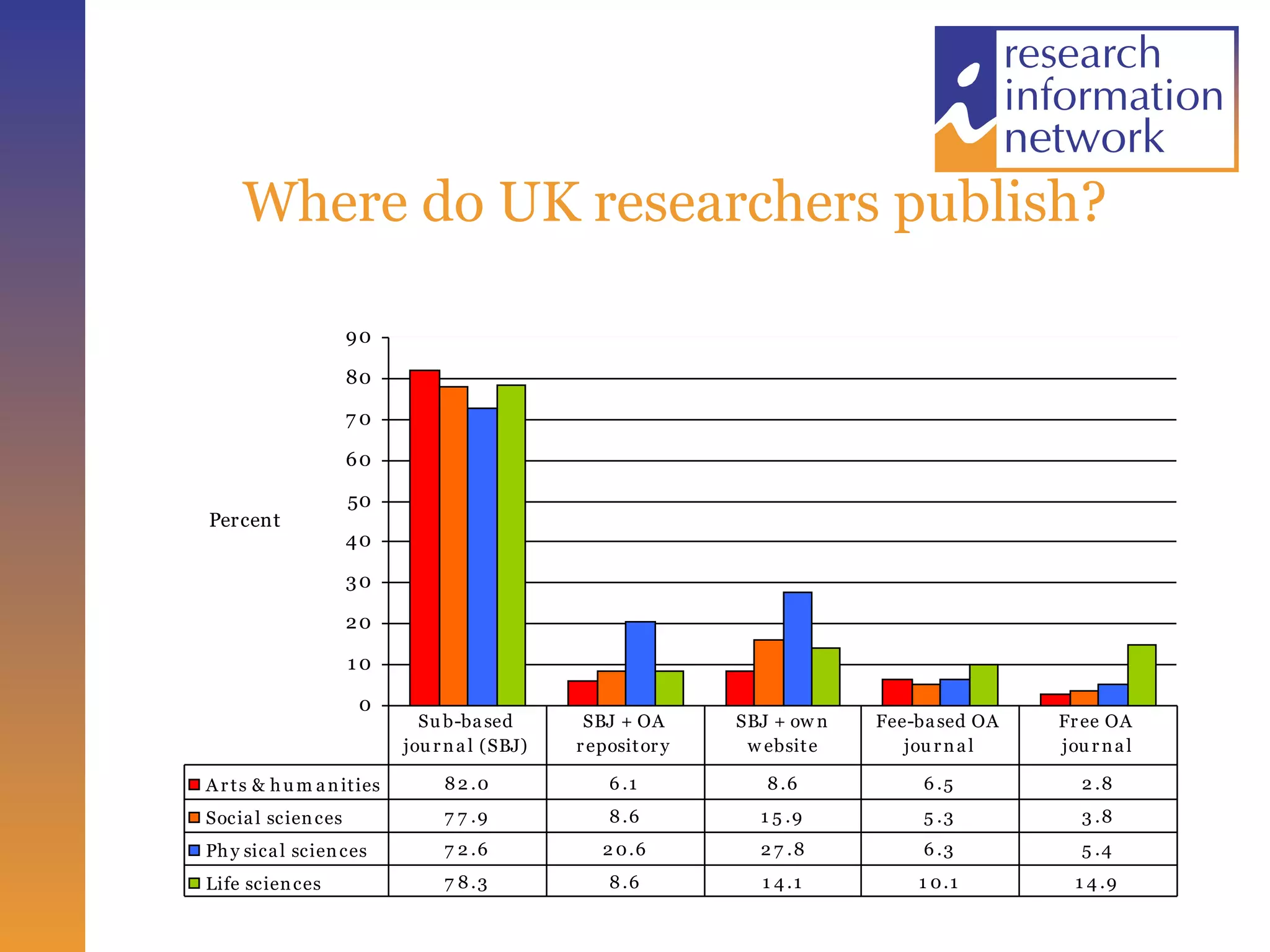
Where do UK researchers publish?
Key issues Skills Services Content Who provides what and how?  Is that provision sustainable?  What are researchers’ needs?  How can they best be met?
Any questions? Michael Jubb www.rin.ac.uk

SciTech Conference

  • 1.
    Library- What Library? Information Services for Researchers Michael Jubb Research Information Network Sci Tech Conference Masterclass London, 30 April 2009
  • 2.
  • 3.
    A Changing LandscapeResearch in the Lab Libraries and Archives Publications and Data Fieldwork
  • 4.
  • 5.
  • 6.
    The Role ofInformation in Research: a Crude Model Defining a set of research questions, issues or problems Identifying relevant existing information and knowledge Accessing, analysing, and evaluating existing knowledge and data Designing a methodology for generating new knowledge Applying the methodology and discovering new information and knowledge Combining old and new knowledge to answer research questions and to enhance understanding Disseminating the outcomes of research in a form that is both sustainable and retrievable
  • 7.
    Researchers as Usersof Information
  • 8.
    What do researcherswant to find and use?
  • 9.
    What Discovery Servicesdo they Use? 3.5 12. Blogs 3.3 11. List-servs 3.1 10. Librarian 2.9 8=. Citation index 2.9 8=. Browsing internal library shelves 2.7 7. External library or library portal 2.6 6. A&I service, Bibliographic database 2.4 5. Subject-specific gateway 2.2 4. Research colleague 2.1 3. Specialist search engine 2.0 2. Internal library portal 1.6 1. General search engine Rating Ranked research discovery service/source
  • 10.
  • 11.
  • 12.
    Journal use andresearch outcomes 3 groups of universities Link between usage and outcomes?
  • 13.
    Journal use andresearch outcomes
  • 14.
    Researchers as Creatorsand Communicators
  • 15.
    Continuity and ChangingRoles Core requirements registration growth of collaborative research pre-prints and working papers certification pre-publication and post-publication peer review dissemination self-publication print (and journals?) no longer necessary preservation who’s responsible? Key agents researchers research institutions publishers secondary publishers libraries learned societies
  • 16.
    Some more challengesDissemination and impact Research assessment and evaluation Open access publishing Green route Gold route Dealing with data IPR New ways of communicating
  • 17.
    Where do UKresearchers publish?
  • 18.
    Key issues SkillsServices Content Who provides what and how? Is that provision sustainable? What are researchers’ needs? How can they best be met?
  • 19.
    Any questions? MichaelJubb www.rin.ac.uk

Editor's Notes

  • #7 This an elaboration of the AHRC’s definition of the research process, based around the defining of research questions, the specification of a research context (why are these qns important and how do they relate to what we already know or understand), the specifying of research methods, and the generation of research outputs So access to and dissemination of information are the lifeblood of the research process; and fundamental to the reasons why research is funded as a public good. And researchers are both producers and users of information; but they are on the whole little interested in exploiting IP in their own work; and worried about the consequences of others (from outside the research community) seeking to exploit their IP Aside 1 : there are tensions in public policy between the support of research as a public good, and many of the measures used by Govt of the success of the UK research base, which tend to focus on things such as patenting, licensing, spin-out companies etc. But some signs of increasing interest in knowledge transfer as distinct from exploitation Aside 2: there are issues about the definition (lack of) of research in copyright law, and the distinction in particular between commercial and non-commercial research. Not wholly in agreement with BA report here, since it seems to me that there is no real distinction in the doing of the research itself; rather, it is how the results of the research are exploited once the research has been done (focus on the post-hoc activity rather than the intention of the researcher in starting off the research)