GCD and the
Euclidian Algorithm
CSE 311 Fall 2020
Lecture 13
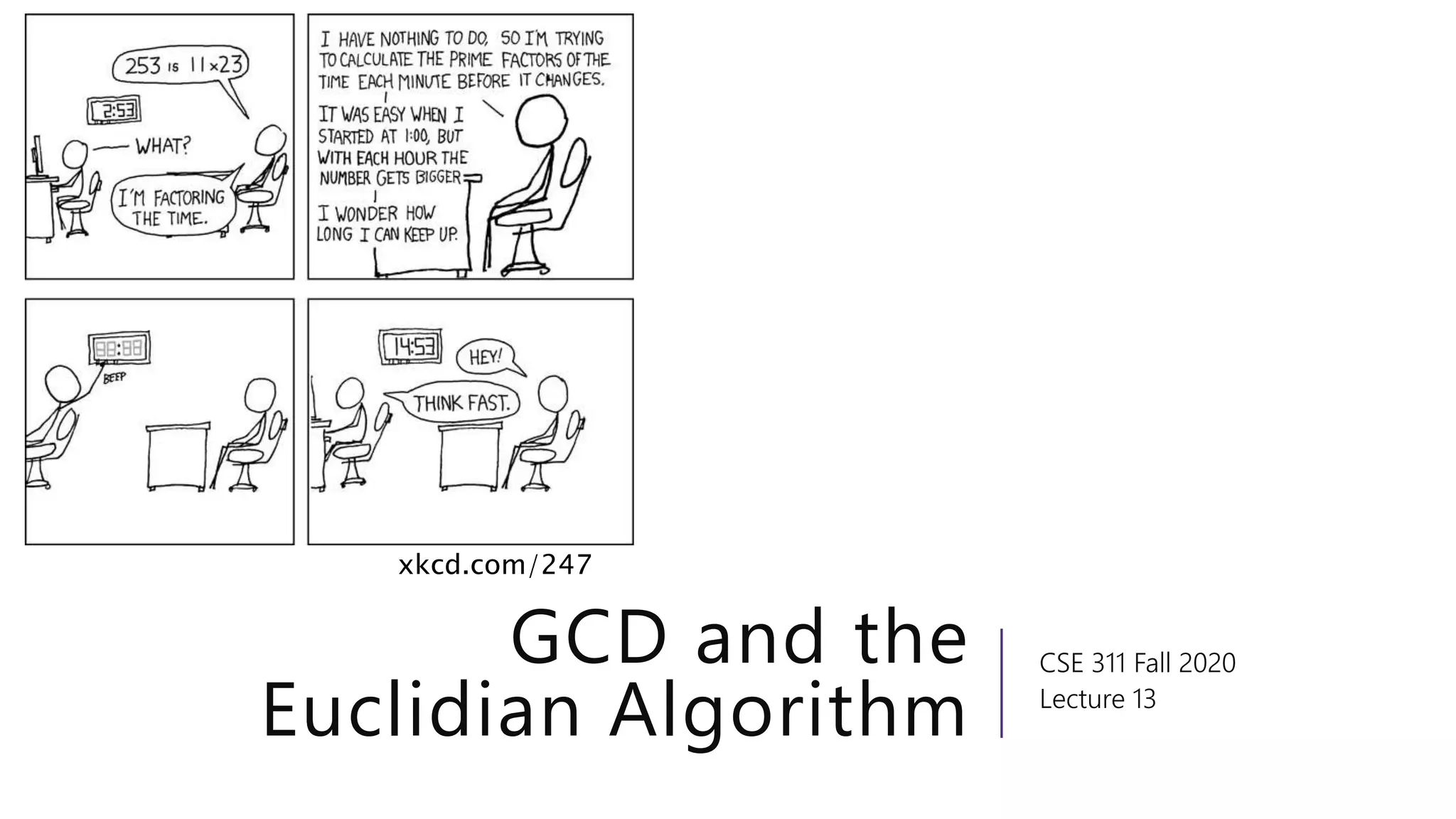
xkcd.com/247
Extra Set Practice
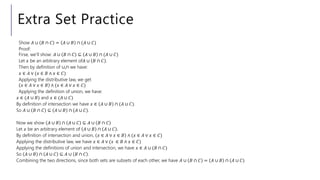
Show 𝐴 ∪ 𝐵 ∩ 𝐶 = 𝐴 ∪ 𝐵 ∩ (𝐴 ∪ 𝐶)
Proof:
Firse, we’ll show: 𝐴 ∪ 𝐵 ∩ 𝐶 ⊆ 𝐴 ∪ 𝐵 ∩ (𝐴 ∪ 𝐶)
Let 𝑥 be an arbitrary element of𝐴 ∪ 𝐵 ∩ 𝐶 .
Then by definition of ∪,∩ we have:
𝑥 ∈ 𝐴 ∨ (𝑥 ∈ 𝐵 ∧ 𝑥 ∈ 𝐶)
Applying the distributive law, we get
𝑥 ∈ 𝐴 ∨ 𝑥 ∈ 𝐵 ∧ (𝑥 ∈ 𝐴 ∨ 𝑥 ∈ 𝐶)
Applying the definition of union, we have:
𝑥 ∈ (𝐴 ∪ 𝐵) and 𝑥 ∈ (𝐴 ∪ 𝐶)
By definition of intersection we have 𝑥 ∈ 𝐴 ∪ 𝐵 ∩ (𝐴 ∪ 𝐶).
So 𝐴 ∪ 𝐵 ∩ 𝐶 ⊆ 𝐴 ∪ 𝐵 ∩ (𝐴 ∪ 𝐶).
Now we show 𝐴 ∪ 𝐵 ∩ 𝐴 ∪ 𝐶 ⊆ 𝐴 ∪ 𝐵 ∩ 𝐶
Let 𝑥 be an arbitrary element of 𝐴 ∪ 𝐵 ∩ 𝐴 ∪ 𝐶 .
By definition of intersection and union, 𝑥 ∈ 𝐴 ∨ 𝑥 ∈ 𝐵 ∧ (𝑥 ∈ 𝐴 ∨ 𝑥 ∈ 𝐶)
Applying the distributive law, we have 𝑥 ∈ 𝐴 ∨ (𝑥 ∈ 𝐵 ∧ 𝑥 ∈ 𝐶)
Applying the definitions of union and intersection, we have 𝑥 ∈ 𝐴 ∪ (𝐵 ∩ 𝐶)
So 𝐴 ∪ 𝐵 ∩ 𝐴 ∪ 𝐶 ⊆ 𝐴 ∪ 𝐵 ∩ 𝐶 .
Combining the two directions, since both sets are subsets of each other, we have 𝐴 ∪ 𝐵 ∩ 𝐶 = 𝐴 ∪ 𝐵 ∩ (𝐴 ∪ 𝐶)
Extra Set Practice
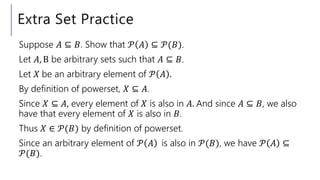
Suppose 𝐴 ⊆ 𝐵. Show that 𝒫 𝐴 ⊆ 𝒫(𝐵).
Let 𝐴, B be arbitrary sets such that 𝐴 ⊆ 𝐵.
Let 𝑋 be an arbitrary element of 𝒫 𝐴 .
By definition of powerset, 𝑋 ⊆ 𝐴.
Since 𝑋 ⊆ 𝐴, every element of 𝑋 is also in 𝐴. And since 𝐴 ⊆ 𝐵, we also
have that every element of 𝑋 is also in 𝐵.
Thus 𝑋 ∈ 𝒫(𝐵) by definition of powerset.
Since an arbitrary element of 𝒫 𝐴 is also in 𝒫(𝐵), we have 𝒫 𝐴 ⊆
𝒫(𝐵).
Extra Set Practice
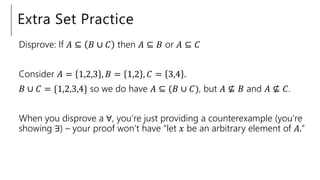
Disprove: If 𝐴 ⊆ 𝐵 ∪ 𝐶 then 𝐴 ⊆ 𝐵 or 𝐴 ⊆ 𝐶
Consider 𝐴 = 1,2,3 , 𝐵 = 1,2 , 𝐶 = 3,4 .
𝐵 ∪ 𝐶 = {1,2,3,4} so we do have 𝐴 ⊆ (𝐵 ∪ 𝐶), but 𝐴 ⊈ 𝐵 and 𝐴 ⊈ 𝐶.
When you disprove a ∀, you’re just providing a counterexample (you’re
showing ∃) – your proof won’t have “let 𝑥 be an arbitrary element of 𝐴.”
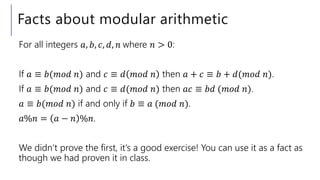
Facts about modular arithmetic
For all integers 𝑎, 𝑏, 𝑐, 𝑑, 𝑛 where 𝑛 > 0:
If 𝑎 ≡ 𝑏(𝑚𝑜𝑑 𝑛) and 𝑐 ≡ 𝑑 𝑚𝑜𝑑 𝑛 then 𝑎 + 𝑐 ≡ 𝑏 + 𝑑(𝑚𝑜𝑑 𝑛).
If 𝑎 ≡ 𝑏(𝑚𝑜𝑑 𝑛) and 𝑐 ≡ 𝑑(𝑚𝑜𝑑 𝑛) then 𝑎𝑐 ≡ 𝑏𝑑 (𝑚𝑜𝑑 𝑛).
𝑎 ≡ 𝑏(𝑚𝑜𝑑 𝑛) if and only if 𝑏 ≡ 𝑎 (𝑚𝑜𝑑 𝑛).
𝑎%𝑛 = 𝑎 − 𝑛 %𝑛.
We didn’t prove the first, it’s a good exercise! You can use it as a fact as
though we had proven it in class.
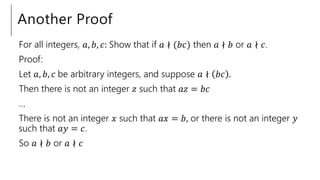
Another Proof
For all integers, 𝑎, 𝑏, 𝑐: Show that if 𝑎 ∤ (𝑏𝑐) then 𝑎 ∤ 𝑏 or 𝑎 ∤ 𝑐.
Proof:
Let 𝑎, 𝑏, 𝑐 be arbitrary integers, and suppose 𝑎 ∤ 𝑏𝑐 .
Then there is not an integer 𝑧 such that 𝑎𝑧 = 𝑏𝑐
…
There is not an integer 𝑥 such that 𝑎𝑥 = 𝑏, or there is not an integer 𝑦
such that 𝑎𝑦 = 𝑐.
So 𝑎 ∤ 𝑏 or 𝑎 ∤ 𝑐
Another Proof
For all integers, 𝑎, 𝑏, 𝑐: Show that if 𝑎 ∤ (𝑏𝑐) then 𝑎 ∤ 𝑏 or 𝑎 ∤ 𝑐.
Proof:
Let 𝑎, 𝑏, 𝑐 be arbitrary integers, and suppose 𝑎 ∤ 𝑏𝑐 .
Then there is not an integer 𝑧 such that 𝑎𝑧 = 𝑏𝑐
…
So 𝑎 ∤ 𝑏 or 𝑎 ∤ 𝑐
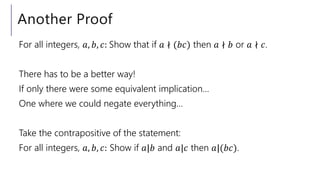
Another Proof
For all integers, 𝑎, 𝑏, 𝑐: Show that if 𝑎 ∤ (𝑏𝑐) then 𝑎 ∤ 𝑏 or 𝑎 ∤ 𝑐.
There has to be a better way!
If only there were some equivalent implication…
One where we could negate everything…
Take the contrapositive of the statement:
For all integers, 𝑎, 𝑏, 𝑐: Show if 𝑎|𝑏 and 𝑎|𝑐 then 𝑎|(𝑏𝑐).
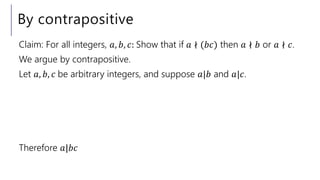
By contrapositive
Claim: For all integers, 𝑎, 𝑏, 𝑐: Show that if 𝑎 ∤ (𝑏𝑐) then 𝑎 ∤ 𝑏 or 𝑎 ∤ 𝑐.
We argue by contrapositive.
Let 𝑎, 𝑏, 𝑐 be arbitrary integers, and suppose 𝑎|𝑏 and 𝑎|𝑐.
Therefore 𝑎|𝑏𝑐
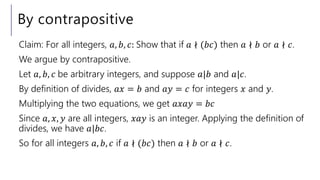
By contrapositive
Claim: For all integers, 𝑎, 𝑏, 𝑐: Show that if 𝑎 ∤ (𝑏𝑐) then 𝑎 ∤ 𝑏 or 𝑎 ∤ 𝑐.
We argue by contrapositive.
Let 𝑎, 𝑏, 𝑐 be arbitrary integers, and suppose 𝑎|𝑏 and 𝑎|𝑐.
By definition of divides, 𝑎𝑥 = 𝑏 and 𝑎𝑦 = 𝑐 for integers 𝑥 and 𝑦.
Multiplying the two equations, we get 𝑎𝑥𝑎𝑦 = 𝑏𝑐
Since 𝑎, 𝑥, 𝑦 are all integers, 𝑥𝑎𝑦 is an integer. Applying the definition of
divides, we have 𝑎|𝑏𝑐.
So for all integers 𝑎, 𝑏, 𝑐 if 𝑎 ∤ (𝑏𝑐) then 𝑎 ∤ 𝑏 or 𝑎 ∤ 𝑐.
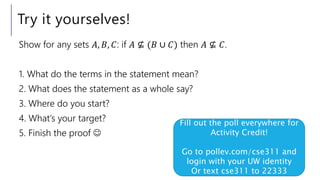
Try it yourselves!
Show for any sets 𝐴, 𝐵, 𝐶: if 𝐴 ⊈ (𝐵 ∪ 𝐶) then 𝐴 ⊈ 𝐶.
1. What do the terms in the statement mean?
2. What does the statement as a whole say?
3. Where do you start?
4. What’s your target?
5. Finish the proof 
Fill out the poll everywhere for
Activity Credit!
Go to pollev.com/cse311 and
login with your UW identity
Or text cse311 to 22333
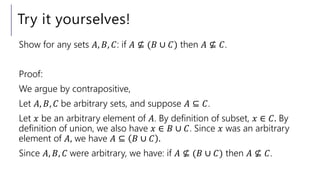
Try it yourselves!
Show for any sets 𝐴, 𝐵, 𝐶: if 𝐴 ⊈ (𝐵 ∪ 𝐶) then 𝐴 ⊈ 𝐶.
Proof:
We argue by contrapositive,
Let 𝐴, 𝐵, 𝐶 be arbitrary sets, and suppose 𝐴 ⊆ 𝐶.
Let 𝑥 be an arbitrary element of 𝐴. By definition of subset, 𝑥 ∈ 𝐶. By
definition of union, we also have 𝑥 ∈ 𝐵 ∪ 𝐶. Since 𝑥 was an arbitrary
element of 𝐴, we have 𝐴 ⊆ 𝐵 ∪ 𝐶 .
Since 𝐴, 𝐵, 𝐶 were arbitrary, we have: if 𝐴 ⊈ (𝐵 ∪ 𝐶) then 𝐴 ⊈ 𝐶.
Divisors and Primes
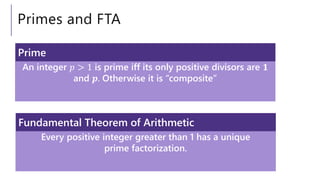
Primes and FTA
An integer 𝑝 > 1 is prime iff its only positive divisors are 𝟏
and 𝒑. Otherwise it is “composite”
Prime
Every positive integer greater than 1 has a unique
prime factorization.
Fundamental Theorem of Arithmetic
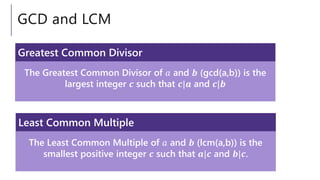
GCD and LCM
The Greatest Common Divisor of 𝑎 and 𝒃 (gcd(a,b)) is the
largest integer 𝒄 such that 𝒄|𝒂 and 𝒄|𝒃
Greatest Common Divisor
The Least Common Multiple of 𝑎 and 𝒃 (lcm(a,b)) is the
smallest positive integer 𝒄 such that 𝒂|𝒄 and 𝒃|𝒄.
Least Common Multiple
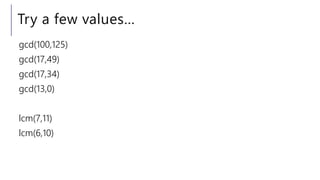
Try a few values…
gcd(100,125)
gcd(17,49)
gcd(17,34)
gcd(13,0)
lcm(7,11)
lcm(6,10)
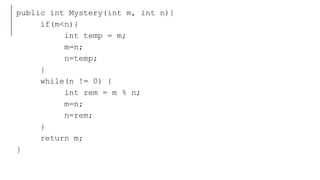
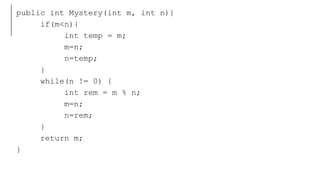
public int Mystery(int m, int n){
if(m<n){
int temp = m;
m=n;
n=temp;
}
while(n != 0) {
int rem = m % n;
m=n;
n=rem;
}
return m;
}
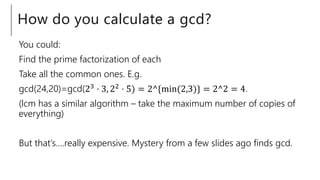
How do you calculate a gcd?
You could:
Find the prime factorization of each
Take all the common ones. E.g.
gcd(24,20)=gcd(23
⋅ 3, 22
⋅ 5) = 2^{min(2,3)} = 2^2 = 4.
(lcm has a similar algorithm – take the maximum number of copies of
everything)
But that’s….really expensive. Mystery from a few slides ago finds gcd.
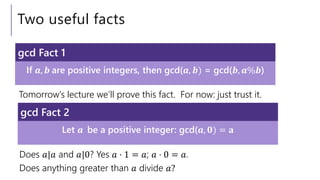
Two useful facts
Tomorrow’s lecture we’ll prove this fact. For now: just trust it.
If 𝒂, 𝒃 are positive integers, then gcd(𝒂, 𝒃) = gcd(𝒃, 𝒂%𝒃)
gcd Fact 1
Let 𝒂 be a positive integer: gcd(𝒂, 𝟎) = 𝐚
gcd Fact 2
Does 𝑎|𝑎 and 𝑎|0? Yes 𝑎 ⋅ 1 = 𝑎; 𝑎 ⋅ 0 = 𝑎.
Does anything greater than 𝑎 divide 𝑎?
public int Mystery(int m, int n){
if(m<n){
int temp = m;
m=n;
n=temp;
}
while(n != 0) {
int rem = m % n;
m=n;
n=rem;
}
return m;
}
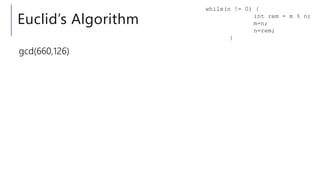
Euclid’s Algorithm
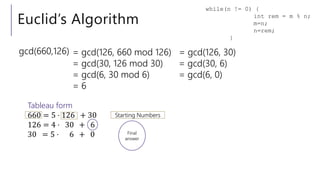
gcd(660,126)
while(n != 0) {
int rem = m % n;
m=n;
n=rem;
}
Euclid’s Algorithm
gcd(660,126)
while(n != 0) {
int rem = m % n;
m=n;
n=rem;
}
= gcd(126, 660 mod 126) = gcd(126, 30)
= gcd(30, 126 mod 30) = gcd(30, 6)
= gcd(6, 30 mod 6) = gcd(6, 0)
= 6
Tableau form
660 = 5 ⋅ 126 + 30
126 = 4 ⋅ 30 + 6
30 = 5 ⋅ 6 + 0
Starting Numbers
Final
answer
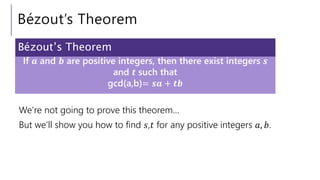
Bézout’s Theorem
We’re not going to prove this theorem…
But we’ll show you how to find 𝑠,𝑡 for any positive integers 𝑎, 𝑏.
If 𝒂 and 𝒃 are positive integers, then there exist integers 𝒔
and 𝒕 such that
gcd(a,b)= 𝒔𝒂 + 𝒕𝒃
Bézout’s Theorem
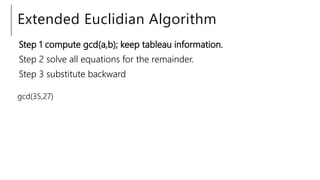
Extended Euclidian Algorithm
Step 1 compute gcd(a,b); keep tableau information.
Step 2 solve all equations for the remainder.
Step 3 substitute backward
gcd(35,27)
Extended Euclidian Algorithm
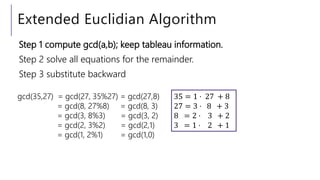
Step 1 compute gcd(a,b); keep tableau information.
Step 2 solve all equations for the remainder.
Step 3 substitute backward
gcd(35,27) = gcd(27, 35%27) = gcd(27,8)
= gcd(8, 27%8) = gcd(8, 3)
= gcd(3, 8%3) = gcd(3, 2)
= gcd(2, 3%2) = gcd(2,1)
= gcd(1, 2%1) = gcd(1,0)
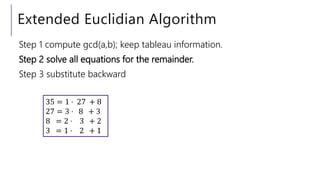
35 = 1 ⋅ 27 + 8
27 = 3 ⋅ 8 + 3
8 = 2 ⋅ 3 + 2
3 = 1 ⋅ 2 + 1
Extended Euclidian Algorithm
Step 1 compute gcd(a,b); keep tableau information.
Step 2 solve all equations for the remainder.
Step 3 substitute backward
35 = 1 ⋅ 27 + 8
27 = 3 ⋅ 8 + 3
8 = 2 ⋅ 3 + 2
3 = 1 ⋅ 2 + 1
Extended Euclidian Algorithm
Step 1 compute gcd(a,b); keep tableau information.
Step 2 solve all equations for the remainder.
Step 3 substitute backward
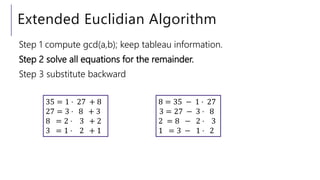
35 = 1 ⋅ 27 + 8
27 = 3 ⋅ 8 + 3
8 = 2 ⋅ 3 + 2
3 = 1 ⋅ 2 + 1
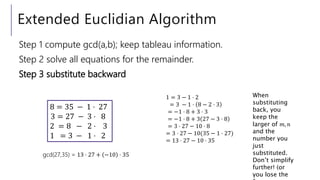
8 = 35 − 1 ⋅ 27
3 = 27 − 3 ⋅ 8
2 = 8 − 2 ⋅ 3
1 = 3 − 1 ⋅ 2
Extended Euclidian Algorithm
Step 1 compute gcd(a,b); keep tableau information.
Step 2 solve all equations for the remainder.
Step 3 substitute backward
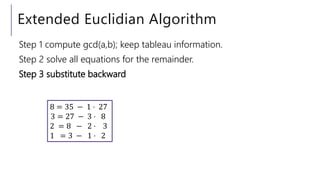
8 = 35 − 1 ⋅ 27
3 = 27 − 3 ⋅ 8
2 = 8 − 2 ⋅ 3
1 = 3 − 1 ⋅ 2
Extended Euclidian Algorithm
Step 1 compute gcd(a,b); keep tableau information.
Step 2 solve all equations for the remainder.
Step 3 substitute backward
8 = 35 − 1 ⋅ 27
3 = 27 − 3 ⋅ 8
2 = 8 − 2 ⋅ 3
1 = 3 − 1 ⋅ 2
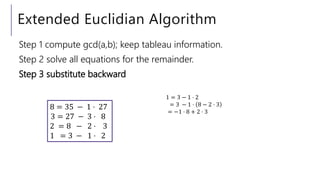
1 = 3 − 1 ⋅ 2
= 3 − 1 ⋅ 8 − 2 ⋅ 3
= −1 ⋅ 8 + 2 ⋅ 3
Extended Euclidian Algorithm
Step 1 compute gcd(a,b); keep tableau information.
Step 2 solve all equations for the remainder.
Step 3 substitute backward
8 = 35 − 1 ⋅ 27
3 = 27 − 3 ⋅ 8
2 = 8 − 2 ⋅ 3
1 = 3 − 1 ⋅ 2
1 = 3 − 1 ⋅ 2
= 3 − 1 ⋅ 8 − 2 ⋅ 3
= −1 ⋅ 8 + 3 ⋅ 3
= −1 ⋅ 8 + 3 27 − 3 ⋅ 8
= 3 ⋅ 27 − 10 ⋅ 8
= 3 ⋅ 27 − 10(35 − 1 ⋅ 27)
= 13 ⋅ 27 − 10 ⋅ 35
gcd(27,35) = 13 ⋅ 27 + −10 ⋅ 35
When
substituting
back, you
keep the
larger of 𝑚, 𝑛
and the
number you
just
substituted.
Don’t simplify
further! (or
you lose the
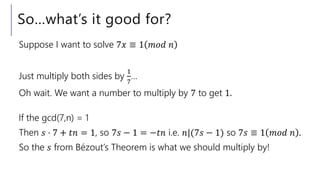
So…what’s it good for?
Suppose I want to solve 7𝑥 ≡ 1 𝑚𝑜𝑑 𝑛
Just multiply both sides by
1
7
…
Oh wait. We want a number to multiply by 7 to get 1.
If the gcd(7,n) = 1
Then 𝑠 ⋅ 7 + 𝑡𝑛 = 1, so 7𝑠 − 1 = −𝑡𝑛 i.e. 𝑛|(7𝑠 − 1) so 7𝑠 ≡ 1 𝑚𝑜𝑑 𝑛 .
So the 𝑠 from Bézout’s Theorem is what we should multiply by!
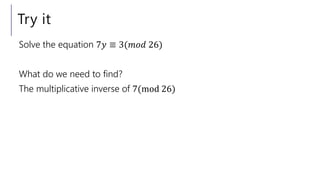
Try it
Solve the equation 7𝑦 ≡ 3(𝑚𝑜𝑑 26)
What do we need to find?
The multiplicative inverse of 7(mod 26)
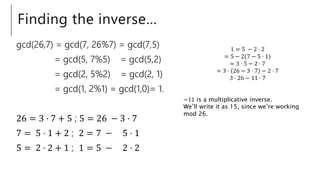
Finding the inverse…
gcd(26,7) = gcd(7, 26%7) = gcd(7,5)
= gcd(5, 7%5) = gcd(5,2)
= gcd(2, 5%2) = gcd(2, 1)
= gcd(1, 2%1) = gcd(1,0)= 1.
26 = 3 ⋅ 7 + 5 ; 5 = 26 − 3 ⋅ 7
7 = 5 ⋅ 1 + 2 ; 2 = 7 − 5 ⋅ 1
5 = 2 ⋅ 2 + 1 ; 1 = 5 − 2 ⋅ 2
1 = 5 − 2 ⋅ 2
= 5 − 2(7 − 5 ⋅ 1)
= 3 ⋅ 5 − 2 ⋅ 7
= 3 ⋅ 26 − 3 ⋅ 7 − 2 ⋅ 7
3 ⋅ 26 − 11 ⋅ 7
−11 is a multiplicative inverse.
We’ll write it as 15, since we’re working
mod 26.
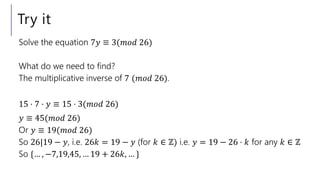
Try it
Solve the equation 7𝑦 ≡ 3(𝑚𝑜𝑑 26)
What do we need to find?
The multiplicative inverse of 7 (𝑚𝑜𝑑 26).
15 ⋅ 7 ⋅ 𝑦 ≡ 15 ⋅ 3(𝑚𝑜𝑑 26)
𝑦 ≡ 45(𝑚𝑜𝑑 26)
Or 𝑦 ≡ 19(𝑚𝑜𝑑 26)
So 26|19 − 𝑦, i.e. 26𝑘 = 19 − 𝑦 (for 𝑘 ∈ ℤ) i.e. 𝑦 = 19 − 26 ⋅ 𝑘 for any 𝑘 ∈ ℤ
So {… , −7,19,45, … 19 + 26𝑘, … }
And now, for some proofs!
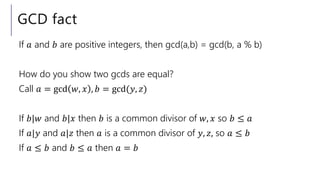
GCD fact
If 𝑎 and 𝑏 are positive integers, then gcd(a,b) = gcd(b, a % b)
How do you show two gcds are equal?
Call 𝑎 = gcd 𝑤, 𝑥 , 𝑏 = gcd(𝑦, 𝑧)
If 𝑏|𝑤 and 𝑏|𝑥 then 𝑏 is a common divisor of 𝑤, 𝑥 so 𝑏 ≤ 𝑎
If 𝑎|𝑦 and 𝑎|𝑧 then 𝑎 is a common divisor of 𝑦, 𝑧, so 𝑎 ≤ 𝑏
If 𝑎 ≤ 𝑏 and 𝑏 ≤ 𝑎 then 𝑎 = 𝑏
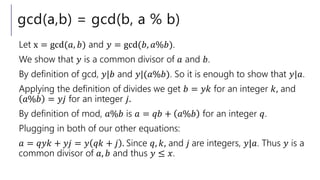
gcd(a,b) = gcd(b, a % b)
Let x = gcd(𝑎, 𝑏) and 𝑦 = gcd(𝑏, 𝑎%𝑏).
We show that 𝑦 is a common divisor of 𝑎 and 𝑏.
By definition of gcd, 𝑦|𝑏 and 𝑦|(𝑎%𝑏). So it is enough to show that 𝑦|𝑎.
Applying the definition of divides we get 𝑏 = 𝑦𝑘 for an integer 𝑘, and
𝑎%𝑏 = 𝑦𝑗 for an integer 𝑗.
By definition of mod, 𝑎%𝑏 is 𝑎 = 𝑞𝑏 + 𝑎%𝑏 for an integer 𝑞.
Plugging in both of our other equations:
𝑎 = 𝑞𝑦𝑘 + 𝑦𝑗 = 𝑦 𝑞𝑘 + 𝑗 . Since 𝑞, 𝑘, and 𝑗 are integers, 𝑦|𝑎. Thus 𝑦 is a
common divisor of 𝑎, 𝑏 and thus 𝑦 ≤ 𝑥.
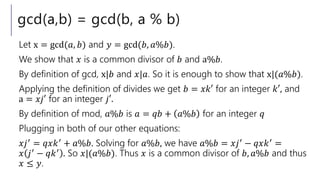
gcd(a,b) = gcd(b, a % b)
Let x = gcd(𝑎, 𝑏) and 𝑦 = gcd(𝑏, 𝑎%𝑏).
We show that 𝑥 is a common divisor of 𝑏 and a%𝑏.
By definition of gcd, x|𝑏 and 𝑥|𝑎. So it is enough to show that x|(𝑎%𝑏).
Applying the definition of divides we get 𝑏 = 𝑥𝑘′ for an integer 𝑘′, and
a = 𝑥𝑗′ for an integer 𝑗′.
By definition of mod, 𝑎%𝑏 is 𝑎 = 𝑞𝑏 + 𝑎%𝑏 for an integer 𝑞
Plugging in both of our other equations:
𝑥𝑗′ = 𝑞𝑥𝑘′ + 𝑎%𝑏. Solving for 𝑎%𝑏, we have 𝑎%𝑏 = 𝑥𝑗′ − 𝑞𝑥𝑘′ =
𝑥 𝑗′
− 𝑞𝑘′
. So 𝑥|(𝑎%𝑏). Thus 𝑥 is a common divisor of 𝑏, 𝑎%𝑏 and thus
𝑥 ≤ 𝑦.
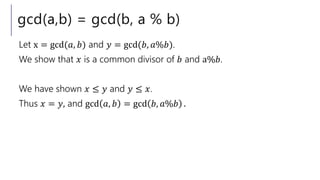
gcd(a,b) = gcd(b, a % b)
Let x = gcd(𝑎, 𝑏) and 𝑦 = gcd(𝑏, 𝑎%𝑏).
We show that 𝑥 is a common divisor of 𝑏 and a%𝑏.
We have shown 𝑥 ≤ 𝑦 and 𝑦 ≤ 𝑥.
Thus 𝑥 = 𝑦, and gcd 𝑎, 𝑏 = gcd 𝑏, 𝑎%𝑏 .

Aed.pptx

  • 1.
    GCD and the EuclidianAlgorithm CSE 311 Fall 2020 Lecture 13 xkcd.com/247
  • 2.
    Extra Set Practice Show𝐴 ∪ 𝐵 ∩ 𝐶 = 𝐴 ∪ 𝐵 ∩ (𝐴 ∪ 𝐶) Proof: Firse, we’ll show: 𝐴 ∪ 𝐵 ∩ 𝐶 ⊆ 𝐴 ∪ 𝐵 ∩ (𝐴 ∪ 𝐶) Let 𝑥 be an arbitrary element of𝐴 ∪ 𝐵 ∩ 𝐶 . Then by definition of ∪,∩ we have: 𝑥 ∈ 𝐴 ∨ (𝑥 ∈ 𝐵 ∧ 𝑥 ∈ 𝐶) Applying the distributive law, we get 𝑥 ∈ 𝐴 ∨ 𝑥 ∈ 𝐵 ∧ (𝑥 ∈ 𝐴 ∨ 𝑥 ∈ 𝐶) Applying the definition of union, we have: 𝑥 ∈ (𝐴 ∪ 𝐵) and 𝑥 ∈ (𝐴 ∪ 𝐶) By definition of intersection we have 𝑥 ∈ 𝐴 ∪ 𝐵 ∩ (𝐴 ∪ 𝐶). So 𝐴 ∪ 𝐵 ∩ 𝐶 ⊆ 𝐴 ∪ 𝐵 ∩ (𝐴 ∪ 𝐶). Now we show 𝐴 ∪ 𝐵 ∩ 𝐴 ∪ 𝐶 ⊆ 𝐴 ∪ 𝐵 ∩ 𝐶 Let 𝑥 be an arbitrary element of 𝐴 ∪ 𝐵 ∩ 𝐴 ∪ 𝐶 . By definition of intersection and union, 𝑥 ∈ 𝐴 ∨ 𝑥 ∈ 𝐵 ∧ (𝑥 ∈ 𝐴 ∨ 𝑥 ∈ 𝐶) Applying the distributive law, we have 𝑥 ∈ 𝐴 ∨ (𝑥 ∈ 𝐵 ∧ 𝑥 ∈ 𝐶) Applying the definitions of union and intersection, we have 𝑥 ∈ 𝐴 ∪ (𝐵 ∩ 𝐶) So 𝐴 ∪ 𝐵 ∩ 𝐴 ∪ 𝐶 ⊆ 𝐴 ∪ 𝐵 ∩ 𝐶 . Combining the two directions, since both sets are subsets of each other, we have 𝐴 ∪ 𝐵 ∩ 𝐶 = 𝐴 ∪ 𝐵 ∩ (𝐴 ∪ 𝐶)
  • 3.
    Extra Set Practice Suppose𝐴 ⊆ 𝐵. Show that 𝒫 𝐴 ⊆ 𝒫(𝐵). Let 𝐴, B be arbitrary sets such that 𝐴 ⊆ 𝐵. Let 𝑋 be an arbitrary element of 𝒫 𝐴 . By definition of powerset, 𝑋 ⊆ 𝐴. Since 𝑋 ⊆ 𝐴, every element of 𝑋 is also in 𝐴. And since 𝐴 ⊆ 𝐵, we also have that every element of 𝑋 is also in 𝐵. Thus 𝑋 ∈ 𝒫(𝐵) by definition of powerset. Since an arbitrary element of 𝒫 𝐴 is also in 𝒫(𝐵), we have 𝒫 𝐴 ⊆ 𝒫(𝐵).
  • 4.
    Extra Set Practice Disprove:If 𝐴 ⊆ 𝐵 ∪ 𝐶 then 𝐴 ⊆ 𝐵 or 𝐴 ⊆ 𝐶 Consider 𝐴 = 1,2,3 , 𝐵 = 1,2 , 𝐶 = 3,4 . 𝐵 ∪ 𝐶 = {1,2,3,4} so we do have 𝐴 ⊆ (𝐵 ∪ 𝐶), but 𝐴 ⊈ 𝐵 and 𝐴 ⊈ 𝐶. When you disprove a ∀, you’re just providing a counterexample (you’re showing ∃) – your proof won’t have “let 𝑥 be an arbitrary element of 𝐴.”
  • 5.
    Facts about modulararithmetic For all integers 𝑎, 𝑏, 𝑐, 𝑑, 𝑛 where 𝑛 > 0: If 𝑎 ≡ 𝑏(𝑚𝑜𝑑 𝑛) and 𝑐 ≡ 𝑑 𝑚𝑜𝑑 𝑛 then 𝑎 + 𝑐 ≡ 𝑏 + 𝑑(𝑚𝑜𝑑 𝑛). If 𝑎 ≡ 𝑏(𝑚𝑜𝑑 𝑛) and 𝑐 ≡ 𝑑(𝑚𝑜𝑑 𝑛) then 𝑎𝑐 ≡ 𝑏𝑑 (𝑚𝑜𝑑 𝑛). 𝑎 ≡ 𝑏(𝑚𝑜𝑑 𝑛) if and only if 𝑏 ≡ 𝑎 (𝑚𝑜𝑑 𝑛). 𝑎%𝑛 = 𝑎 − 𝑛 %𝑛. We didn’t prove the first, it’s a good exercise! You can use it as a fact as though we had proven it in class.
  • 6.
    Another Proof For allintegers, 𝑎, 𝑏, 𝑐: Show that if 𝑎 ∤ (𝑏𝑐) then 𝑎 ∤ 𝑏 or 𝑎 ∤ 𝑐. Proof: Let 𝑎, 𝑏, 𝑐 be arbitrary integers, and suppose 𝑎 ∤ 𝑏𝑐 . Then there is not an integer 𝑧 such that 𝑎𝑧 = 𝑏𝑐 … There is not an integer 𝑥 such that 𝑎𝑥 = 𝑏, or there is not an integer 𝑦 such that 𝑎𝑦 = 𝑐. So 𝑎 ∤ 𝑏 or 𝑎 ∤ 𝑐
  • 7.
    Another Proof For allintegers, 𝑎, 𝑏, 𝑐: Show that if 𝑎 ∤ (𝑏𝑐) then 𝑎 ∤ 𝑏 or 𝑎 ∤ 𝑐. Proof: Let 𝑎, 𝑏, 𝑐 be arbitrary integers, and suppose 𝑎 ∤ 𝑏𝑐 . Then there is not an integer 𝑧 such that 𝑎𝑧 = 𝑏𝑐 … So 𝑎 ∤ 𝑏 or 𝑎 ∤ 𝑐
  • 8.
    Another Proof For allintegers, 𝑎, 𝑏, 𝑐: Show that if 𝑎 ∤ (𝑏𝑐) then 𝑎 ∤ 𝑏 or 𝑎 ∤ 𝑐. There has to be a better way! If only there were some equivalent implication… One where we could negate everything… Take the contrapositive of the statement: For all integers, 𝑎, 𝑏, 𝑐: Show if 𝑎|𝑏 and 𝑎|𝑐 then 𝑎|(𝑏𝑐).
  • 9.
    By contrapositive Claim: Forall integers, 𝑎, 𝑏, 𝑐: Show that if 𝑎 ∤ (𝑏𝑐) then 𝑎 ∤ 𝑏 or 𝑎 ∤ 𝑐. We argue by contrapositive. Let 𝑎, 𝑏, 𝑐 be arbitrary integers, and suppose 𝑎|𝑏 and 𝑎|𝑐. Therefore 𝑎|𝑏𝑐
  • 10.
    By contrapositive Claim: Forall integers, 𝑎, 𝑏, 𝑐: Show that if 𝑎 ∤ (𝑏𝑐) then 𝑎 ∤ 𝑏 or 𝑎 ∤ 𝑐. We argue by contrapositive. Let 𝑎, 𝑏, 𝑐 be arbitrary integers, and suppose 𝑎|𝑏 and 𝑎|𝑐. By definition of divides, 𝑎𝑥 = 𝑏 and 𝑎𝑦 = 𝑐 for integers 𝑥 and 𝑦. Multiplying the two equations, we get 𝑎𝑥𝑎𝑦 = 𝑏𝑐 Since 𝑎, 𝑥, 𝑦 are all integers, 𝑥𝑎𝑦 is an integer. Applying the definition of divides, we have 𝑎|𝑏𝑐. So for all integers 𝑎, 𝑏, 𝑐 if 𝑎 ∤ (𝑏𝑐) then 𝑎 ∤ 𝑏 or 𝑎 ∤ 𝑐.
  • 11.
    Try it yourselves! Showfor any sets 𝐴, 𝐵, 𝐶: if 𝐴 ⊈ (𝐵 ∪ 𝐶) then 𝐴 ⊈ 𝐶. 1. What do the terms in the statement mean? 2. What does the statement as a whole say? 3. Where do you start? 4. What’s your target? 5. Finish the proof  Fill out the poll everywhere for Activity Credit! Go to pollev.com/cse311 and login with your UW identity Or text cse311 to 22333
  • 12.
    Try it yourselves! Showfor any sets 𝐴, 𝐵, 𝐶: if 𝐴 ⊈ (𝐵 ∪ 𝐶) then 𝐴 ⊈ 𝐶. Proof: We argue by contrapositive, Let 𝐴, 𝐵, 𝐶 be arbitrary sets, and suppose 𝐴 ⊆ 𝐶. Let 𝑥 be an arbitrary element of 𝐴. By definition of subset, 𝑥 ∈ 𝐶. By definition of union, we also have 𝑥 ∈ 𝐵 ∪ 𝐶. Since 𝑥 was an arbitrary element of 𝐴, we have 𝐴 ⊆ 𝐵 ∪ 𝐶 . Since 𝐴, 𝐵, 𝐶 were arbitrary, we have: if 𝐴 ⊈ (𝐵 ∪ 𝐶) then 𝐴 ⊈ 𝐶.
  • 13.
  • 14.
    Primes and FTA Aninteger 𝑝 > 1 is prime iff its only positive divisors are 𝟏 and 𝒑. Otherwise it is “composite” Prime Every positive integer greater than 1 has a unique prime factorization. Fundamental Theorem of Arithmetic
  • 15.
    GCD and LCM TheGreatest Common Divisor of 𝑎 and 𝒃 (gcd(a,b)) is the largest integer 𝒄 such that 𝒄|𝒂 and 𝒄|𝒃 Greatest Common Divisor The Least Common Multiple of 𝑎 and 𝒃 (lcm(a,b)) is the smallest positive integer 𝒄 such that 𝒂|𝒄 and 𝒃|𝒄. Least Common Multiple
  • 16.
    Try a fewvalues… gcd(100,125) gcd(17,49) gcd(17,34) gcd(13,0) lcm(7,11) lcm(6,10)
  • 17.
    public int Mystery(intm, int n){ if(m<n){ int temp = m; m=n; n=temp; } while(n != 0) { int rem = m % n; m=n; n=rem; } return m; }
  • 18.
    How do youcalculate a gcd? You could: Find the prime factorization of each Take all the common ones. E.g. gcd(24,20)=gcd(23 ⋅ 3, 22 ⋅ 5) = 2^{min(2,3)} = 2^2 = 4. (lcm has a similar algorithm – take the maximum number of copies of everything) But that’s….really expensive. Mystery from a few slides ago finds gcd.
  • 19.
    Two useful facts Tomorrow’slecture we’ll prove this fact. For now: just trust it. If 𝒂, 𝒃 are positive integers, then gcd(𝒂, 𝒃) = gcd(𝒃, 𝒂%𝒃) gcd Fact 1 Let 𝒂 be a positive integer: gcd(𝒂, 𝟎) = 𝐚 gcd Fact 2 Does 𝑎|𝑎 and 𝑎|0? Yes 𝑎 ⋅ 1 = 𝑎; 𝑎 ⋅ 0 = 𝑎. Does anything greater than 𝑎 divide 𝑎?
  • 20.
    public int Mystery(intm, int n){ if(m<n){ int temp = m; m=n; n=temp; } while(n != 0) { int rem = m % n; m=n; n=rem; } return m; }
  • 21.
    Euclid’s Algorithm gcd(660,126) while(n !=0) { int rem = m % n; m=n; n=rem; }
  • 22.
    Euclid’s Algorithm gcd(660,126) while(n !=0) { int rem = m % n; m=n; n=rem; } = gcd(126, 660 mod 126) = gcd(126, 30) = gcd(30, 126 mod 30) = gcd(30, 6) = gcd(6, 30 mod 6) = gcd(6, 0) = 6 Tableau form 660 = 5 ⋅ 126 + 30 126 = 4 ⋅ 30 + 6 30 = 5 ⋅ 6 + 0 Starting Numbers Final answer
  • 23.
    Bézout’s Theorem We’re notgoing to prove this theorem… But we’ll show you how to find 𝑠,𝑡 for any positive integers 𝑎, 𝑏. If 𝒂 and 𝒃 are positive integers, then there exist integers 𝒔 and 𝒕 such that gcd(a,b)= 𝒔𝒂 + 𝒕𝒃 Bézout’s Theorem
  • 24.
    Extended Euclidian Algorithm Step1 compute gcd(a,b); keep tableau information. Step 2 solve all equations for the remainder. Step 3 substitute backward gcd(35,27)
  • 25.
    Extended Euclidian Algorithm Step1 compute gcd(a,b); keep tableau information. Step 2 solve all equations for the remainder. Step 3 substitute backward gcd(35,27) = gcd(27, 35%27) = gcd(27,8) = gcd(8, 27%8) = gcd(8, 3) = gcd(3, 8%3) = gcd(3, 2) = gcd(2, 3%2) = gcd(2,1) = gcd(1, 2%1) = gcd(1,0) 35 = 1 ⋅ 27 + 8 27 = 3 ⋅ 8 + 3 8 = 2 ⋅ 3 + 2 3 = 1 ⋅ 2 + 1
  • 26.
    Extended Euclidian Algorithm Step1 compute gcd(a,b); keep tableau information. Step 2 solve all equations for the remainder. Step 3 substitute backward 35 = 1 ⋅ 27 + 8 27 = 3 ⋅ 8 + 3 8 = 2 ⋅ 3 + 2 3 = 1 ⋅ 2 + 1
  • 27.
    Extended Euclidian Algorithm Step1 compute gcd(a,b); keep tableau information. Step 2 solve all equations for the remainder. Step 3 substitute backward 35 = 1 ⋅ 27 + 8 27 = 3 ⋅ 8 + 3 8 = 2 ⋅ 3 + 2 3 = 1 ⋅ 2 + 1 8 = 35 − 1 ⋅ 27 3 = 27 − 3 ⋅ 8 2 = 8 − 2 ⋅ 3 1 = 3 − 1 ⋅ 2
  • 28.
    Extended Euclidian Algorithm Step1 compute gcd(a,b); keep tableau information. Step 2 solve all equations for the remainder. Step 3 substitute backward 8 = 35 − 1 ⋅ 27 3 = 27 − 3 ⋅ 8 2 = 8 − 2 ⋅ 3 1 = 3 − 1 ⋅ 2
  • 29.
    Extended Euclidian Algorithm Step1 compute gcd(a,b); keep tableau information. Step 2 solve all equations for the remainder. Step 3 substitute backward 8 = 35 − 1 ⋅ 27 3 = 27 − 3 ⋅ 8 2 = 8 − 2 ⋅ 3 1 = 3 − 1 ⋅ 2 1 = 3 − 1 ⋅ 2 = 3 − 1 ⋅ 8 − 2 ⋅ 3 = −1 ⋅ 8 + 2 ⋅ 3
  • 30.
    Extended Euclidian Algorithm Step1 compute gcd(a,b); keep tableau information. Step 2 solve all equations for the remainder. Step 3 substitute backward 8 = 35 − 1 ⋅ 27 3 = 27 − 3 ⋅ 8 2 = 8 − 2 ⋅ 3 1 = 3 − 1 ⋅ 2 1 = 3 − 1 ⋅ 2 = 3 − 1 ⋅ 8 − 2 ⋅ 3 = −1 ⋅ 8 + 3 ⋅ 3 = −1 ⋅ 8 + 3 27 − 3 ⋅ 8 = 3 ⋅ 27 − 10 ⋅ 8 = 3 ⋅ 27 − 10(35 − 1 ⋅ 27) = 13 ⋅ 27 − 10 ⋅ 35 gcd(27,35) = 13 ⋅ 27 + −10 ⋅ 35 When substituting back, you keep the larger of 𝑚, 𝑛 and the number you just substituted. Don’t simplify further! (or you lose the
  • 31.
    So…what’s it goodfor? Suppose I want to solve 7𝑥 ≡ 1 𝑚𝑜𝑑 𝑛 Just multiply both sides by 1 7 … Oh wait. We want a number to multiply by 7 to get 1. If the gcd(7,n) = 1 Then 𝑠 ⋅ 7 + 𝑡𝑛 = 1, so 7𝑠 − 1 = −𝑡𝑛 i.e. 𝑛|(7𝑠 − 1) so 7𝑠 ≡ 1 𝑚𝑜𝑑 𝑛 . So the 𝑠 from Bézout’s Theorem is what we should multiply by!
  • 32.
    Try it Solve theequation 7𝑦 ≡ 3(𝑚𝑜𝑑 26) What do we need to find? The multiplicative inverse of 7(mod 26)
  • 33.
    Finding the inverse… gcd(26,7)= gcd(7, 26%7) = gcd(7,5) = gcd(5, 7%5) = gcd(5,2) = gcd(2, 5%2) = gcd(2, 1) = gcd(1, 2%1) = gcd(1,0)= 1. 26 = 3 ⋅ 7 + 5 ; 5 = 26 − 3 ⋅ 7 7 = 5 ⋅ 1 + 2 ; 2 = 7 − 5 ⋅ 1 5 = 2 ⋅ 2 + 1 ; 1 = 5 − 2 ⋅ 2 1 = 5 − 2 ⋅ 2 = 5 − 2(7 − 5 ⋅ 1) = 3 ⋅ 5 − 2 ⋅ 7 = 3 ⋅ 26 − 3 ⋅ 7 − 2 ⋅ 7 3 ⋅ 26 − 11 ⋅ 7 −11 is a multiplicative inverse. We’ll write it as 15, since we’re working mod 26.
  • 34.
    Try it Solve theequation 7𝑦 ≡ 3(𝑚𝑜𝑑 26) What do we need to find? The multiplicative inverse of 7 (𝑚𝑜𝑑 26). 15 ⋅ 7 ⋅ 𝑦 ≡ 15 ⋅ 3(𝑚𝑜𝑑 26) 𝑦 ≡ 45(𝑚𝑜𝑑 26) Or 𝑦 ≡ 19(𝑚𝑜𝑑 26) So 26|19 − 𝑦, i.e. 26𝑘 = 19 − 𝑦 (for 𝑘 ∈ ℤ) i.e. 𝑦 = 19 − 26 ⋅ 𝑘 for any 𝑘 ∈ ℤ So {… , −7,19,45, … 19 + 26𝑘, … }
  • 35.
    And now, forsome proofs!
  • 36.
    GCD fact If 𝑎and 𝑏 are positive integers, then gcd(a,b) = gcd(b, a % b) How do you show two gcds are equal? Call 𝑎 = gcd 𝑤, 𝑥 , 𝑏 = gcd(𝑦, 𝑧) If 𝑏|𝑤 and 𝑏|𝑥 then 𝑏 is a common divisor of 𝑤, 𝑥 so 𝑏 ≤ 𝑎 If 𝑎|𝑦 and 𝑎|𝑧 then 𝑎 is a common divisor of 𝑦, 𝑧, so 𝑎 ≤ 𝑏 If 𝑎 ≤ 𝑏 and 𝑏 ≤ 𝑎 then 𝑎 = 𝑏
  • 37.
    gcd(a,b) = gcd(b,a % b) Let x = gcd(𝑎, 𝑏) and 𝑦 = gcd(𝑏, 𝑎%𝑏). We show that 𝑦 is a common divisor of 𝑎 and 𝑏. By definition of gcd, 𝑦|𝑏 and 𝑦|(𝑎%𝑏). So it is enough to show that 𝑦|𝑎. Applying the definition of divides we get 𝑏 = 𝑦𝑘 for an integer 𝑘, and 𝑎%𝑏 = 𝑦𝑗 for an integer 𝑗. By definition of mod, 𝑎%𝑏 is 𝑎 = 𝑞𝑏 + 𝑎%𝑏 for an integer 𝑞. Plugging in both of our other equations: 𝑎 = 𝑞𝑦𝑘 + 𝑦𝑗 = 𝑦 𝑞𝑘 + 𝑗 . Since 𝑞, 𝑘, and 𝑗 are integers, 𝑦|𝑎. Thus 𝑦 is a common divisor of 𝑎, 𝑏 and thus 𝑦 ≤ 𝑥.
  • 38.
    gcd(a,b) = gcd(b,a % b) Let x = gcd(𝑎, 𝑏) and 𝑦 = gcd(𝑏, 𝑎%𝑏). We show that 𝑥 is a common divisor of 𝑏 and a%𝑏. By definition of gcd, x|𝑏 and 𝑥|𝑎. So it is enough to show that x|(𝑎%𝑏). Applying the definition of divides we get 𝑏 = 𝑥𝑘′ for an integer 𝑘′, and a = 𝑥𝑗′ for an integer 𝑗′. By definition of mod, 𝑎%𝑏 is 𝑎 = 𝑞𝑏 + 𝑎%𝑏 for an integer 𝑞 Plugging in both of our other equations: 𝑥𝑗′ = 𝑞𝑥𝑘′ + 𝑎%𝑏. Solving for 𝑎%𝑏, we have 𝑎%𝑏 = 𝑥𝑗′ − 𝑞𝑥𝑘′ = 𝑥 𝑗′ − 𝑞𝑘′ . So 𝑥|(𝑎%𝑏). Thus 𝑥 is a common divisor of 𝑏, 𝑎%𝑏 and thus 𝑥 ≤ 𝑦.
  • 39.
    gcd(a,b) = gcd(b,a % b) Let x = gcd(𝑎, 𝑏) and 𝑦 = gcd(𝑏, 𝑎%𝑏). We show that 𝑥 is a common divisor of 𝑏 and a%𝑏. We have shown 𝑥 ≤ 𝑦 and 𝑦 ≤ 𝑥. Thus 𝑥 = 𝑦, and gcd 𝑎, 𝑏 = gcd 𝑏, 𝑎%𝑏 .