PRESENTATION
ON
INSURANCE DOCUMENTS
Presented By:
Mrs. Seema Mahajan
Asst. Prof. in Commerce
Pt. Mohan Lal S.D. College for Women
Gurdaspur
Introduction
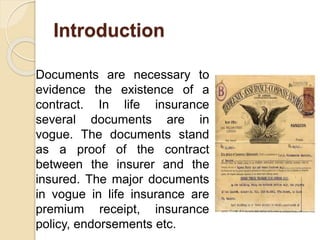
Documents are necessary to
evidence the existence of a
contract. In life insurance
several documents are in
vogue. The documents stand
as a proof of the contract
between the insurer and the
insured. The major documents
in vogue in life insurance are
premium receipt, insurance
policy, endorsements etc.
NEED FOR INSURANCE DOCUMENTATION
Life insurance is a legally enforceable contract
between two parties both of whom are legally
qualified to contract. It is therefore, necessary
that the terms and conditions of the agreement
must be suitably documented in a manner that
would make it clear that both parties to the
contract are Adidem i.e., of the same mind. Ad-
Idem means that both the parties understand the
same thing in the same sense or are of the same
mind on the same subject. There must be
consensus or Ad-Idem between the parties to the
contract. This is possible provided all the terms
and conditions, rights and duties - privileges and
obligations are properly documented in terms
which can be clearly interpreted in a court of law.
Kinds of documents which become
necessary at three stages of a policy
Insurance is also a contract of utmost good faith and
enforced only in the distant future. It is therefore
necessary that the declarations made by both the
parties should be put in black and white for future
reference. Any suppression, willful and material shall
make the contract void. The insured, therefore, has a
duty to declare all that he knows about himself, his
health, his financial status in answering questions
contained in the proposal form and other ancillary
documents which may be required by the insurer.
Various kinds of documents which become necessary
at three stages of a policy –
 (1) at the stage of proposal, which if accepted result into
a policy, (2) during the duration of the policy where
several alterations may become necessary
 (3) at the end of the policy contract when insurer pays
the final claim.
Documents needed at the stage of the proposal
Proposal form is the basic format which is filled in by the proposer
who wants to take an insurance policy. It can be defined as the
application for insurance.
A proposal form has three portions:
 The first gives details about the proposer, his name, address,
occupation, the details about the type of insurance that he wants to take
and the name of the nominee to whom the money is payable in case the
policyholder does not survive to take the maturity amount.
 The second portion relates to the details of the insurance policy that the
proposer already possesses, the present health conditions and the
personal history of his health, any sickness or accident he might have
had.
 The last portion of the proposal form relates to the declaration. Through
this declaration, the proposer (i) affirms the veracity of the statements
made in the proposal form in replying to the question (ii) affirms that
he/she has not suppressed, misrepresented or concealed any fact
which may be material to the risk (iii) agrees that this declaration along
with the proposal form shall form the basis of the contract and if any
information is found to be false the contract will be null and void
Age Proof
Age is an important factor in deciding the quantum of
premium against a policy. The document proving the age, i.e.
age proof must be reliable and the insured has to undertake
as to its truthfulness. An insurer accepts these documents as
standard age proof –
 Certified extract from municipal records, recorded at the time
of birth.
 Certificate of baptism or extract from Family Bible
 Extract from school or college records.
 Extract from service register in case of employees -
Government or semi government or such other reputed
institutions which insist on conclusive evidence of age at the
time of recruitment.
 Identity card issued by Defence department.
 Marriage certificates issued by Roman Catholic Church.
 Domicile certificate.
 Passport.
Non-standard age proofs
Non-standard age proofs are those which are comparatively less
reliable and therefore the insurer accepts them with a pinch of salt.
In other words the insurer takes certain precautions before accepting
such age proofs as final.
Such non–standard age proofs are:
 Horoscope,
 service records of employers other than those mentioned above
 ESI card,
 Marriage Certificate in case of a Muslim proposer.,
 Elders Declaration,
 Self Declaration,
 Driving Licence,
 Certificate issued by village panchayat,
 Electoral role,
 Ration card.
Proof of income
This document may become necessary whenever the
sum proposed is very high. Normally a sum proposed
which is seven to eight times of the declared income is
acceptable for insurance. But proposals do come to the
insurer when the known source of income of the
proposer is much less compared to the amount of
insurance desired.
 A service holder normally does not face this problem
as his sources of income are verifiable.
 In case of business people, the assessed income is
at times much less compared to what is a desirable
income for the amount of insurance desired. In such
cases the insurer at times calls for assessed income tax
returns, or Chartered Accountant’s certificate etc.
 Such precautions are necessary to eliminate the
possibility of moral hazard.
DOCUMENTS NEEDED DURING THE
CONTINUANCE OF THE POLICY
 First Premium Receipts
The First Premium Receipt (FPR) is the confirmation
of insurance. This document is important as it gives the
date of assumption of the risk but its value is nil once
the policy document has been issued.
 Renewal premium receipt
Though it is the duty of the insured to pay the renewal
premium on the due date the insurer sends a renewal
premium notice to the insured out of courtesy and on
receiving premium issues a renewal premium receipt
(RPR) which is an important document and has to be
preserved as it is the only documentary proof that the
due payment has been made.
Policy Contract
 Policy document is a detailed document and it is the Evidence of the
insurance contract which mentions all the terms and conditions of the
insurance.
 The pre-amble to the insurance contract makes the above statement
clear and states that this policy is issued subject to the conditions and
privileges printed on the back of the policy. The endorsements placed on
the policy shall also be part of the policy and it also makes a reference to
the proposal form saying that that the statements given in the proposal
form are the basis of the contract.
 The schedule which is printed on the policy document identifies the
office which has issued the policy. It states the name of the policyholder,
the date of commencement of the policy, an identification number of the
policy called policy number.
 Beneficiary’s name is also mentioned along with address. It also states
the name of the nominee and the date upto which premium has to be
paid. It of course also mentions when and how long the premium is to be
paid.
 The policy document is signed by an official of the insurer and dated
and stamped as per the provision of the Stamp Act to make it a
Endorsements
 Life insurance policy being a long term contract, it is
quite likely that the conditions may so change over the
time that an alteration or change in the policy conditions
may be required. The insurers normally permit such
changes which are in the interest of the policyholders
and also simultaneously do not adversely affect the
insurer’s interest.
 It has to be noted however, that the insurer is not
authorized to make any change in the conditions of the
policy during its continuance except such which has
been agreed to in the beginning of the policy. An
insurance policy, in this sense is called an unilateral
contract.
 All such alterations are effected by an endorsement on
the back of the policy or by a separate memo which
becomes a part of the policy.
Duplicate policy
 A policy document is a valuable document and can be
used for mortgage etc. Loss of policy document does
not absolve the insurer from the liability of payment of
policy proceeds when the claim arises. The claim can
be settled on the claimants, furnishing an indemnity
bond jointly with one surety.
 If a policy is irrevocably lost, a duplicate policy can be
issued, after following a certain procedure. The insurer
satisfies itself of the circumstances leading to loss.
Being so satisfied the insurer insists upon an
advertisement in a news paper, production of an
indemnity bond and payment of policy preparation
charges and there after a duplicate policy is issued.
The duplicate policy is stamped “Duplicate Policy”.
Nomination
Generally nomination is made at the
time of taking a policy. In case it is not
done, it is possible to make
nomination subsequently by an
endorsement on the policy. It is also
possible to change a nomination
subsequently by an endorsement.
After marriage, such change in
nomination is normally required.
Assignment
An assignment of a policy in favour of
another person or institution can be
effected by an endorsement on the
policy. Re-assignment can also be
done by a subsequent endorsement
on the same policy. As a nomination is
automatically cancelled due to an
assignment, after re-assignment, it is
necessary to make a fresh
nomination.
Renewal Notice

Keeping the policy in force is in the interest of the policyholder and
also of the insurer. The insured loses the valuable protection that the
life assurance policy ensures. The insurer loses because without the
renewal premium coming, the heavy expenses which it incurs in the
beginning of a policy cannot be compensated. Every insurer will,
therefore, take all possible actions to reduce policy-lapses and if
lapsed, to get the policy revived.
An insurer therefore sends out regular premium notices even though
it is not a legal requirement.
 Premium notice is usually sent before the due date of the premium.
An insurer is not legally obliged to send a premium notice. It is a
matter of courtesy and greatly helps the life assured for timely
payment of premium.
 Premium default notice : This notice is sent within 3 months after the
due date reminding the policyholder to pay the premium to prevent
the policy-lapses.
 Issue of Final lapse notice : If the premium is not paid within six
months of the due date, and the policy is allowed to lapse, this notice
is issued to the policyholder requesting him to revive the policy to
restore the full insurance cover.
 Intimation to agent : Agent being vitally concerned with the
continuance of a policy, he is also suitably informed every time so
Conclusion
Life insurance being a legally enforceable contract, needs to
be documented with details of the rights and obligations of
the parties to the contract. Proposal form duly filled in and
signed by the proposer is the first document which forms the
basis of the contract. Every time, the insured pays the
premium, he receives a premium receipt. The premium needs
to be paid in time, nonpayment of premium leads to policy-
lapses. Re-instatement of the cover is called revival of the
policy. If the policy is not revived, the policy can become a
paid up policy for a reduced sum assured under certain
conditions. The policy document mentions in detail all the
rights and obligations of the policyholder. The agent is
advised to explain the various provisions of the policy to the
policyholder. The wordings in the policy document are of
technical nature and hence the need for explaining. If there
are certain endorsements on the policy, that need to be
explained too. It needs to be explained that the policy is a
valuable document and needs to be kept in safe custody and
in the knowledge of the close relatives.
Thank you

Insurance documents ppt

  • 1.
    PRESENTATION ON INSURANCE DOCUMENTS Presented By: Mrs.Seema Mahajan Asst. Prof. in Commerce Pt. Mohan Lal S.D. College for Women Gurdaspur
  • 2.
    Introduction Documents are necessaryto evidence the existence of a contract. In life insurance several documents are in vogue. The documents stand as a proof of the contract between the insurer and the insured. The major documents in vogue in life insurance are premium receipt, insurance policy, endorsements etc.
  • 3.
    NEED FOR INSURANCEDOCUMENTATION Life insurance is a legally enforceable contract between two parties both of whom are legally qualified to contract. It is therefore, necessary that the terms and conditions of the agreement must be suitably documented in a manner that would make it clear that both parties to the contract are Adidem i.e., of the same mind. Ad- Idem means that both the parties understand the same thing in the same sense or are of the same mind on the same subject. There must be consensus or Ad-Idem between the parties to the contract. This is possible provided all the terms and conditions, rights and duties - privileges and obligations are properly documented in terms which can be clearly interpreted in a court of law.
  • 4.
    Kinds of documentswhich become necessary at three stages of a policy Insurance is also a contract of utmost good faith and enforced only in the distant future. It is therefore necessary that the declarations made by both the parties should be put in black and white for future reference. Any suppression, willful and material shall make the contract void. The insured, therefore, has a duty to declare all that he knows about himself, his health, his financial status in answering questions contained in the proposal form and other ancillary documents which may be required by the insurer. Various kinds of documents which become necessary at three stages of a policy –  (1) at the stage of proposal, which if accepted result into a policy, (2) during the duration of the policy where several alterations may become necessary  (3) at the end of the policy contract when insurer pays the final claim.
  • 5.
    Documents needed atthe stage of the proposal Proposal form is the basic format which is filled in by the proposer who wants to take an insurance policy. It can be defined as the application for insurance. A proposal form has three portions:  The first gives details about the proposer, his name, address, occupation, the details about the type of insurance that he wants to take and the name of the nominee to whom the money is payable in case the policyholder does not survive to take the maturity amount.  The second portion relates to the details of the insurance policy that the proposer already possesses, the present health conditions and the personal history of his health, any sickness or accident he might have had.  The last portion of the proposal form relates to the declaration. Through this declaration, the proposer (i) affirms the veracity of the statements made in the proposal form in replying to the question (ii) affirms that he/she has not suppressed, misrepresented or concealed any fact which may be material to the risk (iii) agrees that this declaration along with the proposal form shall form the basis of the contract and if any information is found to be false the contract will be null and void
  • 6.
    Age Proof Age isan important factor in deciding the quantum of premium against a policy. The document proving the age, i.e. age proof must be reliable and the insured has to undertake as to its truthfulness. An insurer accepts these documents as standard age proof –  Certified extract from municipal records, recorded at the time of birth.  Certificate of baptism or extract from Family Bible  Extract from school or college records.  Extract from service register in case of employees - Government or semi government or such other reputed institutions which insist on conclusive evidence of age at the time of recruitment.  Identity card issued by Defence department.  Marriage certificates issued by Roman Catholic Church.  Domicile certificate.  Passport.
  • 7.
    Non-standard age proofs Non-standardage proofs are those which are comparatively less reliable and therefore the insurer accepts them with a pinch of salt. In other words the insurer takes certain precautions before accepting such age proofs as final. Such non–standard age proofs are:  Horoscope,  service records of employers other than those mentioned above  ESI card,  Marriage Certificate in case of a Muslim proposer.,  Elders Declaration,  Self Declaration,  Driving Licence,  Certificate issued by village panchayat,  Electoral role,  Ration card.
  • 8.
    Proof of income Thisdocument may become necessary whenever the sum proposed is very high. Normally a sum proposed which is seven to eight times of the declared income is acceptable for insurance. But proposals do come to the insurer when the known source of income of the proposer is much less compared to the amount of insurance desired.  A service holder normally does not face this problem as his sources of income are verifiable.  In case of business people, the assessed income is at times much less compared to what is a desirable income for the amount of insurance desired. In such cases the insurer at times calls for assessed income tax returns, or Chartered Accountant’s certificate etc.  Such precautions are necessary to eliminate the possibility of moral hazard.
  • 9.
    DOCUMENTS NEEDED DURINGTHE CONTINUANCE OF THE POLICY  First Premium Receipts The First Premium Receipt (FPR) is the confirmation of insurance. This document is important as it gives the date of assumption of the risk but its value is nil once the policy document has been issued.  Renewal premium receipt Though it is the duty of the insured to pay the renewal premium on the due date the insurer sends a renewal premium notice to the insured out of courtesy and on receiving premium issues a renewal premium receipt (RPR) which is an important document and has to be preserved as it is the only documentary proof that the due payment has been made.
  • 10.
    Policy Contract  Policydocument is a detailed document and it is the Evidence of the insurance contract which mentions all the terms and conditions of the insurance.  The pre-amble to the insurance contract makes the above statement clear and states that this policy is issued subject to the conditions and privileges printed on the back of the policy. The endorsements placed on the policy shall also be part of the policy and it also makes a reference to the proposal form saying that that the statements given in the proposal form are the basis of the contract.  The schedule which is printed on the policy document identifies the office which has issued the policy. It states the name of the policyholder, the date of commencement of the policy, an identification number of the policy called policy number.  Beneficiary’s name is also mentioned along with address. It also states the name of the nominee and the date upto which premium has to be paid. It of course also mentions when and how long the premium is to be paid.  The policy document is signed by an official of the insurer and dated and stamped as per the provision of the Stamp Act to make it a
  • 11.
    Endorsements  Life insurancepolicy being a long term contract, it is quite likely that the conditions may so change over the time that an alteration or change in the policy conditions may be required. The insurers normally permit such changes which are in the interest of the policyholders and also simultaneously do not adversely affect the insurer’s interest.  It has to be noted however, that the insurer is not authorized to make any change in the conditions of the policy during its continuance except such which has been agreed to in the beginning of the policy. An insurance policy, in this sense is called an unilateral contract.  All such alterations are effected by an endorsement on the back of the policy or by a separate memo which becomes a part of the policy.
  • 12.
    Duplicate policy  Apolicy document is a valuable document and can be used for mortgage etc. Loss of policy document does not absolve the insurer from the liability of payment of policy proceeds when the claim arises. The claim can be settled on the claimants, furnishing an indemnity bond jointly with one surety.  If a policy is irrevocably lost, a duplicate policy can be issued, after following a certain procedure. The insurer satisfies itself of the circumstances leading to loss. Being so satisfied the insurer insists upon an advertisement in a news paper, production of an indemnity bond and payment of policy preparation charges and there after a duplicate policy is issued. The duplicate policy is stamped “Duplicate Policy”.
  • 13.
    Nomination Generally nomination ismade at the time of taking a policy. In case it is not done, it is possible to make nomination subsequently by an endorsement on the policy. It is also possible to change a nomination subsequently by an endorsement. After marriage, such change in nomination is normally required.
  • 14.
    Assignment An assignment ofa policy in favour of another person or institution can be effected by an endorsement on the policy. Re-assignment can also be done by a subsequent endorsement on the same policy. As a nomination is automatically cancelled due to an assignment, after re-assignment, it is necessary to make a fresh nomination.
  • 15.
    Renewal Notice  Keeping thepolicy in force is in the interest of the policyholder and also of the insurer. The insured loses the valuable protection that the life assurance policy ensures. The insurer loses because without the renewal premium coming, the heavy expenses which it incurs in the beginning of a policy cannot be compensated. Every insurer will, therefore, take all possible actions to reduce policy-lapses and if lapsed, to get the policy revived. An insurer therefore sends out regular premium notices even though it is not a legal requirement.  Premium notice is usually sent before the due date of the premium. An insurer is not legally obliged to send a premium notice. It is a matter of courtesy and greatly helps the life assured for timely payment of premium.  Premium default notice : This notice is sent within 3 months after the due date reminding the policyholder to pay the premium to prevent the policy-lapses.  Issue of Final lapse notice : If the premium is not paid within six months of the due date, and the policy is allowed to lapse, this notice is issued to the policyholder requesting him to revive the policy to restore the full insurance cover.  Intimation to agent : Agent being vitally concerned with the continuance of a policy, he is also suitably informed every time so
  • 16.
    Conclusion Life insurance beinga legally enforceable contract, needs to be documented with details of the rights and obligations of the parties to the contract. Proposal form duly filled in and signed by the proposer is the first document which forms the basis of the contract. Every time, the insured pays the premium, he receives a premium receipt. The premium needs to be paid in time, nonpayment of premium leads to policy- lapses. Re-instatement of the cover is called revival of the policy. If the policy is not revived, the policy can become a paid up policy for a reduced sum assured under certain conditions. The policy document mentions in detail all the rights and obligations of the policyholder. The agent is advised to explain the various provisions of the policy to the policyholder. The wordings in the policy document are of technical nature and hence the need for explaining. If there are certain endorsements on the policy, that need to be explained too. It needs to be explained that the policy is a valuable document and needs to be kept in safe custody and in the knowledge of the close relatives.
  • 17.