ACTURIAL PRINCIPLES  AND  WORKING
DEFINITION   A a financial expert who applies mathematical and statistical methods for  assessment of financial and other risks   relating to various contingent events  and  scientific valuation of financial products  in the fields of insurance, retirement and other various benefits, investment and other related areas
ACTUARIAL VALUATION Premium calculated  taking into assumptions or expectations of  Mortality interest and  expenses Validity of these assumptions are periodically checked to ensure business is on sound line – process of doing so called Actuarial Valuation IRDA requirement – Actuarial Valuation to be done annually
PROCEDURE - APPOINTMENT OF APPOINTED ACTUARY Appointed Actuary-   shall be appointed by IC in India  Qualification   – Indian Resident; Fellow Member of the Actuarial Society of India; employee of IC; not committed any of professional misconduct; no disciplinary action by ASCI Approval of IRDA  –  application within 30 days Date of appointment  –  date of IRDA approval Failure to appoint  –  IC cease to carry on life insurer business
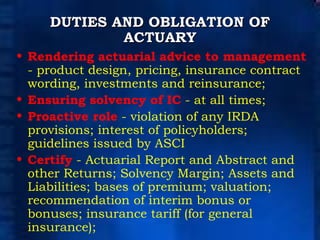
DUTIES AND OBLIGATION OF ACTUARY Rendering actuarial advice to management  - product design, pricing, insurance contract wording, investments and reinsurance; Ensuring solvency of IC  - at all times;  Proactive role  - violation of any IRDA provisions; interest of policyholders; guidelines issued by ASCI Certify  - Actuarial Report and Abstract and other Returns; Solvency Margin; Assets and Liabilities; bases of premium; valuation; recommendation of interim bonus or bonuses; insurance tariff (for general insurance);
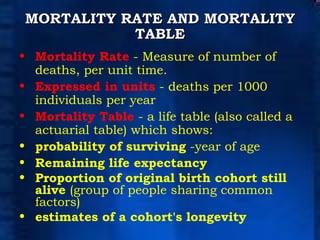
MORTALITY RATE AND MORTALITY TABLE Mortality Rate  - Measure of number of deaths, per unit time.  Expressed in units  - deaths per 1000 individuals per year Mortality Table  - a life table (also called a actuarial table) which shows: probability of surviving  -year of age  Remaining life expectancy   Proportion of original birth cohort still alive  (group of people sharing common factors) estimates of a cohort's longevity
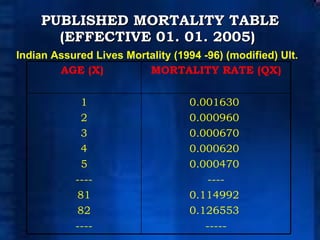
PUBLISHED MORTALITY TABLE (EFFECTIVE 01. 01. 2005)   Indian Assured Lives Mortality (1994 -96) (modified) Ult.   0.001630  0.000960  0.000670  0.000620  0.000470  ---- 0.114992  0.126553  ----- 1 2 3 4 5 ---- 81 82 ---- MORTALITY RATE (QX) AGE (X)
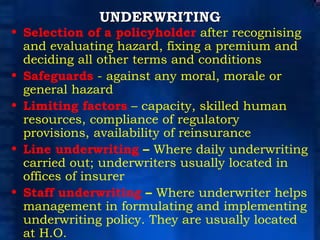
UNDERWRITING Selection of a policyholder  after recognising and evaluating hazard, fixing a premium and deciding all other terms and conditions Safeguards  - against any moral, morale or general hazard Limiting factors  – capacity, skilled human resources, compliance of regulatory provisions,   availability of reinsurance Line underwriting  –  Where daily underwriting carried out; underwriters usually located in offices of insurer Staff underwriting  –  Where underwriter helps management in formulating and implementing underwriting   policy. They are usually located at H.O.
CONCEPT OF RISK Chance of having a loss  - due to occurrence of an event A condition  - in which there is possibility of an adverse deviation from a desired outcome Risk always associated with loss  - word itself has the association of `Danger of loss` Probability of the occurrence  - an event resulting in loss/ gain
PERILS AND HAZARDS Uncertainty  – a situation where outcome not certain or unknown, its state of mind characterized by doubt, based on lack of knowledge  CAUSES OF LOSS   (A)  PERILS  – immediate causes of loss ( i ) General ( Ex –  Fire may affect building, machinery, equipment and also human ) ( ii ) Specific ( Ex-  Collusion in automobile-financial loss)   (B)  HAZARDS  – conditions that increase severity of loss/perils ( i ) Physical – Property conditions ( Ex-  crackers stocked in packed commercial complex) ( ii ) Intangible – Moral Hazard ( Ex – Fraud );  Morale Hazard ( Ex –  Indifference )   ( iii ) Societal Hazard ( Ex - Legal and Cultural )
HOW THE LOSS IS CAUSED ? Loss is caused by operation of perils  - refers to the causes for the losses Ex -  fire, explosion, flood, storm etc Loss potential ( extent of loss) depends on  - conditions which are favourable for the incident to assume large proportions.  Known as hazard or potential of the loss.  More the potential - severe will be the extent of loss PERIL  (CAUSE) -------------  LOSS  (EFFECT) HAZARD
RISK AND MANAGEMENT Risk - chance of an event happening resulting in loss/ gain To appreciate the need for loss prevention and implement measures to achieve the same The efforts are aimed to prevent a loss happening but also to make it manageable if it happens This aspect is to be achieved in all activities of the organization be in production, storage, handling, transportation and distribution
RISK ANALYSIS & RISK IDENTIFICATION Initial steps of Risk Management  -  Risk identification and Risk Analysis  Risk identification  – all those events which may bring about a deterioration in one's present welfare for :- Physical and mental well-being Current income Value of his assets Any other event that may frustrate fulfillment of future plans
RISK EVALUATION Involves two elements  :- Probabilities of loss-producing events occurring – frequency, severity of loss; and Potential losses   Collect, collate, analyse and interpret historical data  – number and size of fire losses suffered in last one year, data to be shown orderly to reveal loss trends, patterns of behaviour, relation between variables  Highlight possible trends Identifying and analysing loss exposure  - probability concepts using statistical tools
REPRESENTATIONS AND WARRANTIES   Representation  - Statements made by an applicant in the application, which he represents as being substantially true to the best of his knowledge and belief, but which are not warranted as exact in every detail.  Warranties  - a usually written undertaking of the integrity of a product and of the maker's responsibility for the repair or replacement of defective parts

Chapter 04 acturial principles

  • 1.
  • 2.
    DEFINITION A a financial expert who applies mathematical and statistical methods for assessment of financial and other risks relating to various contingent events and scientific valuation of financial products in the fields of insurance, retirement and other various benefits, investment and other related areas
  • 3.
    ACTUARIAL VALUATION Premiumcalculated taking into assumptions or expectations of Mortality interest and expenses Validity of these assumptions are periodically checked to ensure business is on sound line – process of doing so called Actuarial Valuation IRDA requirement – Actuarial Valuation to be done annually
  • 4.
    PROCEDURE - APPOINTMENTOF APPOINTED ACTUARY Appointed Actuary- shall be appointed by IC in India Qualification – Indian Resident; Fellow Member of the Actuarial Society of India; employee of IC; not committed any of professional misconduct; no disciplinary action by ASCI Approval of IRDA – application within 30 days Date of appointment – date of IRDA approval Failure to appoint – IC cease to carry on life insurer business
  • 5.
    DUTIES AND OBLIGATIONOF ACTUARY Rendering actuarial advice to management - product design, pricing, insurance contract wording, investments and reinsurance; Ensuring solvency of IC - at all times; Proactive role - violation of any IRDA provisions; interest of policyholders; guidelines issued by ASCI Certify - Actuarial Report and Abstract and other Returns; Solvency Margin; Assets and Liabilities; bases of premium; valuation; recommendation of interim bonus or bonuses; insurance tariff (for general insurance);
  • 6.
    MORTALITY RATE ANDMORTALITY TABLE Mortality Rate - Measure of number of deaths, per unit time. Expressed in units - deaths per 1000 individuals per year Mortality Table - a life table (also called a actuarial table) which shows: probability of surviving -year of age Remaining life expectancy Proportion of original birth cohort still alive (group of people sharing common factors) estimates of a cohort's longevity
  • 7.
    PUBLISHED MORTALITY TABLE(EFFECTIVE 01. 01. 2005) Indian Assured Lives Mortality (1994 -96) (modified) Ult. 0.001630 0.000960 0.000670 0.000620 0.000470 ---- 0.114992 0.126553 ----- 1 2 3 4 5 ---- 81 82 ---- MORTALITY RATE (QX) AGE (X)
  • 8.
    UNDERWRITING Selection ofa policyholder after recognising and evaluating hazard, fixing a premium and deciding all other terms and conditions Safeguards - against any moral, morale or general hazard Limiting factors – capacity, skilled human resources, compliance of regulatory provisions, availability of reinsurance Line underwriting – Where daily underwriting carried out; underwriters usually located in offices of insurer Staff underwriting – Where underwriter helps management in formulating and implementing underwriting policy. They are usually located at H.O.
  • 9.
    CONCEPT OF RISKChance of having a loss - due to occurrence of an event A condition - in which there is possibility of an adverse deviation from a desired outcome Risk always associated with loss - word itself has the association of `Danger of loss` Probability of the occurrence - an event resulting in loss/ gain
  • 10.
    PERILS AND HAZARDSUncertainty – a situation where outcome not certain or unknown, its state of mind characterized by doubt, based on lack of knowledge CAUSES OF LOSS (A) PERILS – immediate causes of loss ( i ) General ( Ex – Fire may affect building, machinery, equipment and also human ) ( ii ) Specific ( Ex- Collusion in automobile-financial loss) (B) HAZARDS – conditions that increase severity of loss/perils ( i ) Physical – Property conditions ( Ex- crackers stocked in packed commercial complex) ( ii ) Intangible – Moral Hazard ( Ex – Fraud ); Morale Hazard ( Ex – Indifference ) ( iii ) Societal Hazard ( Ex - Legal and Cultural )
  • 11.
    HOW THE LOSSIS CAUSED ? Loss is caused by operation of perils - refers to the causes for the losses Ex - fire, explosion, flood, storm etc Loss potential ( extent of loss) depends on - conditions which are favourable for the incident to assume large proportions. Known as hazard or potential of the loss. More the potential - severe will be the extent of loss PERIL (CAUSE) ------------- LOSS (EFFECT) HAZARD
  • 12.
    RISK AND MANAGEMENTRisk - chance of an event happening resulting in loss/ gain To appreciate the need for loss prevention and implement measures to achieve the same The efforts are aimed to prevent a loss happening but also to make it manageable if it happens This aspect is to be achieved in all activities of the organization be in production, storage, handling, transportation and distribution
  • 13.
    RISK ANALYSIS &RISK IDENTIFICATION Initial steps of Risk Management - Risk identification and Risk Analysis Risk identification – all those events which may bring about a deterioration in one's present welfare for :- Physical and mental well-being Current income Value of his assets Any other event that may frustrate fulfillment of future plans
  • 14.
    RISK EVALUATION Involvestwo elements :- Probabilities of loss-producing events occurring – frequency, severity of loss; and Potential losses Collect, collate, analyse and interpret historical data – number and size of fire losses suffered in last one year, data to be shown orderly to reveal loss trends, patterns of behaviour, relation between variables Highlight possible trends Identifying and analysing loss exposure - probability concepts using statistical tools
  • 15.
    REPRESENTATIONS AND WARRANTIES Representation - Statements made by an applicant in the application, which he represents as being substantially true to the best of his knowledge and belief, but which are not warranted as exact in every detail. Warranties - a usually written undertaking of the integrity of a product and of the maker's responsibility for the repair or replacement of defective parts