Instrument Transfer
Instrument Transfer
Proper instrument transfer occurs when:
Operator’s view remains on oral cavity
Stress and fatigue are reduced
Safety and comfort are maintained
Production is increased with less motion
Instrument Transfer
Efficient transfer allows the operator to keep his
or her eyes focused on the oral cavity and
requires minimal movement of the operator’s
hands.
A smooth transition occurs when the assistant is
able to anticipate the operator’s needs.
Instrument Transfer
 Transfer zone
Area just below patient’s nose near chin
 Fulcrum
Point of rest on which fingers are stabilized and can pivot
 Tactile sensation
Feeling sensed by touch
Instrument Transfer
Transfer hand
Assistant passes and receives instruments with left
hand while working with right-handed dentist
Assistant passes and receives instruments with
right hand while working with left-handed dentist
Instrument Grasps
The way an instrument is held influences how
efficiently the instrument can be used.
Selecting the correct grasp allows the operator
control of the instrument, greater tactile sensitivity,
and reduces fatigue to the operator’s fingers and
hands.
Instrument Grasps
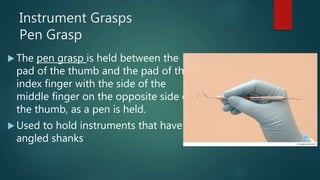
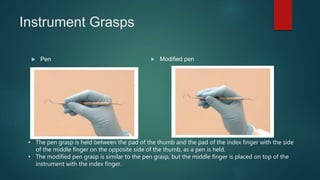
Pen Grasp
 The pen grasp is held between the
pad of the thumb and the pad of the
index finger with the side of the
middle finger on the opposite side of
the thumb, as a pen is held.
 Used to hold instruments that have
angled shanks
Instrument Grasps
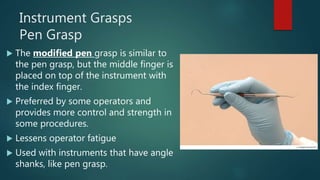
Pen Grasp
 The modified pen grasp is similar to
the pen grasp, but the middle finger is
placed on top of the instrument with
the index finger.
 Preferred by some operators and
provides more control and strength in
some procedures.
 Lessens operator fatigue
 Used with instruments that have angle
shanks, like pen grasp.
Instrument Grasps
 Pen  Modified pen
• The pen grasp is held between the pad of the thumb and the pad of the index finger with the side
of the middle finger on the opposite side of the thumb, as a pen is held.
• The modified pen grasp is similar to the pen grasp, but the middle finger is placed on top of the
instrument with the index finger.
Instrument Grasps
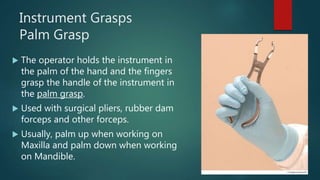
Palm Grasp
 The operator holds the instrument in
the palm of the hand and the fingers
grasp the handle of the instrument in
the palm grasp.
 Used with surgical pliers, rubber dam
forceps and other forceps.
 Usually, palm up when working on
Maxilla and palm down when working
on Mandible.
Instrument Grasps
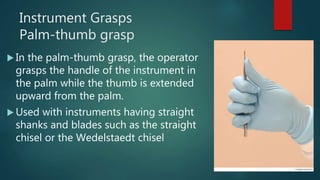
Palm-thumb grasp
 In the palm-thumb grasp, the operator
grasps the handle of the instrument in
the palm while the thumb is extended
upward from the palm.
 Used with instruments having straight
shanks and blades such as the straight
chisel or the Wedelstaedt chisel
Instrument Grasps
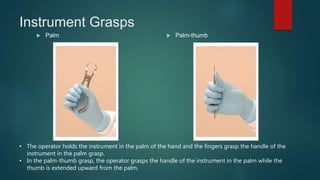
 Palm  Palm-thumb
• The operator holds the instrument in the palm of the hand and the fingers grasp the handle of the
instrument in the palm grasp.
• In the palm-thumb grasp, the operator grasps the handle of the instrument in the palm while the
thumb is extended upward from the palm.
Instrument Grasps
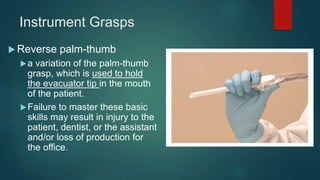
 Reverse palm-thumb
a variation of the palm-thumb
grasp, which is used to hold
the evacuator tip in the mouth
of the patient.
Failure to master these basic
skills may result in injury to the
patient, dentist, or the assistant
and/or loss of production for
the office.
Eight Basic Rules
The assistant selects the next instrument and
holds it until the dentist signals for transfer.
There are eight basic rules for instrument
transfer.
Eight Basic Instrument Transfer
Methods
1. Primary working end should be
placed away from assistant on tray
2. With straight-shank instruments,
primary working end should be
placed toward assistant
Eight Basic Instrument Transfer
Methods
3. With hinged instruments, beaks
are placed toward assistant
4. Hold instrument between thumb
and index finger and middle
finger
Eight Basic Instrument Transfer
Methods
5. With pen grasp instrument, pick
up instrument from tray near end
closest to assistant
6. Assistant’s hand is placed on
instrument opposite from end
operator uses
Eight Basic Instrument Transfer
Methods
7. Rotate working end of instrument
until it is directed toward dental
arch being treated
8. Hold instrument to be passed
parallel to instrument held by
operator
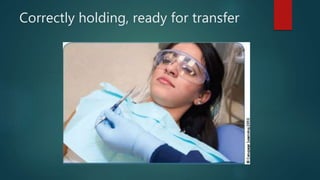
Correctly holding, ready for transfer
Instrument Transfer Methods
Instruments transferred by:
One-handed transfer
Two-handed transfer
One-Handed Transfer
The one-handed transfer is the most common
transfer.
It saves time and allows the assistant to use the
evacuator or air-water syringe at the same time.
The assistant picks up the instrument to be transferred
with the same hand that receives the instrument the
operator is finished using.
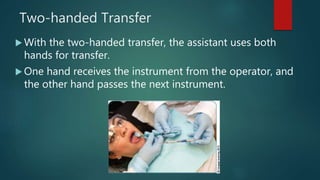
Two-handed Transfer
 With the two-handed transfer, the assistant uses both
hands for transfer.
 One hand receives the instrument from the operator, and
the other hand passes the next instrument.
Instrument Transfer Modifications
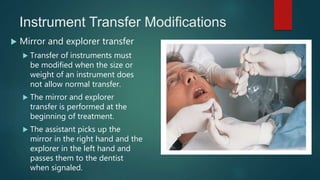
 Mirror and explorer transfer
 Transfer of instruments must
be modified when the size or
weight of an instrument does
not allow normal transfer.
 The mirror and explorer
transfer is performed at the
beginning of treatment.
 The assistant picks up the
mirror in the right hand and the
explorer in the left hand and
passes them to the dentist
when signaled.
Instrument Transfer Modifications
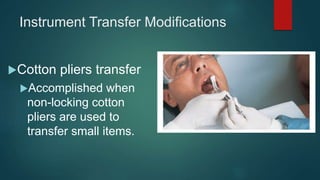
Cotton pliers transfer
Accomplished when
non-locking cotton
pliers are used to
transfer small items.
Instrument Transfer Modifications
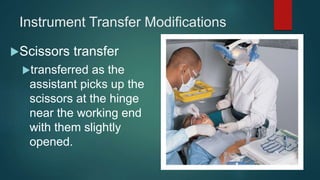
Scissors transfer
transferred as the
assistant picks up the
scissors at the hinge
near the working end
with them slightly
opened.
Instrument Transfer Modifications
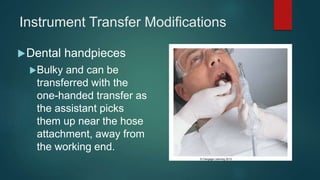
Dental handpieces
Bulky and can be
transferred with the
one-handed transfer as
the assistant picks
them up near the hose
attachment, away from
the working end.
© Cengage Learning 2013
Instrument Transfer Modifications
Air-water syringe transfer
Transferred as the assistant
holds the end of the syringe,
covering the nozzle and tip
with the palm of the hand.
 https://www.youtube.com/watch?feature=player_detailpage&v=pQx-WzeTpjc

Instrument Transfer

  • 1.
  • 2.
    Instrument Transfer Proper instrumenttransfer occurs when: Operator’s view remains on oral cavity Stress and fatigue are reduced Safety and comfort are maintained Production is increased with less motion
  • 3.
    Instrument Transfer Efficient transferallows the operator to keep his or her eyes focused on the oral cavity and requires minimal movement of the operator’s hands. A smooth transition occurs when the assistant is able to anticipate the operator’s needs.
  • 4.
    Instrument Transfer  Transferzone Area just below patient’s nose near chin  Fulcrum Point of rest on which fingers are stabilized and can pivot  Tactile sensation Feeling sensed by touch
  • 5.
    Instrument Transfer Transfer hand Assistantpasses and receives instruments with left hand while working with right-handed dentist Assistant passes and receives instruments with right hand while working with left-handed dentist
  • 6.
    Instrument Grasps The wayan instrument is held influences how efficiently the instrument can be used. Selecting the correct grasp allows the operator control of the instrument, greater tactile sensitivity, and reduces fatigue to the operator’s fingers and hands.
  • 7.
    Instrument Grasps Pen Grasp The pen grasp is held between the pad of the thumb and the pad of the index finger with the side of the middle finger on the opposite side of the thumb, as a pen is held.  Used to hold instruments that have angled shanks
  • 8.
    Instrument Grasps Pen Grasp The modified pen grasp is similar to the pen grasp, but the middle finger is placed on top of the instrument with the index finger.  Preferred by some operators and provides more control and strength in some procedures.  Lessens operator fatigue  Used with instruments that have angle shanks, like pen grasp.
  • 9.
    Instrument Grasps  Pen Modified pen • The pen grasp is held between the pad of the thumb and the pad of the index finger with the side of the middle finger on the opposite side of the thumb, as a pen is held. • The modified pen grasp is similar to the pen grasp, but the middle finger is placed on top of the instrument with the index finger.
  • 10.
    Instrument Grasps Palm Grasp The operator holds the instrument in the palm of the hand and the fingers grasp the handle of the instrument in the palm grasp.  Used with surgical pliers, rubber dam forceps and other forceps.  Usually, palm up when working on Maxilla and palm down when working on Mandible.
  • 11.
    Instrument Grasps Palm-thumb grasp In the palm-thumb grasp, the operator grasps the handle of the instrument in the palm while the thumb is extended upward from the palm.  Used with instruments having straight shanks and blades such as the straight chisel or the Wedelstaedt chisel
  • 12.
    Instrument Grasps  Palm Palm-thumb • The operator holds the instrument in the palm of the hand and the fingers grasp the handle of the instrument in the palm grasp. • In the palm-thumb grasp, the operator grasps the handle of the instrument in the palm while the thumb is extended upward from the palm.
  • 13.
    Instrument Grasps  Reversepalm-thumb a variation of the palm-thumb grasp, which is used to hold the evacuator tip in the mouth of the patient. Failure to master these basic skills may result in injury to the patient, dentist, or the assistant and/or loss of production for the office.
  • 14.
    Eight Basic Rules Theassistant selects the next instrument and holds it until the dentist signals for transfer. There are eight basic rules for instrument transfer.
  • 15.
    Eight Basic InstrumentTransfer Methods 1. Primary working end should be placed away from assistant on tray 2. With straight-shank instruments, primary working end should be placed toward assistant
  • 16.
    Eight Basic InstrumentTransfer Methods 3. With hinged instruments, beaks are placed toward assistant 4. Hold instrument between thumb and index finger and middle finger
  • 17.
    Eight Basic InstrumentTransfer Methods 5. With pen grasp instrument, pick up instrument from tray near end closest to assistant 6. Assistant’s hand is placed on instrument opposite from end operator uses
  • 18.
    Eight Basic InstrumentTransfer Methods 7. Rotate working end of instrument until it is directed toward dental arch being treated 8. Hold instrument to be passed parallel to instrument held by operator
  • 19.
  • 20.
    Instrument Transfer Methods Instrumentstransferred by: One-handed transfer Two-handed transfer
  • 21.
    One-Handed Transfer The one-handedtransfer is the most common transfer. It saves time and allows the assistant to use the evacuator or air-water syringe at the same time. The assistant picks up the instrument to be transferred with the same hand that receives the instrument the operator is finished using.
  • 22.
    Two-handed Transfer  Withthe two-handed transfer, the assistant uses both hands for transfer.  One hand receives the instrument from the operator, and the other hand passes the next instrument.
  • 23.
    Instrument Transfer Modifications Mirror and explorer transfer  Transfer of instruments must be modified when the size or weight of an instrument does not allow normal transfer.  The mirror and explorer transfer is performed at the beginning of treatment.  The assistant picks up the mirror in the right hand and the explorer in the left hand and passes them to the dentist when signaled.
  • 24.
    Instrument Transfer Modifications Cottonpliers transfer Accomplished when non-locking cotton pliers are used to transfer small items.
  • 25.
    Instrument Transfer Modifications Scissorstransfer transferred as the assistant picks up the scissors at the hinge near the working end with them slightly opened.
  • 26.
    Instrument Transfer Modifications Dentalhandpieces Bulky and can be transferred with the one-handed transfer as the assistant picks them up near the hose attachment, away from the working end. © Cengage Learning 2013
  • 27.
    Instrument Transfer Modifications Air-watersyringe transfer Transferred as the assistant holds the end of the syringe, covering the nozzle and tip with the palm of the hand.
  • 28.