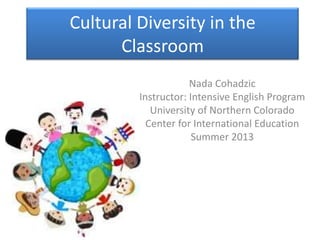
Cultural Diversity in the
Classroom
Nada Cohadzic
Instructor: Intensive English Program
University of Northern Colorado
Center for International Education
Summer 2013
Pair and Share
• Turn to the person sitting next to you and
discuss the following questions
– What does diversity mean to you?
– Reflect on a situation when you or someone you
know felt as an outsider.
– As a teacher, what would you do to foster a
comfortable environment for diverse students?
• (Think about cultural background, learning styles, and
other unseen differences)
What we will cover today
• Diverse students in US classrooms
• Individually Differentiated Education
• Multi-cultural approaches to learners
• National Legislation
– No Child Left Behind
– Race to the Top
– Americans with Disabilities
• Mock-classroom activity
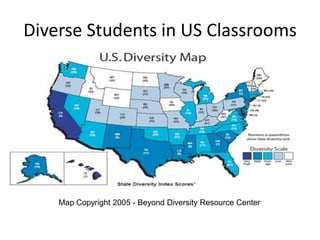
Diverse Students in US Classrooms
Map Copyright 2005 - Beyond Diversity Resource Center
Individually differentiated instruction
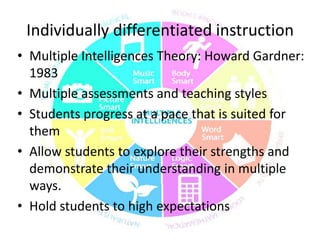
• Multiple Intelligences Theory: Howard Gardner:
1983
• Multiple assessments and teaching styles
• Students progress at a pace that is suited for
them
• Allow students to explore their strengths and
demonstrate their understanding in multiple
ways.
• Hold students to high expectations
Teacher Methodology for Dealing with
Diversity
• Refer to your handout for “Cultural
Consciousness/Macrostrategy Framework”
Macrostrategy Framework
• Maximize leaning opportunities
• Minimize Perceptual mismatches
• Facilitate negotiated interaction
Macrostrategy Framework
• Promote learner autonomy
• Foster language awareness
• Activate intuitive heuristics
Macrostrategy Framework
• Contextualize linguistic input
• Integrate language skills
• Ensure social relevance
Macrostrategy Framework
• Raise cultural consciousness:
emphasizes the need to treat
learners as cultural informants so
that they are encouraged to engage
in a process of classroom
participation that puts a premium on
their power knowledge
Reflective Task
With a peer partner, go over the list of
macrostrategies. Which ones inform your
day-to-day teaching? Which ones are
relevant to your learning/teaching
context?
(Kumaravadivelu (2003) p.40)
Legislation passed in the United
States concerning youth education
1. No Child Left Behind
• No Child Left Behind:
• Enacted by President George W. Bush
• City of Washington
• January 03, 2001
• An act designed to close the achievement gap with accountability,
flexibility, and choice, so that no child is left behind.
• Title 1: Improving the Academic Achievement of the Disadvantaged
– SEC.1001. STATEMENT OF PURPOSE
• The purpose of this title is to ensure that all children have a fair,
equal, and significant opportunity to obtain a high-quality
education and reach, at a minimum, proficiency on challenging
State academic achievement standards and state academic
assessments.
2. Race to the Top
• Enacted by: President Barack Obama
• Program Type: Discretionary/Competitive Grants
• Provides funding to:
– develop assessments that are valid, support and
inform instruction, provide accurate information
about what students know and can do, and measure
student achievement against standards designed to
ensure that all students gain the knowledge and skills
needed to succeed in college and the workplace.
(United States Department of Education)
3. Americans with Disabilities Act
• (1)Having a physical or mental disability does
not mean that a person cannot participate in
society
• (2) historically, society has tended to isolate
and segregate individuals with disabilities
• (3) discrimination against individuals with
disabilities persists in such critical areas as
employment, housing, public
accommodations, education, . . .
Americans with Disabilities
• (4) Unlike those who have experienced
discrimination because of: sex or race people
disabled people usually do not protest with the
law.
• See handout for the remaining findings and
objectives of the ADA.
• The main idea is that people who
are disabled should have equal
opportunities and equal rights as
those who are not.
Workshop Activity
• Divide into 5 groups of 4 students. You will find a
number on the back of your card. Find the other
students with the same number.
• Elect a note-taker and a speaker in your group.
• On each card, there is a description of a student.
Your students will make up a classroom.
• Group: 1 (Language Arts), 2 (Social Studies), 3
(Mathematics), 4 (Science)
Your Task
• Read your topic of instruction and work with your
group members to create a list of objectives for
this lesson.
– Objectives include wording such as “By the end of the
lesson, the learner will be able to . . .”
• Also devise a short lesson plan to meet these
objectives.
• Lastly, discuss how you took into consideration
the diversity in your classroom. What methods
did you use to accommodate all of your students
while still meeting the objectives?
Thank you!

Cultural Diversity in the Classroom by Nada Cohadzic

  • 1.
    Cultural Diversity inthe Classroom Nada Cohadzic Instructor: Intensive English Program University of Northern Colorado Center for International Education Summer 2013
  • 2.
    Pair and Share •Turn to the person sitting next to you and discuss the following questions – What does diversity mean to you? – Reflect on a situation when you or someone you know felt as an outsider. – As a teacher, what would you do to foster a comfortable environment for diverse students? • (Think about cultural background, learning styles, and other unseen differences)
  • 3.
    What we willcover today • Diverse students in US classrooms • Individually Differentiated Education • Multi-cultural approaches to learners • National Legislation – No Child Left Behind – Race to the Top – Americans with Disabilities • Mock-classroom activity
  • 4.
    Diverse Students inUS Classrooms Map Copyright 2005 - Beyond Diversity Resource Center
  • 5.
    Individually differentiated instruction •Multiple Intelligences Theory: Howard Gardner: 1983 • Multiple assessments and teaching styles • Students progress at a pace that is suited for them • Allow students to explore their strengths and demonstrate their understanding in multiple ways. • Hold students to high expectations
  • 6.
    Teacher Methodology forDealing with Diversity • Refer to your handout for “Cultural Consciousness/Macrostrategy Framework”
  • 7.
    Macrostrategy Framework • Maximizeleaning opportunities • Minimize Perceptual mismatches • Facilitate negotiated interaction
  • 8.
    Macrostrategy Framework • Promotelearner autonomy • Foster language awareness • Activate intuitive heuristics
  • 9.
    Macrostrategy Framework • Contextualizelinguistic input • Integrate language skills • Ensure social relevance
  • 10.
    Macrostrategy Framework • Raisecultural consciousness: emphasizes the need to treat learners as cultural informants so that they are encouraged to engage in a process of classroom participation that puts a premium on their power knowledge
  • 11.
    Reflective Task With apeer partner, go over the list of macrostrategies. Which ones inform your day-to-day teaching? Which ones are relevant to your learning/teaching context? (Kumaravadivelu (2003) p.40)
  • 12.
    Legislation passed inthe United States concerning youth education
  • 13.
    1. No ChildLeft Behind • No Child Left Behind: • Enacted by President George W. Bush • City of Washington • January 03, 2001 • An act designed to close the achievement gap with accountability, flexibility, and choice, so that no child is left behind. • Title 1: Improving the Academic Achievement of the Disadvantaged – SEC.1001. STATEMENT OF PURPOSE • The purpose of this title is to ensure that all children have a fair, equal, and significant opportunity to obtain a high-quality education and reach, at a minimum, proficiency on challenging State academic achievement standards and state academic assessments.
  • 14.
    2. Race tothe Top • Enacted by: President Barack Obama • Program Type: Discretionary/Competitive Grants • Provides funding to: – develop assessments that are valid, support and inform instruction, provide accurate information about what students know and can do, and measure student achievement against standards designed to ensure that all students gain the knowledge and skills needed to succeed in college and the workplace. (United States Department of Education)
  • 15.
    3. Americans withDisabilities Act • (1)Having a physical or mental disability does not mean that a person cannot participate in society • (2) historically, society has tended to isolate and segregate individuals with disabilities • (3) discrimination against individuals with disabilities persists in such critical areas as employment, housing, public accommodations, education, . . .
  • 16.
    Americans with Disabilities •(4) Unlike those who have experienced discrimination because of: sex or race people disabled people usually do not protest with the law. • See handout for the remaining findings and objectives of the ADA. • The main idea is that people who are disabled should have equal opportunities and equal rights as those who are not.
  • 17.
    Workshop Activity • Divideinto 5 groups of 4 students. You will find a number on the back of your card. Find the other students with the same number. • Elect a note-taker and a speaker in your group. • On each card, there is a description of a student. Your students will make up a classroom. • Group: 1 (Language Arts), 2 (Social Studies), 3 (Mathematics), 4 (Science)
  • 18.
    Your Task • Readyour topic of instruction and work with your group members to create a list of objectives for this lesson. – Objectives include wording such as “By the end of the lesson, the learner will be able to . . .” • Also devise a short lesson plan to meet these objectives. • Lastly, discuss how you took into consideration the diversity in your classroom. What methods did you use to accommodate all of your students while still meeting the objectives?
  • 19.

Editor's Notes

  • #2 http://www.youtube.com/watch?v=fhTvgl5gep8