Instructional Events and Learning
Outcomes
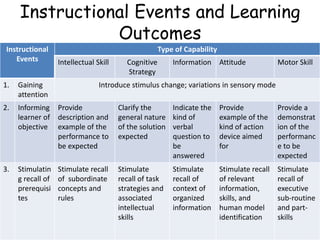
Instructional
Events
Type of Capability
Intellectual Skill Cognitive
Strategy
Information Attitude Motor Skill
1. Gaining
attention
Introduce stimulus change; variations in sensory mode
2. Informing
learner of
objective
Provide
description and
example of the
performance to
be expected
Clarify the
general nature
of the solution
expected
Indicate the
kind of
verbal
question to
be
answered
Provide
example of the
kind of action
device aimed
for
Provide a
demonstrat
ion of the
performanc
e to be
expected
3. Stimulatin
g recall of
prerequisi
tes
Stimulate recall
of subordinate
concepts and
rules
Stimulate
recall of task
strategies and
associated
intellectual
skills
Stimulate
recall of
context of
organized
information
Stimulate recall
of relevant
information,
skills, and
human model
identification
Stimulate
recall of
executive
sub-routine
and part-
skills
continue
Instructional
events
Type of capability
Intellectual
skill
Cognitive
Strategy
Information Attitude Motor Skill
4. Presentin
g the
stimulus
material
Present
examples of
concept or
rule
Present novel
problems
Present
information
in
propositional
form
Present
human
model,
demonstratin
g choice of
personal
action
Provide
external
stimuli for
performance,
including
tools or
implements
5. Providing
learning
guidance
Provide
verbal cues
to proper
combining
sequence
Provide
prompts and
hints to novel
solution
Provide
verbal links
to a larger
meaningful
context
Provide for
observation
of model’s
choice of
action, and of
reinforcemen
t received by
model
Provide
practice with
feedback of
performance
achievement
continue
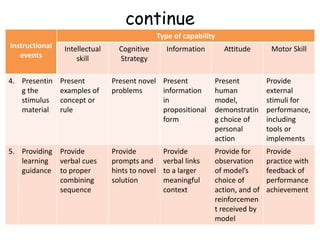
Instructional
Events
Type of Capability
Intellectual
Skill
Cognitive
Strategy
Information Attitude Motor Skill
6. Eliciting
the
performa
nce
Ask learner
to apply rule
or concept
to new
examples
Ask for
problem
solution
Ask for
information in
paraphrase,
or in learner’s
own words
Ask learner to
indicate choices
of action in real
or simulated
situations
Ask for
execution of
the
performance
7. Providing
feedback
Confirm
correctness
of rule or
concept
application
Confirm
originality of
problem
solution
Confirm
correctness of
statement or
information
Provide direct or
vicarious
reinforcement of
action choice
Provide
feedback on
degree of
accuracy and
timing of
performance
continue
Instructional
Events
Type of Capability
Intellectual
Skill
Cognitive
Strategy
Information Attitude Motor Skill
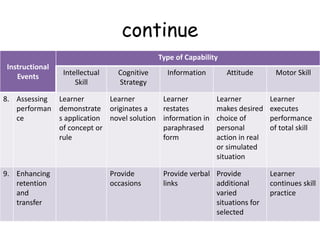
8. Assessing
performan
ce
Learner
demonstrate
s application
of concept or
rule
Learner
originates a
novel solution
Learner
restates
information in
paraphrased
form
Learner
makes desired
choice of
personal
action in real
or simulated
situation
Learner
executes
performance
of total skill
9. Enhancing
retention
and
transfer
Provide
occasions
Provide verbal
links
Provide
additional
varied
situations for
selected
Learner
continues skill
practice
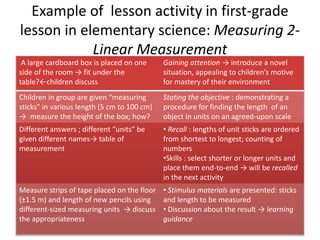
Example of lesson activity in first-grade
lesson in elementary science: Measuring 2-
Linear Measurement
A large cardboard box is placed on one
side of the room → fit under the
table?←children discuss
Gaining attention → introduce a novel
situation, appealing to children’s motive
for mastery of their environment
Children in group are given “measuring
sticks” in various length (5 cm to 100 cm)
→ measure the height of the box; how?
Stating the objective : demonstrating a
procedure for finding the length of an
object in units on an agreed-upon scale
Different answers ; different “units” be
given different names→ table of
measurement
• Recall : lengths of unit sticks are ordered
from shortest to longest; counting of
numbers
•Skills : select shorter or longer units and
place them end-to-end → will be recalled
in the next activity
Measure strips of tape placed on the floor
(±1.5 m) and length of new pencils using
different-sized measuring units → discuss
the appropriateness
• Stimulus materials are presented: sticks
and length to be measured
• Discussion about the result → learning
guidance
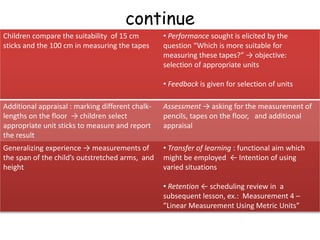
continue
Children compare the suitability of 15 cm
sticks and the 100 cm in measuring the tapes
• Performance sought is elicited by the
question “Which is more suitable for
measuring these tapes?” → objective:
selection of appropriate units
• Feedback is given for selection of units
Additional appraisal : marking different chalk-
lengths on the floor → children select
appropriate unit sticks to measure and report
the result
Assessment → asking for the measurement of
pencils, tapes on the floor, and additional
appraisal
Generalizing experience → measurements of
the span of the child’s outstretched arms, and
height
• Transfer of learning : functional aim which
might be employed ← Intention of using
varied situations
• Retention ← scheduling review in a
subsequent lesson, ex.: Measurement 4 –
”Linear Measurement Using Metric Units”
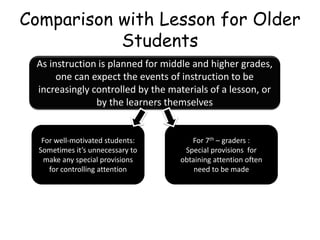
Comparison with Lesson for Older
Students
As instruction is planned for middle and higher grades,
one can expect the events of instruction to be
increasingly controlled by the materials of a lesson, or
by the learners themselves
For well-motivated students:
Sometimes it’s unnecessary to
make any special provisions
for controlling attention
For 7th – graders :
Special provisions for
obtaining attention often
need to be made
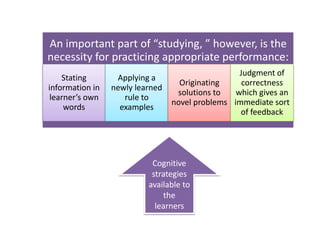
An important part of “studying, ” however, is the
necessity for practicing appropriate performance:
Stating
information in
learner’s own
words
Applying a
newly learned
rule to
examples
Originating
solutions to
novel problems
Judgment of
correctness
which gives an
immediate sort
of feedback
Cognitive
strategies
available to
the
learners
Thank You

Instructional events and learning outcomes

  • 1.
    Instructional Events andLearning Outcomes Instructional Events Type of Capability Intellectual Skill Cognitive Strategy Information Attitude Motor Skill 1. Gaining attention Introduce stimulus change; variations in sensory mode 2. Informing learner of objective Provide description and example of the performance to be expected Clarify the general nature of the solution expected Indicate the kind of verbal question to be answered Provide example of the kind of action device aimed for Provide a demonstrat ion of the performanc e to be expected 3. Stimulatin g recall of prerequisi tes Stimulate recall of subordinate concepts and rules Stimulate recall of task strategies and associated intellectual skills Stimulate recall of context of organized information Stimulate recall of relevant information, skills, and human model identification Stimulate recall of executive sub-routine and part- skills
  • 2.
    continue Instructional events Type of capability Intellectual skill Cognitive Strategy InformationAttitude Motor Skill 4. Presentin g the stimulus material Present examples of concept or rule Present novel problems Present information in propositional form Present human model, demonstratin g choice of personal action Provide external stimuli for performance, including tools or implements 5. Providing learning guidance Provide verbal cues to proper combining sequence Provide prompts and hints to novel solution Provide verbal links to a larger meaningful context Provide for observation of model’s choice of action, and of reinforcemen t received by model Provide practice with feedback of performance achievement
  • 3.
    continue Instructional Events Type of Capability Intellectual Skill Cognitive Strategy InformationAttitude Motor Skill 6. Eliciting the performa nce Ask learner to apply rule or concept to new examples Ask for problem solution Ask for information in paraphrase, or in learner’s own words Ask learner to indicate choices of action in real or simulated situations Ask for execution of the performance 7. Providing feedback Confirm correctness of rule or concept application Confirm originality of problem solution Confirm correctness of statement or information Provide direct or vicarious reinforcement of action choice Provide feedback on degree of accuracy and timing of performance
  • 4.
    continue Instructional Events Type of Capability Intellectual Skill Cognitive Strategy InformationAttitude Motor Skill 8. Assessing performan ce Learner demonstrate s application of concept or rule Learner originates a novel solution Learner restates information in paraphrased form Learner makes desired choice of personal action in real or simulated situation Learner executes performance of total skill 9. Enhancing retention and transfer Provide occasions Provide verbal links Provide additional varied situations for selected Learner continues skill practice
  • 5.
    Example of lessonactivity in first-grade lesson in elementary science: Measuring 2- Linear Measurement A large cardboard box is placed on one side of the room → fit under the table?←children discuss Gaining attention → introduce a novel situation, appealing to children’s motive for mastery of their environment Children in group are given “measuring sticks” in various length (5 cm to 100 cm) → measure the height of the box; how? Stating the objective : demonstrating a procedure for finding the length of an object in units on an agreed-upon scale Different answers ; different “units” be given different names→ table of measurement • Recall : lengths of unit sticks are ordered from shortest to longest; counting of numbers •Skills : select shorter or longer units and place them end-to-end → will be recalled in the next activity Measure strips of tape placed on the floor (±1.5 m) and length of new pencils using different-sized measuring units → discuss the appropriateness • Stimulus materials are presented: sticks and length to be measured • Discussion about the result → learning guidance
  • 6.
    continue Children compare thesuitability of 15 cm sticks and the 100 cm in measuring the tapes • Performance sought is elicited by the question “Which is more suitable for measuring these tapes?” → objective: selection of appropriate units • Feedback is given for selection of units Additional appraisal : marking different chalk- lengths on the floor → children select appropriate unit sticks to measure and report the result Assessment → asking for the measurement of pencils, tapes on the floor, and additional appraisal Generalizing experience → measurements of the span of the child’s outstretched arms, and height • Transfer of learning : functional aim which might be employed ← Intention of using varied situations • Retention ← scheduling review in a subsequent lesson, ex.: Measurement 4 – ”Linear Measurement Using Metric Units”
  • 7.
    Comparison with Lessonfor Older Students As instruction is planned for middle and higher grades, one can expect the events of instruction to be increasingly controlled by the materials of a lesson, or by the learners themselves For well-motivated students: Sometimes it’s unnecessary to make any special provisions for controlling attention For 7th – graders : Special provisions for obtaining attention often need to be made
  • 8.
    An important partof “studying, ” however, is the necessity for practicing appropriate performance: Stating information in learner’s own words Applying a newly learned rule to examples Originating solutions to novel problems Judgment of correctness which gives an immediate sort of feedback Cognitive strategies available to the learners
  • 9.