






















































INSTITUTIONALETHICS
COMMITTEE (IEC)
 Independent body constituted of medical, non-
medical, scientific and non-scientific members
 whose responsibility is to ensure the protection of the
rights, safety and well-being of human subjects
involved in the trial
 by, among other things, reviewing, approving &
providing continuing review of trial protocol &
ICMR GUIDELINES FOR IEC-
AN OVERVIEW
PROF. Dr. V.SATHYA NARAYANAN M.D.,
PROFESSOR OF PHARMACOLOGY
SRM MCH & RC
 the apex body in India for the
 formulation,
 coordination and
 promotion of biomedical research.
 one of the oldest medical research bodies in the world.
 funded by the Government of India through the
Department of Health Research, Ministry of Health &
Family Welfare
The Indian Council of Medical
Research (ICMR)
 Structure of Institutional Ethics Committee
 Functioning of IECs
 Review procedures
 Steps towards IEC Meetings I ( 1- 4 )
 Steps towards IEC Meetings II ( 5-10 )
 Responsibilities of IEC members
 conclusion
OUTLINE
 At the end of the session participants be able to
 Describe the structure of an IEC
 Describe the review process from within
the IEC
 Describe the responsibilities of an IEC
member
Objectives
Composition:
 Multidisciplinary and multisectorial in
composition
 Number of persons – 5/7 – 12/15
Structure of IEC
 Chair should preferably be from outside the Institution
and not head of the same
 Institution to maintain the independence of the
Committee.
 Member secretary, from same institution
 should conduct the business of the Committee
Specific members of IECs
 Chair
 1-2 basic medical scientists
 1-2 clinicians from various institutes
 One legal expert or retired judge
 One social scientist/representative of NG voluntary agency
 One philosopher/ethicist/theologian
 One lay person
 Member Secretary
 If required, subject experts could be invited to offer views
Members of IEC
Described in terms of;
Review procedures
Decision making processes
Documentation requirements
Functioning of IECs
 Scientific evaluation should be completed
before ethical evaluation
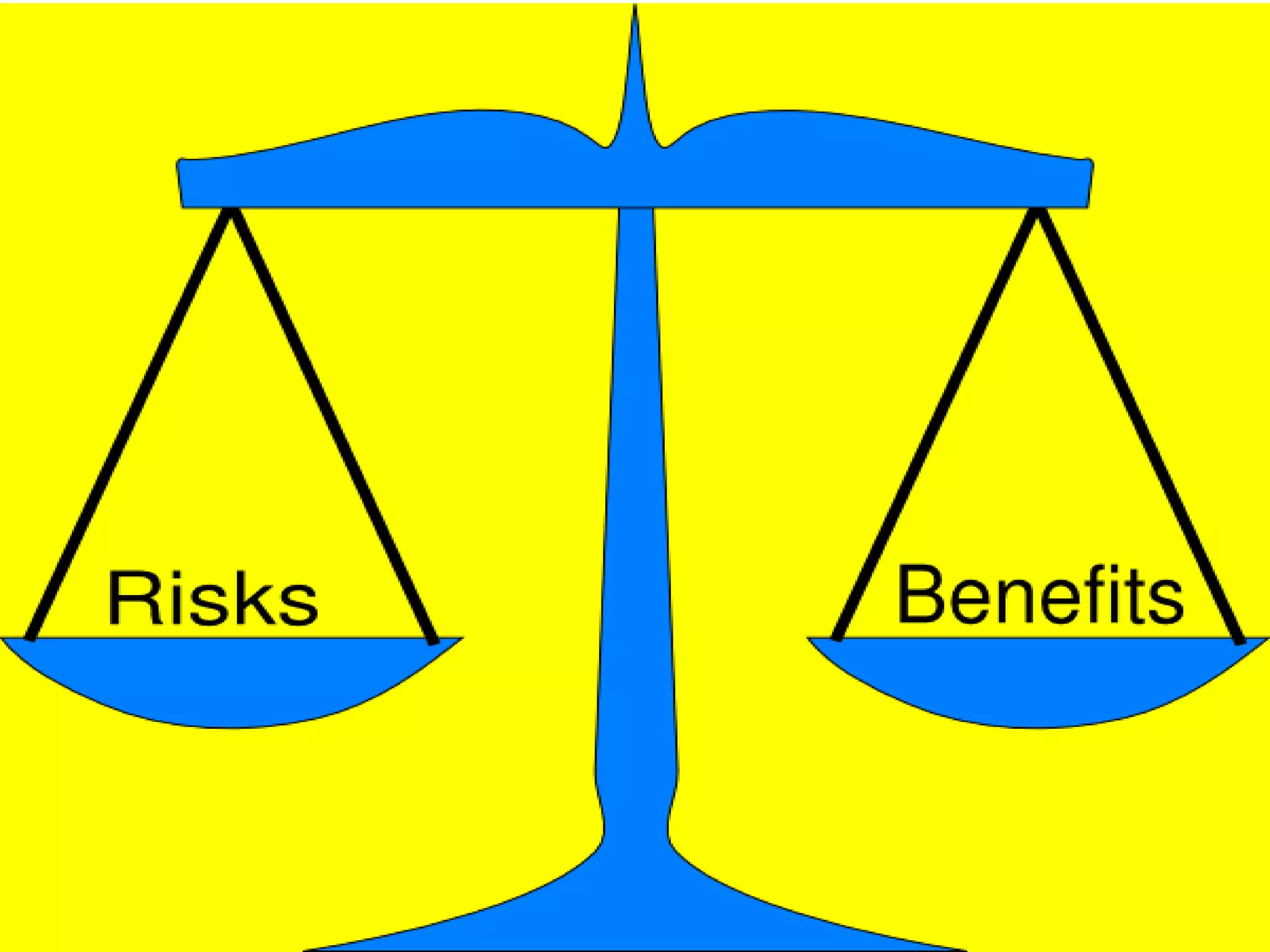
 Evaluate possible risks to the subjects with
proper justification
 Expected benefits
Review Procedures
 Adequacy of documentation for ensuring privacy,
confidentiality and justice issues
 The ethical review should be done through formal
meetings and should not resort to decisions through
circulation of proposals
 Decisions are preferably arrived at by consensus
Review Procedures
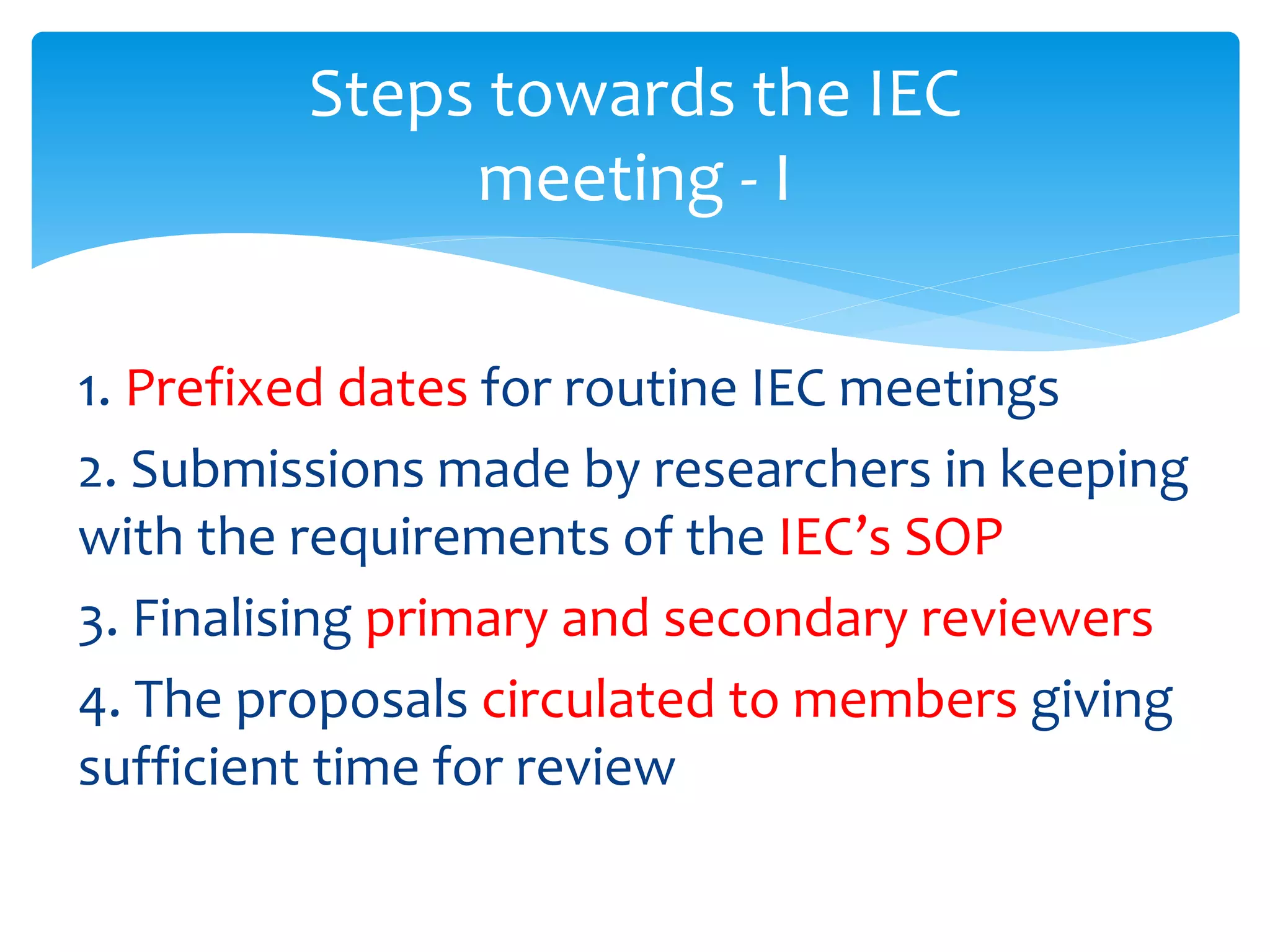
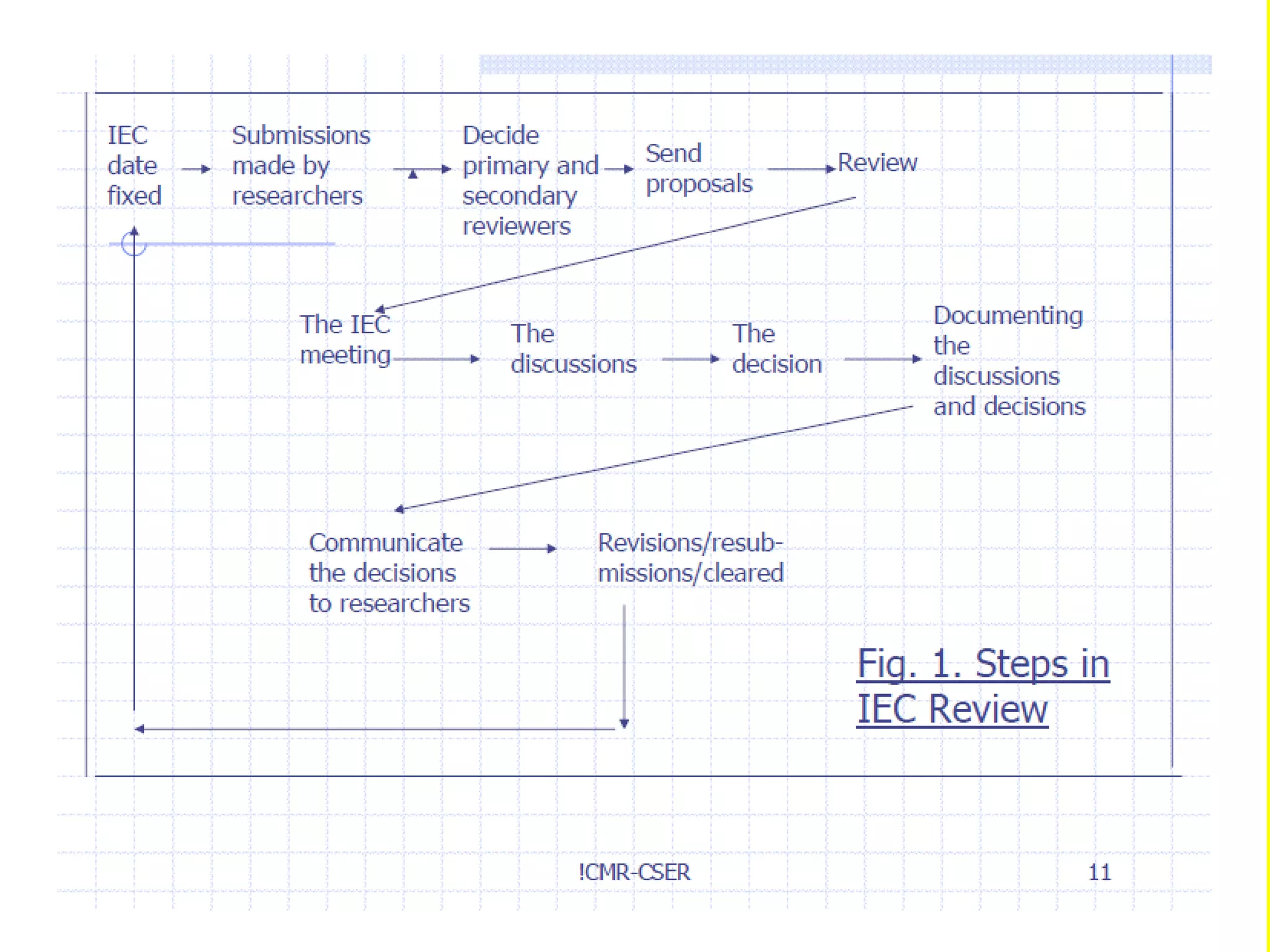
1. Prefixed dates for routine IEC meetings
2. Submissions made by researchers in keeping
with the requirements of the IEC’s SOP
3. Finalising primary and secondary reviewers
4. The proposals circulated to members giving
sufficient time for review
Steps towards the IEC
meeting - I
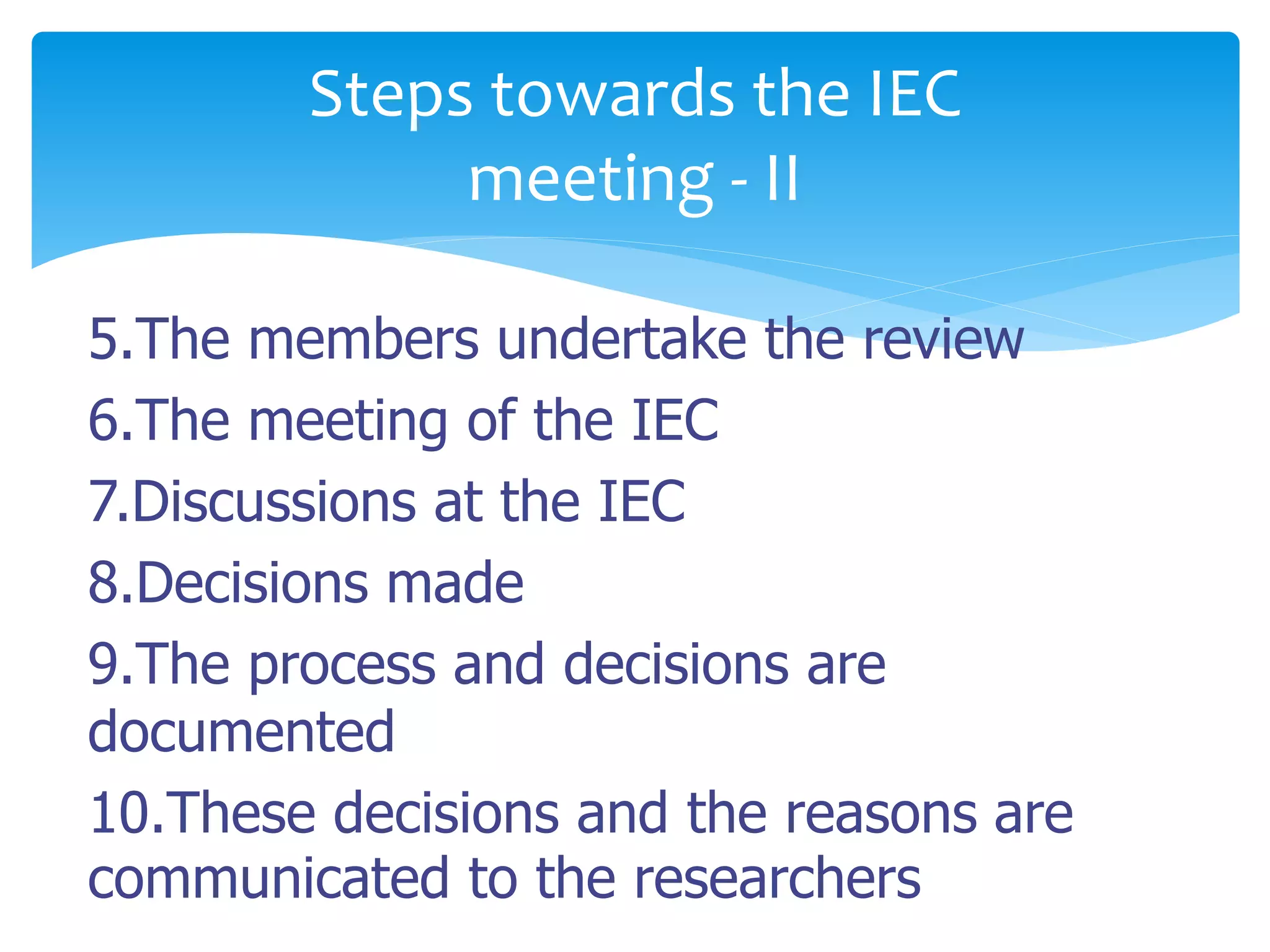
5.The members undertake the review
6.The meeting of the IEC
7.Discussions at the IEC
8.Decisions made
9.The process and decisions are
documented
10.These decisions and the reasons are
communicated to the researchers
Steps towards the IEC
meeting - II
Preparatory phase: steps 1-4
 Need to be finalised in advance
 This helps researchers develop, finalise
the materials
 Plan in advance
Step 1. Prefixed dates
 Knowledge of the dates facilitates timely submissions
Step 2.Submissions to the IEC
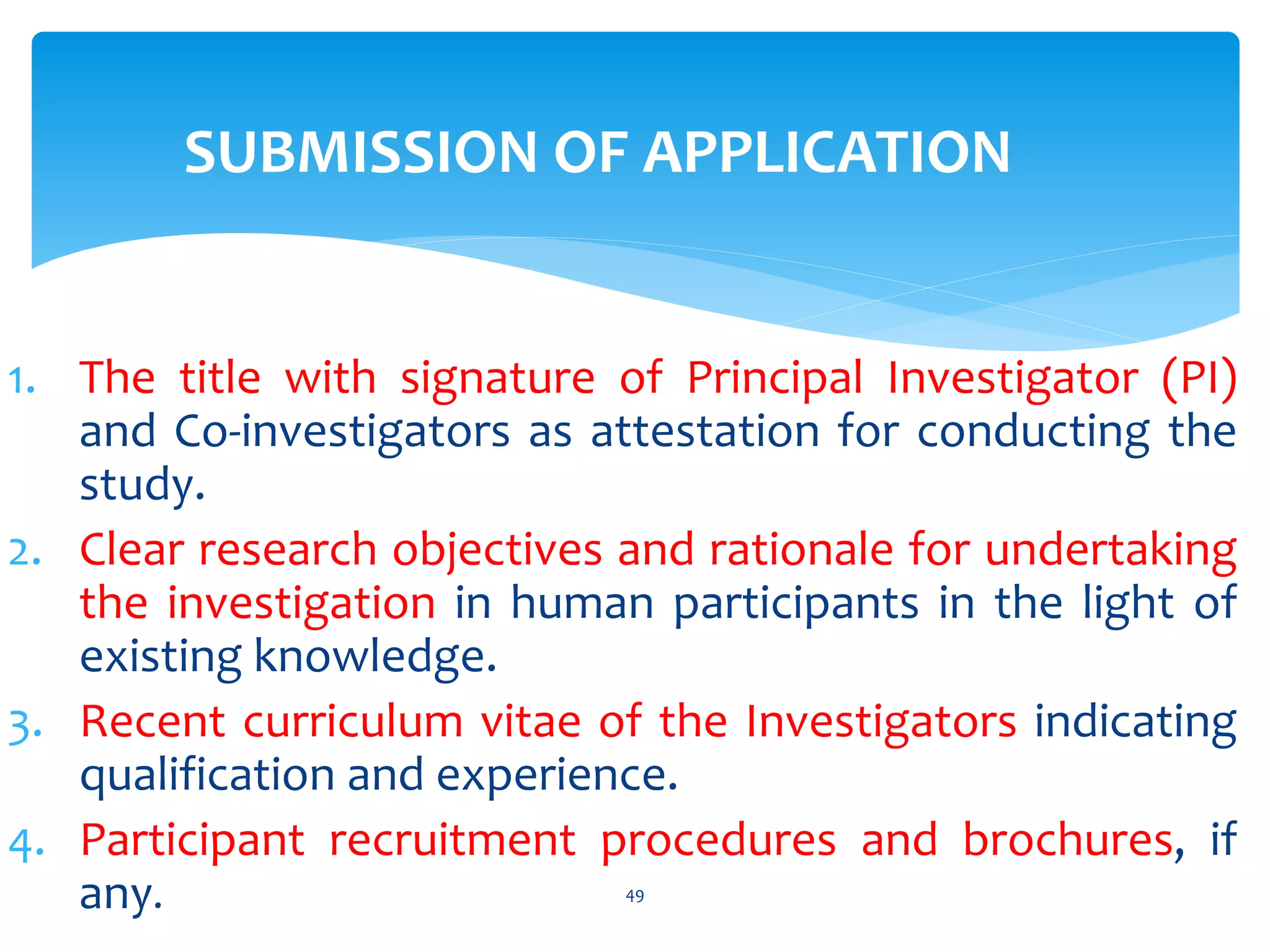
SUBMISSION OF APPLICATION
1. The title with signature of Principal Investigator (PI)
and Co-investigators as attestation for conducting the
study.
2. Clear research objectives and rationale for undertaking
the investigation in human participants in the light of
existing knowledge.
3. Recent curriculum vitae of the Investigators indicating
qualification and experience.
4. Participant recruitment procedures and brochures, if
any. 49
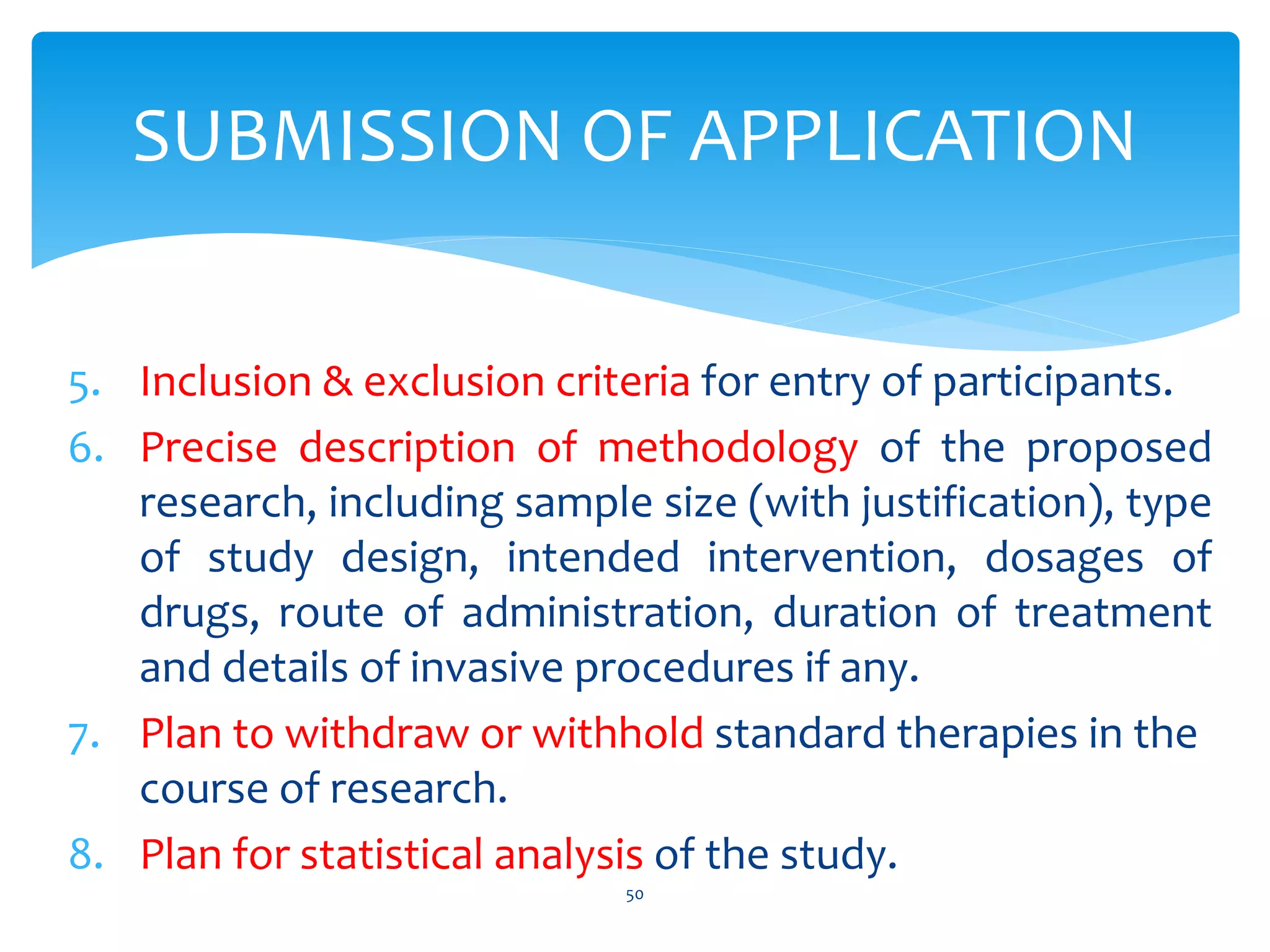
5. Inclusion & exclusion criteria for entry of participants.
6. Precise description of methodology of the proposed
research, including sample size (with justification), type
of study design, intended intervention, dosages of
drugs, route of administration, duration of treatment
and details of invasive procedures if any.
7. Plan to withdraw or withhold standard therapies in the
course of research.
8. Plan for statistical analysis of the study.
50
SUBMISSION OF APPLICATION
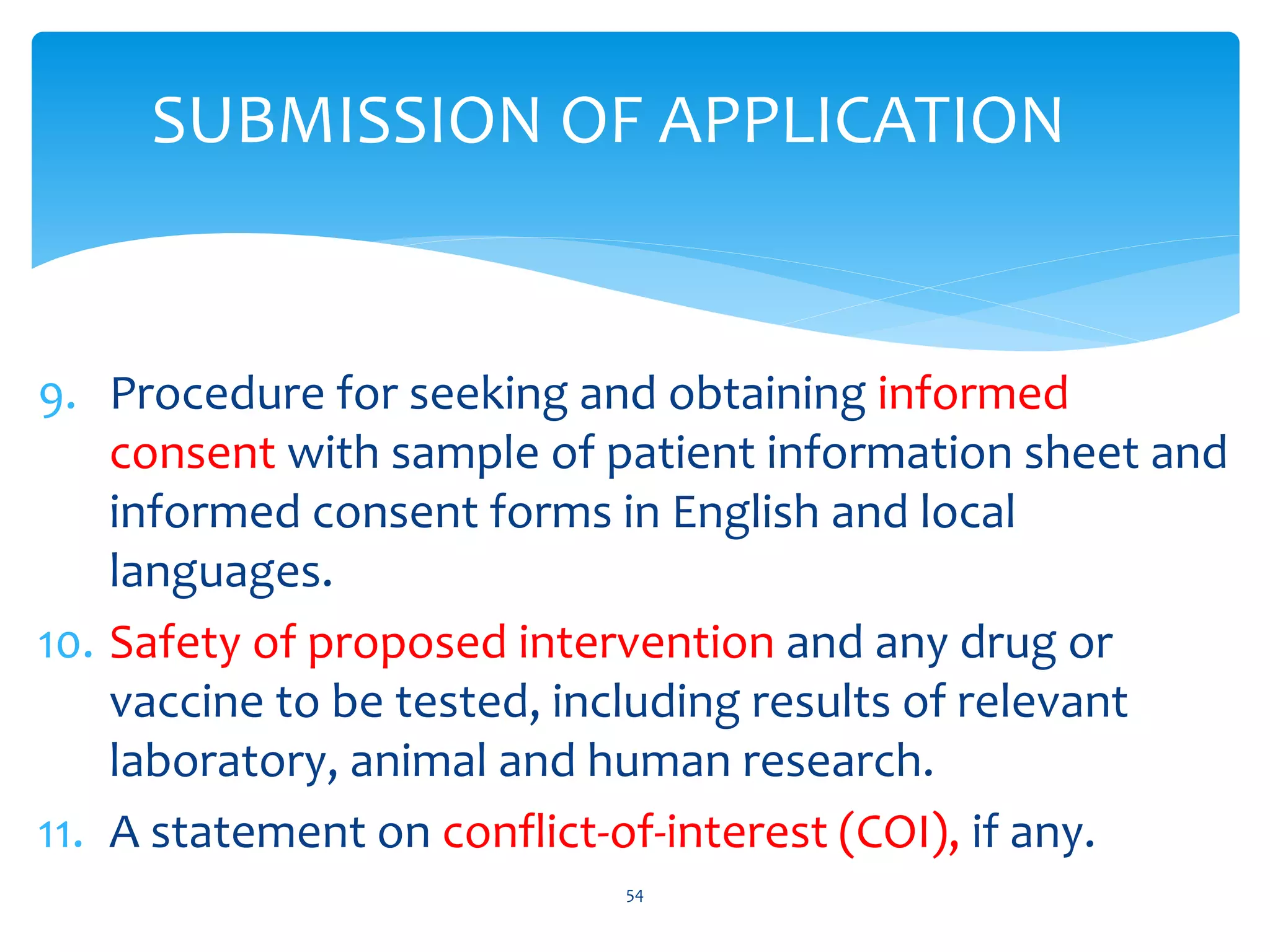
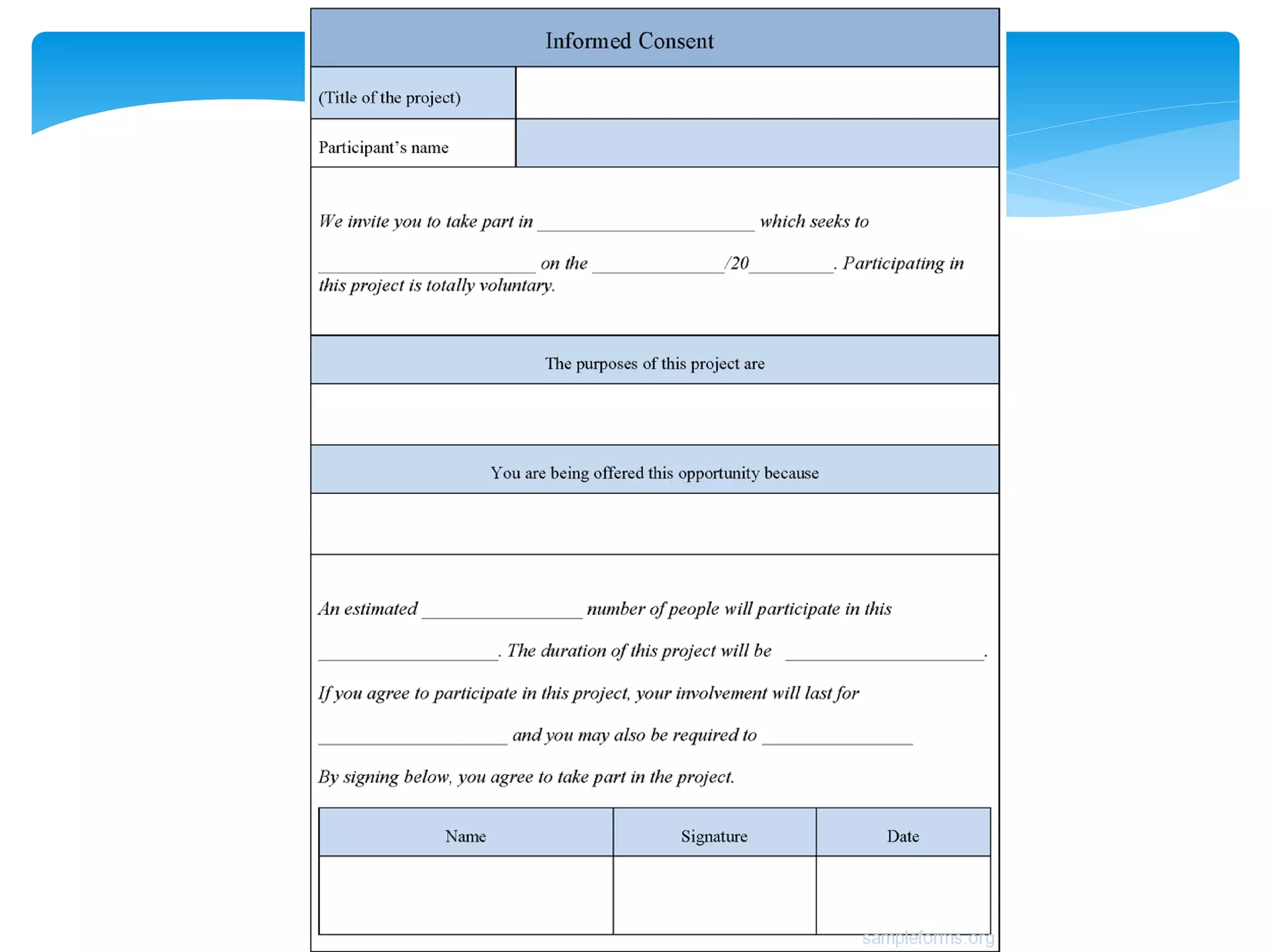
9. Procedure for seeking and obtaining informed
consent with sample of patient information sheet and
informed consent forms in English and local
languages.
10. Safety of proposed intervention and any drug or
vaccine to be tested, including results of relevant
laboratory, animal and human research.
11. A statement on conflict-of-interest (COI), if any.
54
 The secretariat of the IEC sorts through
the proposals,
 allocates primary and secondary
reviewers for the proposals that need
full review
Step 3. Primary and secondary
reviewers
Proposals are mailed to all
members
Step 4. Sending of proposals
The Review Phase: Steps 5-9
 The members review the proposal keeping in mind
the subjects (vulnerability, etc),
 the process(consent, requirements for privacy and
confidentiality etc),
 the study requirements (risks/benefits etc)
 Seeks and obtains clarifications if necessary
Step 5. The review
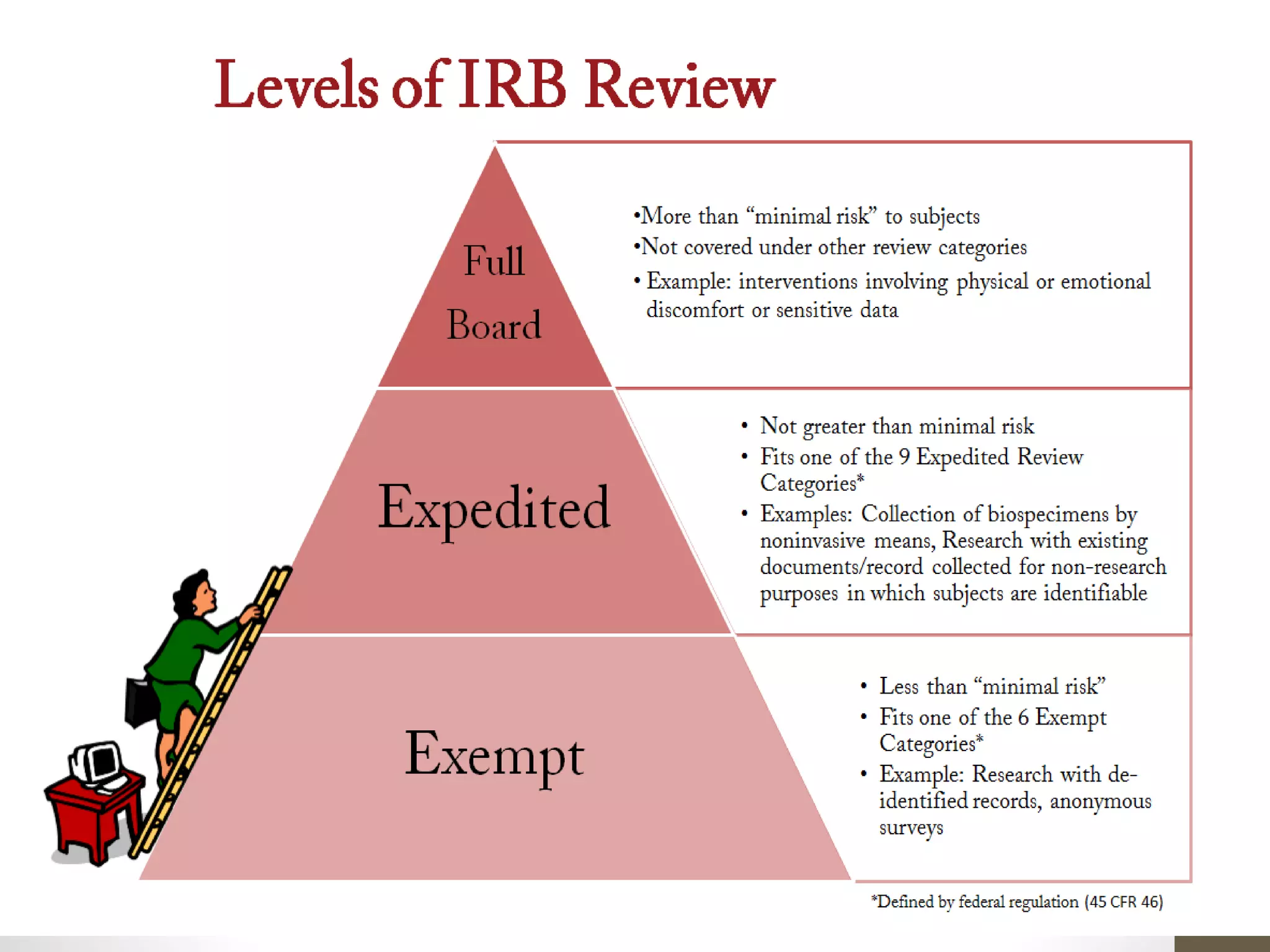
TYPES OF REVIEW
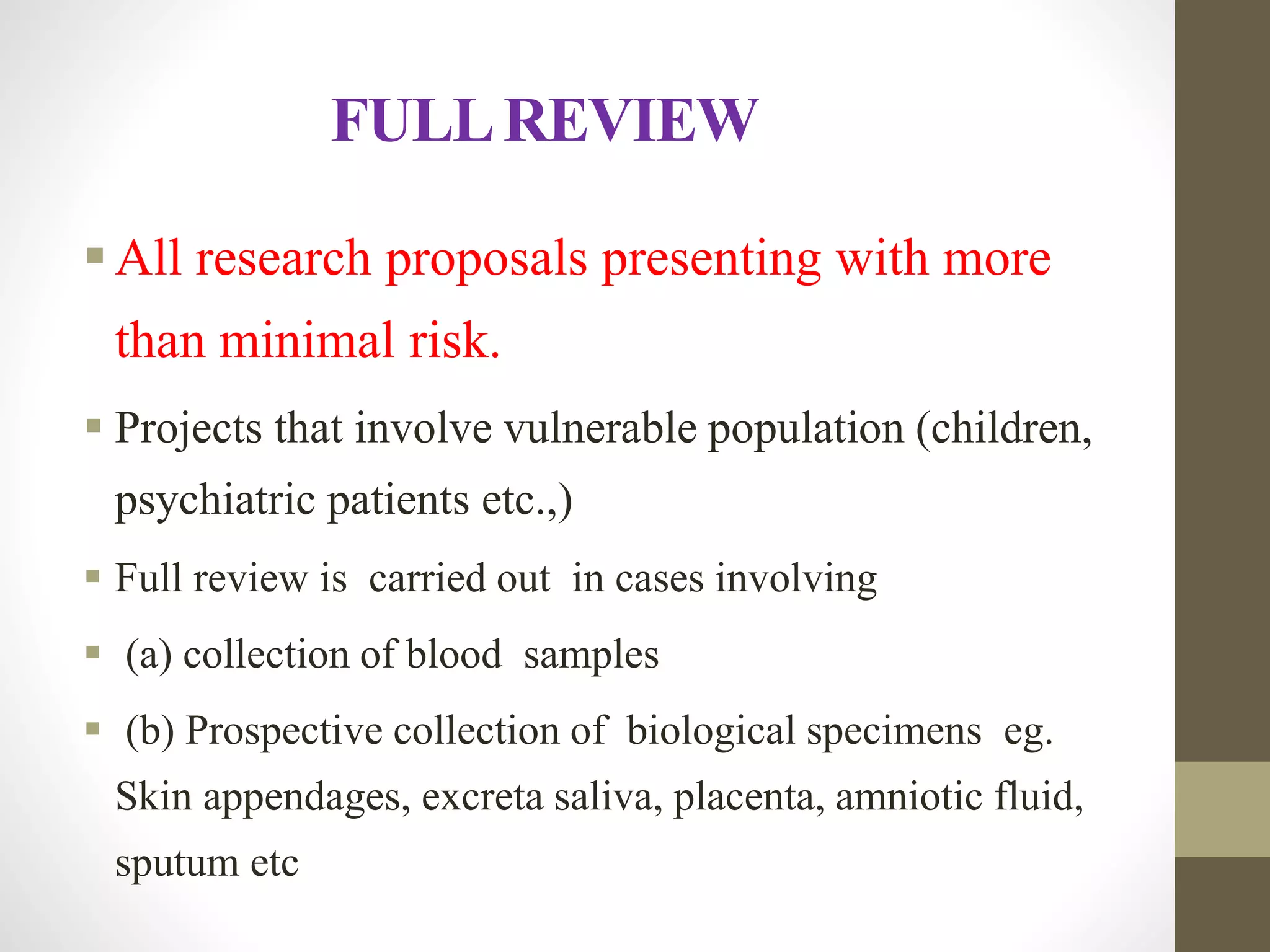
FULLREVIEW
All research proposals presenting with more
than minimal risk.
 Projects that involve vulnerable population (children,
psychiatric patients etc.,)
 Full review is carried out in cases involving
 (a) collection of blood samples
 (b) Prospective collection of biological specimens eg.
Skin appendages, excreta saliva, placenta, amniotic fluid,
sputum etc
EXPEDITED REVIEW
• Those with no more than minimal risk to research
participants may be subjected to this review
Ex: clinical studies of drugs and medical devices
the research involves already approved drugs
when a adverse event or unexpected adverse
reaction is reported
EXEMPTED FROM REVIEW
Proposals with less than minimal risk
Ex: research on educational practice,
• instructional technics, curricula,
• classroom management methods
 Presided over by the chair
 The members have done their homework!
 Attend meeting and engage in discussion
 If further clarifications needed, ask for the
PI to be present
 Discuss and discuss and discuss
Step 6. The IEC meeting
 The various members raise concerns regarding aspects of
proposal
 Many of the issues are clarified by within group discussions
 Usually the guidance from the ICMR guidelines and
the various govt. regulations are referred to already by
specific members when there are contentious issues
 In case these are not adequate, the members also use other
guidelines and use scholarly journals for additional support
for decisions
Step 7. The discussions
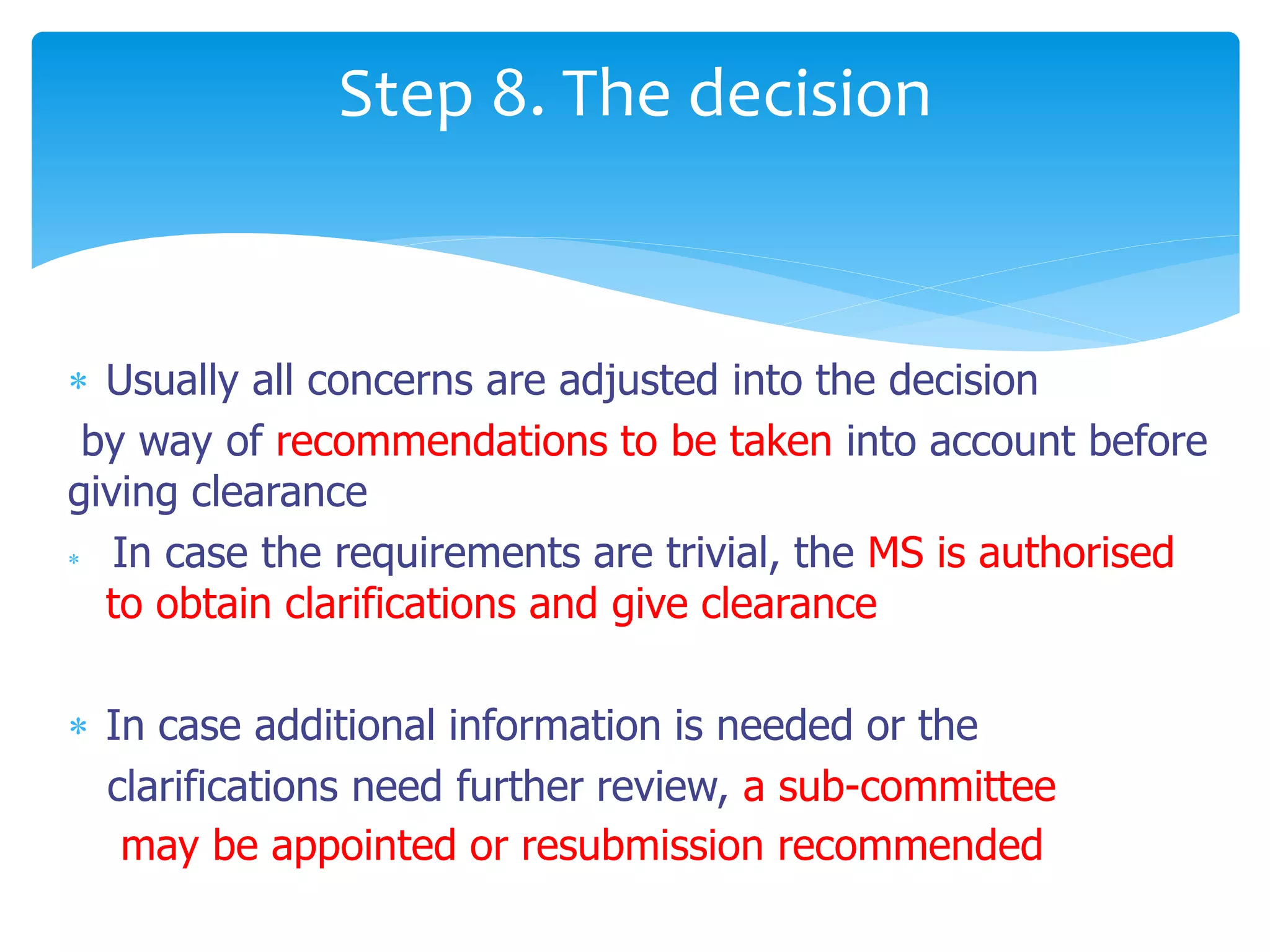
 Usually all concerns are adjusted into the decision
by way of recommendations to be taken into account before
giving clearance
 In case the requirements are trivial, the MS is authorised
to obtain clarifications and give clearance
 In case additional information is needed or the
clarifications need further review, a sub-committee
may be appointed or resubmission recommended
Step 8. The decision
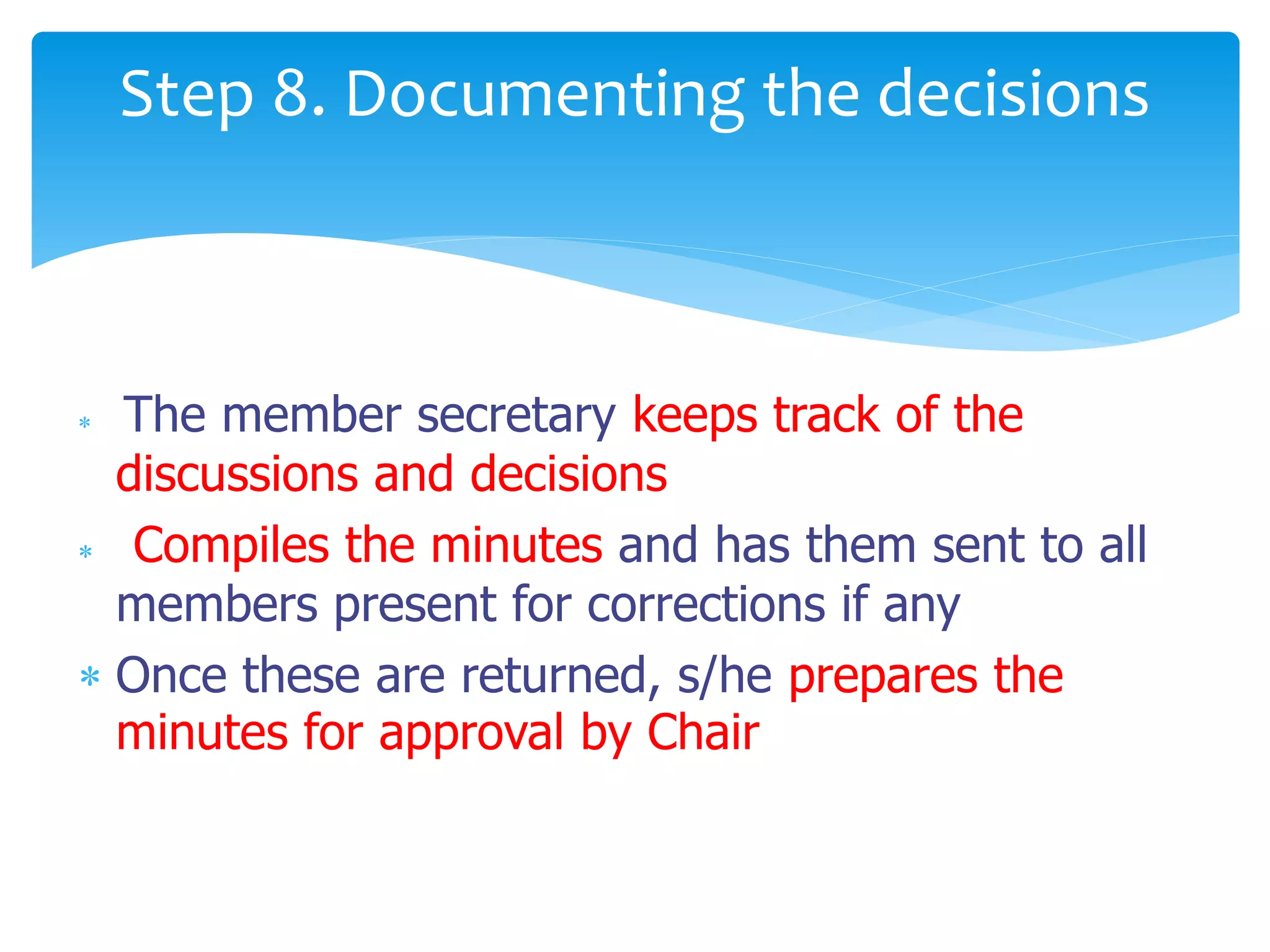
 The member secretary keeps track of the
discussions and decisions
 Compiles the minutes and has them sent to all
members present for corrections if any
 Once these are returned, s/he prepares the
minutes for approval by Chair
Step 8. Documenting the decisions
 The MS communicates these decisions to
the researchers and also
 advices them on what is necessary in case
of any recommendations that call for
changes
Step 9. The communication with the
researchers
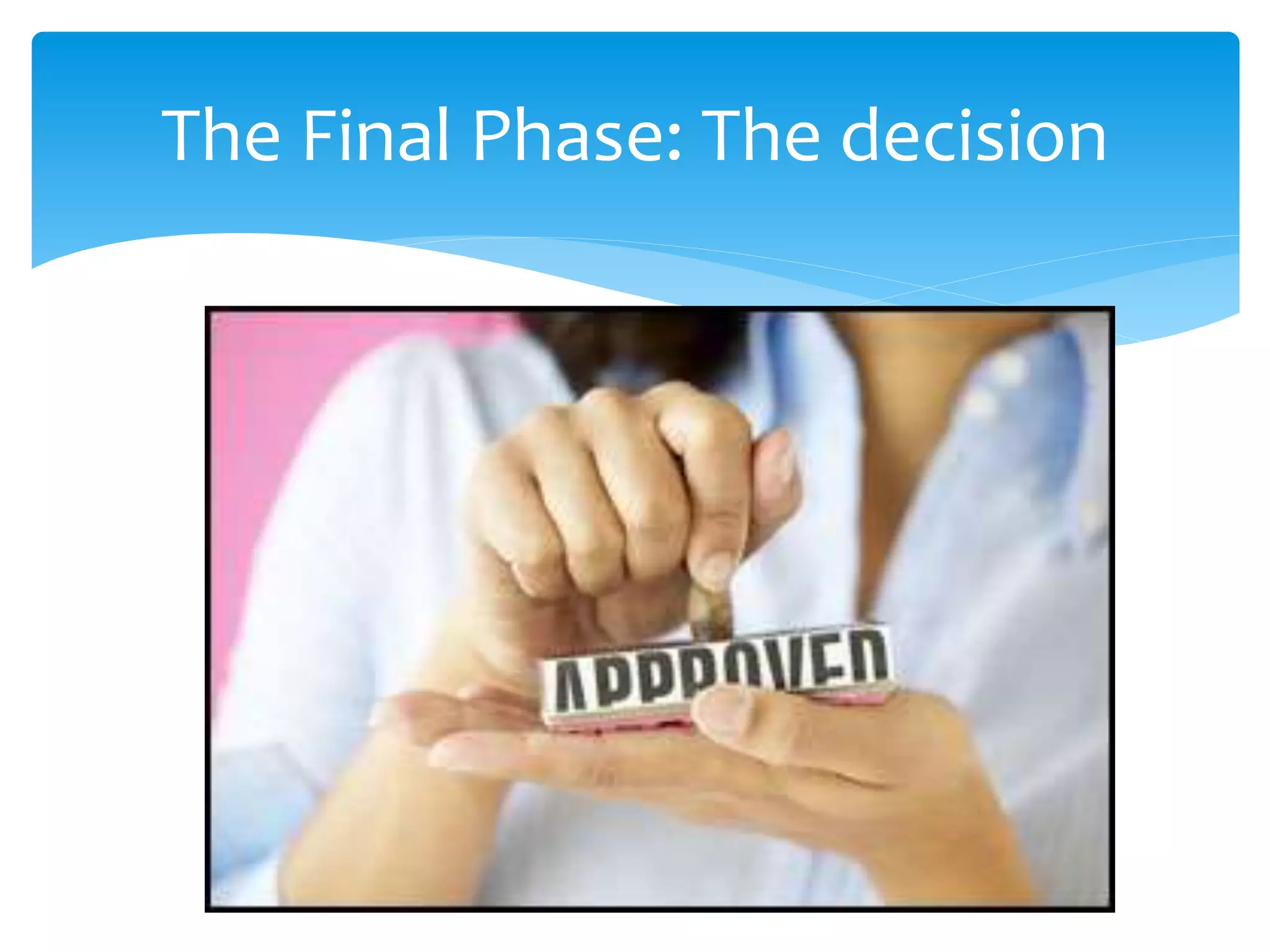
The Final Phase: The decision
 Outright approval (at most, only very minor changes
are suggested. The application contained all necessary
information.)
 Approval with modifications (there is enough
information to judge the study, but clarification or changes
are needed)
 Resubmit with more information (there is not
enough information to judge the application appropriately)
 Outright disapproval (there is no way the researcher
can ethically do study)
Step 10. The decision:
 Meetings must be minuted and approved and
signed by chair
 Strict confidentiality
 All documentation, including final reports of
the study, microfilms, CDs and video recordings
need to be kept safe for about 15 years
(currently revised to a minimum of 3 years)
Documentation requirements
Responsibilities of IEC
Members
1. To provide competent review of all ethical
aspects of the project
2. Undertake review free from bias and
influence
3. Provide advice to the researchers on all
aspects of welfare and safety of research
participants
Responsibilities of IEC
Members
 Undergo appropriate training to enhance
competence
 To maintain confidentiality of documents
obtained and discussions during the review
process
 To allocate time for reviewing the proposals
1. To provide competent review of all
ethical aspects of the project
 Need to put on record various interests,
financial or otherwise to avoid conflict of
interest
 Reflexivity about the nature of
engagement with protocols
 Non-judgmental and unbiased decision
making
2. Undertake review free from
bias and influence
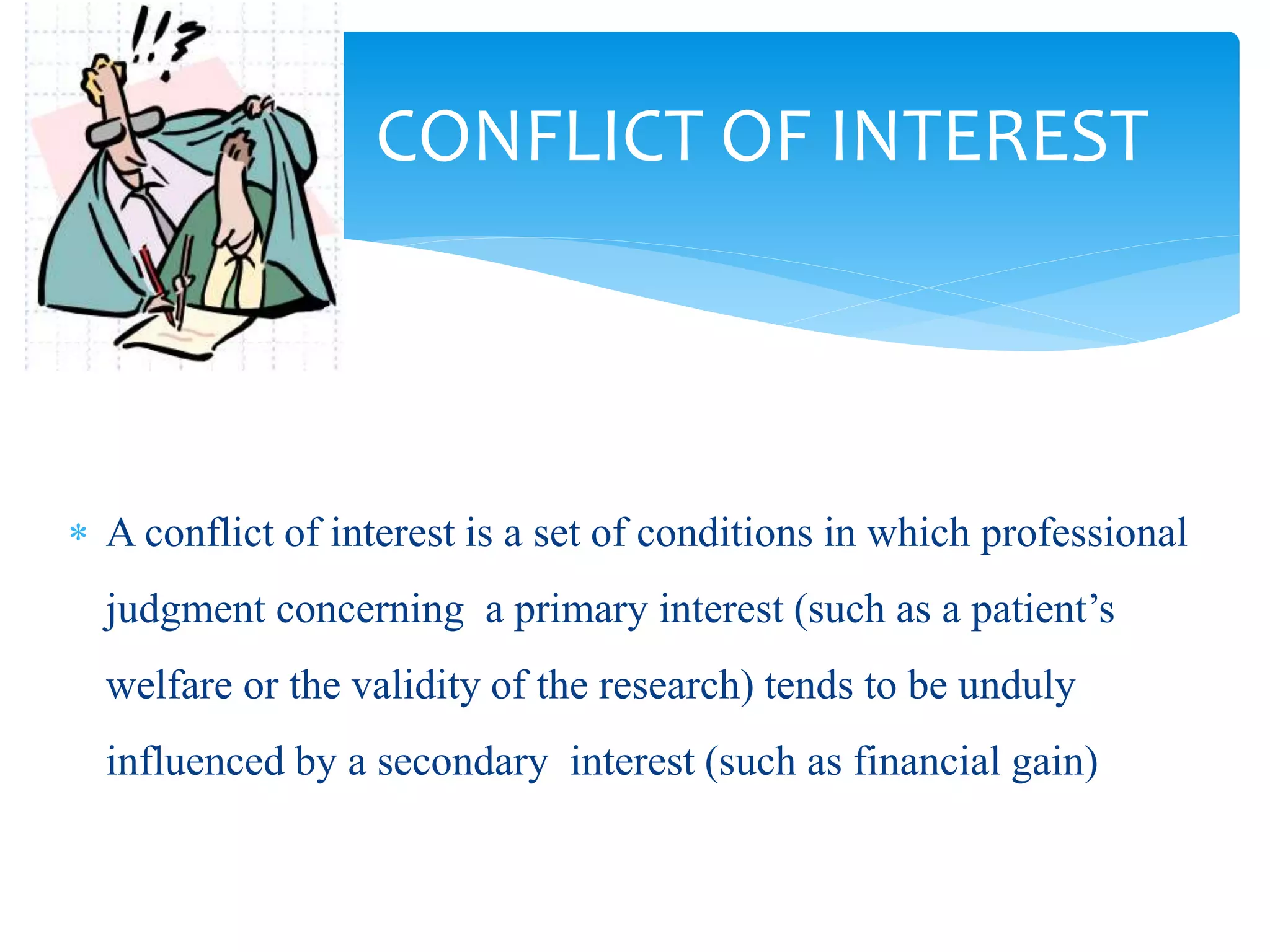
CONFLICT OF INTEREST
 A conflict of interest is a set of conditions in which professional
judgment concerning a primary interest (such as a patient’s
welfare or the validity of the research) tends to be unduly
influenced by a secondary interest (such as financial gain)
 Need to build capacity of researchers
 Provide ongoing review
 Monitor the taking of consent
 Ensure that the guidance from the ERB is actually
followed
 Keep oneself informed of the research process and
re-review whenever necessary
3. Provide advice to the researchers on
all aspects of welfare and safety of
research participants
 Discussed the structure and functions
of IEC
 Described the review process
 Explained the responsibilities of
members of the IEC
 I hope you have a productive time
discussing the proposals
CONCLUSION
A QUOTE ON ETHICS
THANK YOU..

ICMR guidelines for IEC - an overview

  • 10.
    INSTITUTIONALETHICS COMMITTEE (IEC)  Independentbody constituted of medical, non- medical, scientific and non-scientific members  whose responsibility is to ensure the protection of the rights, safety and well-being of human subjects involved in the trial  by, among other things, reviewing, approving & providing continuing review of trial protocol &
  • 11.
    ICMR GUIDELINES FORIEC- AN OVERVIEW PROF. Dr. V.SATHYA NARAYANAN M.D., PROFESSOR OF PHARMACOLOGY SRM MCH & RC
  • 13.
     the apexbody in India for the  formulation,  coordination and  promotion of biomedical research.  one of the oldest medical research bodies in the world.  funded by the Government of India through the Department of Health Research, Ministry of Health & Family Welfare The Indian Council of Medical Research (ICMR)
  • 16.
     Structure ofInstitutional Ethics Committee  Functioning of IECs  Review procedures  Steps towards IEC Meetings I ( 1- 4 )  Steps towards IEC Meetings II ( 5-10 )  Responsibilities of IEC members  conclusion OUTLINE
  • 18.
     At theend of the session participants be able to  Describe the structure of an IEC  Describe the review process from within the IEC  Describe the responsibilities of an IEC member Objectives
  • 21.
    Composition:  Multidisciplinary andmultisectorial in composition  Number of persons – 5/7 – 12/15 Structure of IEC
  • 22.
     Chair shouldpreferably be from outside the Institution and not head of the same  Institution to maintain the independence of the Committee.  Member secretary, from same institution  should conduct the business of the Committee Specific members of IECs
  • 24.
     Chair  1-2basic medical scientists  1-2 clinicians from various institutes  One legal expert or retired judge  One social scientist/representative of NG voluntary agency  One philosopher/ethicist/theologian  One lay person  Member Secretary  If required, subject experts could be invited to offer views Members of IEC
  • 26.
    Described in termsof; Review procedures Decision making processes Documentation requirements Functioning of IECs
  • 31.
     Scientific evaluationshould be completed before ethical evaluation  Evaluate possible risks to the subjects with proper justification  Expected benefits Review Procedures
  • 33.
     Adequacy ofdocumentation for ensuring privacy, confidentiality and justice issues  The ethical review should be done through formal meetings and should not resort to decisions through circulation of proposals  Decisions are preferably arrived at by consensus Review Procedures
  • 38.
    1. Prefixed datesfor routine IEC meetings 2. Submissions made by researchers in keeping with the requirements of the IEC’s SOP 3. Finalising primary and secondary reviewers 4. The proposals circulated to members giving sufficient time for review Steps towards the IEC meeting - I
  • 39.
    5.The members undertakethe review 6.The meeting of the IEC 7.Discussions at the IEC 8.Decisions made 9.The process and decisions are documented 10.These decisions and the reasons are communicated to the researchers Steps towards the IEC meeting - II
  • 43.
  • 44.
     Need tobe finalised in advance  This helps researchers develop, finalise the materials  Plan in advance Step 1. Prefixed dates
  • 47.
     Knowledge ofthe dates facilitates timely submissions Step 2.Submissions to the IEC
  • 49.
    SUBMISSION OF APPLICATION 1.The title with signature of Principal Investigator (PI) and Co-investigators as attestation for conducting the study. 2. Clear research objectives and rationale for undertaking the investigation in human participants in the light of existing knowledge. 3. Recent curriculum vitae of the Investigators indicating qualification and experience. 4. Participant recruitment procedures and brochures, if any. 49
  • 50.
    5. Inclusion &exclusion criteria for entry of participants. 6. Precise description of methodology of the proposed research, including sample size (with justification), type of study design, intended intervention, dosages of drugs, route of administration, duration of treatment and details of invasive procedures if any. 7. Plan to withdraw or withhold standard therapies in the course of research. 8. Plan for statistical analysis of the study. 50 SUBMISSION OF APPLICATION
  • 54.
    SUBMISSION OF APPLICATION 9.Procedure for seeking and obtaining informed consent with sample of patient information sheet and informed consent forms in English and local languages. 10. Safety of proposed intervention and any drug or vaccine to be tested, including results of relevant laboratory, animal and human research. 11. A statement on conflict-of-interest (COI), if any. 54
  • 58.
     The secretariatof the IEC sorts through the proposals,  allocates primary and secondary reviewers for the proposals that need full review Step 3. Primary and secondary reviewers
  • 60.
    Proposals are mailedto all members Step 4. Sending of proposals
  • 63.
  • 64.
     The membersreview the proposal keeping in mind the subjects (vulnerability, etc),  the process(consent, requirements for privacy and confidentiality etc),  the study requirements (risks/benefits etc)  Seeks and obtains clarifications if necessary Step 5. The review
  • 69.
  • 70.
    FULLREVIEW All research proposalspresenting with more than minimal risk.  Projects that involve vulnerable population (children, psychiatric patients etc.,)  Full review is carried out in cases involving  (a) collection of blood samples  (b) Prospective collection of biological specimens eg. Skin appendages, excreta saliva, placenta, amniotic fluid, sputum etc
  • 71.
    EXPEDITED REVIEW • Thosewith no more than minimal risk to research participants may be subjected to this review Ex: clinical studies of drugs and medical devices the research involves already approved drugs when a adverse event or unexpected adverse reaction is reported
  • 72.
    EXEMPTED FROM REVIEW Proposalswith less than minimal risk Ex: research on educational practice, • instructional technics, curricula, • classroom management methods
  • 74.
     Presided overby the chair  The members have done their homework!  Attend meeting and engage in discussion  If further clarifications needed, ask for the PI to be present  Discuss and discuss and discuss Step 6. The IEC meeting
  • 77.
     The variousmembers raise concerns regarding aspects of proposal  Many of the issues are clarified by within group discussions  Usually the guidance from the ICMR guidelines and the various govt. regulations are referred to already by specific members when there are contentious issues  In case these are not adequate, the members also use other guidelines and use scholarly journals for additional support for decisions Step 7. The discussions
  • 81.
     Usually allconcerns are adjusted into the decision by way of recommendations to be taken into account before giving clearance  In case the requirements are trivial, the MS is authorised to obtain clarifications and give clearance  In case additional information is needed or the clarifications need further review, a sub-committee may be appointed or resubmission recommended Step 8. The decision
  • 83.
     The membersecretary keeps track of the discussions and decisions  Compiles the minutes and has them sent to all members present for corrections if any  Once these are returned, s/he prepares the minutes for approval by Chair Step 8. Documenting the decisions
  • 85.
     The MScommunicates these decisions to the researchers and also  advices them on what is necessary in case of any recommendations that call for changes Step 9. The communication with the researchers
  • 87.
    The Final Phase:The decision
  • 88.
     Outright approval(at most, only very minor changes are suggested. The application contained all necessary information.)  Approval with modifications (there is enough information to judge the study, but clarification or changes are needed)  Resubmit with more information (there is not enough information to judge the application appropriately)  Outright disapproval (there is no way the researcher can ethically do study) Step 10. The decision:
  • 94.
     Meetings mustbe minuted and approved and signed by chair  Strict confidentiality  All documentation, including final reports of the study, microfilms, CDs and video recordings need to be kept safe for about 15 years (currently revised to a minimum of 3 years) Documentation requirements
  • 99.
  • 100.
    1. To providecompetent review of all ethical aspects of the project 2. Undertake review free from bias and influence 3. Provide advice to the researchers on all aspects of welfare and safety of research participants Responsibilities of IEC Members
  • 101.
     Undergo appropriatetraining to enhance competence  To maintain confidentiality of documents obtained and discussions during the review process  To allocate time for reviewing the proposals 1. To provide competent review of all ethical aspects of the project
  • 105.
     Need toput on record various interests, financial or otherwise to avoid conflict of interest  Reflexivity about the nature of engagement with protocols  Non-judgmental and unbiased decision making 2. Undertake review free from bias and influence
  • 106.
    CONFLICT OF INTEREST A conflict of interest is a set of conditions in which professional judgment concerning a primary interest (such as a patient’s welfare or the validity of the research) tends to be unduly influenced by a secondary interest (such as financial gain)
  • 109.
     Need tobuild capacity of researchers  Provide ongoing review  Monitor the taking of consent  Ensure that the guidance from the ERB is actually followed  Keep oneself informed of the research process and re-review whenever necessary 3. Provide advice to the researchers on all aspects of welfare and safety of research participants
  • 112.
     Discussed thestructure and functions of IEC  Described the review process  Explained the responsibilities of members of the IEC  I hope you have a productive time discussing the proposals CONCLUSION
  • 113.
    A QUOTE ONETHICS
  • 116.