Ethics Committee’s Role and
Functioning - Committee Formation,
Composition, Registration, SOPs, Role
of Individual Members
DR. SATYABRATA SAHOO
DM CLINICAL PHARMACOLOGY RESIDENT,
DEPT OF CLINICAL AND EXPERIMENTAL PHARMACOLOGY,
CSTM KOLKATA
10/29/2021 1
Introduction
• An ethics committee is a committee formally
designated to review and approve the initiation
of a clinical research study involving human
participants and to provide continuing review of
the research study
• Ethics committee is also known as IRB outside
india
• Any institution and organisation which intends to
conduct Biomedical and health research required
ethics committee according to National Ethical
Guidelines
10/29/2021 2
Committee Formation
• Formation of ethics committee is a new
concept.

• In some corporation a standing committee is
formed to implement ethical concept into
practice
• These committees are headed, directed by
board of directors(internal as well as external)
10/29/2021 3
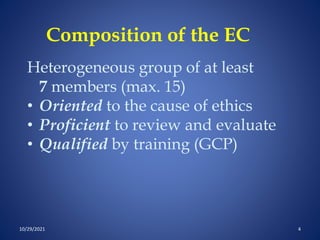
Composition of the EC
Heterogeneous group of at least
7 members (max. 15)
• Oriented to the cause of ethics
• Proficient to review and evaluate
• Qualified by training (GCP)
10/29/2021 4
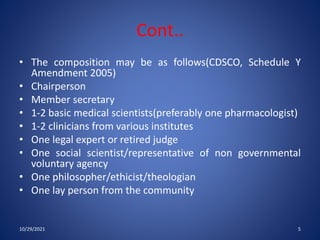
Cont..
• The composition may be as follows(CDSCO, Schedule Y
Amendment 2005)
• Chairperson
• Member secretary
• 1-2 basic medical scientists(preferably one pharmacologist)
• 1-2 clinicians from various institutes
• One legal expert or retired judge
• One social scientist/representative of non governmental
voluntary agency
• One philosopher/ethicist/theologian
• One lay person from the community
10/29/2021 5
10/29/2021 6
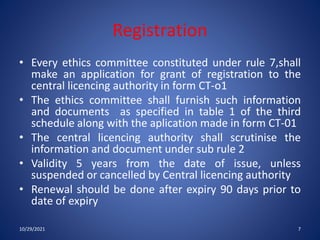
Registration
• Every ethics committee constituted under rule 7,shall
make an application for grant of registration to the
central licencing authority in form CT-o1
• The ethics committee shall furnish such information
and documents as specified in table 1 of the third
schedule along with the aplication made in form CT-01
• The central licencing authority shall scrutinise the
information and document under sub rule 2
• Validity 5 years from the date of issue, unless
suspended or cancelled by Central licencing authority
• Renewal should be done after expiry 90 days prior to
date of expiry
10/29/2021 7
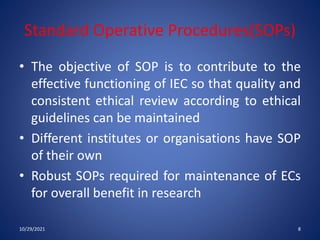
Standard Operative Procedures(SOPs)
• The objective of SOP is to contribute to the
effective functioning of IEC so that quality and
consistent ethical review according to ethical
guidelines can be maintained
• Different institutes or organisations have SOP
of their own
• Robust SOPs required for maintenance of ECs
for overall benefit in research
10/29/2021 8
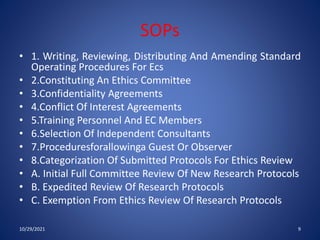
SOPs
• 1. Writing, Reviewing, Distributing And Amending Standard
Operating Procedures For Ecs
• 2.Constituting An Ethics Committee
• 3.Confidentiality Agreements
• 4.Conflict Of Interest Agreements
• 5.Training Personnel And EC Members
• 6.Selection Of Independent Consultants
• 7.Proceduresforallowinga Guest Or Observer
• 8.Categorization Of Submitted Protocols For Ethics Review
• A. Initial Full Committee Review Of New Research Protocols
• B. Expedited Review Of Research Protocols
• C. Exemption From Ethics Review Of Research Protocols
10/29/2021 9
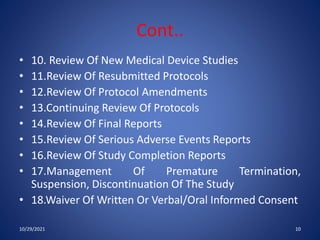
Cont..
• 10. Review Of New Medical Device Studies
• 11.Review Of Resubmitted Protocols
• 12.Review Of Protocol Amendments
• 13.Continuing Review Of Protocols
• 14.Review Of Final Reports
• 15.Review Of Serious Adverse Events Reports
• 16.Review Of Study Completion Reports
• 17.Management Of Premature Termination,
Suspension, Discontinuation Of The Study
• 18.Waiver Of Written Or Verbal/Oral Informed Consent
10/29/2021 10
Cont
• 19.Site Monitoring Visits
• 20.Dealing With Participants Requests And Complaints
• 21.Emergency Meetings
• 22.Communication Records
• 23.Maintainance Of Active Study Files
• 24.Archieve And Retrieval Of Documents
• 25.Maintaining Confidentiality Of Ecs Documents
• 26.Reviewing Proposals Involving Vulnerable Proposals
• 27.Review And Inspection Of EC
• 28.Audio Visual Recording Of The Informed Consent
Process
10/29/2021 11
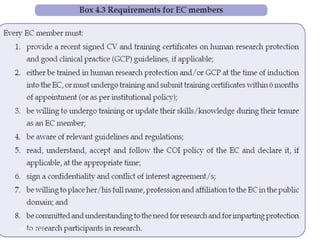
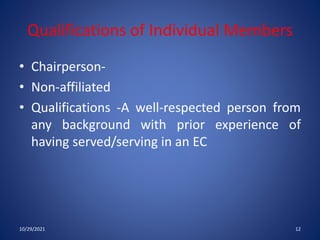
Qualifications of Individual Members
• Chairperson-
• Non-affiliated
• Qualifications -A well-respected person from
any background with prior experience of
having served/serving in an EC
10/29/2021 12
Cont..
• Member secretary-
• Affiliated
• Qualifications -
• Should be a staff member of the institution
• Should have knowledge and experience in clinical
research and ethics, be motivated and have good
communication skills
• Should be able to devote adequate time to this
activity which should be protected by the
institution
10/29/2021 13
Cont..
• Basic Medical Scientist(s)-
• Affiliated/ non-affiliated
• Qualifications -
•Non-medical or medical person with
qualifications in basic medical sciences
•In case of EC reviewing clinical trials with drugs,
the basic medical scientist should preferably
be a pharmacologist
10/29/2021 14
Cont..
• Clinician(s)-
• Affiliated/ non-affiliated
• Qualifications -
• Should be individual/s with recognized medical
qualification, expertise and training
10/29/2021 15
Cont..
• Legal experts-
• Affiliated/ non-affiliated
• Qualifications -
• Should have a basic degree in Law from a
recognized university, with experience
• Desirable: Training in medical law.
10/29/2021 16
Cont..
• Social scientist/ philosopher/
• ethicist/theologian
• Affiliated/ non-affiliated
• Qualifications -
• Should be an individual with social/behavioural
science/ philosophy/ religious qualification and
training and/or expertise and be sensitive to local
cultural and moral values.Can be from an NGO
involved in health-related activities
10/29/2021 17
Cont..
• Lay person(s)
• Non-affiliated
• Qualifications -
• Literate person from the public or community
• Has not pursued a medical science/ health related career in
the last 5 years
• May be a representative of the community from which the
participants are to be drawn
• Is aware of the local language, cultural and moral values of
the community
• Desirable: involved in social and community welfare
activities
10/29/2021 18
EC : Role & Responsibility
Before the study begins:
 EC registration
 Having the SOPs in place
 INV eligibility, site feasibility, conflicts of interests
 Trial registration, regulatory approval
 Review of research proposal (within reasonable time)
 Decision making in formal meeting, documented
 Issuing an approval (in appropriate format)
 Record keeping (meeting agenda, meeting minutes,
decisions communicated to INV, annual/final study
report)
10/29/2021 19
During the study:
 Review of all EC notifications - amendments (protocol,
ICD), protocol deviations
 Review of SAE reporting, analysis, relatedness
assessment, deciding compensation
 Monitoring IC process
 Monitoring study progress and periodic review of study
conduct
 Communicating with INV, RA, Subject (if needed)
 Allowing regulatory inspection
 Record keeping (meeting agenda, meeting minutes,
decisions communicated to INV, annual/final report)
EC : Role & Responsibility
10/29/2021 20
EC : Role & Responsibility
 After the study:
 Review of SAE reporting, analysis, relatedness
assessment, deciding compensation
 Communicating with INV, RA, Subject (if
needed)
 Reviewing study report
 Post trial management
 Publishing
 Record keeping – archival
 Allowing regulatory inspection
10/29/2021 21
Functioning of the EC
• The EC should function in accordance
with the written SOPs that provides
detailed guidelines about the EC
procedures.
• The PI and not the Sponsor
communicates and deals with the
ethics committee.
10/29/2021 22
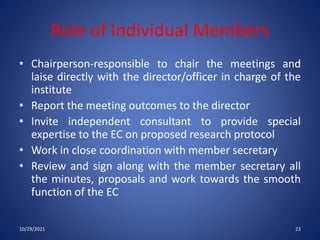
Role of Individual Members
• Chairperson-responsible to chair the meetings and
laise directly with the director/officer in charge of the
institute
• Report the meeting outcomes to the director
• Invite independent consultant to provide special
expertise to the EC on proposed research protocol
• Work in close coordination with member secretary
• Review and sign along with the member secretary all
the minutes, proposals and work towards the smooth
function of the EC
10/29/2021 23
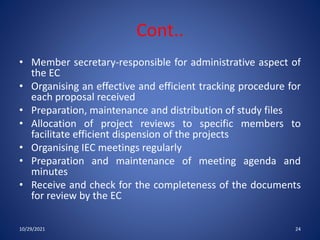
Cont..
• Member secretary-responsible for administrative aspect of
the EC
• Organising an effective and efficient tracking procedure for
each proposal received
• Preparation, maintenance and distribution of study files
• Allocation of project reviews to specific members to
facilitate efficient dispension of the projects
• Organising IEC meetings regularly
• Preparation and maintenance of meeting agenda and
minutes
• Receive and check for the completeness of the documents
for review by the EC
10/29/2021 24
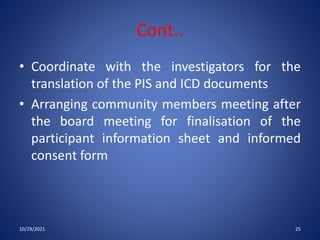
Cont..
• Coordinate with the investigators for the
translation of the PIS and ICD documents
• Arranging community members meeting after
the board meeting for finalisation of the
participant information sheet and informed
consent form
10/29/2021 25
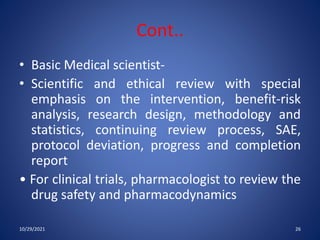
Cont..
• Basic Medical scientist-
• Scientific and ethical review with special
emphasis on the intervention, benefit-risk
analysis, research design, methodology and
statistics, continuing review process, SAE,
protocol deviation, progress and completion
report
• For clinical trials, pharmacologist to review the
drug safety and pharmacodynamics
10/29/2021 26
Cont..
• Clinicians-
• Scientific review of protocols including review of the
intervention, benefit-risk analysis, research design,
methodology, sample size, site of study and statistics
• Ongoing review of the protocol (SAE, protocol deviation
or violation, progress and completion report)
• Review medical care, facility and appropriateness of the
principal investigator, provision for medical care,
management and compensation.
• Thorough review of protocol, investigators brochure (if
applicable) and all other protocol details and submitted
documents.
10/29/2021 27
Cont..
• Legal Expert-
• Ethical review of the proposal, ICD along with
translations, MoU, Clinical Trial Agreement
(CTA),regulatory approval, insurance document,
other site approvals, researcher’s undertaking,
protocol specific other permissions, such as, stem
cell committee for stem cell research, HMSC for
international collaboration, compliance with
guidelines etc.
• Interpret and inform EC members about new
regulations if any
10/29/2021 28
Cont..
• Social scientist/Philosopher/Ethicist/Theologian-
• Ethical review of the proposal, ICD along with the
translations.
• Assess impact on community involvement, socio–
cultural context, religious or philosophical context, if
any
• Serve as a patient/participant/ societal /community
representative and bring in ethical and societal
concerns
10/29/2021 29
Cont..
• Laypersons-
• Ethical review of the proposal, ICD along with
translation(s).
• Evaluate benefits and risks from the participant’s
perspective and opine whether benefits justify
the risks.
• Serve as a patient/participant/ community
representative and bring in ethical and societal
concerns.
• Assess on societal aspects if any.
10/29/2021 30
Roles and responsibilities of IEC
Members
• Regularly attend and actively participate in the EC meetings
• Review ,discuss and consider research proposals submitted
for evaluation.
• Reviewers for each proposal will review the study. later, if
any other issues the other IEC members can voice their
comments/suggestions.
• Discuss serious adverse event reports and recommend
appropriate action, review the progress reports and
monitor ongoing studies as appropriate
• Evaluate final reports and outcomes
• Maintain confidentiality of the documents and
deliberations of IEC meetings
• Declare any conflict of interest
10/29/2021 31
Cont..
• Participate in continuing education activities in
biomedical ethics and biomedical research
• If deemed necessary should suggest any changes that
may be necessary to be included in the SOPs of the IEC
• Conduct monitoring visits for any research proposal, if
needed
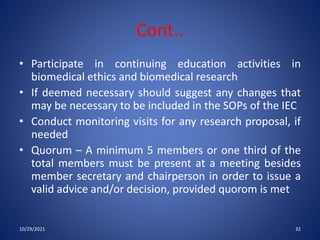
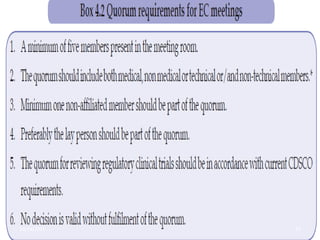
• Quorum – A minimum 5 members or one third of the
total members must be present at a meeting besides
member secretary and chairperson in order to issue a
valid advice and/or decision, provided quorom is met
10/29/2021 32
10/29/2021 33
Summary
• Ecs continue to play an important role in the ethical conduct of
clinical research
• The EC is responsible for reviewing the relatedness of the SAE to
the research, as reported by the researcher, and determining the
quantum and type of assistance to be provided to the participants.
• However Ecs as a system are facing challenges with paucity of trend
experts and lack of supervising national body
• So there is strong need to focus on capacity building and
establishment of an efficient central body to include all Ecs under
its umbrella to bring transparency and accountability in their
functioning
• Combined effort by DCGI,ICMR and individual Ecs will definitely
promote a sound culture of clinical research.
10/29/2021 34
Ethics is not definable, is not implementable,
because it is not conscious; it involves not
only our thinking, but also our feeling.
… Valdemar W. Setzer
10/29/2021 35
References
• ICH GCP GUIDELINE
• ICMR GUIDELINE
• WHO GUIDELINE
• NDCT RULE 2019
• CDSCO GUIDELINE
10/29/2021 36
THANK YOU
10/29/2021 37

Ethics committee’s role and functioning committee formation

  • 1.
    Ethics Committee’s Roleand Functioning - Committee Formation, Composition, Registration, SOPs, Role of Individual Members DR. SATYABRATA SAHOO DM CLINICAL PHARMACOLOGY RESIDENT, DEPT OF CLINICAL AND EXPERIMENTAL PHARMACOLOGY, CSTM KOLKATA 10/29/2021 1
  • 2.
    Introduction • An ethicscommittee is a committee formally designated to review and approve the initiation of a clinical research study involving human participants and to provide continuing review of the research study • Ethics committee is also known as IRB outside india • Any institution and organisation which intends to conduct Biomedical and health research required ethics committee according to National Ethical Guidelines 10/29/2021 2
  • 3.
    Committee Formation • Formationof ethics committee is a new concept. • In some corporation a standing committee is formed to implement ethical concept into practice • These committees are headed, directed by board of directors(internal as well as external) 10/29/2021 3
  • 4.
    Composition of theEC Heterogeneous group of at least 7 members (max. 15) • Oriented to the cause of ethics • Proficient to review and evaluate • Qualified by training (GCP) 10/29/2021 4
  • 5.
    Cont.. • The compositionmay be as follows(CDSCO, Schedule Y Amendment 2005) • Chairperson • Member secretary • 1-2 basic medical scientists(preferably one pharmacologist) • 1-2 clinicians from various institutes • One legal expert or retired judge • One social scientist/representative of non governmental voluntary agency • One philosopher/ethicist/theologian • One lay person from the community 10/29/2021 5
  • 6.
  • 7.
    Registration • Every ethicscommittee constituted under rule 7,shall make an application for grant of registration to the central licencing authority in form CT-o1 • The ethics committee shall furnish such information and documents as specified in table 1 of the third schedule along with the aplication made in form CT-01 • The central licencing authority shall scrutinise the information and document under sub rule 2 • Validity 5 years from the date of issue, unless suspended or cancelled by Central licencing authority • Renewal should be done after expiry 90 days prior to date of expiry 10/29/2021 7
  • 8.
    Standard Operative Procedures(SOPs) •The objective of SOP is to contribute to the effective functioning of IEC so that quality and consistent ethical review according to ethical guidelines can be maintained • Different institutes or organisations have SOP of their own • Robust SOPs required for maintenance of ECs for overall benefit in research 10/29/2021 8
  • 9.
    SOPs • 1. Writing,Reviewing, Distributing And Amending Standard Operating Procedures For Ecs • 2.Constituting An Ethics Committee • 3.Confidentiality Agreements • 4.Conflict Of Interest Agreements • 5.Training Personnel And EC Members • 6.Selection Of Independent Consultants • 7.Proceduresforallowinga Guest Or Observer • 8.Categorization Of Submitted Protocols For Ethics Review • A. Initial Full Committee Review Of New Research Protocols • B. Expedited Review Of Research Protocols • C. Exemption From Ethics Review Of Research Protocols 10/29/2021 9
  • 10.
    Cont.. • 10. ReviewOf New Medical Device Studies • 11.Review Of Resubmitted Protocols • 12.Review Of Protocol Amendments • 13.Continuing Review Of Protocols • 14.Review Of Final Reports • 15.Review Of Serious Adverse Events Reports • 16.Review Of Study Completion Reports • 17.Management Of Premature Termination, Suspension, Discontinuation Of The Study • 18.Waiver Of Written Or Verbal/Oral Informed Consent 10/29/2021 10
  • 11.
    Cont • 19.Site MonitoringVisits • 20.Dealing With Participants Requests And Complaints • 21.Emergency Meetings • 22.Communication Records • 23.Maintainance Of Active Study Files • 24.Archieve And Retrieval Of Documents • 25.Maintaining Confidentiality Of Ecs Documents • 26.Reviewing Proposals Involving Vulnerable Proposals • 27.Review And Inspection Of EC • 28.Audio Visual Recording Of The Informed Consent Process 10/29/2021 11
  • 12.
    Qualifications of IndividualMembers • Chairperson- • Non-affiliated • Qualifications -A well-respected person from any background with prior experience of having served/serving in an EC 10/29/2021 12
  • 13.
    Cont.. • Member secretary- •Affiliated • Qualifications - • Should be a staff member of the institution • Should have knowledge and experience in clinical research and ethics, be motivated and have good communication skills • Should be able to devote adequate time to this activity which should be protected by the institution 10/29/2021 13
  • 14.
    Cont.. • Basic MedicalScientist(s)- • Affiliated/ non-affiliated • Qualifications - •Non-medical or medical person with qualifications in basic medical sciences •In case of EC reviewing clinical trials with drugs, the basic medical scientist should preferably be a pharmacologist 10/29/2021 14
  • 15.
    Cont.. • Clinician(s)- • Affiliated/non-affiliated • Qualifications - • Should be individual/s with recognized medical qualification, expertise and training 10/29/2021 15
  • 16.
    Cont.. • Legal experts- •Affiliated/ non-affiliated • Qualifications - • Should have a basic degree in Law from a recognized university, with experience • Desirable: Training in medical law. 10/29/2021 16
  • 17.
    Cont.. • Social scientist/philosopher/ • ethicist/theologian • Affiliated/ non-affiliated • Qualifications - • Should be an individual with social/behavioural science/ philosophy/ religious qualification and training and/or expertise and be sensitive to local cultural and moral values.Can be from an NGO involved in health-related activities 10/29/2021 17
  • 18.
    Cont.. • Lay person(s) •Non-affiliated • Qualifications - • Literate person from the public or community • Has not pursued a medical science/ health related career in the last 5 years • May be a representative of the community from which the participants are to be drawn • Is aware of the local language, cultural and moral values of the community • Desirable: involved in social and community welfare activities 10/29/2021 18
  • 19.
    EC : Role& Responsibility Before the study begins:  EC registration  Having the SOPs in place  INV eligibility, site feasibility, conflicts of interests  Trial registration, regulatory approval  Review of research proposal (within reasonable time)  Decision making in formal meeting, documented  Issuing an approval (in appropriate format)  Record keeping (meeting agenda, meeting minutes, decisions communicated to INV, annual/final study report) 10/29/2021 19
  • 20.
    During the study: Review of all EC notifications - amendments (protocol, ICD), protocol deviations  Review of SAE reporting, analysis, relatedness assessment, deciding compensation  Monitoring IC process  Monitoring study progress and periodic review of study conduct  Communicating with INV, RA, Subject (if needed)  Allowing regulatory inspection  Record keeping (meeting agenda, meeting minutes, decisions communicated to INV, annual/final report) EC : Role & Responsibility 10/29/2021 20
  • 21.
    EC : Role& Responsibility  After the study:  Review of SAE reporting, analysis, relatedness assessment, deciding compensation  Communicating with INV, RA, Subject (if needed)  Reviewing study report  Post trial management  Publishing  Record keeping – archival  Allowing regulatory inspection 10/29/2021 21
  • 22.
    Functioning of theEC • The EC should function in accordance with the written SOPs that provides detailed guidelines about the EC procedures. • The PI and not the Sponsor communicates and deals with the ethics committee. 10/29/2021 22
  • 23.
    Role of IndividualMembers • Chairperson-responsible to chair the meetings and laise directly with the director/officer in charge of the institute • Report the meeting outcomes to the director • Invite independent consultant to provide special expertise to the EC on proposed research protocol • Work in close coordination with member secretary • Review and sign along with the member secretary all the minutes, proposals and work towards the smooth function of the EC 10/29/2021 23
  • 24.
    Cont.. • Member secretary-responsiblefor administrative aspect of the EC • Organising an effective and efficient tracking procedure for each proposal received • Preparation, maintenance and distribution of study files • Allocation of project reviews to specific members to facilitate efficient dispension of the projects • Organising IEC meetings regularly • Preparation and maintenance of meeting agenda and minutes • Receive and check for the completeness of the documents for review by the EC 10/29/2021 24
  • 25.
    Cont.. • Coordinate withthe investigators for the translation of the PIS and ICD documents • Arranging community members meeting after the board meeting for finalisation of the participant information sheet and informed consent form 10/29/2021 25
  • 26.
    Cont.. • Basic Medicalscientist- • Scientific and ethical review with special emphasis on the intervention, benefit-risk analysis, research design, methodology and statistics, continuing review process, SAE, protocol deviation, progress and completion report • For clinical trials, pharmacologist to review the drug safety and pharmacodynamics 10/29/2021 26
  • 27.
    Cont.. • Clinicians- • Scientificreview of protocols including review of the intervention, benefit-risk analysis, research design, methodology, sample size, site of study and statistics • Ongoing review of the protocol (SAE, protocol deviation or violation, progress and completion report) • Review medical care, facility and appropriateness of the principal investigator, provision for medical care, management and compensation. • Thorough review of protocol, investigators brochure (if applicable) and all other protocol details and submitted documents. 10/29/2021 27
  • 28.
    Cont.. • Legal Expert- •Ethical review of the proposal, ICD along with translations, MoU, Clinical Trial Agreement (CTA),regulatory approval, insurance document, other site approvals, researcher’s undertaking, protocol specific other permissions, such as, stem cell committee for stem cell research, HMSC for international collaboration, compliance with guidelines etc. • Interpret and inform EC members about new regulations if any 10/29/2021 28
  • 29.
    Cont.. • Social scientist/Philosopher/Ethicist/Theologian- •Ethical review of the proposal, ICD along with the translations. • Assess impact on community involvement, socio– cultural context, religious or philosophical context, if any • Serve as a patient/participant/ societal /community representative and bring in ethical and societal concerns 10/29/2021 29
  • 30.
    Cont.. • Laypersons- • Ethicalreview of the proposal, ICD along with translation(s). • Evaluate benefits and risks from the participant’s perspective and opine whether benefits justify the risks. • Serve as a patient/participant/ community representative and bring in ethical and societal concerns. • Assess on societal aspects if any. 10/29/2021 30
  • 31.
    Roles and responsibilitiesof IEC Members • Regularly attend and actively participate in the EC meetings • Review ,discuss and consider research proposals submitted for evaluation. • Reviewers for each proposal will review the study. later, if any other issues the other IEC members can voice their comments/suggestions. • Discuss serious adverse event reports and recommend appropriate action, review the progress reports and monitor ongoing studies as appropriate • Evaluate final reports and outcomes • Maintain confidentiality of the documents and deliberations of IEC meetings • Declare any conflict of interest 10/29/2021 31
  • 32.
    Cont.. • Participate incontinuing education activities in biomedical ethics and biomedical research • If deemed necessary should suggest any changes that may be necessary to be included in the SOPs of the IEC • Conduct monitoring visits for any research proposal, if needed • Quorum – A minimum 5 members or one third of the total members must be present at a meeting besides member secretary and chairperson in order to issue a valid advice and/or decision, provided quorom is met 10/29/2021 32
  • 33.
  • 34.
    Summary • Ecs continueto play an important role in the ethical conduct of clinical research • The EC is responsible for reviewing the relatedness of the SAE to the research, as reported by the researcher, and determining the quantum and type of assistance to be provided to the participants. • However Ecs as a system are facing challenges with paucity of trend experts and lack of supervising national body • So there is strong need to focus on capacity building and establishment of an efficient central body to include all Ecs under its umbrella to bring transparency and accountability in their functioning • Combined effort by DCGI,ICMR and individual Ecs will definitely promote a sound culture of clinical research. 10/29/2021 34
  • 35.
    Ethics is notdefinable, is not implementable, because it is not conscious; it involves not only our thinking, but also our feeling. … Valdemar W. Setzer 10/29/2021 35
  • 36.
    References • ICH GCPGUIDELINE • ICMR GUIDELINE • WHO GUIDELINE • NDCT RULE 2019 • CDSCO GUIDELINE 10/29/2021 36
  • 37.