Addressing Ethics in Clinical Research:
An Overview
Dr.M.K.Sudarshan, MD (BHU), FAMS, Hon.FFPH (UK), DHM,DIH
•Chairman , Fortis Hospital Ethics Committee and IEC, Indian
Institute of Public Health, Public Health Foundation of India
•NABH Assessor of Clinical Trials (Ethics committees)
•Member, RGUHS Committees of Advanced & Collaborative
Research
•Member, Advisory Panel on Rabies, WHO, Geneva, Switzerland
Bangalore
E- Mail: mksudarshan@gmail.com
Disclaimer : The contents and views expressed in this presentation are that of the
speaker and does not in any way reflect that of FH or NABH or RGUHS or WHO .
3/9/2020 1
Clinical research is a branch of medical science that determines the safety
and effectiveness (efficacy) of medications, devices, diagnostic products and
treatment regimens intended for human use. These may be used for
prevention, treatment, diagnosis or for relieving symptoms of a disease.
Ethics : i.Ethics or moral philosophy is a branch of philosophy that involves
systematizing, defending, and recommending concepts of right and wrong
conduct. ii. Moral principles that govern a person's behaviour or the
conducting of an activity.
Four cardinal principles of ethical research
1. Autonomy : To respect the autonomy of the participant [informed consent]
2. Beneficence : To act always in the best interest of the participant [Risk-benefit
analysis by ethics committees ]
3. Non-malfeasance : To do as little harm as possible to the participant;[justify
study]
4. Justice : To act fairly /in selection [of subjects/participants] [blinding and
randomisation]
Four pillars of ethical research
1. Principal Investigator(PI)
2. Ethics committee(EC) [internal regulator]
3. Institution
4. Regulator/Controller (CDSCO/DHR)[National Regulator]
3/9/2020 2
Why “Ethics in Research” is Important?
• It is a reflection of respect for those who ‘take
part ( i.e. Participants ) ’ in research
• It ensures no unreasonable, unsafe or
thoughtless demands are made by
researchers(i.e. Principal Investigators)
• It ensures sufficient knowledge is shared by all
concerned(i.e. Sponsor/PI/CRC/Others)
• It imposes a common standard in all the above
respects(i.e. SOP)
3/9/2020 4
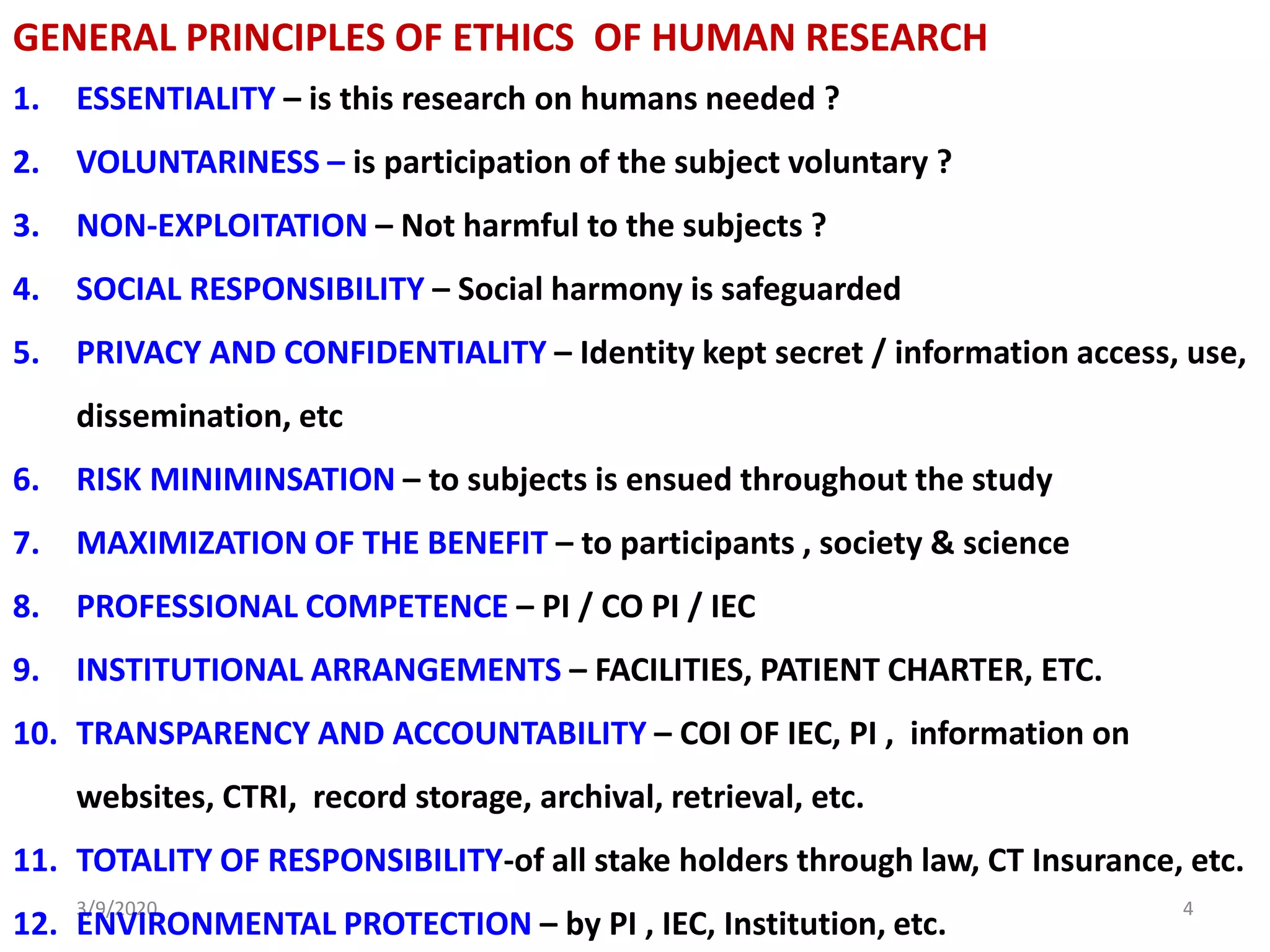
GENERAL PRINCIPLES OF ETHICS OF HUMAN RESEARCH
1. ESSENTIALITY – is this research on humans needed ?
2. VOLUNTARINESS – is participation of the subject voluntary ?
3. NON-EXPLOITATION – Not harmful to the subjects ?
4. SOCIAL RESPONSIBILITY – Social harmony is safeguarded
5. PRIVACY AND CONFIDENTIALITY – Identity kept secret / information access, use,
dissemination, etc
6. RISK MINIMINSATION – to subjects is ensued throughout the study
7. MAXIMIZATION OF THE BENEFIT – to participants , society & science
8. PROFESSIONAL COMPETENCE – PI / CO PI / IEC
9. INSTITUTIONAL ARRANGEMENTS – FACILITIES, PATIENT CHARTER, ETC.
10. TRANSPARENCY AND ACCOUNTABILITY – COI OF IEC, PI , information on
websites, CTRI, record storage, archival, retrieval, etc.
11. TOTALITY OF RESPONSIBILITY-of all stake holders through law, CT Insurance, etc.
12. ENVIRONMENTAL PROTECTION – by PI , IEC, Institution, etc.
3/9/2020 5
The need for “ Ethics committees “ arose in response to a clinical need for a formal
mechanism to address some of the value conflicts and uncertainties that arise in
contemporary health -care settings i.e. hospital and community/public health
Basic role of Ethics committee can be summed as follows :
• To protect the dignity, rights, safety and well being of patients/participants ; by-
– Preventing studies that pose an unacceptable risk of harm to participants
– Ensure that all participants ( subjects)in research are aware about the pros and cons for their
participation in the study and have given appropriate Informed consent
• To promote fair ethical policies and procedures which will maximize the likelihood of
achieving good and patient-oriented outcomes
• To enhance the ethical tenor between health care professionals and organisations
conducting clinical trials/studies
• To provide an overview and monitor thoroughly, compliance of sites with standard operating
procedures (SOPs), regulations, guidelines and ETHICS
• To offer due consideration to views of the community .
The IEC will justify not only right V/S wrong decision but also be competent enough in
judging various right V/S right situations.
3/9/2020 6
AIM : TO PROTECT THE DIGNITY, RIGHTS, SAFETY AND WELL –BEING OF THE
RESEARCH PARTICIPANTS- GENERAL ETHICAL ISSUES
1. RISK –BENEFIT ASSESSMENT
1.1. Risks/ potential harms anticipated – Physical, Psychological, Social, Economic
and Legal
1.1.1 Grading of Risks
•Less than minimal or No risk - No risk or not expected like record analysis, etc.
•Minimal risk – Not greater than routine daily activities like interviews, etc.
•Low risk – More than minimal risk like use of injections ; etc
•High risk – Intervention studies involving invasive procedures like lumbar
puncture, biopsies, surgeries , etc
1.1.2 . Types of benefits – Individual ; societal and community
2. INFORMED CONSENT PROCESS
•Informed consent document(ICD) = informed consent form(ICF) + patient
information sheet (PIS)
•Legally Acceptable / Approved Representative (LAR)
•AV recording
3. PRIVACY & CONFIDENTIALITY
•Privacy of the participant
•Confidentiality of the information of the subject provided to the PI
3/9/2020 7
4. DISTRIBUTIVE JUSTICE
•Selection of the participants – fair process to ensure distribution of benefits and risks
5. PAYMENT FOR PARTICIPATION
•Travel, food, loss of wages, etc.
6. COMPENSATION FOR RESEARCH RELATED HARM
•Report SAE in 24 hours and detailed report in 14days
•Sponsor pays the compensation to the participant through IEC/Institution
7. ANCILLARY CARE
•Free medical care during the clinical trial [ without amounting to inducements ]
8. CONFLICT OF INTEREST
Personal / professional benefit interest outweighs research interests
9. SELECTION OF VULNERABLE & SPECIAL GROUPS
Pregnant women, infants & toddlers, prisoners, students, etc.
10. COMMUNITY ENGAGEMENT
Important in population based research e.g. community advisory group (CAG)
11. POST-RESEARCH ACCESS & BENEFIT SHARING
Information sharing with the participants, other stake holders like sponsors; conference
presentation, publication of report & paper in scientific journal, registration of patent , etc
II. Composition of institutional ethics committee [IEC] :
[ 7-15 members ] [ Quorum is 5 members* ]
1 Chairperson – from outside the institution
1-2 basic medical scientists * (1 MD pharmacologist for clinical trials )
1-2 clinicians * from various institutions
1 legal expert or retired judge *
1 social scientist * /NGO representative or Philosopher/ethicist/theologian
1 lay person * from the community
1 Member secretary – from the institution
Note: a. Subject experts may be invited when needed, but they will have no voting
rights.
b. It is recommended to have a consensus approval of the research
proposals
3/9/2020 8
i. IEC shall be established under an institution.
ii. The IEC shall be registered with CDSCO [ and/or DHR, GoI, wef. Sept.
2019].
iii. New Drugs and CT rules, 2019 ; Guidelines of ICMR,2017 , Indian GCP,
2001, to be followed.
iv. NABH accreditation of ECs ( registered with CDSCO) for regulatory
clinical trials is recommended.
v. SOPs of the IECs are now essential.
vi. The IEC approval of the research proposal shall be given on its letterhead
duly signed by the member secretary and with a period of its validity.
The format of the ICMR or NDCT rules,2019 shall be followed.
i. Registration ( online ) of the clinical trials is mandatory on the website –
clinical trials registry – India [ CTR-I ]. From April ,2019 1st participant
enrolment is to be done only after CTRI number .
3/9/20
20 pst
9
Specific ethical actions in clinical research :
1. Informed consent document [ informed consent form + product
information ]: duly signed with independent witnesses /
audio-video (AV) recorded [ vulnerable and special groups or as
per sponsor guidelines ]
2. Parental consent/permission : involving children below 18 years
3. Children assent : agreement by children of 7-18 years age
4. Randomization [ participants] : shall ensure distribution of risks
and benefits
5. Coding[ Investigation product ] : to facilitate blinding and
eliminate bias
3/9/2020 10
6. Placebos : used to facilitate blinding, but is a tricky issue .
7. Confidentiality of information : Study information shall be
disclosed only under law .
8. Participants selection : enrolment is without any bias and
favour ; special care towards special groups, susceptible , captive
and vulnerable populations like pregnant women, young
children, labourers, students, employees, prisoners, etc.
3/9/2020 11
9. Conflict of interest : of the PI ; IEC members; Institution; etc.
10. Compensation for participation of subjects: shall not be an
inducement but reasonable for loss of wages, travel, food, etc.
11. Free treatment to the subjects and controls too
12. Permission to withdraw from the study Without assigning
whatsoever reason and getting the same benefit till the end of the
study.
13. Compliance to the SOP of the IEC Study shall conform to SOP and
IEC may do on-site monitoring like enrolment, consenting , etc.
14. Compliance to NDCT rules, 2019 /ICMR guidelines,2017 / Indian
GCP norm : IEC approval of the study protocol is mandatory for
starting the study
3/9/2020 12
References / Recommended for study :
1. Indian Council of Medical Research. National Ethical guidelines for
biomedical & health research involving human participants, 2017.
www.icmr.nic.in/ethical_guidelines.pdf
2. Central Drugs Standard Control Organization [ CDSCO] :
www.cdsco.nic.in for New Drugs & CT rules, 2019
3. Clinical Development Services Agency (CDSA) :
www. cdsaindia.in
4. Government of India. GCP Guidelines for clinical trials in Ayush,
March,2013.http://indianmedicine.nic.in/writereaddata
/linkimages/5110899178-Final%20Book%2028-03-13.pdf
5. Clinical Trials – A beginners guide, Alice Kuruvilla and AD Paul, 1st
Edition, 2013 , Paras Medical Publisher, Hyderabad [ Rs. 200/-]3/9/2020 13
3/9/2020 14
Thank you for your kind attention

Addressing ethics in clinical research

  • 1.
    Addressing Ethics inClinical Research: An Overview Dr.M.K.Sudarshan, MD (BHU), FAMS, Hon.FFPH (UK), DHM,DIH •Chairman , Fortis Hospital Ethics Committee and IEC, Indian Institute of Public Health, Public Health Foundation of India •NABH Assessor of Clinical Trials (Ethics committees) •Member, RGUHS Committees of Advanced & Collaborative Research •Member, Advisory Panel on Rabies, WHO, Geneva, Switzerland Bangalore E- Mail: mksudarshan@gmail.com Disclaimer : The contents and views expressed in this presentation are that of the speaker and does not in any way reflect that of FH or NABH or RGUHS or WHO . 3/9/2020 1
  • 2.
    Clinical research isa branch of medical science that determines the safety and effectiveness (efficacy) of medications, devices, diagnostic products and treatment regimens intended for human use. These may be used for prevention, treatment, diagnosis or for relieving symptoms of a disease. Ethics : i.Ethics or moral philosophy is a branch of philosophy that involves systematizing, defending, and recommending concepts of right and wrong conduct. ii. Moral principles that govern a person's behaviour or the conducting of an activity. Four cardinal principles of ethical research 1. Autonomy : To respect the autonomy of the participant [informed consent] 2. Beneficence : To act always in the best interest of the participant [Risk-benefit analysis by ethics committees ] 3. Non-malfeasance : To do as little harm as possible to the participant;[justify study] 4. Justice : To act fairly /in selection [of subjects/participants] [blinding and randomisation] Four pillars of ethical research 1. Principal Investigator(PI) 2. Ethics committee(EC) [internal regulator] 3. Institution 4. Regulator/Controller (CDSCO/DHR)[National Regulator] 3/9/2020 2
  • 3.
    Why “Ethics inResearch” is Important? • It is a reflection of respect for those who ‘take part ( i.e. Participants ) ’ in research • It ensures no unreasonable, unsafe or thoughtless demands are made by researchers(i.e. Principal Investigators) • It ensures sufficient knowledge is shared by all concerned(i.e. Sponsor/PI/CRC/Others) • It imposes a common standard in all the above respects(i.e. SOP)
  • 4.
    3/9/2020 4 GENERAL PRINCIPLESOF ETHICS OF HUMAN RESEARCH 1. ESSENTIALITY – is this research on humans needed ? 2. VOLUNTARINESS – is participation of the subject voluntary ? 3. NON-EXPLOITATION – Not harmful to the subjects ? 4. SOCIAL RESPONSIBILITY – Social harmony is safeguarded 5. PRIVACY AND CONFIDENTIALITY – Identity kept secret / information access, use, dissemination, etc 6. RISK MINIMINSATION – to subjects is ensued throughout the study 7. MAXIMIZATION OF THE BENEFIT – to participants , society & science 8. PROFESSIONAL COMPETENCE – PI / CO PI / IEC 9. INSTITUTIONAL ARRANGEMENTS – FACILITIES, PATIENT CHARTER, ETC. 10. TRANSPARENCY AND ACCOUNTABILITY – COI OF IEC, PI , information on websites, CTRI, record storage, archival, retrieval, etc. 11. TOTALITY OF RESPONSIBILITY-of all stake holders through law, CT Insurance, etc. 12. ENVIRONMENTAL PROTECTION – by PI , IEC, Institution, etc.
  • 5.
    3/9/2020 5 The needfor “ Ethics committees “ arose in response to a clinical need for a formal mechanism to address some of the value conflicts and uncertainties that arise in contemporary health -care settings i.e. hospital and community/public health Basic role of Ethics committee can be summed as follows : • To protect the dignity, rights, safety and well being of patients/participants ; by- – Preventing studies that pose an unacceptable risk of harm to participants – Ensure that all participants ( subjects)in research are aware about the pros and cons for their participation in the study and have given appropriate Informed consent • To promote fair ethical policies and procedures which will maximize the likelihood of achieving good and patient-oriented outcomes • To enhance the ethical tenor between health care professionals and organisations conducting clinical trials/studies • To provide an overview and monitor thoroughly, compliance of sites with standard operating procedures (SOPs), regulations, guidelines and ETHICS • To offer due consideration to views of the community . The IEC will justify not only right V/S wrong decision but also be competent enough in judging various right V/S right situations.
  • 6.
    3/9/2020 6 AIM :TO PROTECT THE DIGNITY, RIGHTS, SAFETY AND WELL –BEING OF THE RESEARCH PARTICIPANTS- GENERAL ETHICAL ISSUES 1. RISK –BENEFIT ASSESSMENT 1.1. Risks/ potential harms anticipated – Physical, Psychological, Social, Economic and Legal 1.1.1 Grading of Risks •Less than minimal or No risk - No risk or not expected like record analysis, etc. •Minimal risk – Not greater than routine daily activities like interviews, etc. •Low risk – More than minimal risk like use of injections ; etc •High risk – Intervention studies involving invasive procedures like lumbar puncture, biopsies, surgeries , etc 1.1.2 . Types of benefits – Individual ; societal and community 2. INFORMED CONSENT PROCESS •Informed consent document(ICD) = informed consent form(ICF) + patient information sheet (PIS) •Legally Acceptable / Approved Representative (LAR) •AV recording 3. PRIVACY & CONFIDENTIALITY •Privacy of the participant •Confidentiality of the information of the subject provided to the PI
  • 7.
    3/9/2020 7 4. DISTRIBUTIVEJUSTICE •Selection of the participants – fair process to ensure distribution of benefits and risks 5. PAYMENT FOR PARTICIPATION •Travel, food, loss of wages, etc. 6. COMPENSATION FOR RESEARCH RELATED HARM •Report SAE in 24 hours and detailed report in 14days •Sponsor pays the compensation to the participant through IEC/Institution 7. ANCILLARY CARE •Free medical care during the clinical trial [ without amounting to inducements ] 8. CONFLICT OF INTEREST Personal / professional benefit interest outweighs research interests 9. SELECTION OF VULNERABLE & SPECIAL GROUPS Pregnant women, infants & toddlers, prisoners, students, etc. 10. COMMUNITY ENGAGEMENT Important in population based research e.g. community advisory group (CAG) 11. POST-RESEARCH ACCESS & BENEFIT SHARING Information sharing with the participants, other stake holders like sponsors; conference presentation, publication of report & paper in scientific journal, registration of patent , etc
  • 8.
    II. Composition ofinstitutional ethics committee [IEC] : [ 7-15 members ] [ Quorum is 5 members* ] 1 Chairperson – from outside the institution 1-2 basic medical scientists * (1 MD pharmacologist for clinical trials ) 1-2 clinicians * from various institutions 1 legal expert or retired judge * 1 social scientist * /NGO representative or Philosopher/ethicist/theologian 1 lay person * from the community 1 Member secretary – from the institution Note: a. Subject experts may be invited when needed, but they will have no voting rights. b. It is recommended to have a consensus approval of the research proposals 3/9/2020 8
  • 9.
    i. IEC shallbe established under an institution. ii. The IEC shall be registered with CDSCO [ and/or DHR, GoI, wef. Sept. 2019]. iii. New Drugs and CT rules, 2019 ; Guidelines of ICMR,2017 , Indian GCP, 2001, to be followed. iv. NABH accreditation of ECs ( registered with CDSCO) for regulatory clinical trials is recommended. v. SOPs of the IECs are now essential. vi. The IEC approval of the research proposal shall be given on its letterhead duly signed by the member secretary and with a period of its validity. The format of the ICMR or NDCT rules,2019 shall be followed. i. Registration ( online ) of the clinical trials is mandatory on the website – clinical trials registry – India [ CTR-I ]. From April ,2019 1st participant enrolment is to be done only after CTRI number . 3/9/20 20 pst 9
  • 10.
    Specific ethical actionsin clinical research : 1. Informed consent document [ informed consent form + product information ]: duly signed with independent witnesses / audio-video (AV) recorded [ vulnerable and special groups or as per sponsor guidelines ] 2. Parental consent/permission : involving children below 18 years 3. Children assent : agreement by children of 7-18 years age 4. Randomization [ participants] : shall ensure distribution of risks and benefits 5. Coding[ Investigation product ] : to facilitate blinding and eliminate bias 3/9/2020 10
  • 11.
    6. Placebos :used to facilitate blinding, but is a tricky issue . 7. Confidentiality of information : Study information shall be disclosed only under law . 8. Participants selection : enrolment is without any bias and favour ; special care towards special groups, susceptible , captive and vulnerable populations like pregnant women, young children, labourers, students, employees, prisoners, etc. 3/9/2020 11
  • 12.
    9. Conflict ofinterest : of the PI ; IEC members; Institution; etc. 10. Compensation for participation of subjects: shall not be an inducement but reasonable for loss of wages, travel, food, etc. 11. Free treatment to the subjects and controls too 12. Permission to withdraw from the study Without assigning whatsoever reason and getting the same benefit till the end of the study. 13. Compliance to the SOP of the IEC Study shall conform to SOP and IEC may do on-site monitoring like enrolment, consenting , etc. 14. Compliance to NDCT rules, 2019 /ICMR guidelines,2017 / Indian GCP norm : IEC approval of the study protocol is mandatory for starting the study 3/9/2020 12
  • 13.
    References / Recommendedfor study : 1. Indian Council of Medical Research. National Ethical guidelines for biomedical & health research involving human participants, 2017. www.icmr.nic.in/ethical_guidelines.pdf 2. Central Drugs Standard Control Organization [ CDSCO] : www.cdsco.nic.in for New Drugs & CT rules, 2019 3. Clinical Development Services Agency (CDSA) : www. cdsaindia.in 4. Government of India. GCP Guidelines for clinical trials in Ayush, March,2013.http://indianmedicine.nic.in/writereaddata /linkimages/5110899178-Final%20Book%2028-03-13.pdf 5. Clinical Trials – A beginners guide, Alice Kuruvilla and AD Paul, 1st Edition, 2013 , Paras Medical Publisher, Hyderabad [ Rs. 200/-]3/9/2020 13
  • 14.
    3/9/2020 14 Thank youfor your kind attention