INSPIRE - ensuring access or
    continuity of access?
                    Robin Rice1, Martin Donnelly2,
                  Anne Robertson1 and James Reid1

                  EDINA and Digital Curation Centre
                      University of Edinburgh

INSPIRE Conference
Edinburgh UK, June 2011
Thesis (1 of 2)
“Policies underpinned by studies of
environmental change require an under-
standing of how phenomena change over time.
This requires access to historic data and earlier
editions of data.
This in turn implies the application of sound
data management and curation principles with
an implicit long term view of preserving the
evidential base for future generations of policy
makers and researchers.”
Thesis (2 of 2)
“Without effective research data management
across the data life-cycle – from creation to use
to preservation, INSPIRE may not be able to
deliver continuity of access to data sets over the
long term.
By marrying the principles of INSPIRE with best
practice in research data management, the
availability of geospatial and temporal data will
be assured for government, the public and the
academy.”
(from our submitted abstract)
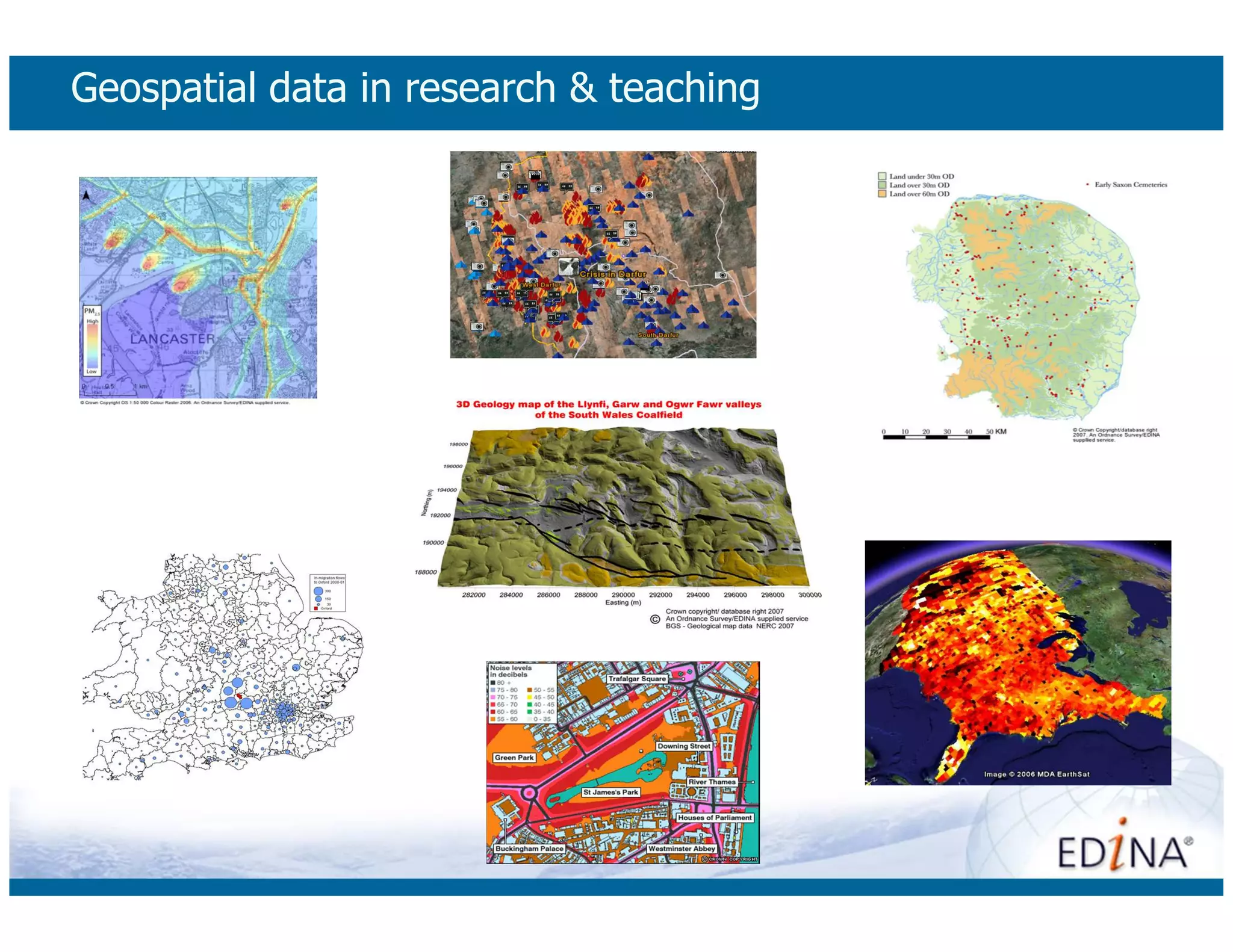
Geospatial data in research & teaching
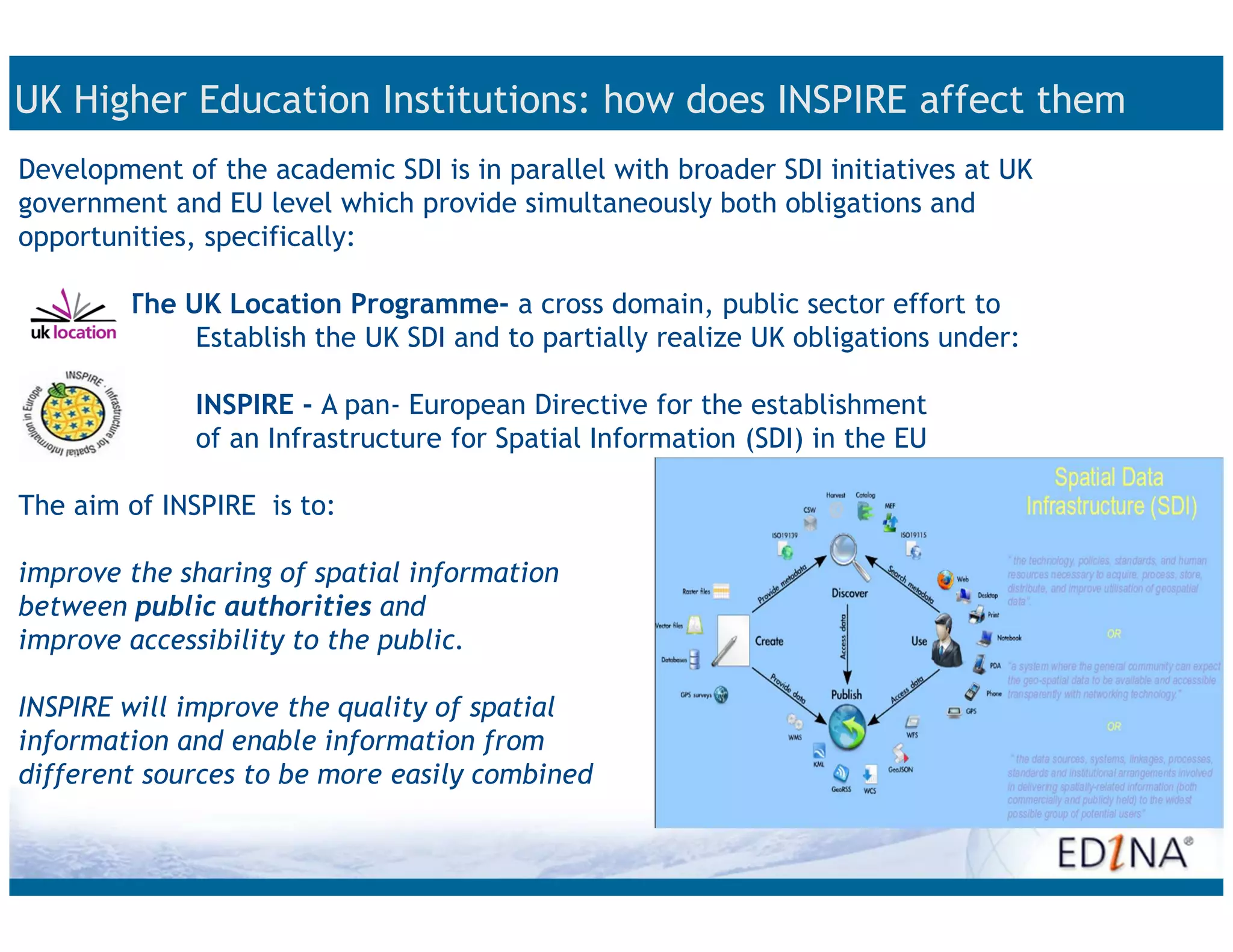
UK Higher Education Institutions: how does INSPIRE affect them
Development of the academic SDI is in parallel with broader SDI initiatives at UK
government and EU level which provide simultaneously both obligations and
opportunities, specifically:

        The UK Location Programme- a cross domain, public sector effort to
             Establish the UK SDI and to partially realize UK obligations under:

              INSPIRE - A pan- European Directive for the establishment
              of an Infrastructure for Spatial Information (SDI) in the EU

The aim of INSPIRE is to:

improve the sharing of spatial information
between public authorities and
improve accessibility to the public.

INSPIRE will improve the quality of spatial
information and enable information from
different sources to be more easily combined
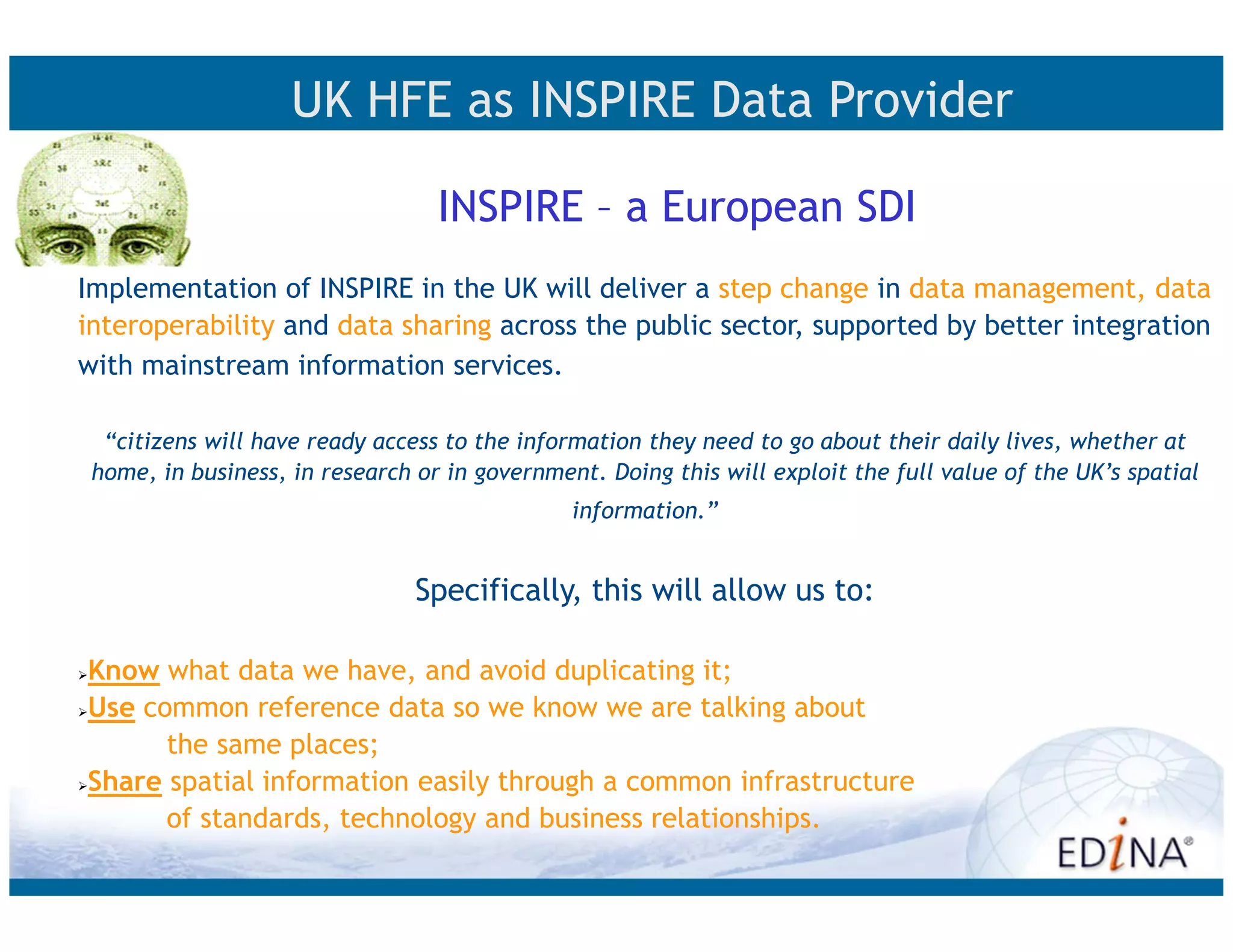
UK HFE as INSPIRE Data Provider

                                  INSPIRE – a European SDI
Implementation of INSPIRE in the UK will deliver a step change in data management, data
interoperability and data sharing across the public sector, supported by better integration
with mainstream information services.

  “citizens will have ready access to the information they need to go about their daily lives, whether at
 home, in business, in research or in government. Doing this will exploit the full value of the UK’s spatial
                                               information.”


                                Specifically, this will allow us to:

Know what data we have, and avoid duplicating it;
Use common reference data so we know we are talking about
      the same places;
Share spatial information easily through a common infrastructure
      of standards, technology and business relationships.
Current & recent Geo activities at EDINA
Services:
Digimap [for Schools]; UKBORDERS; GoGeo; Unlock; agcensus;
ShareGeo Open; OpenBoundaries; OpenStream

Projects & activities
ESDIN - European Spatial Data Infrastructure Best Practice Network
WSTERIA – secure web services (OGC)
Soils demonstrator – eFramework
AddressingHistory
ShareGeo+

Service hosting (GIGateway, Scottish DMS)

Community engagement and outreach e.g.
Seat on UK LP Location Information Interoperability Board
Chair OGC Universities WG
Sit on Scottish Government GI Steering Group
Acting as contact point between OGC and e-Science GRID communities
AGI Working Groups
Census Advisory Committee and Census Web Services Working Group
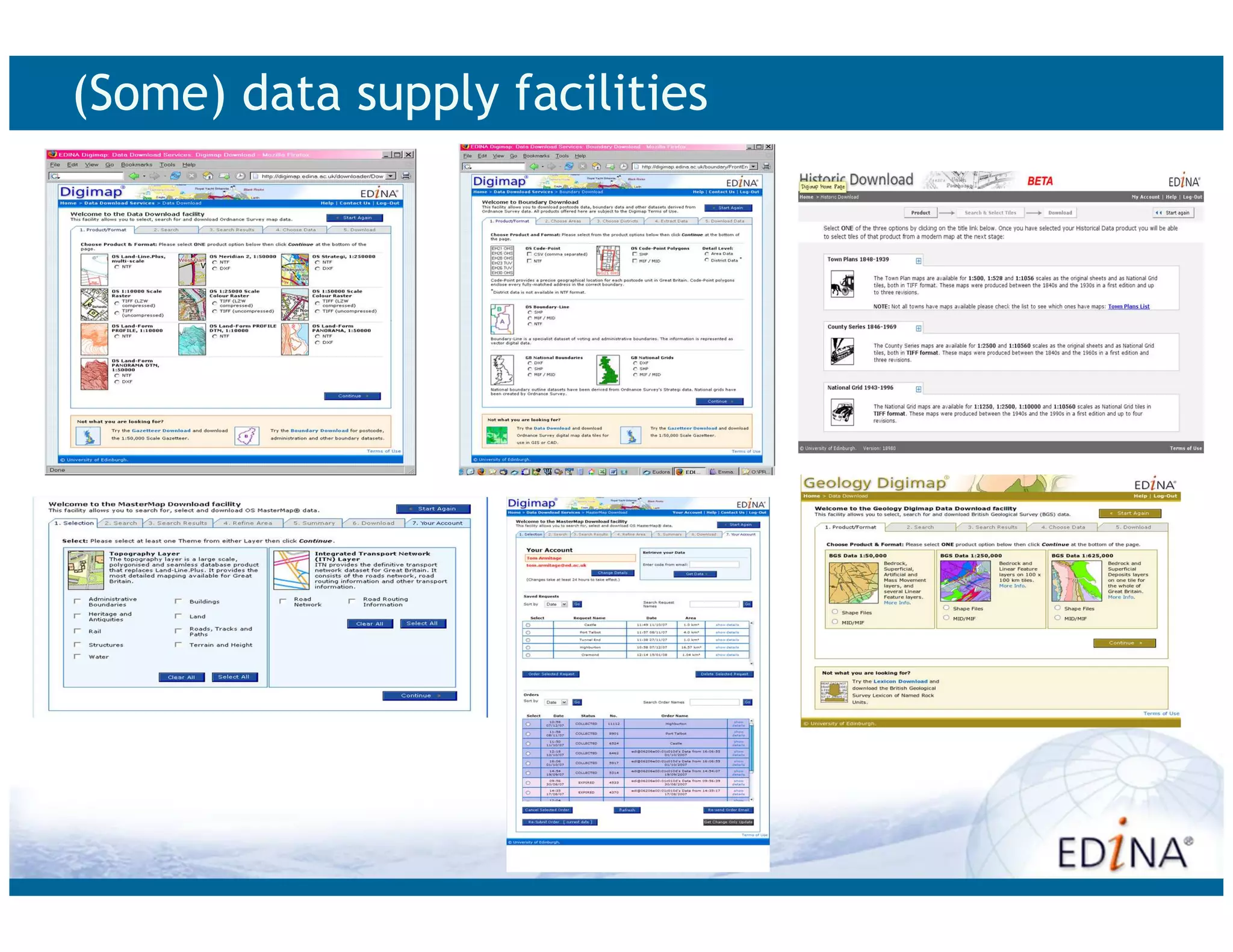
(Some) data supply facilities


  Data Download
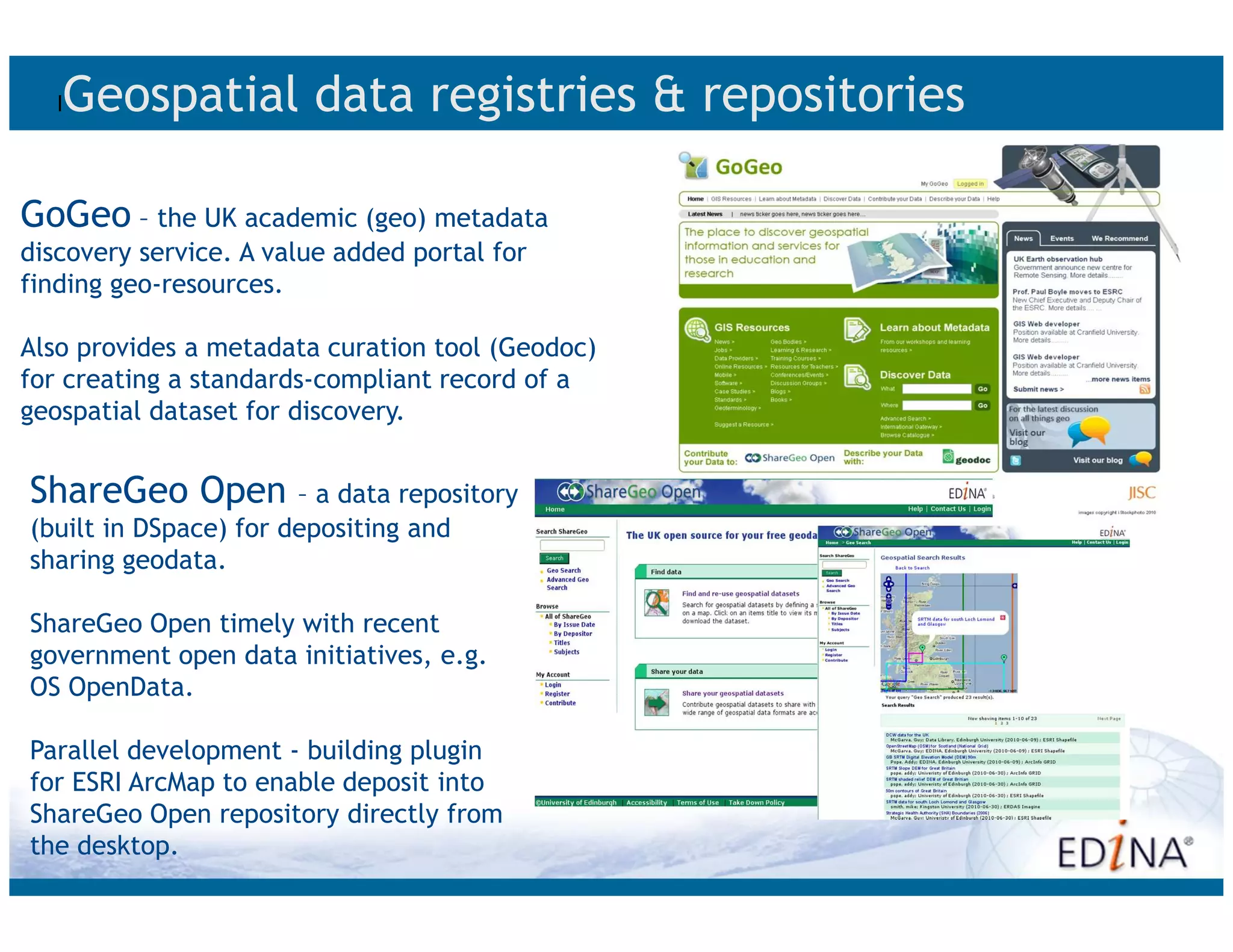
l   Geospatial data registries & repositories

GoGeo – the UK academic (geo) metadata
discovery service. A value added portal for
finding geo-resources.

Also provides a metadata curation tool (Geodoc)
for creating a standards-compliant record of a
geospatial dataset for discovery.


ShareGeo Open          – a data repository
(built in DSpace) for depositing and
sharing geodata.

ShareGeo Open timely with recent
government open data initiatives, e.g.
OS OpenData.

Parallel development - building plugin
for ESRI ArcMap to enable deposit into
ShareGeo Open repository directly from
the desktop.
because good research needs good data


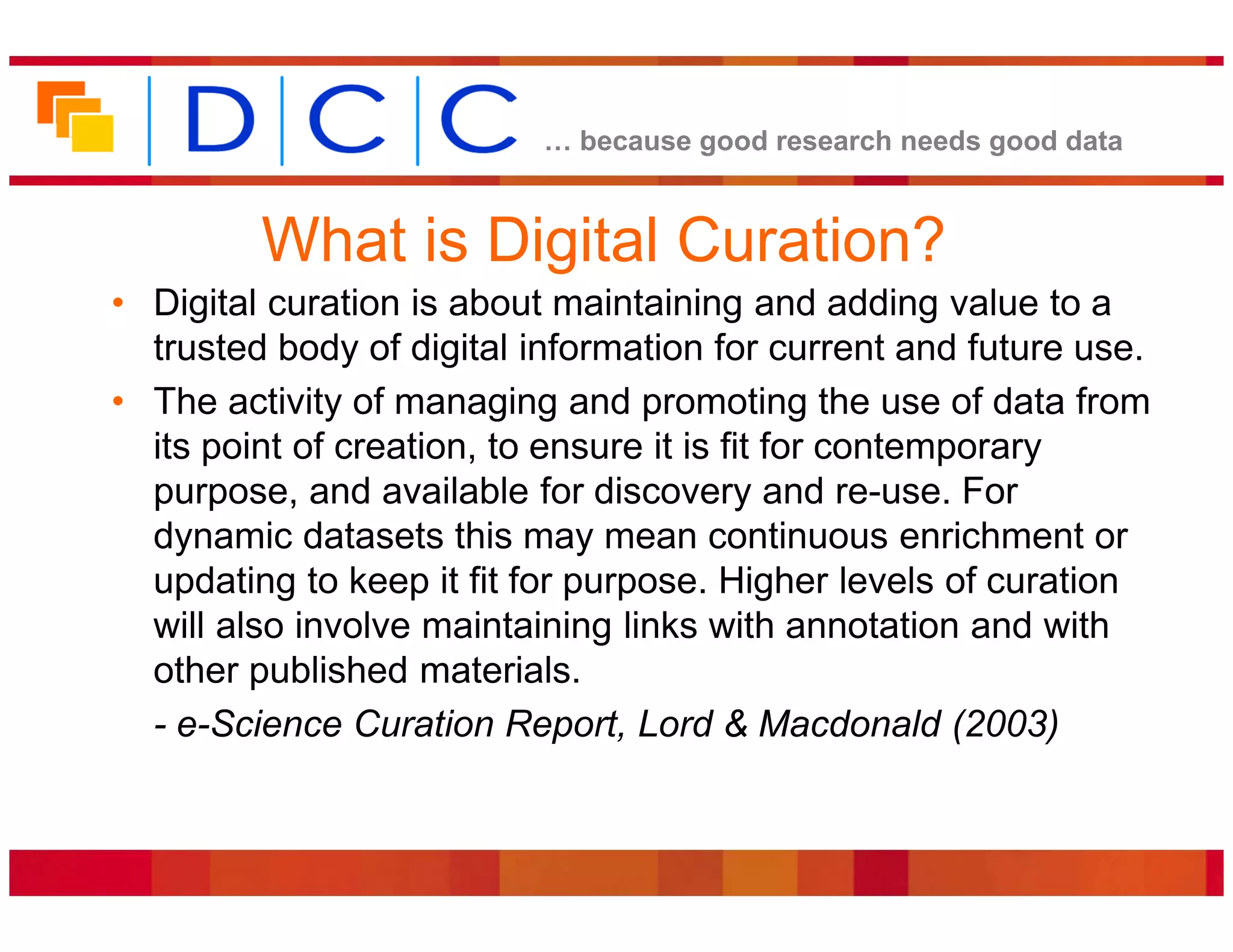
         What is Digital Curation?
• Digital curation is about maintaining and adding value to a
  trusted body of digital information for current and future use.
• The activity of managing and promoting the use of data from
  its point of creation, to ensure it is fit for contemporary
  purpose, and available for discovery and re-use. For
  dynamic datasets this may mean continuous enrichment or
  updating to keep it fit for purpose. Higher levels of curation
  will also involve maintaining links with annotation and with
  other published materials.
  - e-Science Curation Report, Lord & Macdonald (2003)
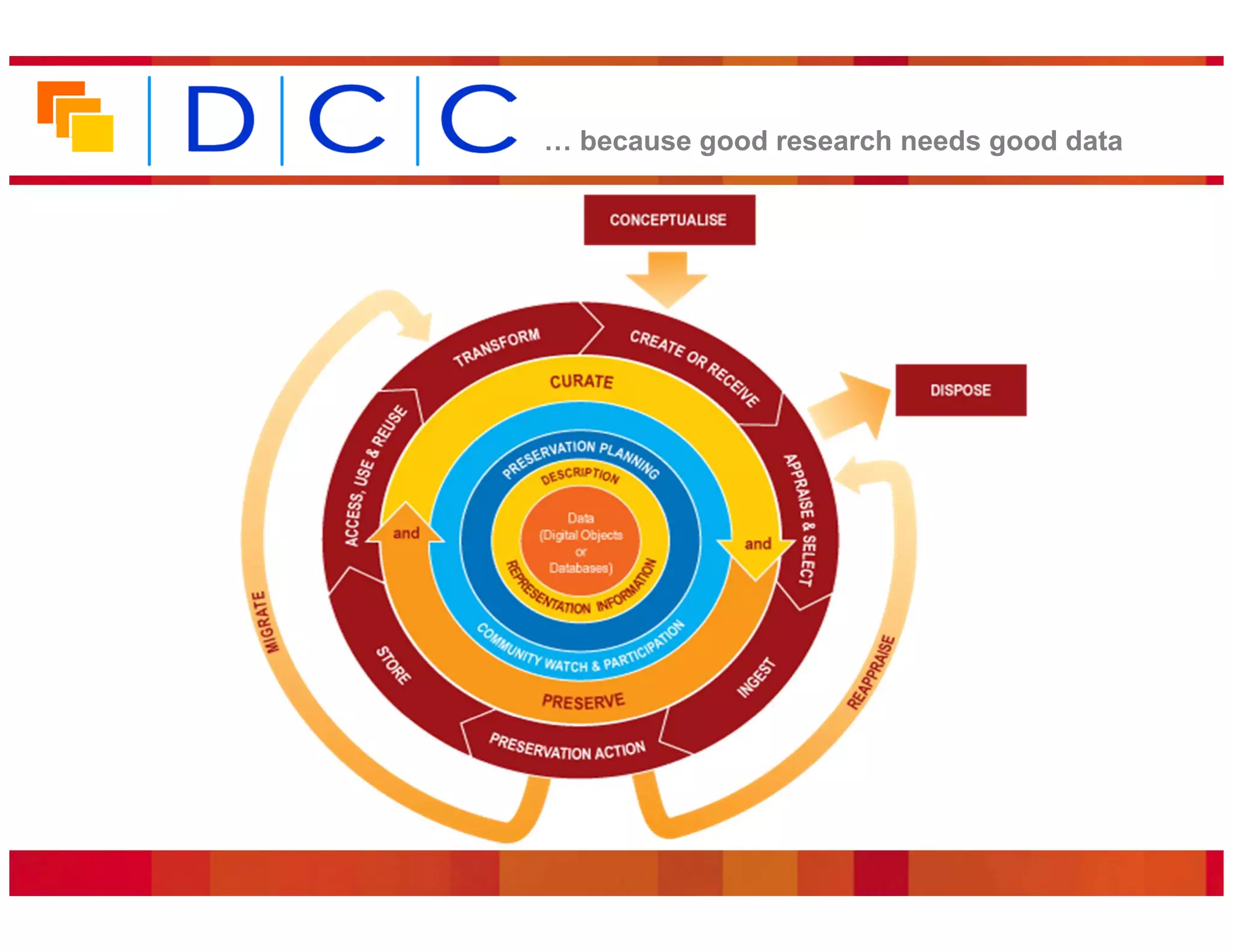
because good research needs good data


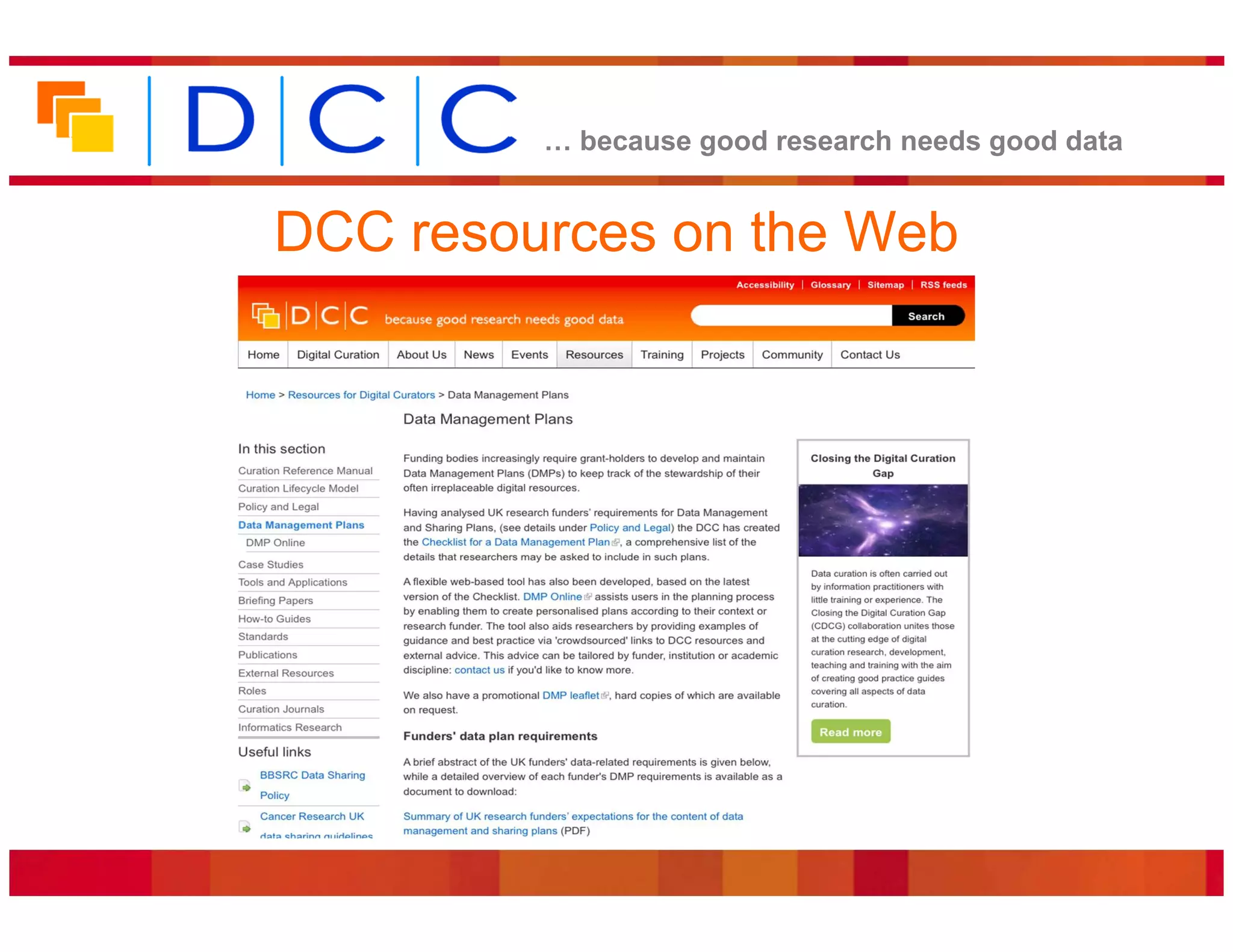
DCC resources on the Web
because good research needs good data


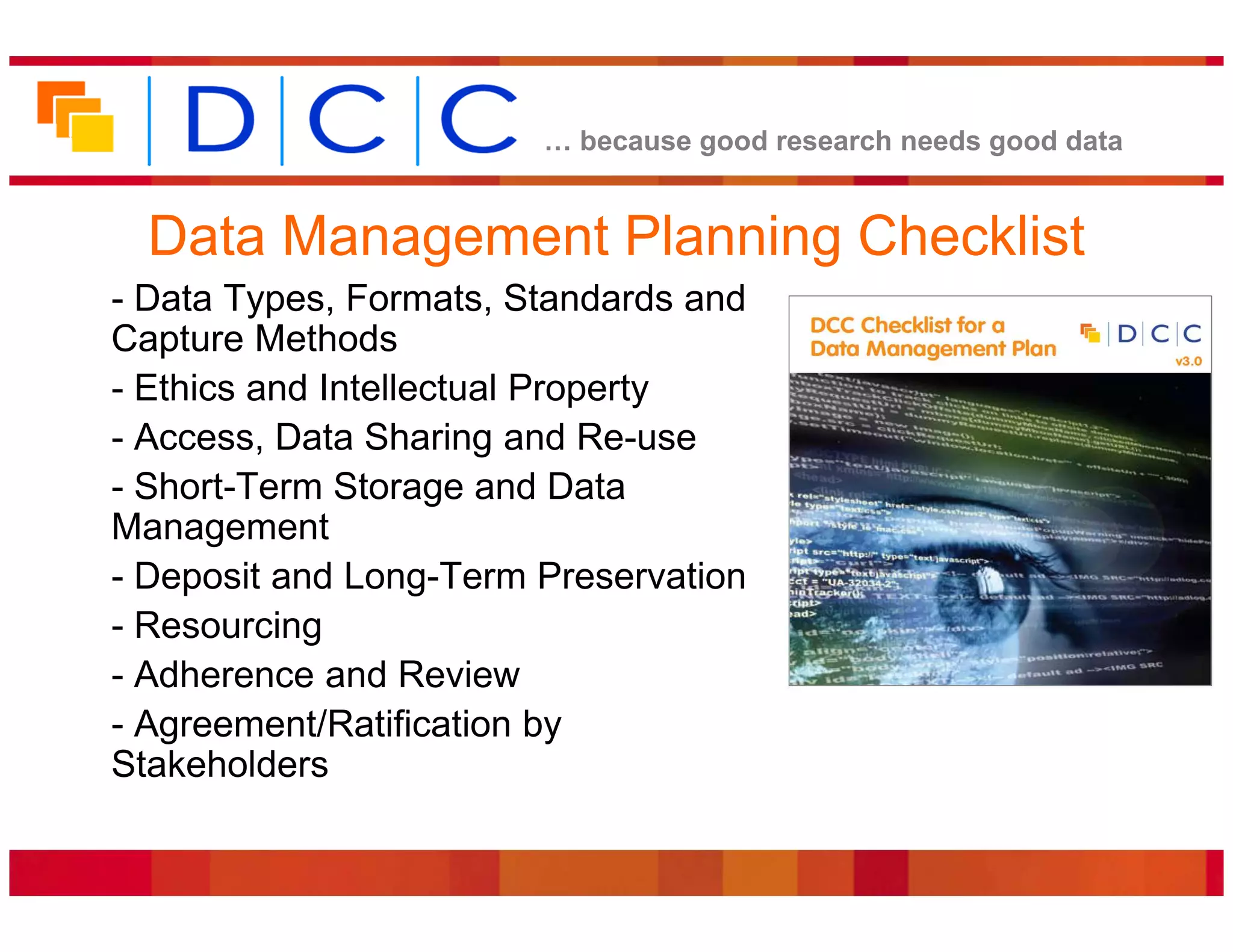
  Data Management Planning Checklist
- Data Types, Formats, Standards and
Capture Methods
- Ethics and Intellectual Property
- Access, Data Sharing and Re-use
- Short-Term Storage and Data
Management
- Deposit and Long-Term Preservation
- Resourcing
- Adherence and Review
- Agreement/Ratification by
Stakeholders
because good research needs good data


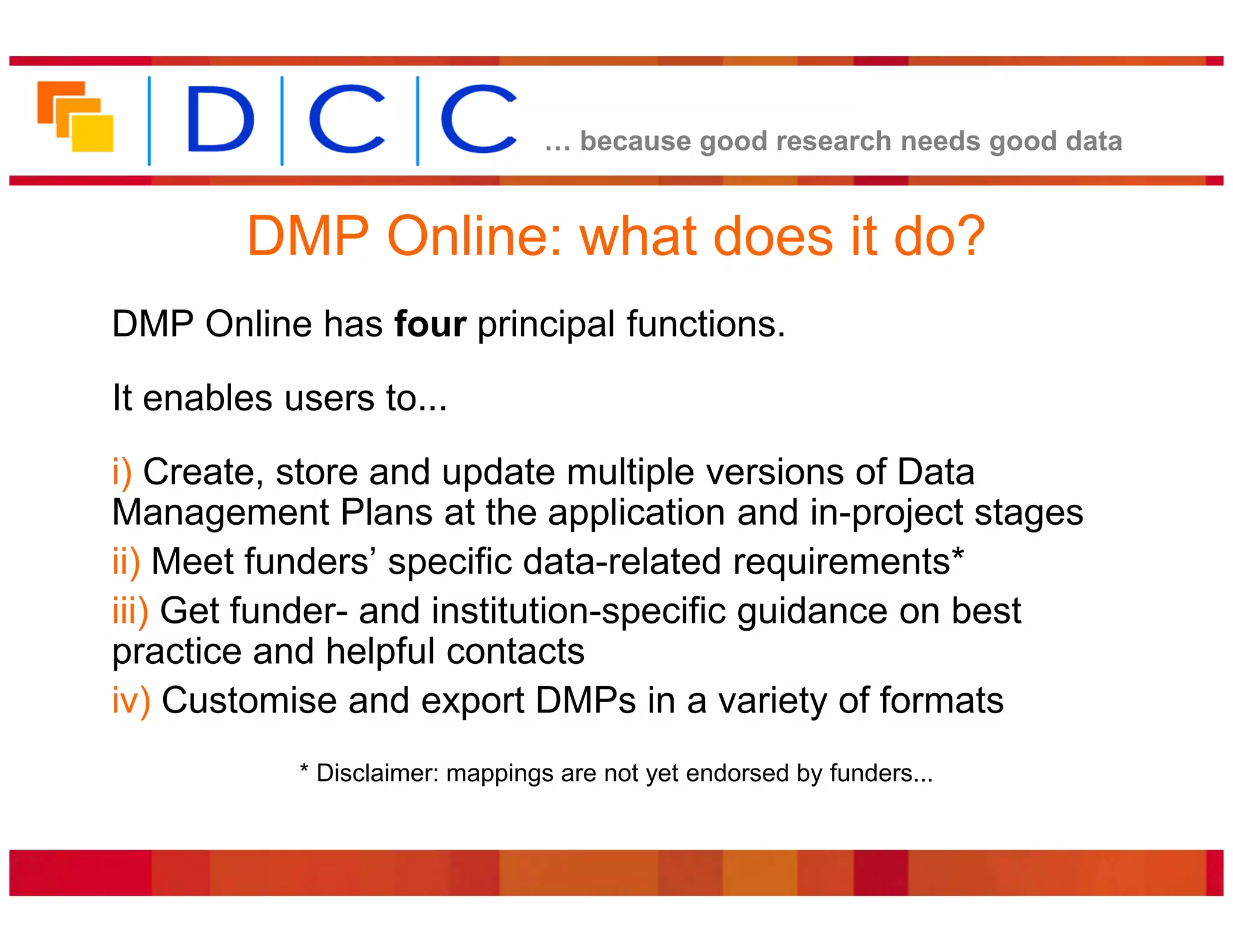
        DMP Online: what does it do?
DMP Online has four principal functions.
It enables users to...
i) Create, store and update multiple versions of Data
Management Plans at the application and in-project stages
ii) Meet funders’ specific data-related requirements*
iii) Get funder- and institution-specific guidance on best
practice and helpful contacts
iv) Customise and export DMPs in a variety of formats
            * Disclaimer: mappings are not yet endorsed by funders...
Geospatial Data Preservation Resource Center
Unlike physical maps and documents, digital data
can be difficult to reuse and preserve in the long run,
because of changing software and formats,
inadequate documentation, loss of media, and other
factors.
A new website, the Geospatial Data Preservation
Resource Center (at CIESIN, University of Columbia)
aims to help those responsible for producing and
managing geospatial data learn about the latest
approaches and tools available to facilitate long-term
geospatial data preservation and access.
For more information:
• EDINA helpdesk - edina@ed.ac.uk
• DCC helpdesk – info@dcc.ac.uk
• GoGeo portal - www.gogeo.ac.uk
• ShareGeo Open - www.sharegeo.ac.uk
• Resources for Digital Curators -
  www.dcc.ac.uk/resources
• DMP Online tool - www.dcc.ac.uk/dmponline
• Geospatial Data Preservation Resource Center -
  http://geopreservation.org

Presentation on INSPIRE and Higher Education (1 of 2)

  • 1.
    INSPIRE - ensuringaccess or continuity of access? Robin Rice1, Martin Donnelly2, Anne Robertson1 and James Reid1 EDINA and Digital Curation Centre University of Edinburgh INSPIRE Conference Edinburgh UK, June 2011
  • 2.
    Thesis (1 of2) “Policies underpinned by studies of environmental change require an under- standing of how phenomena change over time. This requires access to historic data and earlier editions of data. This in turn implies the application of sound data management and curation principles with an implicit long term view of preserving the evidential base for future generations of policy makers and researchers.”
  • 3.
    Thesis (2 of2) “Without effective research data management across the data life-cycle – from creation to use to preservation, INSPIRE may not be able to deliver continuity of access to data sets over the long term. By marrying the principles of INSPIRE with best practice in research data management, the availability of geospatial and temporal data will be assured for government, the public and the academy.” (from our submitted abstract)
  • 4.
    Geospatial data inresearch & teaching
  • 5.
    UK Higher EducationInstitutions: how does INSPIRE affect them Development of the academic SDI is in parallel with broader SDI initiatives at UK government and EU level which provide simultaneously both obligations and opportunities, specifically: The UK Location Programme- a cross domain, public sector effort to Establish the UK SDI and to partially realize UK obligations under: INSPIRE - A pan- European Directive for the establishment of an Infrastructure for Spatial Information (SDI) in the EU The aim of INSPIRE is to: improve the sharing of spatial information between public authorities and improve accessibility to the public. INSPIRE will improve the quality of spatial information and enable information from different sources to be more easily combined
  • 6.
    UK HFE asINSPIRE Data Provider INSPIRE – a European SDI Implementation of INSPIRE in the UK will deliver a step change in data management, data interoperability and data sharing across the public sector, supported by better integration with mainstream information services. “citizens will have ready access to the information they need to go about their daily lives, whether at home, in business, in research or in government. Doing this will exploit the full value of the UK’s spatial information.” Specifically, this will allow us to: Know what data we have, and avoid duplicating it; Use common reference data so we know we are talking about the same places; Share spatial information easily through a common infrastructure of standards, technology and business relationships.
  • 7.
    Current & recentGeo activities at EDINA Services: Digimap [for Schools]; UKBORDERS; GoGeo; Unlock; agcensus; ShareGeo Open; OpenBoundaries; OpenStream Projects & activities ESDIN - European Spatial Data Infrastructure Best Practice Network WSTERIA – secure web services (OGC) Soils demonstrator – eFramework AddressingHistory ShareGeo+ Service hosting (GIGateway, Scottish DMS) Community engagement and outreach e.g. Seat on UK LP Location Information Interoperability Board Chair OGC Universities WG Sit on Scottish Government GI Steering Group Acting as contact point between OGC and e-Science GRID communities AGI Working Groups Census Advisory Committee and Census Web Services Working Group
  • 8.
    (Some) data supplyfacilities Data Download
  • 9.
    l Geospatial data registries & repositories GoGeo – the UK academic (geo) metadata discovery service. A value added portal for finding geo-resources. Also provides a metadata curation tool (Geodoc) for creating a standards-compliant record of a geospatial dataset for discovery. ShareGeo Open – a data repository (built in DSpace) for depositing and sharing geodata. ShareGeo Open timely with recent government open data initiatives, e.g. OS OpenData. Parallel development - building plugin for ESRI ArcMap to enable deposit into ShareGeo Open repository directly from the desktop.
  • 10.
    because good researchneeds good data What is Digital Curation? • Digital curation is about maintaining and adding value to a trusted body of digital information for current and future use. • The activity of managing and promoting the use of data from its point of creation, to ensure it is fit for contemporary purpose, and available for discovery and re-use. For dynamic datasets this may mean continuous enrichment or updating to keep it fit for purpose. Higher levels of curation will also involve maintaining links with annotation and with other published materials. - e-Science Curation Report, Lord & Macdonald (2003)
  • 11.
    because good researchneeds good data
  • 12.
    because good researchneeds good data DCC resources on the Web
  • 13.
    because good researchneeds good data Data Management Planning Checklist - Data Types, Formats, Standards and Capture Methods - Ethics and Intellectual Property - Access, Data Sharing and Re-use - Short-Term Storage and Data Management - Deposit and Long-Term Preservation - Resourcing - Adherence and Review - Agreement/Ratification by Stakeholders
  • 14.
    because good researchneeds good data DMP Online: what does it do? DMP Online has four principal functions. It enables users to... i) Create, store and update multiple versions of Data Management Plans at the application and in-project stages ii) Meet funders’ specific data-related requirements* iii) Get funder- and institution-specific guidance on best practice and helpful contacts iv) Customise and export DMPs in a variety of formats * Disclaimer: mappings are not yet endorsed by funders...
  • 15.
    Geospatial Data PreservationResource Center Unlike physical maps and documents, digital data can be difficult to reuse and preserve in the long run, because of changing software and formats, inadequate documentation, loss of media, and other factors. A new website, the Geospatial Data Preservation Resource Center (at CIESIN, University of Columbia) aims to help those responsible for producing and managing geospatial data learn about the latest approaches and tools available to facilitate long-term geospatial data preservation and access.
  • 16.
    For more information: •EDINA helpdesk - edina@ed.ac.uk • DCC helpdesk – info@dcc.ac.uk • GoGeo portal - www.gogeo.ac.uk • ShareGeo Open - www.sharegeo.ac.uk • Resources for Digital Curators - www.dcc.ac.uk/resources • DMP Online tool - www.dcc.ac.uk/dmponline • Geospatial Data Preservation Resource Center - http://geopreservation.org