GLOBAL BIODIVERSITY INFORMATION FACILITY Vishwas Chavan & Samy Gaiji [email_address] WWW.GBIF.ORG GBIF: An introduction, key points and highlights Building the Biodiversity Informatics Commons ICES WGDIM Meeting 25-27 May 2010 Copenhagen, Denmark
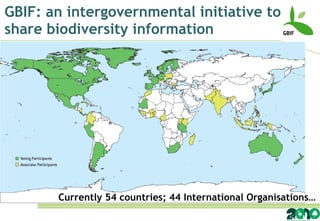
GBIF: an intergovernmental initiative to share biodiversity information Currently 5 4  countries; 4 4  International Organisations…
Growth in GBIF Participation NB: Drop in Associate Participants in 2007 is attributable to delays in signing the new MOU 2007-2011 Last updated: 2010-02-12 39 51 63 72 78 81 79 88 97 98
GBIF’s Mandate ” To  facilitate free and open access to biodiversity data  worldwide, via the Internet, to underpin scientific research, conservation and sustainable development.” GBIF is govt-initiated, and govt. funded,  in response to government agency needs in biodiversity information access and management; GBIF is in service to science, as a global ‘public good’
Data shared online via GBIF  (> 200  m biodiversity records mapped to a 1 X 1 degree grid) Data Publishers: 312 Data Resources: 9900
GBIF facilitates access/exchange of data GBIF-mediated data on the ‘India’
GBIF Data portal and data access/sharing/ repatriation
GBIF, Global Information Infrastructure for Biodiversity Global Infrastructure Tools, Standards, and Processes Strategies and Policy Framework Outreach and Capacity Building
 
 
GBRDS, a Discovery System Consumers Data Publishers Searching Retrieving Discovering Discovery System Registering Service Publishers Others…
 
Building a comprehensive architecture to resolve taxonomic names - GNA
Data Hosting Centers
In summary…GBIF’s Informatics Improved access to Names, Metadata  and Primary Biodiversity  Data Distributed GBIF  informatics architecture Faster and easier  publishing of data
 
train the trainers…
Best Practice Guidelines All freely available
Primary biodiversity data and information  effectively available Data and information that  have been produced  but  are not easy to find, access, and use  (i.e not effectively available!) -  a gigantic task of mobilising billions of data is still needed, as well as integrating new data.  Biological collections Scientific publications Observations Reports Gray literature Data Bases Geography
Broadening Data Types Data Resources Discovery Innovative Approaches to Data Mobilisation Data Mobilisation Strategy Discussions Data Publishing Framework Improving mobilisation and Cultural Changes
Content driven focus....
Discovery:  facilitate access to information about non-digital collections Digitisation:  increase the efficiency of data capture and to enhance data quality Publication:  improve & promote global infrastructure to mobilise digitised collections data GSAP-NHC Recommendations
Towards Data Publishing Framework.... Data Publishing Framework Task Group Data Paper as mechanism for incentivising metadata efforts Data Citation mechanisms Data Usage Index Chavan and Ingewersen, BMC Bioinformatics 2009 10(Suppl 14): s2
Implementation of ‘Data Publishing Framework’ Data Citation Mechanism & Service Data Usage Index Data Paper & simultaneous data publishing Hosting centre infrastructure Beyond 2010.... Demand driven data discovery strategy & action plans by Participants  Best practice guidelines GAP Analysis of GBIF mobilised data Uptake of BIP Index by Participants
The Science-Policy Interface Management, conservation and sustainable use of biodiversity Policy development and decision making (at local, national, regional, and global levels) Scientific monitoring of status and trends of biodiversity GBIF-published data and analyses
GBIF Task Groups & White Papers Mobilisation of Observational Data Mobilisation of Multimedia Resources Metadata Implementation Framework Life Science Identifiers and GUIDs Data Publishing Framework Content Needs Assessment GSAP – Natural History Collections Data Improving geospatial fitness for use
ICES – GBIF Collaboration Data Publishing Framework technical/infrastructural, social/policy Demand driven data mobilisation strategies EIA Biodiversity Data Publishing Framework: Strategic Application Data Hosting Canters
Thank You

Ices wgdim-may-2010

  • 1.
    GLOBAL BIODIVERSITY INFORMATIONFACILITY Vishwas Chavan & Samy Gaiji [email_address] WWW.GBIF.ORG GBIF: An introduction, key points and highlights Building the Biodiversity Informatics Commons ICES WGDIM Meeting 25-27 May 2010 Copenhagen, Denmark
  • 2.
    GBIF: an intergovernmentalinitiative to share biodiversity information Currently 5 4 countries; 4 4 International Organisations…
  • 3.
    Growth in GBIFParticipation NB: Drop in Associate Participants in 2007 is attributable to delays in signing the new MOU 2007-2011 Last updated: 2010-02-12 39 51 63 72 78 81 79 88 97 98
  • 4.
    GBIF’s Mandate ”To facilitate free and open access to biodiversity data worldwide, via the Internet, to underpin scientific research, conservation and sustainable development.” GBIF is govt-initiated, and govt. funded, in response to government agency needs in biodiversity information access and management; GBIF is in service to science, as a global ‘public good’
  • 5.
    Data shared onlinevia GBIF (> 200 m biodiversity records mapped to a 1 X 1 degree grid) Data Publishers: 312 Data Resources: 9900
  • 6.
    GBIF facilitates access/exchangeof data GBIF-mediated data on the ‘India’
  • 7.
    GBIF Data portaland data access/sharing/ repatriation
  • 8.
    GBIF, Global InformationInfrastructure for Biodiversity Global Infrastructure Tools, Standards, and Processes Strategies and Policy Framework Outreach and Capacity Building
  • 9.
  • 10.
  • 11.
    GBRDS, a DiscoverySystem Consumers Data Publishers Searching Retrieving Discovering Discovery System Registering Service Publishers Others…
  • 12.
  • 13.
    Building a comprehensivearchitecture to resolve taxonomic names - GNA
  • 14.
  • 15.
    In summary…GBIF’s InformaticsImproved access to Names, Metadata and Primary Biodiversity Data Distributed GBIF informatics architecture Faster and easier publishing of data
  • 16.
  • 17.
  • 18.
    Best Practice GuidelinesAll freely available
  • 19.
    Primary biodiversity dataand information effectively available Data and information that have been produced but are not easy to find, access, and use (i.e not effectively available!) - a gigantic task of mobilising billions of data is still needed, as well as integrating new data. Biological collections Scientific publications Observations Reports Gray literature Data Bases Geography
  • 20.
    Broadening Data TypesData Resources Discovery Innovative Approaches to Data Mobilisation Data Mobilisation Strategy Discussions Data Publishing Framework Improving mobilisation and Cultural Changes
  • 21.
  • 22.
    Discovery: facilitateaccess to information about non-digital collections Digitisation: increase the efficiency of data capture and to enhance data quality Publication: improve & promote global infrastructure to mobilise digitised collections data GSAP-NHC Recommendations
  • 23.
    Towards Data PublishingFramework.... Data Publishing Framework Task Group Data Paper as mechanism for incentivising metadata efforts Data Citation mechanisms Data Usage Index Chavan and Ingewersen, BMC Bioinformatics 2009 10(Suppl 14): s2
  • 24.
    Implementation of ‘DataPublishing Framework’ Data Citation Mechanism & Service Data Usage Index Data Paper & simultaneous data publishing Hosting centre infrastructure Beyond 2010.... Demand driven data discovery strategy & action plans by Participants Best practice guidelines GAP Analysis of GBIF mobilised data Uptake of BIP Index by Participants
  • 25.
    The Science-Policy InterfaceManagement, conservation and sustainable use of biodiversity Policy development and decision making (at local, national, regional, and global levels) Scientific monitoring of status and trends of biodiversity GBIF-published data and analyses
  • 26.
    GBIF Task Groups& White Papers Mobilisation of Observational Data Mobilisation of Multimedia Resources Metadata Implementation Framework Life Science Identifiers and GUIDs Data Publishing Framework Content Needs Assessment GSAP – Natural History Collections Data Improving geospatial fitness for use
  • 27.
    ICES – GBIFCollaboration Data Publishing Framework technical/infrastructural, social/policy Demand driven data mobilisation strategies EIA Biodiversity Data Publishing Framework: Strategic Application Data Hosting Canters
  • 28.

Editor's Notes

  • #14 Add a NODES component to this SLIDE as GBIF historical focus has collections as a core
  • #21 DIGIT has moved from its NHC focus (specimen, observation, multimedia, impact assessments, domain specific task groups). Data Resources Discovery – GBRDS is planned as registry of biodiversity resources, GBRDS Stakeholders workshop, GBRDS as tool for investment in BI. GSAP-NHC has recommended that metadata creation is way forward to expedite NHC digitisation. Innovative approaches are being adopted by the network Participants as fall out of targets set by 2009-2010 WP. Data Mobilisation Strategy Discussions – assess realities, challenges, and potentials of the Participants Data Publishing Framework Task Group: Data Publishing on par with Scholarly publishing: (a) recommendation on data discovery and publishing, (b) data publishing together with scholarly publishing, (c) Data Paper, (d) Data Usage Index, (e) Data Citation Mechanism
  • #23 DIGIT has moved from its NHC focus (specimen, observation, multimedia, impact assessments, domain specific task groups). Data Resources Discovery – GBRDS is planned as registry of biodiversity resources, GBRDS Stakeholders workshop, GBRDS as tool for investment in BI. GSAP-NHC has recommended that metadata creation is way forward to expedite NHC digitisation. Innovative approaches are being adopted by the network Participants as fall out of targets set by 2009-2010 WP. Data Mobilisation Strategy Discussions – assess realities, challenges, and potentials of the Participants Data Publishing Framework Task Group: Data Publishing on par with Scholarly publishing: (a) recommendation on data discovery and publishing, (b) data publishing together with scholarly publishing, (c) Data Paper, (d) Data Usage Index, (e) Data Citation Mechanism
  • #25 2011 WP activities of DIGIT area will focus on strengthening network capacities in two areas – Demand driven data discovery & action plans by Participants: Best practice guidelines for strategy & action plan development Comprehensive GAP analysis of GBIF mobilised data Uptake of BIP Index by the Participants in furthering progress in ‘biodiversity informatics’ Strategies for ‘internationalisation’ of data discovery & publishing Implementation of ‘Data Publishing Framework’: Data citation mechanism & service Data Usage Index Data Papers for recognising efforts of authoring enriched metadata documents Simultaneous publishing of ‘peer reviewed paper’ and ‘data’ Institutionalisation of hosting centre infrastructure