Inside Our Earth
Class- VIII
Presented by
Gourab Narayan Deb
B.Ed , 4th Semester
KSS Jain College of Education
About The Earth
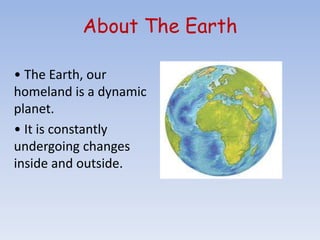
• The Earth, our
homeland is a dynamic
planet.
• It is constantly
undergoing changes
inside and outside.
Interior Of The Earth
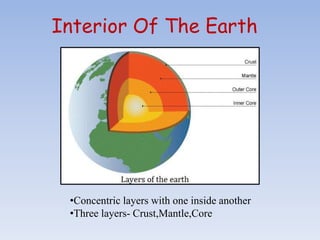
•Concentric layers with one inside another
•Three layers- Crust,Mantle,Core
Crust -
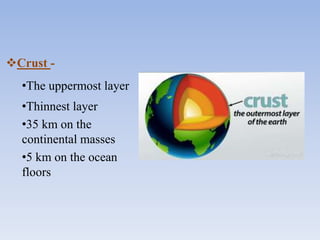
•The uppermost layer
•Thinnest layer
•35 km on the
continental masses
•5 km on the ocean
floors
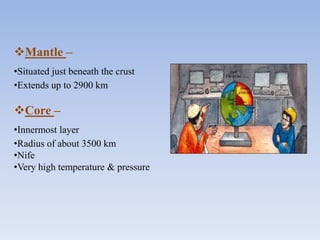
Mantle –
•Situated just beneath the crust
•Extends up to 2900 km
Core –
•Innermost layer
•Radius of about 3500 km
•Nife
•Very high temperature & pressure
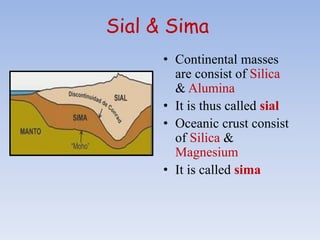
• Continental masses
are consist of Silica
& Alumina
• It is thus called sial
• Oceanic crust consist
of Silica &
Magnesium
• It is called sima
Sial & Sima
Rocks & Minerals
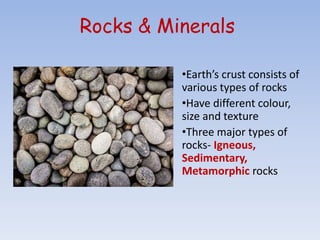
•Earth’s crust consists of
various types of rocks
•Have different colour,
size and texture
•Three major types of
rocks- Igneous,
Sedimentary,
Metamorphic rocks
Igneous Rocks
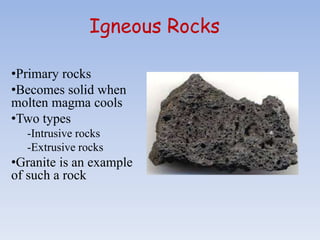
•Primary rocks
•Becomes solid when
molten magma cools
•Two types
-Intrusive rocks
-Extrusive rocks
•Granite is an example
of such a rock
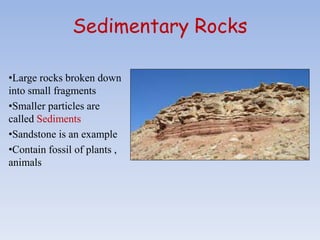
Sedimentary Rocks
•Large rocks broken down
into small fragments
•Smaller particles are
called Sediments
•Sandstone is an example
•Contain fossil of plants ,
animals
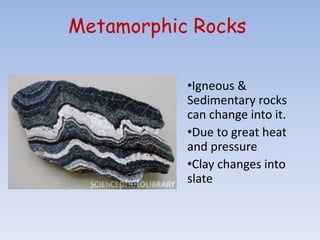
Metamorphic Rocks
•Igneous &
Sedimentary rocks
can change into it.
•Due to great heat
and pressure
•Clay changes into
slate
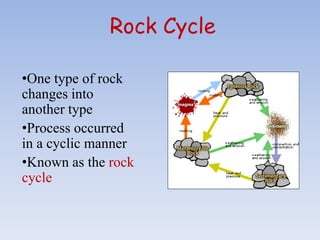
Rock Cycle
•One type of rock
changes into
another type
•Process occurred
in a cyclic manner
•Known as the rock
cycle
Thank You

Inside Our Earth

  • 1.
    Inside Our Earth Class-VIII Presented by Gourab Narayan Deb B.Ed , 4th Semester KSS Jain College of Education
  • 2.
    About The Earth •The Earth, our homeland is a dynamic planet. • It is constantly undergoing changes inside and outside.
  • 3.
    Interior Of TheEarth •Concentric layers with one inside another •Three layers- Crust,Mantle,Core
  • 4.
    Crust - •The uppermostlayer •Thinnest layer •35 km on the continental masses •5 km on the ocean floors
  • 5.
    Mantle – •Situated justbeneath the crust •Extends up to 2900 km Core – •Innermost layer •Radius of about 3500 km •Nife •Very high temperature & pressure
  • 6.
    • Continental masses areconsist of Silica & Alumina • It is thus called sial • Oceanic crust consist of Silica & Magnesium • It is called sima Sial & Sima
  • 7.
    Rocks & Minerals •Earth’scrust consists of various types of rocks •Have different colour, size and texture •Three major types of rocks- Igneous, Sedimentary, Metamorphic rocks
  • 8.
    Igneous Rocks •Primary rocks •Becomessolid when molten magma cools •Two types -Intrusive rocks -Extrusive rocks •Granite is an example of such a rock
  • 9.
    Sedimentary Rocks •Large rocksbroken down into small fragments •Smaller particles are called Sediments •Sandstone is an example •Contain fossil of plants , animals
  • 10.
    Metamorphic Rocks •Igneous & Sedimentaryrocks can change into it. •Due to great heat and pressure •Clay changes into slate
  • 11.
    Rock Cycle •One typeof rock changes into another type •Process occurred in a cyclic manner •Known as the rock cycle
  • 12.