B.J.P.S Samiti’s
M.V.HERWADKAR ENGLISH MEDIUM HIGH SCHOOL
LITHOSPHERE
STD 8TH
Staff Name:Rashmi Pandit
Lithosphere
In this chapter you learn:
The meaning of lithosphere and its importance.
 The structure of the earth and its composition.
 The structure of rocks.
 The internal forces-volcanoes, earthquakes,
tsunami etc. and their effects on life on the
earth.
 The external forces like temperature, wind,
rain and rivers.
 The meaning of underground water and its
importance.
Meaning and importance.
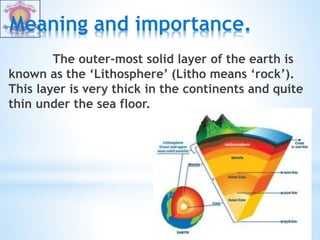
The outer-most solid layer of the earth is
known as the ‘Lithosphere’ (Litho means ‘rock’).
This layer is very thick in the continents and quite
thin under the sea floor.
The lithosphere consists of
rocks, minerals, soils etc. Life
exists on this layer with the help
of the atmosphere and the
hydrosphere. Continents are
parts of the lithosphere where
different land forms like
mountains, plateaus, plains,
etc., are found.
Earth’s Interior and Composition
Our planet Earth is more than 4.6
billion years old and still in the process
of changing. Man is in quest of
understanding this change and eager to
know more about inside the earth.
What is inside the earth is still a
mystery for man.
With years of study and research
human beings have been able to get
information about the materials inside
the earth up to 10 to 12 kms. Going
beyond this depth is very difficult due
to the increase of temperature (10 C for
every 32 meters).
To understand more about the earth’s
interior humans are dependent on
indirect evidences such as seismic
waves, volcanic materials etc. The
earth’s interior comprises of various
materials in different forms. On the
basis of density of material, chemical
composition and physical state of
matter the earth’s interior is classified
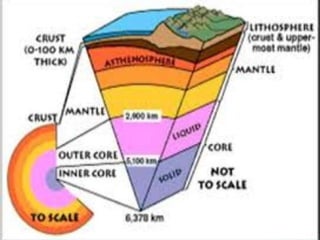
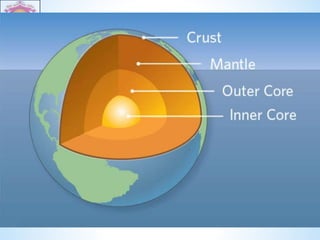
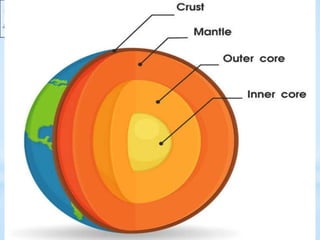
into 3 main layers. They are the Crust,
the Mantle and the Core.
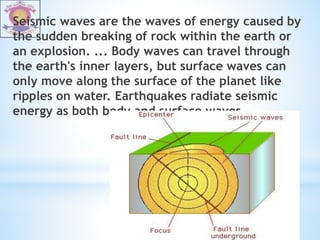
Seismic waves are the waves of energy caused by
the sudden breaking of rock within the earth or
an explosion. ... Body waves can travel through
the earth's inner layers, but surface waves can
only move along the surface of the planet like
ripples on water. Earthquakes radiate seismic
energy as both body and surface waves.
*On the basis of density of material,
chemical composition and physical
state of matter the earth’s interior is
classified into 3 main layers. They are
the Crust, the Mantle and the Core.
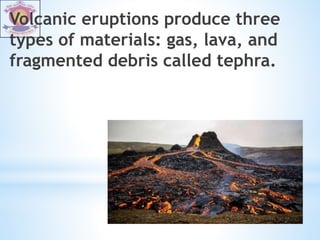
Volcanic eruptions produce three
types of materials: gas, lava, and
fragmented debris called tephra.
The crust is the uppermost layer of
the earth, rich in Silica, Aluminum and
Magnesium. The depth of this layer is
around 60 kms from the surface. In the
upper part of the crust only lighter
materials are found. It is called SIAL (Silica
and Aluminum) or continental crust. The
lower part of the crust is rich in Silica and
Magnesium and it is called SIMA or oceanic
crust.
The Mantle is the second and
the middle layer of the earth. The
depth of this layer is up to 2900 kms
from the surface. The materials are in
semi liquid or partially molten state
which is called magma. The mantle is
composed of dense and rigid rocks
which have predominance of minerals
like magnesium and iron.
The mantle has two parts
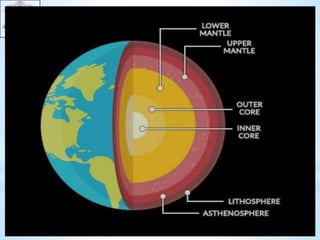
a)Upper mantle or the Asthenosphere is
partially in a molten condition.
b)Lower mantle or the Mesosphere in solid
condition.
The contact zone of the crust and the
mantle is called ‘Mohorovicic
Discontinuity’ or Moho. While the
boundary that separates the Mantle
from the Core is called ‘Gutenberg
Discontinuity’. Here the rocks are
different in chemical composition from
those below and above.
This is the innermost layer of the
earth. The depth of this layer is up
to 6371 kms from the surface. The
most important materials of the
core are Nickel and Ferrous (Iron).
So it is known as NIFE. The core is
divided into two sub layers.
a)The outer core is known as molten
core, where the materials are in
liquid and in molten form.
b)The inner core known as solid core.
Thank-you

Lithosphere 8th.pptx

  • 1.
    B.J.P.S Samiti’s M.V.HERWADKAR ENGLISHMEDIUM HIGH SCHOOL LITHOSPHERE STD 8TH Staff Name:Rashmi Pandit
  • 2.
  • 3.
    In this chapteryou learn: The meaning of lithosphere and its importance.  The structure of the earth and its composition.  The structure of rocks.  The internal forces-volcanoes, earthquakes, tsunami etc. and their effects on life on the earth.  The external forces like temperature, wind, rain and rivers.  The meaning of underground water and its importance.
  • 4.
    Meaning and importance. Theouter-most solid layer of the earth is known as the ‘Lithosphere’ (Litho means ‘rock’). This layer is very thick in the continents and quite thin under the sea floor.
  • 5.
    The lithosphere consistsof rocks, minerals, soils etc. Life exists on this layer with the help of the atmosphere and the hydrosphere. Continents are parts of the lithosphere where different land forms like mountains, plateaus, plains, etc., are found.
  • 8.
    Earth’s Interior andComposition Our planet Earth is more than 4.6 billion years old and still in the process of changing. Man is in quest of understanding this change and eager to know more about inside the earth. What is inside the earth is still a mystery for man.
  • 9.
    With years ofstudy and research human beings have been able to get information about the materials inside the earth up to 10 to 12 kms. Going beyond this depth is very difficult due to the increase of temperature (10 C for every 32 meters).
  • 11.
    To understand moreabout the earth’s interior humans are dependent on indirect evidences such as seismic waves, volcanic materials etc. The earth’s interior comprises of various materials in different forms. On the basis of density of material, chemical composition and physical state of matter the earth’s interior is classified into 3 main layers. They are the Crust, the Mantle and the Core.
  • 12.
    Seismic waves arethe waves of energy caused by the sudden breaking of rock within the earth or an explosion. ... Body waves can travel through the earth's inner layers, but surface waves can only move along the surface of the planet like ripples on water. Earthquakes radiate seismic energy as both body and surface waves.
  • 13.
    *On the basisof density of material, chemical composition and physical state of matter the earth’s interior is classified into 3 main layers. They are the Crust, the Mantle and the Core.
  • 14.
    Volcanic eruptions producethree types of materials: gas, lava, and fragmented debris called tephra.
  • 15.
    The crust isthe uppermost layer of the earth, rich in Silica, Aluminum and Magnesium. The depth of this layer is around 60 kms from the surface. In the upper part of the crust only lighter materials are found. It is called SIAL (Silica and Aluminum) or continental crust. The lower part of the crust is rich in Silica and Magnesium and it is called SIMA or oceanic crust.
  • 17.
    The Mantle isthe second and the middle layer of the earth. The depth of this layer is up to 2900 kms from the surface. The materials are in semi liquid or partially molten state which is called magma. The mantle is composed of dense and rigid rocks which have predominance of minerals like magnesium and iron.
  • 19.
    The mantle hastwo parts a)Upper mantle or the Asthenosphere is partially in a molten condition. b)Lower mantle or the Mesosphere in solid condition.
  • 21.
    The contact zoneof the crust and the mantle is called ‘Mohorovicic Discontinuity’ or Moho. While the boundary that separates the Mantle from the Core is called ‘Gutenberg Discontinuity’. Here the rocks are different in chemical composition from those below and above.
  • 22.
    This is theinnermost layer of the earth. The depth of this layer is up to 6371 kms from the surface. The most important materials of the core are Nickel and Ferrous (Iron). So it is known as NIFE. The core is divided into two sub layers.
  • 24.
    a)The outer coreis known as molten core, where the materials are in liquid and in molten form. b)The inner core known as solid core.
  • 26.