AGRI CULTURE
CLASS 8 Geography Ls - 4
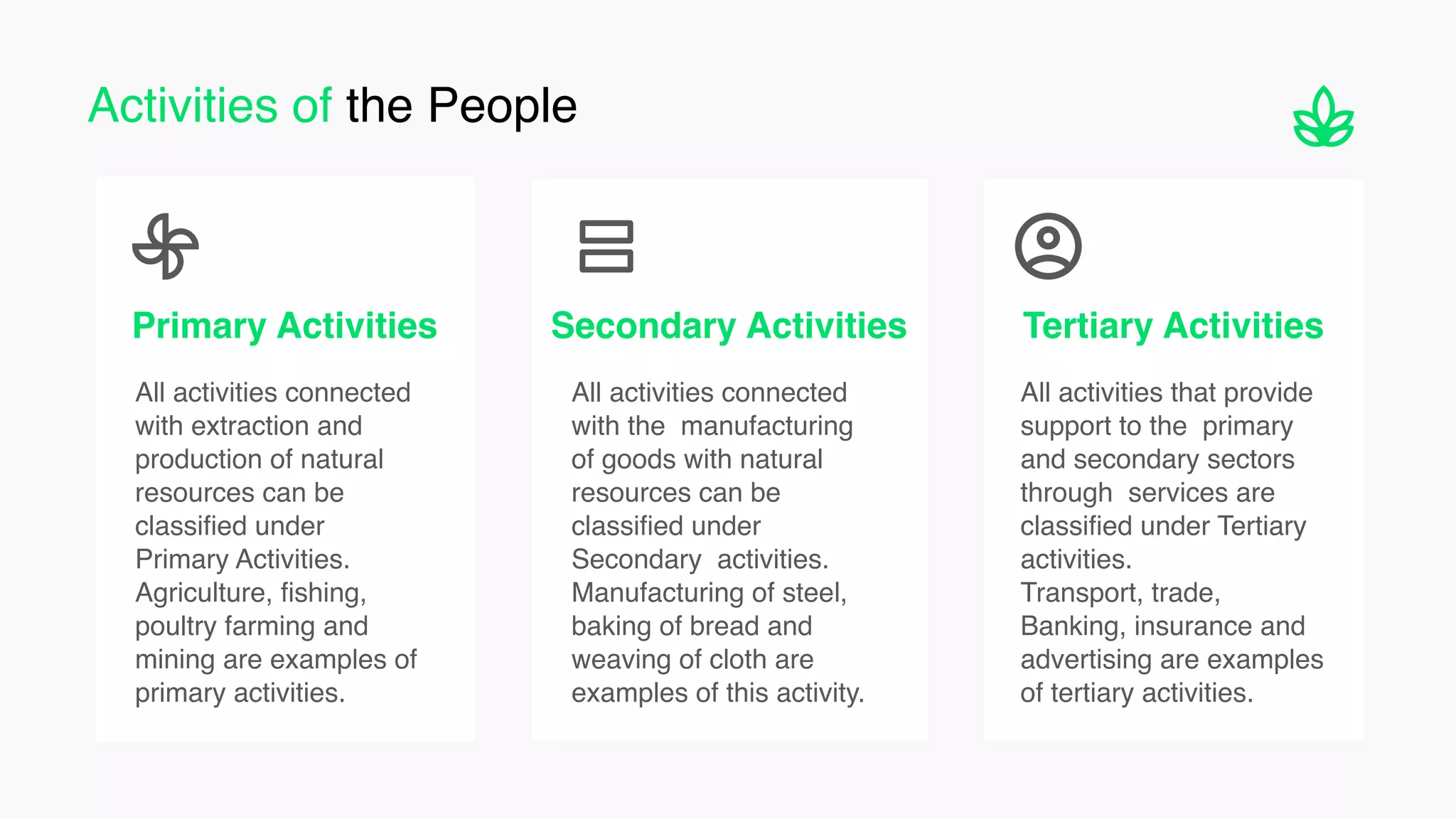
Primary Activities
All activities connected
with extraction and
production of natural
resources can be
classified under
Primary Activities
.

Agriculture, fishing,
poultry farming and
mining are examples of
primary activities.
Secondary Activities
All activities connected
with the manufacturing
of goods with natural
resources can be
classified under
Secondary activities
.

Manufacturing of steel,
baking of bread and
weaving of cloth are
examples of this activity.
Tertiary Activities
All activities that provide
support to the primary
and secondary sectors
through services are
classified under Tertiary
activities
.

Transport, trade,
Banking, insurance an
d

advertising are examples
of tertiary activities.
Activities of the People
What is Agriculture?
• Agriculture is one of the most important economic activity in
the world
.

• About 75 % of India’s total population still depend on
Agriculture
.

• Agriculture is the cultivation of Plants and other life forms for
food, fiber, bio-fuel, medicinal and other products used to
sustain and enhance human life.

• Agriculture was the key development in the rise of sedentary
human civilization, where by farming of domesticated species
created food surpluses that nurtured the development of
civilization.
Meaning of Agriculture
• The word agriculture is the English
adaptation of the Latin word ‘agricultūra’.
‘Ager’ means field and ‘cultūra’ means
cultivation; in the strict sense ‘agricultūra’
means "tillage of the soil".

• Agriculture was developed at least 10,000
years ago, and it has undergone significant
developments since the time of the earliest
cultivation
.

• The Agriculture falls under the Primary
sector activity. Agricultural Activities include
:
1. Growing crops, fruits, vegetables and
flower
s

2. Rearing of livestock
Apple Orchard
Sunflower FarmPaddy Fields
Brinjal Farm
Rearing Livestock
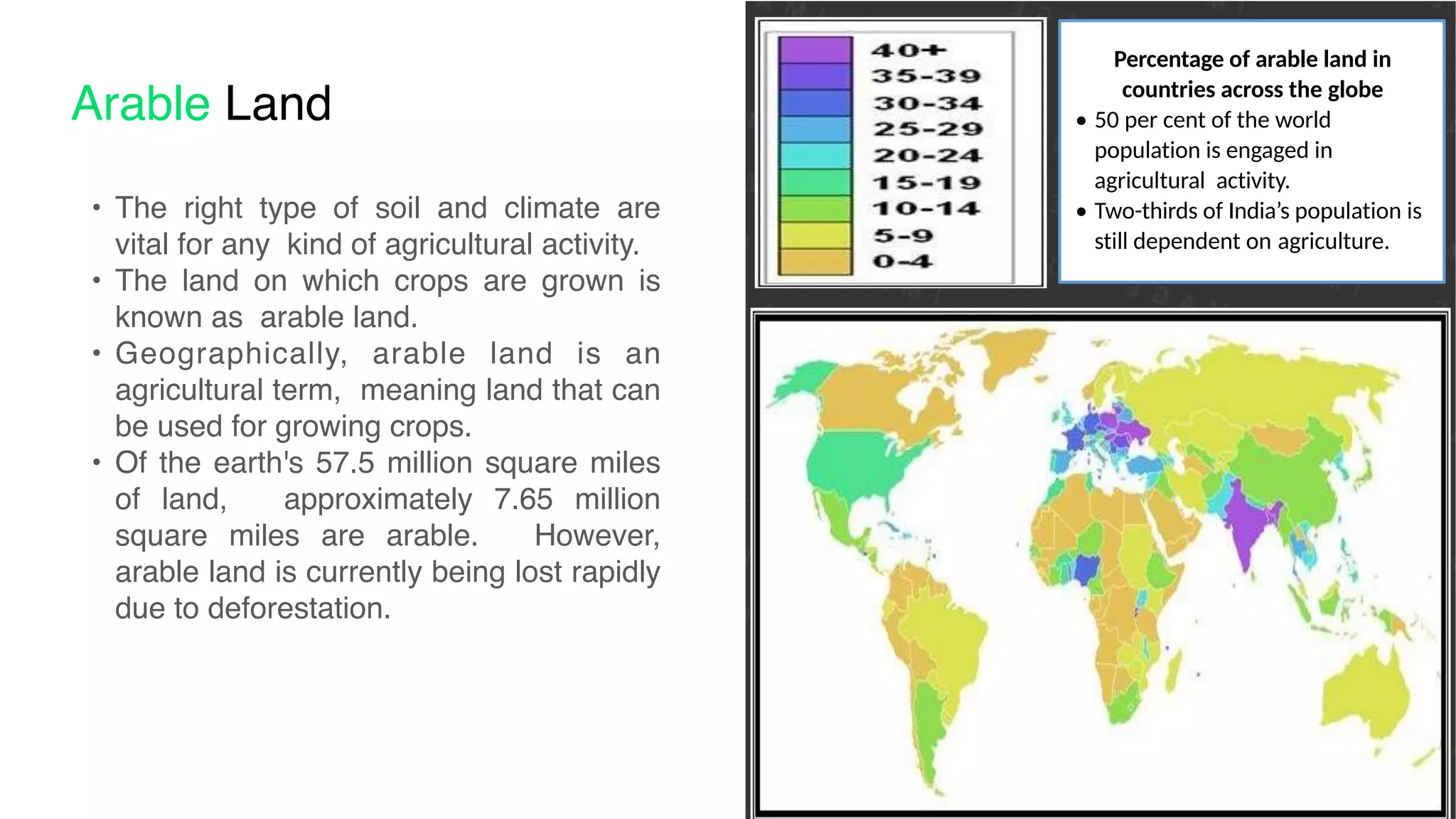
Arable Land
• The right type of soil and climate are
vital for any kind of agricultural activity
.

• The land on which crops are grown is
known as arable land
.

• Geographically, arable land is an
agricultural term, meaning land that can
be used for growing crops
.

• Of the earth's 57.5 million square miles
of land, approximately 7.65 million
square miles are arable. However,
arable land is currently being lost rapidly
due to deforestation.
Percentage of arable land in
countries across the globe


• 50 per cent of the world
population is engaged in
agricultural activity.

• Two-thirds of India’s population is
still dependent on agriculture.
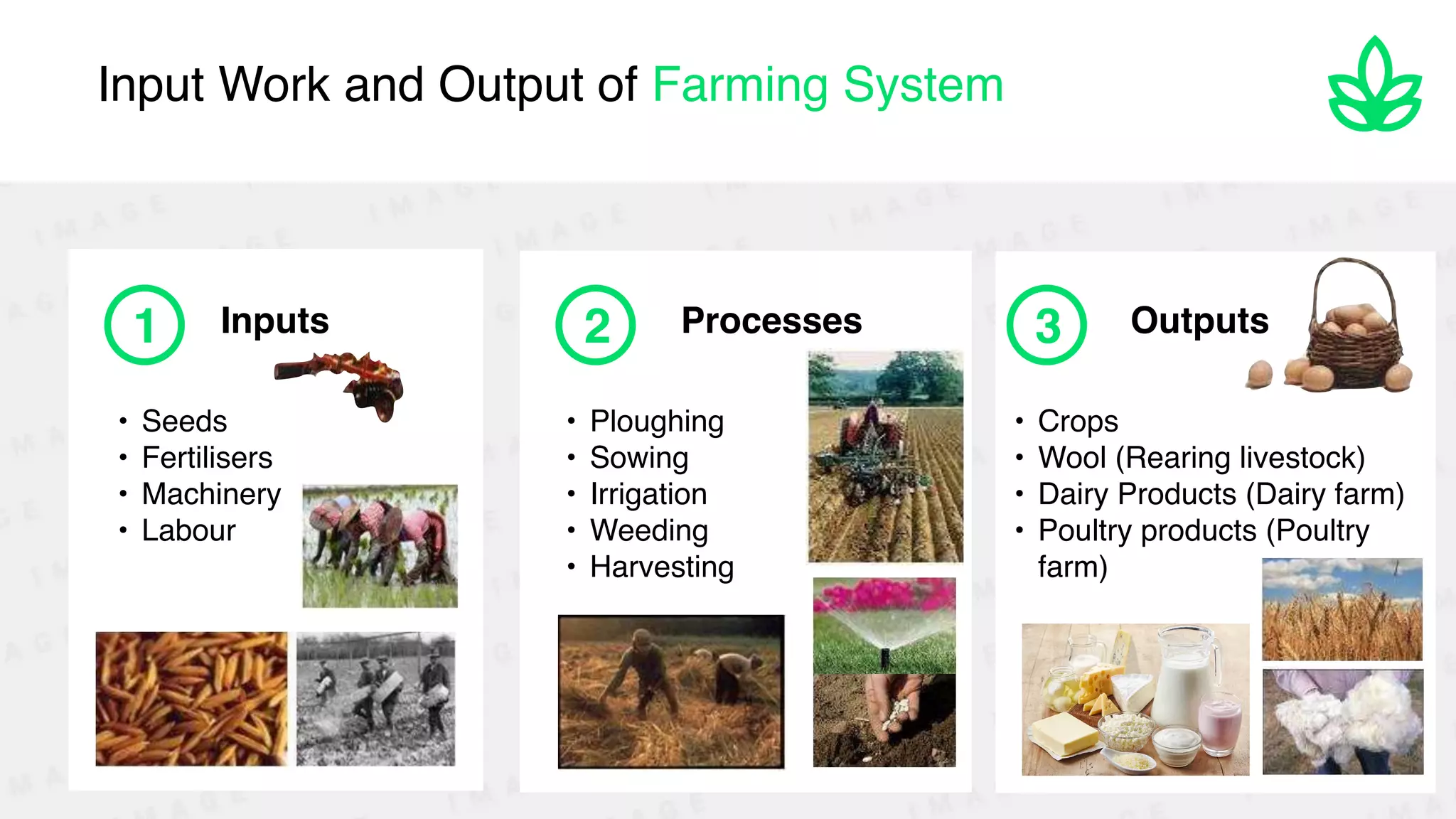
Input Work and Output of Farming System
Inputs
• Seed
s

• Fertiliser
s

• Machiner
y

• Labour
1 Processes
• Ploughin
g

• Sowin
g

• Irrigatio
n

• Weedin
g

• Harvesting
2 Outputs
• Crop
s

• Wool (Rearing livestock
)

• Dairy Products (Dairy farm
)

• Poultry products (Poultry
farm)
3
The factors influencing Agriculture
1.
The geographical conditions of
the are
a

3.
Labour availabl
e

2.
Demand for the product
4.
Level of technolog
y
Classification of Farming
1.
Based on the before factors
farming can be broadly classified
into 2 categories.
2.
They are Subsistence Farming
and Commercial Farming. It
can be further classified as
shown in picture on the right.
Subsistence Farming
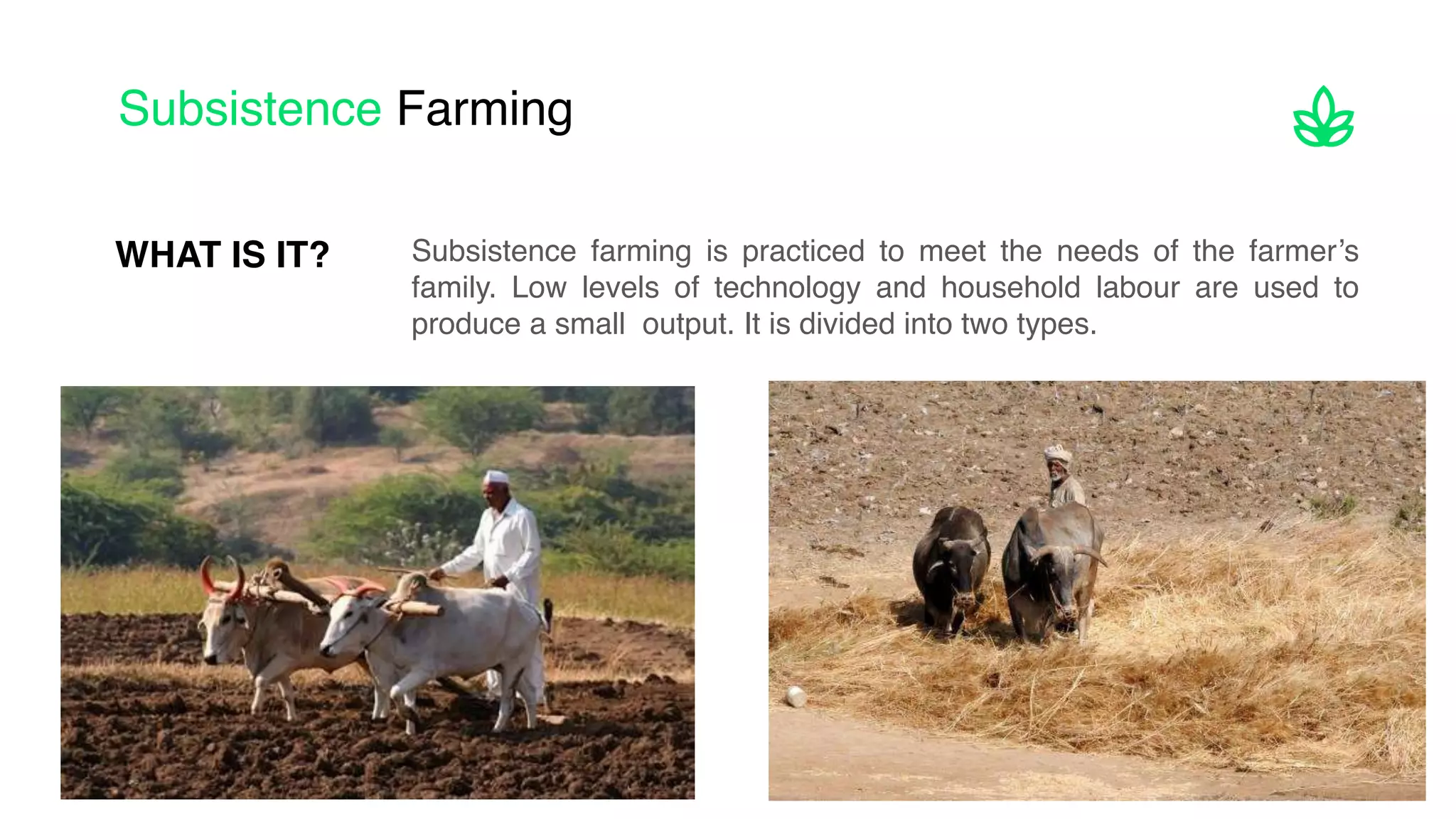
Subsistence farming is practiced to meet the needs of the farmer’s
family. Low levels of technology and household labour are used to
produce a small output. It is divided into two types.
WHAT IS IT?
Intensive Subsistence Farming
• The farmer cultivates a small plot of land using simple tools and more
labour
.

• More than one crop is grown annually, on the same plot, as the climate
is favourable and the soil is fertile
.

• Rice is the main crop; other crops include wheat, maize, pulses and
oilseeds
.

• Intensive subsistence agriculture is prevalent in the thickly populated
areas of the monsoon regions of south, southeast and east Asia.
WHAT IS IT?
SHIFTING CULTIVATIO
N
 This is mostly practiced by people living in the forest. Shifting
cultivation is practiced in the thickly forested areas of Amazon
basin, tropical Africa, parts of Southeast Asia and Northeast
India. It receives heavy rainfall and this helps in the quick
regeneration of vegetation.
NOMADIC HERDING
This is practiced by people living in dry arid regions. In nomadic
farming, herdsmen move from place to place with their animals
for fodder and water, along a definite route. The nomads move
from place to place due to the restraints of the climate and land.
Primitive Subsistence Farming
PRIMITIVE
SHIFTING CULTIVATION
How shifting cultivation is
done?
• A plot of land is cleared by felling the trees
and burning them
.

• The ashes are then mixed with the soil and
crops like maize, yam, potatoes and cassava
are grown
.

• After the soil loses its fertility, the land is
abandoned and the cultivator moves to a new
plot
.

• Shifting cultivation is also known as ‘slash and
burn’ agriculture
.

• Shifting cultivation usually starts with cutting
trees and a fire which clears a spot for crop
production
.

• In some cases, shifting cultivation is a cycle
where farmers come back to the original place
after a couple of years.
What is it?
• Nomadic herding is practiced in the semi-arid and
arid (dry) regions of Sahara, Central Asia and some
parts of India, like Rajasthan and Jammu and
Kashmir
.

• In nomadic farming, herdsmen move from place to
place with their animals for fodder and water, along a
definite route. The nomads move from place to place
due to the restraints of the climate and land
.

• Sheep, camel, yak and goats are most commonly
reared by the nomads. These animals provide milk,
meat, wool, hides and other products to the herders
and their families.
• In the drier parts of Asia, especially Southwest Asia, most rural people make a living by raising livestock. Many are
nomads who move with their herds of animals over large territories, constantly seeking good supplies of grass and
water. The people live simply and carry their tents and belongings with them. They rear animals such as goats,
sheep, camels, and yaks.
Nomadic Herding
Comercial Farming
• Crops are grown and animals are reared for
sale in the market, that is, for commercial
purposes, while in Subsistence farming crops
are grown mainly for the farmer’s family needs
.

• The area cultivated and the amount of capital
invested is larg
e

• Most of the work is done by machines
WHAT IS IT?
GRAIN
FARMING
MIXED
FARMING
PLANTAION
AGRICULTURE
In this, crops are
grown for
commercial
purpose.
In mixed farming,
the land is used for
growing food and
fodder crops and
rearing livestock.
Plantations are a type
of commercial farming
system where single
crop of tea, coffee, etc.
are grown.
Comercial
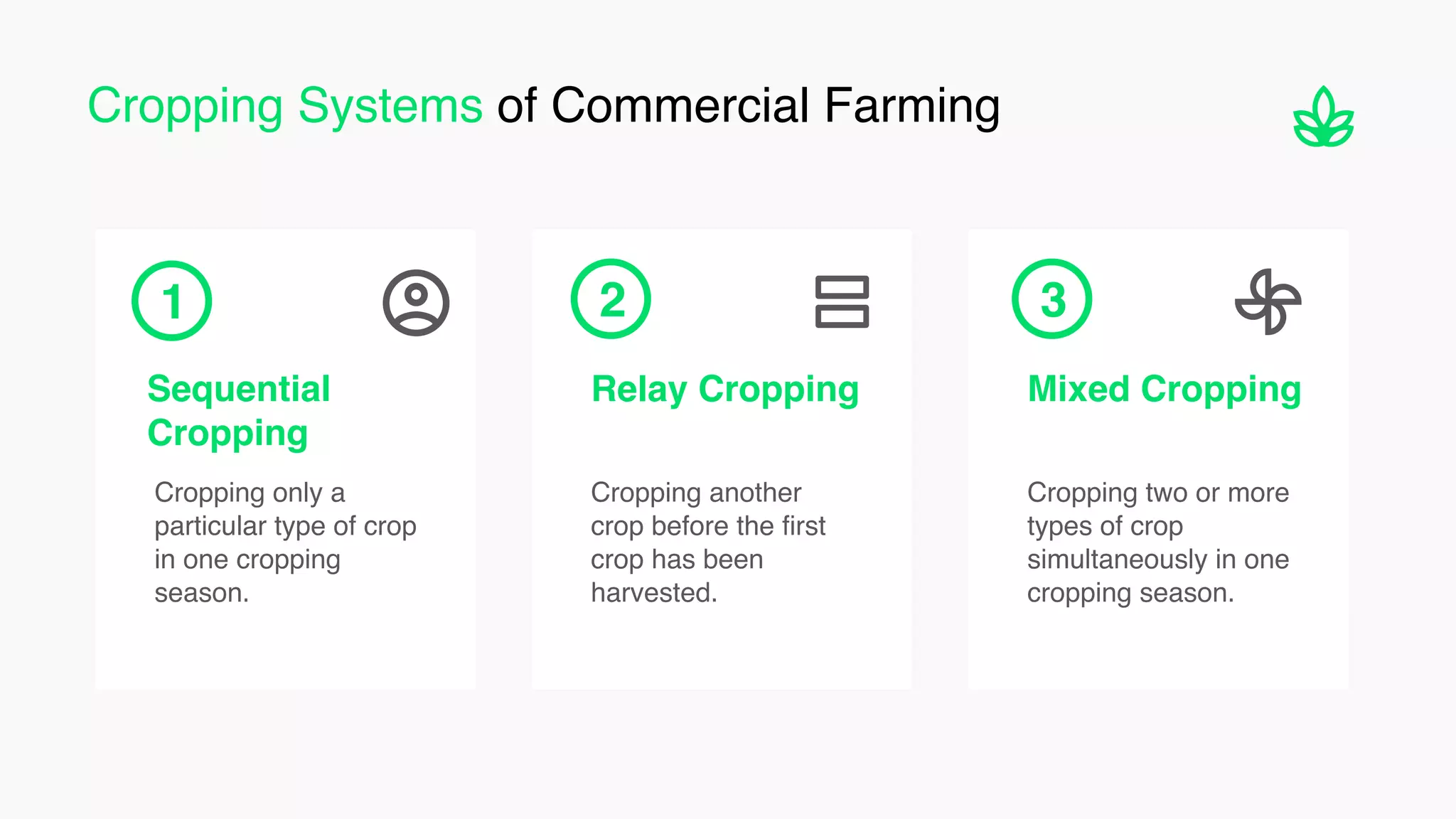
Sequential
Cropping
Cropping only a
particular type of crop
in one cropping
season.
Relay Cropping
Cropping another
crop before the first
crop has been
harvested.
Mixed Cropping
Cropping two or more
types of crop
simultaneously in one
cropping season.
Cropping Systems of Commercial Farming
1 2 3
Mixed Cropping Pattern
• Greater stability of yield over different season
s

• Better use of growth resources
.

• Better control of weeds, pests, and diseases
.

• One crop may provide physical support to another one
.

• One crop provides shelter to the other crop
.

• Erosion control through providing continuous leaf cover over the
ground surface
.

• Benefit to small farmers of limited means.
ADVANTAGES
Crop-livestock Integration : Cattle
grazing under coconut trees . Mixed cropping: pyrethrum and maize
Comercial Grain Farming
• In this crops are grown for commercial purpose
.

• Wheat and maize are common commercially grown grains
.

• It is mostly practised in the temperate grasslands of North America, Europe
and Asia
.

• These areas are sparsely populated with large farms spreading over
hundreds of hectares
.

• Severe winters restrict the growing season and only a single crop is grown
.

• This distinctive type of agriculture known as ‘commercial grain farming’ was
developed in US
.

• It is a type of agriculture that is largely dependent on mechanization
.

• It started with the invention of farm machinery in the early twentieth century
.

• The use of machineries allows farmers to cultivate grains on a large scale.
Mixed Farming
• In mixed farming the land is used for growing food and fodder crops
and rearing livestock
.

• It is practised in Europe, eastern USA, Argentina, southeast
Australia, New Zealand and South Africa
.

• Mixed farming is the combining of two independent agricultural
enterprises on the same farm
.

• A typical case of mixed farming is the combination of crop
enterprise with dairy farming, that is, crop cultivation with livestock
farming
.

• Mixed farming may be treated as a special case of diversified
farming
.

• This particular combination of enterprises, support each other and
add to the farmer’s profitability.
WHAT IS IT?
Plantation Agriculture
• Plantations are a type of commercial
farming system where single crop of
tea, coffee, sugarcane, cashew,
rubber, banana or cotton are grown
.

• Large amount of labour and capital
are required
.

• The produce may be processed on
the farm itself or in nearby factories
.

• The development of a transport
network is essential for such
farming
.

• Major plantations are found in the
tropical regions of the world -
Rubber in Malaysia, coffee in Brazil,
tea in India and Sri Lanka.
Coffee Plantation Tea Plantation
Rubber Plantation Sugar Plantation
Major Crops
• A large variety of crops are grown to meet the
needs of the growing population
.

• Major food crops are wheat, rice, maize and
millets
.

• Main fibre crops are Jute and cotton
.

• Important beverage crops are tea and coffee
.

• Many crops supply raw materials for agro
based industries.
Rice Crop
• Rice is the major food crop of the world
.

• It is the staple diet of the tropical and
sub-tropical regions
.

• Rice needs high temperature, high
humidity and rainfall
.

• It grows best in alluvial clay soil, which
can retain water
.

• China leads in the production of rice
followed by India, Japan, Sri Lanka and
Egypt.
Wheat Crop
• Wheat requires moderate temperature
and rainfall during growing season and
bright sunshine at the time of harvest
.

• It thrives best in well drained loamy soil
.

• Wheat is grown extensively in USA,
Canada, Argentina, Russia, Ukraine,
Australia and India. In India it is grown
in winter.
Millets Crop
• Millets are known as coarse grains and
can be grown on less fertile and sandy
soils
.

• It is a hardy crop that needs low
rainfall and high to moderate
temperature and adequate rainfall
.

• Jowar, bajra and ragi are grown in
India, Nigeria and China.
Maize Crop
• Maize requires moderate
temperature, rainfall and lots of
sunshine
.

• It needs well-drained fertile soils
.

• Maize is grown in North America,
Brazil, China, Russia, Canada, India,
and Mexico.
Cotton Crop
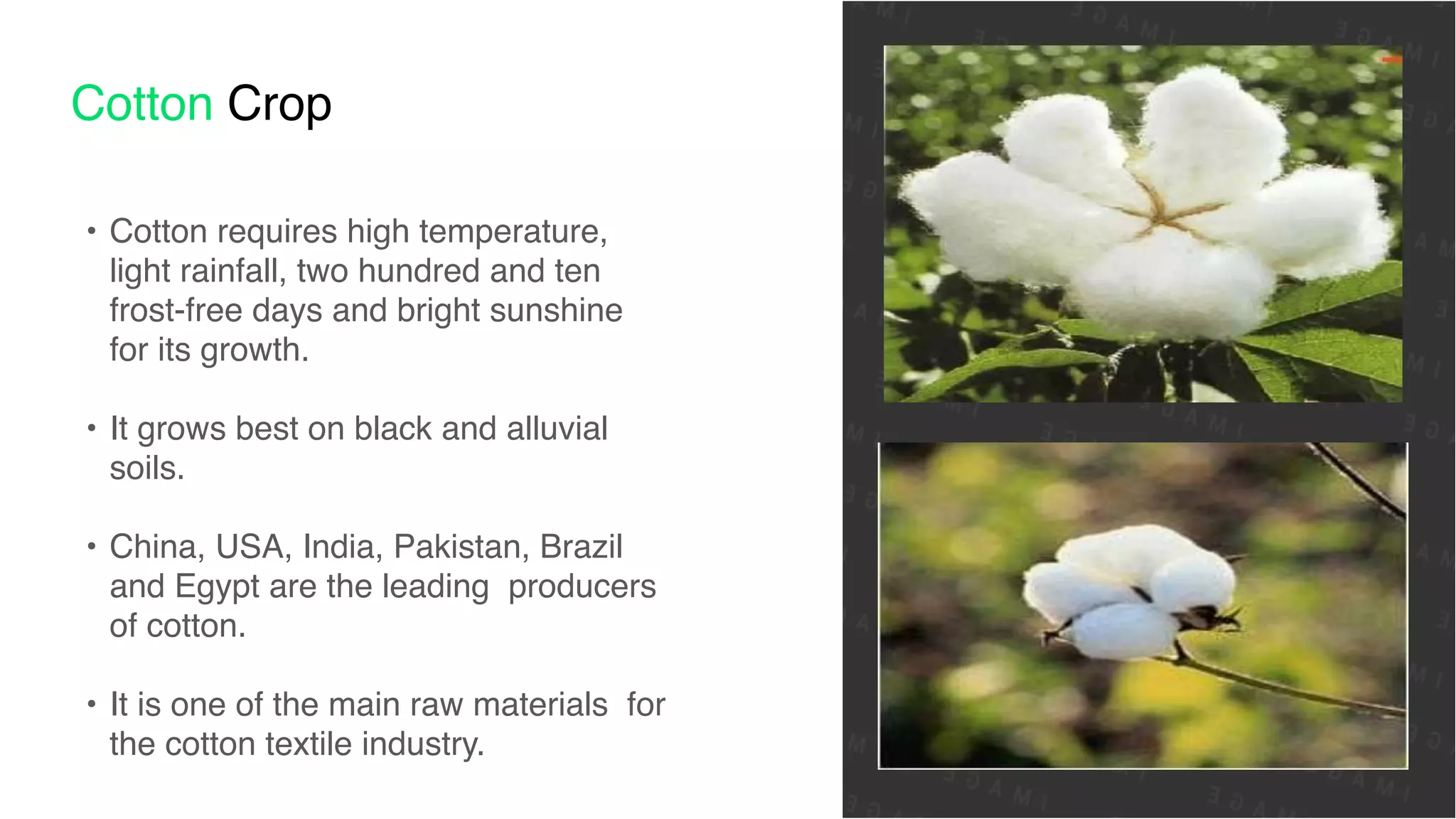
• Cotton requires high temperature,
light rainfall, two hundred and ten
frost-free days and bright sunshine
for its growth
.

• It grows best on black and alluvial
soils
.

• China, USA, India, Pakistan, Brazil
and Egypt are the leading producers
of cotton
.

• It is one of the main raw materials for
the cotton textile industry.
Coffee Crop
• Coffee requires warm and wet
climate and well drained loamy soil
.

• Hill slopes are more suitable for
growth of this crop
.

• Brazil is the leading producer
followed by Columbia and India.
Tea Crop
• Tea is a beverage crop grown on
plantations
.

• This requires cool climate and well
distributed high rainfall throughout the year
for the growth of its tender leaves
.

• It needs well-drained loamy soils and gentle
slopes
.

• Labour in large number is required to pick
the leaves
.

• Kenya, India, China, Sri Lanka produce the
best quality tea in the world.
Agricultural Development
Efforts are constantly being made to increase farm production in order to
meet the growing demand of increasing population.
Tips to increase agricultural production:-
• Increasing area under cultivatio
n

• Increasing the number of crops grown in a yea
r

• Improving irrigational facilities in order to increase yield per acr
e

• Use of fertilizers to increase yield

• Use high yielding variety of seed
s

• Use machinery in cultivatio
n

• The main aim of agricultural development is to provide ‘food security’ for the
growing world population
.

• Agriculture has developed world over. The development varies from place to
place.
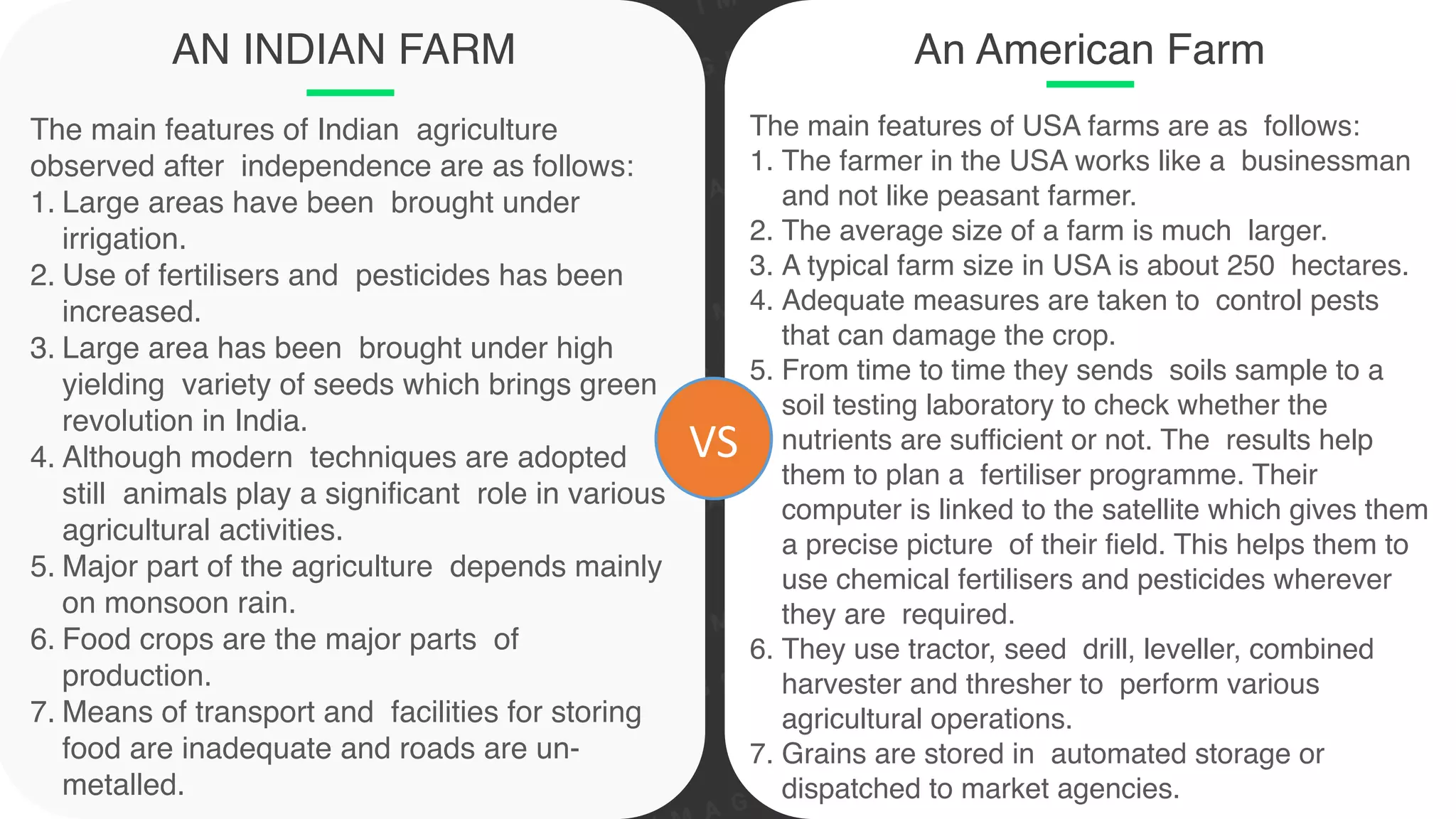
AN INDIAN FARM
The main features of Indian agriculture
observed after independence are as follows
:

1. Large areas have been brought under
irrigation
.

2. Use of fertilisers and pesticides has been
increased
.

3. Large area has been brought under high
yielding variety of seeds which brings green
revolution in India
.

4. Although modern techniques are adopted
still animals play a significant role in various
agricultural activities
.

5. Major part of the agriculture depends mainly
on monsoon rain
.

6. Food crops are the major parts of
production
.

7. Means of transport and facilities for storing
food are inadequate and roads are un-
metalled.
An American Farm
The main features of USA farms are as follows
:

1. The farmer in the USA works like a businessman
and not like peasant farmer
.

2. The average size of a farm is much larger
.

3. A typical farm size in USA is about 250 hectares
.

4. Adequate measures are taken to control pests
that can damage the crop
.

5. From time to time they sends soils sample to a
soil testing laboratory to check whether the
nutrients are sufficient or not. The results help
them to plan a fertiliser programme. Their
computer is linked to the satellite which gives them
a precise picture of their field. This helps them to
use chemical fertilisers and pesticides wherever
they are required
.

6. They use tractor, seed drill, leveller, combined
harvester and thresher to perform various
agricultural operations
.

7. Grains are stored in automated storage or
dispatched to market agencies.
VS
AN INDIAN FARM (Continued)
The main features of Indian agriculture
observed after independence are as follows
:

8. Landholding are small due to the inheritance
of law
.

9. The production of food is the top priority
.

10. The area under fodder crops is almost is
significant
.

11. Most of the farm work as Ploughing ,
irrigation, etc are done by animals and the
members of farmer’s family .
An American Farm (Continued)
The main features of USA farms are as follows
:

8. The rolling plain are well – drained and
suitable for extensive mechanised farming
.

9. The natural environment have favours the
cultivation of a variety in crop
.

10. The dark brown soil is few of humus and
organic matter
.

11. The transcontinental railway connects the
reign to the consuming centres and the town
parts .
VS
Dairy Farming
• Dairy farming is a class of
agriculture for long-term production
of milk, which is processed (either on
the farm or at a dairy plant, either of
which may be called a dairy) for
eventual sale of a dairy product.

• Although any mammal can produce
milk, commercial dairy farms are
typically one-species enterprises. In
developed countries, dairy farms
typically consist of high producing
dairy cows
.

• Other species used in commercial
dairy farming include goats, sheep,
and camels
.

• In Italy, donkey dairies are growing
in popularity to produce an
alternative milk source for human
infants.
Thank You!
AGRI CULTURE
CLASS 8 Geography Ls - 4

Agriculture | Ls - 4 | Class - 8 | Geography | Social Science - PPT

  • 1.
    AGRI CULTURE CLASS 8Geography Ls - 4
  • 2.
    Primary Activities All activitiesconnected with extraction and production of natural resources can be classified under Primary Activities . Agriculture, fishing, poultry farming and mining are examples of primary activities. Secondary Activities All activities connected with the manufacturing of goods with natural resources can be classified under Secondary activities . Manufacturing of steel, baking of bread and weaving of cloth are examples of this activity. Tertiary Activities All activities that provide support to the primary and secondary sectors through services are classified under Tertiary activities . Transport, trade, Banking, insurance an d advertising are examples of tertiary activities. Activities of the People
  • 3.
    What is Agriculture? •Agriculture is one of the most important economic activity in the world . • About 75 % of India’s total population still depend on Agriculture . • Agriculture is the cultivation of Plants and other life forms for food, fiber, bio-fuel, medicinal and other products used to sustain and enhance human life. • Agriculture was the key development in the rise of sedentary human civilization, where by farming of domesticated species created food surpluses that nurtured the development of civilization.
  • 4.
    Meaning of Agriculture •The word agriculture is the English adaptation of the Latin word ‘agricultūra’. ‘Ager’ means field and ‘cultūra’ means cultivation; in the strict sense ‘agricultūra’ means "tillage of the soil". • Agriculture was developed at least 10,000 years ago, and it has undergone significant developments since the time of the earliest cultivation . • The Agriculture falls under the Primary sector activity. Agricultural Activities include : 1. Growing crops, fruits, vegetables and flower s 2. Rearing of livestock Apple Orchard Sunflower FarmPaddy Fields Brinjal Farm Rearing Livestock
  • 5.
    Arable Land • Theright type of soil and climate are vital for any kind of agricultural activity . • The land on which crops are grown is known as arable land . • Geographically, arable land is an agricultural term, meaning land that can be used for growing crops . • Of the earth's 57.5 million square miles of land, approximately 7.65 million square miles are arable. However, arable land is currently being lost rapidly due to deforestation. Percentage of arable land in countries across the globe • 50 per cent of the world population is engaged in agricultural activity. • Two-thirds of India’s population is still dependent on agriculture.
  • 7.
    Input Work andOutput of Farming System Inputs • Seed s • Fertiliser s • Machiner y • Labour 1 Processes • Ploughin g • Sowin g • Irrigatio n • Weedin g • Harvesting 2 Outputs • Crop s • Wool (Rearing livestock ) • Dairy Products (Dairy farm ) • Poultry products (Poultry farm) 3
  • 8.
    The factors influencingAgriculture 1. The geographical conditions of the are a 3. Labour availabl e 2. Demand for the product 4. Level of technolog y
  • 9.
    Classification of Farming 1. Basedon the before factors farming can be broadly classified into 2 categories. 2. They are Subsistence Farming and Commercial Farming. It can be further classified as shown in picture on the right.
  • 10.
    Subsistence Farming Subsistence farmingis practiced to meet the needs of the farmer’s family. Low levels of technology and household labour are used to produce a small output. It is divided into two types. WHAT IS IT?
  • 11.
    Intensive Subsistence Farming •The farmer cultivates a small plot of land using simple tools and more labour . • More than one crop is grown annually, on the same plot, as the climate is favourable and the soil is fertile . • Rice is the main crop; other crops include wheat, maize, pulses and oilseeds . • Intensive subsistence agriculture is prevalent in the thickly populated areas of the monsoon regions of south, southeast and east Asia. WHAT IS IT?
  • 12.
    SHIFTING CULTIVATIO N Thisis mostly practiced by people living in the forest. Shifting cultivation is practiced in the thickly forested areas of Amazon basin, tropical Africa, parts of Southeast Asia and Northeast India. It receives heavy rainfall and this helps in the quick regeneration of vegetation. NOMADIC HERDING This is practiced by people living in dry arid regions. In nomadic farming, herdsmen move from place to place with their animals for fodder and water, along a definite route. The nomads move from place to place due to the restraints of the climate and land. Primitive Subsistence Farming PRIMITIVE
  • 13.
    SHIFTING CULTIVATION How shiftingcultivation is done? • A plot of land is cleared by felling the trees and burning them . • The ashes are then mixed with the soil and crops like maize, yam, potatoes and cassava are grown . • After the soil loses its fertility, the land is abandoned and the cultivator moves to a new plot . • Shifting cultivation is also known as ‘slash and burn’ agriculture . • Shifting cultivation usually starts with cutting trees and a fire which clears a spot for crop production . • In some cases, shifting cultivation is a cycle where farmers come back to the original place after a couple of years.
  • 14.
    What is it? •Nomadic herding is practiced in the semi-arid and arid (dry) regions of Sahara, Central Asia and some parts of India, like Rajasthan and Jammu and Kashmir . • In nomadic farming, herdsmen move from place to place with their animals for fodder and water, along a definite route. The nomads move from place to place due to the restraints of the climate and land . • Sheep, camel, yak and goats are most commonly reared by the nomads. These animals provide milk, meat, wool, hides and other products to the herders and their families. • In the drier parts of Asia, especially Southwest Asia, most rural people make a living by raising livestock. Many are nomads who move with their herds of animals over large territories, constantly seeking good supplies of grass and water. The people live simply and carry their tents and belongings with them. They rear animals such as goats, sheep, camels, and yaks. Nomadic Herding
  • 15.
    Comercial Farming • Cropsare grown and animals are reared for sale in the market, that is, for commercial purposes, while in Subsistence farming crops are grown mainly for the farmer’s family needs . • The area cultivated and the amount of capital invested is larg e • Most of the work is done by machines WHAT IS IT? GRAIN FARMING MIXED FARMING PLANTAION AGRICULTURE In this, crops are grown for commercial purpose. In mixed farming, the land is used for growing food and fodder crops and rearing livestock. Plantations are a type of commercial farming system where single crop of tea, coffee, etc. are grown. Comercial
  • 16.
    Sequential Cropping Cropping only a particulartype of crop in one cropping season. Relay Cropping Cropping another crop before the first crop has been harvested. Mixed Cropping Cropping two or more types of crop simultaneously in one cropping season. Cropping Systems of Commercial Farming 1 2 3
  • 17.
    Mixed Cropping Pattern •Greater stability of yield over different season s • Better use of growth resources . • Better control of weeds, pests, and diseases . • One crop may provide physical support to another one . • One crop provides shelter to the other crop . • Erosion control through providing continuous leaf cover over the ground surface . • Benefit to small farmers of limited means. ADVANTAGES Crop-livestock Integration : Cattle grazing under coconut trees . Mixed cropping: pyrethrum and maize
  • 18.
    Comercial Grain Farming •In this crops are grown for commercial purpose . • Wheat and maize are common commercially grown grains . • It is mostly practised in the temperate grasslands of North America, Europe and Asia . • These areas are sparsely populated with large farms spreading over hundreds of hectares . • Severe winters restrict the growing season and only a single crop is grown . • This distinctive type of agriculture known as ‘commercial grain farming’ was developed in US . • It is a type of agriculture that is largely dependent on mechanization . • It started with the invention of farm machinery in the early twentieth century . • The use of machineries allows farmers to cultivate grains on a large scale.
  • 19.
    Mixed Farming • Inmixed farming the land is used for growing food and fodder crops and rearing livestock . • It is practised in Europe, eastern USA, Argentina, southeast Australia, New Zealand and South Africa . • Mixed farming is the combining of two independent agricultural enterprises on the same farm . • A typical case of mixed farming is the combination of crop enterprise with dairy farming, that is, crop cultivation with livestock farming . • Mixed farming may be treated as a special case of diversified farming . • This particular combination of enterprises, support each other and add to the farmer’s profitability. WHAT IS IT?
  • 20.
    Plantation Agriculture • Plantationsare a type of commercial farming system where single crop of tea, coffee, sugarcane, cashew, rubber, banana or cotton are grown . • Large amount of labour and capital are required . • The produce may be processed on the farm itself or in nearby factories . • The development of a transport network is essential for such farming . • Major plantations are found in the tropical regions of the world - Rubber in Malaysia, coffee in Brazil, tea in India and Sri Lanka. Coffee Plantation Tea Plantation Rubber Plantation Sugar Plantation
  • 21.
    Major Crops • Alarge variety of crops are grown to meet the needs of the growing population . • Major food crops are wheat, rice, maize and millets . • Main fibre crops are Jute and cotton . • Important beverage crops are tea and coffee . • Many crops supply raw materials for agro based industries.
  • 22.
    Rice Crop • Riceis the major food crop of the world . • It is the staple diet of the tropical and sub-tropical regions . • Rice needs high temperature, high humidity and rainfall . • It grows best in alluvial clay soil, which can retain water . • China leads in the production of rice followed by India, Japan, Sri Lanka and Egypt.
  • 23.
    Wheat Crop • Wheatrequires moderate temperature and rainfall during growing season and bright sunshine at the time of harvest . • It thrives best in well drained loamy soil . • Wheat is grown extensively in USA, Canada, Argentina, Russia, Ukraine, Australia and India. In India it is grown in winter.
  • 24.
    Millets Crop • Milletsare known as coarse grains and can be grown on less fertile and sandy soils . • It is a hardy crop that needs low rainfall and high to moderate temperature and adequate rainfall . • Jowar, bajra and ragi are grown in India, Nigeria and China.
  • 25.
    Maize Crop • Maizerequires moderate temperature, rainfall and lots of sunshine . • It needs well-drained fertile soils . • Maize is grown in North America, Brazil, China, Russia, Canada, India, and Mexico.
  • 26.
    Cotton Crop • Cottonrequires high temperature, light rainfall, two hundred and ten frost-free days and bright sunshine for its growth . • It grows best on black and alluvial soils . • China, USA, India, Pakistan, Brazil and Egypt are the leading producers of cotton . • It is one of the main raw materials for the cotton textile industry.
  • 27.
    Coffee Crop • Coffeerequires warm and wet climate and well drained loamy soil . • Hill slopes are more suitable for growth of this crop . • Brazil is the leading producer followed by Columbia and India.
  • 28.
    Tea Crop • Teais a beverage crop grown on plantations . • This requires cool climate and well distributed high rainfall throughout the year for the growth of its tender leaves . • It needs well-drained loamy soils and gentle slopes . • Labour in large number is required to pick the leaves . • Kenya, India, China, Sri Lanka produce the best quality tea in the world.
  • 29.
    Agricultural Development Efforts areconstantly being made to increase farm production in order to meet the growing demand of increasing population. Tips to increase agricultural production:- • Increasing area under cultivatio n • Increasing the number of crops grown in a yea r • Improving irrigational facilities in order to increase yield per acr e • Use of fertilizers to increase yield • Use high yielding variety of seed s • Use machinery in cultivatio n • The main aim of agricultural development is to provide ‘food security’ for the growing world population . • Agriculture has developed world over. The development varies from place to place.
  • 30.
    AN INDIAN FARM Themain features of Indian agriculture observed after independence are as follows : 1. Large areas have been brought under irrigation . 2. Use of fertilisers and pesticides has been increased . 3. Large area has been brought under high yielding variety of seeds which brings green revolution in India . 4. Although modern techniques are adopted still animals play a significant role in various agricultural activities . 5. Major part of the agriculture depends mainly on monsoon rain . 6. Food crops are the major parts of production . 7. Means of transport and facilities for storing food are inadequate and roads are un- metalled. An American Farm The main features of USA farms are as follows : 1. The farmer in the USA works like a businessman and not like peasant farmer . 2. The average size of a farm is much larger . 3. A typical farm size in USA is about 250 hectares . 4. Adequate measures are taken to control pests that can damage the crop . 5. From time to time they sends soils sample to a soil testing laboratory to check whether the nutrients are sufficient or not. The results help them to plan a fertiliser programme. Their computer is linked to the satellite which gives them a precise picture of their field. This helps them to use chemical fertilisers and pesticides wherever they are required . 6. They use tractor, seed drill, leveller, combined harvester and thresher to perform various agricultural operations . 7. Grains are stored in automated storage or dispatched to market agencies. VS
  • 31.
    AN INDIAN FARM(Continued) The main features of Indian agriculture observed after independence are as follows : 8. Landholding are small due to the inheritance of law . 9. The production of food is the top priority . 10. The area under fodder crops is almost is significant . 11. Most of the farm work as Ploughing , irrigation, etc are done by animals and the members of farmer’s family . An American Farm (Continued) The main features of USA farms are as follows : 8. The rolling plain are well – drained and suitable for extensive mechanised farming . 9. The natural environment have favours the cultivation of a variety in crop . 10. The dark brown soil is few of humus and organic matter . 11. The transcontinental railway connects the reign to the consuming centres and the town parts . VS
  • 32.
    Dairy Farming • Dairyfarming is a class of agriculture for long-term production of milk, which is processed (either on the farm or at a dairy plant, either of which may be called a dairy) for eventual sale of a dairy product. • Although any mammal can produce milk, commercial dairy farms are typically one-species enterprises. In developed countries, dairy farms typically consist of high producing dairy cows . • Other species used in commercial dairy farming include goats, sheep, and camels . • In Italy, donkey dairies are growing in popularity to produce an alternative milk source for human infants.
  • 33.