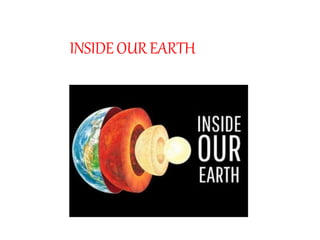
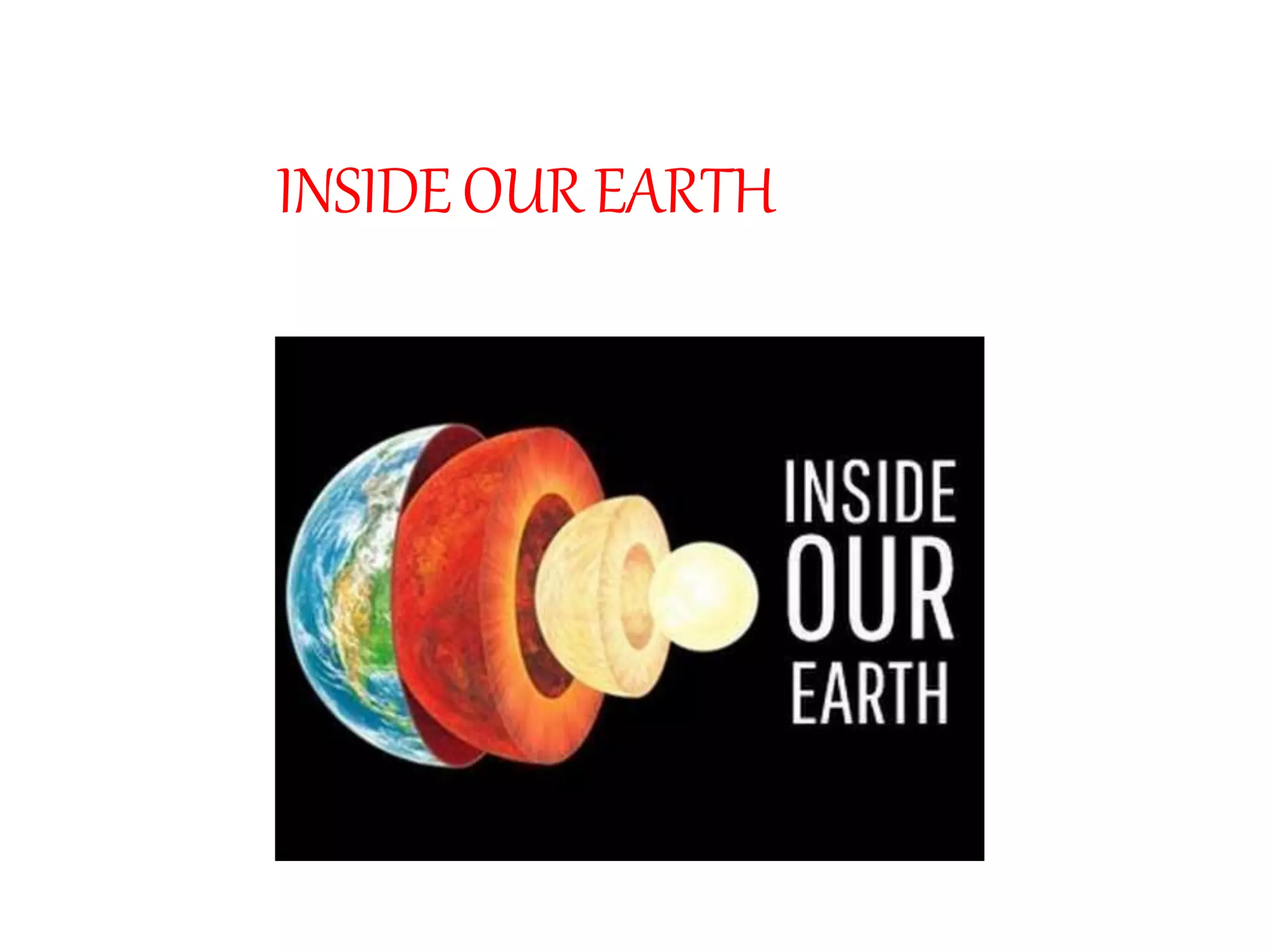
INSIDEOUREARTH
ABOUTTHEEARTH
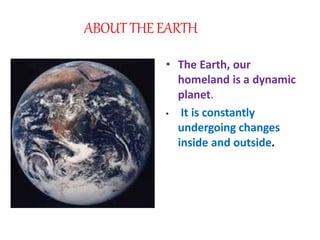
• The Earth, our
homeland is a dynamic
planet.
• It is constantly
undergoing changes
inside and outside.
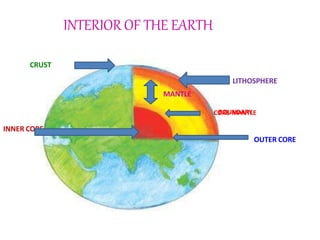
INTERIOR OF THE EARTH
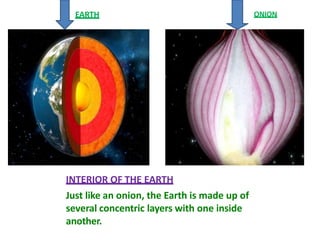
Just like an onion, the Earth is made up of
several concentric layers with one inside
another.
EARTH ONION
INTERIOR OF THE EARTH
CRUST
LITHOSPHERE
MANTLE
CORE-MANTLE
BOUNDARY
OUTER CORE
INNER CORE
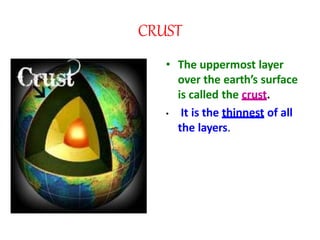
CRUST
• The uppermost layer
over the earth’s surface
is called the crust.
• It is the thinnest of all
the layers.
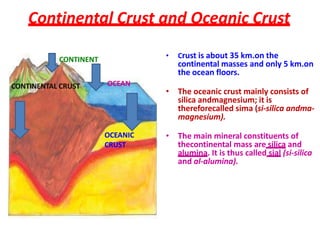
Continental Crust and Oceanic Crust
• Crust is about 35 km.on the
continental masses and only 5 km.on
the ocean floors.
• The oceanic crust mainly consists of
silica andmagnesium; it is
thereforecalled sima (si-silica andma-
magnesium).
• The main mineral constituents of
thecontinental mass are silica and
alumina. It is thus called sial (si-silica
and al-alumina).
CONTINENTAL CRUST
CONTINENT
OCEAN
OCEANIC
CRUST
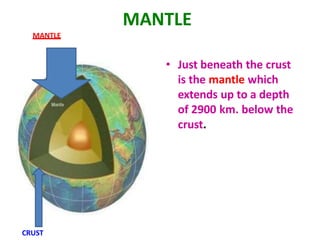
MANTLE
• Just beneath the crust
is the mantle which
extends up to a depth
of 2900 km. below the
crust.
MANTLE
CRUST
CORE
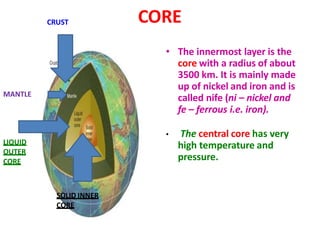
• The innermost layer is the
core with a radius of about
3500 km. It is mainly made
up of nickel and iron and is
called nife (ni – nickel and
fe – ferrous i.e. iron).
• The central core has very
high temperature and
pressure.
LIQUID
OUTER
CORE
SOLID INNER
CORE
CRUST
MANTLE
ROCKS AND
MINERALS
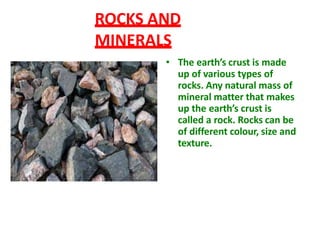
• The earth’s crust is made
up of various types of
rocks. Any natural mass of
mineral matter that makes
up the earth’s crust is
called a rock. Rocks can be
of different colour, size and
texture.
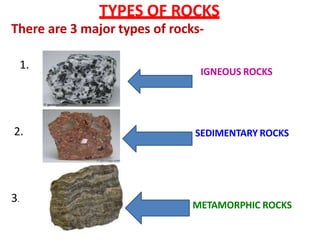
TYPES OF ROCKS
There are 3 major types of rocks-
IGNEOUS ROCKS
1.
2.
3.
SEDIMENTARY ROCKS
METAMORPHIC ROCKS
IGNEOUS ROCKS
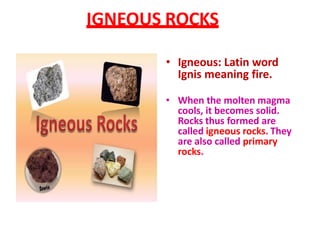
• Igneous: Latin word
Ignis meaning fire.
• When the molten magma
cools, it becomes solid.
Rocks thus formed are
called igneous rocks. They
are also called primary
rocks.
Inside our Earth.pptx

Inside our Earth.pptx

  • 1.
  • 2.
    ABOUTTHEEARTH • The Earth,our homeland is a dynamic planet. • It is constantly undergoing changes inside and outside.
  • 3.
    INTERIOR OF THEEARTH Just like an onion, the Earth is made up of several concentric layers with one inside another. EARTH ONION
  • 4.
    INTERIOR OF THEEARTH CRUST LITHOSPHERE MANTLE CORE-MANTLE BOUNDARY OUTER CORE INNER CORE
  • 5.
    CRUST • The uppermostlayer over the earth’s surface is called the crust. • It is the thinnest of all the layers.
  • 6.
    Continental Crust andOceanic Crust • Crust is about 35 km.on the continental masses and only 5 km.on the ocean floors. • The oceanic crust mainly consists of silica andmagnesium; it is thereforecalled sima (si-silica andma- magnesium). • The main mineral constituents of thecontinental mass are silica and alumina. It is thus called sial (si-silica and al-alumina). CONTINENTAL CRUST CONTINENT OCEAN OCEANIC CRUST
  • 7.
    MANTLE • Just beneaththe crust is the mantle which extends up to a depth of 2900 km. below the crust. MANTLE CRUST
  • 8.
    CORE • The innermostlayer is the core with a radius of about 3500 km. It is mainly made up of nickel and iron and is called nife (ni – nickel and fe – ferrous i.e. iron). • The central core has very high temperature and pressure. LIQUID OUTER CORE SOLID INNER CORE CRUST MANTLE
  • 9.
    ROCKS AND MINERALS • Theearth’s crust is made up of various types of rocks. Any natural mass of mineral matter that makes up the earth’s crust is called a rock. Rocks can be of different colour, size and texture.
  • 10.
    TYPES OF ROCKS Thereare 3 major types of rocks- IGNEOUS ROCKS 1. 2. 3. SEDIMENTARY ROCKS METAMORPHIC ROCKS
  • 11.
    IGNEOUS ROCKS • Igneous:Latin word Ignis meaning fire. • When the molten magma cools, it becomes solid. Rocks thus formed are called igneous rocks. They are also called primary rocks.