Insect Sampling in Forest Ecosystems Simon R. Leather
Insect Sampling in Forest Ecosystems Simon R. Leather
Insect Sampling in Forest Ecosystems Simon R. Leather
Insect Sampling in Forest Ecosystems Simon R. Leather
Insect Sampling in Forest Ecosystems Simon R. Leather
1.
Insect Sampling inForest Ecosystems Simon R.
Leather download
https://ebookgate.com/product/insect-sampling-in-forest-
ecosystems-simon-r-leather/
Get Instant Ebook Downloads – Browse at https://ebookgate.com
2.
Get Your DigitalFiles Instantly: PDF, ePub, MOBI and More
Quick Digital Downloads: PDF, ePub, MOBI and Other Formats
Sampling Techniques for Forest Inventories 1st Edition
Daniel Mandallaz
https://ebookgate.com/product/sampling-techniques-for-forest-
inventories-1st-edition-daniel-mandallaz/
Invasive Plants and Forest Ecosystems 1st Edition
Ravinder Kumar Kohli (Editor)
https://ebookgate.com/product/invasive-plants-and-forest-
ecosystems-1st-edition-ravinder-kumar-kohli-editor/
Forest Insect Population Dynamics Outbreaks And Global
Warming Effects 1st Edition Isaev
https://ebookgate.com/product/forest-insect-population-dynamics-
outbreaks-and-global-warming-effects-1st-edition-isaev/
Bioavailability Toxicity and Risk Relationship in
Ecosystems 1st Edition R Naidu (Author)
https://ebookgate.com/product/bioavailability-toxicity-and-risk-
relationship-in-ecosystems-1st-edition-r-naidu-author/
3.
Climate Change Adaptationand Mitigation Management
Options A Guide for Natural Resource Managers in
Southern Forest Ecosystems 1st Edition James M. Vose
https://ebookgate.com/product/climate-change-adaptation-and-
mitigation-management-options-a-guide-for-natural-resource-
managers-in-southern-forest-ecosystems-1st-edition-james-m-vose/
Coping and Complaining Simon R. Wilkinson
https://ebookgate.com/product/coping-and-complaining-simon-r-
wilkinson/
Emergency Orthopedics 6th Edition Robert R. Simon
https://ebookgate.com/product/emergency-orthopedics-6th-edition-
robert-r-simon/
Daemons Are Forever 1st Edition Simon R. Green
https://ebookgate.com/product/daemons-are-forever-1st-edition-
simon-r-green/
Drinking Midnight Wine 3rd Edition Simon R. Green
https://ebookgate.com/product/drinking-midnight-wine-3rd-edition-
simon-r-green/
SERIES LIST
Geographic InformationSystems in Ecology
1997, Carol A. Johnston, University of Minnesota
Researchers will find this an invaluable guide to applying and getting the most out of
Geographical Information Systems, one of the most revolutionary and important tools that
have become available to ecological researchers in recent years.
An Introduction to Ecological Modelling: Putting Practice into Theory
1997, M. Gillman & Rosie Hails, Open University & CEH Oxford
“Teachers of courses on ecological modelling will find [this book] a useful source-book at a competitive
price.”
This book aims to open up the exciting area of ecological modeling to a much wider audience.
Stable Isotopes in Ecology and Environmental Science
1994, edited by Kate Lajtha & Robert Michener, Oregon State University & Boston University
This book, written by two of the leading researchers in the field, explains the background to
stable isotope methodology and discuss the use of the methods in varying ecological
situations.
Geographical Population Analysis: Tools for the Analysis of Biodiversity
1994, Brian A. Maurer, Michigan State University
This book discusses methods and statistical techniques that can be used to analyze spatial
patterns in geographic populations. These techniques incorporate ideas from fractal geometry
to develop measures of geographic range fragmentation, and can be used to ask questions
regarding the conservation of biodiversity.
Molecular Methods in Ecology
2000, edited by Allan J. Baker, Royal Ontario Museum
This book provides both postgraduates and researchers with a guide to choosing and
employing appropriate methodologies for successful research in the field of molecular ecology.
Biogenic Trace Gases: Measuring Emissions from Soils and Water
1995, edited by P.A. Matson & R.C. Harriss, University of California & University of New
Hampshire
“The present volume . . . will serve as an important tool box for researchers and graduate students in this
discipline, and will provide both a range of techniques for field measurements and a conceptual
framework for extrapolation strategies.”
This how-to guide details the concepts and techniques involved in the detection and
measurement of trace gases, and the impact they have on ecological studies.
Ecological Data: Design, Management and Processing
2000, edited by William Michener & James Brunt, University of New Mexico
This book provides a much-needed resource for those involved in designing and implementing
ecological research, as well as students who are entering the environmental sciences.
Population Parameters: Estimation for Ecological Models
1999, Hamish McCallum, University of Queensland
This book brings together a diverse and scattered literature, to provide clear guidance on how
to estimate parameters for models of animal populations.
METHODS IN ECOLOGY
7.
Insect Sampling in
ForestEcosystems
EDITED BY
SIMON R. LEATHER
Department of Biological Sciences
Imperial College of Science, Technology and Medicine
Silwood Park
Ascot
UK
SERIES EDITORS
J.H. LAWTON C B E , F R S
Natural Environment Research Council
Swindon, UK
G.E. LIKENS
Institute of Ecosystem Studies
Millbrook, USA
METHODS IN ECOLOGY
Contents
Contributors, vii
Methods inEcology series, ix
Preface, xi
1 Sampling theory and practice, 1
Simon R. Leather and Allan D. Watt
2 Sampling insects from roots, 16
Alan C. Gange
3 Pitfall trapping in ecological studies, 37
B.A. Woodcock
4 Sampling methods for forest understory vegetation, 58
Claire M.P. Ozanne
5 Sampling insects from trees: shoots, stems, and trunks, 77
Martin R. Speight
6 Insects in flight, 116
Mark Young
7 Techniques and methods for sampling canopy insects, 146
Claire M.P. Ozanne
8 Sampling methods for water-filled tree holes and their artificial
analogues, 168
S.P. Yanoviak and O.M. Fincke
9 Sampling devices and sampling design for aquatic insects, 186
Leon Blaustein and Matthew Spencer
v
10.
10 Methods forsampling termites, 221
David T. Jones, Robert H.J. Verkerk, and Paul Eggleton
11 Parasitoids and predators, 254
Nick Mills
Index, 279
vi CONTENTS
11.
Contributors
Leon Blaustein
Community EcologyLaboratory, Institute of Evolution, University of Haifa,
Haifa 31905, Israel
Paul Eggleton
Termite Research Group, Department of Entomology, The Natural History
Museum, Cromwell Road, London, SW7 5BD, UK
O.M. Fincke
Department of Zoology, University of Oklahoma, Norman, Oklahoma 73019,
USA
Alan C. Gange
School of Biological Sciences, Royal Holloway, University of London, Egham,
Surrey, TW20 0EX, UK
David T. Jones
Termite Research Group, Department of Entomology, The Natural History
Museum, Cromwell Road, London, SW7 5BD, UK
Simon R. Leather
Department of Biological Sciences, Imperial College of Science, Technology
and Medicine, Silwood Park, Ascot, Berkshire, SL5 7PY, UK
Nick Mills
Insect Biology, Wellman Hall, University of California at Berkeley, Berkeley,
California 94720-3112, USA
Claire M.P. Ozanne
Centre for Research in Ecology and the Environment, School of Life Sciences,
Roehampton University of Surrey, West Hill, London SW15 3SN, UK
vii
12.
Martin R. Speight
Departmentof Zoology, University of Oxford, South Parks Road, Oxford, UK
Matthew Spencer
Community Ecology Laboratory, Institute of Evolution, University of Haifa,
Haifa 31905, Israel
Current address: Department of Mathematics and Statistics, Dalhousie
University, Halifax, Nova Scotia, B3H 3J5, Canada
Robert H.J. Verkerk
Department of Biology, Imperial College of Science, Technology and Medicine,
Silwood Park, Ascot, Berkshire, SL5 7PY, UK
Allan D. Watt
Centre for Ecology and Hydrology, Hill of Brathens, Glassel, Banchory,
Aberdeenshire AB31 4BW, UK
B.A. Woodcock
Centre for Agri-Environment Research, Department of Agriculture,
University of Reading, RG6 6AR, UK
S.P. Yanoviak
Department of Zoology, University of Oklahoma, Norman, Oklahoma 73019,
USA
Current address: Florida Medical Entomology Laboratory, 200 9th Street SE,
Vero Beach, FL 32962, USA
Mark Young
Culterty Field Station, Department of Zoology, University of Aberdeen,
Newburgh Ellon, Aberdeenshire, AB41 OAA, UK
viii CONTRIBUTORS
13.
Methods in Ecologyseries
Series editors
ProfessorJohnH.LawtonisChiefExecutiveoftheUKNaturalEnvironment
Research Council, and holds honorary professorships at Imperial College
London and the University of York. He is a Fellow of the Royal Society, and has
received numerous national and international prizes. Professor Lawton is au-
thor, co-author, or editor of six books, a former editor of Ecological Entomology,
and has published over 300 scientific articles.
Dr Gene E. Likens is President and Director of the Institute of Ecosystem
Studies in Millbrook, New York, and also holds professorships at Cornell
University, Yale University, and Rutgers University. He received the 2001
National Medal of Science and has received eight honorary degrees. Dr Likens
is also author, co-author, or editor of 15 books, and of over 450 published
scientific articles.
About the series
The Methods in Ecology series is a useful and ever-growing collection of books
aimedathelpingecologiststochooseandapplyanappropriatemethodologyfor
their research. The series is edited by two internationally renowned ecologists,
Professor John H. Lawton and Dr Gene E. Likens, and aims to address the need
for a set of concise and authoritative books to guide researchers through the
wide range of methods and approaches that are available to ecologists.
Each volume is not simply a recipe book, but takes a critical look at different
approaches to the solution of a problem, whether in the laboratory or in the
field, and whether involving the collection or the analysis of data.
Rather than reiterate established methods, authors are encouraged to feature
new technologies, often borrowed from other disciplines, that ecologists
can apply to their work. Innovative techniques, properly used, can offer par-
ticularly exciting opportunities for the advancement of ecology.
ix
14.
The series strivesto be at the cutting edge of the subject, introducing ecologists
to a wide range of techniques that are currently rarely used, but deserve to be
better known, or it seeks to provide up-to-date methods in more familiar areas.
Its main purpose is not only to provide instruction in basic methods (the “how
to”), but also to explain the benefits and limitations of each method (the “why
this way?”), as well as showing how to interpret the results, what they mean,
and generally to put them in the context of the discipline.
Much is now expected of the science of ecology, as humankind struggles with a
growingenvironmentalcrisis.Goodmethodologyaloneneversolvedanyprob-
lem, but bad or inappropriate methodology can only make matters worse.
Ecologists now have a powerful and rapidly growing set of methods and tools
with which to confront fundamental problems of a theoretical and applied na-
ture. We hope that this series will be a major contribution towards making these
techniques known to a much wider audience.
x METHODS IN ECOLOGY SERIES
15.
Preface
Insect sampling, althoughfirmly based on standard ecological census tech-
niques, presents special problems that are not faced by other ecologists. With
the small size, varied life cycles, rapid rates of increase, and ingenious adapta-
tions to habitats of insects, ecological entomologists face problems that are
somewhat different to those faced by vertebrate or plant ecologists. That said,
these same features make working with insects more amenable than working,
for example, with large mammals.
Withintheentomologicalworldtherearemanydifferentgroupsofspecialists
—those that work in agricultural systems, in desert systems, or with particular
groups of insects. Many of these overlap in their approach and methodology,
but some are unique and require specialist knowledge. One such specialization
is forest entomology, another is aquatic entomology.
Forestecosystems,whethernaturalormanmade,presentspecialproblemsto
the ecologists working beneath their canopies. In contrast to grassland, arable,
and moorland ecosystems, where the scientist can stand above the study area
and view the system in large patches, forest ecologists are towered over by their
study substrate. Trees are large, dominate the canopy, and are not as amenable
to sampling as herbaceous plants. The forest floor, often criss-crossed by surface
or near-surface roots, also presents its own particular hazards to the researcher.
In plantation forests, ridges, furrows, and drains mean that soil sampling, al-
though superficially a similar exercise to that conducted in an arable ecosystem,
is again not quite as simple. Root grafting makes sub-soil sampling onerous in
the extreme.
Tropical forests are perhaps even more difficult to work in; the profusion of
endophytic vegetation and the multi-layered structure of the canopy in many
types of forest can make sampling a nightmare.
Study in forest ecosystems is an important part of ecology. In tropical natural
forest ecosystems much work is performed in attempts to quantify the diversity
of these unique systems. In temperate and boreal forests equally important
work is conducted. Furthermore, with the massive increase in plantation
forestry (tropical plantation forestry has increased more than threefold in
the last decade), the need to sample for survey and protection purposes has
dramatically increased. This book, although covering all aspects of insect sam-
pling within all ecosystems, has a definite bias towards forest ecosystems. There
xi
16.
are, however, manycommon features of insect sampling that can be applied to
other ecosystems and every chapter brings these together in an integrated
whole. Special cases do of course exist and each of these gets a chapter to itself.
This book brings together the collective expertise obtained over many years
of intensive fieldwork in tropical and temperate ecosystems by a number of
well-known entomologists. Each chapter, as well as dealing with sampling
a particular stratum of the canopy or specialized group of insects, presents a
comprehensive guide to running experiments within and beneath the forest
canopy. Many potentially useful pieces of work conducted in forest ecosystems
have fallen at the final hurdle – the translation of field data to the printed page.
Unless surveys and field experiments are realistically designed within a sound
but manageable framework they are doomed to failure. In addition, the failure
of many ecologists working in agricultural ecosystems or on parkland trees to
recognize the constraints imposed on ecologists working within large scale
forest ecosystems must be redressed.
This book attempts to highlight the problems faced by entomologists working
in different ecosystems and to suggest ways in which their methodology can be
modified so as to be understood by ecologists and become accepted within the
general fields of ecology and entomology.
Simon Leather graduated from the University of Leeds in 1977 with a first-
class honors degree in Agricultural Zoology. He followed that with a PhD in
aphid ecology at the University of East Anglia. He is currently Reader in Applied
Ecology in the Department of Biological Sciences at Imperial College’s Silwood
Park campus. He has been researching the population biology of agricultural
and forest pests, particularly insects, for over 25 years. Ten of these years were
spent with the British Forestry Commission, where he learnt how to canopy-
sample the hard way! He has written and edited several books and has, since
1996, been editor (latterly co-editor) of Ecological Entomology.
xii PREFACE
17.
CHAPTER 1
Sampling theoryand practice
SIMON R. LEATHER AND ALLAN D. WATT
Introduction
This chapter deals with the need to sample insects, the theory underlying sam-
pling, the need to calibrate samples, and the design of sampling programs, and it
evaluates the use of different sampling techniques.
Why sample?
Sampling is a scientist’s way of collecting information, and the majority of sam-
pling is undertaken to answer specific questions. This was not always the case.
Sampling as we know it was first done in a haphazard manner and bore little re-
lation to what we would call sampling today. The first samples taken were basi-
callyaby-productofthedesireofnaturalhistorianstocollectinformationabout
the world around them.
A brief history of information collection
The history of information collection can be classified into three main
stages. There is a little overlap, but in the main we can recognize three separate
phases.
1 The collectors
This can be classified as the pin, stuff, and draw era. As travel became relatively
safer and people became more interested in what lay beyond their horizons
there was a rapid expansion both in the number of naturalists traveling to other
continents and in the number of people employed by naturalists to collect and
return specimens to Europe. Drawing was also a popular activity and to a cer-
tain extent filled the niche now occupied by photography. Many ships’ officers
were accomplished amateur artists and many had an interest in the flora and
fauna of the countries they visited. This phase resulted in the acquisition of
many thousands of specimens of plants and animals, either stuffed, pickled,
1
18.
pressed, or pinned,accompanied by many sketches of the organisms in their
native settings, although as the majority of the artists had no scientific training
these drawings and paintings sometimes bear only a passing resemblance to
reality.
Although this resulted in the garnering of many examples of plants and ani-
mals there was little knowledge of the biology or ecology of the organisms. This
ledtoagreatdealofconfusion,particularlyinthefieldofentomologywherethe
sometimes complicated life cycles such as those occurring in dimorphic and
polymorphic species such as aphids led to the misclassification of many species.
For example, several aphid species were classified as being more than one
species, depending on which host plant they were removed from or depending
on which stage of the life cycle they were in at the time of their collection. Other
similar mistakes occurred in the Lepidoptera where confusion over the identity
of members of several mimic species lasted for some time until the larval stages
were recognized. Ladybird beetles such as Adalia bipunctata and Adalia decem-
punctata, now well known as being extremely variable in their different color
forms were also once misidentified as separate species until their life histories
were fully elucidated.
2 The observers
There were of course some collectors who also collected observations. Many
natural historians, as well as having a keen eye for the chase and for sketching,
also felt the need to observe the behavior of the animals that they were collect-
ing. These are exemplified by Darwin and Fabre who, as well as making detailed
collections of specimens, also spent many hours observing and recording pat-
terns of behavior. These observations provided plenty of information on the bi-
ology of the species, but as much of it was centered on individuals and their
interactions with other individuals of the same species did not provide a great
deal of information on their place in ecosystems, did not always provide accu-
rate information about mortality factors and was confounded by a great deal of
unrecognized environmental “noise.”
3 Experimental/controlled sampling
The next great step forward in the field of information collecting was the use
of experimental studies in controlled conditions. For example, by studying
the biology of an insect in the laboratory, it is possible to obtain detailed know-
ledge of life history parameters such as fecundity, longevity, etc., and it is also
possible to assign specific values to mortality factors, albeit in a far from natural
environment. The main drawback of this type of study is that environmental
variability is lost and the natural impact of mortality and natality factors is
compromised.
Thebestoptionistocombinelaboratorymethodsandnaturalconditions,and
2 CHAPTER 1
19.
to do experimentaland manipulative work in the field. The need to obtain ac-
curate estimates of animal numbers in the field led to the development of the
theory of sampling and, incidentally, to the use of statistics in the biological
sciences.
Estimating abundance and predicting population dynamics
The major use of sampling in entomology is to determine the number of insects
in a given area or location, usually for pest control or conservation purposes.
Theothermainreasonforwantinginformationoninsectnumbersistoincrease
our understanding of the population dynamics of the insect(s) in question and
to make predictions of their future abundance.
Before one can make a prediction, one needs to know how many insects
there are in the first place. This is equally true, whether one is going to control a
pest or to conserve an endangered species. It is not a sound practice (although
some modelers do it) to conjure a number out of thin air. There is also a need to
know what factors affect those numbers. There are basically six facts about the
population of an insect that are required before sensible predictions of the pop-
ulation dynamics can be made:
1 density —an expression of the species’ abundance in an area;
2 dispersion (distribution) —the spatial distribution of individuals of a
species;
3 natality —birth rate;
4 mortality —death rate;
5 age structure —the relative proportions of individuals in different age
classes;
6 population trend —the trend in the abundance of the study species.
It is only from this sort of information that one can start to make some sort of in-
ferences about the population dynamics of the insect. The only reliable way to
obtain this type of information is to sample.
Sampling methods
To sample an insect requires both a sampling technique and a sampling pro-
gram. These are different things, although it is noticeable that even in the scien-
tific literature the two terms are quite often used interchangeably.
Sampling techniques
A sampling technique is the method used to collect information from a single
sampling unit. Therefore the focus of a sampling technique is on the equipment
and/or the way the count is accomplished.
SAMPLING THEORY AND PRACTICE 3
20.
Sampling programs
A samplingprogram, on the other hand, is the procedure for employing
the sampling technique to obtain a sample and make an estimate. Sampling
programs direct how a sample is to be taken, including sampling unit size, num-
ber of sample units, spatial pattern of obtaining sampling units, and timing of
samples.
Before, however, one starts to think about either the sampling unit or the
sampling program it is necessary to know something about the insect that is
going to be sampled.
An important starting point is to find out about the life cycle and biology of
the insect and especially about where it is likely to be found. There is no point in
sampling terrestrial habitats for something that lives in water. Some insects
have marked changes in distribution during the course of a year, so it is import-
ant that this is taken into account before any sampling program is undertaken.
For example, the bird cherry aphid Rhopalosiphum padi lives on grasses in sum-
mer and on the bird cherry tree Prunus padus in autumn, winter, and spring
(Dixon & Glen 1971). For those insects that show seasonal changes in habitat
use, it is essential to know when the changeover from habitat to habitat takes
place, at least approximately. Sampling will of course have to be conducted in
both habitats for some period of time to pinpoint this changeover. Thus, a good
knowledge of the biology and ecology of the insect is very important. Another
important consideration is the likely cost of the sampling in terms of both time
and money.
Deciding on the approach
Sampling tools/techniques
There are a number of tools that can be used to sample insect populations. One
can sample aerially, for example using suction traps. These are used throughout
Britain by Rothamsted Insect Survey (Knight et al. 1992) and in many other
parts of the world. They are primarily used to trap aphids, and sample at two
standard heights, 1.2m and 12.2m. Sticky traps, either with or without attrac-
tants, can be used for almost anything that flies and is too weak to get off the
sticky board. Light traps are also commonly used to sample aerial populations,
although the insects mainly caught are night-flying Lepidoptera. There are var-
iousintercepttrapsthatareusedtocatchbeetles,flies,aphids,andotherinsects,
such as yellow water traps, Malaise traps and window traps. These are discussed
further in other chapters. It is useful to note that the range of technology is quite
vast.Agreatdealofeffortcangointothedesignandevaluationoftraps,andthis
isoftenanessentialpartofthedesignofasamplingprogram.Forexample,some
insects are more readily caught by certain types of trap (Heathcote 1957,
4 CHAPTER 1
21.
Niemelä et al.1986). The behavior of the insect will largely determine the type
of trap or sampling tool used (see later chapters).
Passive traps versus active traps
Sampling and trapping techniques can broadly be classified into two types —
passive or active.
A passive trap is one that should be neutral and depends entirely on chance.
An active trap depends on the behavior of the insect but takes advantage of the
behavior and attracts the insect to the trap by chemical lures, baits, or even
color —all of which can be varied to give different trapping efficiencies and tar-
gets (Finch 1990).
What is the advantage of a passive trap over an active trap?
Passive traps allow unbiased estimates of insect populations because the insects
areneitherattractednorrepelledbythetraps.Forexample,althoughaerialsuc-
tion traps are powered by a motor and draw air into the collecting tube they are
essentially passive in action as they depend on the insect flying into the ambit of
the trap and do not depend on it being attracted to the area. A big drawback to
the use of passive traps is that they are not very useful at low densities. This is a
particular problem when programs have been designed to monitor the abun-
dance of occurrence of pests —for example insects on quarantine lists. In those
cases an attractant trap is a much better alternative as they are better detection
tools. They do, however, give a biased estimate of the density per unit area and
conversion factors then have to be applied. Thus, when using attractant traps,
particularly if they are being used to obtain population estimates, it is vitally im-
portant to know over what range the trap is effective and whether there are di-
rectional as well as distance effects.
Direct habitat sampling
Sometimes, particularly if one is working with a pest species, the most useful
method of sampling is one that estimates the population size in the habitat —
e.g.acropornaturereserve.Indirectmethodsofsampling —e.g.aerialsampling
with a suction trap or pan trapping in a field —only indicate what is present in
the area, and do not tell you what is actually on the plant or in the soil. It will tell
youwhatisthereandgivessomeideaofwhethertherearemanyorfew,butun-
less it has been backed up by calibration studies it does not tell you how many
insects there are per plant or per unit area of habitat, or whether they are actu-
ally present on the area that you are concerned with; they may just have been
en route somewhere when they were caught. This is particularly true of migra-
tory insects.
SAMPLING THEORY AND PRACTICE 5
22.
What methods areavailable and what determines their use?
Particular methods are dealt with in the following chapters. Here, we consider
the rationale behind the selection of available techniques. When sampling on
the ground there are a number of methods available. Quadrats may be used for
some insects —e.g. predatory surface-active beetles, aphids on plants, etc. How-
ever, searching a surface quadrat is no good for cryptic, soil-dwelling nocturnal
insects such as the large pine weevil Hylobius abietis. Whole-plant searches or
part-plant searches are also useful, and if the insects are relatively sedentary can
give good population estimates. Pitfall trapping is useful for surface-active in-
sects, particularly those active during the night, (see Chapter 3). Soil extraction
methods can be used for soil or root-dwelling species (see Chapter 2).
Destructive versus non-destructive sampling
If whole plants or small areas of habitat are to be sampled, two approaches can
be used —destructive and non-destructive. Destructive sampling involves the
removal of the sample unit for later assessment (see below), whereas with non-
destructive sampling the sample unit is searched or sampled in situ.
Both these approaches have their merits and disadvantages. For example,
suppose you are counting aphids on a plant. You could sample destructively —
i.e.removetheplantorpartoftheplantfromthegroundorfromthemainstem,
and bring it back into the laboratory. Alternatively, you could sample non-
destructively —for example, examine 100 leaves and record what is found.
Destructive sampling is more accurate as the insects are less likely to escape
during the counting process. One cannot, however, go back and sample the
same plant or area again. This is a particular problem if there are only a limited
number of plants to begin with, or if the habitat type is rare and easily disturbed.
If one is sampling from a large number of uniform plants such as a field of leeks
or a forest plantation, destructive sampling may be a useful technique. A disad-
vantage of destructive sampling is that it is more time consuming, and is thus
not useful in situations where a quick estimate of insect numbers is required,
say for a control operation. It is possible with destructive sampling, however, to
postpone sampling by storage, be it in the freezer or in some sort of preservative.
This is particularly useful in those situations where a large number of samples
have to be taken in a limited time period and where there is no need for a swift
result.Itmeansthattheactualcountingoftheinsectscanbesavedforalessbusy
time of year —e.g. the winter.
Non-destructive sampling, on the other hand, does allow re-sampling of the
plants and habitats on a frequent or regular basis. This is very useful in sensitive
areas and when local population dynamics are being studied. Non-destructive
sampling tends to be quicker than destructive sampling and causes less distur-
bance to the habitat. It does however depend on the insects being relatively
sedentary or slow to respond to disturbance. Thus the counts will tend to be
6 CHAPTER 1
23.
underestimates. To counterthis, as non-destructive sampling is fairly quick,
more samples can be taken, although this does not entirely solve the problems
of underestimation.
How many samples?
There are a number of factors that determine the number of samples that are
taken. The first requirement is to be sure that the sample taken is representative
of the population that is being sampled. To ascertain this it may be necessary to
perform stratified sampling. It is not always safe to assume that insects are sys-
tematically distributed. A number of different distributions are possible. The
population could be randomly distributed, uniformly distributed, or even in an
aggregated (clumped or contagious) distribution (Fig. 1.1). These factors all
need considering. It is possible to determine what distribution the population
has by using the following approach.
Variance —mean ratios
The dispersion of a population determines the relationships between the vari-
ance s2 and the arithmetic mean m thus:
1 random distribution —the variance is equal to the mean —s2 = m;
2 regular (uniform) distribution —the variance is less than the mean —s2 < m;
3 aggregated (clumped or contagious) distribution —the variance is greater
than the mean —s2 > m.
The distribution of the organism can have a marked influence on the way in
which you might sample. Take, for example, a site in which the organism you
are going to sample has a soil-dwelling pupae. The easiest approach is to do a
simple line transect from one corner of the field to another, or if you are
SAMPLING THEORY AND PRACTICE 7
(a) (b) (c)
Fig. 1.1 Sampling different distributions with a common sample plan: (a) random, (b)
uniform or regular, and (c) aggregated distribution. Note that the values returned, even in
this simple example, are very different for the aggregated distribution.
24.
concerned about theslope or topography you might do another transect across
from the other two corners in the form of an X. Depending on the distribution of
the organism you may get totally different answers (Fig. 1.1).
Stratified sampling
Suppose we know that the population we are going to sample varies systemati-
cally across the area we are going to sample.
We may know, for example, that the insect does not occur in high densities in
particular areas —e.g. where there are lots of stones —but does occur in high
numbers in areas where there is a lot of sand. It may even be something more
specific: for example, if we were sampling trees for insects, we might know that
the distribution of the insect within the crown of the tree is not uniform. The
pine beauty moth, for example, lays most of its eggs in the upper third of the
tree, so one can get a good estimate of the population by just counting eggs
found on the first five whorls and then either multiplying up or just taking
the figure obtained to be representative of the population (Watt & Leather
1988a). It really depends on what one is sampling for. If one is sampling for
predictive purposes than the first five whorls is good enough; on the other
hand, if the sampling is part of a detailed population study, then the sampling
needs to be more thorough and to take more account of the distribution of the
organism. Thus, for the pine beauty moth, a branch is taken from every other
whorl, the number of branches per whorl counted, and the counts are then
multipliedupaccordingly.Ifonehadaverylargescalestudy,onemightjusttake
a third-whorl branch at random and multiply up from there (Leather 1993).
Of course one would have to have done some whole-tree sampling first to
determine what all the various multiplication factors were going to be. For ex-
ample, with winter moth eggs on Sitka spruce there is a marked difference in
egg distribution, not just in relation to tree height, but also within the branches
(Watt et al. 1992) (Fig. 1.2). One could therefore work out various sampling
schemes to use.
In essence, though, before a sampling scheme can be devised, one needs to do
some preliminary sampling to get a feel for what number or size of sample one
will require.
In general, the more samples that are taken the more precise the population
estimates will be. However, time and expense are always constraining factors.
Thus the usual approach is to decide on the lowest number of samples that can
be taken to achieve a reasonable population estimate within the error limits set
(Box 1.1).
One should make such calculations throughout the season. So for example if
you are sampling cereal aphids at the beginning of a season when numbers are
low you would start with a thousand tillers per field, and make adjustments as
the population rises —but never below 100 tillers per field. There is usually a
minimum value that the sampler never falls below and a maximum that
8 CHAPTER 1
25.
is never exceeded:these are determined by time and the requirement for
accuracy. (For a number of case studies see Chapter 9.)
Sampling concepts
Choosing a sample unit
What is a sampling unit?
A sampling unit is a proportion of the habitable space from which insect counts
are taken. The units must be distinct and not overlap. A sampling unit can be
veryvariableinform.Forexample,itcouldbedirectcountsofallthecaterpillars
SAMPLING THEORY AND PRACTICE 9
0
5
10
15
20
25
30
10 20 30 40 50 60 70 80 90 100
Distance from main trunk (cm)
Frequency
of
eggs
Fig. 1.2 The distribution of winter moth eggs along Sitka spruce branches. Data from Watt
et al. (1992).
Box 1.1 To calculate the number of samples required
n = (s/m) ¥ cv)2
where n is the number of samples required, s (sigma) is the variance, m (mu) is the un-
known mean of the population, and cv is the coefficient of variation of the mean which in
turn is defined as
For practical purposes one needs to collect a series of samples and make preliminary esti-
mates of the mean (Xe) and the variance (Se) and then use this formula
n = (Se/Xe ¥ cv)2
cv X n
( )= s m
/
26.
in 1m2
of cerealfield, or it could be 20 sweeps of a sweep net down a row. More
usually, a sample unit is more easily measurable, e.g. a quadrat or template of a
known area.
What determines the choice of a sampling unit?
The choice of sampling unit is dependent on what information is required. In an
agricultural system the grower most frequently wants to know whether a par-
ticular insect pest has reached a threshold level which requires action (e.g.
spraying), or what proportion of the crop is infested. In other circumstances
(e.g. a population study) the observer may be more interested in the number of
insects per given unit area (Box 1.2).
Criteria for sampling units
Sample units must meet a number of criteria if they are to be useful.
1 Each sample unit should have an equal chance of selection
This is where it is important to know what type of distribution individuals
within the population display. Unfortunately using a totally random sampl-
ing scheme in some situations, even agricultural, can be too expensive in terms
of time. Certainly in some situations —e.g. in a dense forest —it may not be lo-
gistically possible to apply a totally random sampling pattern. Therefore most
fields and plots are sampled on a prearranged pattern —e.g. two X’s, a V, a W, or
whatever, with the samples collected along the transects. A degree of random-
ization can then be introduced, for example by varying the distance between
sampling stations or by taking samples from either side of the transect on a ran-
dom basis. It is important to avoid bias when sampling. This is particularly easy
to introduce when sampling in crops. It is difficult to avoid selecting the leaves
that look infested, e.g. discolored or curling. In cases like that, an element of
chance should be built into the process when arriving at the sample station —
e.g. take the first plant on the left, or throw a quadrat to standardize the
sampling unit.
10 CHAPTER 1
Box 1.2 Possible types of information required from a sampling scheme
1 Estimates of population density per unit area
2 Assessments of percentage infestation or parasitism
3 Estimation of damage per unit area
4 Absolute population counts
27.
2 The proportionof an insect population using the sample unit as habitat should
remain constant throughout the sampling event
If for example the insect moves around depending on time of day, then your
populationestimateswillvaryaccordingly —e.g.thebeetarmywormSpodoptera
exigua is phototactic so sampling at midday will produce lower counts than dur-
ing twilight or dawn as the larvae move into the ground or center of plants at
high light intensities. The large pine weevilHylobiusabietis is another example —
it is night active so sampling should be done at the same time each day to keep
thingsconstant.Samplingshouldthereforebeplannedtotakethesefactorsinto
account.
3 There should be a reasonable balance between the variance produced when
data are collected from a given sample unit and the cost (time, labor, or
equipment) in assessing that unit
Generally a preferred sample unit would be the minimum size which would
allow an adequate number of replications on a given date to produce averages
with meaningful variance. Sampling all the leaves on a plant would provide
very accurate information on that plant but as one would only be able to sample
a few plants then the population estimate for the site would be extremely poor.
Incidencecountsarealsouseful(Wardetal.1985).Theserelyonintensivesam-
pling over a number of seasons so that one has a robust relationship between
the numbers of insects present and the infestation rate of those plants. This is a
very useful technique for non-experts such as farmers. It is however, not a fea-
sible option unless the preliminary studies have been completed. Caution
should also be exercised with this method as the relationship between inci-
dence and population can change.
4 Whenever possible or practical the sample unit should be as near as possible to
the natural habitat unit
In other words the area within which the insect is likely to spend most of its time
in a given developmental stage —e.g. a cereal plant for an aphid, a leaf on a tree
for an aphid or leaf miner, a branch for a defoliating caterpillar, and so on. In-
sects without discrete habitats —e.g. soil dwellers, predatory beetles, etc. —are
somewhat more problematic and in such cases it is probably wise to rely on ran-
dom quadrats etc.
5 A sample unit should have stability
Or, if not, then its changes should be easily and continuously measured —e.g.
the number of shoots in a cereal crop.
SAMPLING THEORY AND PRACTICE 11
28.
6 The samplingunit must be easily delineated or described
For example, buds on a branch, leaves, or plants, or quadrats of standard size.
7 Ideally a sample unit should be able to be converted to some measure of unit area
Thus it is important to count the number of trees in a compartment or plants in
a field, etc., and then to be able to convert the counts obtained to numbers per
m2, for example (Box 1.3). What conversion is used, however, is less important
that the fact that a conversion of some type is required in order to compare the
density of different stages of the same insect species. This is essential if the mor-
tality occurring between different stages is to be estimated.
8 The number and location of sample units should be selected according to the
purpose of the sampling
Thus one could just sample the ears of cereal plants if one was interested in Sito-
bion avenae for prediction purposes (George & Gair 1979), whereas whole-plant
counts would be needed for population estimates (Leather et al. 1984).
12 CHAPTER 1
Box 1.3 Sampling the pine beauty moth
ThepinebeautymothPanolisflammeahasatypicalunivoltinelifecycle.Theadultlayseggs
on pine needles which hatch into larvae that pass through five instars whilst feeding in
thecanopy.Thefifth-instarlarvastopsfeedingandpassesintoapre-pupalstagethatspins
to the ground, burrows into the litter layer, and pupates (Watt & Leather 1988b).
Sampling is carried out at all stages of the life cycle. Although each sampling technique
gives a different output, they are all easily converted to a common measure, in this case
individuals per square meter.
Stage Method Output Conversion
Adult Pheromone trap Males per trap Calibrated to area
covered by trap
Eggs Needle counts Eggs per whorl Converted to
projected area
covered by tree
Larvae Funnel traps Head capsules per Collecting area of
funnel funnel known
Pre-pupae Basin traps Pre-pupae per basin Collecting area of
basin known
Pupae Soil sample Pupae per 15cm2 Converted to per m2
measure
29.
Informed sampling andcollecting
As one works more and more with insects, one gains a knowledge or feeling of
where to find particular groups or species. Although this is not strictly sampling,
it does help inform the sampling process, and when one requires insects to start
cultures or laboratory and field experiments it is certainly useful to be able to
locate relatively large numbers of specimens quickly and easily.
In general, insects are small and relatively fragile, their reproductive and de-
velopment rates are highly influenced by environmental factors, in particular
temperature, and many of them, especially in their larval stages, are likely to
feature in the diets of birds and other vertebrates as well as arthropod predators.
This tends to mean that insects, except for the brightly colored highly mobile
speciessuchasbutterflies,aremorelikelytospendmostoftheirdayinsheltered
or concealed habitats, and in fact many insect species have taken this to the ex-
treme and spend much of their life cycle living and feeding within plant parts —
e.g.gallinsects,leafminers,barkbeetles.Therefore,iflookingforareadysupply
of various insect species, dense clumps of grass, piles of leaves, under rocks and
stones, in tree hollows and crevices, under loose bark, under logs, or even in
fungi,willproverewardingsitestosearch.Verydryhabitatsareunlikelytoyield
large numbers of individuals or species, but a moist, sheltered hollow under a
broad-leaved tree is a sure source of a myriad of different species, albeit not all
insects.
Insects, particularly herbivorous ones, are of course closely associated with
their host plants, and certain times of year and sites on the plant are more likely
to yield results than others. Certain plant species naturally potentially harbor
moreinsectspeciesthanothers.Oaks,willows,andbirchesarenaturalhotspots
for insects of all descriptions from bark-dwelling Pscoptera to gallers, miners,
general defoliators, and sap suckers. Many herbivorous insects depend on a
ready supply of nitrogen to enable them to develop quickly at the beginning of
the year. Check meristems, developing buds, young shoots, and flower buds for
caterpillars and sap suckers. Birch aphids Euceraphis punctipennis closely follow
growingshoots.Curledordistortedleavesareoftensignsthatsapsuckersorleaf
tiers are in the vicinity, although be warned that these deformations will persist
long after the insect has completed its life cycle and departed. Similarly, sooty
mould, sticky leaves, and silken threads are often signs that aphids, other sap
suckers, and web-spinning Lepidoptera are or have been present. Swellings on
stems and sap and resin flows may also indicate the presence of stem borers,
gallers, and bark beetles.
In temperate parts of the world insects spend a large proportion of their life
cycle overwintering (Leather et al. 1993). Many have behavioral adaptations
that cause them to seek out specific overwintering sites —e.g. negative photo-
taxis that causes them to search for dark crevices or thigmotactic responses that
make them aggregate. If looking for ladybirds during the winter, it is often use-
ful to look under loose bark, under window sills, or even on fence posts. Aggre-
SAMPLING THEORY AND PRACTICE 13
30.
gationsoftenforminsuchsituations.Ifyourinsectoverwintersinthesoil,avoid
wet places andlook for well-drained sites, preferably under trees rather than in
the open. Overwintering is a costly business and insects attempt to minimize
costs by overwintering in sites where the soil is unlikely to freeze, below about
10cm depth. During winter, searching under hedges, in the middle of rotting
logs, and in dense clumps of grass is also likely to repay one’s efforts.
In general, think shelter, food, and protection and you are likely to find some
insects in a relatively short space of time.
Conclusions
In this chapter we have tried to give an overview of the philosophy of sampling,
the rationale behind the choice of sample unit and technique, and some
pointers towards what is the best approach to use in particular situations. We
have not provided detailed mathematical and statistical formulae or numer-
ous worked examples. Those wishing to acquire more of the mathematical
background should consult two excellent textbooks that provide a wealth of
such information, Southwood and Henderson (2000) and Sutherland (1996).
Chapters within this book provide more specific mathematical and theoretical
approaches for specific cases, but in the main deal with the practicalities of
sampling either in specific habitats or with problematic guilds or groups.
References
Dixon, A.F.G. & Glen, D.M. (1971) Morph determination in the bird cherry-oat aphid,
Rhopalosiphum padi (L). Annals of Applied Biology, 68, 11–21.
Finch, S. (1990) The effectiveness of traps used currently for monitoring populations of the
cabbage root fly (Delia radicum). Annals of Applied Biology, 116, 447–454.
George, K.S. & Gair, R. (1979) Crop loss assessment on winter wheat attacked by the grain
aphid Sitobion avenae (F.). Plant Pathology, 28, 143–149.
Heathcote,G.D.(1957)Thecomparisonofyellowcylindrical,flatandwatertraps,andofJohn-
son suction traps for sampling aphids. Annals of Applied Biology, 45, 133–139.
Knight, J.D., Tatchell, G.M., Norton, G.A., & Harrington, R. (1992) FLYPAST: an information
management system for the Rothamsted aphid database to aid pest control research and
advice. Crop Protection, 11, 419–426.
Leather, S.R. (1993) Influence of site factor modification on the population development of
the pine beauty moth (Panolis flammea) in a Scottish lodgepole pine (Pinus contorta) planta-
tion. Forest Ecology & Management, 59, 207–223.
Leather, S.R., Bale, J.S., & Walters, K.F.A. (1993) The Ecology of Insect Overwintering. Cambridge
University Press, Cambridge.
Leather, S.R., Carter, N., Walters , K.F.A., et al. (1984) Epidemiology of cereal aphids on winter
wheat in Norfolk, 1979–1981. Journal of Applied Ecology, 21, 103–114.
Niemelä, J., Halme, E., Pajunen, T., & Haila, Y. (1986) Sampling spiders and carabid beetles
with pitfall traps: the effect of increased sampling effort. Annales Entomologici Fennici, 52,
109–111.
14 CHAPTER 1
31.
Southwood, T.R.E. &Henderson, P.A. (2000) Ecological Methods. 3rd edn. Blackwell Science,
Oxford.
Sutherland, W.J. (1996) Ecological Census Techniques. Cambridge University Press, Cambridge.
Ward, S.A., Rabbinge, R., & Mantel, W.P. (1985) The use of incidence counts for estimation of
aphid populations. 1. Minimum sample size for required accuracy. Netherlands Journal of
Plant Pathology, 91, 93–99.
Watt, A.D. & Leather, S.R. (1988a) The distribution of eggs laid by the pine beauty moth
Panolis flammea (Denis & Schiff.) (Lep., Noctuidae) on lodgepole pine. Journal of Applied
Entomology, 106, 108–110.
Watt, A.D. & Leather, S.R. (1988b). The pine beauty in Scottish lodgepole pine plantations.
In Dynamics of Forest Insect Populations: Patterns, Causes, Implications (ed. A.A. Berryman),
pp. 243–266. Plenum Press, New York.
Watt, A.D., Evans, R., & Varley, T. (1992) The egg-laying behaviour of a native insect, the
winter moth Operophtera brumata (L.) (Lep., Geometridae), on an introduced tree species,
Sitka spruce, Picea sitchensis. Journal of Applied Entomology, 114, 1–4.
SAMPLING THEORY AND PRACTICE 15
32.
CHAPTER 2
Sampling insectsfrom roots
ALAN C. GANGE
Introduction
There are relatively few ecologists who dare to venture below ground, to study
the effects of subterranean insects on plants. If one examines the insect–plant
interaction literature for the last 20 years, fewer than 2 percent of studies deal
with root-feeding insects. From this paucity of information, one is tempted to
conclude that subterranean insects are of little consequence in natural systems.
However, a quick glance at the agricultural and horticultural literature shows
that there is a rich array of studies involving these insects, since many of them
are pests of considerable economic importance. Indeed, root-feeding insects
can be so destructive that several species have been introduced in biological
control programs against weeds (e.g. Blossey 1993, Cordo et al. 1995, Sheppard
et al. 1995).
Why is there this apparent lack of interest in ecological studies involving sub-
terranean insects? The answer undoubtedly lies in the difficulty of sampling
these animals. Unlike their foliar counterparts, rhizophagous insects are often
invisible for part or all of their life cycles. Furthermore, excavation of soil may
not always be sufficient to detect them, since some species feed internally in the
root system. Experiments involving these insects often end in failure, as non-
destructive monitoring of the system is difficult and problems may go undetect-
ed. To add to these physical problems, various aspects of the biology of the
species may also hinder sampling methods. In some cases, the stage in the soil is
long-lived and the time span involved may be greater than that allotted to stan-
dard research projects, which are generally of three years’ duration. The end re-
sult of these problems is that sampling for rhizophagous insects is generally a
laborious, time-consuming, and often tedious operation. However, it need not
always be so and a number of ingenious methods have been developed.
The most recent comprehensive review of rhizophagous insects and their ef-
fects on plants is that of Brown and Gange (1990). This documents that only six
ofthe26ordersofinsectsarewellrepresentedasbelow-groundherbivores,and
of these the most important order is the Coleoptera. Diptera and Lepidoptera
also contain species with rhizophagous larvae, while within the Hemiptera the
Aphididae (aphids), Cercopidae (spittle bugs), Cicadidae (cicadas), and Pseudo-
coccidae (mealy bugs) contain economically important root-feeding species.
16
33.
The Collembola alsohave representatives which feed on roots, though the ma-
jority probably feed on microorganisms or decaying leaf litter (Hopkin 1997).
Collembola apart, the majority of insects associated with roots have a stage of
their life cycle above ground and these mobile adults can easily be used to iden-
tify the presence of subterranean stages in a particular area. A good way to start
with rhizophagous insect sampling is to understand the visible signs of their
presence, manifest in the terrestrial environment.
External clues
To determine if a species is present in a location, a variety of trapping methods
for adults can be used. Suction sampling (e.g. Arnold 1994) can be particularly
effective, but a number of species have nocturnal adults. Many of these seem to
be attracted to light, and mercury vapor (MV) light traps have been used to
monitor adult numbers of chafer grubs (Coleoptera: Scarabaeidae) near
pastures (Roberts et al. 1982b). Interestingly, adults of the wingless black vine
weevil Otiorhynchus sulcatus are also attracted to light, but generally to tungsten
bulbs, rather than MV (Labuschagne 1999). Water traps have been used to
capture adults of the cabbage root fly Delia radicum (Bracken 1988), while
pheromone traps have been developed for some species (e.g. the pea and bean
weevil Sitona lineatus [Smart et al. 1994]). If the biology of the species is well
known, then emergence traps (described in Southwood & Henderson 2000)
canbeveryeffective(e.g.forS.discoideus[Goldsonetal.1988]).Somespecieson
eclosion leave characteristic evidence, and the empty emergence skins of vari-
ous cicada species have been used to estimate nymphal densities below ground
(White & Sedcole 1993). Sticky traps, with the sticky side facing downwards,
have been used to estimate numbers of grape phylloxera Daktulosphaira
vitifoliae emerging from grape rootstocks (Hawthorne & Dennehy 1991).
Adults of many species feed on foliage in a characteristic manner. A good ex-
ample of this is the leaf-notching produced by O. sulcatus and this can be used as
an excellent method of detecting the pest (Labuschagne 1999). However, the
effects of subterranean larval feeding are also often apparent, most commonly
manifest in wilting of foliar tissues, because the main effect of root removal by
larvae is the imposition of drought stress in a plant (Masters 1995). In natural
plant populations, individuals which show unusual drought stress or which die
forreasonsnotattributabletofoliarinsectsorpathogens(e.g.Strongetal.1995)
should be suspected of having insects attacking the roots. In some cases, inter-
nal root borers produce quantities of frass at the exterior end of their tunnels
andthiscanbevisibleatorjustbelowthesoilsurface.Maron(1998)givesanex-
ample with ghost moth Hepialuscalifornicus, where frass can be easily seen at the
base of infested bush lupine plants.
Subterranean aphids often live in close proximity to ant colonies and a num-
ber of species live entirely within the nest of the ants. In grassland systems, one
SAMPLING INSECTS FROM ROOTS 17
34.
must first findthe ant mounds and then sample within these to find the aphids
(Pontin 1978). Although the aphids are “cultured” by the ants, a significant
number are eaten too, and a further method of deciding whether subterranean
insects are present in any given location is to look for the signs of predation. For
example, in pasture grassland and amenity turf, birds such as rooks, crows, and
magpies can do significant damage, when searching for large subterranean
larvae of chafer grubs (Coleoptera: Scarabaeidae) or “leatherjackets” (Diptera:
Tipulidae). Indeed, for turf managers, birds represent the best early warning
system that subterranean larvae are present and may need to be controlled
(Fermanian et al. 1997).
Field extraction methods
Chemical methods
Extraction of insects from soil without disturbance of the soil profile must in-
volve some form of chemical expulsion or the use of an attractant. Various
chemicals have been used over the years to expel insects from soil, with varying
degrees of success. These include St Ives fluid (a mixture of disinfectant and
other chemicals), potassium permanganate, mustard, formalin, petrol (gaso-
line),dieselfuel,ammonia,nitricacid,aceticacid,soapywater,andbrine.Inthe
earlyyears,thechemicalwaspouredontothesurfaceofsoilandtheappearance
of larvae awaited. There are of course many problems with this approach, not
least toxicity of the chemicals to the operator and to any plant life present.
Furthermore, the method is not quantifiable, as the area from which larvae
have appeared is unknown.
Of these chemicals, only brine has any merit and is worth consideration.
Stewart and Kozicki (1987) developed a successful sampling method for tipulid
larvae in grassland, termed the “brine pipe method.” This involved hammering
10cm diameter plastic pipes into soil to a depth of about 5cm, and filling the
pipes with strong brine solution. The brine slowly percolates into the soil, and
on contact with the larvae causes these to rise to the surface, where they float in
the pipe. The method can produce comparable results with more conventional
laboratory-basedtechniques(below)andcanbequantified,bytreatingthepipe
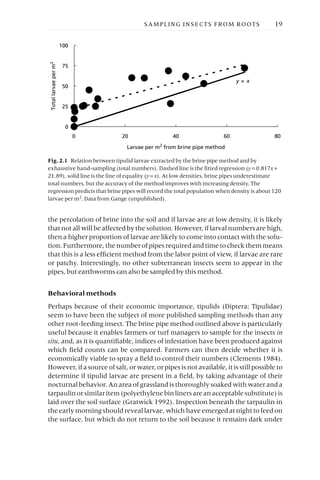
as a soil “core.” Figure 2.1 shows the efficacy of the method. Here, 16 different
fields, all under permanent ryegrass Lolium perenne / clover Trifolium repens pas-
ture were sampled in the spring of 1999 (Gange, unpublished). Twenty 10cm
diameter brine pipes were placed randomly in each field. Within 30cm of each
pipe, a 10cm diameter ¥ 10cm deep soil core was taken and tipulid larvae were
extracted from each in the laboratory by wet-sieving (see below). It can be seen
that the brine pipe method provides a good estimator of total abundance when
larval numbers are high, but tends to underestimate abundance when total
numbersarelow.Themostlikelyreasonforthisisthatthepipemethodrelieson
18 CHAPTER 2
35.
the percolation ofbrine into the soil and if larvae are at low density, it is likely
that not all will be affected by the solution. However, if larval numbers are high,
then a higher proportion of larvae are likely to come into contact with the solu-
tion. Furthermore, the number of pipes required and time to check them means
that this is a less efficient method from the labor point of view, if larvae are rare
or patchy. Interestingly, no other subterranean insects seem to appear in the
pipes, but earthworms can also be sampled by this method.
Behavioral methods
Perhaps because of their economic importance, tipulids (Diptera: Tipulidae)
seem to have been the subject of more published sampling methods than any
other root-feeding insect. The brine pipe method outlined above is particularly
useful because it enables farmers or turf managers to sample for the insects in
situ, and, as it is quantifiable, indices of infestation have been produced against
which field counts can be compared. Farmers can then decide whether it is
economically viable to spray a field to control their numbers (Clements 1984).
However, if a source of salt, or water, or pipes is not available, it is still possible to
determine if tipulid larvae are present in a field, by taking advantage of their
nocturnal behavior. An area of grassland is thoroughly soaked with water and a
tarpaulinorsimilaritem(polyethylenebinlinersareanacceptablesubstitute)is
laid over the soil surface (Gratwick 1992). Inspection beneath the tarpaulin in
the early morning should reveal larvae, which have emerged at night to feed on
the surface, but which do not return to the soil because it remains dark under
SAMPLING INSECTS FROM ROOTS 19
0
25
50
75
100
0 20 40 60 80
Larvae per m2
from brine pipe method
Total
larvae
per
m
2
y = x
Fig. 2.1 Relation between tipulid larvae extracted by the brine pipe method and by
exhaustive hand-sampling (total numbers). Dashed line is the fitted regression (y = 0.817x +
21.89), solid line is the line of equality (y = x). At low densities, brine pipes underestimate
total numbers, but the accuracy of the method improves with increasing density. The
regression predicts that brine pipes will record the total population when density is about 120
larvae per m2. Data from Gange (unpublished).
36.
the cover. Thesemust be collected quickly, because exposure to light will cause
them to burrow rapidly into the soil. If the researcher merely wishes to obtain
larvae for experiments or to start a culture, this is a very easy method for their
collection.
Baits
Instead of trying to persuade insects to leave the soil, an alternative method is to
provide them with an attractant in the form of a bait. Perhaps surprisingly, this
is not a widely adopted method, most likely because it produces only semi-
quantitative information, as the area from which larvae have been attracted is
difficult to measure. However, baits have been developed for wireworms
(Coleoptera: Elateridae) (Ward & Keaster 1977) and a bait consisting of a 1:1
mixture of wheat and corn was used by Belcher (1989) to estimate the propor-
tion of corn fields infested with wireworms in Missouri. An example of the kind
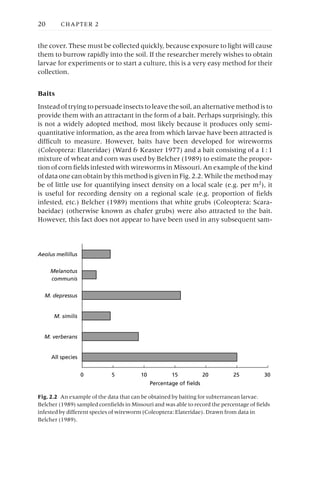
of data one can obtain by this method is given in Fig. 2.2. While the method may
be of little use for quantifying insect density on a local scale (e.g. per m2), it
is useful for recording density on a regional scale (e.g. proportion of fields
infested, etc.) Belcher (1989) mentions that white grubs (Coleoptera: Scara-
baeidae) (otherwise known as chafer grubs) were also attracted to the bait.
However, this fact does not appear to have been used in any subsequent sam-
20 CHAPTER 2
0 5 10 15 20 25 30
M. verberans
M. similis
M. depressus
Melanotus
communis
Aeolus mellillus
Percentage of fields
All species
Fig. 2.2 An example of the data that can be obtained by baiting for subterranean larvae.
Belcher (1989) sampled cornfields in Missouri and was able to record the percentage of fields
infested by different species of wireworm (Coleoptera: Elateridae). Drawn from data in
Belcher (1989).
37.
pling program forthese often injurious insects. Baits have been used to control
one insect pest, the black field cricket Teleogrylluscommodus, which can cause se-
riousdamagetopasturesinAustralia.Williamsetal.(1982)describethesuccess
of cereal baits impregnated with insecticide in the fight against this insect.
Recipes for baits for attracting adults of O. sulcatus are given by Labuschagne
(1999) and can be most successful when scouting for the presence of this pest.
Most baits for larvae and adults (Labuschagne 1999) appear to be based on a
cereal/bran mixture, but probably the main criterion for a successful bait is the
evolution of CO2. This is because it is thought that CO2 is the primary stimulus
used by insects to orientate themselves to roots in the soil (Brown & Gange
1990, Bernklau & Bjostad 1998). This probably explains why another excellent
bait for wireworm larvae in ex-pasture is a buried potato. Apart from being an
acceptable food source, the potato gives off CO2 and the larvae aggregate to-
wards it. While not being of much use from a quantitative point of view, this
method can be used to determine if the insects are present.
Hand-sorting
Themostlaborious,butalsoprobablythemostaccuratemethodofextractionin
the field is hand-sorting of extracted soil cores. An excellent example of this is
providedbyPenev(1992)whohand-sortedsoilcoresmeasuring25¥25cmand
30–40cm deep in the field when sampling for wireworms. For large insects
which are abundant, this method is often quite rewarding. Gange et al. (1991)
hand-sorted turf when sampling for larvae of Phyllopertha horticola (garden
chafer) infesting a golf tee. They used 25 ¥ 25cm ¥ 10cm deep quadrats and
found that the number of larvae varied between 1 and 49 per quadrat, equiva-
lent to a range of 16–784 per m2. The distribution of larvae was highly aggre-
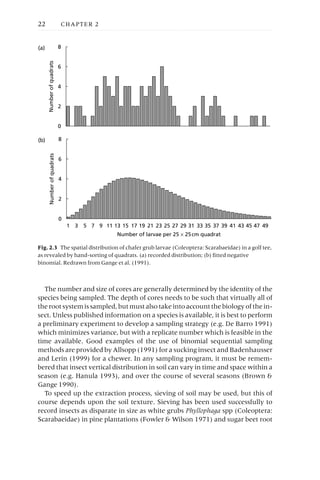
gated, conforming to a negative binomial distribution (Fig. 2.3).
Highly aggregated distributions are observed commonly with subterranean
insects and result from clumped ovipositional patterns, feeding preferences,
and the heterogeneous nature of the soil environment (Brown & Gange 1990).
This means that in any situation a large number of quadrats may contain zero or
veryfewinsects,andtheoverallprocessofaccuratelymeasuringthepopulation
and its spatial distribution may be an extremely time-consuming business. The
time taken largely depends on the ease of visibility of larvae and their size.
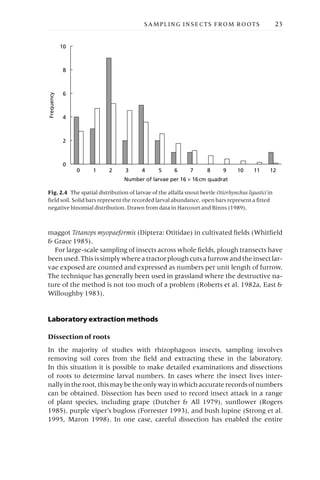
For example, Harcourt and Binns (1989) hand-sorted soil cores measuring
3600cm3 whensearchingforlarvaeofthealfalfasnoutbeetleOtiorhynchusligus-
tici and it took them nine minutes for each core. The distribution of larvae was
also highly aggregated, again conforming to a negative binomial distribution
(Fig. 2.4). Meanwhile, Seastedt (1984) sorted soil cores from prairie grassland
measuring 2000cm3 and it took 40 minutes per core. The best option is to or-
ganize a team of people to perform the sampling together. Thus, in the study of
Gange et al. (1991), seven people managed to sort 100 cores, each measuring
6250cm3
, in five hours (equivalent to 21 person minutes per core).
SAMPLING INSECTS FROM ROOTS 21
38.
The number andsize of cores are generally determined by the identity of the
species being sampled. The depth of cores needs to be such that virtually all of
the root system is sampled, but must also take into account the biology of the in-
sect. Unless published information on a species is available, it is best to perform
a preliminary experiment to develop a sampling strategy (e.g. De Barro 1991)
which minimizes variance, but with a replicate number which is feasible in the
time available. Good examples of the use of binomial sequential sampling
methods are provided by Allsopp (1991) for a sucking insect and Badenhausser
and Lerin (1999) for a chewer. In any sampling program, it must be remem-
bered that insect vertical distribution in soil can vary in time and space within a
season (e.g. Hanula 1993), and over the course of several seasons (Brown &
Gange 1990).
To speed up the extraction process, sieving of soil may be used, but this of
course depends upon the soil texture. Sieving has been used successfully to
record insects as disparate in size as white grubs Phyllophaga spp (Coleoptera:
Scarabaeidae) in pine plantations (Fowler & Wilson 1971) and sugar beet root
22 CHAPTER 2
0
2
4
6
8
Number
of
quadrats
0
2
4
6
8
1 3 5 7 9 11 13 15 17 19 21 23 25 27 29 31 33 35 37 39 41 43 45 47 49
Number of larvae per 25 ¥ 25cm quadrat
(a)
(b)
Number
of
quadrats
Fig. 2.3 The spatial distribution of chafer grub larvae (Coleoptera: Scarabaeidae) in a golf tee,
as revealed by hand-sorting of quadrats. (a) recorded distribution; (b) fitted negative
binomial. Redrawn from Gange et al. (1991).
39.
maggot Tetanops myopaeformis(Diptera: Otitidae) in cultivated fields (Whitfield
& Grace 1985).
For large-scale sampling of insects across whole fields, plough transects have
been used. This is simply where a tractor plough cuts a furrow and the insect lar-
vae exposed are counted and expressed as numbers per unit length of furrow.
The technique has generally been used in grassland where the destructive na-
ture of the method is not too much of a problem (Roberts et al. 1982a, East &
Willoughby 1983).
Laboratory extraction methods
Dissection of roots
In the majority of studies with rhizophagous insects, sampling involves
removing soil cores from the field and extracting these in the laboratory.
In this situation it is possible to make detailed examinations and dissections
of roots to determine larval numbers. In cases where the insect lives inter-
nallyintheroot,thismaybetheonlywayinwhichaccuraterecordsofnumbers
can be obtained. Dissection has been used to record insect attack in a range
of plant species, including grape (Dutcher & All 1979), sunflower (Rogers
1985), purple viper’s bugloss (Forrester 1993), and bush lupine (Strong et al.
1995, Maron 1998). In one case, careful dissection has enabled the entire
SAMPLING INSECTS FROM ROOTS 23
0
2
4
6
8
10
0 1 2 3 4 5 6 7 8 9 10 11 12
Number of larvae per 16 ¥ 16cm quadrat
Frequency
Fig. 2.4 The spatial distribution of larvae of the alfalfa snout beetle Otiorhynchus ligustici in
field soil. Solid bars represent the recorded larval abundance, open bars represent a fitted
negative binomial distribution. Drawn from data in Harcourt and Binns (1989).
40.
entomofauna associated withthe roots of Centaurea species to be determined
(Müller et al. 1989).
Flotation methods
As with field studies, hand-sorting has been commonly used. However, it is no-
ticeable in a number of long-term studies that this process has then given way to
other, more automated forms of extraction. For example, Goldson and Proffitt
(1988) and Goldson et al. (1988) used hand-sorting in the early stages of their
work, but subsequently changed to using flotation methods for the extraction
of S. discoideus larvae from lucerne field samples.
A variety of flotation methods have been described (Southwood & Hender-
son 2000); these generally involve a thorough mixing of the soil sample with
water, sugar, or salt solution and collecting the insects from the surface. Salt is
most commonly used —e.g. for tipulids (Lauenstein 1986) and Sitona spp
(Coleoptera: Curculionidae) (Goldson et al. 1988). The advantages of this so-
called passive extraction technique are that it is inexpensive and relatively
quick. De Barro (1991) compared hand-sorting of sugarcane roots with flota-
tion in water for the wax-covered mealybug Saccharicoccus sacchari. Flotation
took half the time of direct counting and produced identical counts of insects.
Furthermore, flotation is particularly useful for the extraction of inactive stages
such as pupae and eggs. Indeed, this is the standard method for obtaining egg
counts of a range of subterranean Coleoptera (Elvin & Yeargan 1985, Blank
et al. 1986) and Diptera (Dosdall et al. 1994).
However, if one is trying to obtain an accurate estimate of the spatial distribu-
tion of eggs in soil, then flotation is not ideal, particularly for friable soils, in
which cores easily break up. An ingenious egg sampling method for onion fly
Delia antiqua eggs was therefore developed by Havukkala et al. (1992). In this,
Petri dishes 15cm diameter ¥ 2cm deep with wire gauze bottoms were filled
with soil and then exposed to ovipositing flies in various situations. After ovipo-
sition, the dishes were filled with molten agar, from below. After cooling, the re-
sulting solid was cut into sections and mixed with hot water, and the position of
eggs accurately determined following extraction with flotation. In this way, it
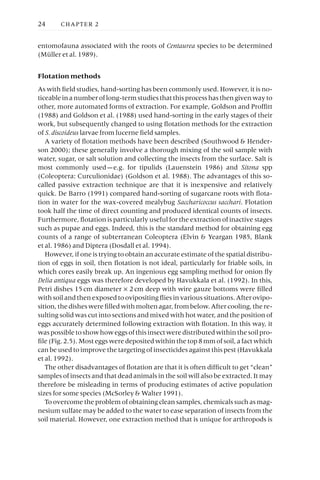
waspossibletoshowhoweggsofthisinsectweredistributedwithinthesoilpro-
file (Fig. 2.5). Most eggs were deposited within the top 8mm of soil, a fact which
can be used to improve the targeting of insecticides against this pest (Havukkala
et al. 1992).
The other disadvantages of flotation are that it is often difficult to get “clean”
samples of insects and that dead animals in the soil will also be extracted. It may
therefore be misleading in terms of producing estimates of active population
sizes for some species (McSorley & Walter 1991).
To overcome the problem of obtaining clean samples, chemicals such as mag-
nesium sulfate may be added to the water to ease separation of insects from the
soil material. However, one extraction method that is unique for arthropods is
24 CHAPTER 2
41.
hydrocarbon adhesion. Asthe cuticle of most species is lipophilic, it adheres to
petroleum derivatives and makes for a very efficient extraction process. The soil
is mixed with a solution of water and a hydrocarbon (usually heptane) and al-
lowed to settle. The insects will be found in the heptane layer. The procedure
was first described by Walter et al. (1987) and has since been improved by Geurs
et al. (1991) and Kethley (1991).
A variation of the “wet” method involves the sieving of insects from the
soil/water solution. With the aid of a continuous stream of water, this method
can be an improvement on the simple act of flotation and has been used
successfully when the root-feeding community is sought (e.g. Clements et al.
1987). Sieving can also be combined with subsequent flotation in magnesium
sulfate (Murray & Clements 1995) to separate small larvae from the debris re-
maining on the sieve. Another refinement to the flotation method is elutria-
tion, in which air is bubbled through the soil/water mixture in an effort to
improve separation of the insects from vegetative and soil material (e.g. House
& Alzugaray 1989).
Behavioral methods
In contrast to passive extraction methods, a variety of active techniques are also
available, which rely on behavioral mechanisms of the insects. As all subter-
ranean insects shun light and avoid high temperatures, these methods rely
on the production of a temperature gradient to drive them out of soil samples.
SAMPLING INSECTS FROM ROOTS 25
0
5
10
15
20
25
30
2 4 6 8 10 12 14 16 18 20
Depth in soil (mm)
Percentage
of
eggs
Fig. 2.5 The vertical distribution of onion fly Delia antiqua eggs in soil, as revealed by the
molten agar technique. Redrawn from Havukkala et al. (1992).
42.
Possibly the mostcommon method is use of the Berlese–Tullgren funnel, the
history and development of which is described by Southwood and
Henderson (2000). Briefly, this technique involves the use of heat and light to
drive insects out of a soil sample into a collecting container. The collecting
receptacle is usually filled with a 70% alcohol solution, to preserve specimens.
This method can be used to extract the active stages of any subterranean insect,
but it is especially useful for microarthropods, such as Collembola, which
cannot easily be obtained by any of the preceding methods.
Various modifications to the basic design have been made, usually for
particular root-feeding insects. For example, the soil may be contained within
a canister, which allows for regulation of temperature gradients through
the core (Lussenhop 1971). This method can easily be adapted to collect live
insects and in this way it is particularly useful for obtaining microarthropod
“communities.” Indeed, Klironomos and Kendrick (1995) used the canister
method to extract Collembola and mites from leaf litter for use in subsequent
experiments.
One of the most widely used and efficient variations of the funnel is the Blas-
dale version, for tipulid larval extraction (Blasdale 1974). In this, turf cores are
held in metal cylinders and positioned turf surface downwards in a dish of cold
water. Heat is applied to the soil end of the core and this drives the larvae
through the core and into the water. It is likely that this method would be of
little use for most rhizophagous insects, as many species will only move
downwards through a soil profile. Tipulids are an exception, as they often leave
the soil at night to feed on the surface (Gratwick 1992).
The use of active extraction methods for root-feeding insect density estimates
is widespread and in general they are inexpensive and produce clean samples.
However, their efficiency is often questioned (e.g. McSorley & Walter 1991),
as the number of insects extracted can be affected by soil moisture content,
whether the soil core is inverted or in its original position, and whether it is in-
tact or broken up. Hammer (1944) found that to extract maximum numbers of
Collembola it was necessary to maintain the core intact and to invert it. Inver-
sion appears to allow animals to leave the soil by natural passages, such as
earthworm burrows, which open to the surface. Another problem is that con-
densation can form on the inside of the soil container and small animals can be-
come trapped in this and so not be counted (Haarløv 1947). Furthermore, a
particular problem, especially with Tullgren-type extractors with high temper-
ature gradients (e.g. Crossley & Blair 1991) is that the temperature generated
insidethecoremaybedetrimentaltotheinsectbeingsampled.Itisafactthatbig
funnels extract relatively more large invertebrates, which Ausden (1996) at-
tributed to the desiccation of microarthropods in large funnels. It is best to run
the extractor with a low temperature gradient and to prevent the soil from dry-
ing out. A simple alteration to the standard Tullgren funnel is to use a very low
wattage light bulb (e.g. 10W), and to place polyethylene film over the sample
container. Indeed, a very simple demonstration of the importance of these
26 CHAPTER 2
43.
modificationscanbeseeninFig.2.6.Here,theuseoftoopowerfulabulbandno
protective covering dramaticallyreduced the number of Collembola obtained
from soil samples.
With any behavioral extraction method, there must be a trade-off between
extraction time and the accuracy of the method. Thus, the use of a high temper-
ature gradient will speed up the extraction process, but may underestimate
numbers if many microarthropods die without leaving the soil. Use of a lower
temperature gradient means a longer extraction period, but higher estimates of
abundance. However, a further problem with these systems is that in the time it
takes for the insects to be persuaded to leave the soil, considerable reproduction
can have taken place. The slower the process, the worse this situation is likely to
become. This problem was noted by Pontin (1978), who suggested that subter-
ranean aphids could produce a large number of offspring while still in the sam-
pling containers, leading to overestimates of population size.
An excellent comparison of a behavioral and a passive extraction method for
root aphids is provided by Salt et al. (1996). Here, Tullgren funnels were com-
pared with flotation to extract the subterranean aphids Pachypappa spp and
Pachypappella spp from Sitka spruce Picea sitchensis plantation soil (Fig. 2.7). In
Tullgren funnels, the majority of the aphids extracted were first-instar nymphs,
while in water flotation the majority of the aphids were adults and late-instar
nymphs. Tullgren estimates of total abundance were significantly higher than
SAMPLING INSECTS FROM ROOTS 27
0
20
40
60
80
100
120
140
160
40W bulb,
uncovered
40W bulb,
covered
10W bulb,
uncovered
10W bulb,
covered
Collembola
per
10
cm
core
(±
s.e.)
Fig. 2.6 Collembola abundance in a rye grass Lolium perenne pasture soil, as measured by
Tullgren extraction. Each sample was left for one week. Use of too powerful a bulb (40W)
significantly reduces the numbers of animals recorded, while the use of a polyethylene
protective covering over the sample increases the numbers obtained. Data from Gange
(unpublished).
44.
flotation estimates (Fig.2.7), caused by the large numbers of first instars ob-
tained by this method. Salt et al. (1996) suggest that reproduction had occurred
in the funnels, leading to the high proportion of first instars, but also acknow-
ledge that flotation underestimated first-instar numbers, because it is virtually
impossible to separate such small animals from the organic debris floating on
the surface. This paper emphasizes why neither active nor passive extraction
methods are ideal for small root-feeding insects. In general, the method used
should be commensurate with the biology and size of the insect being sampled.
Thus,forlargerlarvae,whicharenotclosetopupation,Tullgrenfunnelsortheir
equivalent are very efficient. However, for smaller larvae or insects, inactive
stages, or actively reproducing adult insects, flotation is a better choice, with the
proviso that great care must be taken to ensure that all individuals, no matter
how small, are found. For the latter scenario, wet-sieving is likely to represent
the best way of ensuring that (for example) first-instar aphid nymphs are sam-
pled efficiently.
Laboratory visualization methods
While not strictly sampling methods, a number of techniques have been used
for the examination of insect distribution and behavior in soils. These methods
have not been widely used, but offer a lot of promise for the understanding of
insect responses to soil parameters such as moisture content and temperature.
Improved knowledge of rhizophagous insect response to biotic and abiotic fac-
28 CHAPTER 2
0
200
400
600
800
1000
1200
1400
First-instar
nymphs
2nd–4th-instar
nymphs
Adult aphids Total aphids
Aphids
per
m
2
(±
s.e.)
Tullgren extraction Flotation extraction
Fig. 2.7 A comparison of Tullgren extraction with flotation, for measuring the abundance
of spruce root aphids Pachypappa spp and Pachypappella spp. Tullgren extraction produces
higher overall estimates, but these are almost entirely first-instar nymphs. Flotation reveals
very few small, first-instar aphids, but records more adults. Drawn from data in Salt et al.
(1996).
45.
tors in thesoil will enable improved targeting and efficacy of pesticides against
injurious species and a clearer understanding of the interactions between these
insects and their host plants in natural situations.
To understand which insects were feeding on clover roots, Baylis et al. (1986)
labeled roots with 32P and then used autoradiography to see which members of
the soil fauna were radioactive. This method would be useful if one were simply
trying to determine the structure of the rhizophagous community associated
with one plant species, but it is of little use for the determination of host plant
preferences in a given community. More recently, Briones et al. (1999) have
used carbon stable isotope analysis to determine the feeding of two collembolan
species associated with leaf litter. This method assumes that the isotopic compo-
sition of the body tissue of microarthropods gives an accurate estimate of the
d13C value of their diet. With this approach, Briones et al. (1999) were able to
show feeding preferences for organic matter derived from maize, a C4 plant (or
microorganisms growing on it), compared with matter derived from C3 plants.
This technique represents an important advance in soil biological research and
should be applicable to rhizophagous insects, as has already been achieved with
earthworms (e.g. Schmidt et al. 1997).
A technique for insect behavioral observation was presented by Lussenhop et
al. (1991), who advocated the use of video technology for the observation insitu
ofsubterraneaninsects.Themethoddoesallowforaconsiderableamountofvi-
sual observation time to be achieved. However, the manner in which the exper-
imental units (biotrons) are set up may be open to criticism in that they
generally involve some form of glass observation plate, against which insects
and roots may show unnatural behavior. Nevertheless, for the observation of
small organisms and the detection of their feeding behavior, this method does
offer a number of opportunities. Direct observation of southern corn rootworm
larvae Diabroticaundecimpunctata was successfully used by Brust (1991) to mon-
itor predation of larvae in the soil and enabled a species of Lasius(Hymenoptera:
Formicidae) to be identified as the main predator.
To overcome the problem of soil disturbance or insertion of observation
chambers into soil, Villani and Gould (1986) and Villani and Wright (1988) de-
veloped the use of radiography for direct observation. Intact blocks of soil were
subjected to X-ray analysis and, as the pictures in Villani and Wright (1988)
demonstrate, individual scarab larvae could be clearly seen. The larvae used in
these experiments were all large; smaller individuals or species may be impossi-
bletodetectbythismethod,soarecoursetohand-sortingmustbemade(Villani
& Nyrop 1991). Nevertheless, Harrison et al. (1993) applied X-ray computed to-
mography to the study of the smaller pecan weevil Curculiocaryae and were able
to record the burrowing activity of this insect. The X-ray technique is very use-
ful for documenting the responses of larvae to changes in abiotic parameters,
such as soil moisture, and is considerably less time-consuming than hand-
sorting the soil to determine larval positions. Such observation methods are
particularly important for documenting the behavior of larvae within a soil
SAMPLING INSECTS FROM ROOTS 29
46.
profile. Results suchas those of Villani and Nyrop (1991) clearly show differ-
ences in the behavioral patterns of two species of chafer grub (Coleoptera:
Scarabaeidae) and could be used to target insecticides more efficiently in time
and space in the field.
Conclusions
The difficulty of sampling subterranean insects has undoubtedly led to a lack of
study by ecologists. However, a number of methods are available for their study,
and a summary of the decisions needed to be taken is given in Fig. 2.8. Before
starting any sampling program, it is wise to understand as much about the biol-
ogyofthespeciesinvolvedaspossible.Manyspecieshaveadultstageswhichare
free-flying above ground.
Developing a sampling program for these is a good start, and considerably
easier than searching for the larval forms in the soil. In situations such as grass-
land,predatorssuchasbirdsandmammalsprovideanexcellentindicatoroflar-
val presence in the soil. Other visible signs in the host plant are drought stress
(though not necessarily in hot dry conditions) and poor plant growth not attrib-
utable to foliar feeders or pathogenic fungi.
There are few insitu extraction methods in the field. Brine pipes work well for
tipulid larvae and baits are an under-used method of determining larval pres-
ence.Allothersamplingmethodsaredestructive.Hand-sortingofsoil,whether
in field or laboratory, is the most accurate method, but is time-consuming and
tedious. For internal root-feeders, there is no other way than excavating the
root system and dissecting it. Passive extraction methods, generally involving
some form of flotation, are useful for inactive stages, very small insects, and
actively reproducing adults. Great care must be taken to separate things such as
Collembola or first-instar aphids from soil debris; the use of wet-sieving may
help in the capture of these individuals. Hydrocarbon adhesion is excellent,
though surprisingly under-used.
Active extraction methods rely on heat and light to drive insects out of the
soil. They are good for large, active insects but do not sample inactive stages.
They have been widely used for the extraction of small insects, but there are
several problems with this approach. Adult insects such as aphids can produce
considerable numbers of offspring within the apparatus, leading to erroneous
estimates of population size and structure. Too high a temperature gradient in
the soil core can kill small insects such as Collembola, leading to underestimates
of abundance.
Several methods of subterranean insect observation have been developed,
the most promising of which is radiographic imaging. This is very good for
larger insects, but needs to be refined to detect small individuals. The use of
carbon stable isotopes offers great promise for the future.
30 CHAPTER 2
47.
SAMPLING INSECTS FROMROOTS 31
Identify
the insect
Adult
visible
Collembola
Chewer
Sucker
Tipulid
Other
Lab.
Lab.
Lab.
Lab.
Field
Field
Field
Field
Field
Quick
Quick
Quick
Quick
Quick
Quick
Quick
Quick
Slow
Slow
Slow
Slow
Slow
Slow
Slow
Slow
Traps, scouting, baits
Tullgren
Flotation, wet-sieving
None
None
Tullgren
Flotation, wet-sieving,
hand-sorting
Chemical expulsion
Hand-sorting, sieving
Tullgren
Flotation, wet-sieving,
hand-sorting,
root dissection
None
Baits, hand-sorting,
sieving
Tullgren
Flotation, wet-sieving,
hand-sorting
None
Hand-sorting
Fig. 2.8 Schematic diagram showing the decisions that need to be taken to decide on a
particular sampling method appropriate for any subterranean insect. First, identify the insect;
having done so, the nature of its life history (sucker, chewer, etc.) needs to determined. Then,
one must ask if the extraction procedure will take place in the laboratory (lab.) or field. The
final step is to decide whether answers are required with relative ease (quick), perhaps at the
expense of complete accuracy, or whether some time can be devoted to the procedure, to
ensure that is as accurate as possible (slow). Each extraction procedure, with respective
advantages and disadvantages, is described in the text. For some groups in some situations
(e.g. Collembola in the field) there is no realistic method available.
48.
References
Allsopp,P.G.(1991)BinomialsequentialsamplingofadultSaccharicoccussaccharionsugarcane.
Entomologia Experimentalis etApplicata, 60, 213–218.
Arnold, A.J. (1994) Insect sampling without nets, bags or filters. Crop Protection, 13, 73–76.
Ausden, M. (1996) Invertebrates. In Ecological Census Techniques: a Handbook (ed. W.J.
Sutherland), pp. 139–177. Cambridge University Press, Cambridge.
Badenhausser, I. & Lerin, J. (1999) Binomial and numerical sampling for estimating density of
Bariscoerulescens(Coleoptera:Curculionidae)onoilseedrape.JournalofEconomicEntomology,
92, 875–885.
Baylis, J.P., Cherrett, J.M., & Ford, J.B. (1986) A survey of the invertebrates feeding on living
clover roots (Trifolium repens L) using 32P as a radiotracer. Pedobiologia, 29, 201–208.
Belcher,D.W.(1989)Influenceofcroppingsystemsonthenumberofwireworms(Coleoptera:
Elateridae) collected in baits in Missouri cornfields. JournaloftheKansasEntomologicalSociety,
62, 590–592.
Bernklau, E.J. & Bjostad, L.B. (1998) Reinvestigation of host location by western corn root-
worm larvae (Coleoptera: Chrysomelidae): CO2 is the only volatile attractant. Journal of Eco-
nomic Entomology, 91, 1331–1340.
Blank, R.H., Bell, D.S., & Olson, M.H. (1986) Differentiating between black field cricket and
black beetle damage in Northland pastures under drought conditions. NewZealandJournalof
Experimental Agriculture, 14, 361–367.
Blasdale, P. (1974) A method of turf sampling and extraction of leatherjackets. Plant Pathology,
23, 14–16.
Blossey, B. (1993) Herbivory below ground and biological weed control: life history of a root-
boring weevil on purple loosestrife. Oecologia, 94, 380–387.
Bracken, G.K. (1988) Seasonal occurrence and infestation potential of cabbage maggot, Delia
radicum (L.) (Diptera: Anthomyiidae), attacking Rutabaga in Manitoba as determined by
captures of females in water traps. Canadian Entomologist, 120, 609–614.
Briones,M.J.I.,Ineson,P.,&Sleep,D.(1999)Useof d13Ctodeterminefoodselectionincollem-
bolan species. Soil Biology and Biochemistry, 31, 937–940.
Brown, V.K. & Gange, A.C. (1990) Insect herbivory below ground. Advances in Ecological
Research, 20, 1–58.
Brust, G.E. (1991) A method for observing belowground pest–predator interactions in corn
agroecosystems. Journal of Entomological Science, 26, 1–8.
Clements, R.O. (1984) Control of insect pests in grassland. Span, 27, 77–80.
Clements, R.O., Bentley, B.R., & Nuttall, R.M. (1987) The invertebrate population and re-
sponse to pesticide treatment of two permanent and two temporary pastures. Annals of Ap-
plied Biology, 111, 399–407.
Cordo, H.A., DeLoach, C.J., & Ferrer, R. (1995) Host range of the Argentine root borer Car-
menta haematica (Ureta) (Lepidoptera: Sesiidae), a potential biocontrol agent for snake-
weeds (Gutierrezia) in the United States. Biological Control, 5, 1–10.
Crossley, D.A. & Blair, J.M. (1991) A high-efficiency, “low-technology” Tullgren-type
extractor for soil microarthropods. Agriculture, Ecosystems and Environment, 34, 187–
192.
De Barro, P.J. (1991) Sampling strategies for above and below ground populations of Sacchari-
coccus sacchari (Cockerell) (Hemiptera: Pseudococcidae) on sugarcane. Journal of the
Australian Entomological Society, 30, 19–20.
Dosdall, L.M., Herbut, M.J., & Cowle, N.T. (1994) Susceptibilities of species and cultivars of
canola and mustard to infestation by root maggots (Delia spp.) (Diptera: Anthomyiidae).
Canadian Entomologist, 126, 251–260.
32 CHAPTER 2
Notwithstanding our loadswe made good time, and reached the outer camp
of Indians about 9 p.m. We found that Muddy Bull, who had been away on
the chase while we passed, had returned and, as usual with him, had made a
great hunt. He generously supplemented our loads with tongues and backfats
and bosses, so that when we left his camp that night we were well
provisioned. Continuing our journey we passed several small camps en
route, and stopping about 2 a.m., slept for a few hours and were away again
by daylight. Pushing on, we reached home the third day of the return
journey, bringing word of Indians and buffalo, which missionaries and
traders and settlers were all delighted to hear.
CHAPTER XIII.
A run to Edmonton—Mr. Hardisty and other Hudson's Bay Company officers spend New
Year's with us—Sports and amusements—Our party sets out for Mountain House—I
experience a "scare"—Intense cold—A cunning dog—Mishaps to a cariole—In the
foot-hills—My first view of the Rockies—Hearty reception at Mountain House—Back
to Victoria.
It was now the middle of December, and father arranged to spend a
Sabbath in Edmonton before the winter holidays came on. I went as cariole
driver, and Mark brought on the provision and baggage sled. A little more
than a day and a half brought us to the fort, and while we were there Mr.
Hardisty and party arrived from the Rocky Mountain House. This fort and
trading-post had been abandoned by the Hudson's Bay Company for some
years, but in the summer of 1865 it was decided to reopen it in order to draw
the trade of the surrounding Indian tribes—Blackfeet and Bloods, Piegans
and Sarcees—as also to keep these turbulent tribes as much as possible from
collision with the wood and plain Crees, their hereditary foes.
Mr. Hardisty had been put in charge of this enterprise, and with a large
complement of men and an ample outfit, had gone overland during the
51.
autumn to thesite of the abandoned post. A temporary fort was built in the
woods near by, and his men were now taking out timber and sawing lumber
preparatory to the erection of permanent buildings during the next season.
The old fort had been the scene of many a fight between the contending
tribes, and as the Hudson's Bay Company invariably followed a "peace
policy," not only between themselves and the various tribes, but also in
preserving amity among the different races, they had given up the fort and in
so doing lost a large portion of the southern trade. But now that the Crees
had moved farther east, Victoria had become an important post, intermediate
between Edmonton and Fort Pitt, and the reasonable conclusion presented
itself that the Blackfeet and southern trade might now again be secured by
rebuilding the Mountain Fort.
Mr. Hardisty and Messrs. McAnley and MacDonald returned with us to
spend the holidays at Victoria, father having promised to go to the Mountain
Fort directly after New Year's day, for the two-fold purpose of meeting the
Mountain Stonies, who were expected there then, and also of marrying Mr.
McAuley to Miss Brazeau, the daughter of the second officer in charge of
the fort.
On our return trip to Victoria, in company with the Hudson's Bay officers,
we did not camp, but leaving Edmonton in the evening we journeyed all
night, reaching Victoria early next morning. As I had father in my cariole,
and the rest of the party were comparatively light, the run of between ninety
and a hundred miles was a hard one for my team. But old Draffan and his
driver did not come in last by any means.
Readers of "FOREST, LAKE AND PRAIRIE" will remember that in the
autumn of 1862 Gladstone and I began this place. In loneliness sublime our
leather lodge stood on the north bank of the big Saskatchewan. Little more
than three years have passed, and this is now the rendezvous of several large
camps of Indians. Wood and plain Crees and wood Stonies have frequented
the spot. A colony of some twenty-five families of English half-breeds have
settled beside us. The Hudson's Bay Company have established a post
alongside the Mission. The Mission party has been augmented by the arrival
of father and mother, and part of the family from Norway House, and of my
brother and sister from Ontario. I have taken unto me a wife, and we are no
more alone at Victoria.
52.
The holidays of1865-66 were full of pleasurable excitement. Religious
services and literary entertainments and concerts occupied the evenings, and
out-door games, such as football, snowshoe and dog-train races and foot
races, were provided for the day. Thus the fun and enjoyment were kept up.
Then came watch-night with its solemnity and New Year's day as the
culmination of our feasting and innocent frolic.
The second day of January, 1866, found us driving our dog-teams
westward for the Mountain House. Again I had father and the cariole as far
as Edmonton, and from that point we had the Chief Factor of the
Saskatchewan District, William Christie, Esq., as one of our company.
The distance between Edmonton and the Mountain House is 180 miles.
We left the fort about four o'clock one dark morning, our train comprising in
all nine sleds. I had a load of baggage, a portion of which gave me quite a
start. As I jumped on the sled while going down a gentle slope, there seemed
to be a living, moving object lashed in my load, for it moved under my
moccasined feet. Instantly I sprang into the snow, and then it flashed upon
me that it was a bag of mashed potatoes which a friend was sending to the
Mountain House and which had not yet frozen. I laughed at my scare, but at
five o'clock on a dark stormy morning in a narrow winding forest path, a
very little will startle one. The cold was intense, a keen cutting wind making
us keep a sharp lookout for frostbites. The road was drifted and very heavy,
so that when night came on we were glad enough to make camp, which we
pitched in a spruce grove at the eastern base of the Woodpecker Hills.
Pile on the logs as we would, still the cold was bound to assert itself, and
our clothing alternately steamed and froze as we turned before that fire. The
Chief Factor and father, who had been constrained to sit in one position in
their coffin-like carioles since five o'clock in the morning, were now making
up for it by indulging in lively anecdote and joke and repartee. Pemmican
and hot tea went a long way towards heating the internal man, and the great
fire did something for our extremities. But the cold was omnipresent. In
great chunks, in morsels, in atoms, it was all about us. You could reach out
and grasp it. You could shiver in your clothes and feel it. You could almost
smell it and see it, and you could hear it plainly enough as with might and
force it strained the very earth and made the forest monarchs crack as if
these were so many ends to its lash.
53.
Hours before daybreakwe were climbing the hills and crossing the ice-
bound creeks and lakes, and those of us who had loads or carioles to drive
were "running with patience" (at times) "the race set before us." The
bridegroom-elect being the shortest-legged of the party, and I doubt not the
shortest-winded also, generally brought up the rear. Even if he started out
ahead, or in the middle of the procession, before many miles were passed he
fell behind. The law of gravitation was doing its work. From the rear at
frequent intervals would come the shout to Pat (his leading dog), "Marse!"
uttered with a strong Scotch accent.
Pat was a big white dog with a short bobtail. He also had a peculiar twist
of the head and a squint of the eye which gave him a wise, knowing
appearance. If he had lived in these latter days, and become possessed of
eye-glasses, doubtless he would have been given a degree! The shrewd
fellow seemed to know that his master was on an important mission, and the
dignity of leading a train the owner and driver of which was on his way to be
married, was fully apparent to "His Dogness." His demeanor en route and
around camp was simply taking. Pat and his master gave us endless fun on
that trip. When these would come up, which was generally after camp was
made, the Chief Factor, the Chairman of the Hudson's Bay Missions, and the
rest of our party became all attention, and Pat and his master were the centre
of joke and fun. Their account of the morning's or afternoon's run (I say
their, for Pat would by nod and look confirm his master's recital) was sure to
"bring the house down." We were unanimously thankful during the days and
nights of that very cold trip for the stimulating presence of Pat and our short-
limbed bridegroom-elect.
During our second afternoon's run, while making through a rough
country, we came to an exceedingly sidling place in the trail. Having sent my
own load past and helped father over it, I thought I would wait and see what
our rearguard was doing. After some time I heard "Marse, Pat!" coming from
the little Scot's big lungs (for have you not noticed that Nature in the nice
balance of her equity generally gives the little man a big pair of lungs), and
soon Pat hove in sight, his tongue protruding, and the breath from his big
mouth making little clouds of frozen vapor in the sharp cold air. The cunning
old dog was making the appearance of doing it all, but all the while I could
see that his traces were slack.
54.
Soon dogs andsled were on the sidling road down the hill, and over went
the cariole and down the slope rolled its contents. Pat and his companions
felt the load lighten, and just then remembered that they were far behind, and
in vain my friend shouted "Whoa, Pat, whoa!" On went the train, and now I
came upon the scene. The bridegroom-elect shouted, "Catch those dogs,
John! I say, John, stop those dogs!" Laughing as I ran, I caught and pulled
Pat up, righted the cariole and held the train while the little Celt gathered up
the fragments, which I saw largely consisted of presents from Edmonton
friends to the marriage supper, now nearly two days nearer in view than
when we started.
Nicely cut roasts of beef and pork, bottles of wine, and sundry parcels lay
around in sweet confusion. It took some time to gather them up and pack
them in place in that parchment-sided, primitive vehicle; and all this time his
owner was discoursing on Pat's good qualities—"were it not for his big load
he would take the lead," etc. After a time everything was adjusted again, and
on we went, camping that night among the rolling hills west of Blindman's
River.
Another "stingo" night and away long before day. Roads heavy, snow
deep, day so cloudy and stormy that the promised view of the Rockies failed
to realize. There were some of us in the party who had travelled far and wide
in the North-West for from five to fifteen years, and as yet had not seen the
mountains. We were now looking keenly for the first glimpse of them, but
the third night came, and still because of cloud and storm we had not beheld
them.
Our camp that night was made on the wooded summit of a foot-hill. We
were climbing the world fast. If it had been moonlight or clear daylight we
would have looked upon a sea of mountains, but darkness and storm and
smoke were our portion instead. The smoke from our camp-fire found no
vacuum in the overhanging atmosphere, but on the contrary was pressed to
the ground about our camp. In fact the conditions were such that I think of
that "hill summit camp" as one of the more disagreeable experiences of my
frontier life. Gladly we left it while hours of the long night were still
unspent, and as daylight came we were ascending another big foot-hill, from
the summit of which I first beheld the glorious old Rockies.
55.
Spellbound and inrapture I gazed upon the sublime spectacle before me.
How supremely beyond my largest imaginings those lofty ranges stood
revealed to the delighted senses. The clouds had disappeared, and in clear,
distinct outline hundreds of snow-clad peaks stood out as if cut by a mighty
diamond upon the dimly lighted morning sky. The beauty of the scene
intensely moved me. The majesty and power apparent were most satisfying
to my soul. The God who made these made me also: I felt exultant in the
thought. But now the morning sun had clearly risen, and as I looked the
highest peaks were illumined as by electric touch, and scores of great
beacon-fires seemed to have sprung into instantaneous being. And the great
picture quickly grew. Snow-clad summit and glacier glint and granite wall
and forest growth speedily became transformed as with the touches of a
million brushes. Halos of light, radiant and grandly bright, spread
themselves upon the mighty canvas. In rapture I beheld and worshipped. I
had seen a glimpse of the glory of the Eternal, and still I lived. As I
reluctantly left the scene and ran to catch up with our party over the foot-
hills and across the wide valley beyond, I was elated above measure. What
matter the cost in travel and cold and extreme hardship, I had seen the
mountains, and the sight would be a perennial blessing in my life.
When I came up to our party they were already descending the sloping
bank of the Saskatchewan. Miles of this, and then an almost perpendicular
jump or slide, and we were on the ice of the river, following up which for a
couple of miles we reached the temporary fort.
It was early morn, but up went the flag, and the little metropolis was all
excitement in consequence of our arrival. The Chief Factor in those days
was supreme in his own district. And what a district! From below the
junction of the two Saskatchewans it stretched to the Columbia, and from the
forty-ninth parallel it extended to the north tributaries of the Peace River.
Father's field was still larger, in that it stretched eastward down to below
Oxford House and close to Hudson Bay.
No wonder the roughly built but strongly made fort was en fete when
such ecclesiastical and commercial dignity came suddenly upon it. Our
welcome was hearty, and that of our "rearguard" doubly so. We were
fortunate in meeting here numbers of Mountain Stonies and Blackfeet,
56.
hardy, muscular mountaineersand wild plain Indians, both comparatively
new types to me.
The temporary fort was built on a low flat near the river. The permanent
new fort was to be placed on a higher bench. I found that the site of
Mountain Fort was about sixty miles from the real base of the mountains and
on the north bank of the North Saskatchewan.
We spent a Sabbath at the fort. Father held services for both whites and
Indians. In due time the marriage was solemnized, and the wedding supper
eaten, and we began our return journey. As the cold had intensified there was
no loitering by the way, and early the third day we were back at Edmonton.
Sixty miles per day was not bad travelling in such hard weather. The last
night we left camp about midnight. I wrapped father in his cariole and kept it
right side up until we stopped for breakfast. The next day we started for
Victoria, and camping once, arrived there early the second day, right glad to
be at home once more.
CHAPTER XIV.
Home occupations—A course of lectures—Mark and Jimmie as raconteurs—Mark's success
as a deer-killer—A buffalo chase on a dog-sled—Our first child is born—Chickens at
eight shillings apiece!
The big open fire-places in the Mission house were delightful spots
beside which to spend a few hours after a trip such as we had just concluded;
but such was the extent of our moving circuit, and such our circumstances,
that we could spare but very few hours at home. Many camps must be
visited and many mouths must be fed. Mark and I and a lad named Jimmie
Horn were kept pretty constantly on the move, now bringing in loads of
fresh meat, and the next trip loads of dried provisions wherewith to make
pemmican for summer use. We generally managed to keep Sunday in some
57.
Indian camp orat the Mission. If the former, the whole day was one
continuous series of meetings. I would go from one chief's tent to that of
another, and the respective followers would crowd the lodges while I did my
best to tell the pagan and barbarous people the old, old story of Jesus and His
love.
Many a night, at the close of a long day's run, I would give informal
lectures on civilization and education, telling my eager listeners what
Christianity was doing for man in other parts of the world; and all this time I
was learning the language and studying the people. Old men and painted and
feathered warriors and the youth of these camps crowded the lodges in
which I made my temporary home. There was no rest while in Indian camps,
and not until we were in our own seven-by-eight-foot hole in the snow, with
wood cut and carried and piled at hand and dogs fed, would I sit down to rest
both mind and body, and be free for a time from the inquisitive and eager
listening and questionings of these people to whom we were sent. Then
Mark and Jimmie would take their turn. Jimmie was a lad of nimble legs, but
of much nimbler tongue. Had he not come from the famous Red River? He
had even visited old Fort Garry, and he would fairly take Mark's breath as he
drew from the range of his wide experience.
Mark would tell of the mountains, and grizzlies and panthers and
avalanches, and encounters with the enemy, till Jimmie's eyes would bulge
with excitement. I would look on and listen and rest. Then before retiring
Mark would lead in prayer in his mother-tongue, which neither Jimmie nor
myself could understand, though we always said "Amen."
During short intervals at the Mission Mark made several hunting
excursions, and killed some moose and deer. One night he came home and
reported one moose killed and another wounded. Early next morning we
went out and killed the wounded moose and brought the meat of both home.
Another time he killed two deer, and brought back word that the forest was
so dense the meat would have to be packed to the river some miles above.
Accordingly he and I took our dogs and drove up the river opposite to where
the deer lay. Fastening the dogs, we struck into the forest, and coming across
fresh tracks of more deer, we went after these and killed two more. It was
midnight before we had packed the meat of the four deer to the place where
58.
our dogs andsleds were. Hard work it was, but the venison was good, and
our larder was handsomely replenished.
All that winter the wood Cree camps were from one hundred to one
hundred and fifty miles distant from the Mission. The buffalo kept out south
of these camps, and sometimes were a long distance from them. But now
that there was a regularly established post beside the Mission, trading parties
and settlers and Indians kept passing to and fro, giving us comparatively
good roads, and thus enabling us to travel quickly. Once well loaded with
either dried provisions or fresh meat, we lost no time on the road.
It was on one of the trips we made at this time that we were stopping for
the day in Ka-kake's camp, which was situated beside a pound for catching
buffalo, when, hearing of another cluster of lodges some ten or twelve miles
distant, I made a run over to see the people, and while coming back the same
afternoon I ran across a fine herd of buffalo. As my leader was obedient to
the word, I thought "now is my chance to run that herd over to the pound." I
had no load whatever on the sled, so I gripped the ground-lashing with both
hands and feet, and sent the dogs after the herd, or rather to one side of it.
My dogs went into the hunt most heartily, and sometimes brought me
dangerously near to the flying mass. Then I would get them under control
again, and on we went from side to side, but always nearing the point of
timber where the pound was. Presently we came within the lines of "dumb-
watchers," and now these helped us, and I kept looking, when I could spare a
glance, to see some move in camp. But as the lodges were behind the bluff,
and the Indians did not look for buffalo at the time, no one saw us until it
was too late to prepare and run the herd into the pound; so, after bringing the
buffalo close up to camp, I had the bitterness of seeing them break through
the "head sentinels" and dash away.
But what a ride I had that afternoon, my big dogs jumping together, and
with long leaps making the sled leap also. It required a firm grip to stay on
that narrow sled, and also dexterous poising to keep right side up. Down
hills, across valleys, over knolls, jumping the rough frozen snow where
thousands of buffalo had rooted and tramped only a few days before,
certainly that was a toboggan ride with a race against a herd of buffalo
thrown in; and the only disappointment was that after bringing the bunch to
the pound, the Indians were not there to receive them.
59.
When Ka-kake camein that evening he loudly lamented that we had not
been seen in time, for, said he, "It would have given a name to this part of
the country and to my camp, and men would have pointed to this as the place
where John brought buffalo into the pound with his dog-train."
One day in February, 1866, while I was at home, my mother, coming
down stairs, congratulated me on the birth of a daughter, and when I knew
that mother and child were well I mentally and consciously made a step
forward in being. It was as God would have it. We gave our first-born the
good old Scotch name of Flora, which also belonged to my youngest sister.
About the middle of March father made another pastoral visit to
Edmonton, and as we remained over for Monday, I went out to St. Albert,
the Roman Catholic Mission north of Edmonton, to find, if I could, some
domestic chickens, as mother had often expressed a strong desire for some.
It took me all day to drive about twenty-five miles and find the chickens and
buy them, the latter two enterprises being the most difficult of the three. At
last I purchased three birds, two hens and a cock, paying for them eight
shillings each—six dollars to start a poultry farm in our part of the country!
Wild-duck eggs were very good in their place, but unfortunately for
cooking purposes these were generally some way on in the process of
incubation before we obtained them, and mother with her eastern ideas did
long for a few fresh eggs occasionally.
I was quite proud of my purchase, but was rather taken aback when at the
supper table that evening the august Chief Factor inquired of me what I had
paid for those chickens, and when I told him eight shillings each, he pooh-
poohed the whole thing; and while I was not prepared for such criticism, I
could but answer that this was largely a matter of sentiment, that I had often
been where if I had it I would have given all that to hear a cock crow. The
old gentleman gave me up as incorrigible. However, to the credit of
humanity it must be said that we are not all Peters. The crow of a cock or the
tinkling of a cow-bell often have been as sweetest music in the ear of a poor
lost traveller.
60.
CHAPTER XV.
David andI visit Lac la Biche—High-priced seed wheat—Our party sets out for Pigeon
Lake—Old Joseph—Paul Chian—Samson—Our larder depleted—We organize a hunt
—Precarious living—Old Paul proves himself a skilful guide—Samson tells of a tragic
murder by Blackfeet—We move cautiously—Broiled owlets as a delicacy—I shoot an
elk—Little Paul's flint-lock hangs fire—Samson's brilliant hunting feats—Feasting on
antlers.
Just before the winter was breaking up, my brother David and myself
made a trip to Lac la Biche to try if we could procure some seed wheat. The
Roman Catholic priest was the only person who had any to dispose of, and
we traded a few bushels from him, giving him pemmican pound for pound.
Very dear wheat that, costing us, independent of freight, at least ten cents per
pound, besides a two hundred mile tramp to get it. But we needed it, and it
was good grain. The reader will notice that here was wheat grown eight
hundred miles west of the Red River, and one hundred miles north of the
North Saskatchewan!
The spring was now upon us, the Indians were coming in in large
numbers, and the time was at hand for our going back to Pigeon Lake in
accordance with our promise to the Crees and Stonies. Therefore our small
party, consisting of my wife and young child, an elderly widow and her boy
of some seven or eight years, and Mark and myself, bade the rest of the
Mission party good-bye, and crossing the Saskatchewan just before the ice
broke up, turned our faces westward on the southern trail. As food was
limited, and our means of transport by no means large, we hunted on our
way as much as possible, saving what dried provisions we had for future use.
Ducks and rabbits formed the principal part of our fare. In due time we were
at the end of the cart-road, and then packing the rest of the way we came to
the new Mission, and found some Indians there already waiting for us.
Among these were old Joseph and Paul Chian, the latter a French half-
breed, but a staunch Protestant. The readers of "SADDLE, SLED AND
61.
SNOWSHOE" will rememberJoseph as a consistent Sabbatarian and a
really plucky fellow. Paul but now comes on the scene of our narrative. He
was a true man, and having embraced Christianity and espoused
Protestantism, was invaluable to me. These and others heartily welcomed us,
and our daily meetings were seasons of blessing.
Camp after camp came in, mountain and wood Stonies and Crees—
pagans and Christians—ours was a truly cosmopolitan gathering. Gambling
and conjuring, heathen feasts and our own singing and preaching and
praying were interchanging exercises of day and night. When I was not
holding meetings or attending councils I was hunting or fishing, or trying to
garden; but as to the latter, our means were limited and seeds few.
Among the wood Crees who came to us for the first time was one called
Samson. He was old Paul's son-in-law, and he and I became fast friends from
the first. There was an instinctive understanding between us.
By the middle of May our nomadic congregation was scattering to the
four winds. We had done what we could in sowing the seeds of truth and
righteousness, as we understood it, though we were but babes ourselves in
this great matter. All we could do was to leave our disappearing
congregation to the Lord.
In the meantime, as provisions were low, we concluded to pitch away on
a hunting expedition, some six or seven lodges accompanying us on the trip.
In our party were old Paul and Samson. As ours was what might be called a
wood-hunt, it would not be practicable to go in large parties, for the reason
that the food supply would be a difficulty. Drying some fish to start with, we
left the lake and struck eastward across Battle River, below where our
present Mission is situated. Though we were constantly on guard, day and
night, yet we did not apprehend that the enemy were near, knowing that the
buffalo were far out on the plains and that this was not the usual season for
war parties.
Our living for the first week or two was very precarious. We had with us
my first cow, one I had traded from old Joseph. As there was no one left at
the lake, we had to take her along with us; but as she gave no milk she was
only a care and burden to the party. Rabbits, ducks, geese, owls, hawks, bear,
62.
beaver, badger, porcupine,skunk—there was certain variety in our bill of
fare, but there was no certain quantity of it. Sometimes we were filled, and
oftentimes we were empty, not knowing when or how we should get our next
meal. Our mode of transport was on horseback or on foot. As yet there were
no cart or waggon roads in or out of the Pigeon Lake country. Old Paul, who
was an invalid and could move only with difficulty because of some spinal
trouble, but who knew that part of the country as other men knew their
quarter-sections, sat on his horse and led the way. Part of our able-bodied
hunters scouted along the line of march, while the others struck out on either
hand in search of game. Our whole camp, as to food supply, was
communistic—we shared alike.
Weather permitting and provisions allowing it, we generally held two
services in the day. In the early morn, while the dew was on the grass, we
sang our hymns and knelt together in prayer. And in the evening in camp,
when the hunters had come in and our horses were picketed or driven close
and hobbled, again we met. I would read a few verses and comment on
them, and with hymn and prayer we closed the day. And old Paul, life-long
warrior and scout and hunter, what delightful sites he chose for our camp!
Security, utility and beauty were sure to harmonize in his selection. Beside
rippling stream or glistening lakelet, with growing grass and budding
flowers and leafy foliage, with Mother Nature's breath full and fragrant of
early summer, how like hallowed sanctuaries those camping spots were!
Verily God blessed us as we journeyed, and souls were born again.
Samson and I were inseparable in those days. I wanted to be the friend of
all, but I could not help being his friend. We became brothers in the regular
native style, and cemented a bond which continues unto this day.
Soon after we crossed the Battle River, one beautiful morning, bright and
early, Samson and old Paul's son, whom we called "little Paul," and myself
left our camp to come slowly on, while we set out on a scouting and hunting
trip in advance. Steadily we jogged over hill and plain, through a lovely
park-like country, Samson quietly regaling us with hunting and war exploits.
On the brow of a mossy knoll, which still showed the travois markings
which proved it to have been an old Blackfoot trail, Samson paused, and
pointing to a spot just in front of us, said: "Right here one of the bravest of
our men was slain. Crowds were in ambush for him, and, knowing the man,
63.
did not givehim the slightest chance to resist. He was a Mountain Stony and
an old friend of mine. He was one of that kind who know no fear. Men or
beasts, it was all the same. Here he died, and the Blackfeet say that while
they killed him he smiled upon them. He was one of those who listened to
the first praying men." As we rode along past the spot where the brave man
had died, one could not help but grip his gun and keep a sharp look-out, for
the same conditions still governed this whole country.
As we had set out without a mouthful of provision, and now had ridden
some hours, I began to feel hungry. Fortunately about noon we came athwart
an owl's nest, one of the largest kind, and though it was up in the top of a tall
tree, we could see that the owlets were large. Little Paul climbed the tree and
brought them down. There was one apiece, and in a very little time they
were roasting on willow "broiling sticks" before a quick fire. The birds were
fat and juicy, and most agreeably eased the pangs of hunger, after which we
proceeded with better spirits. Our course was straight out toward the big
plains. We did not see any game, nor did we stop to hunt, as Samson desired
to travel a certain distance in order to determine if possible the presence or
non-presence of hostile camps.
Late in the evening we camped in a secluded spot. Little Paul drew the
load from his flintlock, and putting in small charges of powder and shot,
killed some rabbits, which we roasted for our supper. Tethering our horses
close, little Paul and I stood guard the first part of the night. After midnight
Samson went on guard while we slept, and with the first peep of day he
woke us; but before we were fairly astir he said, "If we do not meet during
the day, we will meet at this place to-night," and he was away. Little Paul
and I saddled up and started out on our own line. We rode quietly, listening
intently for a shot from Samson's gun. Presently as the sun was freshly
gilding the hills, making millions of crystal dew-drops to reflect his rays, I
caught sight of something over the brow of a knoll at the edge of some
timber. We cautiously scouted for a closer view, and there before us were
two large buck elk feeding on the browse and leaves.
"Now, John, this is your chance," whispered my companion, and alighting
from our horses we fastened them and crawled towards the elk. When we
could see them plainly, we found that one was much larger than the other,
and little Paul said to me, "You fire at the big fellow, and I will take the
64.
other." We werenow at the end of our cover, and rising up I let drive at the
larger of the two. But when little Paul attempted to shoot, his treacherous old
flint-lock hung fire, and both man and beast had moved before it went off.
Both elk jumped into the thicket, and reloading we rushed in after them. We
soon came upon mine, still standing, but badly hurt. I let him have another
shot, and this finished him. The other was gone on the jump through the
woods.
My companion and I straightened the dead elk for skinning, and then
went for our horses. Having done this we began to skin and cut up our game,
of course keeping watch all the time. Samson's blood-curdling facts, related
so recently, made us more than ordinarily watchful, for we knew that our
three shots fired in quick succession would be heard a long way in the clear
morning air.
65.
"Rising up Ilet drive at the larger of the two."
We had scarcely got started at the work of skinning the elk, when the
uneasiness of our horses indicated some movement in sight. We seized our
guns and sprang to see what it was, when to our delight Samson rode up.
"Well, what luck?" he asked. We showed him our "kill," and told him of the
66.
other elk. Hesaid he had killed a large jumping deer, but that hearing our
shots he had galloped to see what was the matter. "And now I am here," he
added, "I will leave my horse with you and go on the track of the elk."
Saying which, away he sprang into the thicket on the trail of the flying beast.
We were not half through with our task when we heard a shot, and
presently Samson was back with us to report the death of the other elk.
"Now," said he, "the carcase is about half way from here to where my deer
lies. Let us pack this one over to his comrade, and then have our breakfast,
after which we can cache the meat of the three animals and take the hides
and part of the meat and strike back to camp."
As he was the captain of our hunt this was done. We had breakfast on elk
horn and bits of tripe and the marrow of the shank bones. Then we made a
temporary staging in the shade and packed our meat on it, taking care to
secure it against the tireless wolverine. We also covered the meat with
boughs laden with fresh leaves, and then with a hide on each saddle and a
supply of meat we started back and found our people camped not far from
where we had fared so sumptuously the day before on broiled owlets.
The next day, while our camp moved steadily out, little Paul led a party of
one from each lodge to bring in the meat from our cache. Samson went the
other way on foot into a dense hill of timber which was situate west of us,
and in the evening after we had camped he came in with the nose of a moose
and some other titbits on his back. We were now beginning to live! The next
day I went with Samson for the meat of the moose. We found this in a forest
on the bank of a beautiful fresh-water lake. We lunched beside the carcase,
and when we were through our meal Samson said, "You do not need me to
take the meat home. I will take a turn through the timber." The result was
that in the evening he brought in another moose nose, this time that of a big
buck. Both moose and elk were in the season when their antlers were
growing and were covered by a kind of plush or velvet which was
considered very good eating. We would cut the antlers from the head and
throw them into the fire, when the plush would singe off and each antler
point split open in the process of cooking. The portion which split open, and
all the skin covering on the antler, were thought good food.
67.
It seemed passingstrange that the enormous antlers of both moose and
elk should be of but a few months' growth. Nevertheless this was a fact, as
on this trip I saw the horns or antlers in various stages of growth, and later
on in complete condition.
CHAPTER XVI.
Samson and I go on a moose hunt—Samson's clever tracking—He comes up with the
moose and tries a shot—No bullet in the gun—Two dejected hunters return to the camp
—We have better luck next time—Roses make a thorny path—We disturb a band of
wolves—Samson stampedes them with his riding-whip—"Firing Stony" and I go
hunting—I bring down a noble elk—Novel method of fishing.
One day I went with Samson on a moose hunt. We set out early in the
morning, walking fast, and sometimes running for awhile. About ten o'clock,
after hours of tramping through dense forest and wading through many
swamps, we came upon the track of a big buck moose. Samson looked at the
hoof-prints, and also at the ends of brush which had been bitten off by the
huge fellow as he fed by the way. Finally he said, "Let us sit down for a little
while, and let me think." I watched him as he lit his pipe and slowly puffed
and thought out his plan of campaign. At last he rose and said, "That moose
may be close to us. You stop right here, for should I miss him or only wound
him, he is bound to run right past here. If so, you will have a good shot; so
you stay here and wait for me." I therefore sat down at the root of a stout tree
and waited and listened.
Presently a fine large jumping deer came within two rods of me, and
stood giving a long startled look around. I was strongly tempted to fire at the
handsome creature, but refrained for fear of disturbing our larger game. Then
the deer trotted on into the thicket, and I continued to wait. By and by
Samson came back, and bidding me follow him, once more we took up the
track. We strode along for perhaps an hour, when Samson remarked, "There,
68.
we will notfollow the track any longer. He is resting, and I think he is in the
centre of that clump of trees" (pointing to a dense body of timber not far
from us). "See, his track passes straight on to the windward of that spot, and
he will make a circle and come back close to his own track. I think he is
there now. Let us go with the wind from here, and come around and meet his
track."
This we accordingly did, and sure enough, as we came in on our circle,
which was opposite to that of the moose, we presently met his track. The
canny fellow was outwitted and we had but to follow him to his lair, which
we proceeded to do with great caution. As we approached the clump of trees
close to the westward fringe of which his outgoing track passed, we were
moving on tiptoe, I stepping very carefully in Samson's steps as he bent and
wriggled around and through amongst the twigs and brush.
Soon we came to where he had first lain down. Here was his bed. Samson
looked troubled for a moment, and whispered, "He may have fled." Then he
looked and said, "No, he is only moving his bed," and with renewed caution
we moved on slowly and carefully. Presently we heard him cough as if a leaf
had stuck in his throat. The brush was very close, and now we could hear
him breathe, and Samson signed for me to step ahead and shoot him. But I
considered that we had been out nearly all day, and as we wanted the meat
badly, I did not want to take any chances on myself. So I signed back, "You
shoot him." Samson thereupon stepped ahead and fired, and I jumped beside
him. We heard the crash of the huge animal making from us, and sprang
forward in his track; but to our surprise there was no blood to be seen. On
we ran until we came to where I had sat and waited so long and patiently.
Samson saw that the moose had passed within three yards of this place, and
as there was still no sign of blood on his track we were forced to the
conclusion that there could not have been a ball in Samson's gun. This might
occur but once in a lifetime, yet it was the only way of explaining the case in
hand. He could not miss him, the moose was so close and offered so large a
target.
Very much disappointed, we turned our steps homeward. It was dark
before we reached the tents. We had gone far, the day had been long, and we
had not eaten anything since early morn. But optimistic old Paul said, "The
best of hunters often come home like you have. We are not starving, there is
69.
plenty in camp,let us be thankful." We could not but be cheered by the old
man's words, but even to this day, though thirty years have gone since then, I
repent me that I had not taken that shot.
About this time my cow presented me with a fine calf, and from thence
on we had milk as part of our provender. Of course the calf could not keep
up when we moved camp, so an old widow woman, Maria, made a travois,
and the calf was placed on it and thus was moved from camp to camp.
One day Samson and I set off on horseback to reconnoitre the country
down east of where we had been hunting, in order to assure ourselves that
the enemy was not in the vicinity. We rode all day, and towards evening,
when about to make camp, Samson killed a jumping deer. Next morning we
shot a cow elk, and I found her calf, so we concluded that with these we had
about all our horses could pack home.
I had little Bob, or "Split Ear," as the Indians called him, and I put the two
smaller skins and half of the meat of the three animals on him, all the time
apologizing to the little fellow for doing so. Then we started for home,
leading our loaded steeds. Everything went well until our moccasins gave
out. The country we were in was rich in roses. Beautiful tiny prairie rose-
bushes, crowded with crimson and pink and white blossoms with their
delicate shadings and fragrant aroma, were all around us, and everywhere
under us, as our bare and bleeding feet evidenced. Under such conditions we
surely had "too much of a good thing." And yet we did not like to leave any
of the meat. While we were thus proceeding painfully on our way we came
upon a sleeping band of prairie wolves. They had evidently gorged
themselves to the full and were now resting. I held both horses, and Samson
tiptoed in amongst them as they snored, and fetching his riding-whip down
full length across the side of a tremendous she-wolf, he brought out of her a
howl of mingled surprise and pain, and then there was a stampede of wolves
in every direction that was amusing to witness. But while we laughed
heartily and trudged on, the rose-bushes seemed to multiply, and I bethought
me of my saddle-blanket, and again apologizing to my horse, I tore a strip
from it, and we wound that around our bleeding and bruised feet. Twice I did
this, until no more of the blanket could be spared from the horse's back; and
when the second wrapping was worn out I again made profound apologies to
my horse, and mounted on top of the meat and hides. The sturdy little fellow,
70.
nothing daunted, trottedme into camp, I promising to give him many days of
absolute rest.
Another day I went out with one of our hunters called "Firing-at-a-mark
Stony." We generally cut his name short, calling him "Firing Stony." He was
a good hunter, but just then he was suffering with weak eyes and had not
done much on this trip. We rode for miles, when presently I saw a buck elk
in the distance, moving across our course. We headed him off, and I said to
my companion, "Run to that bluff and shoot him." This he attempted to do,
but missed the elk. Then said I, "You have had your chance; the next one is
mine."
We kept on a few miles farther, when suddenly I saw a monster elk
feeding along the shore of a small lake. I seized my companion's rein and
pulled both horse and man out of sight as quickly as I could. We hastily
fastened our horses and approached the spot where I had seen the elk. There
was quite a promontory or hill down to the spot where our game was
feeding, and he seemed to be coming our way. So I crawled to the top of this
hill, and Firing Stony came behind me. "If you miss him I will fire," he said.
"Of course," said I, "you are Firing Stony; you cannot do anything else but
fire. However, I am not going to miss him," and up to the top of the hill we
crawled. When I peeped over the summit the big fellow was almost directly
beneath me, and still calmly feeding; so I rose and shot him right through the
back, and down he tumbled. Firing Stony then ran excitedly down and shot
him in the head. "Why did you do that?" I enquired. "To make sure of him,"
he responded cheerfully, "we already missed one to-day." "You missed one,
but I did not," said I, and we laughed as we reloaded our guns and
straightened the immense creature preparatory to skinning him. We made a
fire and roasted the antlers, and were hungry enough to heartily enjoy a
substantial meal.
Once more our horses were heavily laden, especially mine, for besides
half of the meat I had the hide; but this time it was not little Bob, so I did not
much care.
71.
"Down we ran,and chased them across the full length of the bar."
I had with me my train of dogs, and as we were drying all the meat we
could spare for future use, I was glad to hear that there were fish in a creek
which ran from Spotted Lake into Buffalo Lake. So one day I took a boy
with me and a pack-horse, and whistling the dogs after us, we galloped on to
the creek. This I found to be made up of a long bar on which the water was
shallow, and deep holes, and sure enough in the deep holes the fish were
found in great numbers. I saw these were suckers and jackfish; but while
here were the fish in plenty, we had neither nets nor spear, nor even a hook.
How were we to kill the fish? I sat down on the bank to study out some
method for this purpose. The day was clear and fine, with small clouds
scudding across the sky. Presently one of these clouds came between us and
the sun. As the sky darkened, I saw to my delight that the fish came up out of
the deep holes and started across the bar and down stream. They were in the
process of migrating. I called to the boy to make ready, and he slipped off his
leggings and I took off my trousers, and we got some sticks and watched the
sky. Now another fleecy cloud was sailing athwart us and the sun, and up
72.
came the fish,and down we ran, and chased them across the full length of
the bar, each of us killing quite a number as we ran. These we threw out to
the dogs, who ate them eagerly, and in a few hours we had killed all our dogs
could eat and all our horses could carry home. Indeed, the boy's horse
seriously objected to carrying any, for no sooner had we got the animal
packed and the boy astride of the pack, than there was the biggest kind of a
circus, and presently down came both boy and fish. But we made the
"bucking" brute pack most of the fish home, and the boy rode the other horse
as we rode back to camp.
CHAPTER XVII.
Our camp visited by a band of Mountain Stonies—My schooling in the university of
frontier life—Back to our Mission again—Limited cuisine—Home-made agricultural
implements—We visit Victoria—Off to Fort Carlton for Mission supplies—Inquisitive
Chippewyans—My eldest sister married to Mr. Hardisty, of the Hudson's Bay Company
—The honeymoon trip to Mountain House—Rival sportsmen—Charging a flock of
wild geese at full gallop—Return to Pigeon Lake—Our work extending.
While we were near Spotted Lake we fell in with some five or six lodges
of Mountain Stonies, who were so overjoyed to see us that they moved over
and camped beside us for a time. Among them were the two young fellows
who came to our camp at the bend of Battle River during the autumn of
1863, as readers of "SADDLE, SLED AND SNOWSHOE" may remember.
This was our first meeting since that time, and we were naturally pleased.
Here was my opportunity as a missionary, and I seized it with eagerness. In
the tent, on the hunt, at our services, Sunday and Monday and all the week,
we were watching our opportunities and preaching the gospel of peace and
good-will, of a present and eternal salvation. What a school to be placed in
by the order of God's providence!
73.
For the workI had to do I must acquire an actual knowledge of the
country, I must gain the confidence of the people, I must learn their language
and mode of life, I must become familiar with their history, their religion,
and their idioms of thought; and here amongst these Crees and Stonies,
living with them in their own way and in their own country, I was being
educated for the work God had in hand for me to do.
A short time ago, in one of the favored cities of older Canada, a
prominent lawyer asked me at the close of the service one Sunday morning,
"What university did you graduate from, Mr. McDougall?" "The largest on
earth," I answered; "all out of doors, amid the varied experiences of frontier
life." "Certainly," said the lawyer, "it was a grand schooling, and you have
profited by it." Thus God was training me. My teachers were Samson and
Paul, Cree and Stony, Blackfoot and Blood, Piegan and Sarcee, and every
Hudson's Bay Company officer and employee, every cultivated traveller and
hardy pioneer and wild western empire foundation layer; and along with
these the grand pages of the older Bible, as written upon the mountains and
plains and forests and streams of this big new country. I was learning every
day some needed lesson.
Our Sundays were busy times. When the weather permitted we held three
open-air meetings. When it rained we went from lodge to lodge. Mrs.
McDougall sang well and rendered effective aid. The Indians generally take
to singing, and as some of the translations we used were full of the very pith
of the gospel message, their hearts were reached; the men cried out for
salvation, and through Jesus found it.
For some two weeks the Stonies remained with us, we doing what we
could for them in instruction in religious matters, as also awakening within
them a desire for knowledge as to the world and things in general. When
they left us to go back to the mountains we began to move northward, and I
concluded to leave with Samson what horses of mine were still without
loads, and move straight on to the lake, for the time was drawing near when
other parties might visit the Mission.
Accordingly we started, travelling as fast as our cow could keep pace.
While we had open country we kept the calf on an ordinary travois, but
when we came to the woods near Pigeon Lake, we made a narrower one to
74.
suit the morelimited space of the bridle-path. Mrs. McDougall and our baby,
old Maria and her boy, and myself constituted the party. Travelling as we
did, we reached the Mission on the fifth day, and were glad to be at home
once more. Our little one-roomed house seemed a palace beside the smoky
lodge of our pilgrimage.
We found everything as we left it. Apparently we were the first to come
in to the Mission, but in a day or two others from the west and north came
straggling in, and our work was ready to hand. In a couple of weeks Samson
arrived with more dried meat, having killed several elk and moose after we
had left him. The reader will be astonished at the amount of meat we got
through with, but one must remember that our diet in those days was for the
most part of the time "meat straight" or "fish straight," with duck and rabbit
for an occasional change. It was one thing or the other; there were no
courses at our meals. Not only, however, were we without variety of food,
but we were as badly off for a change of dishes. Indeed, our outfit for
household purposes was small, and unique of its kind. But our neighbors
were even more poorly provided than we. Often when invited to a feast by
some successful friend, the shout would come from the door of his lodge,
"John, come along and bring your dish with you." And I would take my dish
or plate with me as I went.
75.
"We carried thehaycocks in between us on two poles."
As we contemplated wintering at this point, I took Samson and went to
work making hay. Our implements were of the crudest sort. We had scythes
with improvised handles and wooden pitchforks, and when stacking we
carried the haycocks in between us on two poles. Samson had never swung a
76.
scythe before, andhe soon broke his, but fortunately I had a spare one. He
was apt, however, and learned quickly. We worked hard and "made hay
while the sun shone," and when it rained we went hunting. When we had
several good-sized stacks made and strongly fenced, the time was come to
journey down to the older Mission, as per arrangement with our Chairman
when we left there last spring.
Our migratory people—for here people as well as preacher were
itinerants—had scattered, some for the mountains, others into the northern
forests, and quite a few to join the autumn hunt on the plains. And as my
wife and I were owners of three wooden carts and three sets of rawhide cart
harness, and a few cayuses, we concluded to let old Paul's wife have a cart
and horse on shares for this "plain hunt." If the hunt was successful the outfit
would bring us some provisions for the coming winter.
I engaged Samson to go with us to Victoria, and when we left the lake old
Paul and Samson's wife and children were the only residents of the Mission.
Reaching Victoria, I found that father wanted me to take charge of the
transports from Whitefish Lake and Victoria Missions and go with these to
Fort Carlton, to bring from that point the supplies needed for these Missions;
it having been arranged that the Hudson's Bay Company should bring these
supplies to Carlton, but no farther.
The party from the sister Mission joined forces with ours some little
distance below Saddle Lake, and we journeyed on as fast as was consistent
with conserving the strength of our stock for the return journey. I was glad to
find my old friend Peter Erasmus in charge of the carts from Whitefish Lake
Mission, and in great harmony and good-fellowship we journeyed eastward.
My friend Samson was a decided acquisition on such a trip. He was dead
sure on stock, up early and late, and was ever an inspiration to the rest of our
Indian drivers. We made long days, and in short time compassed the three
hundred and more miles to Fort Carlton.
I camped my party on the north side of the river, at the foot of the high
bank of the Saskatchewan, and crossing over I met the Chief Factor, who
had just come across the plains from Fort Garry, and who told me that our
supplies had not yet reached Carlton. This was a disappointment, but I at
once asked him to give us Hudson's Bay Company freight instead, and have
77.
them bring ourson later, to which he at once acceded. Within an hour of our
arrival we were carting H.B.C. freight from their storehouse within the fort
to the river bank, and crossing this in a small boat and loading it into our
own carts on the north side.
It was while rushing this work that a small party of Chippewyans from
the north were looking on as we worked, and speculating as to who I was.
Was he a Hudson's Bay Company clerk, a free trader, or a traveller bent on
sport? "Who is this fellow, anyway?" was the question which engaged their
attention just then. Presently the "Solon" of the party, doubtless wishing to
evidence the fact that the East had not a monopoly of wisdom, said, "I will
tell you what he is," and stepping up to me he offered to shake hands, and in
doing so, turned up the palm of my hand and saw the marks of blisters, for I
had been working hard. Seeing the condition of my hand, he turned to his
fellows and said, "He is only a common fellow." Like many another man
who lives under more favorable conditions, his judgment of men was
peculiar.
Early the next day we were on the road westward, and with incidents no
more exciting than breaking axles and splitting felloes and snapping dowel-
pins and handling balky horses, and in my own case fighting a wretched
toothache, we very soon rolled into the valley at Victoria, and were
complimented by my father on having made an uncommonly quick trip.
We remained at Victoria until the Hudson's Bay Company brought along
father's outfit. Helping in all matters around the Mission kept us busy with
hands and head and heart. While we were at Victoria my eldest sister, Eliza,
was married to Richard Hardisty, of the Hudson's Bay Company's service,
who was then in charge of the Mountain House. Immediately after the
marriage they and Nellie, one of my younger sisters, started on their long
overland trip to the distant trading-post. Some of us accompanied them out
for a few miles, enjoying some good shooting by the way, for the fowl were
now starting south. Hardisty and Philip Tait, another Hudson's Bay Company
officer, challenged my brother David and myself as to size and quality of our
several hunts, and we kept about even up to almost the last minute, when
David and I luckily saw a flock of geese light in a shallow swamp at some
distance from us. There was no cover whatever to aid our approach, so I said
to David, "Let us separate and charge that swamp at full speed from two
78.
sides. Perhaps wewill bamboozle those geese by so doing." This we
proceeded to do, and urging our steeds to full speed, we came upon the birds
so suddenly that they did not know what to do. When they rose on David's
side he knocked two down; that sent them over to me, and I was equally
successful, so that we were thus put four birds ahead of our competitors.
This sport gave us a good time in giving our newly-married friends a "send-
off" on their honeymoon trip. Away up at the foot of the Rockies, among the
wild tribes of the mountains, my sisters were to make their home for a time;
but we all had great faith in our new brother, so we wished them a hearty
God-speed and returned to Victoria. When the goods came, father helped us
all he could, and we soon were on the way back to Pigeon Lake. As I hoped
to build a small church, I took with me an English half-breed, Francis
Whitford by name, a handy fellow with an axe and saw, to aid in the
building operations.
It was now late in September, and we had a house to build for my man,
and a stable for a couple of oxen I had secured and for the calf, whose
mother we found had committed suicide while we were away! The foolish
old thing had started off in search of a mate, and despairing of finding one,
went into a miry lake some thirty-five miles from home and there died.
And now that our Mission was permanently established, the Indians came
from long distances to sojourn for a little time with us, to attend our
meetings and listen to our message. Stonies and Crees and mixed bloods,
pagan and Roman Catholic and Protestant, all came to us and were eager to
learn. We were busy all day long and on into the night, when by the light of
the camp or chimney fire we preached and lectured and sang and prayed, till
out of the old life and old faith men and women came into the light of the
Gospel and into the life that is born of the kingdom of Christ.
79.
CHAPTER XVIII.
Father visitsour Mission—A dream that proved a portent—Drowning of Mr. Connor
—"Straight fish" diet—We are visited by a war party of Crees—I am given a problem
to solve—Francis and I set out to seek fresh provisions—Feasting on fat bear steaks—
A lonely Christmas—Mr. Hardisty visits us—We in turn visit Mountain House—A hard
winter in the Saskatchewan country—Rations on short allowance—A run to Victoria—
David and I have a hard experience—Father and mother as "good Samaritans."
During the autumn father visited our Mission, and as a large camp of
Stonies had gone westward, among whom there were children to be baptized
and couples to be married, I prevailed upon him to follow them up.
Accordingly we set out on their trail, and after two days of steady travel,
during which we made a considerable detour, we came up to them at Buck
Lake. We spent a day and night with them, father marrying several couples
and baptizing some children. On our way back father had a strange dream,
which he related to me the next morning as we rode along. It was to the
effect that Mr. Connor, who had returned from Ontario and gone into Lac la
Biche to trade for the winter, was drowned. Father said he could not shake
off the spirit of depression which the dream had created in his mind.
Reaching Edmonton, he met the word that Mr. Connor was drowned, and,
strangely enough, this had occurred at the time we were camping between
Buck and Pigeon lakes. Readers of "SADDLE, SLED AND SNOWSHOE"
will remember Mr. Connor as the gentleman who travelled with my party
across the plains in 1864.
Cutting and hauling timber, building a stable, whip-sawing lumber,
making dog-sleds and horse-sleds, and fishing entailed an immense amount
of work as winter came on. We made new nets and mended our old ones,
built stagings and hung the fish until the real cold weather set in, when we
froze them on the ice and then packed our catch. But while the fish were
plentiful, they were of a very poor quality, both wormy and lean, so that out
of hundreds a very small percentage was fit to eat. It was a case of over-
production. Later, when some scores of thousands had been caught, there
80.
was a veryperceptible improvement in quality; but that took years to
accomplish.
It was at this time that a war party of Crees came to us. Fortunately there
were quite a number of Stonies camped beside the Mission at this time. It
was in the evening, as Francis and myself were working the whip-saw for all
it was worth, in order to finish our number of planks for the day, that these
fellows, some thirty in number, filed into our clearing. As the Stonies did not
look upon them with favor, Fox, their leader, an old acquaintance of mine,
brought the entire party of warriors into our house. Fortunately our one room
was a big one, and in the interests of peace and the future of our work it was
better to put up with a crowd for one night than to have turned them out,
though the Stonies would have stood by us in such a case. We told them
plainly, though, that we would have no nonsense this time; they might stay
with us for the night, but I would issue ammunition to to the Stonies, and
have them guard the place all the time that they were with us, and if they
attempted to play any tricks their own lives would be the forfeit.
Fox protested against any evil intention on their part. He said they were
tired and hungry, and were on their way back home, disappointed in their
attempt to make a foray against the Blackfeet. Said he, "Let us stay with you
one night, John, and we will leave quietly in the morning." We therefore
sheltered and fed them and guarded them from the Stonies, who very
naturally were resentful of the conduct of the Crees at different times in the
past. However, old Mark took charge of the watch, and assured me that it
would be all right. I have no doubt that some of those men for the first time
listened to the Gospel message sung and spoken in the language wherein
they were born.
We entertained our guests as best we could, and spent the long evening by
the light of our big chimney fire, opening to their minds visions of peace and
predicting to them the near approach of the time when they should go to war
no more. During the evening an old warrior, who had evidently been
listening to what we had to say in an unbelieving mood, said, "You white
men think you are very wise; now I will give you something to count which
you will never be able to find out." "Well, let us have it," I said, when I saw
that the crowd was interested in the matter. So the old fellow propounded his
great puzzle. Said he, "There were seven buffalo bulls. Each had two horns
81.
and two eyesand one tail, and each foot had a split hoof, and above the hoof
were two little horns. Now, for the seven bulls what was the whole number?"
and the painted warrior gave a contemptuous grin, as if to say, "There, take
that for your boasted wisdom to grapple with." I mentally worked out the
simple question, and quickly gave him the number, and then Fox laughed
and said, "Did I not tell you you could not catch John? He is very much
wiser than we are." But the old man, being much more obtuse and ignorant
than Indians generally are, would not believe that I had answered his
question, so he got a small pole and faced it on all sides with his knife. Then
he took a piece of charcoal and began laboriously to make marks for the
horns and eyes and tail, etc., of the bull. But his companions chafed him so
unmercifully that he was soon lost in his calculations and gave up in chagrin.
This incident gave me a chance to enlarge on the benefit of schools and of
education. I told that old mathematician that the little boys and girls in our
schools would laugh at such a simple question as he gave; that the white men
went on into millions upon millions in their calculations. Fox then said, "We
are worse than children in all these matters, and we are foolish to gainsay the
white man. But I believe John when he says that what has been possible to
the white man is also possible to us Indians, for I notice that in some things
our minds are quicker than those of most white men. But as for John, you
cannot play with him; he is both white man and Indian put together." I
warmly protested that I was but a child in wisdom; that I was learning about
the Indians every day, and wanted to be their friend in truth.
Early next morning the party took their departure, and Mark and I saw
them off some distance on their road, for it was hard to restrain some of the
more turbulent and revengeful of the Stonies—they had too many old scores
to wipe out.
Winter was now upon us, and our people scattered in quest of food and
furs, so that by the first of December Francis and myself and our families
were the only ones left at the Mission. At times the solitude was oppressive,
and would have been much worse but that we were constantly busy hunting
and fishing, taking out timber, gathering in firewood, etc. Breaking in dogs
also took some time, for the old stock was about used up. Old Draffan and
his contemporaries were gone, either dead or now too old for hard service.
82.
About the middleof December Francis and I started out towards the
plains with dog-trains. My object was two-fold—to visit the people, if I
could find any, and also to try and obtain some provisions. We were growing
tired of fish. We had about a foot of snow to break on the trail, and were glad
towards the close of the third day to find the track of a solitary hunter, which
we followed into his camp. Here we found Samson and old Paul and other of
our own people, all very glad to see us, but, like ourselves, on "short
commons." The buffalo were far out, and these people were barely existing
on an occasional deer and a few porcupines. But, fortunately for us, someone
had run across a deer and killed him just before we arrived in camp, and we
feasted with the rest on good fat meat. It was a rare treat to taste some fatty
substance once more.
We held a meeting that night and another the next morning, and then went
on, taking Samson with us, hoping to find some food. But after three days'
steady travel all we got was a starving bull, which made both dogs and men
sick, so we concluded to separate, Samson to strike straight for camp, and
we for home. Snow had deepened, our dogs, like ourselves, were hungry and
tired, and the miles seemed longer than usual, so that it was midnight on the
fourth day on the home stretch before we reached the lake, glad enough to
settle down again even to fish diet.
Christmas of 1864 came, but no Santa Claus for any of our party.
However, my frugal wife managed to contrive a plum-pudding, and our little
company enjoyed immensely such a delightful break in the monotony of our
daily fare.
During the holidays I started alone for Edmonton, and there found my
brother-in-law Hardisty from the Mountain House. He accompanied me to
Victoria, where we spent New Year's day with father and mother and the rest
of our family. We found that at Edmonton and Victoria there was the same
scarcity of food as with us. The buffalo were as yet far out, and the Indians
were between us and them, and in a semi-starving condition. Moreover, the
winter was a hard one, the snow deep and the cold intense.
Hardisty accompanied me back to Pigeon Lake on condition that I would
go on with him to the Mountain Fort. "For," said he, "you should visit your
sisters; our fort is part of your parish. You can preach to us—we need it—
83.
Welcome to OurBookstore - The Ultimate Destination for Book Lovers
Are you passionate about books and eager to explore new worlds of
knowledge? At our website, we offer a vast collection of books that
cater to every interest and age group. From classic literature to
specialized publications, self-help books, and children’s stories, we
have it all! Each book is a gateway to new adventures, helping you
expand your knowledge and nourish your soul
Experience Convenient and Enjoyable Book Shopping Our website is more
than just an online bookstore—it’s a bridge connecting readers to the
timeless values of culture and wisdom. With a sleek and user-friendly
interface and a smart search system, you can find your favorite books
quickly and easily. Enjoy special promotions, fast home delivery, and
a seamless shopping experience that saves you time and enhances your
love for reading.
Let us accompany you on the journey of exploring knowledge and
personal growth!
ebookgate.com



![SERIES LIST
Geographic Information Systems in Ecology
1997, Carol A. Johnston, University of Minnesota
Researchers will find this an invaluable guide to applying and getting the most out of
Geographical Information Systems, one of the most revolutionary and important tools that
have become available to ecological researchers in recent years.
An Introduction to Ecological Modelling: Putting Practice into Theory
1997, M. Gillman & Rosie Hails, Open University & CEH Oxford
“Teachers of courses on ecological modelling will find [this book] a useful source-book at a competitive
price.”
This book aims to open up the exciting area of ecological modeling to a much wider audience.
Stable Isotopes in Ecology and Environmental Science
1994, edited by Kate Lajtha & Robert Michener, Oregon State University & Boston University
This book, written by two of the leading researchers in the field, explains the background to
stable isotope methodology and discuss the use of the methods in varying ecological
situations.
Geographical Population Analysis: Tools for the Analysis of Biodiversity
1994, Brian A. Maurer, Michigan State University
This book discusses methods and statistical techniques that can be used to analyze spatial
patterns in geographic populations. These techniques incorporate ideas from fractal geometry
to develop measures of geographic range fragmentation, and can be used to ask questions
regarding the conservation of biodiversity.
Molecular Methods in Ecology
2000, edited by Allan J. Baker, Royal Ontario Museum
This book provides both postgraduates and researchers with a guide to choosing and
employing appropriate methodologies for successful research in the field of molecular ecology.
Biogenic Trace Gases: Measuring Emissions from Soils and Water
1995, edited by P.A. Matson & R.C. Harriss, University of California & University of New
Hampshire
“The present volume . . . will serve as an important tool box for researchers and graduate students in this
discipline, and will provide both a range of techniques for field measurements and a conceptual
framework for extrapolation strategies.”
This how-to guide details the concepts and techniques involved in the detection and
measurement of trace gases, and the impact they have on ecological studies.
Ecological Data: Design, Management and Processing
2000, edited by William Michener & James Brunt, University of New Mexico
This book provides a much-needed resource for those involved in designing and implementing
ecological research, as well as students who are entering the environmental sciences.
Population Parameters: Estimation for Ecological Models
1999, Hamish McCallum, University of Queensland
This book brings together a diverse and scattered literature, to provide clear guidance on how
to estimate parameters for models of animal populations.
METHODS IN ECOLOGY](https://image.slidesharecdn.com/49818-250510053000-6dc7c7c1/85/Insect-Sampling-in-Forest-Ecosystems-Simon-R-Leather-6-320.jpg)




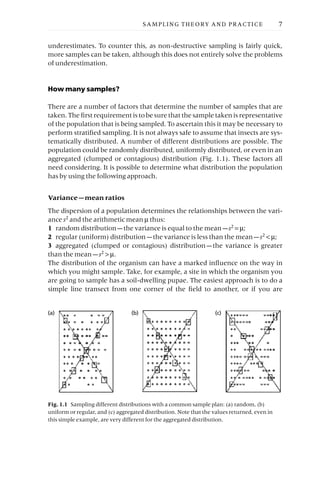
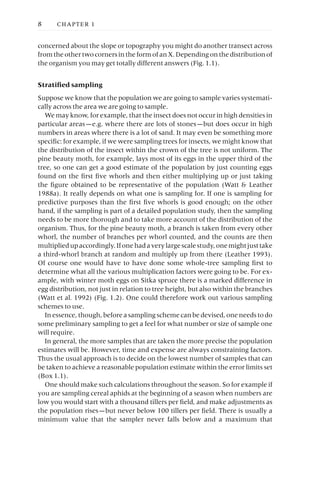
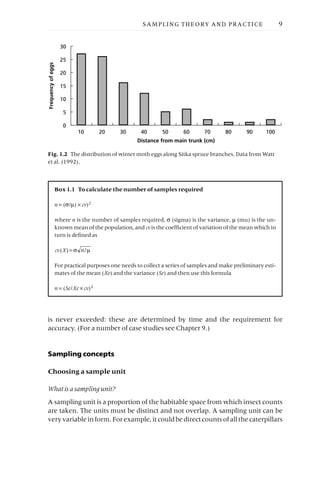
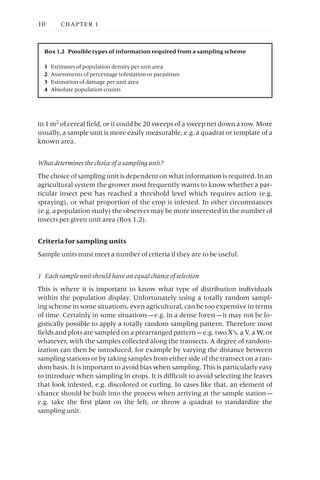
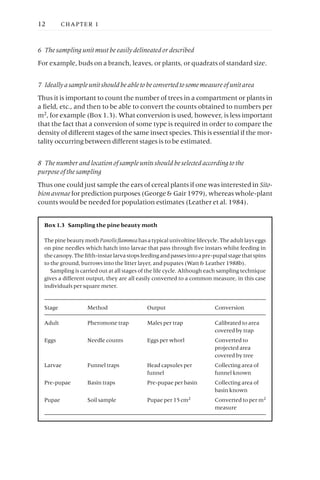

![The Collembola also have representatives which feed on roots, though the ma-
jority probably feed on microorganisms or decaying leaf litter (Hopkin 1997).
Collembola apart, the majority of insects associated with roots have a stage of
their life cycle above ground and these mobile adults can easily be used to iden-
tify the presence of subterranean stages in a particular area. A good way to start
with rhizophagous insect sampling is to understand the visible signs of their
presence, manifest in the terrestrial environment.
External clues
To determine if a species is present in a location, a variety of trapping methods
for adults can be used. Suction sampling (e.g. Arnold 1994) can be particularly
effective, but a number of species have nocturnal adults. Many of these seem to
be attracted to light, and mercury vapor (MV) light traps have been used to
monitor adult numbers of chafer grubs (Coleoptera: Scarabaeidae) near
pastures (Roberts et al. 1982b). Interestingly, adults of the wingless black vine
weevil Otiorhynchus sulcatus are also attracted to light, but generally to tungsten
bulbs, rather than MV (Labuschagne 1999). Water traps have been used to
capture adults of the cabbage root fly Delia radicum (Bracken 1988), while
pheromone traps have been developed for some species (e.g. the pea and bean
weevil Sitona lineatus [Smart et al. 1994]). If the biology of the species is well
known, then emergence traps (described in Southwood & Henderson 2000)
canbeveryeffective(e.g.forS.discoideus[Goldsonetal.1988]).Somespecieson
eclosion leave characteristic evidence, and the empty emergence skins of vari-
ous cicada species have been used to estimate nymphal densities below ground
(White & Sedcole 1993). Sticky traps, with the sticky side facing downwards,
have been used to estimate numbers of grape phylloxera Daktulosphaira
vitifoliae emerging from grape rootstocks (Hawthorne & Dennehy 1991).
Adults of many species feed on foliage in a characteristic manner. A good ex-
ample of this is the leaf-notching produced by O. sulcatus and this can be used as
an excellent method of detecting the pest (Labuschagne 1999). However, the
effects of subterranean larval feeding are also often apparent, most commonly
manifest in wilting of foliar tissues, because the main effect of root removal by
larvae is the imposition of drought stress in a plant (Masters 1995). In natural
plant populations, individuals which show unusual drought stress or which die
forreasonsnotattributabletofoliarinsectsorpathogens(e.g.Strongetal.1995)
should be suspected of having insects attacking the roots. In some cases, inter-
nal root borers produce quantities of frass at the exterior end of their tunnels
andthiscanbevisibleatorjustbelowthesoilsurface.Maron(1998)givesanex-
ample with ghost moth Hepialuscalifornicus, where frass can be easily seen at the
base of infested bush lupine plants.
Subterranean aphids often live in close proximity to ant colonies and a num-
ber of species live entirely within the nest of the ants. In grassland systems, one
SAMPLING INSECTS FROM ROOTS 17](https://image.slidesharecdn.com/49818-250510053000-6dc7c7c1/85/Insect-Sampling-in-Forest-Ecosystems-Simon-R-Leather-33-320.jpg)