UNIT I
03 :OBJECTIVES ,
CHARACTERISTICS ,
CONCEPTAND
PHILOSOPHYOF
NURSING
KRISHNA PATEL
OBJECTIVES OF NURSING.
• To prepare nurses who will give expert bedside nursing care in the
hospital and community.
• To provide integration of health and social aspect of theory and
practice in generalized public health nursing.
• To provide an adequate, sound scientific foundation to understand
the functioning of body and mind in health and disease.
• To prepare nurses who will be able to work cooperatively with
team members.
• To provide opportunities through curricular and extracurricular
activities for full development of personality of each individual
student.
CHARACTERISTICS OF NURSING.
• Nursing is caring.
• Nursing involves close personal contact with the recipient of care.
• Nursing is concerned with services that take humans into account
as physiological, psychological, and sociological organisms.
• Nursing is committed to promoting individual, family, community,
and national health goals in its best manner possible.
• Nursing is committed to personalized services for all persons
without regard to color, creed, social or economic status.
• Nursing is committed to involvement in ethical, legal, and
political issues in the delivery of health care.
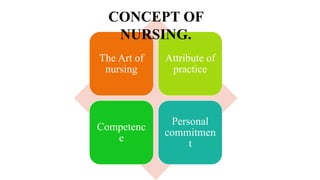
The Art of
nursing
Attribute of
practice
Competenc
e
Personal
commitmen
t
CONCEPT OF
NURSING.
1.THE ART OF NURSING:
A holistic, client-centered focus; being caring and
ethical in interactions with patients, families, and
colleagues
having above-average interpersonal skills; and
making sound judgments based on experience and
knowledge, thus averting (prevent) potential
problems.
2.COMPETENCE:
Professional practice demands competence in
relation to knowledge and technical skills.
This requires not only a broad base of knowledge,
but also depth of knowledge in a chosen area of
practice, a desire and ability to continue developing
that knowledge base and to share it with others and
critical thinking in decision-making.
3.ATTRIBUTES OF PRACTICE:
Professional nursing practice means working in
partnership with other nurses and health
professionals in providing client care, being highly
organized in managing activities and time, having
the ability to manage many complex tasks
simultaneously, working autonomously as
appropriate and having an open mind and
nonjudgmental manner.
4.PERSONAL COMMITMENT
having confidence in one's abilities and taking
responsibility for one's actions, including having a
sound understanding of the boundaries and
limitations of nursing practice.
Having a balanced lifestyle and supporting the
advancement of the profession were also considered
important characteristics of a professional nurse.
NURSING PHILOSOPHY
A philosophy of nursing is a statement, sometimes written, that
declares a nurse's beliefs, values, and ethics regarding their
care and treatment of patients while they are in the nursing
profession.
The philosophy of the nursing profession is defined by four basic
concepts. The nursing profession is built upon four key concepts-
person, environment, health and nursing.
The four concepts are interrelated and each is built upon the
1. Person:
In nursing theory, human beings are considered in terms of their
physiological, psychological, social, spiritual and cultural selves.
People are evaluated in terms of their individual place in society
as well as their relationships to their family, community and
society as a whole.
Additionally, human beings are viewed in terms of their
individual needs and how nursing practice is applied to meet
these needs.
The purpose of nursing and nursing theory is to identify how a
2. Environment:
The environment concept of nursing comprises all the internal
and external factors that act on human beings and affect their
behavior and development.
This includes psychological, spiritual, social, physical and
cultural forces as well as the environment in which nursing care
is provided.
The idea behind this concept is that the environment influences
individual and collective health and that individuals who
3. Health:
The concept of health refers to an individual's physical, mental
and social well-being and at what point they are on the health
spectrum, which ranges from good health to poor health or death.
Health is considered to be affected by genetic factors,
environmental factors, lifestyle factors and external mechanisms
such as bacteria.
a person's place on the health spectrum is constantly changing
and in a nursing context, it's the responsibility of nursing
4. Nursing:
Nursing refers to the process of caring for the health of human
beings and assisting individuals in meeting their needs while also
teaching them the basics of caring for themselves.
The responsibilities of the nursing profession are to promote good
health, to prevent disease when possible, to promote healing in
those who are ill and to ease the suffering of dying patients. The
concept of nursing extends beyond the healthcare facility to the
community and society as a whole, and views individual health
and the environment as closely related. Nursing is defined as care
that is tailored to the needs of individuals and that is provided in
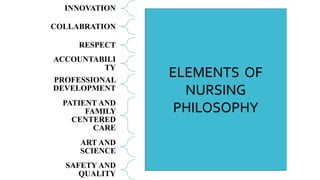
INNOVATION
COLLABRATION
RESPECT
ACCOUNTABILI
TY
PROFESSIONAL
DEVELOPMENT
PATIENT AND
FAMILY
CENTERED
CARE
ART AND
SCIENCE
SAFETY AND
QUALITY
ELEMENTS OF
NURSING
PHILOSOPHY
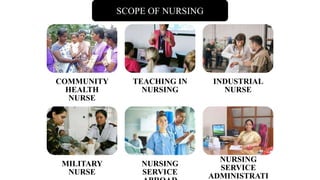
SCOPE OF NURSING
COMMUNITY
HEALTH
NURSE
TEACHING IN
NURSING
INDUSTRIAL
NURSE
MILITARY
NURSE
NURSING
SERVICE
NURSING
SERVICE
ADMINISTRATI
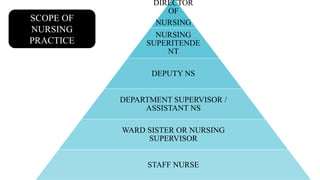
DIRECTOR
OF
NURSING
NURSING
SUPERITENDE
NT
DEPUTY NS
DEPARTMENT SUPERVISOR /
ASSISTANT NS
WARD SISTER OR NURSING
SUPERVISOR
STAFF NURSE
SCOPE OF
NURSING
PRACTICE
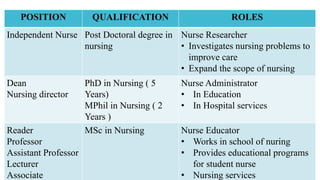
POSITION QUALIFICATION ROLES
Independent Nurse Post Doctoral degree in
nursing
Nurse Researcher
• Investigates nursing problems to
improve care
• Expand the scope of nursing
Dean
Nursing director
PhD in Nursing ( 5
Years)
MPhil in Nursing ( 2
Years )
Nurse Administrator
• In Education
• In Hospital services
Reader
Professor
Assistant Professor
Lecturer
Associate
MSc in Nursing Nurse Educator
• Works in school of nuring
• Provides educational programs
for student nurse
• Nursing services
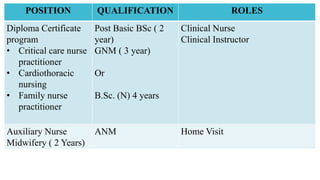
POSITION QUALIFICATION ROLES
Diploma Certificate
program
• Critical care nurse
practitioner
• Cardiothoracic
nursing
• Family nurse
practitioner
Post Basic BSc ( 2
year)
GNM ( 3 year)
Or
B.Sc. (N) 4 years
Clinical Nurse
Clinical Instructor
Auxiliary Nurse
Midwifery ( 2 Years)
ANM Home Visit
CATEGORIESOF
NURSING PERSONNEL
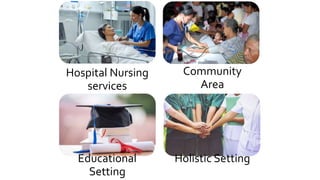
Hospital Nursing
services
Community
Area
Educational
Setting
Holistic Setting
Nursing Director
• Formation of the aims and the objectives policies
of the new nursing services
• Staffing based on the nursing requirement
according to the accepted standards of the medical
standards
• Planning and directing the nursing care
• Coordinating the interdepartmental activities
• Maintaining the supplies and the equipment
• Budgeting
Chief Nursing Officer
• She does planning, coordination, supervision, controlling,
reporting to higher medical officer and delegating the work
schedules to other nurses.
• Follows and adapts policies, which helps to recruit, assign and
allocate the required staff at the right place and time.
• Explains the job description, supervision and delegating
responsibilities to each staff nurse.
• conducts nursing audit, does anecdotal reporting to evaluate
nursing care.
• Make all staff observes and follows code of ethics and regulation
of the hospitals.
• Has authority to terminate any nurse if she misbehaves or violates
Head Nurse
• To plan the duty roster specific to the ward,
implement PCS and allocate ward in charge to specific
wards.
• To control and coordinate the activities of the specific
wards.
• To plan all the activities done by ward in charge in
advance, delegate responsibilities and supervise the
activities in the wards.
• To conduct nursing rounds with ward in charges to
assess the problem, plan care, clarify issues, fulfill the
requirements and guide the ward in charge.
• To maintain the enrolment register of all the staff and
ward in charge, and ensure that all the staff reported
duty in time.
• To allocate the alternative staff in case of absenteeism.
• To conduct meeting with the subordinate staff, and
Ward In Charge
• Report to the head nurse for any issue.
• Plan control and supervise the activity of the
subordinates and also ensure that the staff are allocated
at required areas and provide good care to the patients.
• Ensure ward cleanliness, safety and security for all the
patients in the ward.
• Oversee the patients' conditions regularly and to care
for the concerns of doctors who take care of the
• Conduct ward rounds with staff nurse and plan her
daily activities accordingly.
• Coordinate the shift schedule, day/night off in the
coordination with the head nurse.
• Meet the healthcare needs of all patients in the ward.
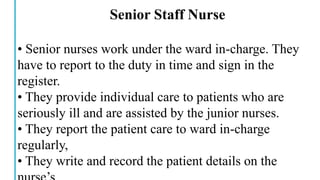
Senior Staff Nurse
• Senior nurses work under the ward in-charge. They
have to report to the duty in time and sign in the
register.
• They provide individual care to patients who are
seriously ill and are assisted by the junior nurses.
• They report the patient care to ward in-charge
regularly,
• They write and record the patient details on the
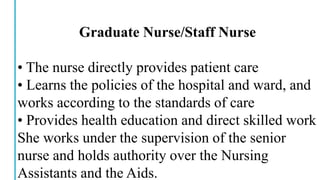
Graduate Nurse/Staff Nurse
• The nurse directly provides patient care
• Learns the policies of the hospital and ward, and
works according to the standards of care
• Provides health education and direct skilled work
She works under the supervision of the senior
nurse and holds authority over the Nursing
Assistants and the Aids.
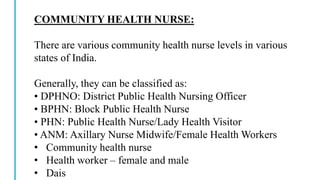
COMMUNITY HEALTH NURSE:
There are various community health nurse levels in various
states of India.
Generally, they can be classified as:
• DPHNO: District Public Health Nursing Officer
• BPHN: Block Public Health Nurse
• PHN: Public Health Nurse/Lady Health Visitor
• ANM: Axillary Nurse Midwife/Female Health Workers
• Community health nurse
• Health worker – female and male
• Dais
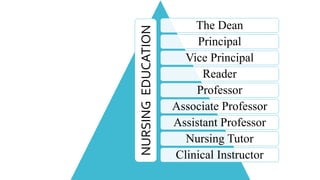
The Dean
Principal
Vice Principal
Reader
Professor
Associate Professor
Assistant Professor
Nursing Tutor
Clinical Instructor
NURSING
EDUCATION
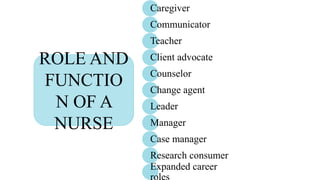
Caregiver
Communicator
Teacher
Client advocate
Counselor
Change agent
Leader
Manager
Case manager
Research consumer
Expanded career
ROLE AND
FUNCTIO
N OF A
NURSE
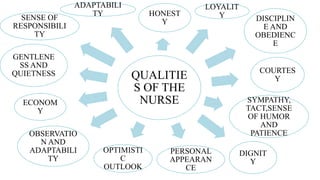
QUALITIE
S OF THE
NURSE
HONEST
Y
LOYALIT
Y DISCIPLIN
E AND
OBEDIENC
E
COURTES
Y
DIGNIT
Y
PERSONAL
APPEARAN
CE
SYMPATHY,
TACT,SENSE
OF HUMOR
AND
PATIENCE
OPTIMISTI
C
OUTLOOK
OBSERVATIO
N AND
ADAPTABILI
TY
ECONOM
Y
GENTLENE
SS AND
QUIETNESS
SENSE OF
RESPONSIBILI
TY
ADAPTABILI
TY
NURSINGASA
PROFESSION
A profession is defined as an occupation
with
ethical components, that is devoted to the
promotion of human and social welfare.
Profession has been defined as that requires extensive
education or a calling that requires special knowledge,
skill and preparation.
Professional nurse is a health worker, a graduate from a
recognized school who is identified by law as a
CRITERIA FOR PROFESSION
Specialized education is an important aspect of professional
status. In modern times, the trend in education for the
professions has shifted towards programs in colleges and
universities.
1. Body of knowledge: As a profession, nursing is
establishing a well-defined body of knowledge and
expertise. A number of nursing conceptual frameworks
contribute to the knowledge base of nursing and give
direction to nursing practice, education and ongoing
CRITERIA FOR PROFESSION
2. Service orientation: Nursing as a tradition of service to
others. This service, however, must be guided by certain
rules, policies or codes of ethics. Today, nursing is also an
important component of the healthcare delivery system.
3. Ongoing research: Since the 1970's nursing research has
focused on practice related issues. Increasing research in
nursing is contributing to nursing practice. Nursing research
as a dimension of the nurse's role directed to nursing
education and practice.
CRITERIA FOR PROFESSION
4. Code of ethics: Ethical code change as the needs and
values of society change. Nursing has developed its own
codes of ethics and in most instances has set up means to
monitor the professional behaviors of its members.
CRITERIA FOR PROFESSION
5. Autonomy:
A profession is autonomous, if it regulates itself and sets
standards for its members. Providing autonomy is one of
the purposes of a professional association. To be
autonomous, a professional group must be granted legal
authority to define the scope of its practice, describe its
particular functions and roles and determine its goals and
responsibilities in delivery of its services.
CHARACTERISTICS OF NURSE.
• Good physical and mental health.
• Truthful and efficient in technical competence.
• Cleanliness, tidy, neat and well groomed.
• Confidence in others and itself.
• Intelligence.
• Open minded, cooperative, responsible, able to develop good
interpersonal relations.
• Leadership quality.
• Positive attitudes.
• Self-belief towards human care and cure.
• Convey cooperative attitudes towards co-worker.
• Responsible towards family and society.
BASIC NURSING PRINCIPLES
The principles describe what constitutes safe and
effective nursing care, and cover the aspects of behaviour,
attitude and approach that improve good care.
1. Safety: It is the protection to hazards to patients and
members of the health team from the possible mechanical,
chemical, thermal, bacteriological and psychological
injuries.
2. Therapeutic effectiveness: It is the result of the work,
BASIC NURSING PRINCIPLES
3.Comfort: Every nursing procedure is aimed for the
comfort of the patient. It should give the satisfaction to the
patient, relatives, and nurse on completion of the work.
4.Use of resources: The use of time energy and material
should be economic. A procedure should not be cancelled
due to the want of one or two items required if they are not
extremely essential. In such situations adjustment can be
done by improving materials with the available resources.
5. Good workmanship: It is the skill in doing
procedures. There is great difference, in doing things by
a fresh hand and an experienced hand. Such skills or
the art of doing procedure are developed only by doing
the same repeatedly. Nursing is learning by doing and
not merely by reading.
6. Individuality: The likes and dislikes are different
persons. So when we are planning nursing care to a
person, his needs are to be anticipated and problems are
to be identified and feelings are to be considered.
PRINCIPLES OF NURSING PRACTICE
• Nurses and nursing staff treat everyone in their care with
dignity and humanity-they understand their individual
needs, show compassion and sensitivity, and provide care in
a way that respects all people equally.
• Nurses and nursing staff take responsibility for the care they
provide and answer for their own judgments and actions.
They carry out these actions in a way that is agreed with
their patients, and the families and carers of their patients,
and in a way that meets the requirements of their
professional bodies and the law.
• Nurses and nursing staff provide and promote care that
puts people at the center, involves patients, service users,
their families and their carers in decisions and helps them
make informed choices about their treatment and care.
• Nurses and nursing staff are at the heart of the
communication process: They assess, record and report on
treatment and care, handle information sensitively and
confidentially, deal with complaints effectively, and are
conscientious in reporting the things they are concerned
about.
• Nurses and nursing staff have up-to-date knowledge and
skills, and use these with intelligence, insight and
understanding in line with the needs of each individual in
their care.
• Nurses and nursing staff work closely with their own team
and with other professionals, making sure patients' care and
treatment is co-ordinated, is of a high standard and has the
best possible outcome.
• Nurses and nursing staff lead by example, develop
themselves and other staff, and influence the way care is
NURSING IS
ARTAND
SCIENCE
What is an Art;
Composed of skills that require expertise for their
competent education.
It is the creative use of knowledge in service to others.
Originally nursing considered as an ‘art’. Called ‘born
nurses’ (natural / untaught). Art improved by practice.
Need little education as nurses only carry out doctors
orders.
What is a Science?
It requires systemized knowledge derived from observation,
critical thinking, study and research.
Nursing as a ‘Science’…Gradually, as the body of scientific
knowledge grew, nurses aware of the basic principles for
practice.
Nursing borrowed its ‘science’ from other disciplines.
What was unique to nursing? – Leeds to develop nursing
The art has long been accepted. The science has
been recognized recently. Hence nursing is both a
science and an art.
“the science of nursing is the knowledge base for
the care that is given, and the art of nursing is the
skilled application of that knowledge to help others
achieve maximum health and quality of life”
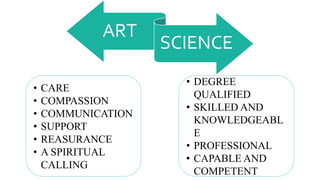
ART
SCIENCE
• CARE
• COMPASSION
• COMMUNICATION
• SUPPORT
• REASURANCE
• A SPIRITUAL
CALLING
• DEGREE
QUALIFIED
• SKILLED AND
KNOWLEDGEABL
E
• PROFESSIONAL
• CAPABLE AND
COMPETENT
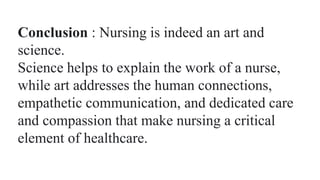
Conclusion : Nursing is indeed an art and
science.
Science helps to explain the work of a nurse,
while art addresses the human connections,
empathetic communication, and dedicated care
and compassion that make nursing a critical
element of healthcare.