SEMINAR
ON
Independent
practice
issues in nursing
and independent
nurse midwifery
practitioner
Outlines
Independent practice
issues
• Introduction
• Definition of
independent
practitioners
• Key issues
• Areas of independent
nursing practice
• Responsibility of
independent nursing
practitioner
Independent nurse
midwifery practitioner
• Introduction
• Definition of midwife
• Independent midwifery
practice packages.
• Standards for midwifery
practices.
• Challenges for Indian
midwives.
Introduction
Definition
• NURSE PRACTIONERS
Nurse practitioners (NPs) are registered
nurses who have graduate level nursing
preparation as a nurse practitioner at the
master’s or doctoral level and perform
comprehensive assessments and promote
health and the prevention of illness and injury.
KEY ISSUES TO CONSIDER -
PROFESSIONAL ISSUES
1. Conflict of interest
2. Endorsement
3. Advertising
4. Fees
5. Informed consent
Contiiii……
1. Documentation
2. Confidentiality
3. Other issues
 Liability protection
 Networking
 Business or legal council
AREAS OF INDEPENDENT NURSING
PRACTICE
• CONSULTANCY
• GERIATRIC NURSING
• MEDICAL SURGICAL NURSING PRACTICE
• PAEDIATRIC NURSING
• PSYCHIATRIC NURSING
• Women Health Nursing
• School Health Nursing
RESPONSIBILITY OF A INDEPENDENT
NURSE PRACTIONER
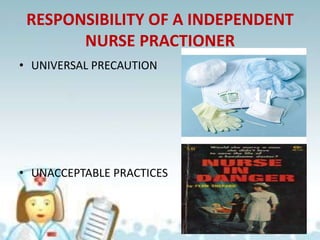
• UNIVERSAL PRECAUTION
• UNACCEPTABLE PRACTICES
• VERIFYING RECIPIENT
ELIGIBILITY
• PRIVATE DUTY NURSING
REQUIREMENTS
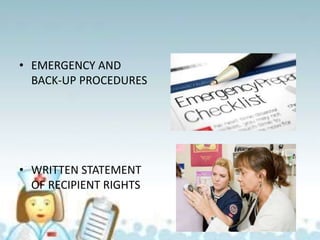
• EMERGENCY AND
BACK-UP PROCEDURES
• WRITTEN STATEMENT
OF RECIPIENT RIGHTS
• CONTRACTS WITH
RECIPIENT AND/OR
FAMILY
• REQUIRED
INFORMATION FOR
MEDICAL RECORD
• TERMINATING SERVICE
TO A RECIPIENT
Independent nurse
midwifery
practitioner
Independent midwifery practice
package
• Access to a midwife 24 hours a day, 7 days a
week.
• Provide women centered care antenatal,
intrapartum and postnatal midwifery care.
• Antenatal care in privacy.
• Continuity of care through the labour.
• Postnatal care up to 6 weeks.
• Knowledgeable breastfeeding support.
Standards for midwifery practice
STANDARD I
• Midwifery care is provided by qualified
practitioners
STANDARD II
• Midwifery care occurs in a safe environment
within the context of the family, community,
and a system of health care.
STANDARD III
• Midwifery care supports individual rights and
self-determination within boundaries of
safety
STANDARD IV
• Midwifery care is comprised of knowledge,
skills, and judgments that foster the delivery
of safe, satisfying, and culturally competent
care.
STANDARD V
• Midwifery care is based upon knowledge,
skills, and judgments which are reflected in
written practice guidelines and are used to
guide the scope of midwifery care and
services provided to clients.
STANDARD VI
• Midwifery care is documented in a format
that is accessible and complete.
STANDARD VII
• Midwifery care is evaluated according to an
established program for quality management
that includes a plan to identify and resolve
problems.
STANDARD VIII
• Midwifery practice may be expanded beyond
the ACNM core competencies to incorporate
new procedures that improve care for
women and their families.
Challenges for Indian midwives
Practice challenges
• Midwives should be recognized as independent
practitioners with the rights and responsibilities
regarding scope of practice. Authority and
accountability that all independent by share.
• Health organization should use to allow quality
and standard based midwifery care.
• Midwife should ensure case consultation,
collaboration and referral provided to a woman
without interruption and for overall benefits.
Challenges for law regulation
• State regulators should enact laws which are
based on entry to practice standards on
successful completion of midwifery educational
programme.
• Health care system should develop privileging
and credentializing mechanisms for midwives
that are consistent with professional standards,
recognize established process that permits
midwives to build upon competencies within
their statutory scope of practice.
Educational challenge
• Direct entry midwife programme to create a
new category of professional midwife.
• The midwifery profession should identify,
develop and implement mechanism to recruit
midwives who reflect Indian population with
their competencies.
• It is needed to develop categories of midwives
as per their expertise in their midwifery.
Challenges for research activities
• It is required to continually grow and evolve in
order to provide evidence based midwifery
practice which will help to practice
independently.
• Analysis of midwifery practice in view of
consumers or women who receive care.
Challenges for policy makers
• Some of the most pressing issue regarding
midwifery go beyond the current scope of
regulatory bodies, professional associations,
educators and practitioners.
• Policy makers are to be convinced for the
importance of independent practice.
• Research efforts have found the midwifery
makes a positive contribution to the health of
the women and babies.
References
• Basher P. Shabeer, Khan Yasheen S. “A concise text book of advanced nursing
practice”, EMMESS Medical Publishers, first edition 2012, page no. 694-698.
• Kozier B, Erb G, Barman A, Synder AJ. Fundaments of Nursing, concepts, process
and practice, edition 7 2001.
• Potter Perry;S, fundaments of nursing by Jackie crisp, patricia ann potter, 2nd
edition, Annegriffin perry page no. 143-155.
• World Health Organization (2001) Health and human rights publication series,
WHO press, geneva available: www.who.int accessed 19 march 2008.
• A.A.C. Title 9, Chapter 10, Article 8: Hospices; Inpatient Hospice Services. (2003).
Arizona
• AAFP. (2008). Guidelines on the Supervision of Certified Nurse Midwives, Nurse
Practitioners and Physician Assistants. Retrieved March 5, 2009, from American
Academy of Family
• PhysiciansPolicyandAdvocacy:http://www.aafp.org/online/en/home/policy/policie
s/n/nonphysicianproviders.html American Association of Colleges of Nursing.
(2004). AACN Position Statement on the Practice
• www.Wikipedia .com
• www.scribd.com
• currentnursing.com
• www.google.com

Independentpracticeissuesinnursing 111115105545-phpapp01

  • 1.
    SEMINAR ON Independent practice issues in nursing andindependent nurse midwifery practitioner
  • 3.
    Outlines Independent practice issues • Introduction •Definition of independent practitioners • Key issues • Areas of independent nursing practice • Responsibility of independent nursing practitioner Independent nurse midwifery practitioner • Introduction • Definition of midwife • Independent midwifery practice packages. • Standards for midwifery practices. • Challenges for Indian midwives.
  • 4.
  • 5.
    Definition • NURSE PRACTIONERS Nursepractitioners (NPs) are registered nurses who have graduate level nursing preparation as a nurse practitioner at the master’s or doctoral level and perform comprehensive assessments and promote health and the prevention of illness and injury.
  • 6.
    KEY ISSUES TOCONSIDER - PROFESSIONAL ISSUES 1. Conflict of interest 2. Endorsement 3. Advertising 4. Fees 5. Informed consent
  • 7.
    Contiiii…… 1. Documentation 2. Confidentiality 3.Other issues  Liability protection  Networking  Business or legal council
  • 8.
    AREAS OF INDEPENDENTNURSING PRACTICE • CONSULTANCY • GERIATRIC NURSING • MEDICAL SURGICAL NURSING PRACTICE • PAEDIATRIC NURSING • PSYCHIATRIC NURSING • Women Health Nursing • School Health Nursing
  • 9.
    RESPONSIBILITY OF AINDEPENDENT NURSE PRACTIONER • UNIVERSAL PRECAUTION • UNACCEPTABLE PRACTICES
  • 10.
    • VERIFYING RECIPIENT ELIGIBILITY •PRIVATE DUTY NURSING REQUIREMENTS
  • 11.
    • EMERGENCY AND BACK-UPPROCEDURES • WRITTEN STATEMENT OF RECIPIENT RIGHTS
  • 12.
    • CONTRACTS WITH RECIPIENTAND/OR FAMILY • REQUIRED INFORMATION FOR MEDICAL RECORD • TERMINATING SERVICE TO A RECIPIENT
  • 13.
  • 14.
    Independent midwifery practice package •Access to a midwife 24 hours a day, 7 days a week. • Provide women centered care antenatal, intrapartum and postnatal midwifery care. • Antenatal care in privacy.
  • 15.
    • Continuity ofcare through the labour. • Postnatal care up to 6 weeks. • Knowledgeable breastfeeding support.
  • 16.
    Standards for midwiferypractice STANDARD I • Midwifery care is provided by qualified practitioners
  • 17.
    STANDARD II • Midwiferycare occurs in a safe environment within the context of the family, community, and a system of health care.
  • 18.
    STANDARD III • Midwiferycare supports individual rights and self-determination within boundaries of safety
  • 19.
    STANDARD IV • Midwiferycare is comprised of knowledge, skills, and judgments that foster the delivery of safe, satisfying, and culturally competent care.
  • 20.
    STANDARD V • Midwiferycare is based upon knowledge, skills, and judgments which are reflected in written practice guidelines and are used to guide the scope of midwifery care and services provided to clients.
  • 21.
    STANDARD VI • Midwiferycare is documented in a format that is accessible and complete.
  • 22.
    STANDARD VII • Midwiferycare is evaluated according to an established program for quality management that includes a plan to identify and resolve problems.
  • 23.
    STANDARD VIII • Midwiferypractice may be expanded beyond the ACNM core competencies to incorporate new procedures that improve care for women and their families.
  • 24.
  • 25.
    Practice challenges • Midwivesshould be recognized as independent practitioners with the rights and responsibilities regarding scope of practice. Authority and accountability that all independent by share. • Health organization should use to allow quality and standard based midwifery care. • Midwife should ensure case consultation, collaboration and referral provided to a woman without interruption and for overall benefits.
  • 26.
    Challenges for lawregulation • State regulators should enact laws which are based on entry to practice standards on successful completion of midwifery educational programme. • Health care system should develop privileging and credentializing mechanisms for midwives that are consistent with professional standards, recognize established process that permits midwives to build upon competencies within their statutory scope of practice.
  • 27.
    Educational challenge • Directentry midwife programme to create a new category of professional midwife. • The midwifery profession should identify, develop and implement mechanism to recruit midwives who reflect Indian population with their competencies. • It is needed to develop categories of midwives as per their expertise in their midwifery.
  • 28.
    Challenges for researchactivities • It is required to continually grow and evolve in order to provide evidence based midwifery practice which will help to practice independently. • Analysis of midwifery practice in view of consumers or women who receive care.
  • 29.
    Challenges for policymakers • Some of the most pressing issue regarding midwifery go beyond the current scope of regulatory bodies, professional associations, educators and practitioners. • Policy makers are to be convinced for the importance of independent practice. • Research efforts have found the midwifery makes a positive contribution to the health of the women and babies.
  • 31.
    References • Basher P.Shabeer, Khan Yasheen S. “A concise text book of advanced nursing practice”, EMMESS Medical Publishers, first edition 2012, page no. 694-698. • Kozier B, Erb G, Barman A, Synder AJ. Fundaments of Nursing, concepts, process and practice, edition 7 2001. • Potter Perry;S, fundaments of nursing by Jackie crisp, patricia ann potter, 2nd edition, Annegriffin perry page no. 143-155. • World Health Organization (2001) Health and human rights publication series, WHO press, geneva available: www.who.int accessed 19 march 2008. • A.A.C. Title 9, Chapter 10, Article 8: Hospices; Inpatient Hospice Services. (2003). Arizona • AAFP. (2008). Guidelines on the Supervision of Certified Nurse Midwives, Nurse Practitioners and Physician Assistants. Retrieved March 5, 2009, from American Academy of Family • PhysiciansPolicyandAdvocacy:http://www.aafp.org/online/en/home/policy/policie s/n/nonphysicianproviders.html American Association of Colleges of Nursing. (2004). AACN Position Statement on the Practice • www.Wikipedia .com • www.scribd.com • currentnursing.com • www.google.com