

Term Sheets – Legal Issues
Indian Institute of Management - Bangalore,
March 7, 2015
NEELA BADAMI
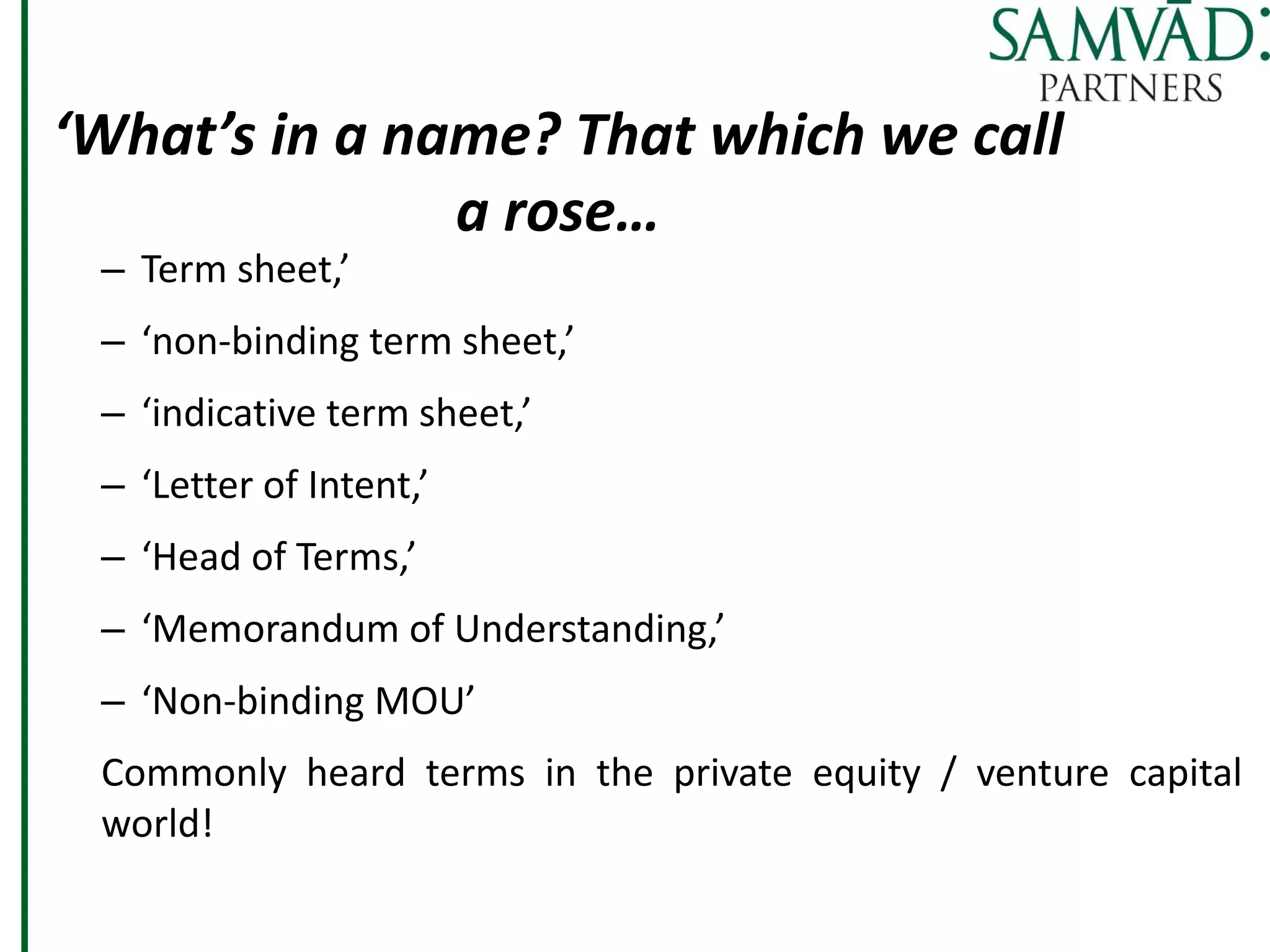
‘What’s in a name? That which we call
a rose…
– Term sheet,’
– ‘non-binding term sheet,’
– ‘indicative term sheet,’
– ‘Letter of Intent,’
– ‘Head of Terms,’
– ‘Memorandum of Understanding,’
– ‘Non-binding MOU’
Commonly heard terms in the private equity / venture capital
world!
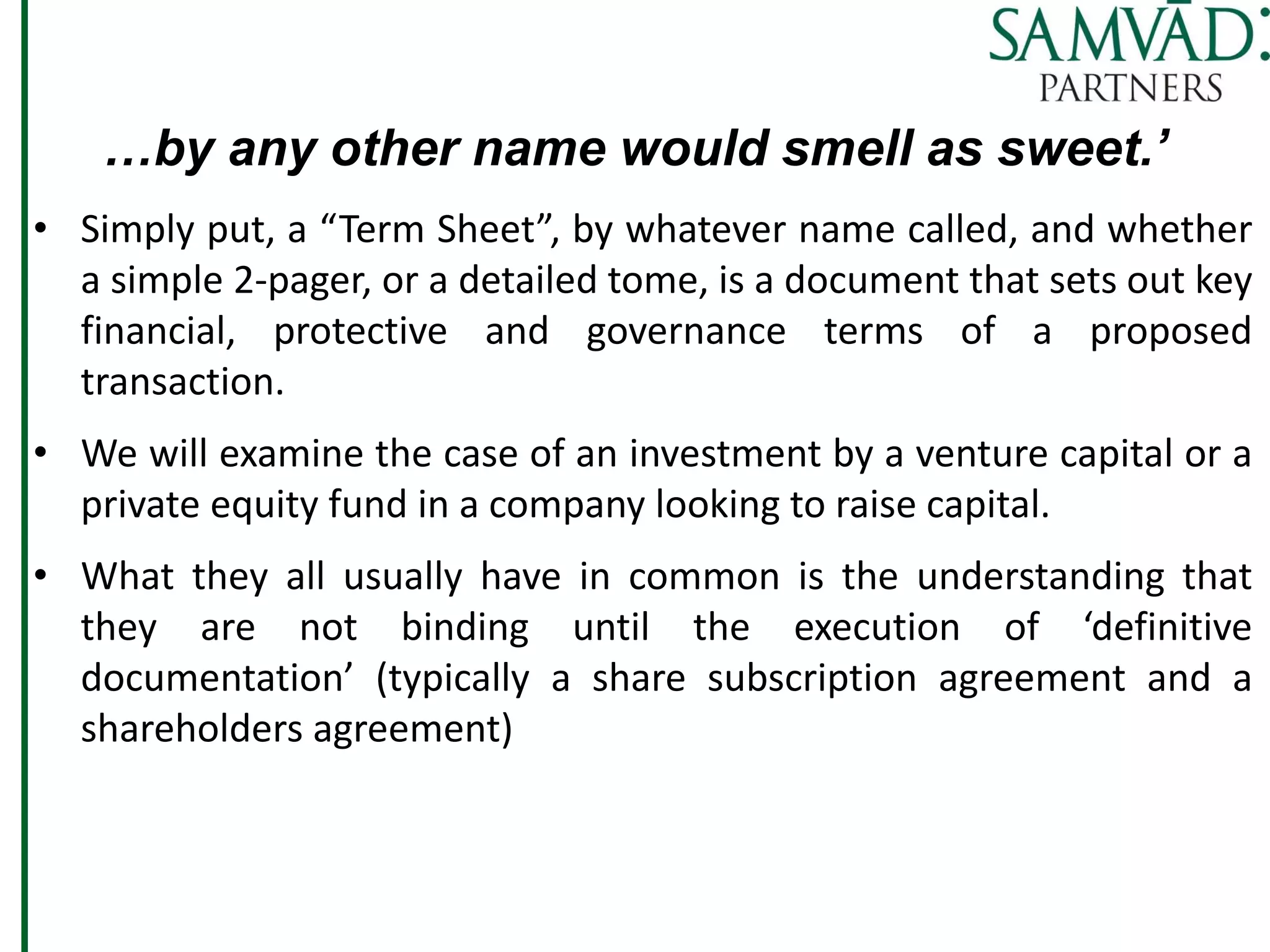
…by any other name would smell as sweet.’
• Simply put, a “Term Sheet”, by whatever name called, and whether
a simple 2-pager, or a detailed tome, is a document that sets out key
financial, protective and governance terms of a proposed
transaction.
• We will examine the case of an investment by a venture capital or a
private equity fund in a company looking to raise capital.
• What they all usually have in common is the understanding that
they are not binding until the execution of ‘definitive
documentation’ (typically a share subscription agreement and a
shareholders agreement)
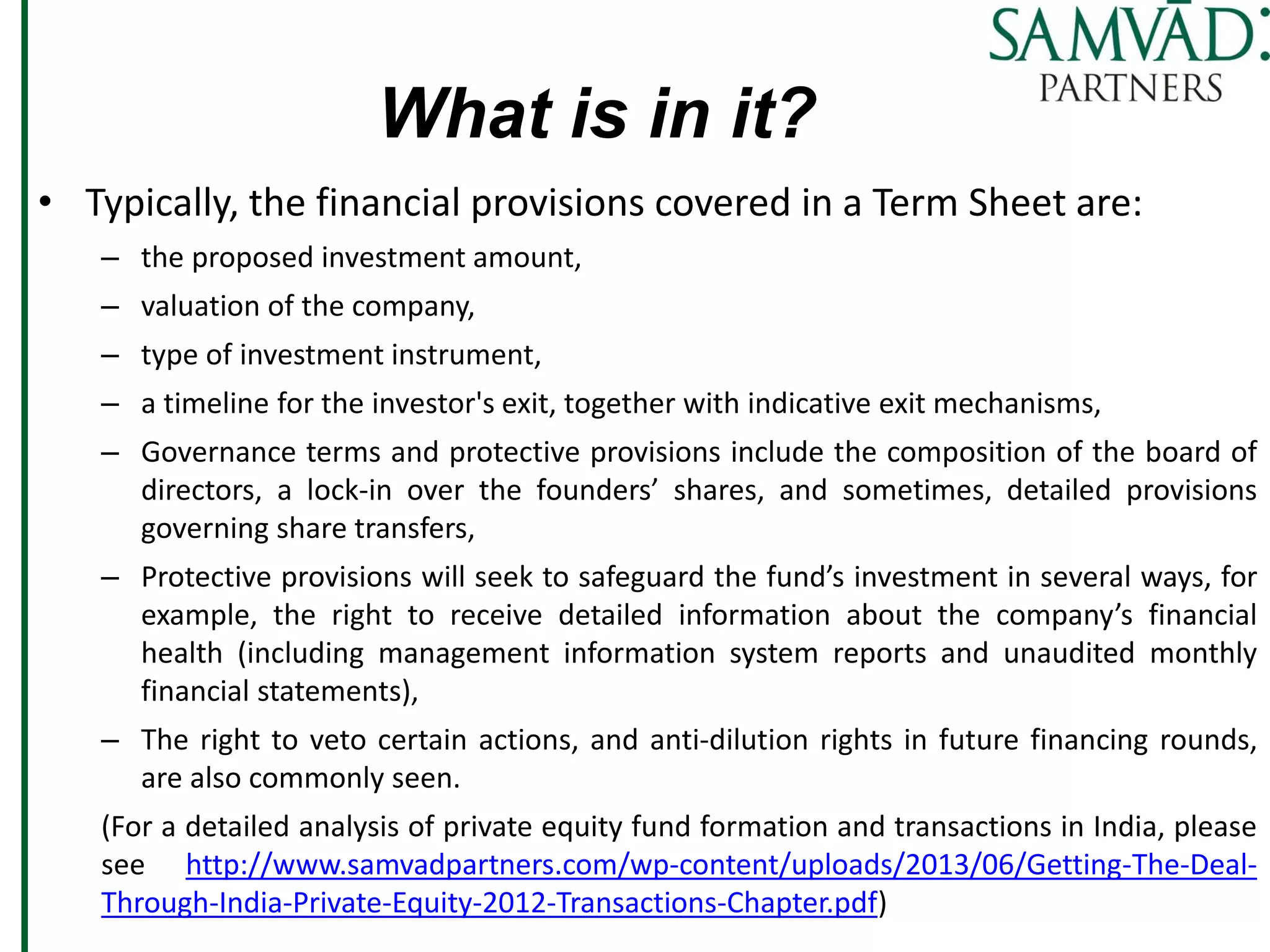
What is in it?
• Typically, the financial provisions covered in a Term Sheet are:
– the proposed investment amount,
– valuation of the company,
– type of investment instrument,
– a timeline for the investor's exit, together with indicative exit mechanisms,
– Governance terms and protective provisions include the composition of the board of
directors, a lock-in over the founders’ shares, and sometimes, detailed provisions
governing share transfers,
– Protective provisions will seek to safeguard the fund’s investment in several ways, for
example, the right to receive detailed information about the company’s financial
health (including management information system reports and unaudited monthly
financial statements),
– The right to veto certain actions, and anti-dilution rights in future financing rounds,
are also commonly seen.
(For a detailed analysis of private equity fund formation and transactions in India, please
see http://www.samvadpartners.com/wp-content/uploads/2013/06/Getting-The-Deal-
Through-India-Private-Equity-2012-Transactions-Chapter.pdf)
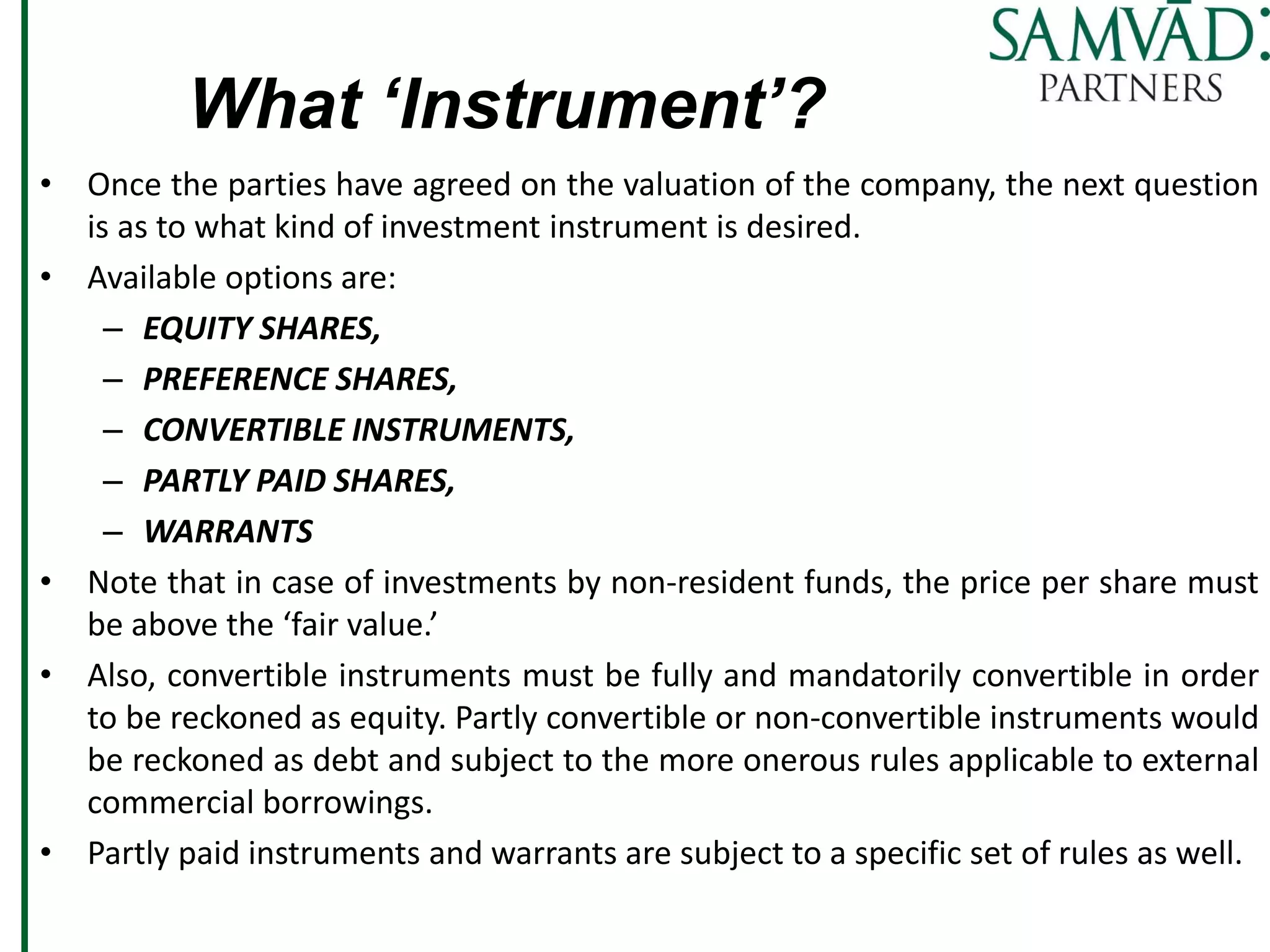
What ‘Instrument’?
• Once the parties have agreed on the valuation of the company, the next question
is as to what kind of investment instrument is desired.
• Available options are:
– EQUITY SHARES,
– PREFERENCE SHARES,
– CONVERTIBLE INSTRUMENTS,
– PARTLY PAID SHARES,
– WARRANTS
• Note that in case of investments by non-resident funds, the price per share must
be above the ‘fair value.’
• Also, convertible instruments must be fully and mandatorily convertible in order
to be reckoned as equity. Partly convertible or non-convertible instruments would
be reckoned as debt and subject to the more onerous rules applicable to external
commercial borrowings.
• Partly paid instruments and warrants are subject to a specific set of rules as well.
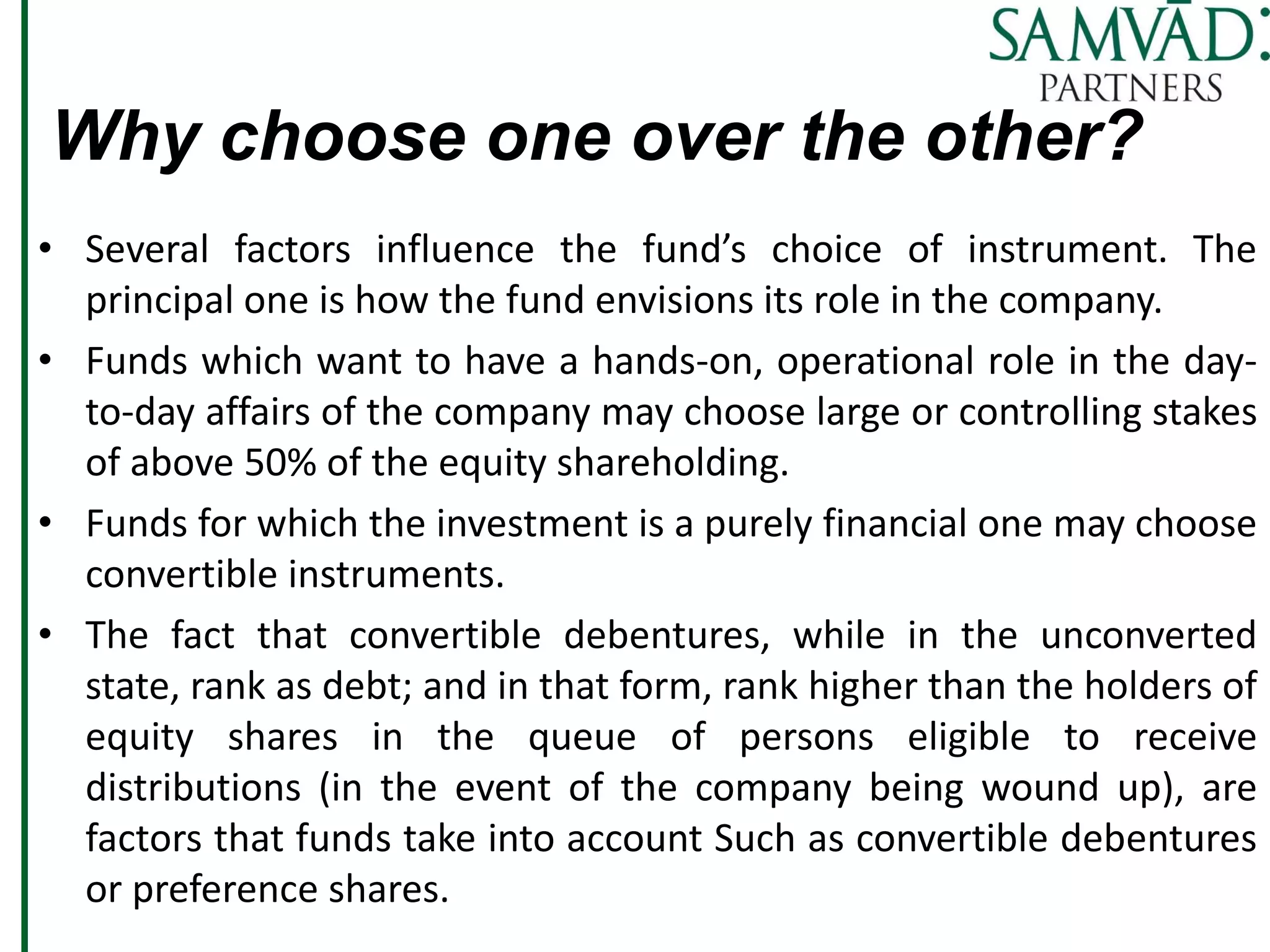
Why choose one over the other?
• Several factors influence the fund’s choice of instrument. The
principal one is how the fund envisions its role in the company.
• Funds which want to have a hands-on, operational role in the day-
to-day affairs of the company may choose large or controlling stakes
of above 50% of the equity shareholding.
• Funds for which the investment is a purely financial one may choose
convertible instruments.
• The fact that convertible debentures, while in the unconverted
state, rank as debt; and in that form, rank higher than the holders of
equity shares in the queue of persons eligible to receive
distributions (in the event of the company being wound up), are
factors that funds take into account Such as convertible debentures
or preference shares.
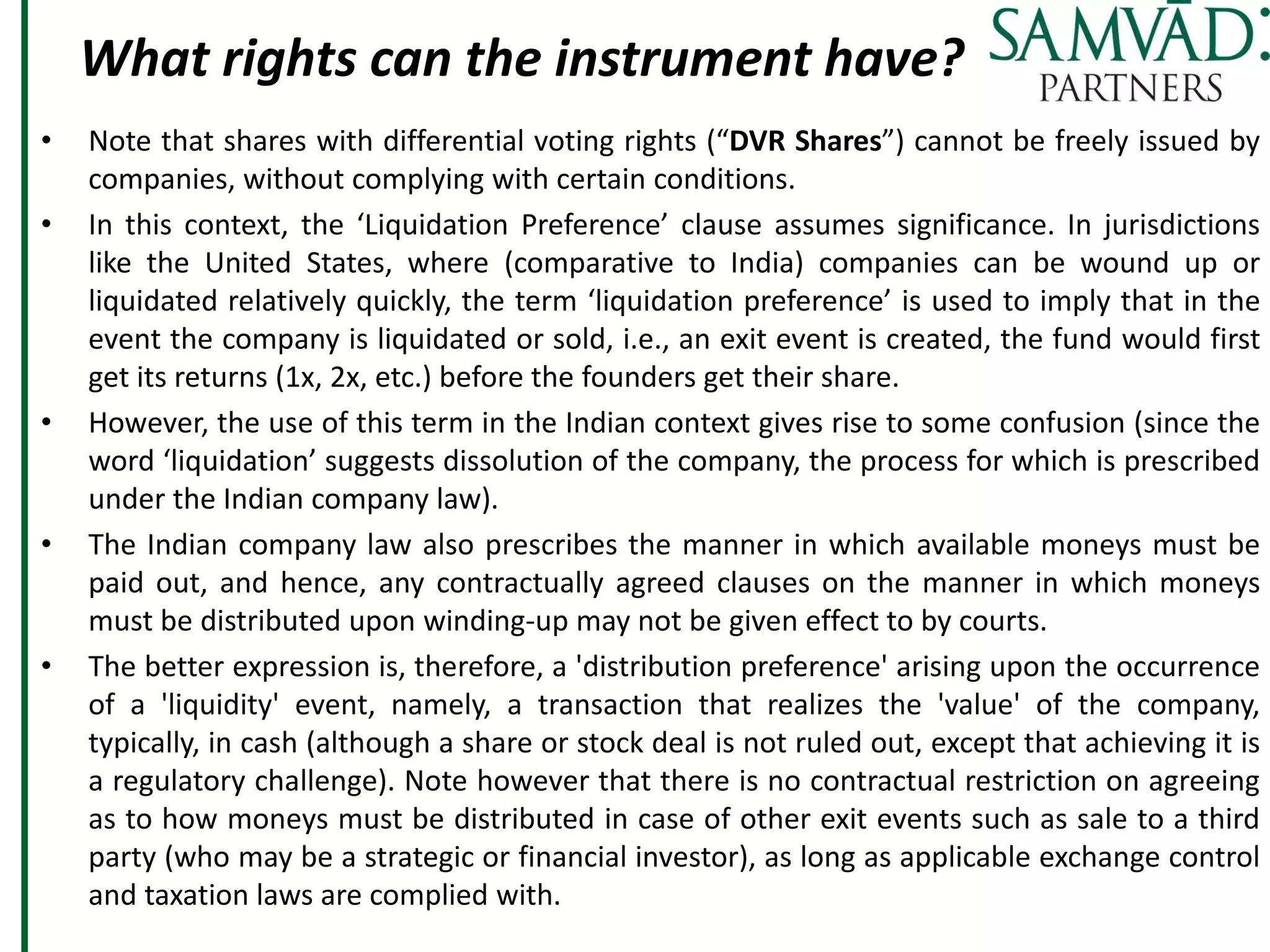
What rights can the instrument have?
• Note that shares with differential voting rights (“DVR Shares”) cannot be freely issued by
companies, without complying with certain conditions.
• In this context, the ‘Liquidation Preference’ clause assumes significance. In jurisdictions
like the United States, where (comparative to India) companies can be wound up or
liquidated relatively quickly, the term ‘liquidation preference’ is used to imply that in the
event the company is liquidated or sold, i.e., an exit event is created, the fund would first
get its returns (1x, 2x, etc.) before the founders get their share.
• However, the use of this term in the Indian context gives rise to some confusion (since the
word ‘liquidation’ suggests dissolution of the company, the process for which is prescribed
under the Indian company law).
• The Indian company law also prescribes the manner in which available moneys must be
paid out, and hence, any contractually agreed clauses on the manner in which moneys
must be distributed upon winding-up may not be given effect to by courts.
• The better expression is, therefore, a 'distribution preference' arising upon the occurrence
of a 'liquidity' event, namely, a transaction that realizes the 'value' of the company,
typically, in cash (although a share or stock deal is not ruled out, except that achieving it is
a regulatory challenge). Note however that there is no contractual restriction on agreeing
as to how moneys must be distributed in case of other exit events such as sale to a third
party (who may be a strategic or financial investor), as long as applicable exchange control
and taxation laws are complied with.
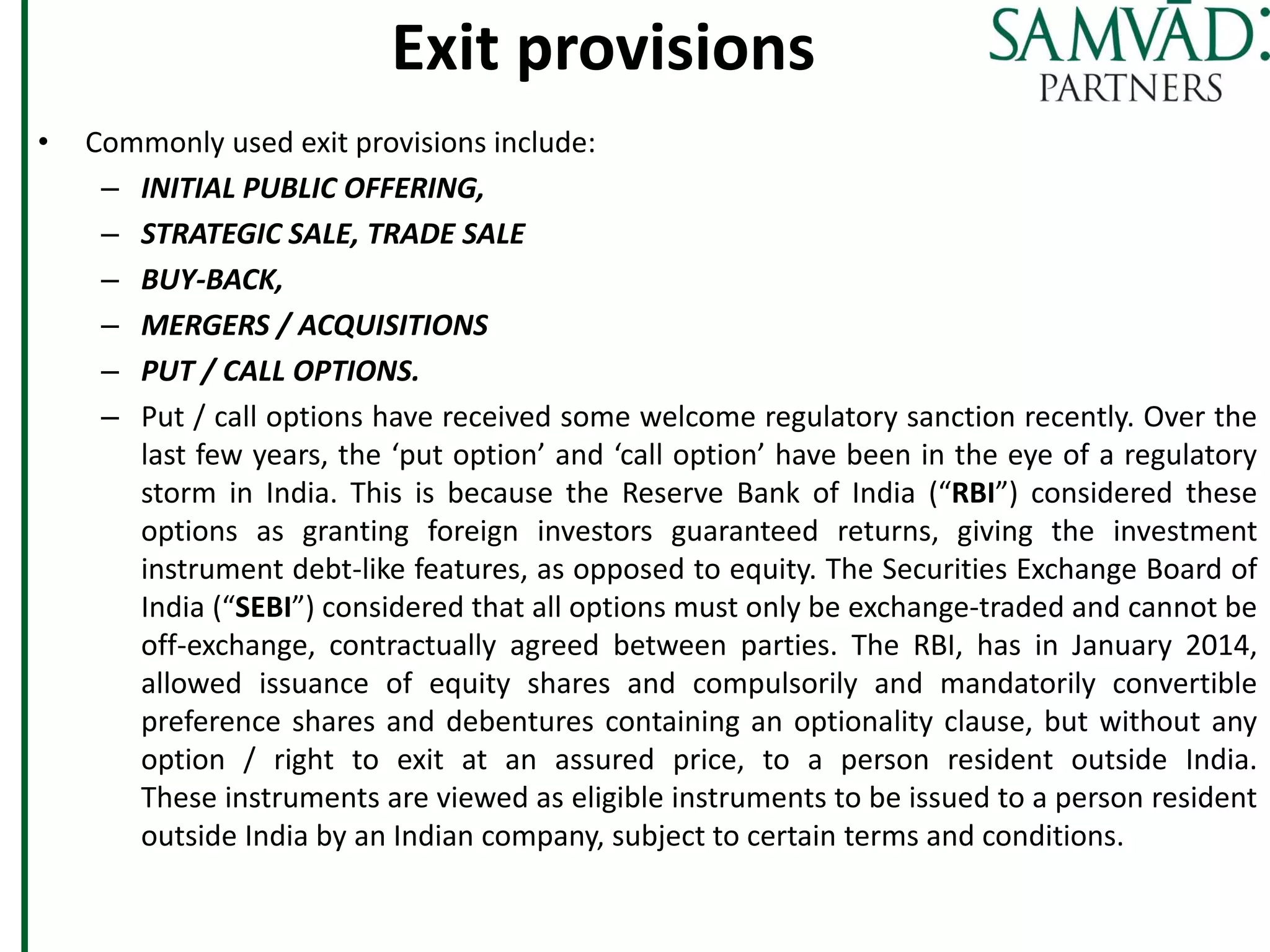
Exit provisions
• Commonly used exit provisions include:
– INITIAL PUBLIC OFFERING,
– STRATEGIC SALE, TRADE SALE
– BUY-BACK,
– MERGERS / ACQUISITIONS
– PUT / CALL OPTIONS.
– Put / call options have received some welcome regulatory sanction recently. Over the
last few years, the ‘put option’ and ‘call option’ have been in the eye of a regulatory
storm in India. This is because the Reserve Bank of India (“RBI”) considered these
options as granting foreign investors guaranteed returns, giving the investment
instrument debt-like features, as opposed to equity. The Securities Exchange Board of
India (“SEBI”) considered that all options must only be exchange-traded and cannot be
off-exchange, contractually agreed between parties. The RBI, has in January 2014,
allowed issuance of equity shares and compulsorily and mandatorily convertible
preference shares and debentures containing an optionality clause, but without any
option / right to exit at an assured price, to a person resident outside India.
These instruments are viewed as eligible instruments to be issued to a person resident
outside India by an Indian company, subject to certain terms and conditions.
Governance Terms: Board and
Shareholder meetings.
• Funds would want a say in the way the company is run, on certain important items, at
least, and will typically nominate at least 1 director to the company’s board, coupled with
a list of items on which the board cannot proceed unless such nominee director has
consented.
• This list is typically replicated at the shareholder level as well, such that no resolution can
be passed by the shareholders in general meeting on the specified list of matters, unless
the fund, as a shareholder has consented (whether at the shareholders’ meeting, through
its authorized representative, or through a separate written consent).
• While most funds seek to nominate a director(s) on the company’s board, there has been
a rise in the trend where certain funds prefer to appoint an “observer” on the company’s
board instead of a director.
• These rights carry greater weight in private companies, while in public and public listed
companies, the legal implications of these kinds of rights is very much a grey area.
‘Control’
• When the question of whether these ‘affirmative rights’ or ‘veto
rights’ amount to the fund acquiring ‘control’ over the investee
company for the purpose of the takeover regulations came up
before the SEBI, SEBI ruled in the affirmative.
• The Securities Appellate Tribunal (“SAT”) reversed SEBI’s order. The
matter went up before the Supreme Court, but was unfortunately
settled before the Supreme Court could pass an order on the
merits. The Supreme Court did however expressly state that the
SAT’s ruling was not to be treated as precedent. There is a likelihood
that in the future a regulator or court could take the view that funds
enjoy ‘control’ over their investee companies, with attendant legal
implications.
Restrictions on Share Transfers.
• The ability to restrict the transfer of shares in private companies
is important from the investors’ point of view.
• Typically, such investors would want to ensure that the founders
/ promoters of their investee company cannot unilaterally decide
to jump ship in the event the company’s business is floundering –
therefore, elaborate provisions governing the transfer of shares is
typically included in transaction documents and replicated in the
articles of association of the company, most common being
founders’ lock-in.
• Exceptions?
• Other commonly heard terms include rights of “tag-along,”
“drag-along,” “come along”, ‘right of first offer’ and ‘right of
first refusal.’ While these rights are now fairly common in the
industry, their enforceability in court is yet to be tested.
De-jargoned!
• Tag- Along. If A decides to sell his shares to X, then B can tag-along with A and X is
obligated to purchase not just A’s shares but also B’s. Needless to say when A is a
departing promoter shareholder / investor, A will need to find a buyer X who will buy not
just A’s but also B’s shares.
• Drag-Along. If A (usually the investor) decides to exit the firm and sell his shares to a buyer
X, he can compel the founder / promoter shareholder B to sell his shareholding also, such
that the sale is a more attractive proposition for X, who receives total control of the
investee company.
• ROFO: If A decides to sell his shares, he must first offer them to B (who enjoys the ROFO),
who in turn may offer a price for the shares to A. If satisfied by the price offered by B, or if
A is unable to obtain a higher price from a third party, then A only has the option to sell its
shares to B. However, if A receives a price higher than that offered by B from a third party,
A is free to sell shares to the third party at the higher price.
• ROFR: On the other hand, if B enjoys the ROFR, then A is first required to offer his shares
to third parties and obtain a price from them. A is then required to approach B with such
price offered by third parties. If B can match or better the price offered by third parties, A
must sell his shares to B.
Enforceability of Term Sheets in India
• There have not been significant judicial pronouncements on the question of enforceability
of a venture capital term sheet.
• To summarise, term sheets are preliminary agreements, evidencing an intention of the
parties to enter into a contract at a future date.
• Such ‘agreements to agree’ are not enforceable under both English and Indian law,
although, there may be exceptions depending on the facts and circumstance of each case,
the conduct and the intention (whether express or implied) of the parties to create legal
relations.
• Whether or not a term sheet is binding on the parties depends on the provisions
contained therein. Therefore, the parties must employ a clear and unambiguous language
to avoid disputes. Certain clauses like Exclusivity, Confidentiality and ‘No-Shop,’ and the
related Dispute Resolution provisions, must be expressly stated to be valid and binding,
independently of whether or not the deal goes ahead with the execution of definitive
documentation.
• Importantly, clauses dealing with costs or fees, and who is to bear them, whether or not
the deal goes through, must also be clearly indicated to be binding, so as to avoid
unpleasant shocks later. The concept of ‘break-fees’ and its payment, is another clause,
that must be made so binding irrespective of deal closure.
Questions?
Thank you!
Bangalore • Chennai • Mumbai • New Delhi
Samvād: Partners is a partner-led, solution-oriented, full service law firm, formed by the
merger of Narasappa, Doraswamy & Raja and V Chambers of Law, having a deep and
diverse international perspective.
With offices in Bangalore, Chennai, Mumbai and New Delhi – comprising over 30 lawyers
– the Firm’s partners (and its legacy firms) have regularly received the highest accolades and
rankings from our peers, including recognition in Chambers & Partners and Legal500,
over the past several years.
The Partners of the Firm – Mr. Harish Narasappa, Ms. Poornima Hatti, Mr. Rohan K.
George, Mr. Siddharth Raja, Ms. Vineetha M. G., Ms. Nivedita Nivargi and Ms. Neela
Badami – are leaders in their respective fields of practice, having a rich mix of domestic
and international experience, having worked in several legal and financial capitals around
the world, including London, Hong Kong, Singapore, Mumbai, New Delhi and the Hague.
© Samvad Partners16
Neela Badami (neela@samvadpartners.com)
# 62 / 1 Palace Road, Vasanth Nagar, Bangalore 560 001
(+91.80.4268.6000 / 30)
© Samvad Partners
Bangalore • Chennai • Mumbai • New Delhi
17

Term Sheets – Legal Issues By Ms. Neela Badami of Samvaad Ventures

  • 1.
    Term Sheets –Legal Issues Indian Institute of Management - Bangalore, March 7, 2015 NEELA BADAMI
  • 2.
    ‘What’s in aname? That which we call a rose… – Term sheet,’ – ‘non-binding term sheet,’ – ‘indicative term sheet,’ – ‘Letter of Intent,’ – ‘Head of Terms,’ – ‘Memorandum of Understanding,’ – ‘Non-binding MOU’ Commonly heard terms in the private equity / venture capital world!
  • 3.
    …by any othername would smell as sweet.’ • Simply put, a “Term Sheet”, by whatever name called, and whether a simple 2-pager, or a detailed tome, is a document that sets out key financial, protective and governance terms of a proposed transaction. • We will examine the case of an investment by a venture capital or a private equity fund in a company looking to raise capital. • What they all usually have in common is the understanding that they are not binding until the execution of ‘definitive documentation’ (typically a share subscription agreement and a shareholders agreement)
  • 4.
    What is init? • Typically, the financial provisions covered in a Term Sheet are: – the proposed investment amount, – valuation of the company, – type of investment instrument, – a timeline for the investor's exit, together with indicative exit mechanisms, – Governance terms and protective provisions include the composition of the board of directors, a lock-in over the founders’ shares, and sometimes, detailed provisions governing share transfers, – Protective provisions will seek to safeguard the fund’s investment in several ways, for example, the right to receive detailed information about the company’s financial health (including management information system reports and unaudited monthly financial statements), – The right to veto certain actions, and anti-dilution rights in future financing rounds, are also commonly seen. (For a detailed analysis of private equity fund formation and transactions in India, please see http://www.samvadpartners.com/wp-content/uploads/2013/06/Getting-The-Deal- Through-India-Private-Equity-2012-Transactions-Chapter.pdf)
  • 5.
    What ‘Instrument’? • Oncethe parties have agreed on the valuation of the company, the next question is as to what kind of investment instrument is desired. • Available options are: – EQUITY SHARES, – PREFERENCE SHARES, – CONVERTIBLE INSTRUMENTS, – PARTLY PAID SHARES, – WARRANTS • Note that in case of investments by non-resident funds, the price per share must be above the ‘fair value.’ • Also, convertible instruments must be fully and mandatorily convertible in order to be reckoned as equity. Partly convertible or non-convertible instruments would be reckoned as debt and subject to the more onerous rules applicable to external commercial borrowings. • Partly paid instruments and warrants are subject to a specific set of rules as well.
  • 6.
    Why choose oneover the other? • Several factors influence the fund’s choice of instrument. The principal one is how the fund envisions its role in the company. • Funds which want to have a hands-on, operational role in the day- to-day affairs of the company may choose large or controlling stakes of above 50% of the equity shareholding. • Funds for which the investment is a purely financial one may choose convertible instruments. • The fact that convertible debentures, while in the unconverted state, rank as debt; and in that form, rank higher than the holders of equity shares in the queue of persons eligible to receive distributions (in the event of the company being wound up), are factors that funds take into account Such as convertible debentures or preference shares.
  • 7.
    What rights canthe instrument have? • Note that shares with differential voting rights (“DVR Shares”) cannot be freely issued by companies, without complying with certain conditions. • In this context, the ‘Liquidation Preference’ clause assumes significance. In jurisdictions like the United States, where (comparative to India) companies can be wound up or liquidated relatively quickly, the term ‘liquidation preference’ is used to imply that in the event the company is liquidated or sold, i.e., an exit event is created, the fund would first get its returns (1x, 2x, etc.) before the founders get their share. • However, the use of this term in the Indian context gives rise to some confusion (since the word ‘liquidation’ suggests dissolution of the company, the process for which is prescribed under the Indian company law). • The Indian company law also prescribes the manner in which available moneys must be paid out, and hence, any contractually agreed clauses on the manner in which moneys must be distributed upon winding-up may not be given effect to by courts. • The better expression is, therefore, a 'distribution preference' arising upon the occurrence of a 'liquidity' event, namely, a transaction that realizes the 'value' of the company, typically, in cash (although a share or stock deal is not ruled out, except that achieving it is a regulatory challenge). Note however that there is no contractual restriction on agreeing as to how moneys must be distributed in case of other exit events such as sale to a third party (who may be a strategic or financial investor), as long as applicable exchange control and taxation laws are complied with.
  • 8.
    Exit provisions • Commonlyused exit provisions include: – INITIAL PUBLIC OFFERING, – STRATEGIC SALE, TRADE SALE – BUY-BACK, – MERGERS / ACQUISITIONS – PUT / CALL OPTIONS. – Put / call options have received some welcome regulatory sanction recently. Over the last few years, the ‘put option’ and ‘call option’ have been in the eye of a regulatory storm in India. This is because the Reserve Bank of India (“RBI”) considered these options as granting foreign investors guaranteed returns, giving the investment instrument debt-like features, as opposed to equity. The Securities Exchange Board of India (“SEBI”) considered that all options must only be exchange-traded and cannot be off-exchange, contractually agreed between parties. The RBI, has in January 2014, allowed issuance of equity shares and compulsorily and mandatorily convertible preference shares and debentures containing an optionality clause, but without any option / right to exit at an assured price, to a person resident outside India. These instruments are viewed as eligible instruments to be issued to a person resident outside India by an Indian company, subject to certain terms and conditions.
  • 9.
    Governance Terms: Boardand Shareholder meetings. • Funds would want a say in the way the company is run, on certain important items, at least, and will typically nominate at least 1 director to the company’s board, coupled with a list of items on which the board cannot proceed unless such nominee director has consented. • This list is typically replicated at the shareholder level as well, such that no resolution can be passed by the shareholders in general meeting on the specified list of matters, unless the fund, as a shareholder has consented (whether at the shareholders’ meeting, through its authorized representative, or through a separate written consent). • While most funds seek to nominate a director(s) on the company’s board, there has been a rise in the trend where certain funds prefer to appoint an “observer” on the company’s board instead of a director. • These rights carry greater weight in private companies, while in public and public listed companies, the legal implications of these kinds of rights is very much a grey area.
  • 10.
    ‘Control’ • When thequestion of whether these ‘affirmative rights’ or ‘veto rights’ amount to the fund acquiring ‘control’ over the investee company for the purpose of the takeover regulations came up before the SEBI, SEBI ruled in the affirmative. • The Securities Appellate Tribunal (“SAT”) reversed SEBI’s order. The matter went up before the Supreme Court, but was unfortunately settled before the Supreme Court could pass an order on the merits. The Supreme Court did however expressly state that the SAT’s ruling was not to be treated as precedent. There is a likelihood that in the future a regulator or court could take the view that funds enjoy ‘control’ over their investee companies, with attendant legal implications.
  • 11.
    Restrictions on ShareTransfers. • The ability to restrict the transfer of shares in private companies is important from the investors’ point of view. • Typically, such investors would want to ensure that the founders / promoters of their investee company cannot unilaterally decide to jump ship in the event the company’s business is floundering – therefore, elaborate provisions governing the transfer of shares is typically included in transaction documents and replicated in the articles of association of the company, most common being founders’ lock-in. • Exceptions? • Other commonly heard terms include rights of “tag-along,” “drag-along,” “come along”, ‘right of first offer’ and ‘right of first refusal.’ While these rights are now fairly common in the industry, their enforceability in court is yet to be tested.
  • 12.
    De-jargoned! • Tag- Along.If A decides to sell his shares to X, then B can tag-along with A and X is obligated to purchase not just A’s shares but also B’s. Needless to say when A is a departing promoter shareholder / investor, A will need to find a buyer X who will buy not just A’s but also B’s shares. • Drag-Along. If A (usually the investor) decides to exit the firm and sell his shares to a buyer X, he can compel the founder / promoter shareholder B to sell his shareholding also, such that the sale is a more attractive proposition for X, who receives total control of the investee company. • ROFO: If A decides to sell his shares, he must first offer them to B (who enjoys the ROFO), who in turn may offer a price for the shares to A. If satisfied by the price offered by B, or if A is unable to obtain a higher price from a third party, then A only has the option to sell its shares to B. However, if A receives a price higher than that offered by B from a third party, A is free to sell shares to the third party at the higher price. • ROFR: On the other hand, if B enjoys the ROFR, then A is first required to offer his shares to third parties and obtain a price from them. A is then required to approach B with such price offered by third parties. If B can match or better the price offered by third parties, A must sell his shares to B.
  • 13.
    Enforceability of TermSheets in India • There have not been significant judicial pronouncements on the question of enforceability of a venture capital term sheet. • To summarise, term sheets are preliminary agreements, evidencing an intention of the parties to enter into a contract at a future date. • Such ‘agreements to agree’ are not enforceable under both English and Indian law, although, there may be exceptions depending on the facts and circumstance of each case, the conduct and the intention (whether express or implied) of the parties to create legal relations. • Whether or not a term sheet is binding on the parties depends on the provisions contained therein. Therefore, the parties must employ a clear and unambiguous language to avoid disputes. Certain clauses like Exclusivity, Confidentiality and ‘No-Shop,’ and the related Dispute Resolution provisions, must be expressly stated to be valid and binding, independently of whether or not the deal goes ahead with the execution of definitive documentation. • Importantly, clauses dealing with costs or fees, and who is to bear them, whether or not the deal goes through, must also be clearly indicated to be binding, so as to avoid unpleasant shocks later. The concept of ‘break-fees’ and its payment, is another clause, that must be made so binding irrespective of deal closure.
  • 14.
  • 15.
  • 16.
    Bangalore • Chennai• Mumbai • New Delhi Samvād: Partners is a partner-led, solution-oriented, full service law firm, formed by the merger of Narasappa, Doraswamy & Raja and V Chambers of Law, having a deep and diverse international perspective. With offices in Bangalore, Chennai, Mumbai and New Delhi – comprising over 30 lawyers – the Firm’s partners (and its legacy firms) have regularly received the highest accolades and rankings from our peers, including recognition in Chambers & Partners and Legal500, over the past several years. The Partners of the Firm – Mr. Harish Narasappa, Ms. Poornima Hatti, Mr. Rohan K. George, Mr. Siddharth Raja, Ms. Vineetha M. G., Ms. Nivedita Nivargi and Ms. Neela Badami – are leaders in their respective fields of practice, having a rich mix of domestic and international experience, having worked in several legal and financial capitals around the world, including London, Hong Kong, Singapore, Mumbai, New Delhi and the Hague. © Samvad Partners16
  • 17.
    Neela Badami (neela@samvadpartners.com) #62 / 1 Palace Road, Vasanth Nagar, Bangalore 560 001 (+91.80.4268.6000 / 30) © Samvad Partners Bangalore • Chennai • Mumbai • New Delhi 17