What is it?

…concerned with the new or the novel.


Is innovation technology based? Many of the more
significant innovations of the 20th century are
organizational rather than technology based.
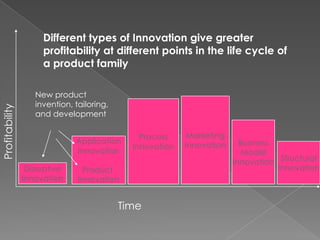
Different types of Innovation give greater
                     profitability at different points in the life cycle of
                     a product family

                   New product
                   invention, tailoring,
Profitability


                   and development

                                               Process     Marketing
                              Application                                Business
                                             Innovation   Innovation
                              Innovation                                  Model
                                                                       Innovation Structural
                 Disruptive     Product                                           Innovation
                Innovation     Innovation


                                           Time
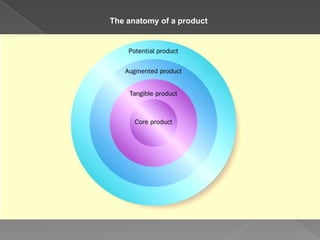
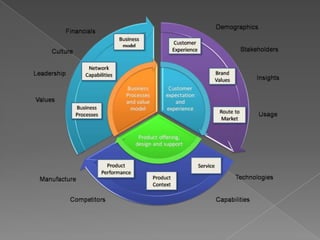
The anatomy of a product
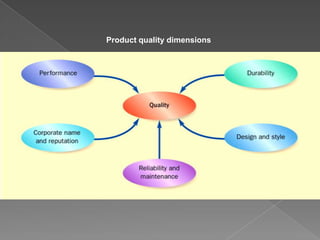
Product quality dimensions
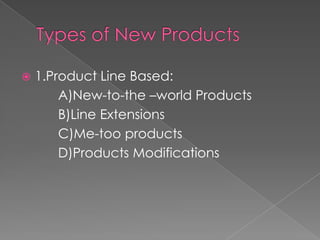
   1.Product Line Based:
        A)New-to-the –world Products
        B)Line Extensions
        C)Me-too products
        D)Products Modifications
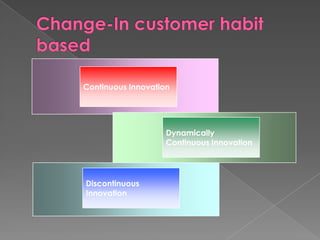
Continuous Innovation


                    Dynamically
                    Continuous Innovation


Discontinuous
Innovation
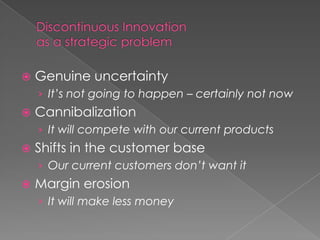
   Genuine uncertainty
    › It’s not going to happen – certainly not now
   Cannibalization
    › It will compete with our current products
   Shifts in the customer base
    › Our current customers don’t want it
   Margin erosion
    › It will make less money
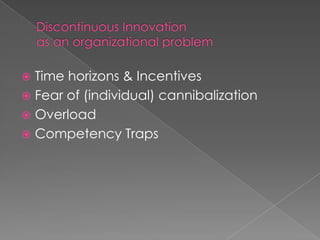
 Time horizons & Incentives
 Fear of (individual) cannibalization
 Overload
 Competency Traps
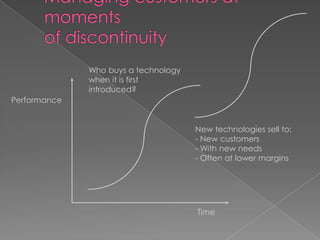
Who buys a technology
              when it is first
              introduced?
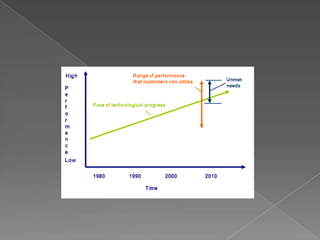
Performance


                                      New technologies sell to:
                                      - New customers
                                      - With new needs
                                      - Often at lower margins


                                      Time
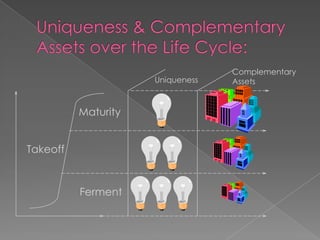
Complementary
                     Uniqueness   Assets


          Maturity


Takeoff


          Ferment
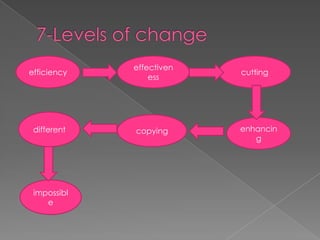
effectiven
efficiency                   cutting
   e               ess


    different   copying      enhancin
                                g


    impossibl
       e
   Dynamically continuous innovation:
    A pronounced modification to an
    existing product
    › Requires a *moderate* amount of learning or
      behavior change
    › Convergence:
      The coming together of two or more
      technologies to create a new system with
      greater benefits than its parts
“ Disruptive innovation theory points to situations
    in which new organizations can use relatively
    simple, convenient, low-cost innovations to
    create growth and triumph over powerful
    incumbents.”

   Sustaining versus Disruptive Innovation
   Markets that don’t exist can’t be analyzed

   The experts, including you, will be wrong

   Don’t invest all your resources on the first effort
    — beta release

   Discovery, not implementation, based planning
   Markets that don’t exist can’t be analyzed

   The experts, including you, will be wrong

   Don’t invest all your resources on the first effort
    — beta release

   Discovery, not implementation, based planning
 Bring a difference value proposition to the
  market
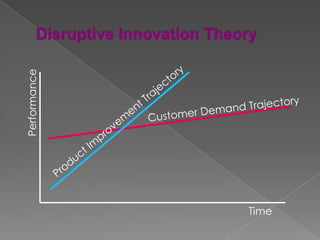
 Initially under perform established products in
  mainstream market
 But, the products improve at a rapid rate
 Superior in ways that are not valued by the
  established market — more reliable, easier to
  use, or cheaper
Performance


Time
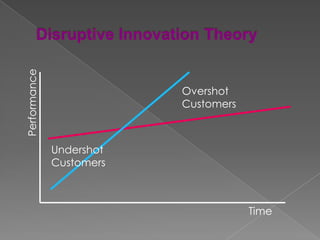
Performance


                          Overshot
                          Customers


              Undershot
              Customers


                                      Time
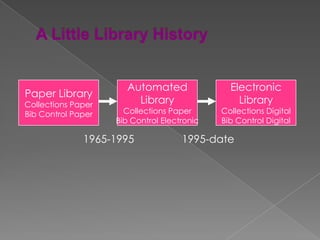
Automated               Electronic
Paper Library
Collections Paper        Library                 Library
Bib Control Paper     Collections Paper      Collections Digital
                    Bib Control Electronic   Bib Control Digital

              1965-1995              1995-date
Automated               Electronic
Paper Library
Collections Paper        Library                 Library
Bib Control Paper     Collections Paper      Collections Digital
                    Bib Control Electronic   Bib Control Digital

              1965-1995              1995-date
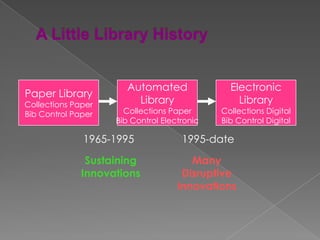
               Sustaining              Many
              Innovations            Disruptive
                                    Innovations
 Browsing versus Search
 Britannica versus Wikipedia
 Journals versus Repositories
 Browsing — requires prior arrangement, you
  are putting things (usually books) in order on a
  shelf
 Problems
    › Mind reading — guess what the user is thinking
    › Fortune telling — make predictions about the future
   Searching —
    › “the only group that can categorize everything is
      everybody”
    › “One reason Google was adopted so quickly when it
      came along is that Google understood there is no
      shelf… Google can decide what goes with what after
      hearing form the user.”
“The Web has an editor, it’s everybody. In a
world where publishing is expensive, the act of
publishing is also a statement of quality — the
filter comes before publication. In a world
where publishing is cheap, putting something
out there says nothing about quality. It’s what
happens after it gets published that matters. If
people don’t point to it, other people won’t read
it.”
 Google versus traditional bibliographic control
 Open Archives/Repositories versus journals
  (and soon monographs?)
 Google Book Project, Open Content Alliance
  versus library collections
 Reference librarians versus Yahoo/Google
  Answers
 Product variation
 Customization
 Modular Designs
 New Technology
 Hybrid Technology
33
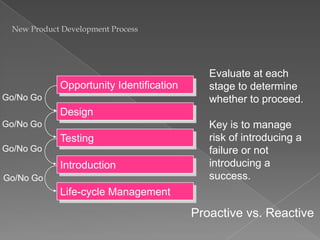
New Product Development Process


                                            Evaluate at each
            Opportunity Identification      stage to determine
Go/No Go                                    whether to proceed.
            Design
Go/No Go                                    Key is to manage
            Testing                         risk of introducing a
Go/No Go                                    failure or not
            Introduction                    introducing a
Go/No Go                                    success.
            Life-cycle Management

                                         Proactive vs. Reactive
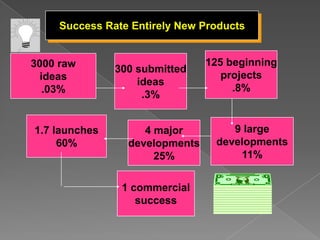
Success Rate Entirely New Products


3000 raw                        125 beginning
               300 submitted
  ideas                            projects
                   ideas
   .03%                              .8%
                    .3%


1.7 launches        4 major         9 large
     60%         developments    developments
                      25%            11%


                1 commercial
                   success
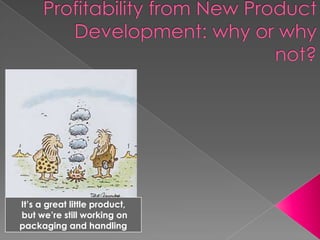
It’s a great little product,
but we’re still working on
packaging and handling
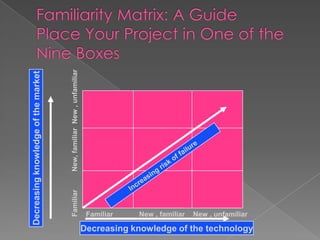
New, familiar New , unfamiliar
Decreasing knowledge of the market


                                     Familiar


                                                                       Familiar   New , familiar   New , unfamiliar

                                                                      Decreasing knowledge of the technology
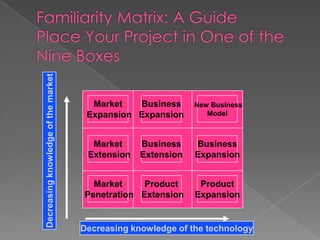
Decreasing knowledge of the market


                                       Market   Business      New Business
                                      Expansion Expansion        Model


                                       Market     Business    Business
                                      Extension   Extension   Expansion


                                       Market     Product      Product
                                     Penetration Extension    Expansion


                                     Decreasing knowledge of the technology
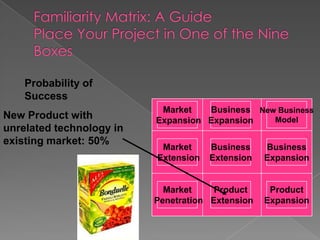
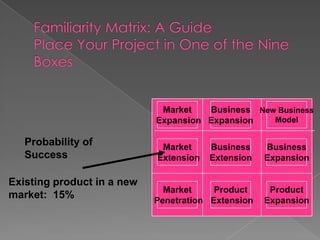
Probability of
    Success
                           Market   Business New Business
New Product with          Expansion Expansion   Model
unrelated technology in
existing market: 50%
                           Market     Business    Business
                          Extension   Extension   Expansion


                            Market     Product     Product
                          Penetration Extension   Expansion
Market   Business New Business
                            Expansion Expansion   Model

   Probability of            Market     Business    Business
   Success                  Extension   Extension   Expansion

Existing product in a new
                              Market     Product     Product
market: 15%                 Penetration Extension   Expansion
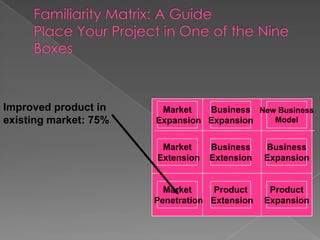
Improved product in     Market   Business New Business
existing market: 75%   Expansion Expansion   Model


                        Market     Business    Business
                       Extension   Extension   Expansion


                         Market     Product     Product
                       Penetration Extension   Expansion
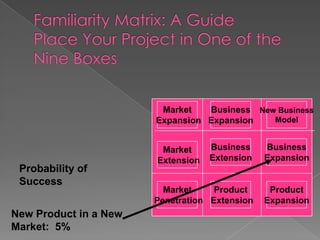
Market   Business New Business
                       Expansion Expansion   Model


                        Market     Business    Business
                       Extension   Extension   Expansion
 Probability of
 Success
                         Market     Product     Product
                       Penetration Extension   Expansion
New Product in a New
Market: 5%
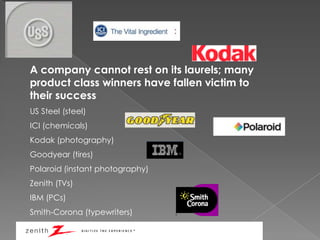
A company cannot rest on its laurels; many
product class winners have fallen victim to
their success
US Steel (steel)
ICI (chemicals)
Kodak (photography)
Goodyear (tires)
Polaroid (instant photography)
Zenith (TVs)
IBM (PCs)
Smith-Corona (typewriters)
   The right product is one that becomes available at
    the right time (i.e., when the market needs it), and
    is better and/or less expensive that its competition.
   To have the right product, therefore, one must:
      Predict a market need
      Envisage a product whose performance and
        capability will meet that need
      Develop the product to the appropriate time
        scale and produce it.
      Sell the product at the right price
   There are, unfortunately, many examples of potentially
     innovative space products being developed at the
     wrong time, at the wrong price point, or due to poor
     market predictions:
      TV-SAT and TDF-SAT: Performance wrong (few high power
       transponders when many medium/low power were needed)
      OLYMPUS: Too soon (large busses only started to become
       needed some years later)
      IRIDIUM and GLOBALSTAR: Wrong market and/or too late
       (development of GSM took away most of the market)
      AIRPHONE: Too expensive


CONCLUSION? Introduce only Productive Innovation
OTHER POSSIBILITIES???
Battery Powered Battery Charger?
Braille TV Guide?
Fireproof Matches?
Solar Powered Flashlight?
Sugar coated Insulin btablet?
.....
› Innovation can be productive or wasteful. The
 secret to success is being able to spot the
 difference in advance and encourage the former.


           This should be your goal!!

Product innovation

  • 2.
    What is it? …concernedwith the new or the novel. Is innovation technology based? Many of the more significant innovations of the 20th century are organizational rather than technology based.
  • 3.
    Different types ofInnovation give greater profitability at different points in the life cycle of a product family New product invention, tailoring, Profitability and development Process Marketing Application Business Innovation Innovation Innovation Model Innovation Structural Disruptive Product Innovation Innovation Innovation Time
  • 6.
    The anatomy ofa product
  • 7.
  • 8.
    1.Product Line Based: A)New-to-the –world Products B)Line Extensions C)Me-too products D)Products Modifications
  • 9.
    Continuous Innovation Dynamically Continuous Innovation Discontinuous Innovation
  • 10.
    Genuine uncertainty › It’s not going to happen – certainly not now  Cannibalization › It will compete with our current products  Shifts in the customer base › Our current customers don’t want it  Margin erosion › It will make less money
  • 11.
     Time horizons& Incentives  Fear of (individual) cannibalization  Overload  Competency Traps
  • 12.
    Who buys atechnology when it is first introduced? Performance New technologies sell to: - New customers - With new needs - Often at lower margins Time
  • 13.
    Complementary Uniqueness Assets Maturity Takeoff Ferment
  • 15.
    effectiven efficiency cutting  e ess different copying enhancin g impossibl e
  • 16.
    Dynamically continuous innovation: A pronounced modification to an existing product › Requires a *moderate* amount of learning or behavior change › Convergence: The coming together of two or more technologies to create a new system with greater benefits than its parts
  • 18.
    “ Disruptive innovationtheory points to situations in which new organizations can use relatively simple, convenient, low-cost innovations to create growth and triumph over powerful incumbents.”  Sustaining versus Disruptive Innovation
  • 19.
    Markets that don’t exist can’t be analyzed  The experts, including you, will be wrong  Don’t invest all your resources on the first effort — beta release  Discovery, not implementation, based planning
  • 20.
    Markets that don’t exist can’t be analyzed  The experts, including you, will be wrong  Don’t invest all your resources on the first effort — beta release  Discovery, not implementation, based planning
  • 21.
     Bring adifference value proposition to the market  Initially under perform established products in mainstream market  But, the products improve at a rapid rate  Superior in ways that are not valued by the established market — more reliable, easier to use, or cheaper
  • 22.
  • 23.
    Performance Overshot Customers Undershot Customers Time
  • 24.
    Automated Electronic Paper Library Collections Paper Library Library Bib Control Paper Collections Paper Collections Digital Bib Control Electronic Bib Control Digital 1965-1995 1995-date
  • 25.
    Automated Electronic Paper Library Collections Paper Library Library Bib Control Paper Collections Paper Collections Digital Bib Control Electronic Bib Control Digital 1965-1995 1995-date Sustaining Many Innovations Disruptive Innovations
  • 26.
     Browsing versusSearch  Britannica versus Wikipedia  Journals versus Repositories
  • 27.
     Browsing —requires prior arrangement, you are putting things (usually books) in order on a shelf  Problems › Mind reading — guess what the user is thinking › Fortune telling — make predictions about the future
  • 28.
    Searching — › “the only group that can categorize everything is everybody” › “One reason Google was adopted so quickly when it came along is that Google understood there is no shelf… Google can decide what goes with what after hearing form the user.”
  • 29.
    “The Web hasan editor, it’s everybody. In a world where publishing is expensive, the act of publishing is also a statement of quality — the filter comes before publication. In a world where publishing is cheap, putting something out there says nothing about quality. It’s what happens after it gets published that matters. If people don’t point to it, other people won’t read it.”
  • 30.
     Google versustraditional bibliographic control  Open Archives/Repositories versus journals (and soon monographs?)  Google Book Project, Open Content Alliance versus library collections  Reference librarians versus Yahoo/Google Answers
  • 31.
     Product variation Customization  Modular Designs
  • 32.
     New Technology Hybrid Technology
  • 33.
  • 38.
    New Product DevelopmentProcess Evaluate at each Opportunity Identification stage to determine Go/No Go whether to proceed. Design Go/No Go Key is to manage Testing risk of introducing a Go/No Go failure or not Introduction introducing a Go/No Go success. Life-cycle Management Proactive vs. Reactive
  • 39.
    Success Rate EntirelyNew Products 3000 raw 125 beginning 300 submitted ideas projects ideas .03% .8% .3% 1.7 launches 4 major 9 large 60% developments developments 25% 11% 1 commercial success
  • 40.
    It’s a greatlittle product, but we’re still working on packaging and handling
  • 42.
    New, familiar New, unfamiliar Decreasing knowledge of the market Familiar Familiar New , familiar New , unfamiliar Decreasing knowledge of the technology
  • 43.
    Decreasing knowledge ofthe market Market Business New Business Expansion Expansion Model Market Business Business Extension Extension Expansion Market Product Product Penetration Extension Expansion Decreasing knowledge of the technology
  • 44.
    Probability of Success Market Business New Business New Product with Expansion Expansion Model unrelated technology in existing market: 50% Market Business Business Extension Extension Expansion Market Product Product Penetration Extension Expansion
  • 45.
    Market Business New Business Expansion Expansion Model Probability of Market Business Business Success Extension Extension Expansion Existing product in a new Market Product Product market: 15% Penetration Extension Expansion
  • 46.
    Improved product in Market Business New Business existing market: 75% Expansion Expansion Model Market Business Business Extension Extension Expansion Market Product Product Penetration Extension Expansion
  • 47.
    Market Business New Business Expansion Expansion Model Market Business Business Extension Extension Expansion Probability of Success Market Product Product Penetration Extension Expansion New Product in a New Market: 5%
  • 49.
    A company cannotrest on its laurels; many product class winners have fallen victim to their success US Steel (steel) ICI (chemicals) Kodak (photography) Goodyear (tires) Polaroid (instant photography) Zenith (TVs) IBM (PCs) Smith-Corona (typewriters)
  • 50.
    The right product is one that becomes available at the right time (i.e., when the market needs it), and is better and/or less expensive that its competition.  To have the right product, therefore, one must:  Predict a market need  Envisage a product whose performance and capability will meet that need  Develop the product to the appropriate time scale and produce it.  Sell the product at the right price
  • 51.
    There are, unfortunately, many examples of potentially innovative space products being developed at the wrong time, at the wrong price point, or due to poor market predictions:  TV-SAT and TDF-SAT: Performance wrong (few high power transponders when many medium/low power were needed)  OLYMPUS: Too soon (large busses only started to become needed some years later)  IRIDIUM and GLOBALSTAR: Wrong market and/or too late (development of GSM took away most of the market)  AIRPHONE: Too expensive CONCLUSION? Introduce only Productive Innovation
  • 55.
    OTHER POSSIBILITIES??? Battery PoweredBattery Charger? Braille TV Guide? Fireproof Matches? Solar Powered Flashlight? Sugar coated Insulin btablet? .....
  • 57.
    › Innovation canbe productive or wasteful. The secret to success is being able to spot the difference in advance and encourage the former. This should be your goal!!

Editor's Notes

  • #5 Conclusion? Innovation should have a composite definition: a process whereby a new idea is conceived and detailed in the mind, developed into a physical entity through detailed design, analysis, experimentation, and production, and then introduced to give a company a competitive edge.In simplest terms, however, innovation is simple change for the better.
  • #6 Customization for different group of people
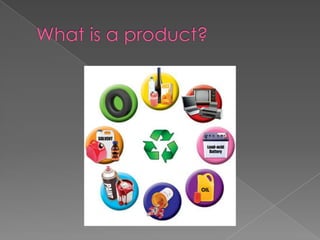
  • #9 Product definition:A product is a physical good, service, idea, person or place that is capable of offering tangible and intangible attributes that individuals or organisations regard as so necessary, worthwhile, or satisfying that they are prepared to exchange money, patronage or some other unit of value in order to acquire it.
  • #35 The client was able to prioritize the three top composite markets and applications. The company… Optimized their R&D spendAddressed needed improvements with their materials and technology Formulated an overall market entry strategy for the composites industryCreated an approach for the individual markets and applications. …resulting in years of time and millions of $ savings, allowing the company to confidently focus on executing a well developed plan.