1 
Medical Mathematics 
By Michael Austin, AS, EMT-P, FP-C 
There are a few drug calculations necessary in the pre-hospital setting. These calculations are needed to administer IV Bolus medications, IV medication infusions, IV fluid flow rates, and IM/SC injections. In addition, there are a few ‘street rules’ that come in handy. This packet will cover the above listed formulas. In addition, you will receive instruction in metric conversion and a review of basic arithmetic. 
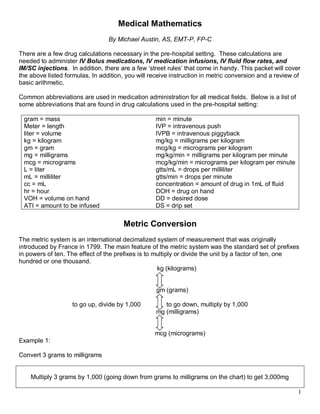
Common abbreviations are used in medication administration for all medical fields. Below is a list of some abbreviations that are found in drug calculations used in the pre-hospital setting: 
gram = mass 
min = minute 
Meter = length 
IVP = intravenous push 
liter = volume 
IVPB = intravenous piggyback 
kg = kilogram 
mg/kg = milligrams per kilogram 
gm = gram 
mcg/kg = micrograms per kilogram 
mg = milligrams 
mg/kg/min = milligrams per kilogram per minute 
mcg = micrograms 
mcg/kg/min = micrograms per kilogram per minute 
L = liter 
gtts/mL = drops per milliliter 
mL = milliliter 
gtts/min = drops per minute 
cc = mL 
concentration = amount of drug in 1mL of fluid 
hr = hour 
VOH = volume on hand 
ATI = amount to be infused 
DOH = drug on hand 
DD = desired dose 
DS = drip set 
Metric Conversion 
The metric system is an international decimalized system of measurement that was originally introduced by France in 1799. The main feature of the metric system was the standard set of prefixes in powers of ten. The effect of the prefixes is to multiply or divide the unit by a factor of ten, one hundred or one thousand. 
kg (kilograms) 
gm (grams) 
to go up, divide by 1,000 to go down, multiply by 1,000 
mg (milligrams) 
mcg (micrograms) 
Example 1: 
Convert 3 grams to milligrams 
Multiply 3 grams by 1,000 (going down from grams to milligrams on the chart) to get 3,000mg
2 
Example 2: 
Convert 2 grams to micrograms 
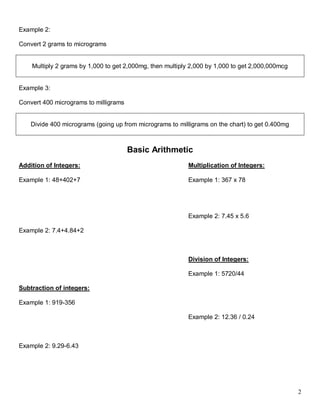
Multiply 2 grams by 1,000 to get 2,000mg, then multiply 2,000 by 1,000 to get 2,000,000mcg 
Example 3: 
Convert 400 micrograms to milligrams 
Divide 400 micrograms (going up from micrograms to milligrams on the chart) to get 0.400mg 
Basic Arithmetic 
Addition of Integers: Multiplication of Integers: 
Example 1: 48+402+7 Example 1: 367 x 78 
Example 2: 7.4+4.84+2 Example 2: 7.45 x 5.6 
Subtraction of integers: Division of Integers: 
Example 1: 919-356 Example 1: 5720/44 
Example 2: 9.29-6.43 Example 2: 12.36/0.24
3 
IV Medication Bolus / Volume to be Administered 
This formula is used when administering a specific medication as a single event. This medication administration can be done via IV, SC or IM. 
When you are given a volume to administer, make sure all of the units of measure are in the same prefix. After converting all the units to the same prefix, use the following formula: 
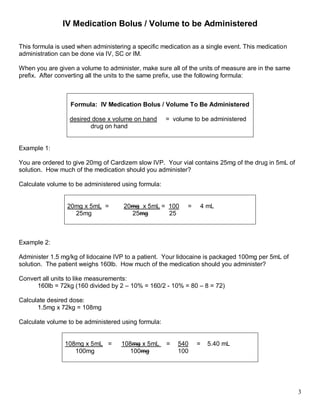
Formula: IV Medication Bolus / Volume To Be Administered 
desired dose x volume on hand = volume to be administered 
drug on hand 
Example 1: 
You are ordered to give 20mg of Cardizem slow IVP. Your vial contains 25mg of the drug in 5mL of solution. How much of the medication should you administer? 
Calculate volume to be administered using formula: 
20mg x 5mL = 20mg x 5mL = 100 = 4 mL 
25mg 25mg 25 
Example 2: 
Administer 1.5 mg/kg of lidocaine IVP to a patient. Your lidocaine is packaged 100mg per 5mL of solution. The patient weighs 160lb. How much of the medication should you administer? 
Convert all units to like measurements: 
160lb = 72kg (160 divided by 2 – 10% = 160/2 - 10% = 80 – 8 = 72) 
Calculate desired dose: 
1.5mg x 72kg = 108mg 
Calculate volume to be administered using formula: 
108mg x 5mL = 108mg x 5mL = 540 = 5.40 mL 
100mg 100mg 100
4 
Example 3: 
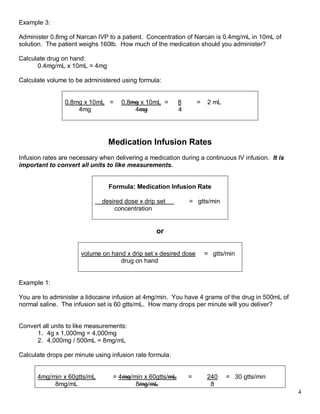
Administer 0.8mg of Narcan IVP to a patient. Concentration of Narcan is 0.4mg/mL in 10mL of solution. The patient weighs 160lb. How much of the medication should you administer? 
Calculate drug on hand: 
0.4mg/mL x 10mL = 4mg 
Calculate volume to be administered using formula: 
0.8mg x 10mL = 0.8mg x 10mL = 8 = 2 mL 
4mg 4mg 4 
Medication Infusion Rates 
Infusion rates are necessary when delivering a medication during a continuous IV infusion. It is important to convert all units to like measurements. 
Formula: Medication Infusion Rate 
desired dose x drip set = gtts/min 
concentration 
or 
volume on hand x drip set x desired dose = gtts/min 
drug on hand 
Example 1: 
You are to administer a lidocaine infusion at 4mg/min. You have 4 grams of the drug in 500mL of normal saline. The infusion set is 60 gtts/mL. How many drops per minute will you deliver? 
Convert all units to like measurements: 
1. 4g x 1,000mg = 4,000mg 
Calculate concentration: 
2. 4,000mg / 500mL = 8mg/mL
5 
Calculate drops per minute using infusion rate formula: 
4mg/min x 60gtts/mL = 4mg/min x 60gtts/mL = 240 = 30 gtts/min 
8mg/mL 8mg/mL 8 
or 
Convert all units to like measurements: 
1. 4g x 1,000mg =4,000mg 
Calculate drops per minute using infusion rate formula: 
500mL x 60gtts/mL x 4mg/min = 500mL x 60gtts/mL x 4mg/min = 120,000 = 30 gtts/min 
4,000mg 4,000mg 4,000 
Example 2: 
You are to administer epinephrine at 8mcg/min. You have 2mg of the drug in 250mL of normal saline. The infusion set is 60gtts/mL. What is your infusion rate? 
Convert all units to like measurements: 
1. 2mg x 1,000mcg = 2,000mcg 
Calculate concentration: 
2. 2,000mcg / 250mL = 8mcg/mL 
Calculate drops per minute using infusion rate formula: 
8mcg/min x 60gtts/mL = 8mcg/min x 60gtts/mL = 480 = 60gtts/min 
8mcg in 1 mL 8mcg in 1 mL 8 
or 
Convert all units to like measurements: 
1. 2mg x 1,000mcg = 2,000mcg 
Calculate drops per minute using infusion rate formula: 
250mL x 60gtts/mL x 8mcg/min = 250mL x 60gtts/mL x 8mcg/min = 120,000 = 60gtts/min 
2,000mcg 2,000mcg 2,000
6 
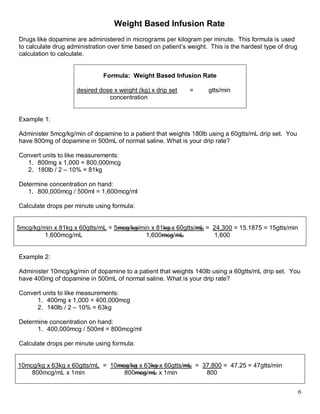
Weight Based Infusion Rate 
Drugs like dopamine are administered in micrograms per kilogram per minute. This formula is used to calculate drug administration over time based on patient’s weight. 
Formula: Weight Based Infusion Rate 
desired dose x weight (kg) x drip set = gtts/min 
concentration 
Example 1: 
Administer 5mcg/kg/min of dopamine to a patient that weights 180lb using a 60gtts/mL drip set. You have 800mg of dopamine in 500mL of normal saline. What is your drip rate? 
Convert units to like measurements: 
1. 800mg x 1,000 = 800,000mcg 
2. 180lb / 2 – 10% = 81kg 
Calculate concentration: 
1. 800,000mcg / 500ml = 1,600mcg/ml 
Calculate drops per minute using formula: 
5mcg/kg/min x 81kg x 60gtts/mL = 5mcg/kg/min x 81kg x 60gtts/mL = 24,300 = 15.1875 = 15gtts/min 
1,600mcg/mL 1,600mcg/mL 1,600 
Example 2: 
Administer 10mcg/kg/min of dopamine to a patient that weights 140lb using a 60gtts/mL drip set. You have 400mg of dopamine in 500mL of normal saline. What is your drip rate? 
Convert units to like measurements: 
1. 400mg x 1,000 = 400,000mcg 
2. 140lb / 2 – 10% = 63kg 
Calculate concentration: 
1. 400,000mcg / 500ml = 800mcg/ml 
Calculate drops per minute using formula: 
10mcg/kg x 63kg x 60gtts/mL = 10mcg/kg x 63kg x 60gtts/mL = 37,800 = 47.25 = 47gtts/min 
800mcg/mL x 1min 800mcg/mL x 1min 800
7 
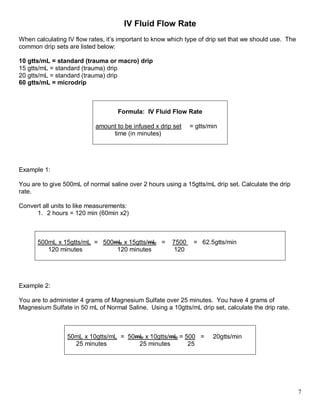
IV Fluid Flow Rate 
When calculating IV flow rates, it’s important to know which type of drip set that we should use. The common drip sets are listed below: 
10 gtts/mL = standard (trauma or macro) drip 
15 gtts/mL = standard (trauma) drip 
20 gtts/mL = standard (trauma) drip 
60 gtts/mL = microdrip 
Formula: IV Fluid Flow Rate 
amount to be infused x drip set = gtts/min 
time (in minutes) 
Example 1: 
You are to give 500mL of normal saline over 2 hours using a 15gtts/mL drip set. Calculate the drip rate. 
Convert all units to like measurements: 
1. 2 hours = 120 min (60min x2) 
500mL x 15gtts/mL = 500mL x 15gtts/mL = 7500 = 62.5 = 60 gtts/min 
120 minutes 120 minutes 120 
Example 2: 
You are to administer 4 grams of Magnesium Sulfate over 25 minutes. You have 4 grams of Magnesium Sulfate in 50 mL of Normal Saline. Using a 10gtts/mL drip set, calculate the drip rate. 
50mL x 10gtts/mL = 50mL x 10gtts/mL = 500 = 20gtts/min 
25 minutes 25 minutes 25
8 
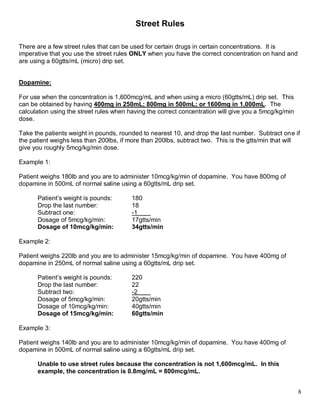
Street Rules 
There are a few street rules that can be used for certain drugs in certain concentrations. It is imperative that you use the street rules ONLY when you have the correct concentration on hand and are using a 60gtts/mL (micro) drip set. 
Dopamine: 
For use when the concentration is 1,600mcg/mL and when using a micro (60gtts/mL) drip set. This can be obtained by having 400mg in 250mL; 800mg in 500mL; or 1600mg in 1,000mL. The calculation using the street rules when having the correct concentration will give you a 5mcg/kg/min dose. 
Take the patients weight in pounds, rounded to nearest 10, and drop the last number. Subtract one if the patient weighs less than 200lbs, if more than 200lbs, subtract two. This is the gtts/min that will give you roughly 5mcg/kg/min dose. 
Example 1: 
Patient weighs 184lbs and you are to administer 10mcg/kg/min of dopamine. You have 800mg of dopamine in 500mL of normal saline using a 60gtts/mL drip set. 
Patient’s rounded weight in pounds: 180 
Drop the last number: 18 
Subtract one (patient’s weight is <200lbs): -1 
Dosage of 5mcg/kg/min: 17gtts/min 
Dosage of 10mcg/kg/min: 34gtts/min 
Example 2: 
Patient weighs 218lbs and you are to administer 15mcg/kg/min of dopamine. You have 400mg of dopamine in 250mL of normal saline using a 60gtts/mL drip set. 
Patient’s rounded weight in pounds: 220 
Drop the last number: 22 
Subtract two (patient’s weight is >200lbs): -2 
Dosage of 5mcg/kg/min: 20gtts/min 
Dosage of 10mcg/kg/min: 40gtts/min 
Dosage of 15mcg/kg/min: 60gtts/min 
Example 3: 
Patient weighs 140lb and you are to administer 10mcg/kg/min of dopamine. You have 400mg of dopamine in 500mL of normal saline using a 60gtts/mL drip set. 
Unable to use street rules because the concentration is not 1,600mcg/mL. In this 
example, the concentration is 0.8mg/mL = 800mcg/mL.
9 
Lidocaine: 
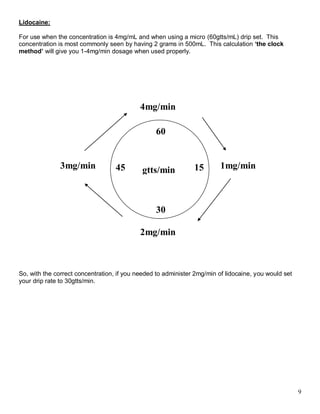
For use when the concentration is 4mg/mL and when using a micro (60gtts/mL) drip set. This concentration is most commonly seen by having 2 grams in 500mL. This calculation ‘the clock method’ will give you 1-4mg/min dosage when used properly. 
So, with the correct concentration, if you needed to administer 2mg/min of lidocaine, you would set your drip rate to 30gtts/min. 
60 
15 
30 
45 
gtts/min 
1mg/min 
2mg/min 
3mg/min 
4mg/min
10 
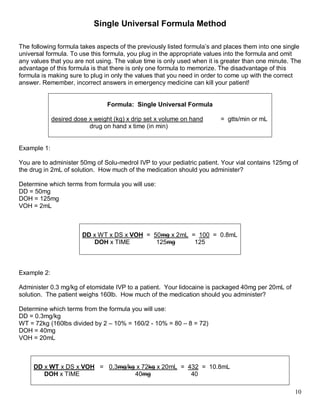
Single Universal Formula Method 
The following formula takes aspects of the previously listed formula’s and places them into one single universal formula. To use this formula, you plug in the appropriate values into the formula and omit any values that you are not using. The value time is only used when it is greater than one minute. The advantage of this formula is that there is only one formula to memorize. The disadvantage of this formula is making sure to plug in only the values that you need in order to come up with the correct answer. Remember, incorrect answers in emergency medicine can kill your patient! 
Formula: Single Universal Formula 
desired dose x weight (kg) x drip set x volume on hand = gtts/min or mL 
drug on hand x time (in min) 
Example 1: 
You are to administer 50mg of Solu-medrol IVP to your pediatric patient. Your vial contains 125mg of the drug in 2mL of solution. How much of the medication should you administer? 
Determine which terms from formula you will use: 
DD = 50mg 
DOH = 125mg 
VOH = 2mL 
DD x WT x DS x VOH = 50mg x 2mL = 100 = 0.8mL 
DOH x TIME 125mg 125 
Example 2: 
Administer 0.3 mg/kg of etomidate IVP to a patient. Your etomidate is packaged 40mg per 20mL of solution. The patient weighs 160lb. How much of the medication should you administer? 
Determine which terms from the formula you will use: 
DD = 0.3mg/kg 
WT = 72kg (160lbs divided by 2 – 10% = 160/2 - 10% = 80 – 8 = 72) 
DOH = 40mg 
VOH = 20mL 
DD x WT x DS x VOH = 0.3mg/kg x 72kg x 20mL = 432 = 10.8mL 
DOH x TIME 40mg 40
11 
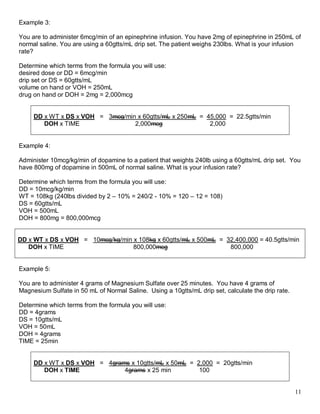
Example 3: 
You are to administer 6mcg/min of an epinephrine infusion. You have 2mg of epinephrine in 250mL of normal saline. You are using a 60gtts/mL drip set. The patient weighs 230lbs. What is your infusion rate? 
Determine which terms from the formula you will use: 
desired dose or DD = 6mcg/min 
drip set or DS = 60gtts/mL 
volume on hand or VOH = 250mL 
drug on hand or DOH = 2mg = 2,000mcg 
DD x WT x DS x VOH = 3mcg/min x 60gtts/mL x 250mL = 45,000 = 22.5gtts/min 
DOH x TIME 2,000mcg 2,000 
Example 4: 
Administer 10mcg/kg/min of dopamine to a patient that weights 240lb using a 60gtts/mL drip set. You have 800mg of dopamine in 500mL of normal saline. What is your infusion rate? 
Determine which terms from the formula you will use: 
DD = 10mcg/kg/min 
WT = 108kg (240lbs divided by 2 – 10% = 240/2 - 10% = 120 – 12 = 108) 
DS = 60gtts/mL 
VOH = 500mL 
DOH = 800mg = 800,000mcg 
DD x WT x DS x VOH = 10mcg/kg/min x 108kg x 60gtts/mL x 500mL = 32,400,000 = 40.5gtts/min 
DOH x TIME 800,000mcg 800,000 
Example 5: 
You are to administer 4 grams of Magnesium Sulfate over 25 minutes. You have 4 grams of Magnesium Sulfate in 50 mL of Normal Saline. Using a 10gtts/mL drip set, calculate the drip rate. 
Determine which terms from the formula you will use: 
DD = 4grams 
DS = 10gtts/mL 
VOH = 50mL 
DOH = 4grams 
TIME = 25min 
DD x WT x DS x VOH = 4grams x 10gtts/mL x 50mL = 2,000 = 20gtts/min 
DOH x TIME 4grams x 25 min 100
12 
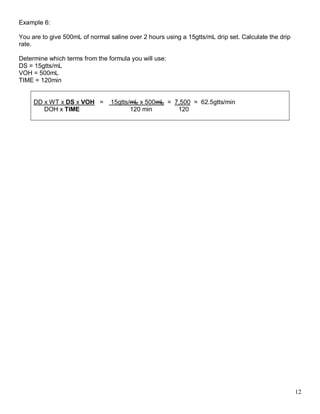
Example 6: 
You are to give 500mL of normal saline over 2 hours using a 15gtts/mL drip set. Calculate the drip rate. 
Determine which terms from the formula you will use: 
DS = 15gtts/mL 
VOH = 500mL 
TIME = 120min 
DD x WT x DS x VOH = 15gtts/mL x 500mL = 7,500 = 62.5gtts/min 
DOH x TIME 120 min 120

Medical mathmatics, a handout

  • 1.
    1 Medical Mathematics By Michael Austin, AS, EMT-P, FP-C There are a few drug calculations necessary in the pre-hospital setting. These calculations are needed to administer IV Bolus medications, IV medication infusions, IV fluid flow rates, and IM/SC injections. In addition, there are a few ‘street rules’ that come in handy. This packet will cover the above listed formulas. In addition, you will receive instruction in metric conversion and a review of basic arithmetic. Common abbreviations are used in medication administration for all medical fields. Below is a list of some abbreviations that are found in drug calculations used in the pre-hospital setting: gram = mass min = minute Meter = length IVP = intravenous push liter = volume IVPB = intravenous piggyback kg = kilogram mg/kg = milligrams per kilogram gm = gram mcg/kg = micrograms per kilogram mg = milligrams mg/kg/min = milligrams per kilogram per minute mcg = micrograms mcg/kg/min = micrograms per kilogram per minute L = liter gtts/mL = drops per milliliter mL = milliliter gtts/min = drops per minute cc = mL concentration = amount of drug in 1mL of fluid hr = hour VOH = volume on hand ATI = amount to be infused DOH = drug on hand DD = desired dose DS = drip set Metric Conversion The metric system is an international decimalized system of measurement that was originally introduced by France in 1799. The main feature of the metric system was the standard set of prefixes in powers of ten. The effect of the prefixes is to multiply or divide the unit by a factor of ten, one hundred or one thousand. kg (kilograms) gm (grams) to go up, divide by 1,000 to go down, multiply by 1,000 mg (milligrams) mcg (micrograms) Example 1: Convert 3 grams to milligrams Multiply 3 grams by 1,000 (going down from grams to milligrams on the chart) to get 3,000mg
  • 2.
    2 Example 2: Convert 2 grams to micrograms Multiply 2 grams by 1,000 to get 2,000mg, then multiply 2,000 by 1,000 to get 2,000,000mcg Example 3: Convert 400 micrograms to milligrams Divide 400 micrograms (going up from micrograms to milligrams on the chart) to get 0.400mg Basic Arithmetic Addition of Integers: Multiplication of Integers: Example 1: 48+402+7 Example 1: 367 x 78 Example 2: 7.4+4.84+2 Example 2: 7.45 x 5.6 Subtraction of integers: Division of Integers: Example 1: 919-356 Example 1: 5720/44 Example 2: 9.29-6.43 Example 2: 12.36/0.24
  • 3.
    3 IV MedicationBolus / Volume to be Administered This formula is used when administering a specific medication as a single event. This medication administration can be done via IV, SC or IM. When you are given a volume to administer, make sure all of the units of measure are in the same prefix. After converting all the units to the same prefix, use the following formula: Formula: IV Medication Bolus / Volume To Be Administered desired dose x volume on hand = volume to be administered drug on hand Example 1: You are ordered to give 20mg of Cardizem slow IVP. Your vial contains 25mg of the drug in 5mL of solution. How much of the medication should you administer? Calculate volume to be administered using formula: 20mg x 5mL = 20mg x 5mL = 100 = 4 mL 25mg 25mg 25 Example 2: Administer 1.5 mg/kg of lidocaine IVP to a patient. Your lidocaine is packaged 100mg per 5mL of solution. The patient weighs 160lb. How much of the medication should you administer? Convert all units to like measurements: 160lb = 72kg (160 divided by 2 – 10% = 160/2 - 10% = 80 – 8 = 72) Calculate desired dose: 1.5mg x 72kg = 108mg Calculate volume to be administered using formula: 108mg x 5mL = 108mg x 5mL = 540 = 5.40 mL 100mg 100mg 100
  • 4.
    4 Example 3: Administer 0.8mg of Narcan IVP to a patient. Concentration of Narcan is 0.4mg/mL in 10mL of solution. The patient weighs 160lb. How much of the medication should you administer? Calculate drug on hand: 0.4mg/mL x 10mL = 4mg Calculate volume to be administered using formula: 0.8mg x 10mL = 0.8mg x 10mL = 8 = 2 mL 4mg 4mg 4 Medication Infusion Rates Infusion rates are necessary when delivering a medication during a continuous IV infusion. It is important to convert all units to like measurements. Formula: Medication Infusion Rate desired dose x drip set = gtts/min concentration or volume on hand x drip set x desired dose = gtts/min drug on hand Example 1: You are to administer a lidocaine infusion at 4mg/min. You have 4 grams of the drug in 500mL of normal saline. The infusion set is 60 gtts/mL. How many drops per minute will you deliver? Convert all units to like measurements: 1. 4g x 1,000mg = 4,000mg Calculate concentration: 2. 4,000mg / 500mL = 8mg/mL
  • 5.
    5 Calculate dropsper minute using infusion rate formula: 4mg/min x 60gtts/mL = 4mg/min x 60gtts/mL = 240 = 30 gtts/min 8mg/mL 8mg/mL 8 or Convert all units to like measurements: 1. 4g x 1,000mg =4,000mg Calculate drops per minute using infusion rate formula: 500mL x 60gtts/mL x 4mg/min = 500mL x 60gtts/mL x 4mg/min = 120,000 = 30 gtts/min 4,000mg 4,000mg 4,000 Example 2: You are to administer epinephrine at 8mcg/min. You have 2mg of the drug in 250mL of normal saline. The infusion set is 60gtts/mL. What is your infusion rate? Convert all units to like measurements: 1. 2mg x 1,000mcg = 2,000mcg Calculate concentration: 2. 2,000mcg / 250mL = 8mcg/mL Calculate drops per minute using infusion rate formula: 8mcg/min x 60gtts/mL = 8mcg/min x 60gtts/mL = 480 = 60gtts/min 8mcg in 1 mL 8mcg in 1 mL 8 or Convert all units to like measurements: 1. 2mg x 1,000mcg = 2,000mcg Calculate drops per minute using infusion rate formula: 250mL x 60gtts/mL x 8mcg/min = 250mL x 60gtts/mL x 8mcg/min = 120,000 = 60gtts/min 2,000mcg 2,000mcg 2,000
  • 6.
    6 Weight BasedInfusion Rate Drugs like dopamine are administered in micrograms per kilogram per minute. This formula is used to calculate drug administration over time based on patient’s weight. Formula: Weight Based Infusion Rate desired dose x weight (kg) x drip set = gtts/min concentration Example 1: Administer 5mcg/kg/min of dopamine to a patient that weights 180lb using a 60gtts/mL drip set. You have 800mg of dopamine in 500mL of normal saline. What is your drip rate? Convert units to like measurements: 1. 800mg x 1,000 = 800,000mcg 2. 180lb / 2 – 10% = 81kg Calculate concentration: 1. 800,000mcg / 500ml = 1,600mcg/ml Calculate drops per minute using formula: 5mcg/kg/min x 81kg x 60gtts/mL = 5mcg/kg/min x 81kg x 60gtts/mL = 24,300 = 15.1875 = 15gtts/min 1,600mcg/mL 1,600mcg/mL 1,600 Example 2: Administer 10mcg/kg/min of dopamine to a patient that weights 140lb using a 60gtts/mL drip set. You have 400mg of dopamine in 500mL of normal saline. What is your drip rate? Convert units to like measurements: 1. 400mg x 1,000 = 400,000mcg 2. 140lb / 2 – 10% = 63kg Calculate concentration: 1. 400,000mcg / 500ml = 800mcg/ml Calculate drops per minute using formula: 10mcg/kg x 63kg x 60gtts/mL = 10mcg/kg x 63kg x 60gtts/mL = 37,800 = 47.25 = 47gtts/min 800mcg/mL x 1min 800mcg/mL x 1min 800
  • 7.
    7 IV FluidFlow Rate When calculating IV flow rates, it’s important to know which type of drip set that we should use. The common drip sets are listed below: 10 gtts/mL = standard (trauma or macro) drip 15 gtts/mL = standard (trauma) drip 20 gtts/mL = standard (trauma) drip 60 gtts/mL = microdrip Formula: IV Fluid Flow Rate amount to be infused x drip set = gtts/min time (in minutes) Example 1: You are to give 500mL of normal saline over 2 hours using a 15gtts/mL drip set. Calculate the drip rate. Convert all units to like measurements: 1. 2 hours = 120 min (60min x2) 500mL x 15gtts/mL = 500mL x 15gtts/mL = 7500 = 62.5 = 60 gtts/min 120 minutes 120 minutes 120 Example 2: You are to administer 4 grams of Magnesium Sulfate over 25 minutes. You have 4 grams of Magnesium Sulfate in 50 mL of Normal Saline. Using a 10gtts/mL drip set, calculate the drip rate. 50mL x 10gtts/mL = 50mL x 10gtts/mL = 500 = 20gtts/min 25 minutes 25 minutes 25
  • 8.
    8 Street Rules There are a few street rules that can be used for certain drugs in certain concentrations. It is imperative that you use the street rules ONLY when you have the correct concentration on hand and are using a 60gtts/mL (micro) drip set. Dopamine: For use when the concentration is 1,600mcg/mL and when using a micro (60gtts/mL) drip set. This can be obtained by having 400mg in 250mL; 800mg in 500mL; or 1600mg in 1,000mL. The calculation using the street rules when having the correct concentration will give you a 5mcg/kg/min dose. Take the patients weight in pounds, rounded to nearest 10, and drop the last number. Subtract one if the patient weighs less than 200lbs, if more than 200lbs, subtract two. This is the gtts/min that will give you roughly 5mcg/kg/min dose. Example 1: Patient weighs 184lbs and you are to administer 10mcg/kg/min of dopamine. You have 800mg of dopamine in 500mL of normal saline using a 60gtts/mL drip set. Patient’s rounded weight in pounds: 180 Drop the last number: 18 Subtract one (patient’s weight is <200lbs): -1 Dosage of 5mcg/kg/min: 17gtts/min Dosage of 10mcg/kg/min: 34gtts/min Example 2: Patient weighs 218lbs and you are to administer 15mcg/kg/min of dopamine. You have 400mg of dopamine in 250mL of normal saline using a 60gtts/mL drip set. Patient’s rounded weight in pounds: 220 Drop the last number: 22 Subtract two (patient’s weight is >200lbs): -2 Dosage of 5mcg/kg/min: 20gtts/min Dosage of 10mcg/kg/min: 40gtts/min Dosage of 15mcg/kg/min: 60gtts/min Example 3: Patient weighs 140lb and you are to administer 10mcg/kg/min of dopamine. You have 400mg of dopamine in 500mL of normal saline using a 60gtts/mL drip set. Unable to use street rules because the concentration is not 1,600mcg/mL. In this example, the concentration is 0.8mg/mL = 800mcg/mL.
  • 9.
    9 Lidocaine: Foruse when the concentration is 4mg/mL and when using a micro (60gtts/mL) drip set. This concentration is most commonly seen by having 2 grams in 500mL. This calculation ‘the clock method’ will give you 1-4mg/min dosage when used properly. So, with the correct concentration, if you needed to administer 2mg/min of lidocaine, you would set your drip rate to 30gtts/min. 60 15 30 45 gtts/min 1mg/min 2mg/min 3mg/min 4mg/min
  • 10.
    10 Single UniversalFormula Method The following formula takes aspects of the previously listed formula’s and places them into one single universal formula. To use this formula, you plug in the appropriate values into the formula and omit any values that you are not using. The value time is only used when it is greater than one minute. The advantage of this formula is that there is only one formula to memorize. The disadvantage of this formula is making sure to plug in only the values that you need in order to come up with the correct answer. Remember, incorrect answers in emergency medicine can kill your patient! Formula: Single Universal Formula desired dose x weight (kg) x drip set x volume on hand = gtts/min or mL drug on hand x time (in min) Example 1: You are to administer 50mg of Solu-medrol IVP to your pediatric patient. Your vial contains 125mg of the drug in 2mL of solution. How much of the medication should you administer? Determine which terms from formula you will use: DD = 50mg DOH = 125mg VOH = 2mL DD x WT x DS x VOH = 50mg x 2mL = 100 = 0.8mL DOH x TIME 125mg 125 Example 2: Administer 0.3 mg/kg of etomidate IVP to a patient. Your etomidate is packaged 40mg per 20mL of solution. The patient weighs 160lb. How much of the medication should you administer? Determine which terms from the formula you will use: DD = 0.3mg/kg WT = 72kg (160lbs divided by 2 – 10% = 160/2 - 10% = 80 – 8 = 72) DOH = 40mg VOH = 20mL DD x WT x DS x VOH = 0.3mg/kg x 72kg x 20mL = 432 = 10.8mL DOH x TIME 40mg 40
  • 11.
    11 Example 3: You are to administer 6mcg/min of an epinephrine infusion. You have 2mg of epinephrine in 250mL of normal saline. You are using a 60gtts/mL drip set. The patient weighs 230lbs. What is your infusion rate? Determine which terms from the formula you will use: desired dose or DD = 6mcg/min drip set or DS = 60gtts/mL volume on hand or VOH = 250mL drug on hand or DOH = 2mg = 2,000mcg DD x WT x DS x VOH = 3mcg/min x 60gtts/mL x 250mL = 45,000 = 22.5gtts/min DOH x TIME 2,000mcg 2,000 Example 4: Administer 10mcg/kg/min of dopamine to a patient that weights 240lb using a 60gtts/mL drip set. You have 800mg of dopamine in 500mL of normal saline. What is your infusion rate? Determine which terms from the formula you will use: DD = 10mcg/kg/min WT = 108kg (240lbs divided by 2 – 10% = 240/2 - 10% = 120 – 12 = 108) DS = 60gtts/mL VOH = 500mL DOH = 800mg = 800,000mcg DD x WT x DS x VOH = 10mcg/kg/min x 108kg x 60gtts/mL x 500mL = 32,400,000 = 40.5gtts/min DOH x TIME 800,000mcg 800,000 Example 5: You are to administer 4 grams of Magnesium Sulfate over 25 minutes. You have 4 grams of Magnesium Sulfate in 50 mL of Normal Saline. Using a 10gtts/mL drip set, calculate the drip rate. Determine which terms from the formula you will use: DD = 4grams DS = 10gtts/mL VOH = 50mL DOH = 4grams TIME = 25min DD x WT x DS x VOH = 4grams x 10gtts/mL x 50mL = 2,000 = 20gtts/min DOH x TIME 4grams x 25 min 100
  • 12.
    12 Example 6: You are to give 500mL of normal saline over 2 hours using a 15gtts/mL drip set. Calculate the drip rate. Determine which terms from the formula you will use: DS = 15gtts/mL VOH = 500mL TIME = 120min DD x WT x DS x VOH = 15gtts/mL x 500mL = 7,500 = 62.5gtts/min DOH x TIME 120 min 120