Principles of Information Security, 3rd Edition 2
 Define information security
 Relate the history of computer security and how it
evolved into information security
 Define key terms and critical concepts of information
security as presented in this chapter
 Discuss the phases of the security systems
development life cycle
 Present the roles of professionals involved in
information security within an organization
Learning Objectives
Upon completion of this material, you should be able to:
Principles of Information Security, 3rd Edition 3
Introduction
 Information security: a “well-informed sense of
assurance that the information risks and controls are in
balance.” — Jim Anderson, Inovant (2002)
 Necessary to review the origins of this field and its
impact on our understanding of information security
today
Principles of Information Security, 3rd Edition 4
The History of Information Security
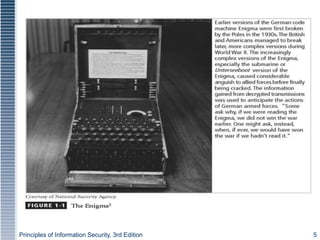
 Began immediately after the first mainframes were
developed
 Groups developing code-breaking computations during
World War II created the first modern computers
 Physical controls to limit access to sensitive military
locations to authorized personnel
 Rudimentary in defending against physical theft,
espionage, and sabotage
Principles of Information Security, 3rd Edition 5
Figure 1-1 – The Enigma
Principles of Information Security, 3rd Edition 6
The 1960s
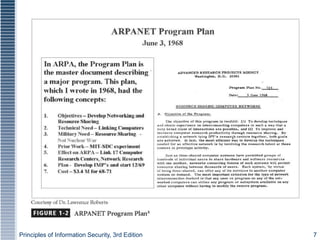
 Advanced Research Project Agency (ARPA) began to
examine feasibility of redundant networked
communications
 Larry Roberts developed ARPANET from its inception
Principles of Information Security, 3rd Edition 7
Figure 1-2 - ARPANET
Principles of Information Security, 3rd Edition 8
The 1970s and 80s
 ARPANET grew in popularity as did its potential for misuse
 Fundamental problems with ARPANET security were
identified
 No safety procedures for dial-up connections to ARPANET
 Nonexistent user identification and authorization to system
 Late 1970s: microprocessor expanded computing
capabilities and security threats
Principles of Information Security, 3rd Edition 9
The 1970s and 80s (continued)
 Information security began with Rand Report R-609 (paper
that started the study of computer security)
 Scope of computer security grew from physical security to
include:
 Safety of data
 Limiting unauthorized access to data
 Involvement of personnel from multiple levels of an
organization
Principles of Information Security, 3rd Edition 10
MULTICS
 Early focus of computer security research was a system
called Multiplexed Information and Computing Service
(MULTICS)
 First operating system created with security as its primary
goal
 Mainframe, time-sharing OS developed in mid-1960s by
General Electric (GE), Bell Labs, and Massachusetts
Institute of Technology (MIT)
 Several MULTICS key players created UNIX
 Primary purpose of UNIX was text processing
Principles of Information Security, 3rd Edition 11
The 1990s
 Networks of computers became more common; so too
did the need to interconnect networks
 Internet became first manifestation of a global network of
networks
 In early Internet deployments, security was treated as a
low priority
Principles of Information Security, 3rd Edition 12
The Present
 The Internet brings millions of computer networks into
communication with each other—many of them
unsecured
 Ability to secure a computer’s data influenced by the
security of every computer to which it is connected
Principles of Information Security, 3rd Edition 13
What is Security?
 “The quality or state of being secure—to be free from
danger”
 A successful organization should have multiple layers of
security in place:
 Physical security
 Personal security
 Operations security
 Communications security
 Network security
 Information security
Principles of Information Security, 3rd Edition 14
What is Security? (continued)
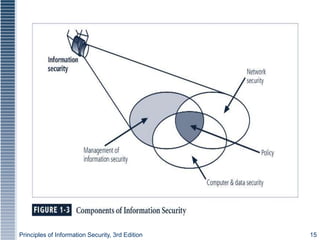
 The protection of information and its critical elements,
including systems and hardware that use, store, and
transmit that information
 Necessary tools: policy, awareness, training, education,
technology
 C.I.A. triangle was standard based on confidentiality,
integrity, and availability
 C.I.A. triangle now expanded into list of critical
characteristics of information
Principles of Information Security, 3rd Edition 15
Principles of Information Security, 3rd Edition 16
Critical Characteristics of Information
 The value of information comes from the characteristics it
possesses:
 Availability
 Accuracy
 Authenticity
 Confidentiality
 Integrity
 Utility
 Possession
Principles of Information Security, 3rd Edition 17
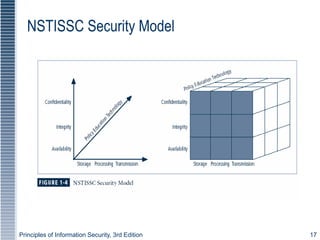
Figure 1-4 – NSTISSC Security
Model
NSTISSC Security Model
Principles of Information Security, 3rd Edition 18
Components of an Information System
 Information system (IS) is entire set of software,
hardware, data, people, procedures, and networks
necessary to use information as a resource in the
organization
Principles of Information Security, 3rd Edition 19
Securing Components
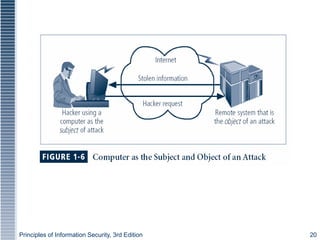
 Computer can be subject of an attack and/or the object
of an attack
 When the subject of an attack, computer is used as an
active tool to conduct attack
 When the object of an attack, computer is the entity being
attacked
Principles of Information Security, 3rd Edition 20
Figure 1-5 – Subject and Object of
Attack
Principles of Information Security, 3rd Edition 21
Balancing Information Security and Access
 Impossible to obtain perfect security—it is a process, not
an absolute
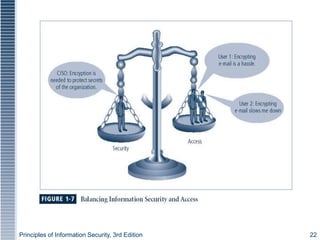
 Security should be considered balance between
protection and availability
 To achieve balance, level of security must allow
reasonable access, yet protect against threats
Principles of Information Security, 3rd Edition 22
Figure 1-6 – Balancing Security and
Access
Principles of Information Security, 3rd Edition 23
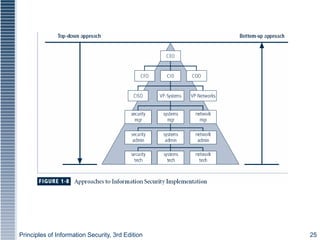
Approaches to Information Security
Implementation: Bottom-Up Approach
 Grassroots effort: systems administrators attempt to
improve security of their systems
 Key advantage: technical expertise of individual
administrators
 Seldom works, as it lacks a number of critical features:
 Participant support
 Organizational staying power
Principles of Information Security, 3rd Edition 24
Approaches to Information Security
Implementation: Top-Down Approach
 Initiated by upper management
 Issue policy, procedures, and processes
 Dictate goals and expected outcomes of project
 Determine accountability for each required action
 The most successful also involve formal development
strategy referred to as systems development life cycle
Principles of Information Security, 3rd Edition 25
Principles of Information Security, 3rd Edition 26
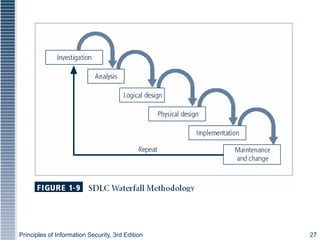
The Systems Development Life Cycle
 Systems Development Life Cycle (SDLC) is methodology
for design and implementation of information system within
an organization
 Methodology is formal approach to problem solving based
on structured sequence of procedures
 Using a methodology:
 Ensures a rigorous process
 Avoids missing steps
 Goal is creating a comprehensive security posture/program
 Traditional SDLC consists of six general phases
Principles of Information Security, 3rd Edition 27
Principles of Information Security, 3rd Edition 28
Investigation
 What problem is the system being developed to solve?
 Objectives, constraints, and scope of project are
specified
 Preliminary cost-benefit analysis is developed
 At the end, feasibility analysis is performed to assess
economic, technical, and behavioral feasibilities of the
process
Principles of Information Security, 3rd Edition 29
Analysis
 Consists of assessments of the organization, status of
current systems, and capability to support proposed
systems
 Analysts determine what new system is expected to do
and how it will interact with existing systems
 Ends with documentation of findings and update of
feasibility analysis
Principles of Information Security, 3rd Edition 30
Logical Design
 Main factor is business need; applications capable of
providing needed services are selected
 Data support and structures capable of providing the
needed inputs are identified
 Technologies to implement physical solution are
determined
 Feasibility analysis performed at the end
Principles of Information Security, 3rd Edition 31
Physical Design
 Technologies to support the alternatives identified and
evaluated in the logical design are selected
 Components evaluated on make-or-buy decision
 Feasibility analysis performed; entire solution presented
to end-user representatives for approval
Principles of Information Security, 3rd Edition 32
Implementation
 Needed software created; components ordered, received,
assembled, and tested
 Users trained and documentation created
 Feasibility analysis prepared; users presented with
system for performance review and acceptance test
Principles of Information Security, 3rd Edition 33
Maintenance and Change
 Consists of tasks necessary to support and modify
system for remainder of its useful life
 Life cycle continues until the process begins again from
the investigation phase
 When current system can no longer support the
organization’s mission, a new project is implemented
Principles of Information Security, 3rd Edition 34
The Security Systems Development Life Cycle
 The same phases used in traditional SDLC may be
adapted to support specialized implementation of an IS
project
 Identification of specific threats and creating controls to
counter them
 SecSDLC is a coherent program rather than a series of
random, seemingly unconnected actions
Principles of Information Security, 3rd Edition 35
Investigation
 Identifies process, outcomes, goals, and constraints of
the project
 Begins with Enterprise Information Security Policy (EISP)
 Organizational feasibility analysis is performed
Principles of Information Security, 3rd Edition 36
Analysis
 Documents from investigation phase are studied
 Analysis of existing security policies or programs, along
with documented current threats and associated controls
 Includes analysis of relevant legal issues that could
impact design of the security solution
 Risk management task begins
Principles of Information Security, 3rd Edition 37
Logical Design
 Creates and develops blueprints for information security
 Incident response actions planned:
 Continuity planning
 Incident response
 Disaster recovery
 Feasibility analysis to determine whether project should
be continued or outsourced
Principles of Information Security, 3rd Edition 38
Physical Design
 Needed security technology is evaluated, alternatives are
generated, and final design is selected
 At end of phase, feasibility study determines readiness of
organization for project
Principles of Information Security, 3rd Edition 39
Implementation
 Security solutions are acquired, tested, implemented, and
tested again
 Personnel issues evaluated; specific training and
education programs conducted
 Entire tested package is presented to management for
final approval
Principles of Information Security, 3rd Edition 40
Maintenance and Change
 Perhaps the most important phase, given the ever-
changing threat environment
 Often, reparation and restoration of information is a
constant duel with an unseen adversary
 Information security profile of an organization requires
constant adaptation as new threats emerge and old
threats evolve
Principles of Information Security, 3rd Edition 41
Security Professionals and the Organization
 Wide range of professionals required to support a diverse
information security program
 Senior management is key component; also, additional
administrative support and technical expertise are
required to implement details of IS program
Principles of Information Security, 3rd Edition 42
Senior Management
 Chief Information Officer (CIO)
 Senior technology officer
 Primarily responsible for advising senior executives on
strategic planning
 Chief Information Security Officer (CISO)
 Primarily responsible for assessment, management,
and implementation of IS in the organization
 Usually reports directly to the CIO
Principles of Information Security, 3rd Edition 43
Information Security Project Team
 A number of individuals who are experienced in one or
more facets of required technical and nontechnical areas:
 Champion
 Team leader
 Security policy developers
 Risk assessment specialists
 Security professionals
 Systems administrators
 End users
Principles of Information Security, 3rd Edition 44
Data Ownership
 Data owner: responsible for the security and use of a
particular set of information
 Data custodian: responsible for storage, maintenance,
and protection of information
 Data users: end users who work with information to
perform their daily jobs supporting the mission of the
organization
Principles of Information Security, 3rd Edition 45
Communities of Interest
 Group of individuals united by similar interests/values
within an organization
 Information security management and professionals
 Information technology management and professionals
 Organizational management and professionals
Principles of Information Security, 3rd Edition 46
Information Security: Is it an Art or a Science?
 Implementation of information security often described as
combination of art and science
 “Security artesan” idea: based on the way individuals
perceive systems technologists since computers became
commonplace
Principles of Information Security, 3rd Edition 47
Security as Art
 No hard and fast rules nor many universally accepted
complete solutions
 No manual for implementing security through entire
system
Principles of Information Security, 3rd Edition 48
Security as Science
 Dealing with technology designed to operate at high
levels of performance
 Specific conditions cause virtually all actions that occur in
computer systems
 Nearly every fault, security hole, and systems
malfunction are a result of interaction of specific
hardware and software
 If developers had sufficient time, they could resolve and
eliminate faults
Principles of Information Security, 3rd Edition 49
Security as a Social Science
 Social science examines the behavior of individuals
interacting with systems
 Security begins and ends with the people that interact
with the system
 Security administrators can greatly reduce levels of risk
caused by end users, and create more acceptable and
supportable security profiles
Principles of Information Security, 3rd Edition 50
Key Terms
 Access
 Asset
 Attack
 Control, Safeguard, or
Countermeasure
 Exploit
 Exposure
 Hack
 Object
 Risk
 Security Blueprint
 Security Model
 Security Posture or
Security Profile
 Subject
 Threats
 Threat Agent
 Vulnerability
Principles of Information Security, 3rd Edition 51
Summary
 Information security is a “well-informed sense of
assurance that the information risks and controls are in
balance”
 Computer security began immediately after first
mainframes were developed
 Successful organizations have multiple layers of security
in place: physical, personal, operations, communications,
network, and information
Principles of Information Security, 3rd Edition 52
Summary (continued)
 Security should be considered a balance between
protection and availability
 Information security must be managed similarly to any
major system implemented in an organization using a
methodology like SecSDLC
 Implementation of information security often described as
a combination of art and science

information-security-3rd-edition2-define-information-security.ppt

  • 2.
    Principles of InformationSecurity, 3rd Edition 2  Define information security  Relate the history of computer security and how it evolved into information security  Define key terms and critical concepts of information security as presented in this chapter  Discuss the phases of the security systems development life cycle  Present the roles of professionals involved in information security within an organization Learning Objectives Upon completion of this material, you should be able to:
  • 3.
    Principles of InformationSecurity, 3rd Edition 3 Introduction  Information security: a “well-informed sense of assurance that the information risks and controls are in balance.” — Jim Anderson, Inovant (2002)  Necessary to review the origins of this field and its impact on our understanding of information security today
  • 4.
    Principles of InformationSecurity, 3rd Edition 4 The History of Information Security  Began immediately after the first mainframes were developed  Groups developing code-breaking computations during World War II created the first modern computers  Physical controls to limit access to sensitive military locations to authorized personnel  Rudimentary in defending against physical theft, espionage, and sabotage
  • 5.
    Principles of InformationSecurity, 3rd Edition 5 Figure 1-1 – The Enigma
  • 6.
    Principles of InformationSecurity, 3rd Edition 6 The 1960s  Advanced Research Project Agency (ARPA) began to examine feasibility of redundant networked communications  Larry Roberts developed ARPANET from its inception
  • 7.
    Principles of InformationSecurity, 3rd Edition 7 Figure 1-2 - ARPANET
  • 8.
    Principles of InformationSecurity, 3rd Edition 8 The 1970s and 80s  ARPANET grew in popularity as did its potential for misuse  Fundamental problems with ARPANET security were identified  No safety procedures for dial-up connections to ARPANET  Nonexistent user identification and authorization to system  Late 1970s: microprocessor expanded computing capabilities and security threats
  • 9.
    Principles of InformationSecurity, 3rd Edition 9 The 1970s and 80s (continued)  Information security began with Rand Report R-609 (paper that started the study of computer security)  Scope of computer security grew from physical security to include:  Safety of data  Limiting unauthorized access to data  Involvement of personnel from multiple levels of an organization
  • 10.
    Principles of InformationSecurity, 3rd Edition 10 MULTICS  Early focus of computer security research was a system called Multiplexed Information and Computing Service (MULTICS)  First operating system created with security as its primary goal  Mainframe, time-sharing OS developed in mid-1960s by General Electric (GE), Bell Labs, and Massachusetts Institute of Technology (MIT)  Several MULTICS key players created UNIX  Primary purpose of UNIX was text processing
  • 11.
    Principles of InformationSecurity, 3rd Edition 11 The 1990s  Networks of computers became more common; so too did the need to interconnect networks  Internet became first manifestation of a global network of networks  In early Internet deployments, security was treated as a low priority
  • 12.
    Principles of InformationSecurity, 3rd Edition 12 The Present  The Internet brings millions of computer networks into communication with each other—many of them unsecured  Ability to secure a computer’s data influenced by the security of every computer to which it is connected
  • 13.
    Principles of InformationSecurity, 3rd Edition 13 What is Security?  “The quality or state of being secure—to be free from danger”  A successful organization should have multiple layers of security in place:  Physical security  Personal security  Operations security  Communications security  Network security  Information security
  • 14.
    Principles of InformationSecurity, 3rd Edition 14 What is Security? (continued)  The protection of information and its critical elements, including systems and hardware that use, store, and transmit that information  Necessary tools: policy, awareness, training, education, technology  C.I.A. triangle was standard based on confidentiality, integrity, and availability  C.I.A. triangle now expanded into list of critical characteristics of information
  • 15.
    Principles of InformationSecurity, 3rd Edition 15
  • 16.
    Principles of InformationSecurity, 3rd Edition 16 Critical Characteristics of Information  The value of information comes from the characteristics it possesses:  Availability  Accuracy  Authenticity  Confidentiality  Integrity  Utility  Possession
  • 17.
    Principles of InformationSecurity, 3rd Edition 17 Figure 1-4 – NSTISSC Security Model NSTISSC Security Model
  • 18.
    Principles of InformationSecurity, 3rd Edition 18 Components of an Information System  Information system (IS) is entire set of software, hardware, data, people, procedures, and networks necessary to use information as a resource in the organization
  • 19.
    Principles of InformationSecurity, 3rd Edition 19 Securing Components  Computer can be subject of an attack and/or the object of an attack  When the subject of an attack, computer is used as an active tool to conduct attack  When the object of an attack, computer is the entity being attacked
  • 20.
    Principles of InformationSecurity, 3rd Edition 20 Figure 1-5 – Subject and Object of Attack
  • 21.
    Principles of InformationSecurity, 3rd Edition 21 Balancing Information Security and Access  Impossible to obtain perfect security—it is a process, not an absolute  Security should be considered balance between protection and availability  To achieve balance, level of security must allow reasonable access, yet protect against threats
  • 22.
    Principles of InformationSecurity, 3rd Edition 22 Figure 1-6 – Balancing Security and Access
  • 23.
    Principles of InformationSecurity, 3rd Edition 23 Approaches to Information Security Implementation: Bottom-Up Approach  Grassroots effort: systems administrators attempt to improve security of their systems  Key advantage: technical expertise of individual administrators  Seldom works, as it lacks a number of critical features:  Participant support  Organizational staying power
  • 24.
    Principles of InformationSecurity, 3rd Edition 24 Approaches to Information Security Implementation: Top-Down Approach  Initiated by upper management  Issue policy, procedures, and processes  Dictate goals and expected outcomes of project  Determine accountability for each required action  The most successful also involve formal development strategy referred to as systems development life cycle
  • 25.
    Principles of InformationSecurity, 3rd Edition 25
  • 26.
    Principles of InformationSecurity, 3rd Edition 26 The Systems Development Life Cycle  Systems Development Life Cycle (SDLC) is methodology for design and implementation of information system within an organization  Methodology is formal approach to problem solving based on structured sequence of procedures  Using a methodology:  Ensures a rigorous process  Avoids missing steps  Goal is creating a comprehensive security posture/program  Traditional SDLC consists of six general phases
  • 27.
    Principles of InformationSecurity, 3rd Edition 27
  • 28.
    Principles of InformationSecurity, 3rd Edition 28 Investigation  What problem is the system being developed to solve?  Objectives, constraints, and scope of project are specified  Preliminary cost-benefit analysis is developed  At the end, feasibility analysis is performed to assess economic, technical, and behavioral feasibilities of the process
  • 29.
    Principles of InformationSecurity, 3rd Edition 29 Analysis  Consists of assessments of the organization, status of current systems, and capability to support proposed systems  Analysts determine what new system is expected to do and how it will interact with existing systems  Ends with documentation of findings and update of feasibility analysis
  • 30.
    Principles of InformationSecurity, 3rd Edition 30 Logical Design  Main factor is business need; applications capable of providing needed services are selected  Data support and structures capable of providing the needed inputs are identified  Technologies to implement physical solution are determined  Feasibility analysis performed at the end
  • 31.
    Principles of InformationSecurity, 3rd Edition 31 Physical Design  Technologies to support the alternatives identified and evaluated in the logical design are selected  Components evaluated on make-or-buy decision  Feasibility analysis performed; entire solution presented to end-user representatives for approval
  • 32.
    Principles of InformationSecurity, 3rd Edition 32 Implementation  Needed software created; components ordered, received, assembled, and tested  Users trained and documentation created  Feasibility analysis prepared; users presented with system for performance review and acceptance test
  • 33.
    Principles of InformationSecurity, 3rd Edition 33 Maintenance and Change  Consists of tasks necessary to support and modify system for remainder of its useful life  Life cycle continues until the process begins again from the investigation phase  When current system can no longer support the organization’s mission, a new project is implemented
  • 34.
    Principles of InformationSecurity, 3rd Edition 34 The Security Systems Development Life Cycle  The same phases used in traditional SDLC may be adapted to support specialized implementation of an IS project  Identification of specific threats and creating controls to counter them  SecSDLC is a coherent program rather than a series of random, seemingly unconnected actions
  • 35.
    Principles of InformationSecurity, 3rd Edition 35 Investigation  Identifies process, outcomes, goals, and constraints of the project  Begins with Enterprise Information Security Policy (EISP)  Organizational feasibility analysis is performed
  • 36.
    Principles of InformationSecurity, 3rd Edition 36 Analysis  Documents from investigation phase are studied  Analysis of existing security policies or programs, along with documented current threats and associated controls  Includes analysis of relevant legal issues that could impact design of the security solution  Risk management task begins
  • 37.
    Principles of InformationSecurity, 3rd Edition 37 Logical Design  Creates and develops blueprints for information security  Incident response actions planned:  Continuity planning  Incident response  Disaster recovery  Feasibility analysis to determine whether project should be continued or outsourced
  • 38.
    Principles of InformationSecurity, 3rd Edition 38 Physical Design  Needed security technology is evaluated, alternatives are generated, and final design is selected  At end of phase, feasibility study determines readiness of organization for project
  • 39.
    Principles of InformationSecurity, 3rd Edition 39 Implementation  Security solutions are acquired, tested, implemented, and tested again  Personnel issues evaluated; specific training and education programs conducted  Entire tested package is presented to management for final approval
  • 40.
    Principles of InformationSecurity, 3rd Edition 40 Maintenance and Change  Perhaps the most important phase, given the ever- changing threat environment  Often, reparation and restoration of information is a constant duel with an unseen adversary  Information security profile of an organization requires constant adaptation as new threats emerge and old threats evolve
  • 41.
    Principles of InformationSecurity, 3rd Edition 41 Security Professionals and the Organization  Wide range of professionals required to support a diverse information security program  Senior management is key component; also, additional administrative support and technical expertise are required to implement details of IS program
  • 42.
    Principles of InformationSecurity, 3rd Edition 42 Senior Management  Chief Information Officer (CIO)  Senior technology officer  Primarily responsible for advising senior executives on strategic planning  Chief Information Security Officer (CISO)  Primarily responsible for assessment, management, and implementation of IS in the organization  Usually reports directly to the CIO
  • 43.
    Principles of InformationSecurity, 3rd Edition 43 Information Security Project Team  A number of individuals who are experienced in one or more facets of required technical and nontechnical areas:  Champion  Team leader  Security policy developers  Risk assessment specialists  Security professionals  Systems administrators  End users
  • 44.
    Principles of InformationSecurity, 3rd Edition 44 Data Ownership  Data owner: responsible for the security and use of a particular set of information  Data custodian: responsible for storage, maintenance, and protection of information  Data users: end users who work with information to perform their daily jobs supporting the mission of the organization
  • 45.
    Principles of InformationSecurity, 3rd Edition 45 Communities of Interest  Group of individuals united by similar interests/values within an organization  Information security management and professionals  Information technology management and professionals  Organizational management and professionals
  • 46.
    Principles of InformationSecurity, 3rd Edition 46 Information Security: Is it an Art or a Science?  Implementation of information security often described as combination of art and science  “Security artesan” idea: based on the way individuals perceive systems technologists since computers became commonplace
  • 47.
    Principles of InformationSecurity, 3rd Edition 47 Security as Art  No hard and fast rules nor many universally accepted complete solutions  No manual for implementing security through entire system
  • 48.
    Principles of InformationSecurity, 3rd Edition 48 Security as Science  Dealing with technology designed to operate at high levels of performance  Specific conditions cause virtually all actions that occur in computer systems  Nearly every fault, security hole, and systems malfunction are a result of interaction of specific hardware and software  If developers had sufficient time, they could resolve and eliminate faults
  • 49.
    Principles of InformationSecurity, 3rd Edition 49 Security as a Social Science  Social science examines the behavior of individuals interacting with systems  Security begins and ends with the people that interact with the system  Security administrators can greatly reduce levels of risk caused by end users, and create more acceptable and supportable security profiles
  • 50.
    Principles of InformationSecurity, 3rd Edition 50 Key Terms  Access  Asset  Attack  Control, Safeguard, or Countermeasure  Exploit  Exposure  Hack  Object  Risk  Security Blueprint  Security Model  Security Posture or Security Profile  Subject  Threats  Threat Agent  Vulnerability
  • 51.
    Principles of InformationSecurity, 3rd Edition 51 Summary  Information security is a “well-informed sense of assurance that the information risks and controls are in balance”  Computer security began immediately after first mainframes were developed  Successful organizations have multiple layers of security in place: physical, personal, operations, communications, network, and information
  • 52.
    Principles of InformationSecurity, 3rd Edition 52 Summary (continued)  Security should be considered a balance between protection and availability  Information security must be managed similarly to any major system implemented in an organization using a methodology like SecSDLC  Implementation of information security often described as a combination of art and science