

ASSIGNMENT ON

‘MACROECONOMIC’
Bil              Particulars   Pages


TABLE OF CONTENT
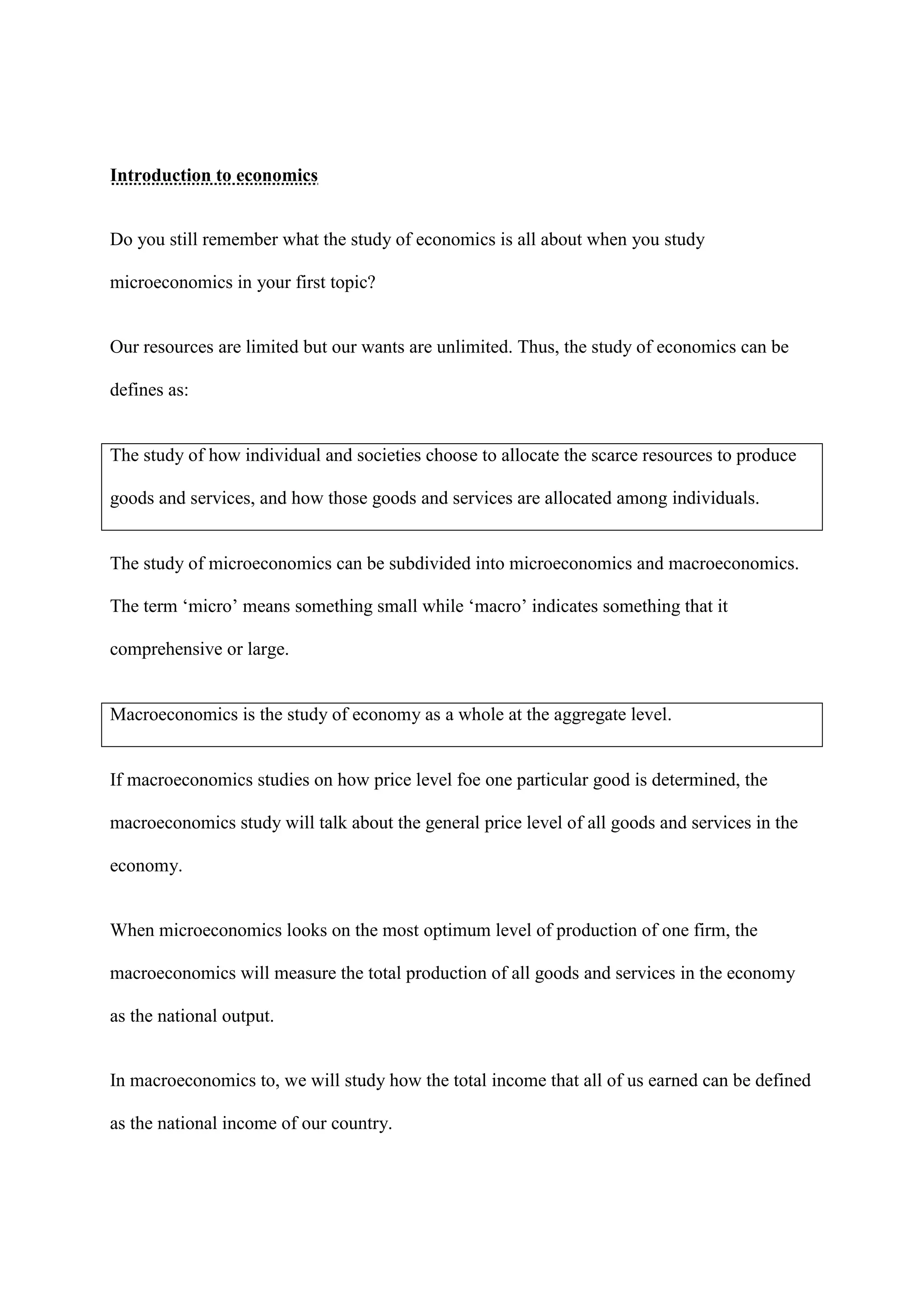
Introduction to economics


Do you still remember what the study of economics is all about when you study

microeconomics in your first topic?


Our resources are limited but our wants are unlimited. Thus, the study of economics can be

defines as:


The study of how individual and societies choose to allocate the scarce resources to produce

goods and services, and how those goods and services are allocated among individuals.


The study of microeconomics can be subdivided into microeconomics and macroeconomics.

The term ‘micro’ means something small while ‘macro’ indicates something that it

comprehensive or large.


Macroeconomics is the study of economy as a whole at the aggregate level.


If macroeconomics studies on how price level foe one particular good is determined, the

macroeconomics study will talk about the general price level of all goods and services in the

economy.


When microeconomics looks on the most optimum level of production of one firm, the

macroeconomics will measure the total production of all goods and services in the economy

as the national output.


In macroeconomics to, we will study how the total income that all of us earned can be defined

as the national income of our country.
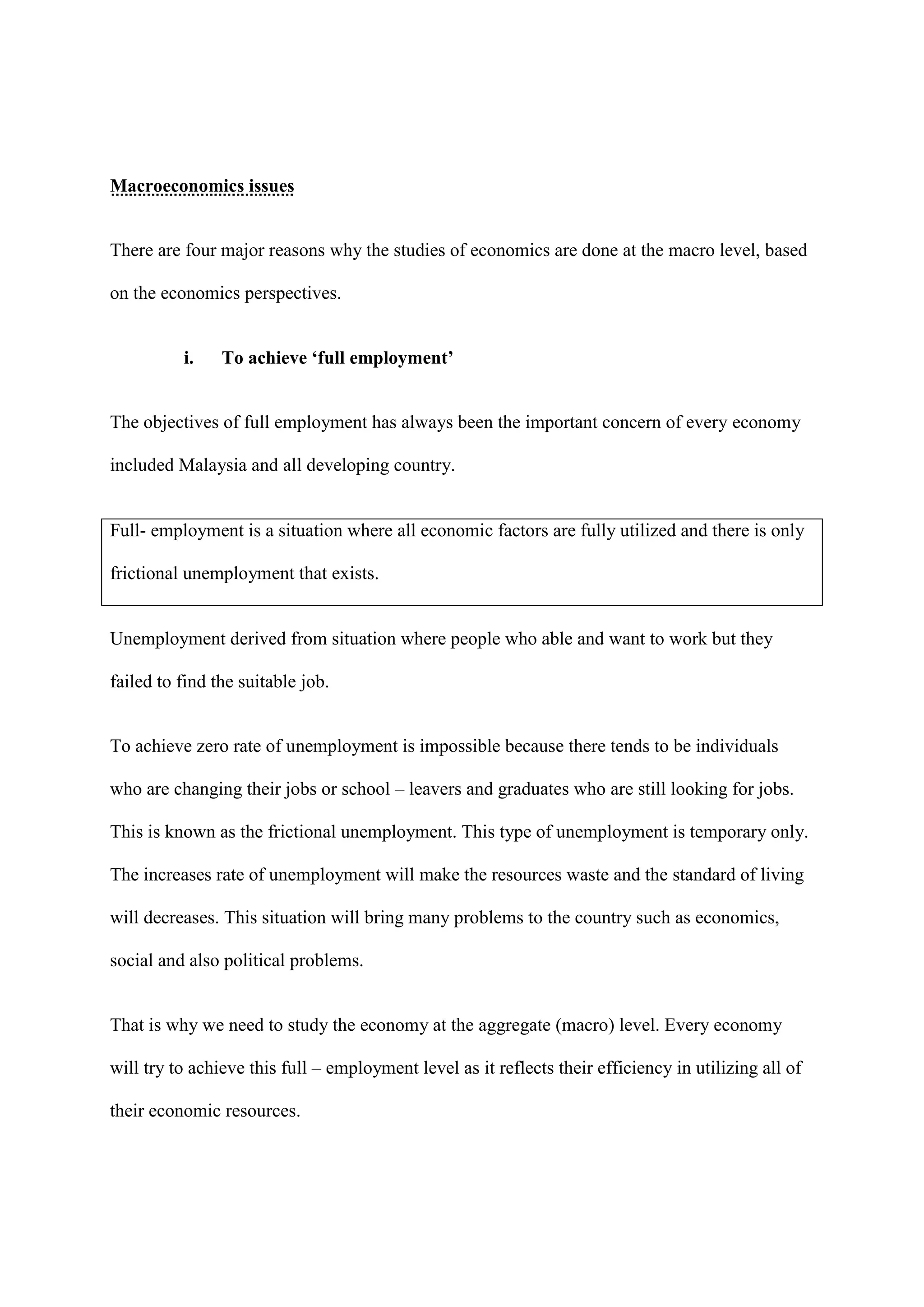
Macroeconomics issues


There are four major reasons why the studies of economics are done at the macro level, based

on the economics perspectives.


          i.    To achieve ‘full employment’


The objectives of full employment has always been the important concern of every economy

included Malaysia and all developing country.


Full- employment is a situation where all economic factors are fully utilized and there is only

frictional unemployment that exists.


Unemployment derived from situation where people who able and want to work but they

failed to find the suitable job.


To achieve zero rate of unemployment is impossible because there tends to be individuals

who are changing their jobs or school – leavers and graduates who are still looking for jobs.

This is known as the frictional unemployment. This type of unemployment is temporary only.

The increases rate of unemployment will make the resources waste and the standard of living

will decreases. This situation will bring many problems to the country such as economics,

social and also political problems.


That is why we need to study the economy at the aggregate (macro) level. Every economy

will try to achieve this full – employment level as it reflects their efficiency in utilizing all of

their economic resources.
ii.   To obtain a satisfactory rates of ‘economic growth’

       Economic growth is situation where the economy experiences an increase in its

       ‘national income over a period of time.


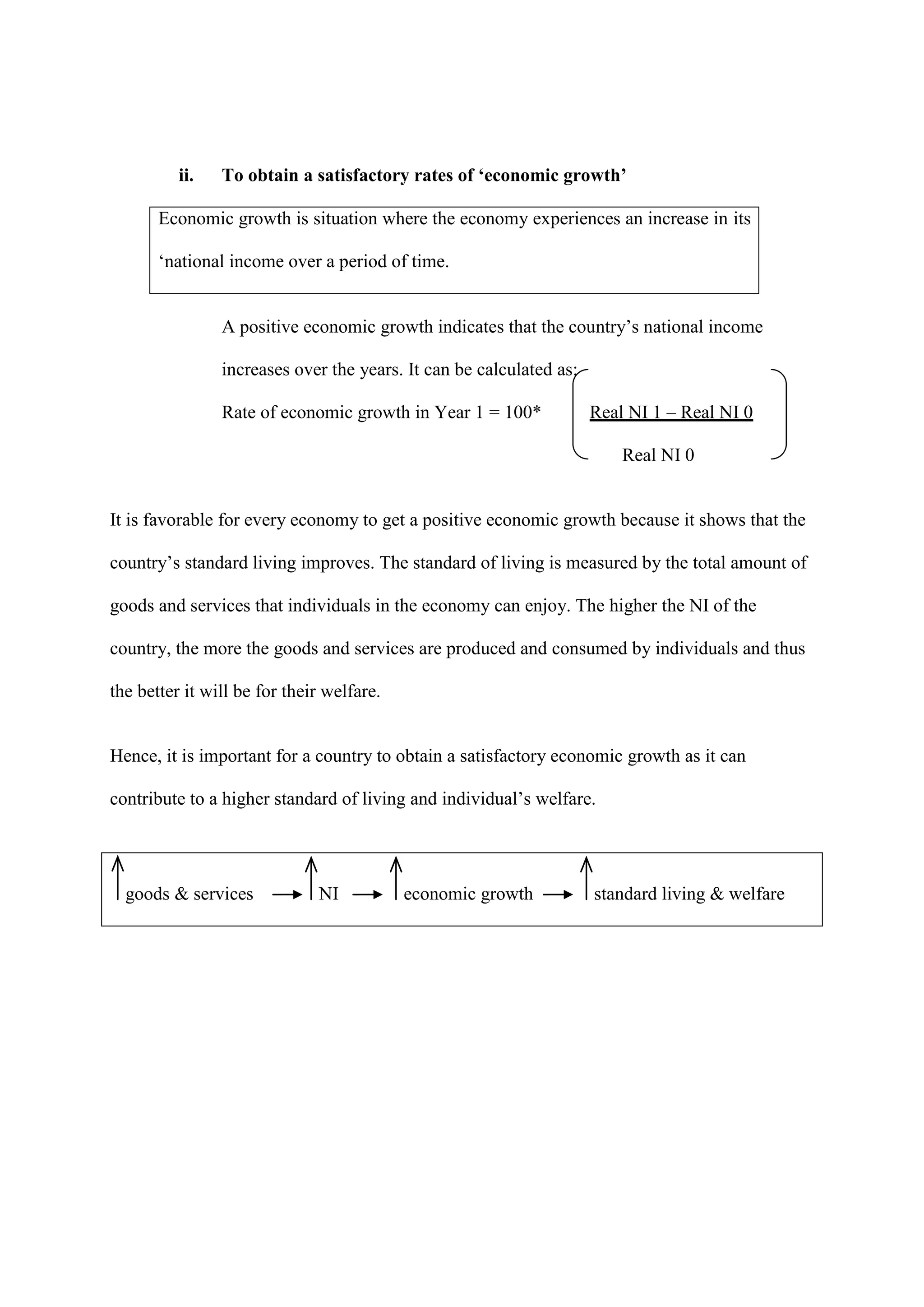
                A positive economic growth indicates that the country’s national income

                increases over the years. It can be calculated as:

                Rate of economic growth in Year 1 = 100*             Real NI 1 – Real NI 0

                                                                         Real NI 0


It is favorable for every economy to get a positive economic growth because it shows that the

country’s standard living improves. The standard of living is measured by the total amount of

goods and services that individuals in the economy can enjoy. The higher the NI of the

country, the more the goods and services are produced and consumed by individuals and thus

the better it will be for their welfare.


Hence, it is important for a country to obtain a satisfactory economic growth as it can

contribute to a higher standard of living and individual’s welfare.


  goods & services            NI           economic growth           standard living & welfare
iii.   To maintain the stability of the ‘general price level’

       The general price level represents the overall average price level of goods and

       services in the economy.


       This general price level also represents the rate of inflation in the economy. As

       we know prices and goods always changing. Some goods might experiences an

       increase in their prices and others might decrease.

       If the overall general price level increases generally, the rate of inflation is

       shown is positive. For example, if the rate of inflation is 4% it means that the

       price level has generally increased by 4%. Hence, it is one of the

       macroeconomics objectives that this general price level has to be maintained as

       stable. It has to be controlled so that no serious inflations occur. If the rate of

       inflations is high, then the values of money will decrease. Inflation leads to a

       decline in the value of money or the ‘purchasing power’ of the money.

       Therefore, the general price level must try to be maintained as stable so as to

       keep the value of the money stable and secured.


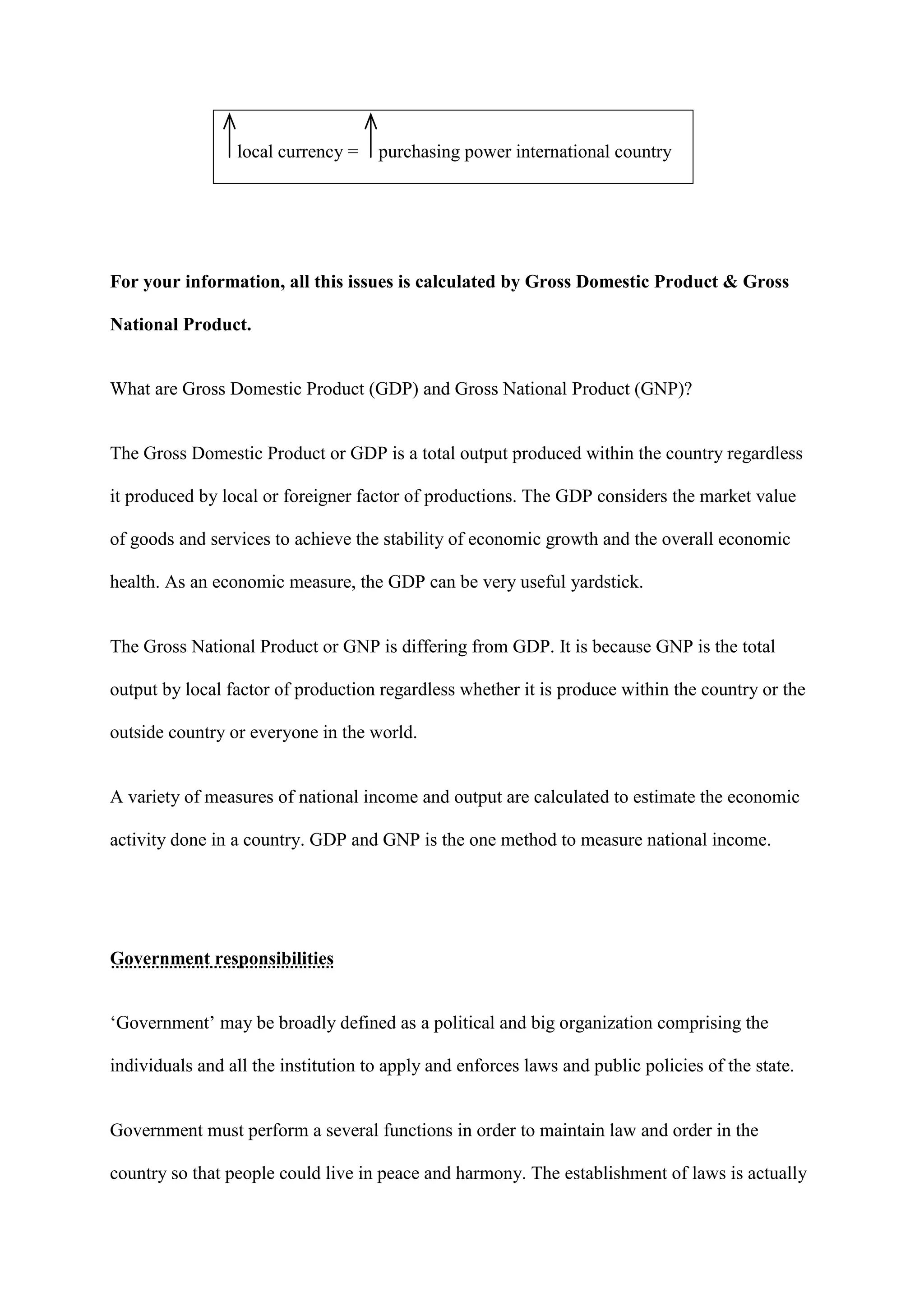
iv.    To achieve external sector stability

       Balance of payment concerns with the payment and income received by the

       economy from its international trade activities. Payment to other countries or

       the outflow of money to other countries is made when we buy or import goods

       and services from those countries. On the other hand, when we export or sell

       our goods and services to other countries we will receive money and there will

       be an inflow of money into our country.
local currency =    purchasing power international country


For your information, all this issues is calculated by Gross Domestic Product & Gross

National Product.


What are Gross Domestic Product (GDP) and Gross National Product (GNP)?


The Gross Domestic Product or GDP is a total output produced within the country regardless

it produced by local or foreigner factor of productions. The GDP considers the market value

of goods and services to achieve the stability of economic growth and the overall economic

health. As an economic measure, the GDP can be very useful yardstick.


The Gross National Product or GNP is differing from GDP. It is because GNP is the total

output by local factor of production regardless whether it is produce within the country or the

outside country or everyone in the world.


A variety of measures of national income and output are calculated to estimate the economic

activity done in a country. GDP and GNP is the one method to measure national income.


Government responsibilities


‘Government’ may be broadly defined as a political and big organization comprising the

individuals and all the institution to apply and enforces laws and public policies of the state.


Government must perform a several functions in order to maintain law and order in the

country so that people could live in peace and harmony. The establishment of laws is actually
to regulate the behavior of citizens. Besides that, government also provides essential services

to promote the general welfare of the people. For examples public facilities, good

maintenance, and utilities such as water, electricity and telecommunication facilities and

others.


There are 3 types of policy that government implemented to control over their national

income.


Firstly, the government used the Monetary Policy as a tool. They use monetary policy to

influence and control the supply and the availability of money. Monetary policy is usually

administered by a Central Bank of Malaysia, which is Bank Negara Malaysia (BNM). The

regulation of the money supply by a central bank is usually to control inflation and stabilize

currency.


There are various instruments that initiate monetary policy such as open market operations,

the discount rate and reserves ratios.


As the country’s monetary authority, Bank Negara Malaysia is responsible to maintain

monetary stability. Monetary stability refers to the stability of the value of the Malaysian

currency, the ringgit. The best way to ensure that the values of the ringgit are preserved is by

ensuring price stability, that, to ensure that inflation in the country remains low and stable.


The second tool available to government is fiscal policy. Fiscal policy is the management on

government revenues and expenditure or spending in the country. The management is either

from taxes revenues or other various revenues. Basically the 60% comes from the taxes

revenues and the remaining comes from the others revenue. Example of revenues comes from

the sold assets, government assets and compound money.
National Income


Definition of National Income


National Income is the total amount of income received by the factors of production in a

country at a given period of time.


Economic agents are the individuals who factors of production where there are four major

classifications of factors in the economy namely labour, land, capital and entrepreneur. These

economic agents perform the activities that contribute to the production of the total output in

the economy.


A full-time housewife is not regarded as an economic agent because she does not hold any

factors. So do full-time students and pensioners. A housewife might receive a monthly

allowance from her husband, a student might receive some money from his parents as his

pocket money and pensioners might receive some money as their pensions. However, the

money received by them cannot be calculated as part of NI because those housewives,

students and pensioners do not produced any goods or services, which can be purchased by

other individuals.


Nevertheless, if the housewife sells nasi lemak to get some extra income or the students work

as part-time sales promoters during school holidays; then the income received by them should

be taken into NI accounts since they had produced some output.
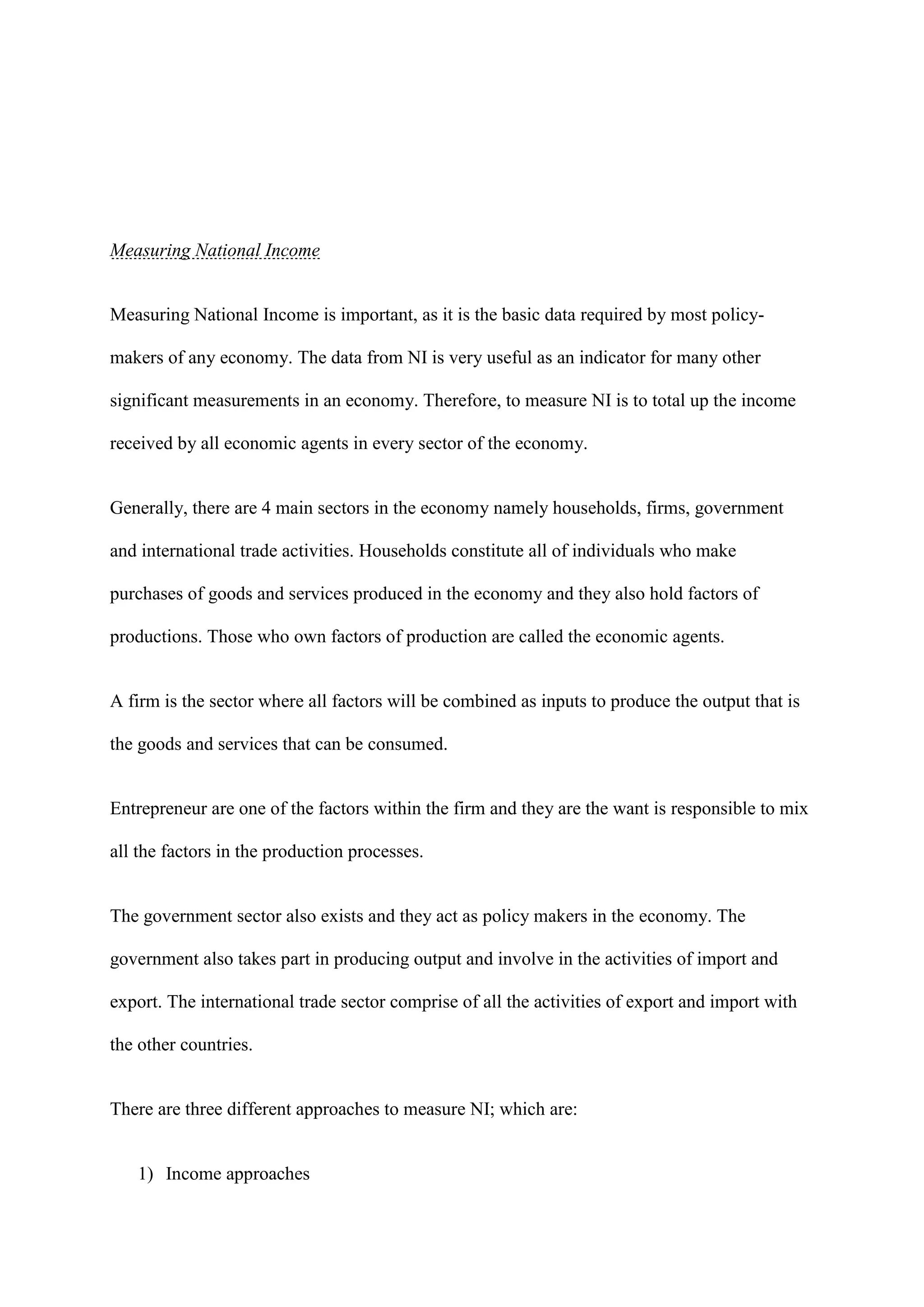
Measuring National Income


Measuring National Income is important, as it is the basic data required by most policy-

makers of any economy. The data from NI is very useful as an indicator for many other

significant measurements in an economy. Therefore, to measure NI is to total up the income

received by all economic agents in every sector of the economy.


Generally, there are 4 main sectors in the economy namely households, firms, government

and international trade activities. Households constitute all of individuals who make

purchases of goods and services produced in the economy and they also hold factors of

productions. Those who own factors of production are called the economic agents.


A firm is the sector where all factors will be combined as inputs to produce the output that is

the goods and services that can be consumed.


Entrepreneur are one of the factors within the firm and they are the want is responsible to mix

all the factors in the production processes.


The government sector also exists and they act as policy makers in the economy. The

government also takes part in producing output and involve in the activities of import and

export. The international trade sector comprise of all the activities of export and import with

the other countries.


There are three different approaches to measure NI; which are:


   1) Income approaches
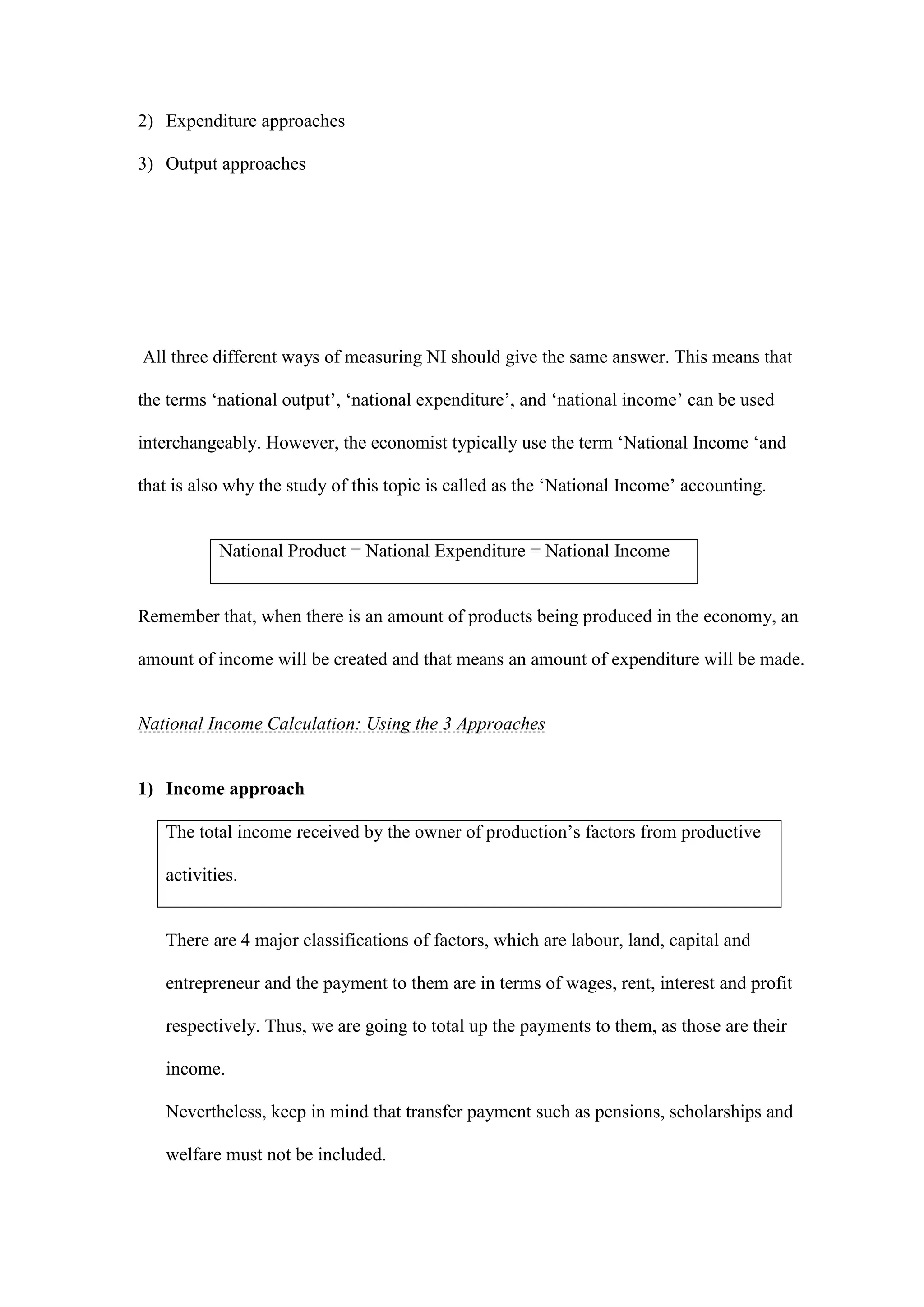
2) Expenditure approaches

3) Output approaches


All three different ways of measuring NI should give the same answer. This means that

the terms ‘national output’, ‘national expenditure’, and ‘national income’ can be used

interchangeably. However, the economist typically use the term ‘National Income ‘and

that is also why the study of this topic is called as the ‘National Income’ accounting.


           National Product = National Expenditure = National Income


Remember that, when there is an amount of products being produced in the economy, an

amount of income will be created and that means an amount of expenditure will be made.


National Income Calculation: Using the 3 Approaches


1) Income approach

   The total income received by the owner of production’s factors from productive

   activities.


   There are 4 major classifications of factors, which are labour, land, capital and

   entrepreneur and the payment to them are in terms of wages, rent, interest and profit

   respectively. Thus, we are going to total up the payments to them, as those are their

   income.

   Nevertheless, keep in mind that transfer payment such as pensions, scholarships and

   welfare must not be included.
Labour : wages; Land: rent; Capital: interest; Entrepreneur: profit

Wages + rent + interest + profit + income from self employment = GDP at FC
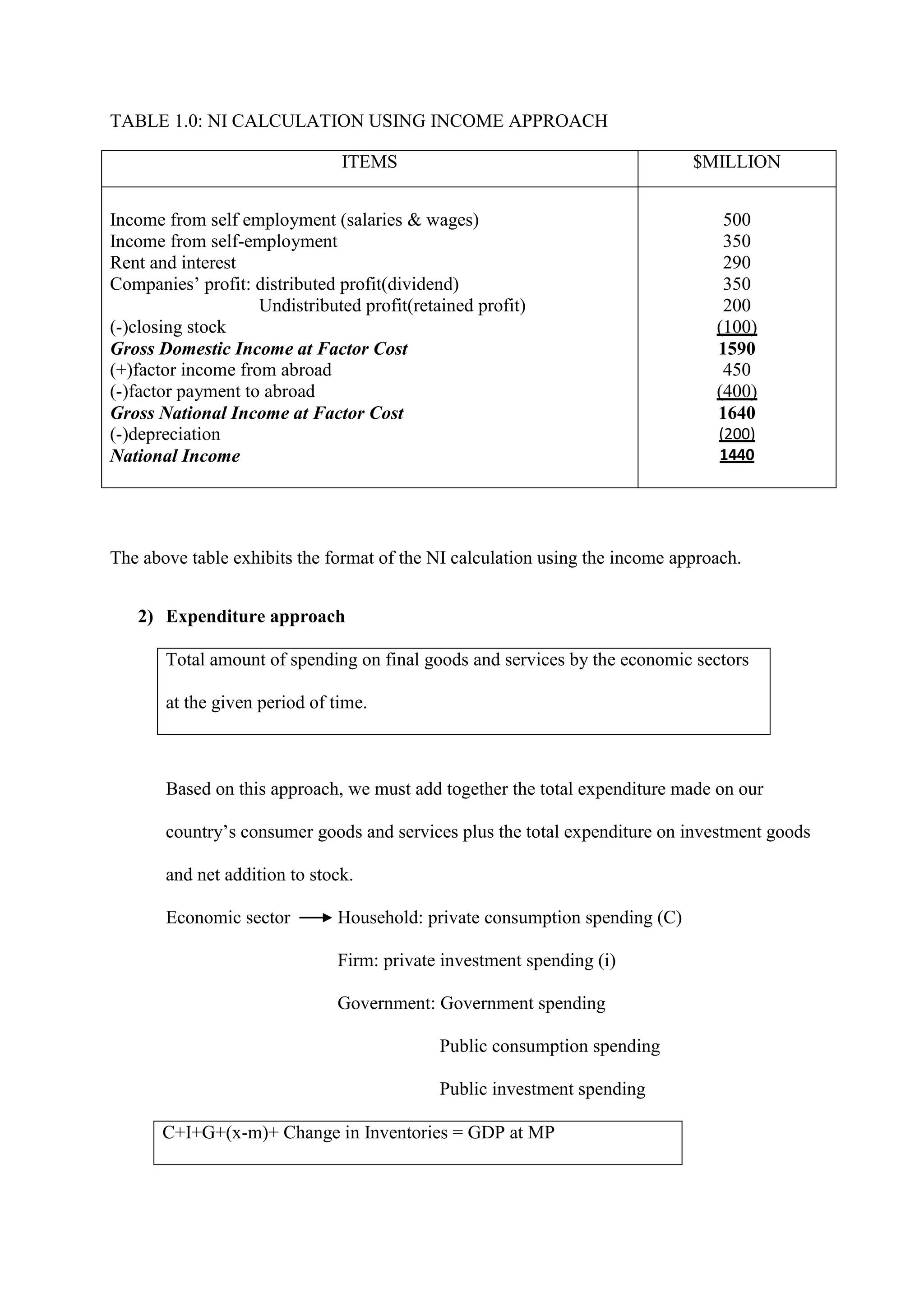
TABLE 1.0: NI CALCULATION USING INCOME APPROACH

                               ITEMS                                         $MILLION


Income from self employment (salaries & wages)                                   500
Income from self-employment                                                      350
Rent and interest                                                                290
Companies’ profit: distributed profit(dividend)                                  350
                    Undistributed profit(retained profit)                        200
(-)closing stock                                                                (100)
Gross Domestic Income at Factor Cost                                            1590
(+)factor income from abroad                                                     450
(-)factor payment to abroad                                                     (400)
Gross National Income at Factor Cost                                            1640
(-)depreciation                                                                 (200)
National Income                                                                 1440


The above table exhibits the format of the NI calculation using the income approach.


   2) Expenditure approach

       Total amount of spending on final goods and services by the economic sectors

       at the given period of time.


       Based on this approach, we must add together the total expenditure made on our

       country’s consumer goods and services plus the total expenditure on investment goods

       and net addition to stock.

       Economic sector         Household: private consumption spending (C)

                               Firm: private investment spending (i)

                               Government: Government spending

                                             Public consumption spending

                                             Public investment spending

       C+I+G+(x-m)+ Change in Inventories = GDP at MP
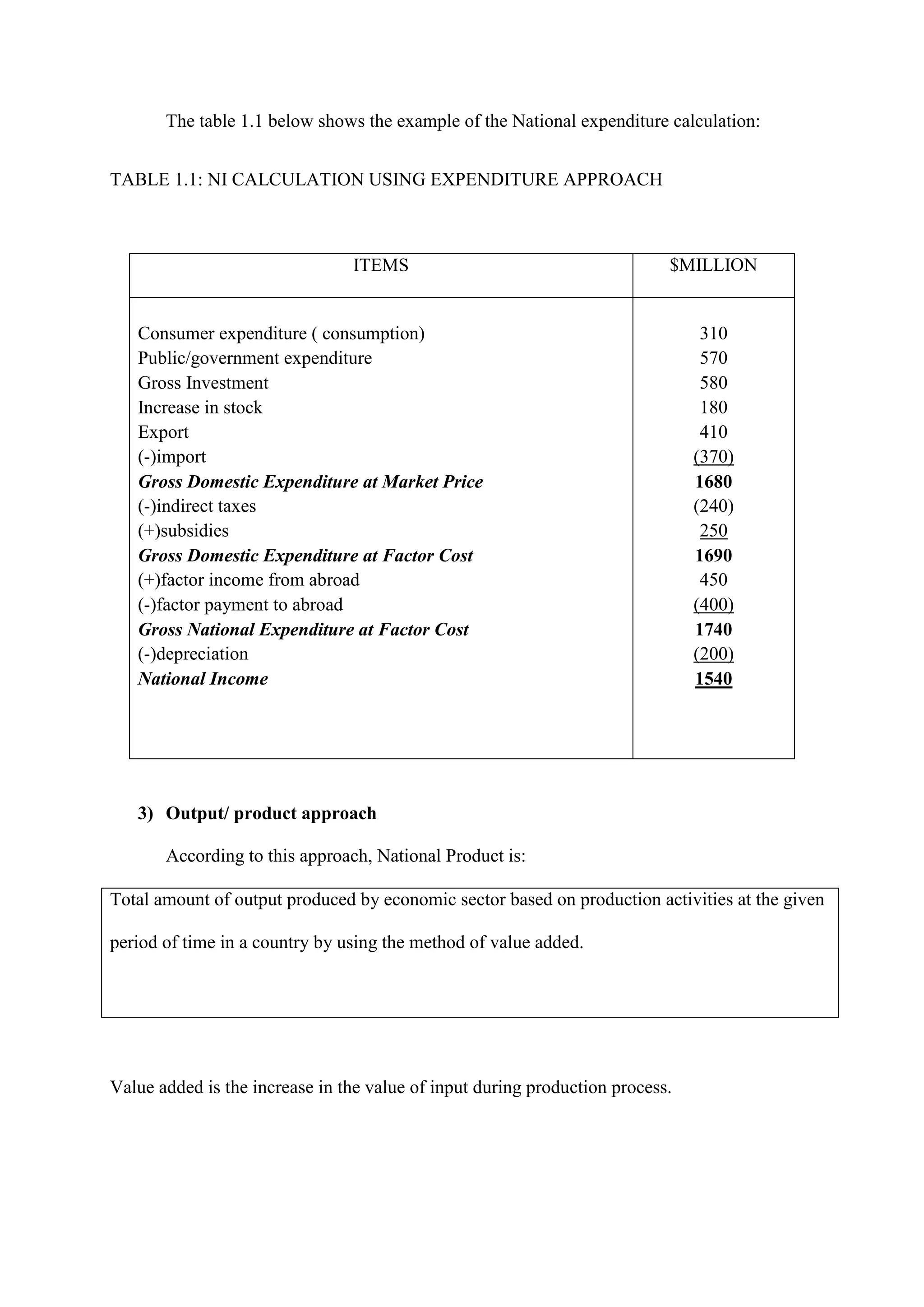
The table 1.1 below shows the example of the National expenditure calculation:


TABLE 1.1: NI CALCULATION USING EXPENDITURE APPROACH


                                ITEMS                                      $MILLION


   Consumer expenditure ( consumption)                                          310
   Public/government expenditure                                                570
   Gross Investment                                                             580
   Increase in stock                                                            180
   Export                                                                       410
   (-)import                                                                   (370)
   Gross Domestic Expenditure at Market Price                                  1680
   (-)indirect taxes                                                           (240)
   (+)subsidies                                                                 250
   Gross Domestic Expenditure at Factor Cost                                   1690
   (+)factor income from abroad                                                 450
   (-)factor payment to abroad                                                 (400)
   Gross National Expenditure at Factor Cost                                   1740
   (-)depreciation                                                             (200)
   National Income                                                             1540


   3) Output/ product approach

       According to this approach, National Product is:

Total amount of output produced by economic sector based on production activities at the given

period of time in a country by using the method of value added.


Value added is the increase in the value of input during production process.
There are many sectors in an economy like manufacturing, agricultural, construction, banking

and insurance, forestry and others. The total value of products and services by these sectors

will give us the ‘Gross Domestic Product at market price. These are the products that are

produced domestically and their values are at the market price because we take those values at

their prevailing market price.


       Below is the formula to calculate by using output approach:

       Primary sector + secondary sector + tertiary sector + import –bank

       services = GDP at MP


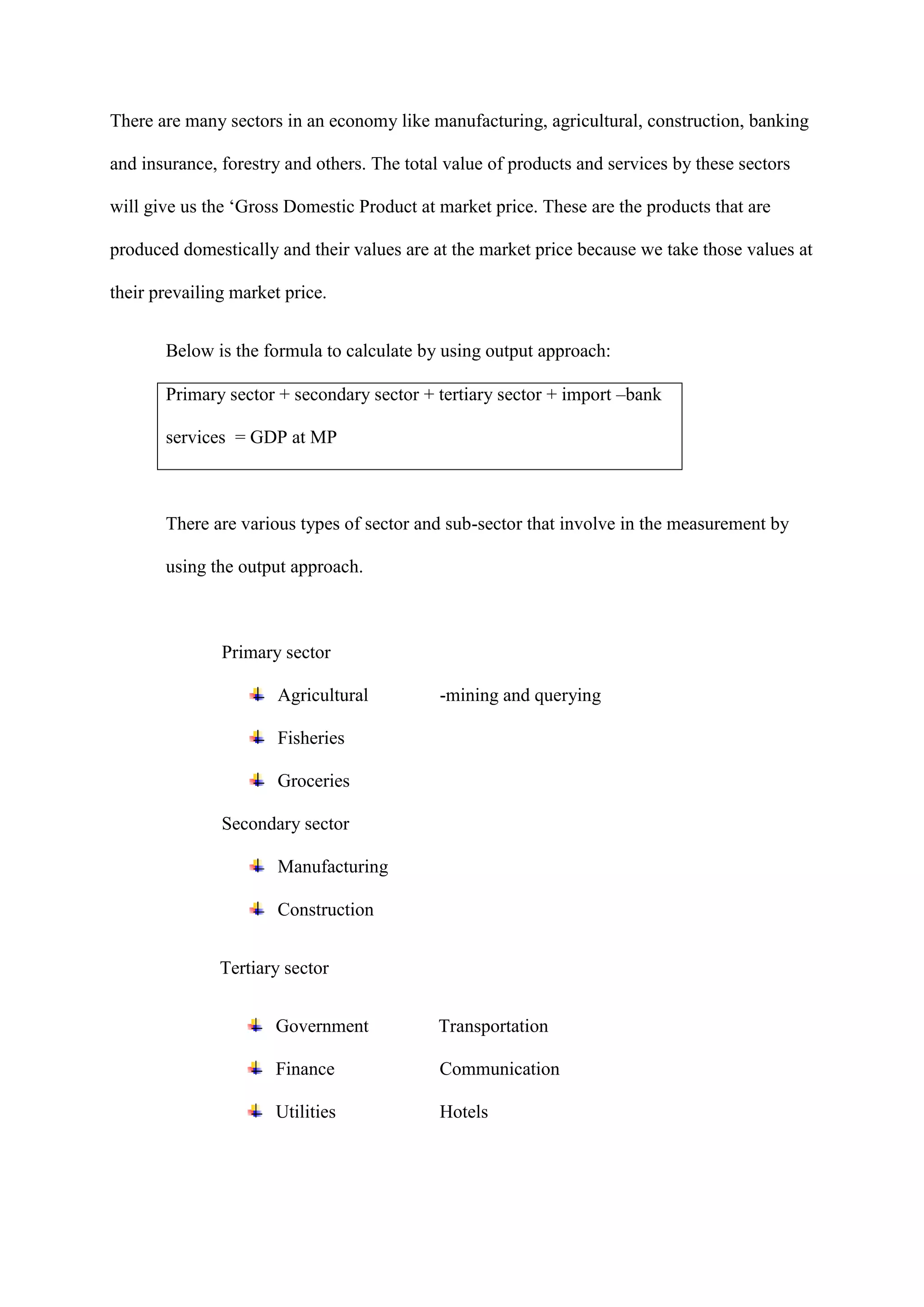
       There are various types of sector and sub-sector that involve in the measurement by

       using the output approach.


               Primary sector

                       Agricultural          -mining and querying

                       Fisheries

                       Groceries

               Secondary sector

                       Manufacturing

                       Construction


               Tertiary sector


                      Government            Transportation

                      Finance                Communication

                      Utilities              Hotels
Table 1.3 below exhibits the example of NI calculation using the product/ output approach.

TABLE 1.2: NI CALCULATION USING OUTPUT/PRODCUT APPROACH
What is macroeconomics

What is macroeconomics

  • 1.
  • 2.
    Bil Particulars Pages TABLE OF CONTENT
  • 3.
    Introduction to economics Doyou still remember what the study of economics is all about when you study microeconomics in your first topic? Our resources are limited but our wants are unlimited. Thus, the study of economics can be defines as: The study of how individual and societies choose to allocate the scarce resources to produce goods and services, and how those goods and services are allocated among individuals. The study of microeconomics can be subdivided into microeconomics and macroeconomics. The term ‘micro’ means something small while ‘macro’ indicates something that it comprehensive or large. Macroeconomics is the study of economy as a whole at the aggregate level. If macroeconomics studies on how price level foe one particular good is determined, the macroeconomics study will talk about the general price level of all goods and services in the economy. When microeconomics looks on the most optimum level of production of one firm, the macroeconomics will measure the total production of all goods and services in the economy as the national output. In macroeconomics to, we will study how the total income that all of us earned can be defined as the national income of our country.
  • 4.
    Macroeconomics issues There arefour major reasons why the studies of economics are done at the macro level, based on the economics perspectives. i. To achieve ‘full employment’ The objectives of full employment has always been the important concern of every economy included Malaysia and all developing country. Full- employment is a situation where all economic factors are fully utilized and there is only frictional unemployment that exists. Unemployment derived from situation where people who able and want to work but they failed to find the suitable job. To achieve zero rate of unemployment is impossible because there tends to be individuals who are changing their jobs or school – leavers and graduates who are still looking for jobs. This is known as the frictional unemployment. This type of unemployment is temporary only. The increases rate of unemployment will make the resources waste and the standard of living will decreases. This situation will bring many problems to the country such as economics, social and also political problems. That is why we need to study the economy at the aggregate (macro) level. Every economy will try to achieve this full – employment level as it reflects their efficiency in utilizing all of their economic resources.
  • 5.
    ii. To obtain a satisfactory rates of ‘economic growth’ Economic growth is situation where the economy experiences an increase in its ‘national income over a period of time. A positive economic growth indicates that the country’s national income increases over the years. It can be calculated as: Rate of economic growth in Year 1 = 100* Real NI 1 – Real NI 0 Real NI 0 It is favorable for every economy to get a positive economic growth because it shows that the country’s standard living improves. The standard of living is measured by the total amount of goods and services that individuals in the economy can enjoy. The higher the NI of the country, the more the goods and services are produced and consumed by individuals and thus the better it will be for their welfare. Hence, it is important for a country to obtain a satisfactory economic growth as it can contribute to a higher standard of living and individual’s welfare. goods & services NI economic growth standard living & welfare
  • 6.
    iii. To maintain the stability of the ‘general price level’ The general price level represents the overall average price level of goods and services in the economy. This general price level also represents the rate of inflation in the economy. As we know prices and goods always changing. Some goods might experiences an increase in their prices and others might decrease. If the overall general price level increases generally, the rate of inflation is shown is positive. For example, if the rate of inflation is 4% it means that the price level has generally increased by 4%. Hence, it is one of the macroeconomics objectives that this general price level has to be maintained as stable. It has to be controlled so that no serious inflations occur. If the rate of inflations is high, then the values of money will decrease. Inflation leads to a decline in the value of money or the ‘purchasing power’ of the money. Therefore, the general price level must try to be maintained as stable so as to keep the value of the money stable and secured. iv. To achieve external sector stability Balance of payment concerns with the payment and income received by the economy from its international trade activities. Payment to other countries or the outflow of money to other countries is made when we buy or import goods and services from those countries. On the other hand, when we export or sell our goods and services to other countries we will receive money and there will be an inflow of money into our country.
  • 7.
    local currency = purchasing power international country For your information, all this issues is calculated by Gross Domestic Product & Gross National Product. What are Gross Domestic Product (GDP) and Gross National Product (GNP)? The Gross Domestic Product or GDP is a total output produced within the country regardless it produced by local or foreigner factor of productions. The GDP considers the market value of goods and services to achieve the stability of economic growth and the overall economic health. As an economic measure, the GDP can be very useful yardstick. The Gross National Product or GNP is differing from GDP. It is because GNP is the total output by local factor of production regardless whether it is produce within the country or the outside country or everyone in the world. A variety of measures of national income and output are calculated to estimate the economic activity done in a country. GDP and GNP is the one method to measure national income. Government responsibilities ‘Government’ may be broadly defined as a political and big organization comprising the individuals and all the institution to apply and enforces laws and public policies of the state. Government must perform a several functions in order to maintain law and order in the country so that people could live in peace and harmony. The establishment of laws is actually
  • 8.
    to regulate thebehavior of citizens. Besides that, government also provides essential services to promote the general welfare of the people. For examples public facilities, good maintenance, and utilities such as water, electricity and telecommunication facilities and others. There are 3 types of policy that government implemented to control over their national income. Firstly, the government used the Monetary Policy as a tool. They use monetary policy to influence and control the supply and the availability of money. Monetary policy is usually administered by a Central Bank of Malaysia, which is Bank Negara Malaysia (BNM). The regulation of the money supply by a central bank is usually to control inflation and stabilize currency. There are various instruments that initiate monetary policy such as open market operations, the discount rate and reserves ratios. As the country’s monetary authority, Bank Negara Malaysia is responsible to maintain monetary stability. Monetary stability refers to the stability of the value of the Malaysian currency, the ringgit. The best way to ensure that the values of the ringgit are preserved is by ensuring price stability, that, to ensure that inflation in the country remains low and stable. The second tool available to government is fiscal policy. Fiscal policy is the management on government revenues and expenditure or spending in the country. The management is either from taxes revenues or other various revenues. Basically the 60% comes from the taxes revenues and the remaining comes from the others revenue. Example of revenues comes from the sold assets, government assets and compound money.
  • 9.
    National Income Definition ofNational Income National Income is the total amount of income received by the factors of production in a country at a given period of time. Economic agents are the individuals who factors of production where there are four major classifications of factors in the economy namely labour, land, capital and entrepreneur. These economic agents perform the activities that contribute to the production of the total output in the economy. A full-time housewife is not regarded as an economic agent because she does not hold any factors. So do full-time students and pensioners. A housewife might receive a monthly allowance from her husband, a student might receive some money from his parents as his pocket money and pensioners might receive some money as their pensions. However, the money received by them cannot be calculated as part of NI because those housewives, students and pensioners do not produced any goods or services, which can be purchased by other individuals. Nevertheless, if the housewife sells nasi lemak to get some extra income or the students work as part-time sales promoters during school holidays; then the income received by them should be taken into NI accounts since they had produced some output.
  • 10.
    Measuring National Income MeasuringNational Income is important, as it is the basic data required by most policy- makers of any economy. The data from NI is very useful as an indicator for many other significant measurements in an economy. Therefore, to measure NI is to total up the income received by all economic agents in every sector of the economy. Generally, there are 4 main sectors in the economy namely households, firms, government and international trade activities. Households constitute all of individuals who make purchases of goods and services produced in the economy and they also hold factors of productions. Those who own factors of production are called the economic agents. A firm is the sector where all factors will be combined as inputs to produce the output that is the goods and services that can be consumed. Entrepreneur are one of the factors within the firm and they are the want is responsible to mix all the factors in the production processes. The government sector also exists and they act as policy makers in the economy. The government also takes part in producing output and involve in the activities of import and export. The international trade sector comprise of all the activities of export and import with the other countries. There are three different approaches to measure NI; which are: 1) Income approaches
  • 11.
    2) Expenditure approaches 3)Output approaches All three different ways of measuring NI should give the same answer. This means that the terms ‘national output’, ‘national expenditure’, and ‘national income’ can be used interchangeably. However, the economist typically use the term ‘National Income ‘and that is also why the study of this topic is called as the ‘National Income’ accounting. National Product = National Expenditure = National Income Remember that, when there is an amount of products being produced in the economy, an amount of income will be created and that means an amount of expenditure will be made. National Income Calculation: Using the 3 Approaches 1) Income approach The total income received by the owner of production’s factors from productive activities. There are 4 major classifications of factors, which are labour, land, capital and entrepreneur and the payment to them are in terms of wages, rent, interest and profit respectively. Thus, we are going to total up the payments to them, as those are their income. Nevertheless, keep in mind that transfer payment such as pensions, scholarships and welfare must not be included.
  • 12.
    Labour : wages;Land: rent; Capital: interest; Entrepreneur: profit Wages + rent + interest + profit + income from self employment = GDP at FC
  • 13.
    TABLE 1.0: NICALCULATION USING INCOME APPROACH ITEMS $MILLION Income from self employment (salaries & wages) 500 Income from self-employment 350 Rent and interest 290 Companies’ profit: distributed profit(dividend) 350 Undistributed profit(retained profit) 200 (-)closing stock (100) Gross Domestic Income at Factor Cost 1590 (+)factor income from abroad 450 (-)factor payment to abroad (400) Gross National Income at Factor Cost 1640 (-)depreciation (200) National Income 1440 The above table exhibits the format of the NI calculation using the income approach. 2) Expenditure approach Total amount of spending on final goods and services by the economic sectors at the given period of time. Based on this approach, we must add together the total expenditure made on our country’s consumer goods and services plus the total expenditure on investment goods and net addition to stock. Economic sector Household: private consumption spending (C) Firm: private investment spending (i) Government: Government spending Public consumption spending Public investment spending C+I+G+(x-m)+ Change in Inventories = GDP at MP
  • 14.
    The table 1.1below shows the example of the National expenditure calculation: TABLE 1.1: NI CALCULATION USING EXPENDITURE APPROACH ITEMS $MILLION Consumer expenditure ( consumption) 310 Public/government expenditure 570 Gross Investment 580 Increase in stock 180 Export 410 (-)import (370) Gross Domestic Expenditure at Market Price 1680 (-)indirect taxes (240) (+)subsidies 250 Gross Domestic Expenditure at Factor Cost 1690 (+)factor income from abroad 450 (-)factor payment to abroad (400) Gross National Expenditure at Factor Cost 1740 (-)depreciation (200) National Income 1540 3) Output/ product approach According to this approach, National Product is: Total amount of output produced by economic sector based on production activities at the given period of time in a country by using the method of value added. Value added is the increase in the value of input during production process.
  • 15.
    There are manysectors in an economy like manufacturing, agricultural, construction, banking and insurance, forestry and others. The total value of products and services by these sectors will give us the ‘Gross Domestic Product at market price. These are the products that are produced domestically and their values are at the market price because we take those values at their prevailing market price. Below is the formula to calculate by using output approach: Primary sector + secondary sector + tertiary sector + import –bank services = GDP at MP There are various types of sector and sub-sector that involve in the measurement by using the output approach. Primary sector Agricultural -mining and querying Fisheries Groceries Secondary sector Manufacturing Construction Tertiary sector Government Transportation Finance Communication Utilities Hotels
  • 16.
    Table 1.3 belowexhibits the example of NI calculation using the product/ output approach. TABLE 1.2: NI CALCULATION USING OUTPUT/PRODCUT APPROACH