Introduction to Information Systems
BY SUJITH B R
.
Functional, Enterprise, and Interorganizational Syste
 The role and function of Management Information
Systems (MIS) and Transaction Processing Systems
(TPS) in organizations
 How functional information systems support
Accounting & Finance; Sales and Marketing;
Production and Operations; and Human Resource
Management
 How and why information systems should be
integrated
 The role of interorganizational systems
Functional Information Systems
 Comprised of several small information system focused
on specific activities
 Specific IS applications can be
 completely independent, or
 integrated to form a departmental functional system
 also, can be integrated to support a broad business process
(cross-departmental)
 Interface with each other to form the organization
wide information system
 Interface with the environment
Functional Information Systems (continued)
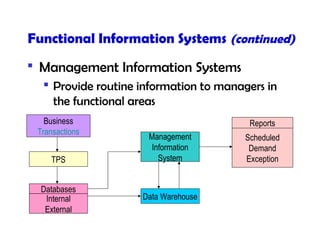
 Management Information Systems
 Provide routine information to managers in
the functional areas
Business
Transactions
TPS
Management
Information
System
Data Warehouse
Databases
Internal
External
Reports
Scheduled
Demand
Exception
Transaction Processing Systems
Every business event that occurs during
business operations is called a transaction
Business events (transactions) can trigger other
business events
Each event (transaction) can be described by
a number of data items
Transaction processing systems (TPS) are
designed to record and store the data that
describes every business event that occurs
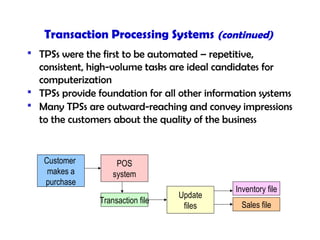
Transaction Processing Systems (continued)
 TPSs were the first to be automated – repetitive,
consistent, high-volume tasks are ideal candidates for
computerization
 TPSs provide foundation for all other information systems
 Many TPSs are outward-reaching and convey impressions
to the customers about the quality of the business
Customer
makes a
purchase
POS
system
Transaction file
Update
files
Inventory file
Sales file
Transaction Processing System (continued)
 Some characteristics of TPSs
 Process large volume of data
 Data sources mostly internal, and output intended mainly for
internal use
 TPS operate regularly (on demand, daily, weekly, etc.)
 Require large storage (database) capacity
 Require high processing speed (due to the high volume)
 Input and output data known and well-understood (highly
structured)
 Requires high processing reliability; organizations cannot function
for long without TPSs
Methods of Processing Transactions
Batch Processing: simple, inexpensive
Employee
timecards
Data entry
of timecard
data
Payroll transactions
Process
payroll
Employee data:
Pay rate
Withholdings
Etc.
Employee
paychecks
Cash on hand Payroll summary
Methods of Processing Transactions
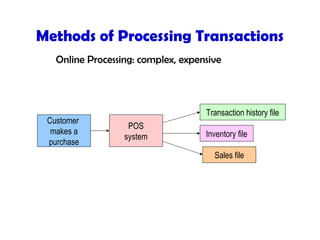
Online Processing: complex, expensive
Customer
makes a
purchase
POS
system
Transaction history file
Inventory file
Sales file
Methods of Processing Transactions
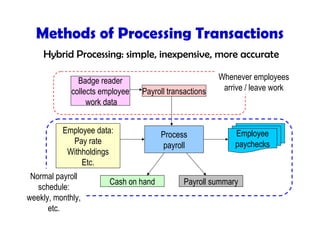
Hybrid Processing: simple, inexpensive, more accurate
Badge reader
collects employee
work data
Payroll transactions
Whenever employees
arrive / leave work
Process
payroll
Employee data:
Pay rate
Withholdings
Etc.
Employee
paychecks
Cash on hand Payroll summary
Normal payroll
schedule:
weekly, monthly,
etc.
Typical TPS Tasks
 Order processing
 Ledger entries
 Payments and receipts
 Inventory management, shipping, and receiving
 Payroll
 Periodic reports and statements
Accounting and Finance Systems
Financial Planning and Budgeting
Financial and economic forecasting
Budgeting
Investment Management
Access to financial and economic reports
Financial analysis
Financial Controls
Budgetary Controls
Auditing
Financial Health Analysis
Profitability Analysis and Cost Control
Accounting and Finance Systems
Marketing & Sales Systems
 Distribution Channel (definition)
 providing the goods or services to the customer; may extend
through various intermediaries such as wholesalers and retailers
Other Channel Systems
 support all marketing linkages, such as after-sales customer
support
Manufacturing
Distribution
R&D/Design
Accounting/Finance
Company
Dealer Systems
Delivery Systems
Customer Support
SystemsSales Systems
Target Marketing
Systems
Market Intelligence
Systems
Channel
Systems
Marketing & Sales Systems (continued)
 Customer Service
customer profiles and preference analysis
mass customization – high volume production of
specialized product
targeted advertising
customer inquiry systems and automated Help Desk
 Telemarketing
advertisement and reaching customers
order processing
customer service
sales support
account management
Marketing & Sales Systems (continued)
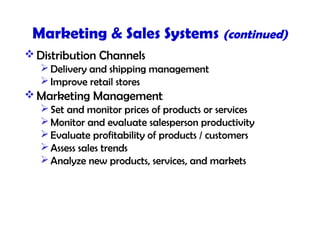
 Distribution Channels
Delivery and shipping management
Improve retail stores
 Marketing Management
Set and monitor prices of products or services
Monitor and evaluate salesperson productivity
Evaluate profitability of products / customers
Assess sales trends
Analyze new products, services, and markets
Marketing & Sales Systems (continued)
 Ethical and Social Issues in IT-supported Sales
Activities
Information collection and usage
Privacy concerns
 Current trend – Customer Relationship
Management (CRM)
Focus is on developing a one-to-one relationship with
customers
Production & Operations Management
Systems
Logistics and Material Management
Logistics Management
• Ordering, purchasing, and inbound and outbound
shipping
Inventory Management
• Determine how much inventory to carry
Quality Control
• Monitor and report quality of materials, work in
process, and finished goods
Planning Production/Operations
Material Requirements Planning; MRP II
Just-In-Time
Project Management (PERT & CPM)
Short-term scheduling
Automatic Design Work and Manufacturing
Computer Aided Design (CAD)
Computer Aided Manufacturing (CAM)
Computer Integrated Manufacturing (CIM)
Production & Operations Management
Systems (continued)
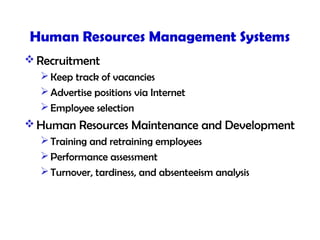
Human Resources Management Systems
 Recruitment
Keep track of vacancies
Advertise positions via Internet
Employee selection
 Human Resources Maintenance and Development
Training and retraining employees
Performance assessment
Turnover, tardiness, and absenteeism analysis
Human Resources Management Systems
Human Resources Management and
Planning
Maintain personnel files and skills inventory
Administer benefits
Comply with government reporting
Personnel planning
Succession planning
Labor negotiations
Integrated Information Systems
Reasons for Integration
Existing, functionally oriented information
systems are deficient:
• cannot give employees all the information they
need
• do not let different departments communicate
effectively
• crucial sales, inventory, and production data often
entered manually into separate computer systems
Integrated Information Systems
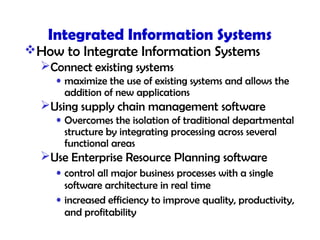
How to Integrate Information Systems
Connect existing systems
• maximize the use of existing systems and allows the
addition of new applications
Using supply chain management software
• Overcomes the isolation of traditional departmental
structure by integrating processing across several
functional areas
Use Enterprise Resource Planning software
• control all major business processes with a single
software architecture in real time
• increased efficiency to improve quality, productivity,
and profitability
Interorganizational Information Systems
(IOS)
 Electronic systems involving information flow
among two or more organizations in an on-going
relationship
 Objective – efficient transaction processing
 Many large businesses require suppliers to be
linked to them though IOS applications
 IOSs may be implemented with
Private, third-party networks (value-added networks)
Publicly accessible networks (Internet)
Interorganizational Systems (continued)
 Types of Interorganizational Systems
 Global systems
 Electronic data interchange (EDI)
 Electronic funds transfer (EFT)
 Extranets
 Shared databases
 Integrated messaging
Issues in IOS / Global IS Design
 Cultural differences
 Economic and political differences
 Cross-border data transfer concerns
Summary
 Role and function of TPSs
 Role and function of MISs
 In-depth review of how Iss support various
business functional areas
 Need and methods for integrating functional
information systems
 Interorganizational and global information
systems provide great opportunities but also
great complexity

Information system 1

  • 1.
    Introduction to InformationSystems BY SUJITH B R . Functional, Enterprise, and Interorganizational Syste
  • 2.
     The roleand function of Management Information Systems (MIS) and Transaction Processing Systems (TPS) in organizations  How functional information systems support Accounting & Finance; Sales and Marketing; Production and Operations; and Human Resource Management  How and why information systems should be integrated  The role of interorganizational systems
  • 3.
    Functional Information Systems Comprised of several small information system focused on specific activities  Specific IS applications can be  completely independent, or  integrated to form a departmental functional system  also, can be integrated to support a broad business process (cross-departmental)  Interface with each other to form the organization wide information system  Interface with the environment
  • 4.
    Functional Information Systems(continued)  Management Information Systems  Provide routine information to managers in the functional areas Business Transactions TPS Management Information System Data Warehouse Databases Internal External Reports Scheduled Demand Exception
  • 5.
    Transaction Processing Systems Everybusiness event that occurs during business operations is called a transaction Business events (transactions) can trigger other business events Each event (transaction) can be described by a number of data items Transaction processing systems (TPS) are designed to record and store the data that describes every business event that occurs
  • 6.
    Transaction Processing Systems(continued)  TPSs were the first to be automated – repetitive, consistent, high-volume tasks are ideal candidates for computerization  TPSs provide foundation for all other information systems  Many TPSs are outward-reaching and convey impressions to the customers about the quality of the business Customer makes a purchase POS system Transaction file Update files Inventory file Sales file
  • 7.
    Transaction Processing System(continued)  Some characteristics of TPSs  Process large volume of data  Data sources mostly internal, and output intended mainly for internal use  TPS operate regularly (on demand, daily, weekly, etc.)  Require large storage (database) capacity  Require high processing speed (due to the high volume)  Input and output data known and well-understood (highly structured)  Requires high processing reliability; organizations cannot function for long without TPSs
  • 8.
    Methods of ProcessingTransactions Batch Processing: simple, inexpensive Employee timecards Data entry of timecard data Payroll transactions Process payroll Employee data: Pay rate Withholdings Etc. Employee paychecks Cash on hand Payroll summary
  • 9.
    Methods of ProcessingTransactions Online Processing: complex, expensive Customer makes a purchase POS system Transaction history file Inventory file Sales file
  • 10.
    Methods of ProcessingTransactions Hybrid Processing: simple, inexpensive, more accurate Badge reader collects employee work data Payroll transactions Whenever employees arrive / leave work Process payroll Employee data: Pay rate Withholdings Etc. Employee paychecks Cash on hand Payroll summary Normal payroll schedule: weekly, monthly, etc.
  • 11.
    Typical TPS Tasks Order processing  Ledger entries  Payments and receipts  Inventory management, shipping, and receiving  Payroll  Periodic reports and statements
  • 12.
    Accounting and FinanceSystems Financial Planning and Budgeting Financial and economic forecasting Budgeting Investment Management Access to financial and economic reports Financial analysis
  • 13.
    Financial Controls Budgetary Controls Auditing FinancialHealth Analysis Profitability Analysis and Cost Control Accounting and Finance Systems
  • 14.
    Marketing & SalesSystems  Distribution Channel (definition)  providing the goods or services to the customer; may extend through various intermediaries such as wholesalers and retailers Other Channel Systems  support all marketing linkages, such as after-sales customer support Manufacturing Distribution R&D/Design Accounting/Finance Company Dealer Systems Delivery Systems Customer Support SystemsSales Systems Target Marketing Systems Market Intelligence Systems Channel Systems
  • 15.
    Marketing & SalesSystems (continued)  Customer Service customer profiles and preference analysis mass customization – high volume production of specialized product targeted advertising customer inquiry systems and automated Help Desk  Telemarketing advertisement and reaching customers order processing customer service sales support account management
  • 16.
    Marketing & SalesSystems (continued)  Distribution Channels Delivery and shipping management Improve retail stores  Marketing Management Set and monitor prices of products or services Monitor and evaluate salesperson productivity Evaluate profitability of products / customers Assess sales trends Analyze new products, services, and markets
  • 17.
    Marketing & SalesSystems (continued)  Ethical and Social Issues in IT-supported Sales Activities Information collection and usage Privacy concerns  Current trend – Customer Relationship Management (CRM) Focus is on developing a one-to-one relationship with customers
  • 18.
    Production & OperationsManagement Systems Logistics and Material Management Logistics Management • Ordering, purchasing, and inbound and outbound shipping Inventory Management • Determine how much inventory to carry Quality Control • Monitor and report quality of materials, work in process, and finished goods
  • 19.
    Planning Production/Operations Material RequirementsPlanning; MRP II Just-In-Time Project Management (PERT & CPM) Short-term scheduling Automatic Design Work and Manufacturing Computer Aided Design (CAD) Computer Aided Manufacturing (CAM) Computer Integrated Manufacturing (CIM) Production & Operations Management Systems (continued)
  • 20.
    Human Resources ManagementSystems  Recruitment Keep track of vacancies Advertise positions via Internet Employee selection  Human Resources Maintenance and Development Training and retraining employees Performance assessment Turnover, tardiness, and absenteeism analysis
  • 21.
    Human Resources ManagementSystems Human Resources Management and Planning Maintain personnel files and skills inventory Administer benefits Comply with government reporting Personnel planning Succession planning Labor negotiations
  • 22.
    Integrated Information Systems Reasonsfor Integration Existing, functionally oriented information systems are deficient: • cannot give employees all the information they need • do not let different departments communicate effectively • crucial sales, inventory, and production data often entered manually into separate computer systems
  • 23.
    Integrated Information Systems Howto Integrate Information Systems Connect existing systems • maximize the use of existing systems and allows the addition of new applications Using supply chain management software • Overcomes the isolation of traditional departmental structure by integrating processing across several functional areas Use Enterprise Resource Planning software • control all major business processes with a single software architecture in real time • increased efficiency to improve quality, productivity, and profitability
  • 24.
    Interorganizational Information Systems (IOS) Electronic systems involving information flow among two or more organizations in an on-going relationship  Objective – efficient transaction processing  Many large businesses require suppliers to be linked to them though IOS applications  IOSs may be implemented with Private, third-party networks (value-added networks) Publicly accessible networks (Internet)
  • 25.
    Interorganizational Systems (continued) Types of Interorganizational Systems  Global systems  Electronic data interchange (EDI)  Electronic funds transfer (EFT)  Extranets  Shared databases  Integrated messaging
  • 26.
    Issues in IOS/ Global IS Design  Cultural differences  Economic and political differences  Cross-border data transfer concerns
  • 27.
    Summary  Role andfunction of TPSs  Role and function of MISs  In-depth review of how Iss support various business functional areas  Need and methods for integrating functional information systems  Interorganizational and global information systems provide great opportunities but also great complexity

Editor's Notes

  • #13 Financial and Economic Forecasting indicators are available on the Internet many software packages available Planning for Cash Management build a decision support model project cash inflows and outflows Budgeting express financial plans allocate resources Access to financial and economic reports hundreds of sources for the financial and economic reports and news Financial analysis Executed with a spreadsheet program or with commercially available, ready-made decision support software Performance analysis Risk analysis Investment strategy analysis
  • #14 Budgetary Controls Summarize actual expenditures and compare to budget Auditing Software helps ensure the accuracy of financial records Financial Health Analysis Assess financial performance and interpret results, sometimes with help of an expert system Profitability Analysis and Cost Control Compute accurate profitability for individual products and for entire organization
  • #16 Customer Service Customer Profiles and Preference Analysis Mass Customization – high volume production of specialized product Targeted advertising Customer Inquiry Systems and Automated Help Desk Telemarketing advertisement and reaching customers order processing customer service sales support account management
  • #21 Recruitment finding, testing, and deciding which employees to hire Human Resources Maintenance and Development Training and Human Resources Development Performance Evaluation Turnover, Tardiness, and Absenteeism Analyses Human Resources Management and Planning Personal files and skills inventory Benefits administration Government reports Personnel planning Succession planning and implementation – Labor-Management Negotiations
  • #22 Recruitment finding, testing, and deciding which employees to hire Human Resources Maintenance and Development Training and Human Resources Development Performance Evaluation Turnover, Tardiness, and Absenteeism Analyses Human Resources Management and Planning Personal files and skills inventory Benefits administration Government reports Personnel planning Succession planning and implementation – Labor-Management Negotiations
  • #26 Global systems – systems connecting two or more companies in two or more countries Electronic data interchange (EDI) – electronic movement of business documents between business partners Electronic funds transfer (EFT) – transfer of money using telecommunications Extranets – extended Intranets that link business partners Shared databases – databases that business partners both have access to Integrated messaging – delivery of email and fax messages through a single communication system.
  • #27 Global systems – systems connecting two or more companies in two or more countries Electronic data interchange (EDI) – electronic movement of business documents between business partners Electronic funds transfer (EFT) – transfer of money using telecommunications Extranets – extended Intranets that link business partners Shared databases – databases that business partners both have access to Integrated messaging – delivery of email and fax messages through a single communication system.
  • #28 Global systems – systems connecting two or more companies in two or more countries Electronic data interchange (EDI) – electronic movement of business documents between business partners Electronic funds transfer (EFT) – transfer of money using telecommunications Extranets – extended Intranets that link business partners Shared databases – databases that business partners both have access to Integrated messaging – delivery of email and fax messages through a single communication system.