Overview
Background
Integration of Systems
Transaction Processing Systems
Innovative Functional Information Systems
Background
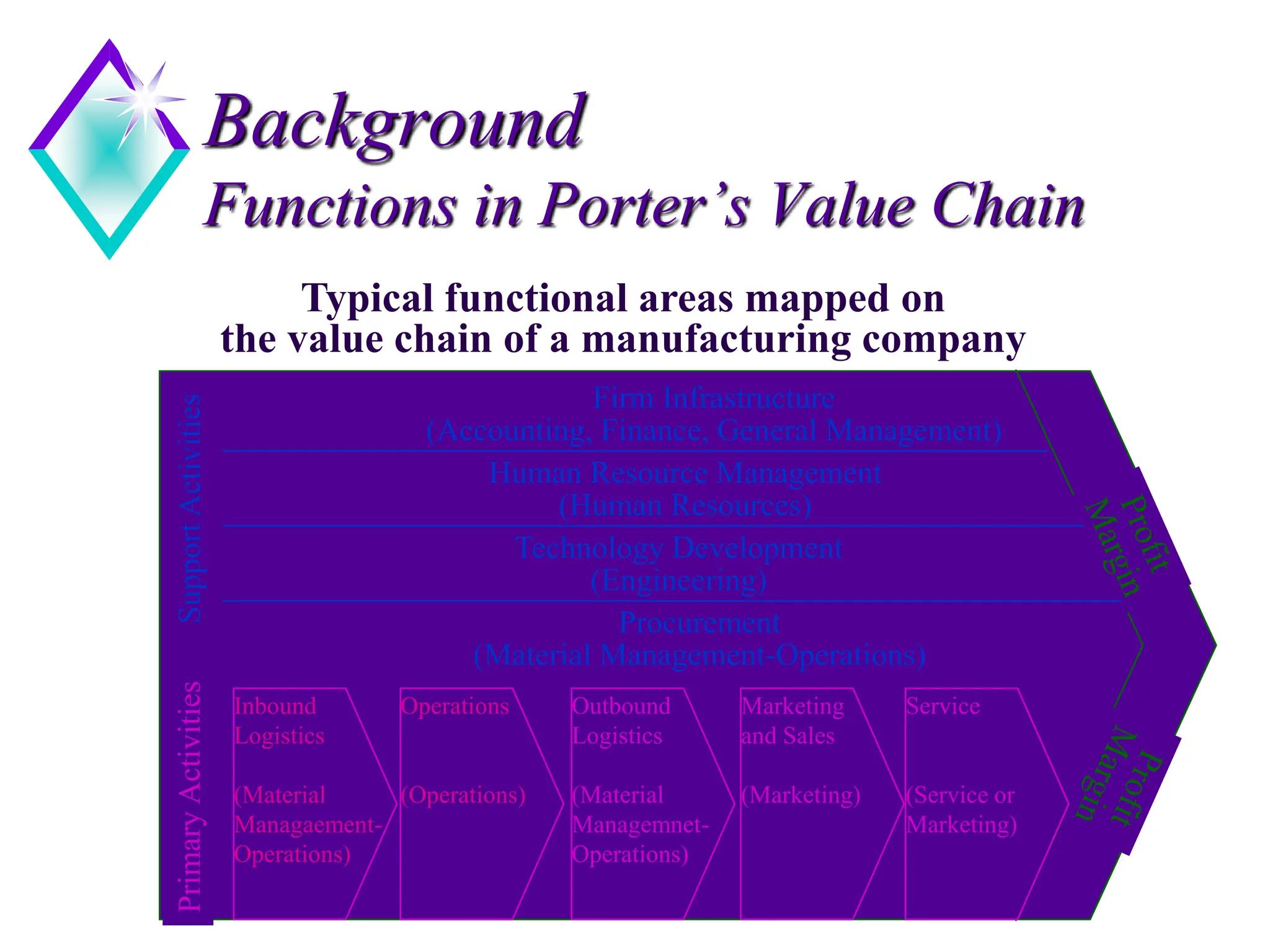
Functions in Porter’s Value Chain
Typical functional areas mapped on
the value chain of a manufacturing company
Firm Infrastructure
(Accounting, Finance, General Management)
Human Resource Management
(Human Resources)
Technology Development
(Engineering)
Procurement
(Material Management-Operations)
Support
Activities
Service
(Service or
Marketing)
Inbound
Logistics
(Material
Managaement-
Operations)
Operations
(Operations)
Outbound
Logistics
(Material
Managemnet-
Operations)
Marketing
and Sales
(Marketing)
Primary
Activities
Background
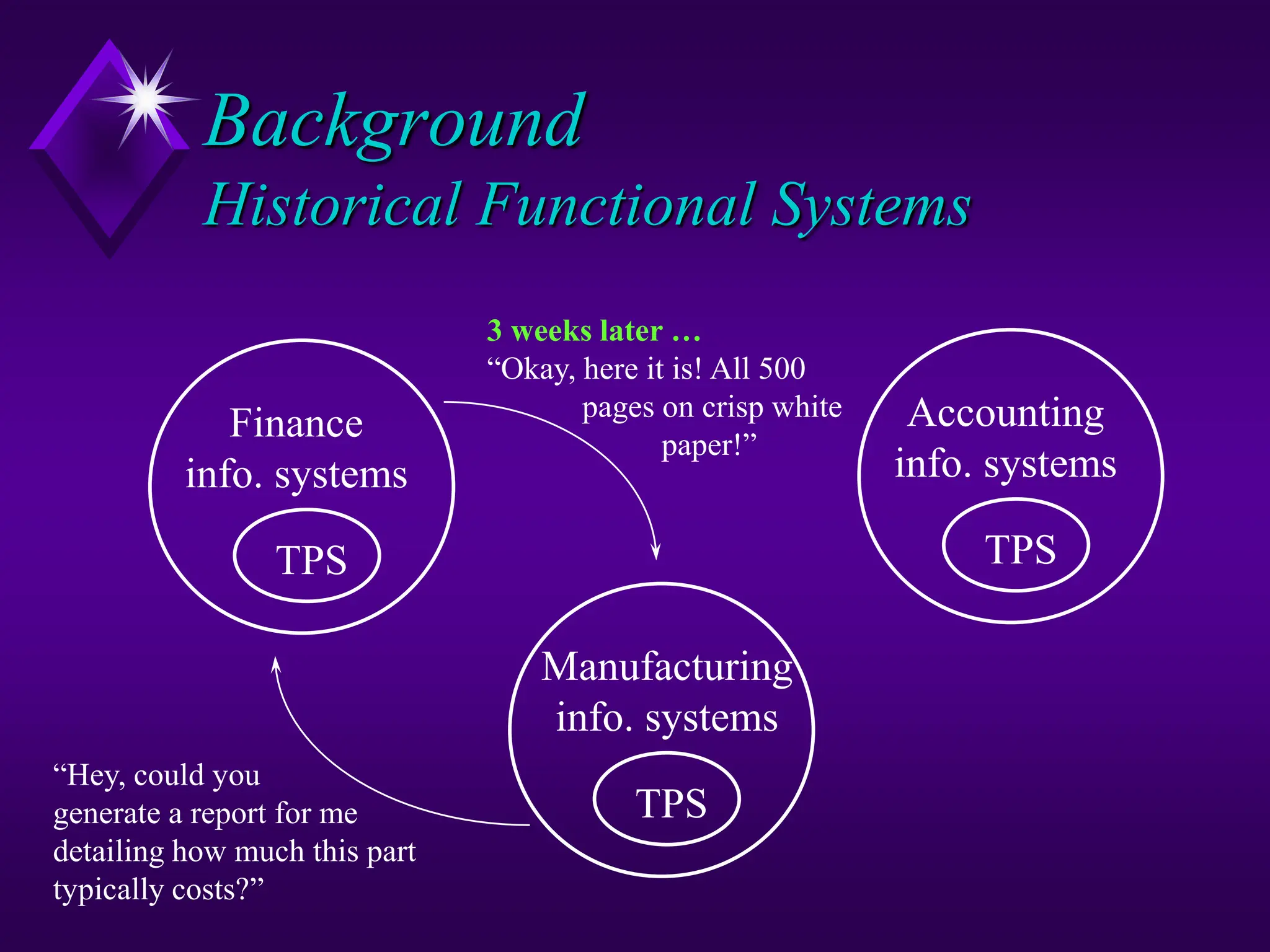
Historical Functional Systems
TPS
Finance
info. systems
TPS
Accounting
info. systems
TPS
Manufacturing
info. systems
“Hey, could you
generate a report for me
detailing how much this part
typically costs?”
3 weeks later …
“Okay, here it is! All 500
pages on crisp white
paper!”
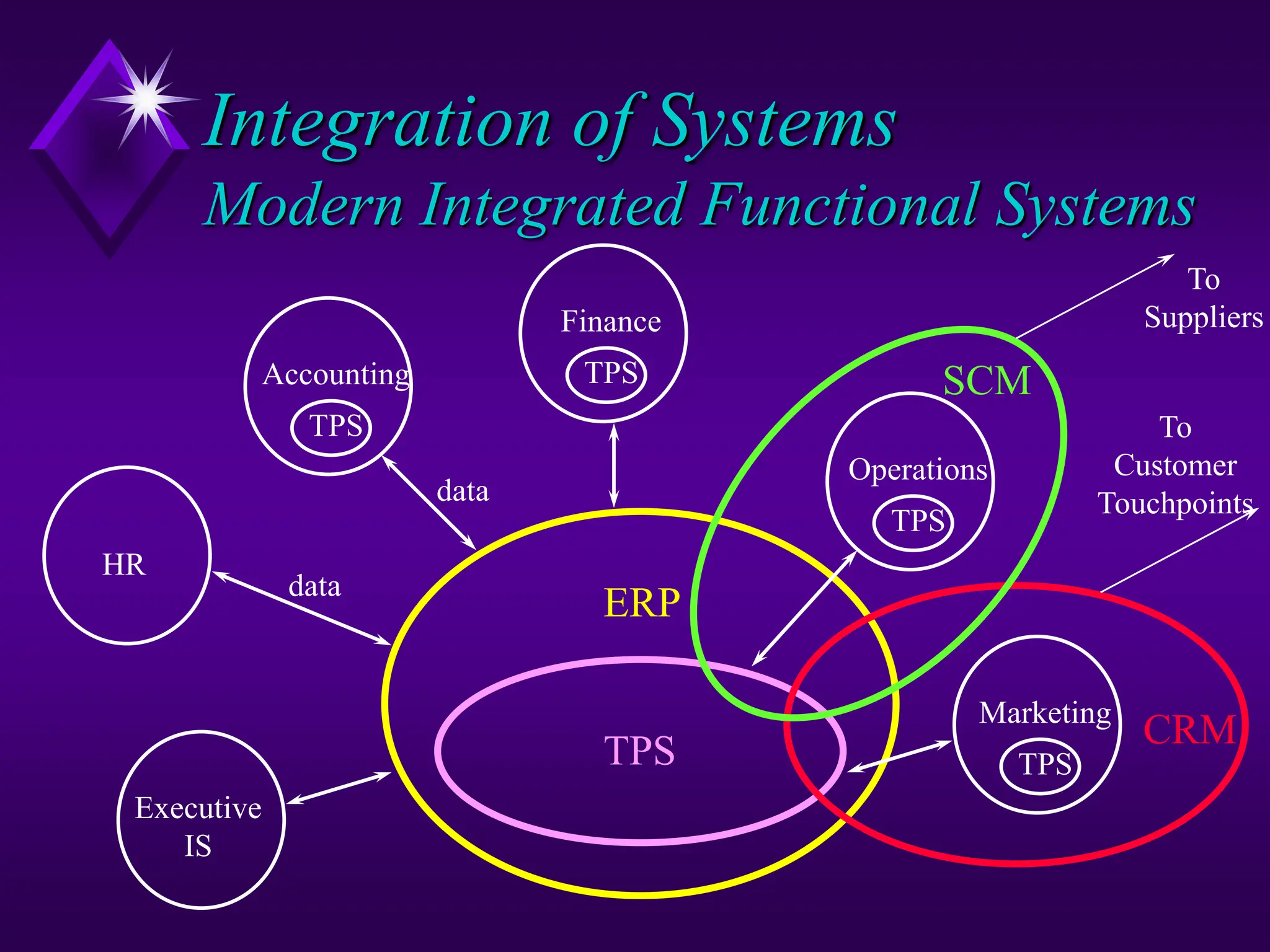
Integration of Systems
Modern Integrated Functional Systems
TPS
Operations
TPS
ERP
Executive
IS
HR
TPS
Accounting TPS
Finance
TPS
Marketing
CRM
SCM
To
Suppliers
To
Customer
Touchpoints
data
data
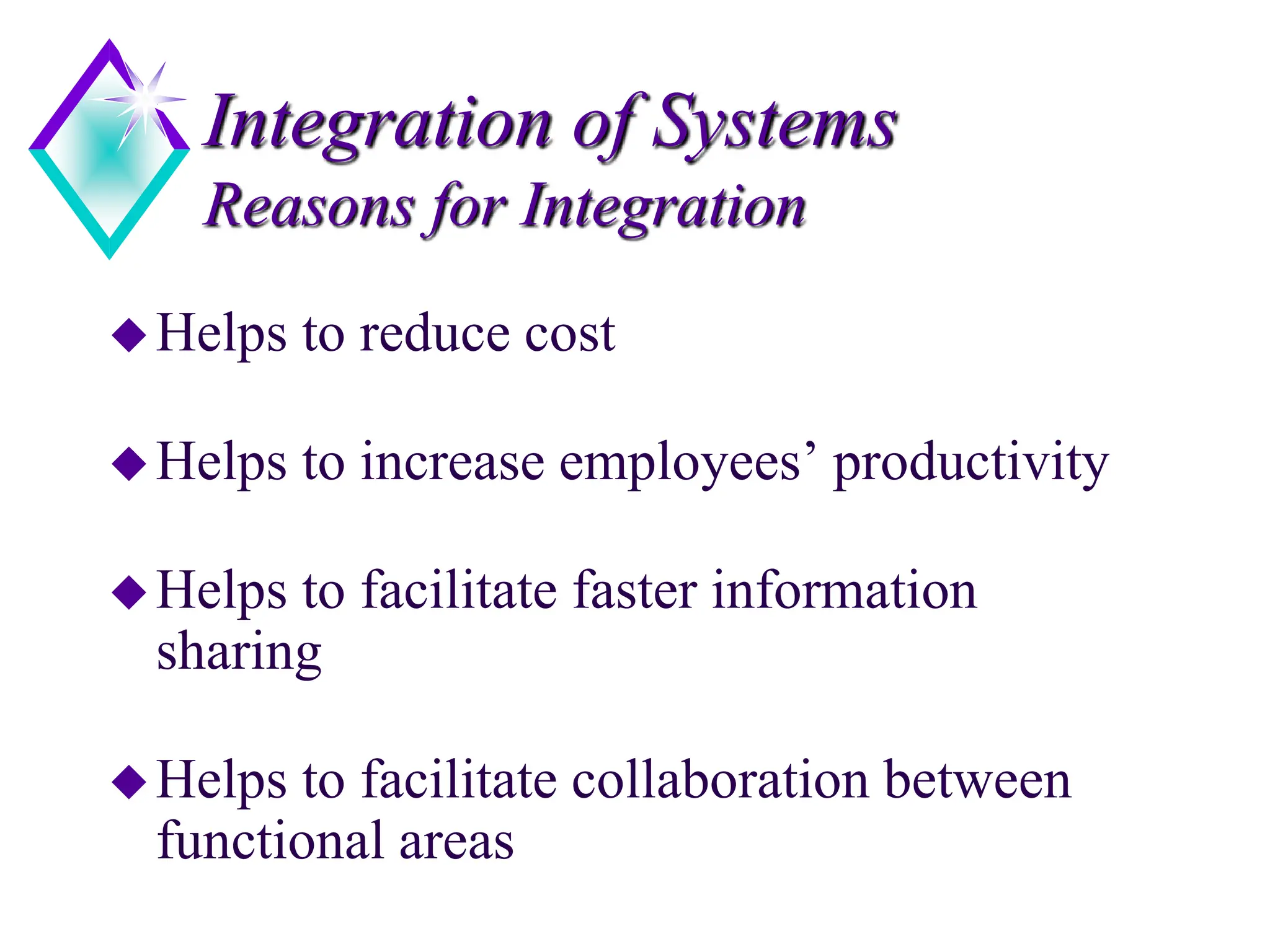
Integration of Systems
Reasons for Integration
Helps to reduce cost
Helps to increase employees’ productivity
Helps to facilitate faster information
sharing
Helps to facilitate collaboration between
functional areas
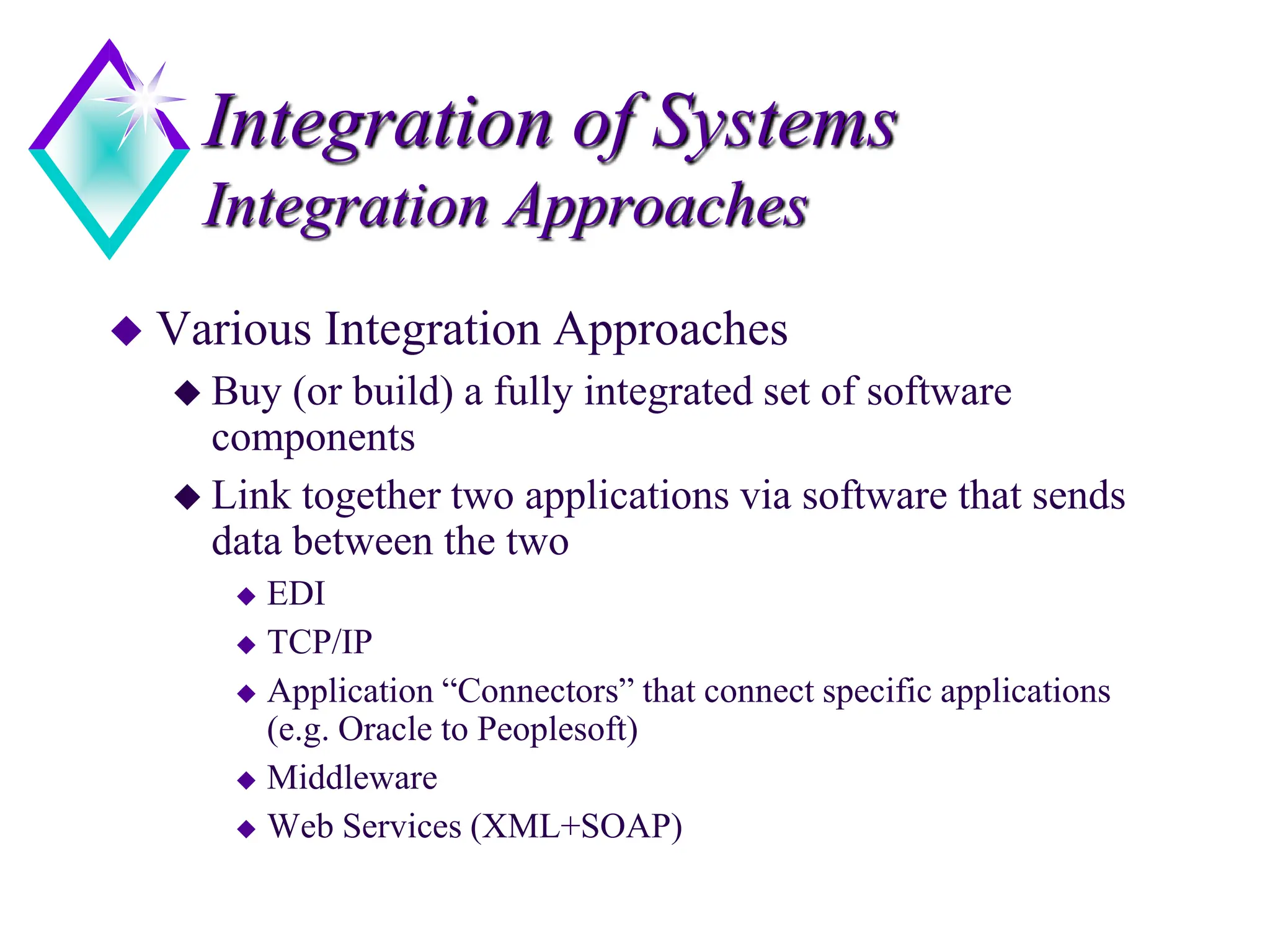
Integration of Systems
Integration Approaches
 Various Integration Approaches
 Buy (or build) a fully integrated set of software
components
 Link together two applications via software that sends
data between the two
 EDI
 TCP/IP
 Application “Connectors” that connect specific applications
(e.g. Oracle to Peoplesoft)
 Middleware
 Web Services (XML+SOAP)
Transaction Processing Systems
Computerization of
Routine Transaction Processes
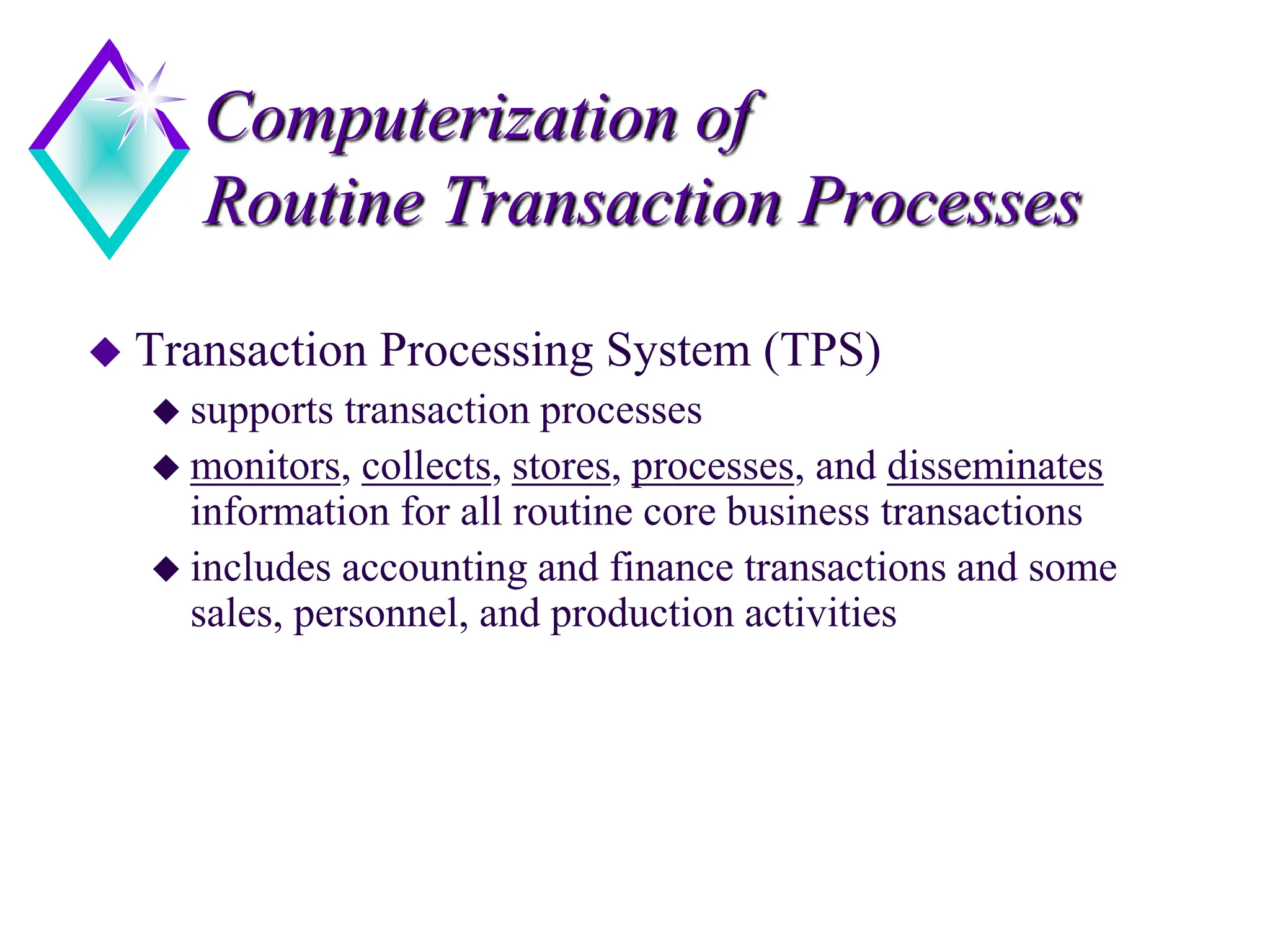
 Transaction Processing System (TPS)
 supports transaction processes
 monitors, collects, stores, processes, and disseminates
information for all routine core business transactions
 includes accounting and finance transactions and some
sales, personnel, and production activities
Transaction Processing Systems
Objectives of TPS
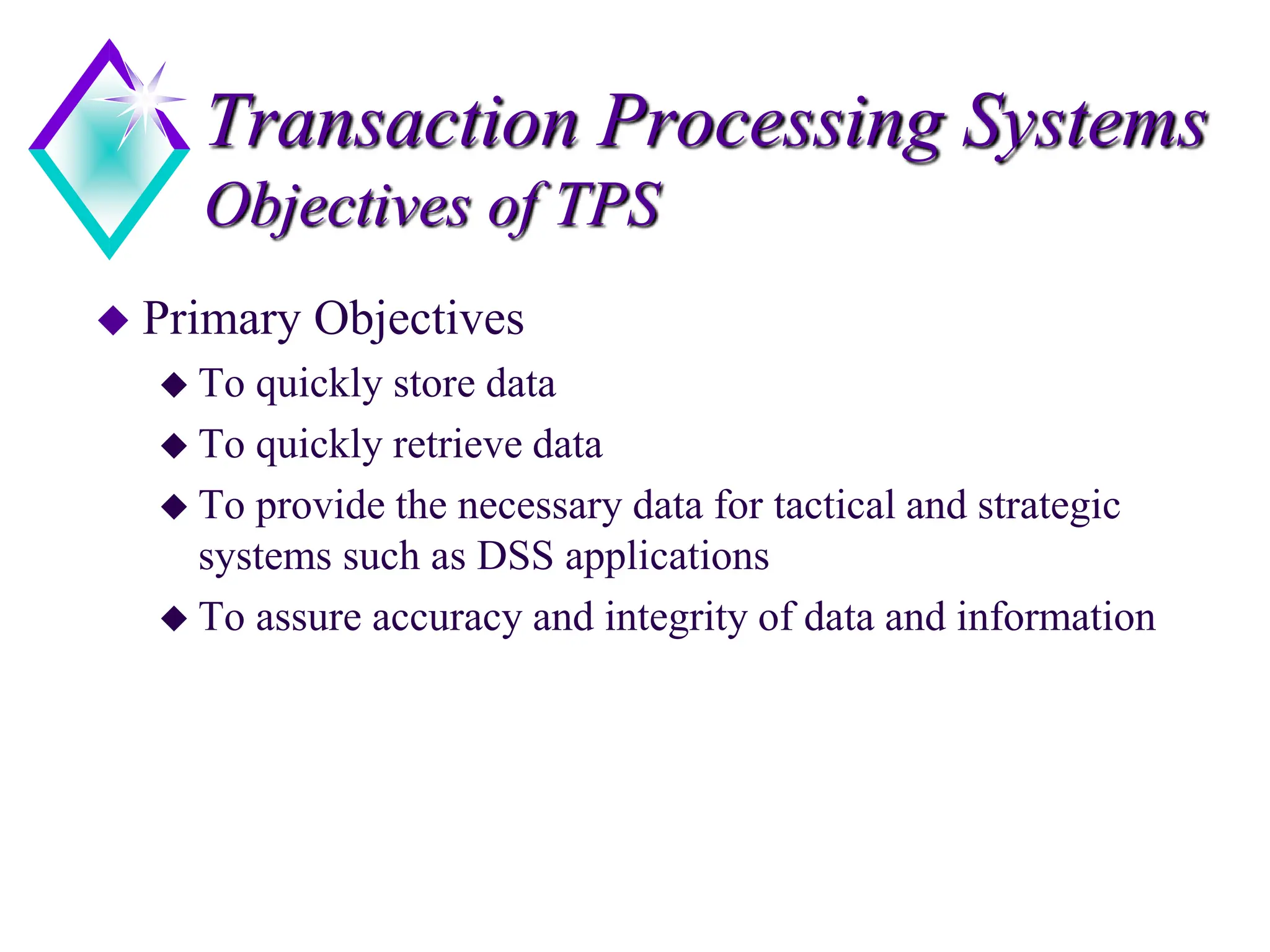
 Primary Objectives
 To quickly store data
 To quickly retrieve data
 To provide the necessary data for tactical and strategic
systems such as DSS applications
 To assure accuracy and integrity of data and information
Transaction Processing Systems
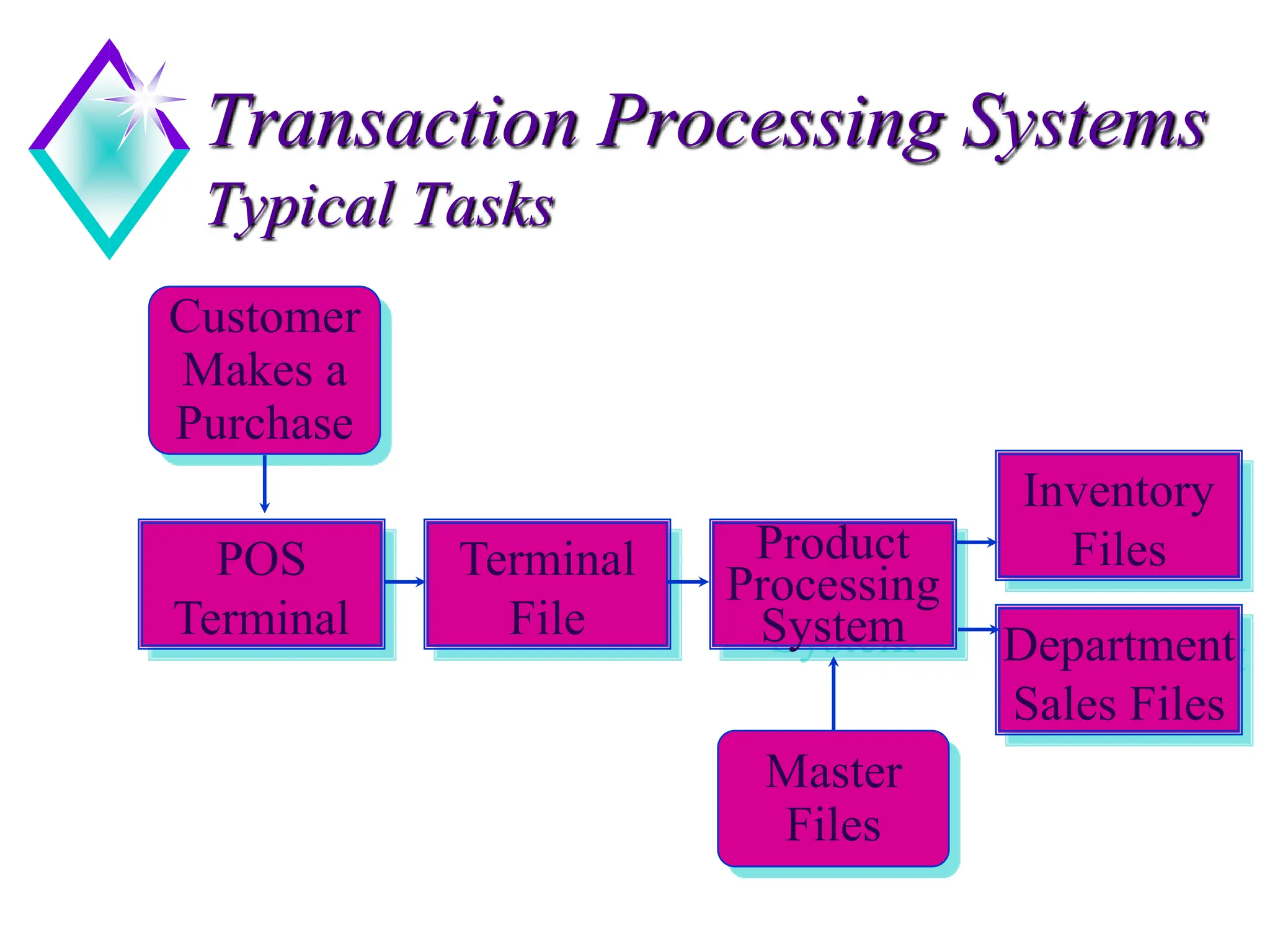
Typical Tasks
POS
Terminal
Terminal
File
Product
Processing
System
Inventory
Files
Department
Sales Files
Customer
Makes a
Purchase
Master
Files
Transaction Processing Systems
Objectives of TPS
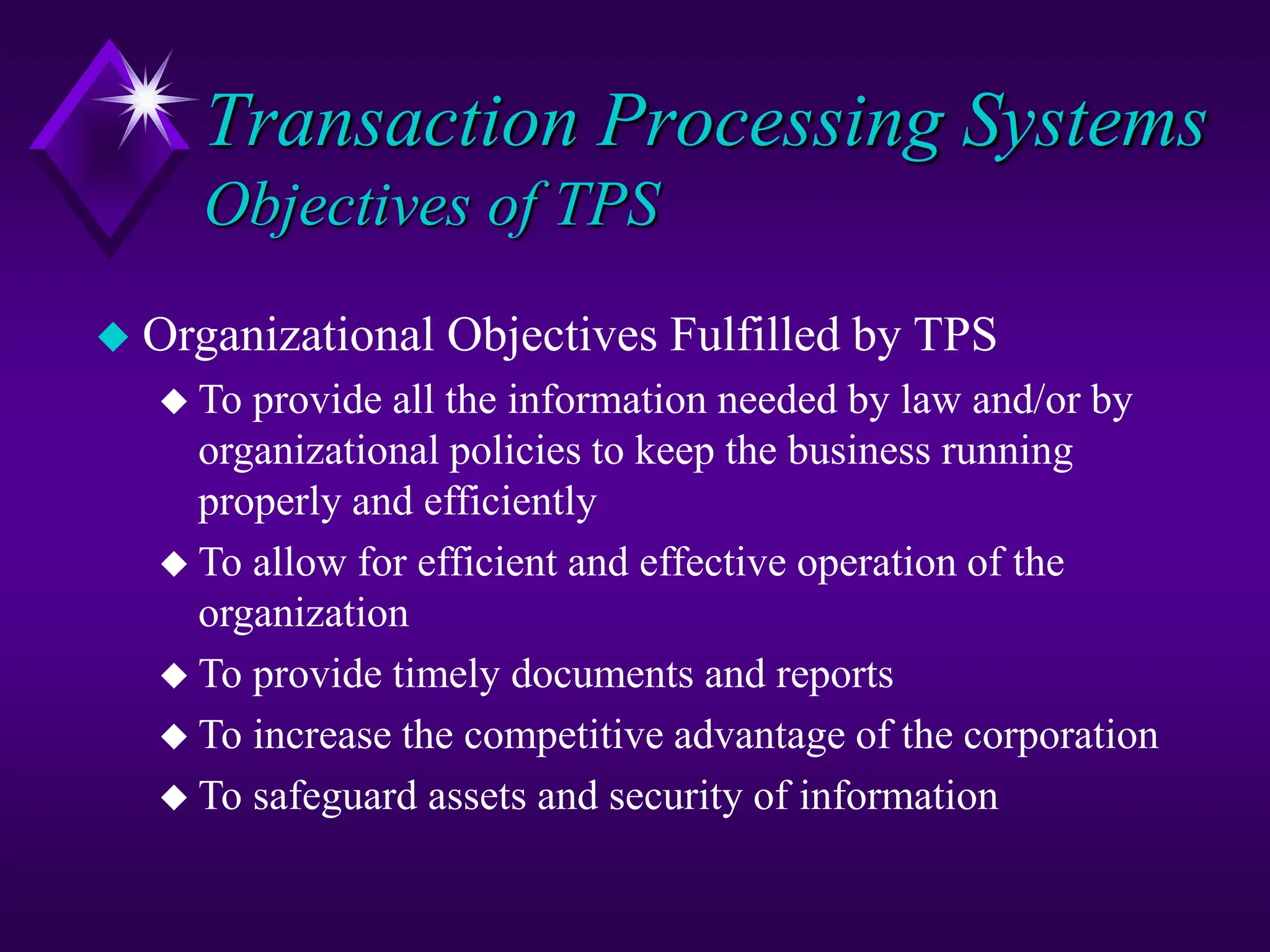
 Organizational Objectives Fulfilled by TPS
 To provide all the information needed by law and/or by
organizational policies to keep the business running
properly and efficiently
 To allow for efficient and effective operation of the
organization
 To provide timely documents and reports
 To increase the competitive advantage of the corporation
 To safeguard assets and security of information
Transaction Processing Systems
Major Characteristics of TPS
 Large amount of data are processed
 The sources of data are mostly internal, and the output is intended mainly
for an internal audience
 The TPS processes information on a regular basis
 Large storage (database) capacity is required
 High processing speed is needed due to the high volume
 TPS basically monitors and collects past data
 Input and output data are structured
 High level of detail is usually observed
 Low computation complexity
 High level of accuracy, data integrity, and security is needed
 High reliability is required
 Inquiry processing is a must
Transaction Processing Systems
Various TPS Technologies
 Some TPS Technologies
 Online Transaction Processing (OLTP)
 Allows managers to run client-server transactions to obtain
some information of interest
 Web-based Transaction Processing
 Similar to OLTP
 Allows managers to run transactions via the web
 Object-Oriented Transaction Monitors (OTM)
 Objects that monitor transactions in web-based applications
 When an activity happens within a web site, the object sends a
query to the data warehouse to record information about what
happened (e.g., customer checked out)
Transaction Processing Systems
Benefits of Internet-based OLTP
 Flexibility to accommodate unpredictable growth in
processing demands
 Cost effectiveness even for small dollar amounts
 Interactive, automatic billing, enabling companies to offer
services to anyone, not just subscribers
 Timely search and analysis of large databases
 Multimedia data such as pictures and sound are handled
effectively and efficiently
 High data throughput to support inquiries requiring massive
file size
 Fast response time
 Effective storage of huge graphics and video databases
Transaction Processing Systems
TPS Hardware
Traditional TPSs were centralized and run
on a mainframe
Today …
mainframes
client/server systems
clusters of servers, each server running multiple
processors
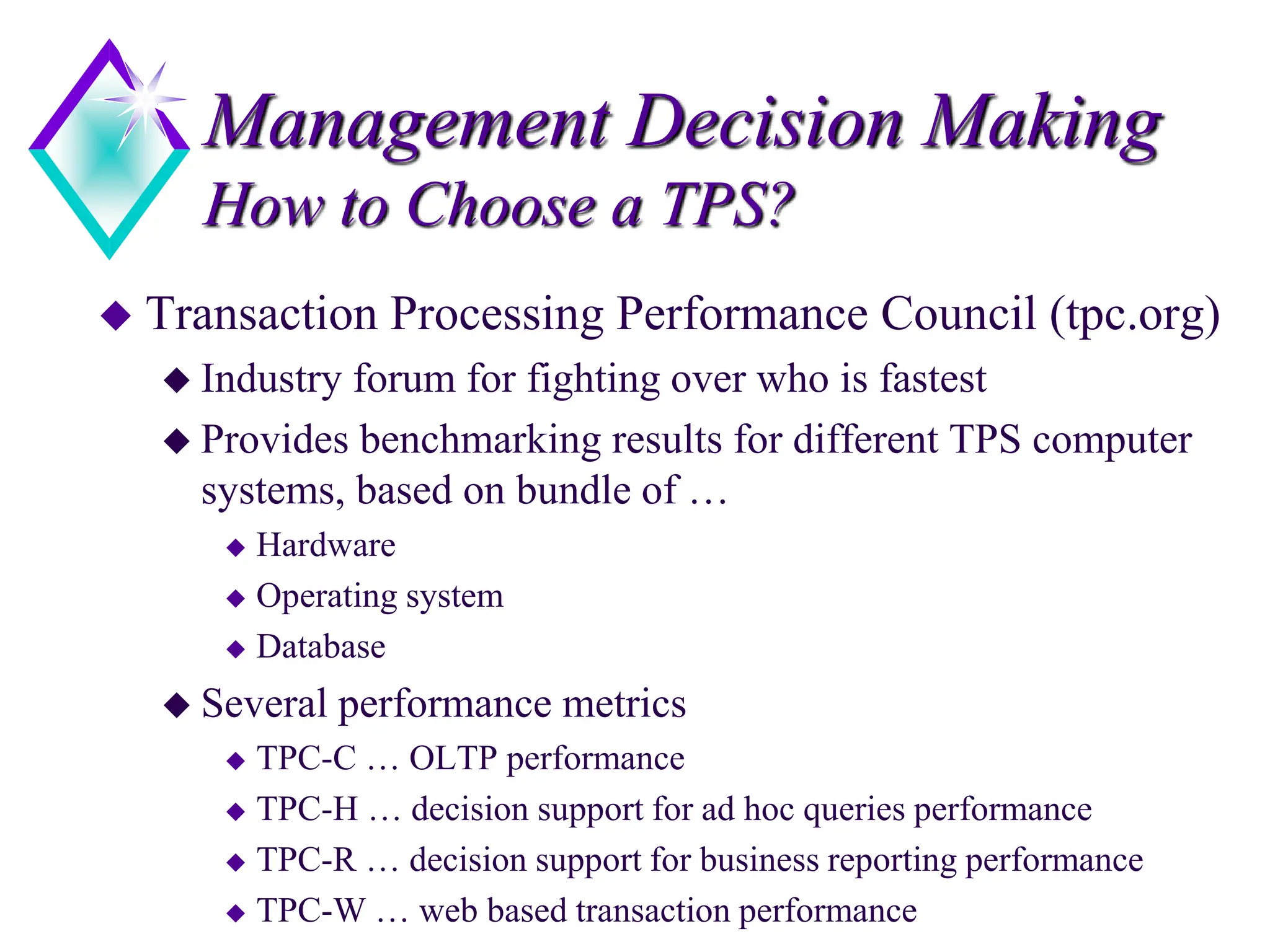
Management Decision Making
How to Choose a TPS?
 Transaction Processing Performance Council (tpc.org)
 Industry forum for fighting over who is fastest
 Provides benchmarking results for different TPS computer
systems, based on bundle of …
 Hardware
 Operating system
 Database
 Several performance metrics
 TPC-C … OLTP performance
 TPC-H … decision support for ad hoc queries performance
 TPC-R … decision support for business reporting performance
 TPC-W … web based transaction performance
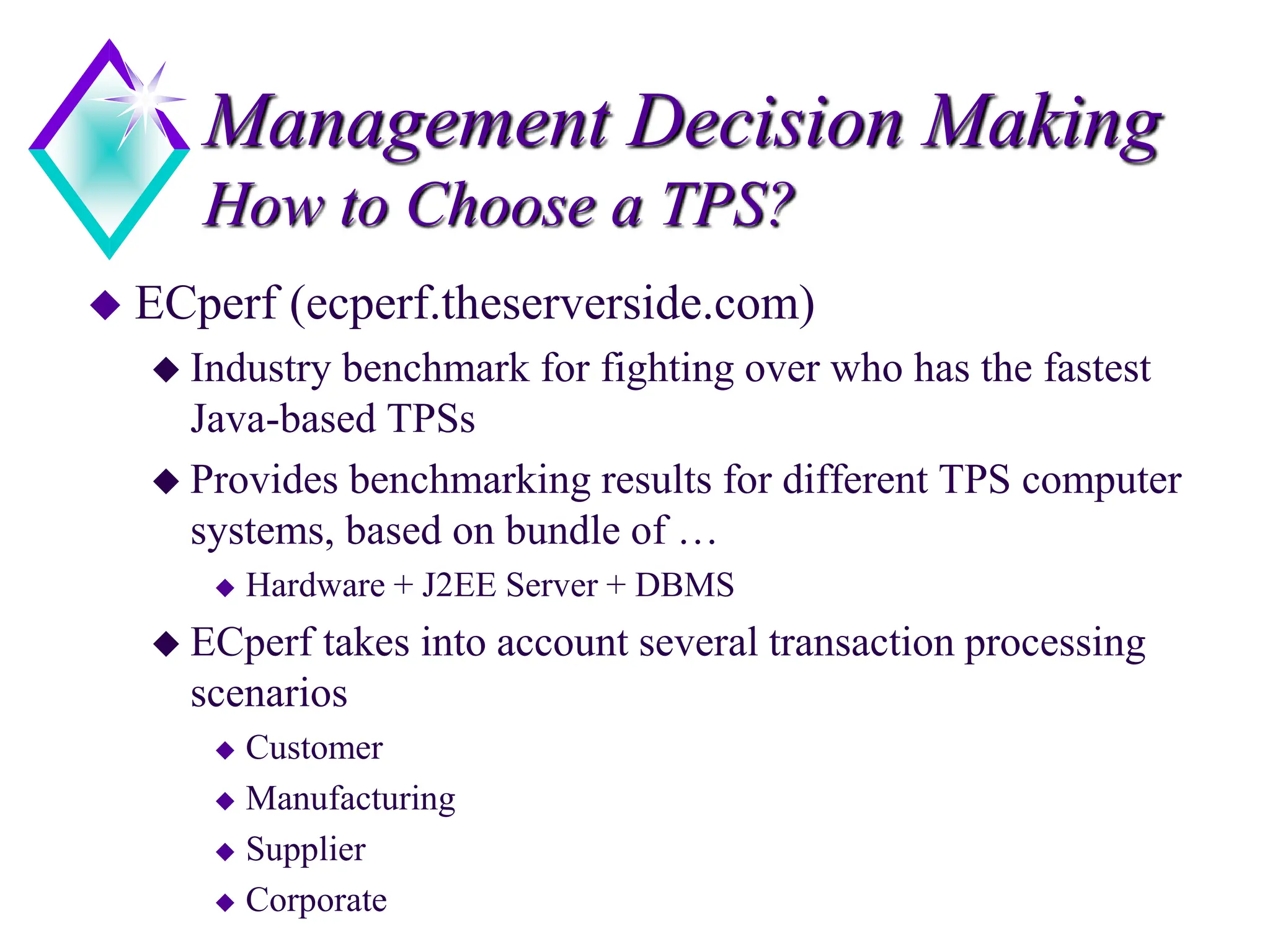
Management Decision Making
How to Choose a TPS?
 ECperf (ecperf.theserverside.com)
 Industry benchmark for fighting over who has the fastest
Java-based TPSs
 Provides benchmarking results for different TPS computer
systems, based on bundle of …
 Hardware + J2EE Server + DBMS
 ECperf takes into account several transaction processing
scenarios
 Customer
 Manufacturing
 Supplier
 Corporate
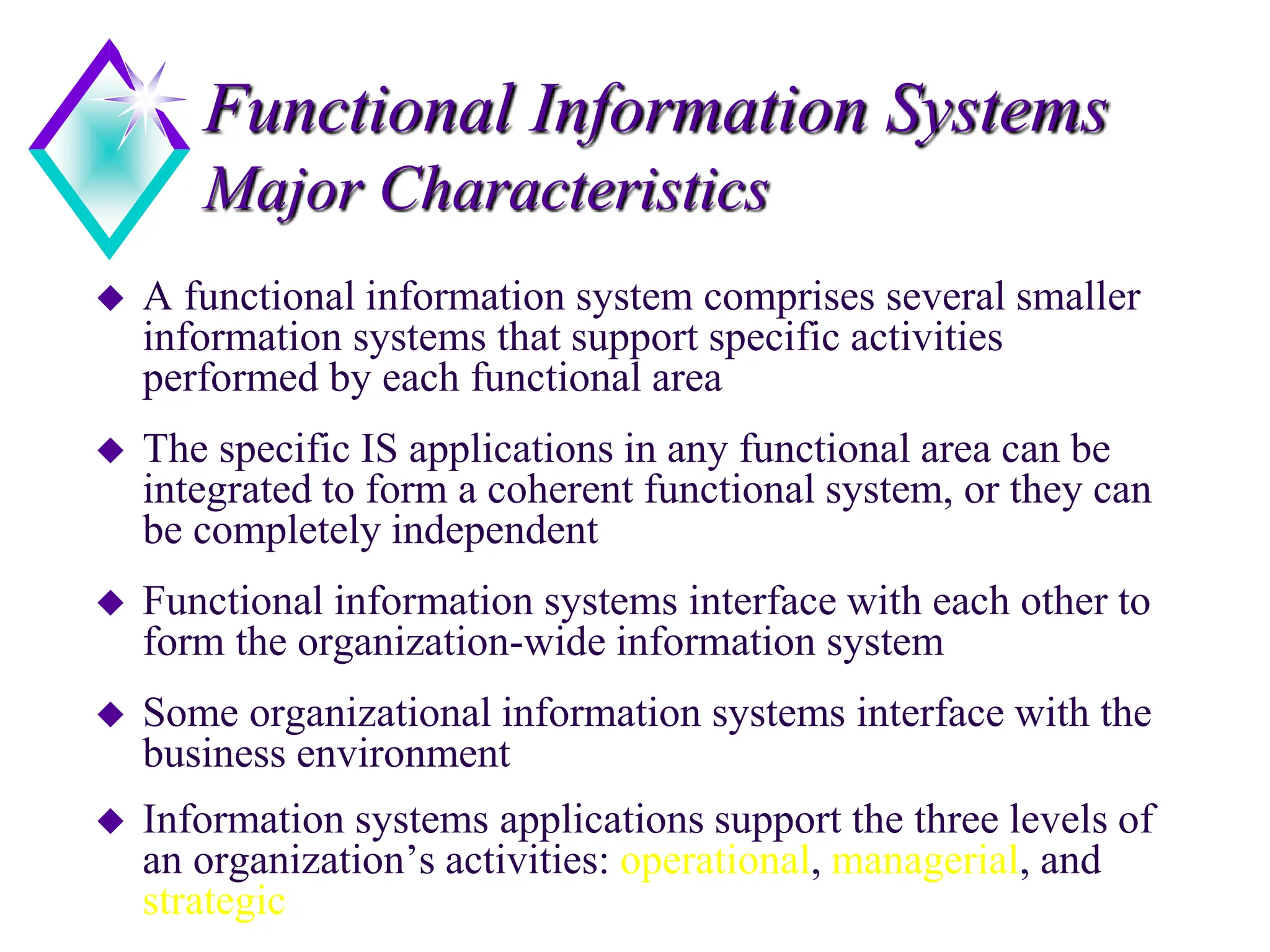
Functional Information Systems
Major Characteristics
 A functional information system comprises several smaller
information systems that support specific activities
performed by each functional area
 The specific IS applications in any functional area can be
integrated to form a coherent functional system, or they can
be completely independent
 Functional information systems interface with each other to
form the organization-wide information system
 Some organizational information systems interface with the
business environment
 Information systems applications support the three levels of
an organization’s activities: operational, managerial, and
strategic
Innovative Functional
Applications of IT
Innovative IT in Operations
Innovative IT Applications
in Operations
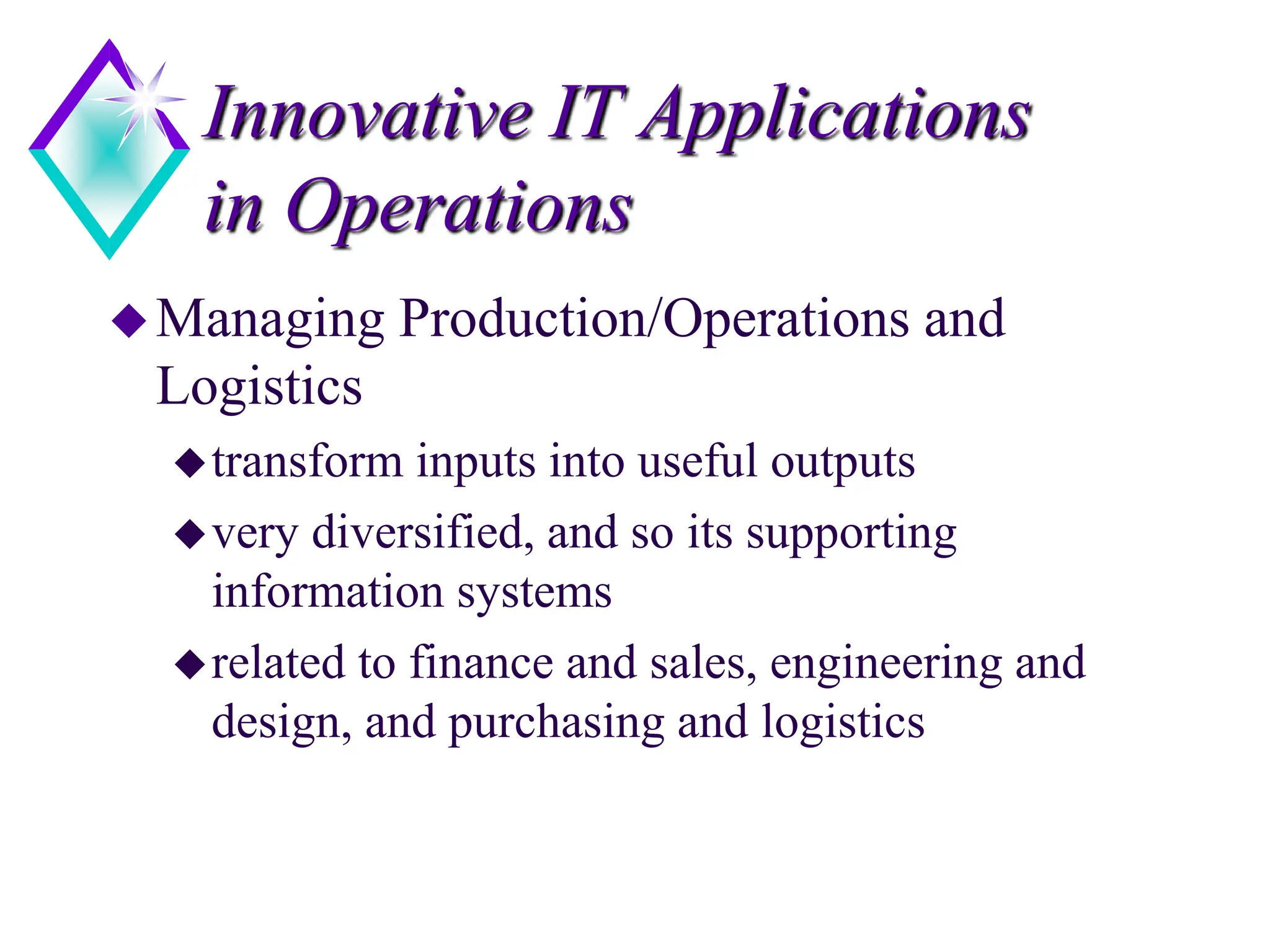
Managing Production/Operations and
Logistics
transform inputs into useful outputs
very diversified, and so its supporting
information systems
related to finance and sales, engineering and
design, and purchasing and logistics
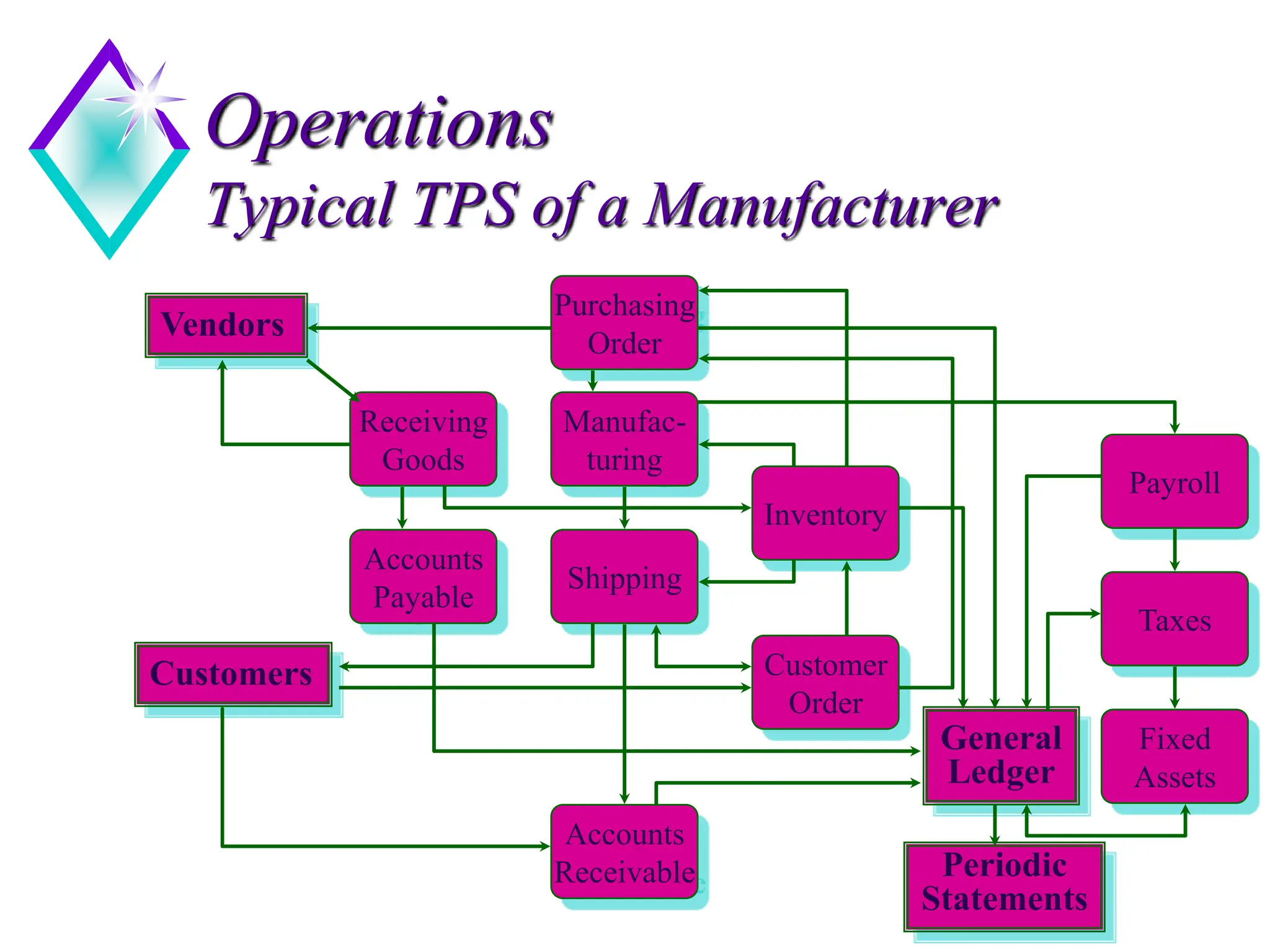
Operations
Typical TPS of a Manufacturer
Vendors
Customers
General
Ledger
Periodic
Statements
Manufac-
turing
Purchasing
Order
Receiving
Goods
Accounts
Payable
Shipping
Accounts
Receivable
Inventory
Customer
Order
Taxes
Payroll
Fixed
Assets
Operations
Supply-Chain Management
objective is to support the flow of goods
and materials from the original supplier
through multiple production and logistic
operations to the ultimate consumer
extensive integrated software is available
for managing portions of the supply chain
as well as the entire process
Operations
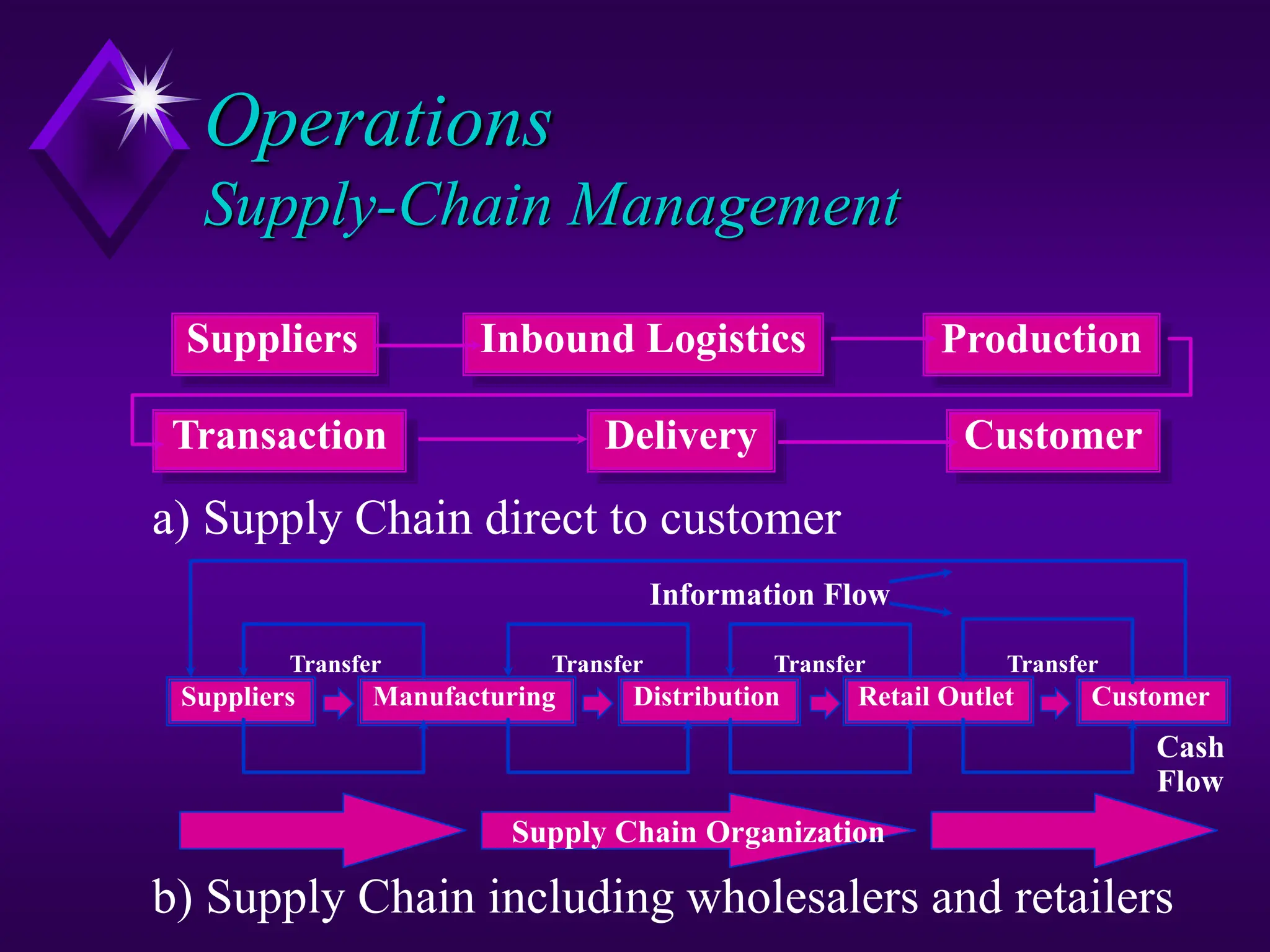
Supply-Chain Management
Suppliers Inbound Logistics Production
Transaction Delivery Customer
a) Supply Chain direct to customer
Suppliers Manufacturing Distribution Retail Outlet Customer
Transfer Transfer Transfer Transfer
Information Flow
Cash
Flow
b) Supply Chain including wholesalers and retailers
Supply Chain Organization
Operations
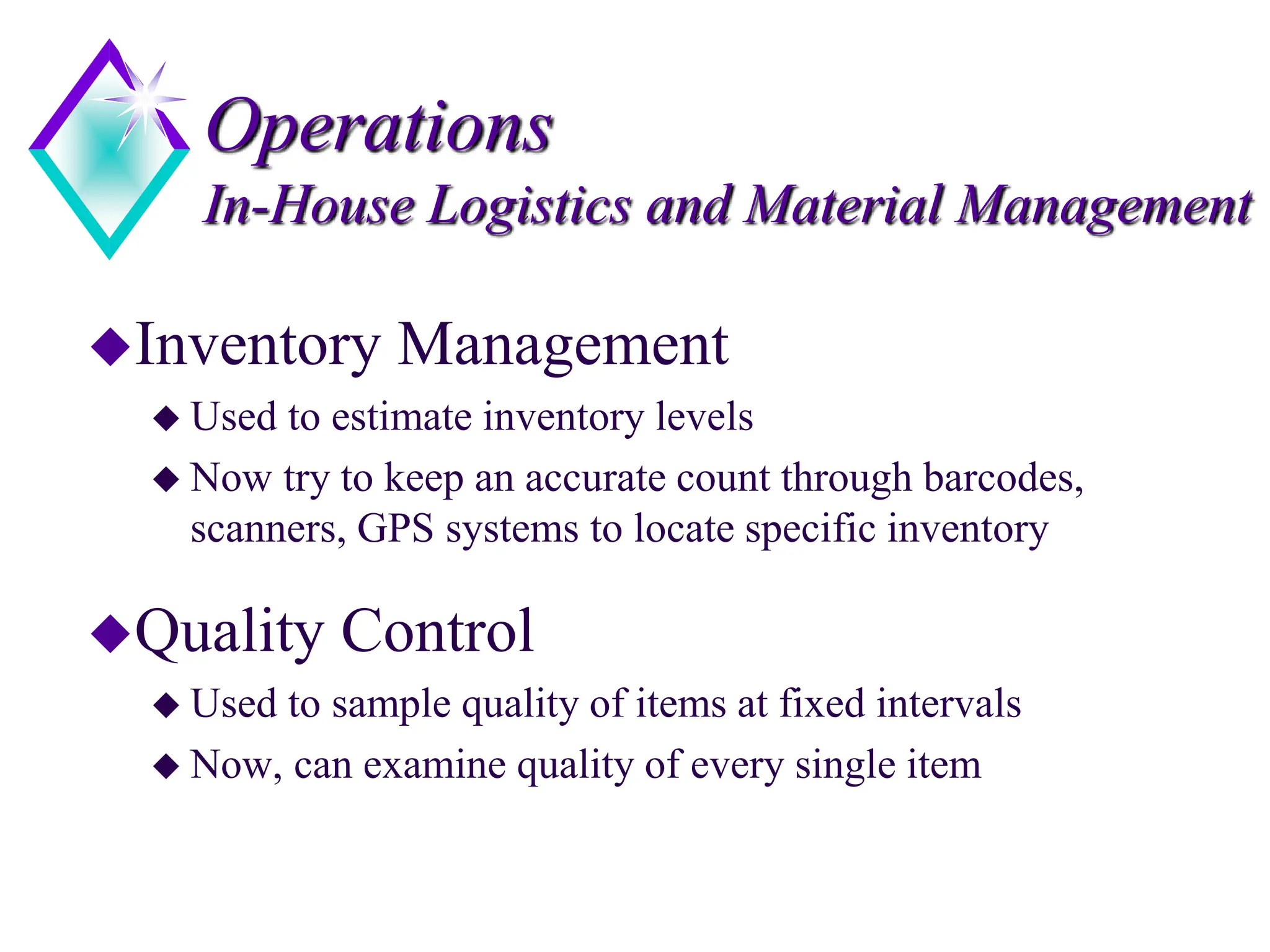
In-House Logistics and Material Management
Inventory Management
 Used to estimate inventory levels
 Now try to keep an accurate count through barcodes,
scanners, GPS systems to locate specific inventory
Quality Control
 Used to sample quality of items at fixed intervals
 Now, can examine quality of every single item
Operations
Planning Production/Operations
Material Requirements Planning (MRP)
Manufacturing Resource Planning (MRP II)
Just-in-Time Systems
Project Management
Short-Term Schedules
Operations
Automated Design and Manufacturing
Computer-aided Design (CAD)
Computer-aided Engineering (CAE)
Computer-aided Manufacturing (CAM)
Operations
Computer-Integrated Manufacturing (CIM)
 “Factory of the Future”
 Three basic goals:
 simplification
 automation
 integration and coordination
 The CIM model
 made up by general business management, product and
process definition, manufacturing planning and control,
factory automation, and information resource
management
Innovative IT in Marketing
Marketing
Channel Systems/Customer Touchpoints
The customer is king (queen)
Customer profiles and preference analysis
Prospective customer lists and marketing
databases
Mass customization
Targeted Advertisement on the Web
Customer inquiry systems and Automated Help
Desk (EC application)
Marketing
Channel Systems/Customer Touchpoints
 Telemarketing
 Capabilities
 personalized contact with the customers
 allows customers to buy at their convenience
 effective in informing customers about a company’s products and
services
 Limitations
 cost can be high
 difficult to find good telemarketers
 may be seen by many as a nuisance
 challenges in reaching people
Marketing
Distribution Channels
 Distribution channels management
 DSS models are frequently used to support the decision of
accomplishing by a company, or by a subcontractor
 Improving sales at retail stores
 using IT, it is possible to improve the situation by
reengineering the checkout process
Marketing
Marketing Management
Pricing of products or services
Salesperson productivity
Productivity software
Products and customers profitability analysis
Sales analysis and trends
New products, services, and market planning
Innovative IT in Finance &
Accounting
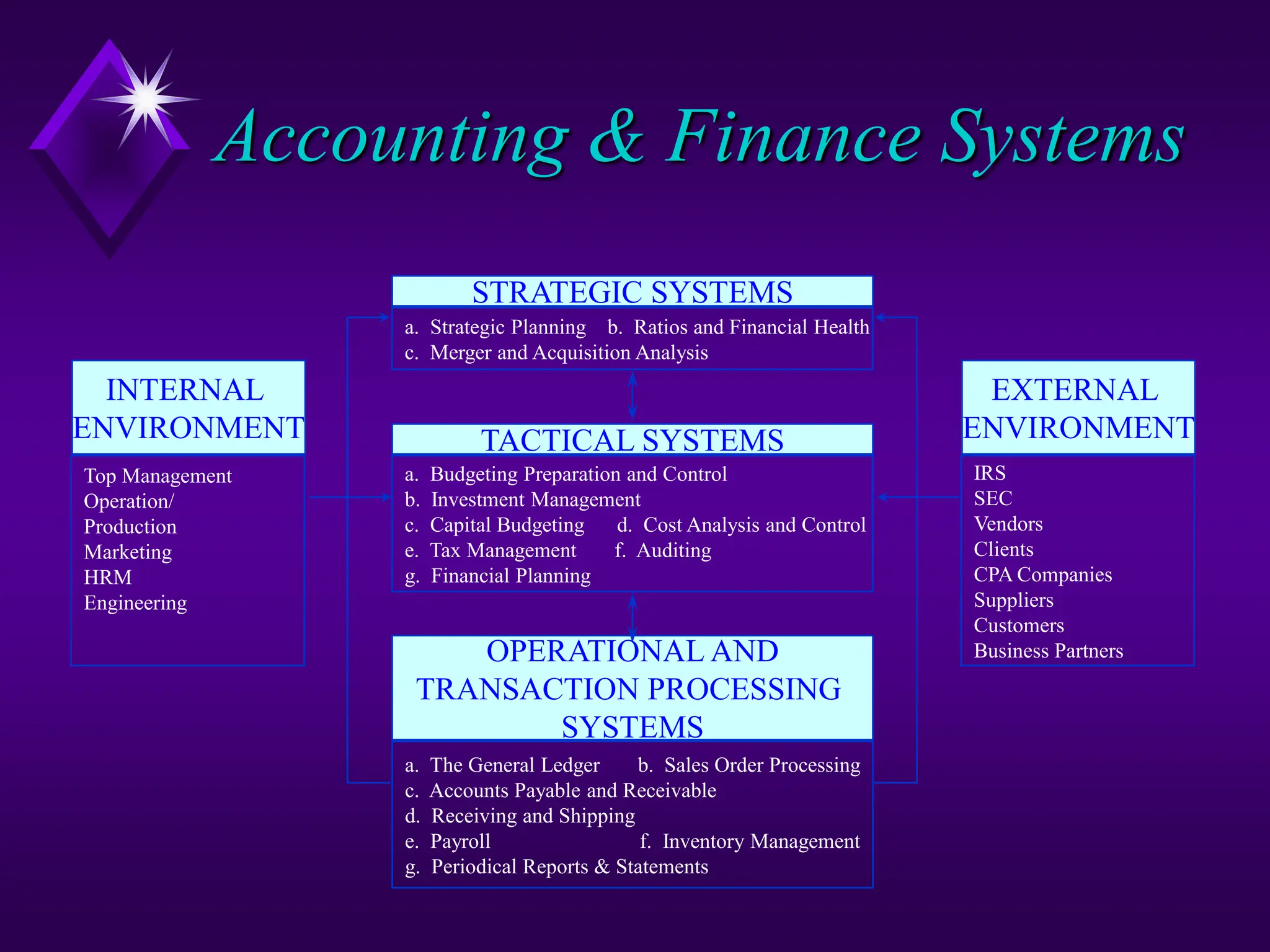
Accounting & Finance Systems
TACTICAL SYSTEMS
a. Budgeting Preparation and Control
b. Investment Management
c. Capital Budgeting d. Cost Analysis and Control
e. Tax Management f. Auditing
g. Financial Planning
INTERNAL
ENVIRONMENT
Top Management
Operation/
Production
Marketing
HRM
Engineering
EXTERNAL
ENVIRONMENT
IRS
SEC
Vendors
Clients
CPA Companies
Suppliers
Customers
Business Partners
STRATEGIC SYSTEMS
a. Strategic Planning b. Ratios and Financial Health
c. Merger and Acquisition Analysis
OPERATIONAL AND
TRANSACTION PROCESSING
SYSTEMS
a. The General Ledger b. Sales Order Processing
c. Accounts Payable and Receivable
d. Receiving and Shipping
e. Payroll f. Inventory Management
g. Periodical Reports & Statements
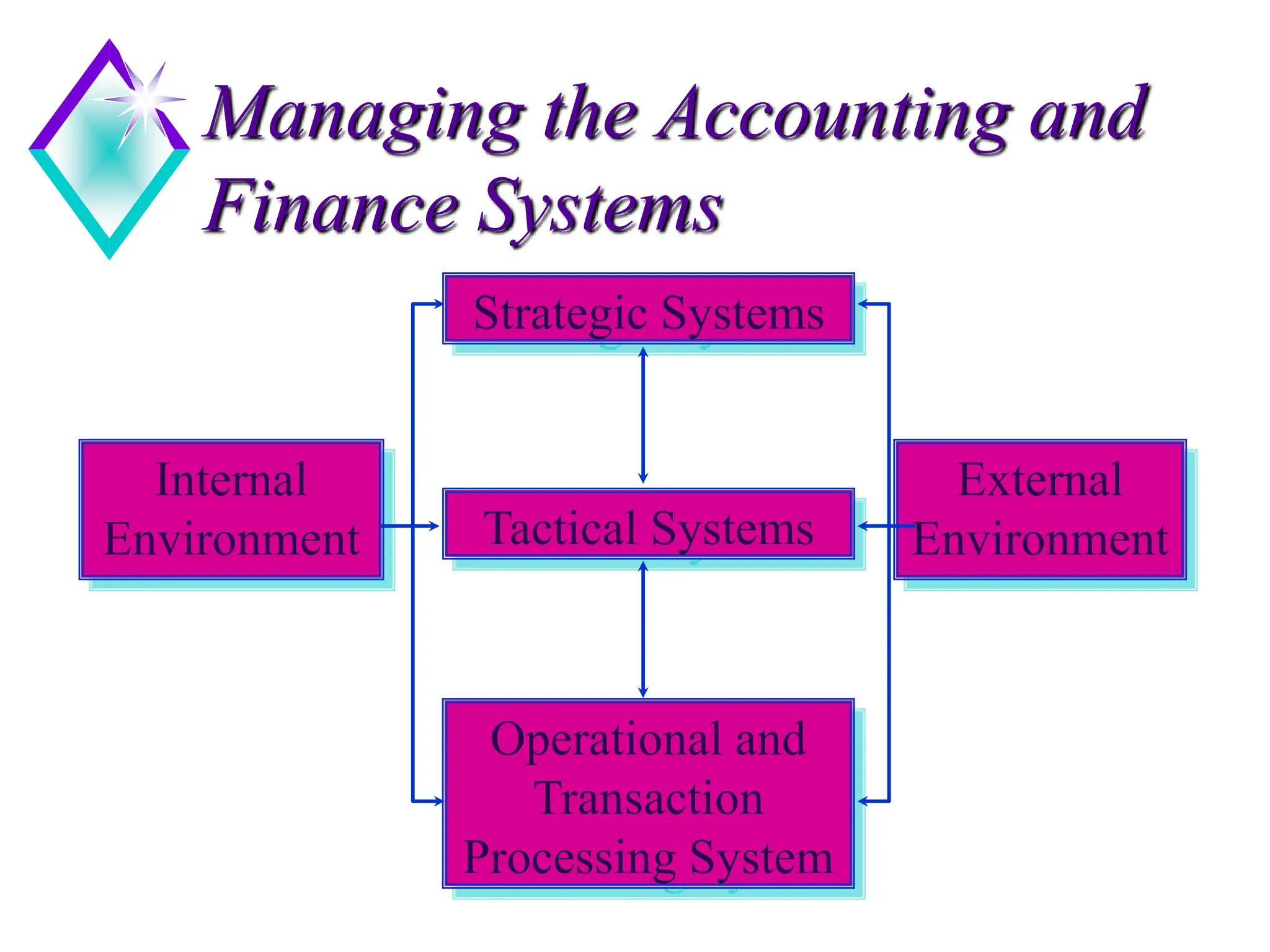
Managing the Accounting and
Finance Systems
Strategic Systems
Tactical Systems
Operational and
Transaction
Processing System
Internal
Environment
External
Environment
Accounting & Finance
Financial Planning and Budgeting
Financial and economic forecasting
Planning for incoming funds
Budgeting preparation and operation
Capital budgeting decision
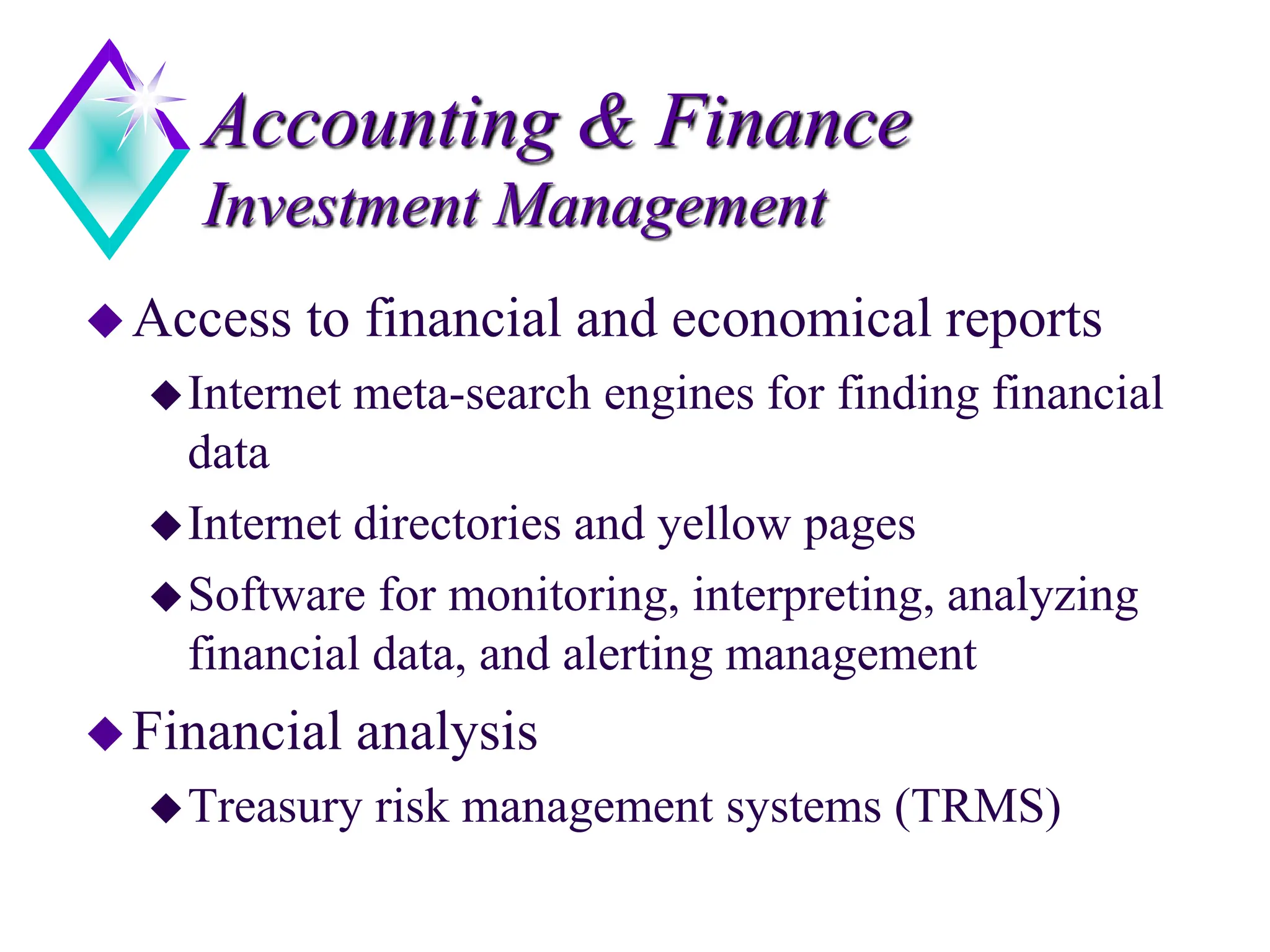
Accounting & Finance
Investment Management
Access to financial and economical reports
Internet meta-search engines for finding financial
data
Internet directories and yellow pages
Software for monitoring, interpreting, analyzing
financial data, and alerting management
Financial analysis
Treasury risk management systems (TRMS)
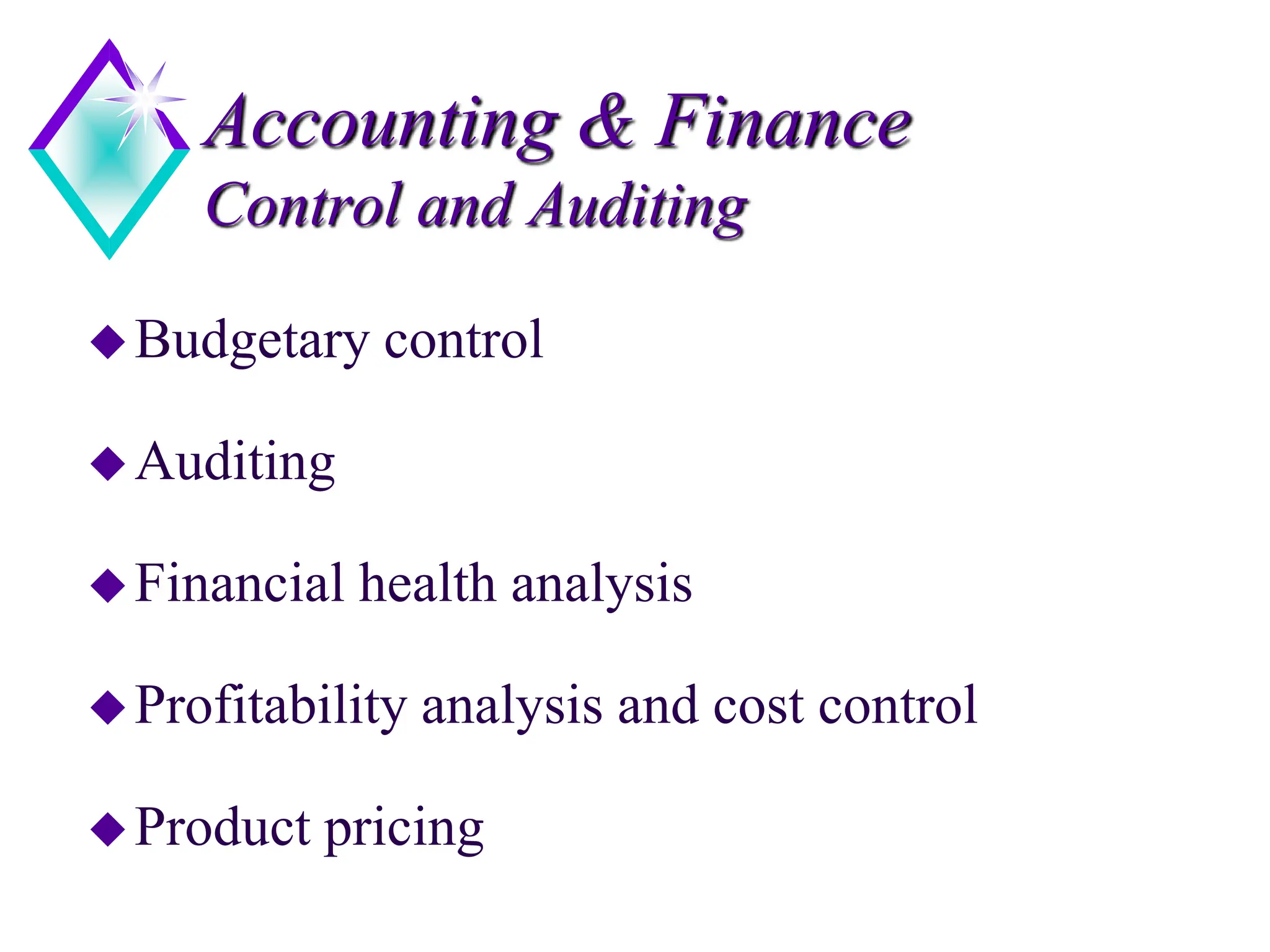
Accounting & Finance
Control and Auditing
Budgetary control
Auditing
Financial health analysis
Profitability analysis and cost control
Product pricing
Innovative IT in HR
Human Resources
Recruitment
Position inventory
Employee selection
Using the Internet
Human Resources
Maintenance and Development
Performance evaluation
Training and human resources development
Turnover, tardiness, and absenteeism analyses
Human Resources
Planning and Management
Personnel planning
Succession planning
Labor-management negotiations
Benefits administration

dbms3.ppt ppt

  • 1.
    Overview Background Integration of Systems TransactionProcessing Systems Innovative Functional Information Systems
  • 2.
    Background Functions in Porter’sValue Chain Typical functional areas mapped on the value chain of a manufacturing company Firm Infrastructure (Accounting, Finance, General Management) Human Resource Management (Human Resources) Technology Development (Engineering) Procurement (Material Management-Operations) Support Activities Service (Service or Marketing) Inbound Logistics (Material Managaement- Operations) Operations (Operations) Outbound Logistics (Material Managemnet- Operations) Marketing and Sales (Marketing) Primary Activities
  • 3.
    Background Historical Functional Systems TPS Finance info.systems TPS Accounting info. systems TPS Manufacturing info. systems “Hey, could you generate a report for me detailing how much this part typically costs?” 3 weeks later … “Okay, here it is! All 500 pages on crisp white paper!”
  • 4.
  • 5.
    Integration of Systems ModernIntegrated Functional Systems TPS Operations TPS ERP Executive IS HR TPS Accounting TPS Finance TPS Marketing CRM SCM To Suppliers To Customer Touchpoints data data
  • 6.
    Integration of Systems Reasonsfor Integration Helps to reduce cost Helps to increase employees’ productivity Helps to facilitate faster information sharing Helps to facilitate collaboration between functional areas
  • 7.
    Integration of Systems IntegrationApproaches  Various Integration Approaches  Buy (or build) a fully integrated set of software components  Link together two applications via software that sends data between the two  EDI  TCP/IP  Application “Connectors” that connect specific applications (e.g. Oracle to Peoplesoft)  Middleware  Web Services (XML+SOAP)
  • 8.
  • 9.
    Computerization of Routine TransactionProcesses  Transaction Processing System (TPS)  supports transaction processes  monitors, collects, stores, processes, and disseminates information for all routine core business transactions  includes accounting and finance transactions and some sales, personnel, and production activities
  • 10.
    Transaction Processing Systems Objectivesof TPS  Primary Objectives  To quickly store data  To quickly retrieve data  To provide the necessary data for tactical and strategic systems such as DSS applications  To assure accuracy and integrity of data and information
  • 11.
    Transaction Processing Systems TypicalTasks POS Terminal Terminal File Product Processing System Inventory Files Department Sales Files Customer Makes a Purchase Master Files
  • 12.
    Transaction Processing Systems Objectivesof TPS  Organizational Objectives Fulfilled by TPS  To provide all the information needed by law and/or by organizational policies to keep the business running properly and efficiently  To allow for efficient and effective operation of the organization  To provide timely documents and reports  To increase the competitive advantage of the corporation  To safeguard assets and security of information
  • 13.
    Transaction Processing Systems MajorCharacteristics of TPS  Large amount of data are processed  The sources of data are mostly internal, and the output is intended mainly for an internal audience  The TPS processes information on a regular basis  Large storage (database) capacity is required  High processing speed is needed due to the high volume  TPS basically monitors and collects past data  Input and output data are structured  High level of detail is usually observed  Low computation complexity  High level of accuracy, data integrity, and security is needed  High reliability is required  Inquiry processing is a must
  • 14.
    Transaction Processing Systems VariousTPS Technologies  Some TPS Technologies  Online Transaction Processing (OLTP)  Allows managers to run client-server transactions to obtain some information of interest  Web-based Transaction Processing  Similar to OLTP  Allows managers to run transactions via the web  Object-Oriented Transaction Monitors (OTM)  Objects that monitor transactions in web-based applications  When an activity happens within a web site, the object sends a query to the data warehouse to record information about what happened (e.g., customer checked out)
  • 15.
    Transaction Processing Systems Benefitsof Internet-based OLTP  Flexibility to accommodate unpredictable growth in processing demands  Cost effectiveness even for small dollar amounts  Interactive, automatic billing, enabling companies to offer services to anyone, not just subscribers  Timely search and analysis of large databases  Multimedia data such as pictures and sound are handled effectively and efficiently  High data throughput to support inquiries requiring massive file size  Fast response time  Effective storage of huge graphics and video databases
  • 16.
    Transaction Processing Systems TPSHardware Traditional TPSs were centralized and run on a mainframe Today … mainframes client/server systems clusters of servers, each server running multiple processors
  • 17.
    Management Decision Making Howto Choose a TPS?  Transaction Processing Performance Council (tpc.org)  Industry forum for fighting over who is fastest  Provides benchmarking results for different TPS computer systems, based on bundle of …  Hardware  Operating system  Database  Several performance metrics  TPC-C … OLTP performance  TPC-H … decision support for ad hoc queries performance  TPC-R … decision support for business reporting performance  TPC-W … web based transaction performance
  • 18.
    Management Decision Making Howto Choose a TPS?  ECperf (ecperf.theserverside.com)  Industry benchmark for fighting over who has the fastest Java-based TPSs  Provides benchmarking results for different TPS computer systems, based on bundle of …  Hardware + J2EE Server + DBMS  ECperf takes into account several transaction processing scenarios  Customer  Manufacturing  Supplier  Corporate
  • 19.
  • 20.
    Functional Information Systems MajorCharacteristics  A functional information system comprises several smaller information systems that support specific activities performed by each functional area  The specific IS applications in any functional area can be integrated to form a coherent functional system, or they can be completely independent  Functional information systems interface with each other to form the organization-wide information system  Some organizational information systems interface with the business environment  Information systems applications support the three levels of an organization’s activities: operational, managerial, and strategic
  • 21.
  • 22.
    Innovative IT inOperations
  • 23.
    Innovative IT Applications inOperations Managing Production/Operations and Logistics transform inputs into useful outputs very diversified, and so its supporting information systems related to finance and sales, engineering and design, and purchasing and logistics
  • 24.
    Operations Typical TPS ofa Manufacturer Vendors Customers General Ledger Periodic Statements Manufac- turing Purchasing Order Receiving Goods Accounts Payable Shipping Accounts Receivable Inventory Customer Order Taxes Payroll Fixed Assets
  • 25.
    Operations Supply-Chain Management objective isto support the flow of goods and materials from the original supplier through multiple production and logistic operations to the ultimate consumer extensive integrated software is available for managing portions of the supply chain as well as the entire process
  • 26.
    Operations Supply-Chain Management Suppliers InboundLogistics Production Transaction Delivery Customer a) Supply Chain direct to customer Suppliers Manufacturing Distribution Retail Outlet Customer Transfer Transfer Transfer Transfer Information Flow Cash Flow b) Supply Chain including wholesalers and retailers Supply Chain Organization
  • 27.
    Operations In-House Logistics andMaterial Management Inventory Management  Used to estimate inventory levels  Now try to keep an accurate count through barcodes, scanners, GPS systems to locate specific inventory Quality Control  Used to sample quality of items at fixed intervals  Now, can examine quality of every single item
  • 28.
    Operations Planning Production/Operations Material RequirementsPlanning (MRP) Manufacturing Resource Planning (MRP II) Just-in-Time Systems Project Management Short-Term Schedules
  • 29.
    Operations Automated Design andManufacturing Computer-aided Design (CAD) Computer-aided Engineering (CAE) Computer-aided Manufacturing (CAM)
  • 30.
    Operations Computer-Integrated Manufacturing (CIM) “Factory of the Future”  Three basic goals:  simplification  automation  integration and coordination  The CIM model  made up by general business management, product and process definition, manufacturing planning and control, factory automation, and information resource management
  • 31.
  • 32.
    Marketing Channel Systems/Customer Touchpoints Thecustomer is king (queen) Customer profiles and preference analysis Prospective customer lists and marketing databases Mass customization Targeted Advertisement on the Web Customer inquiry systems and Automated Help Desk (EC application)
  • 33.
    Marketing Channel Systems/Customer Touchpoints Telemarketing  Capabilities  personalized contact with the customers  allows customers to buy at their convenience  effective in informing customers about a company’s products and services  Limitations  cost can be high  difficult to find good telemarketers  may be seen by many as a nuisance  challenges in reaching people
  • 34.
    Marketing Distribution Channels  Distributionchannels management  DSS models are frequently used to support the decision of accomplishing by a company, or by a subcontractor  Improving sales at retail stores  using IT, it is possible to improve the situation by reengineering the checkout process
  • 35.
    Marketing Marketing Management Pricing ofproducts or services Salesperson productivity Productivity software Products and customers profitability analysis Sales analysis and trends New products, services, and market planning
  • 36.
    Innovative IT inFinance & Accounting
  • 37.
    Accounting & FinanceSystems TACTICAL SYSTEMS a. Budgeting Preparation and Control b. Investment Management c. Capital Budgeting d. Cost Analysis and Control e. Tax Management f. Auditing g. Financial Planning INTERNAL ENVIRONMENT Top Management Operation/ Production Marketing HRM Engineering EXTERNAL ENVIRONMENT IRS SEC Vendors Clients CPA Companies Suppliers Customers Business Partners STRATEGIC SYSTEMS a. Strategic Planning b. Ratios and Financial Health c. Merger and Acquisition Analysis OPERATIONAL AND TRANSACTION PROCESSING SYSTEMS a. The General Ledger b. Sales Order Processing c. Accounts Payable and Receivable d. Receiving and Shipping e. Payroll f. Inventory Management g. Periodical Reports & Statements
  • 38.
    Managing the Accountingand Finance Systems Strategic Systems Tactical Systems Operational and Transaction Processing System Internal Environment External Environment
  • 39.
    Accounting & Finance FinancialPlanning and Budgeting Financial and economic forecasting Planning for incoming funds Budgeting preparation and operation Capital budgeting decision
  • 40.
    Accounting & Finance InvestmentManagement Access to financial and economical reports Internet meta-search engines for finding financial data Internet directories and yellow pages Software for monitoring, interpreting, analyzing financial data, and alerting management Financial analysis Treasury risk management systems (TRMS)
  • 41.
    Accounting & Finance Controland Auditing Budgetary control Auditing Financial health analysis Profitability analysis and cost control Product pricing
  • 42.
  • 43.
  • 44.
    Human Resources Maintenance andDevelopment Performance evaluation Training and human resources development Turnover, tardiness, and absenteeism analyses
  • 45.
    Human Resources Planning andManagement Personnel planning Succession planning Labor-management negotiations Benefits administration