Global Business process
What is globalization?
LEARNING OBJECTIVES
• Define and describe business processes and their relationship to
information systems.
• Describe the information systems supporting the major business
functions: sales and marketing, manufacturing and production, finance
and accounting, and human resources.
• Evaluate the role played by systems serving the various levels of
management in a business and their relationship to each other.
• Explain how enterprise applications and intranets promote business
process integration and improve organizational performance.
• Assess the role of the information systems function in a business.
LEARNING OBJECTIVES (Continued)
Business Processes and Information Systems
• Business processes
• How information technology enhances business processes: efficiency and
transformation
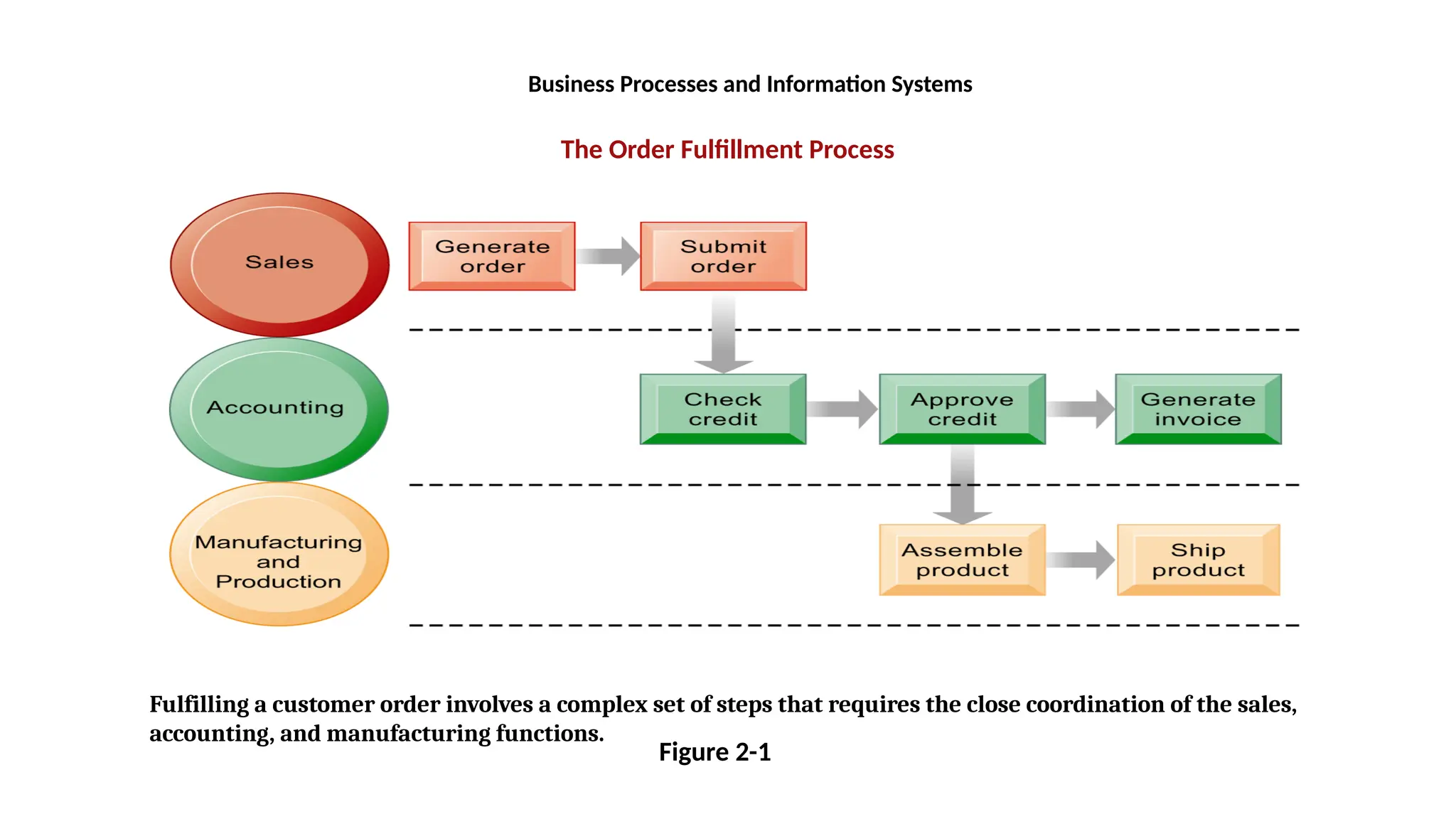
The Order Fulfillment Process
Figure 2-1
Fulfilling a customer order involves a complex set of steps that requires the close coordination of the sales,
accounting, and manufacturing functions.
Business Processes and Information Systems
• Systems from a functional perspective
• Sales and marketing systems
• Manufacturing and production systems
• Finance and accounting systems
• Human resources systems
• Systems from a constituency perspective
• Transaction processing systems
• Management information systems and decision-support
systems
• Executive support systems
• Relationship of systems to one another
Types of Business Information Systems
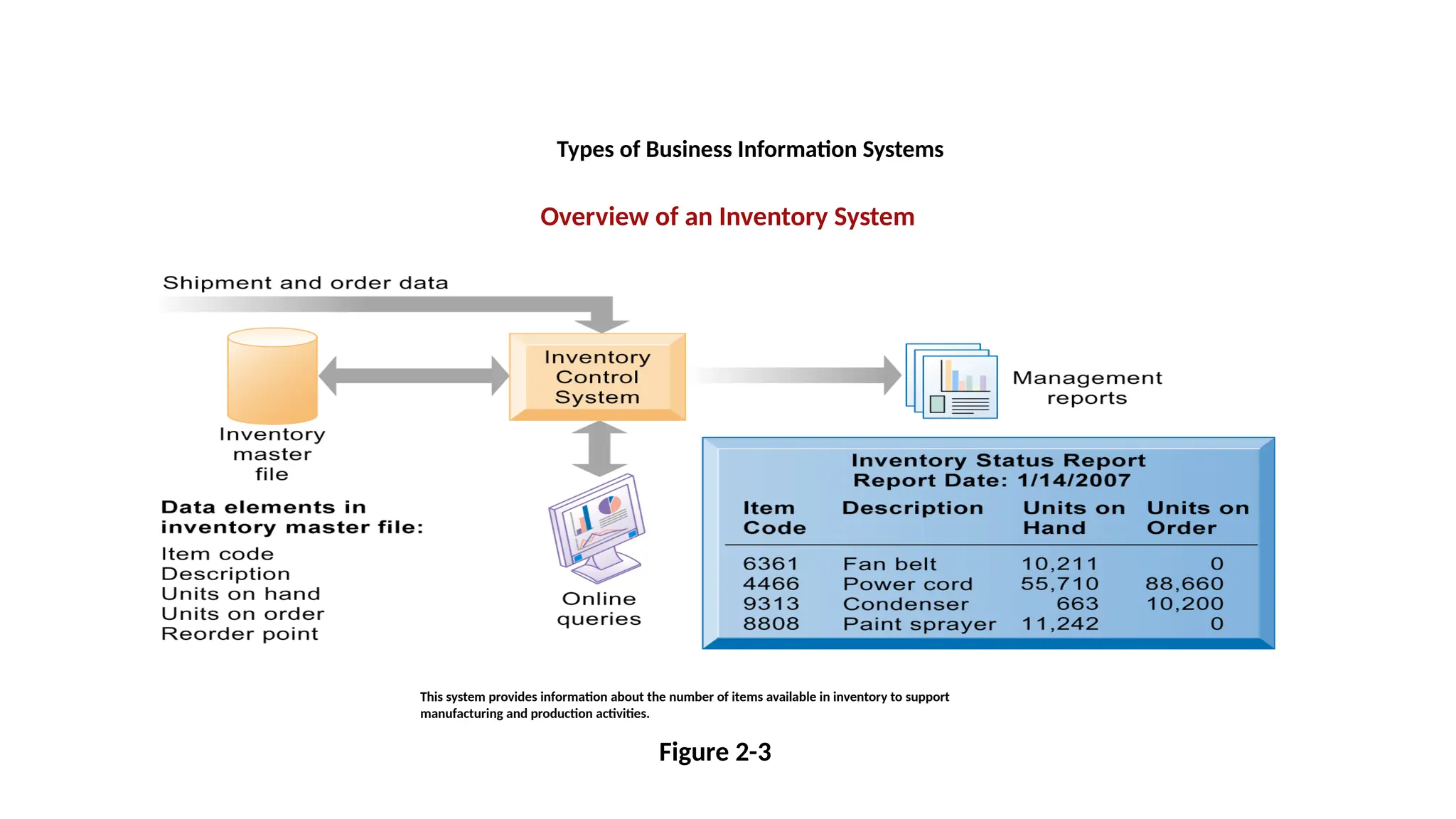
Overview of an Inventory System
Figure 2-3
This system provides information about the number of items available in inventory to support
manufacturing and production activities.
Types of Business Information Systems
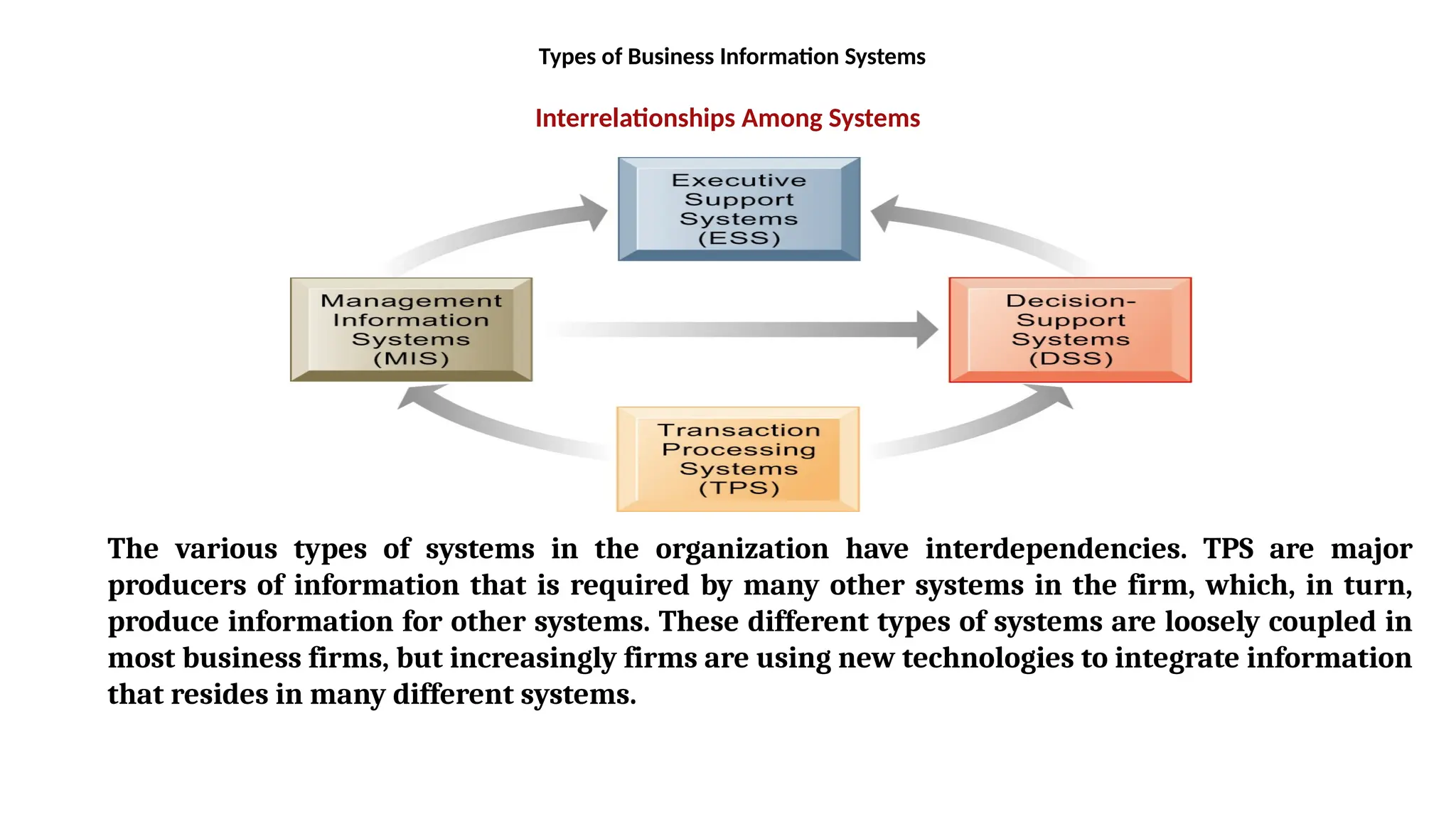
Interrelationships Among Systems
The various types of systems in the organization have interdependencies. TPS are major
producers of information that is required by many other systems in the firm, which, in turn,
produce information for other systems. These different types of systems are loosely coupled in
most business firms, but increasingly firms are using new technologies to integrate information
that resides in many different systems.
Types of Business Information Systems
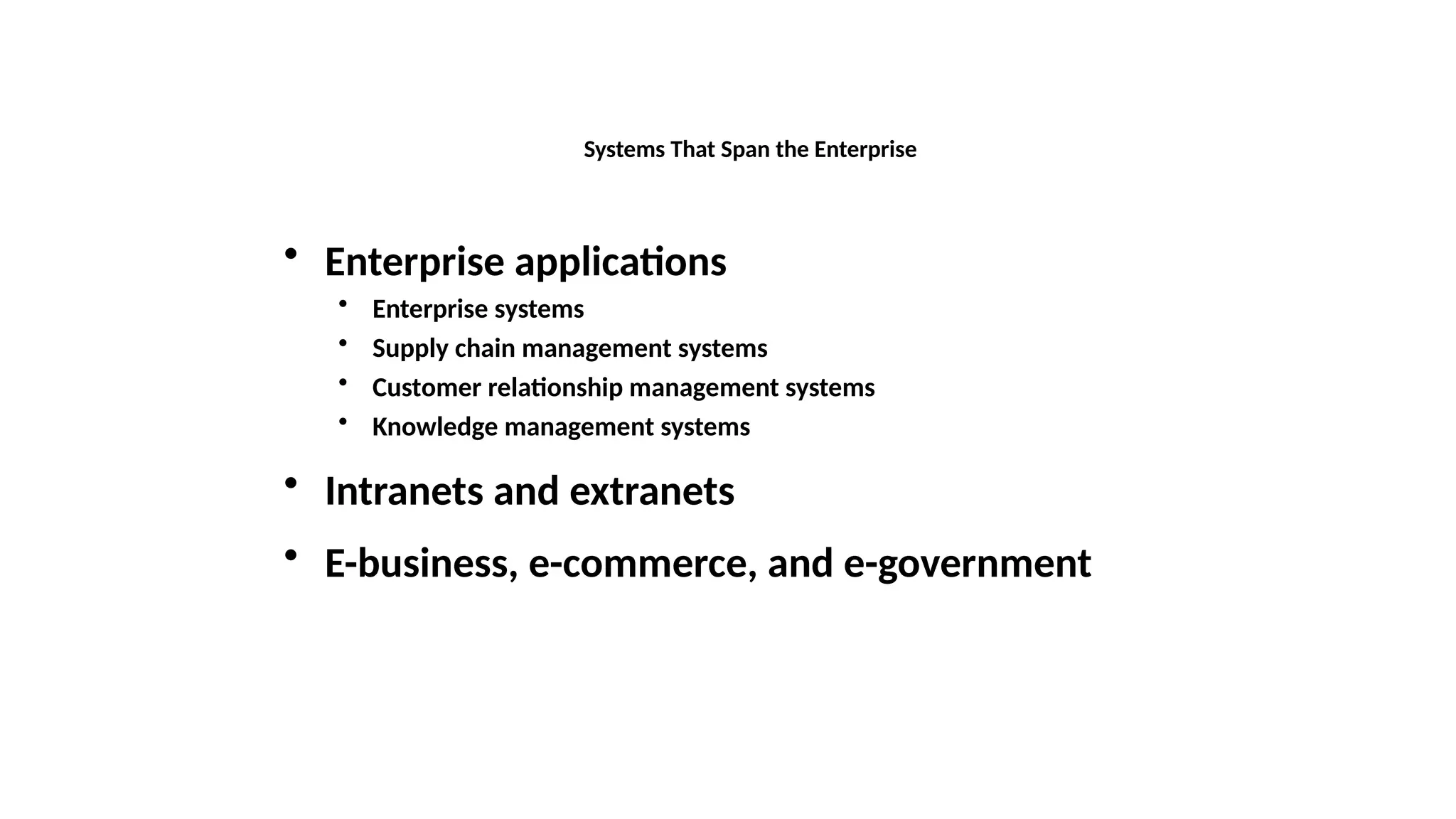
• Enterprise applications
• Enterprise systems
• Supply chain management systems
• Customer relationship management systems
• Knowledge management systems
• Intranets and extranets
• E-business, e-commerce, and e-government
Systems That Span the Enterprise
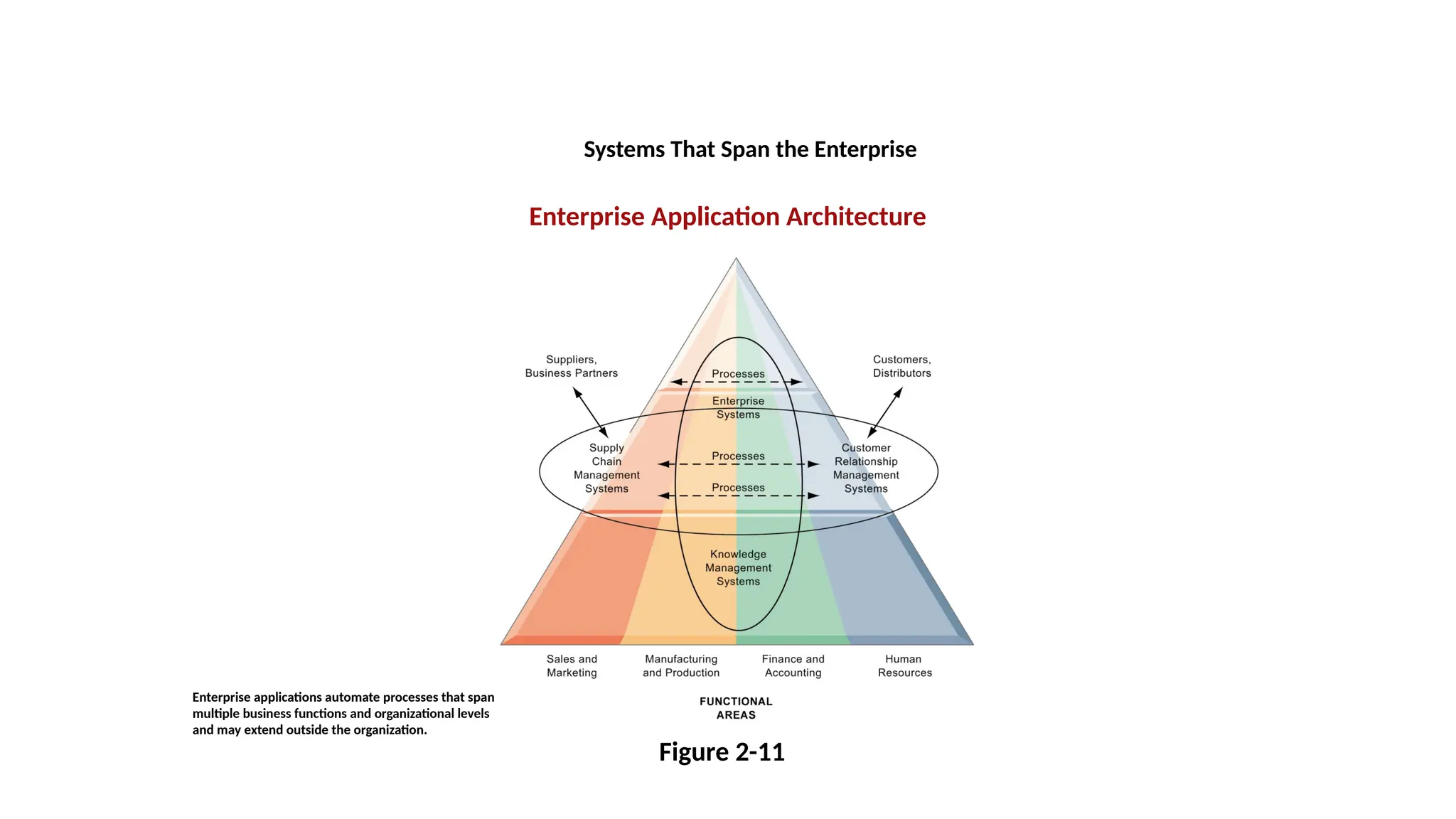
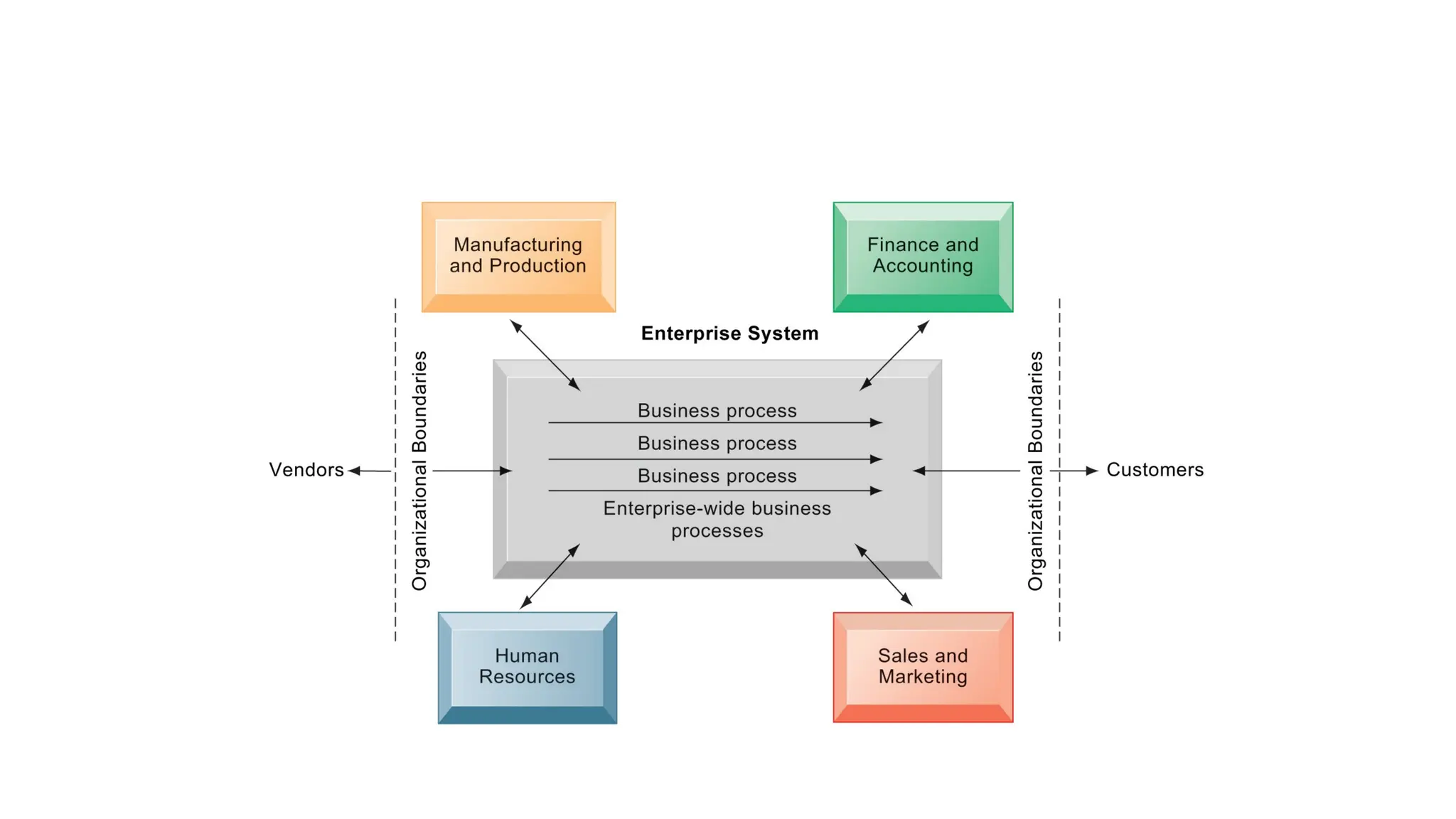
Enterprise Application Architecture
Figure 2-11
Enterprise applications automate processes that span
multiple business functions and organizational levels
and may extend outside the organization.
Systems That Span the Enterprise
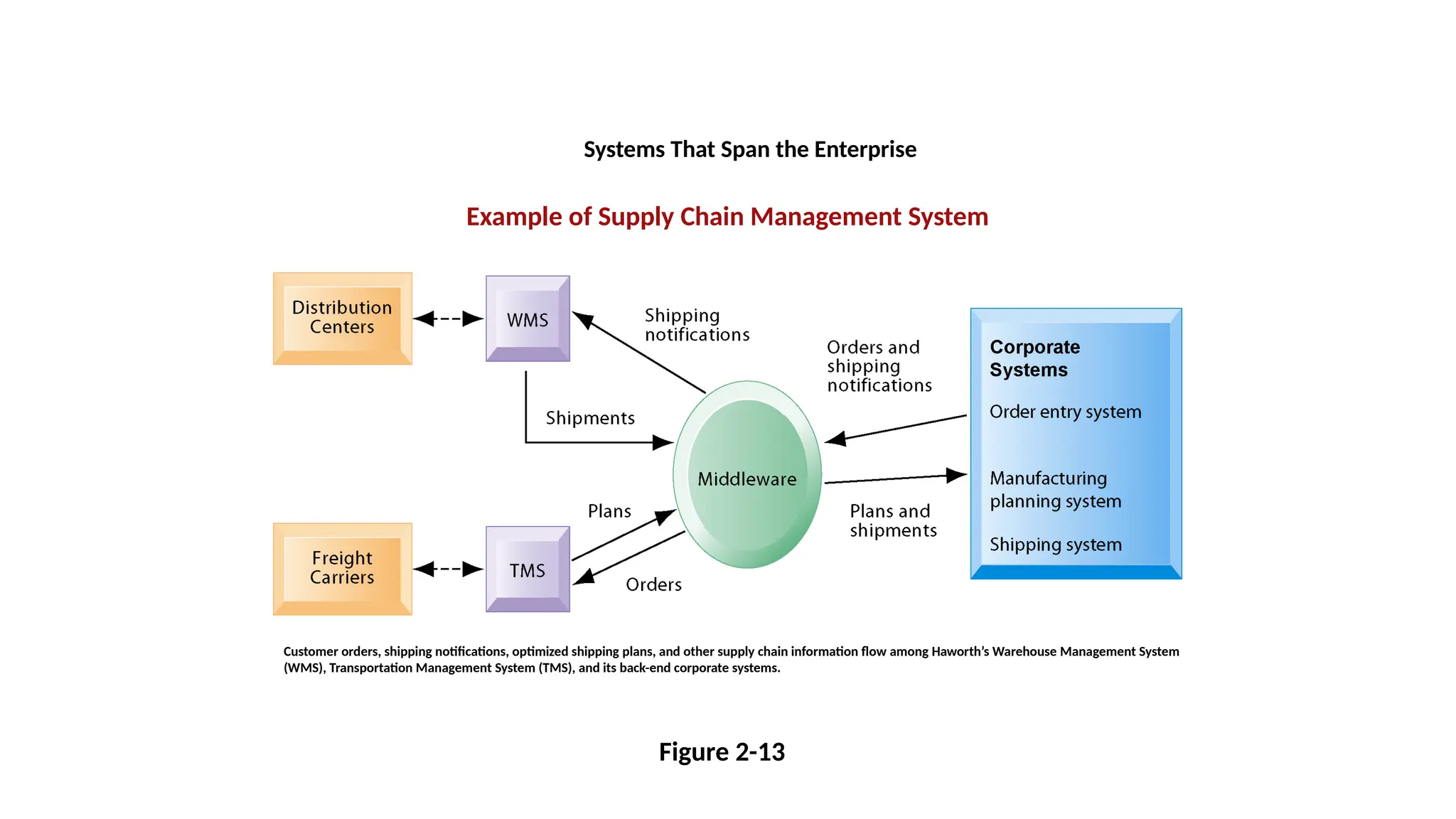
Example of Supply Chain Management System
Figure 2-13
Systems That Span the Enterprise
Customer orders, shipping notifications, optimized shipping plans, and other supply chain information flow among Haworth’s Warehouse Management System
(WMS), Transportation Management System (TMS), and its back-end corporate systems.
• The information systems department
• Organizing the information systems function
The Information Systems Function in Business
•
Because there are different interests, specialties, and levels in an organization,
there are different kinds of systems.
•
•A typical firm has different systems supporting the decision- making
needs of each of the main management groups , i.e. operational
management, middle management, and senior management
•
Therefore, no single system can provide all the information an organization needs.
11
SYSTEMS FOR DIFFERENT
MANAGEMENT GROUPS
SYSTEMS FOR DIFFERENT
MANAGEMENT GROUPS
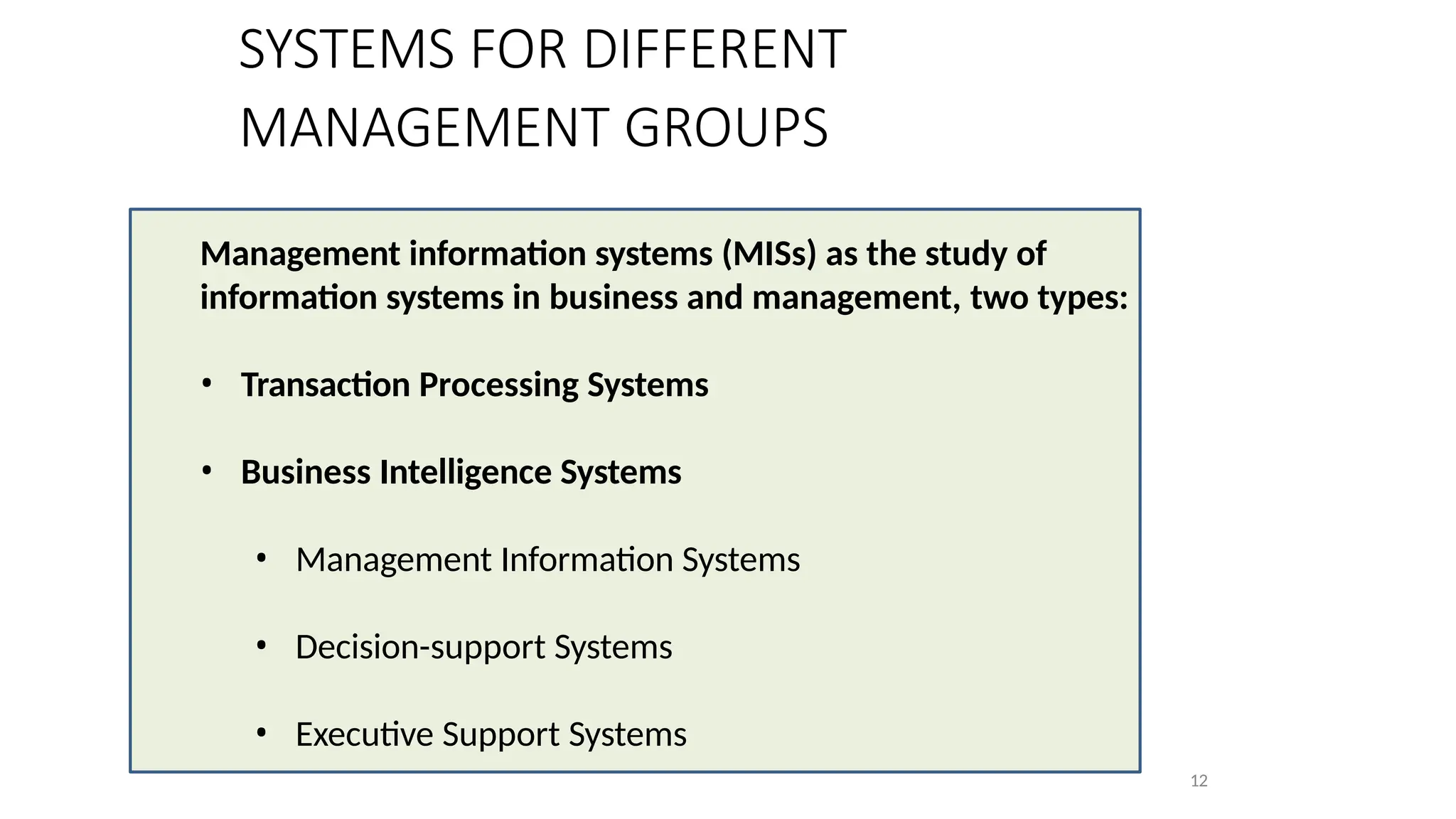
Management information systems (MISs) as the study of
information systems in business and management, two types:
• Transaction Processing Systems
• Business Intelligence Systems
• Management Information Systems
• Decision-support Systems
• Executive Support Systems
12
Transaction Processing Systems (TPS)
• Perform and record daily routine transactions necessary to
conduct business (e.g. sales, payroll, flow of materials in a
factory, shipping, number of parts in inventory, Ahmad’s
payment status, etc.)
• Serve operational managers and staff by monitoring the
status of internal operations
13
SYSTEMS FOR DIFFERENT
MANAGEMENT GROUPS
Transaction Processing Systems (TPS)
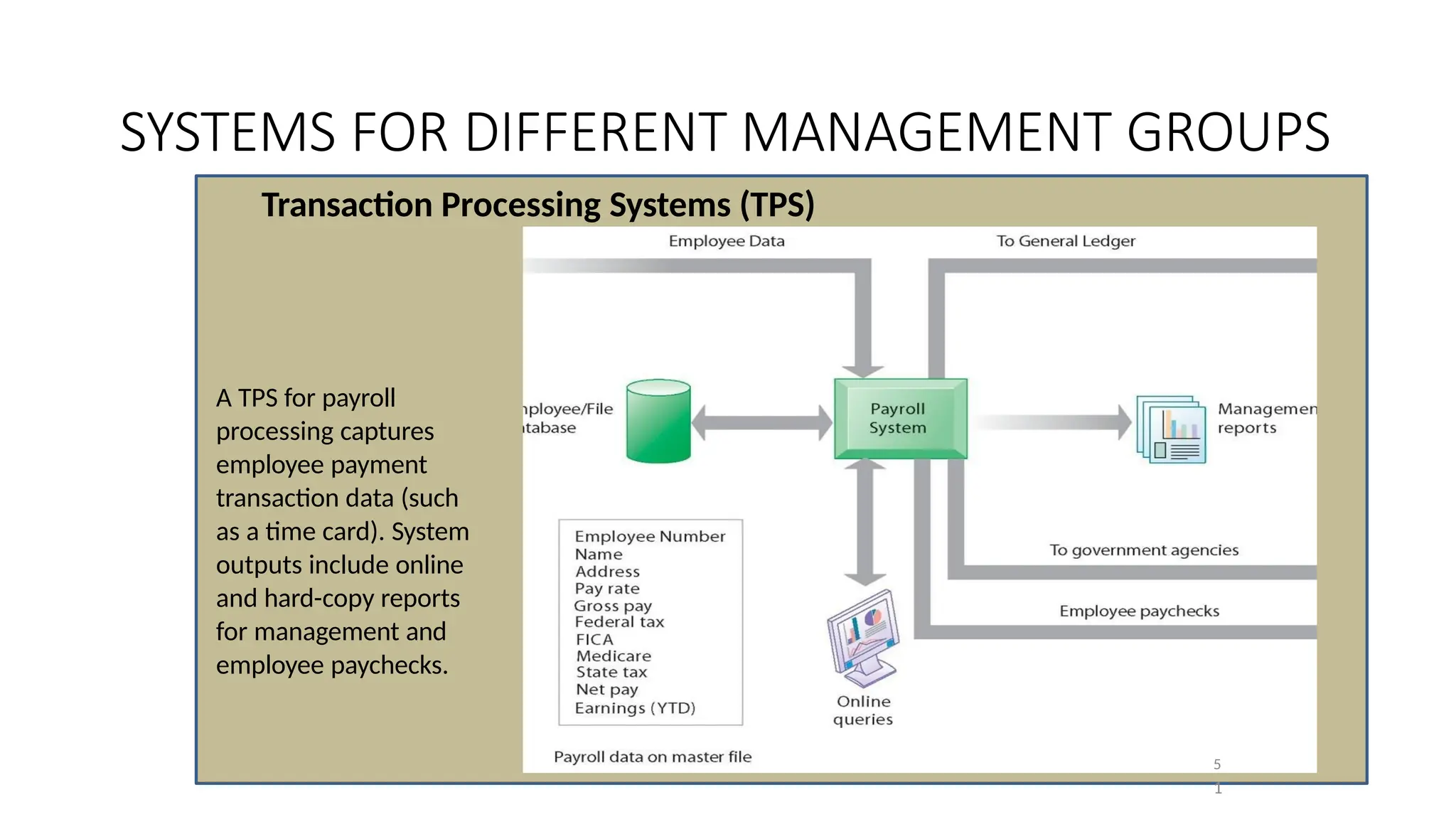
• Major producer of information for other systems, (e.g. the
payroll system, along with other accounting TPS, supplies
data to the company’s general ledger system, which is
responsible for maintaining records of the firm’s income and
expenses and for producing reports such as income
statements and balance sheets. It also supplies employee
payment history data for insurance, pension, etc.)
• Structured goals and decision making based on a
predefined criteria (e.g. assigning a credit to a customer
follows a predefined criteria)
SYSTEMS FOR DIFFERENT
MANAGEMENT GROUPS
Transaction Processing Systems (TPS)
A TPS for payroll
processing captures
employee payment
transaction data (such
as a time card). System
outputs include online
and hard-copy reports
for management and
employee paychecks.
5
1
SYSTEMS FOR DIFFERENT MANAGEMENT GROUPS
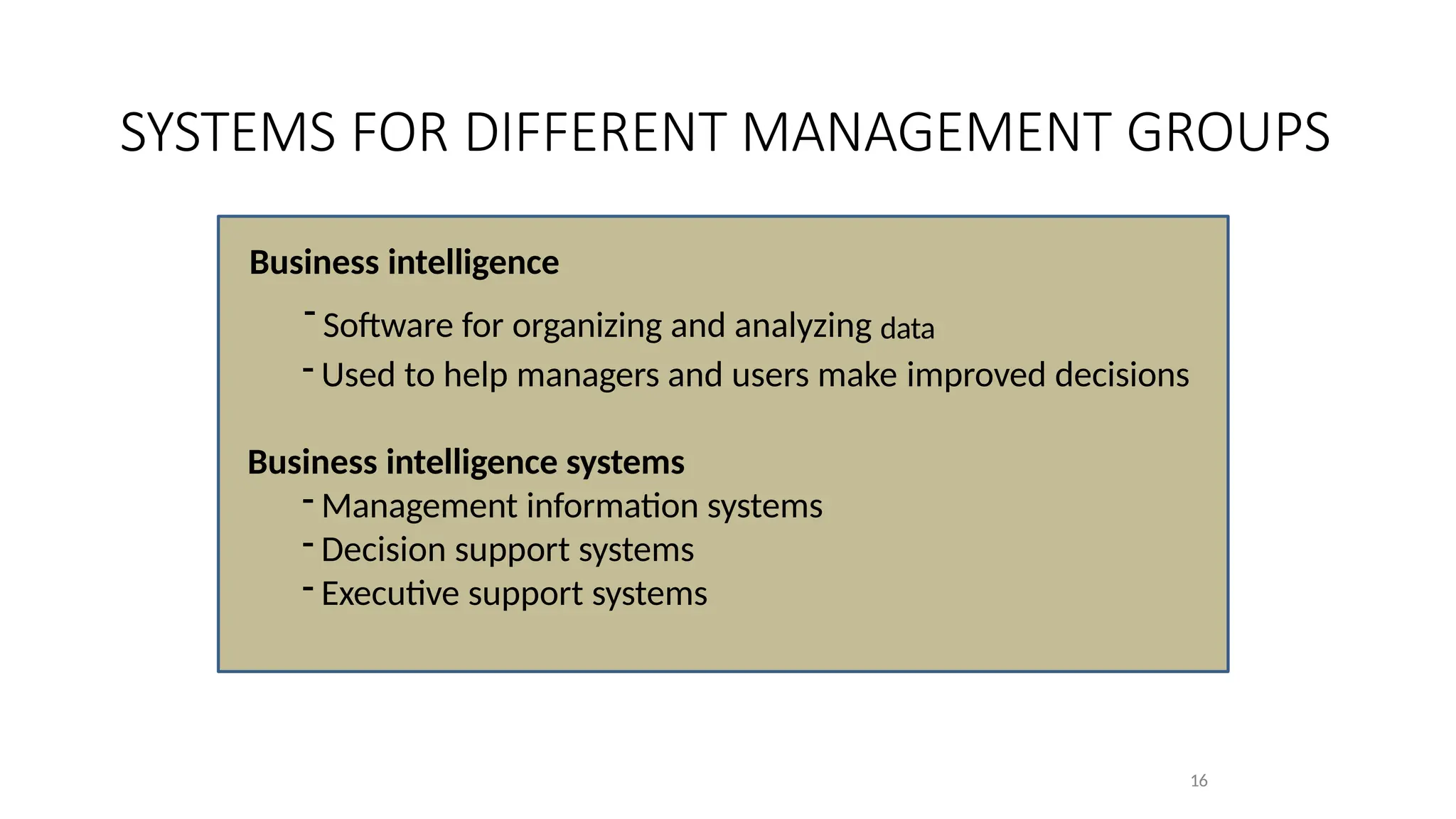
Business intelligence
- Software for organizing and analyzing data
- Used to help managers and users make improved decisions
Business intelligence systems
- Management information systems
- Decision support systems
- Executive support systems
16
SYSTEMS FOR DIFFERENT MANAGEMENT GROUPS
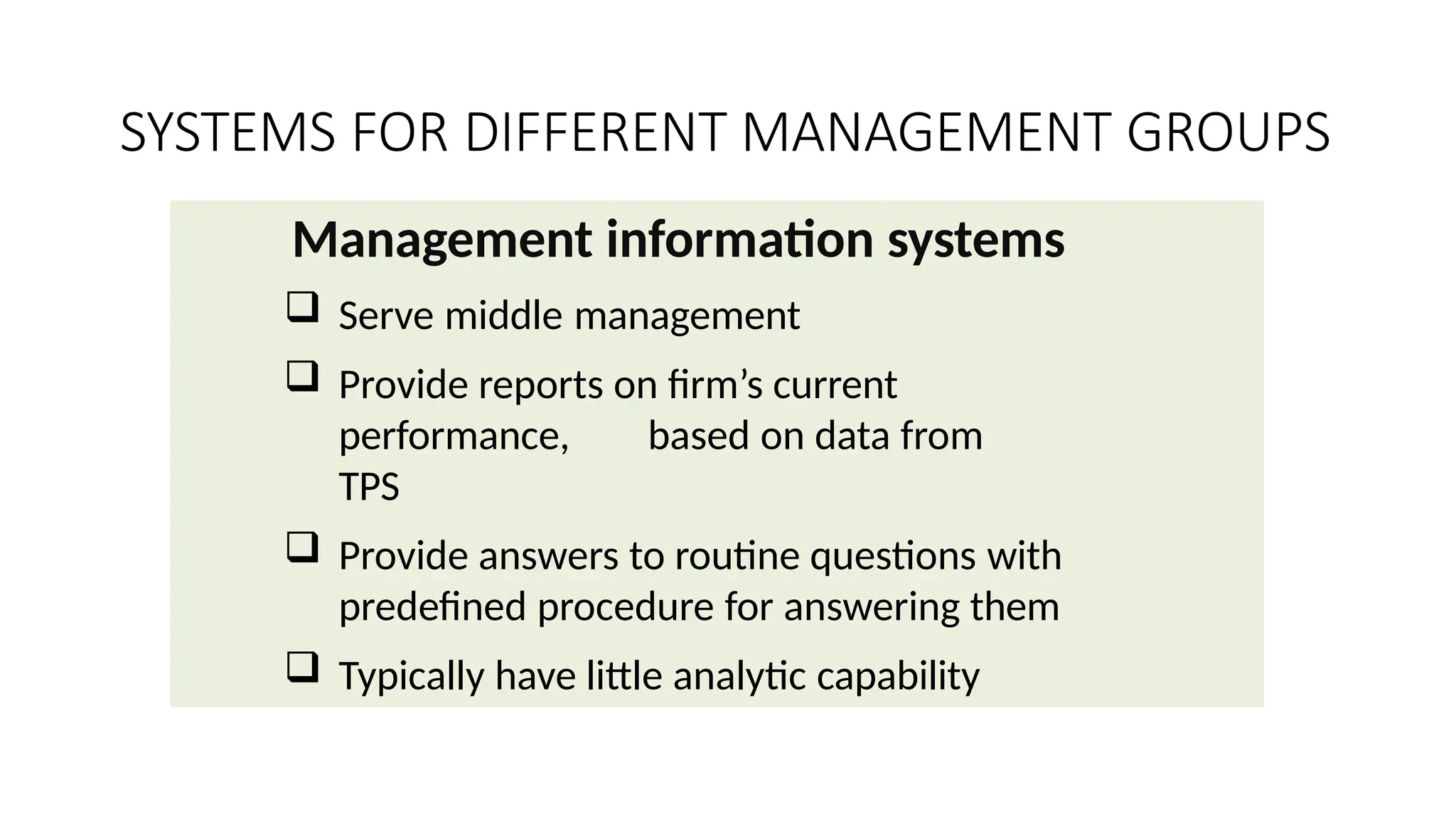
Management information systems
 Serve middle management
 Provide reports on firm’s current
performance, based on data from
TPS
 Provide answers to routine questions with
predefined procedure for answering them
 Typically have little analytic capability
SYSTEMS FOR DIFFERENT MANAGEMENT GROUPS
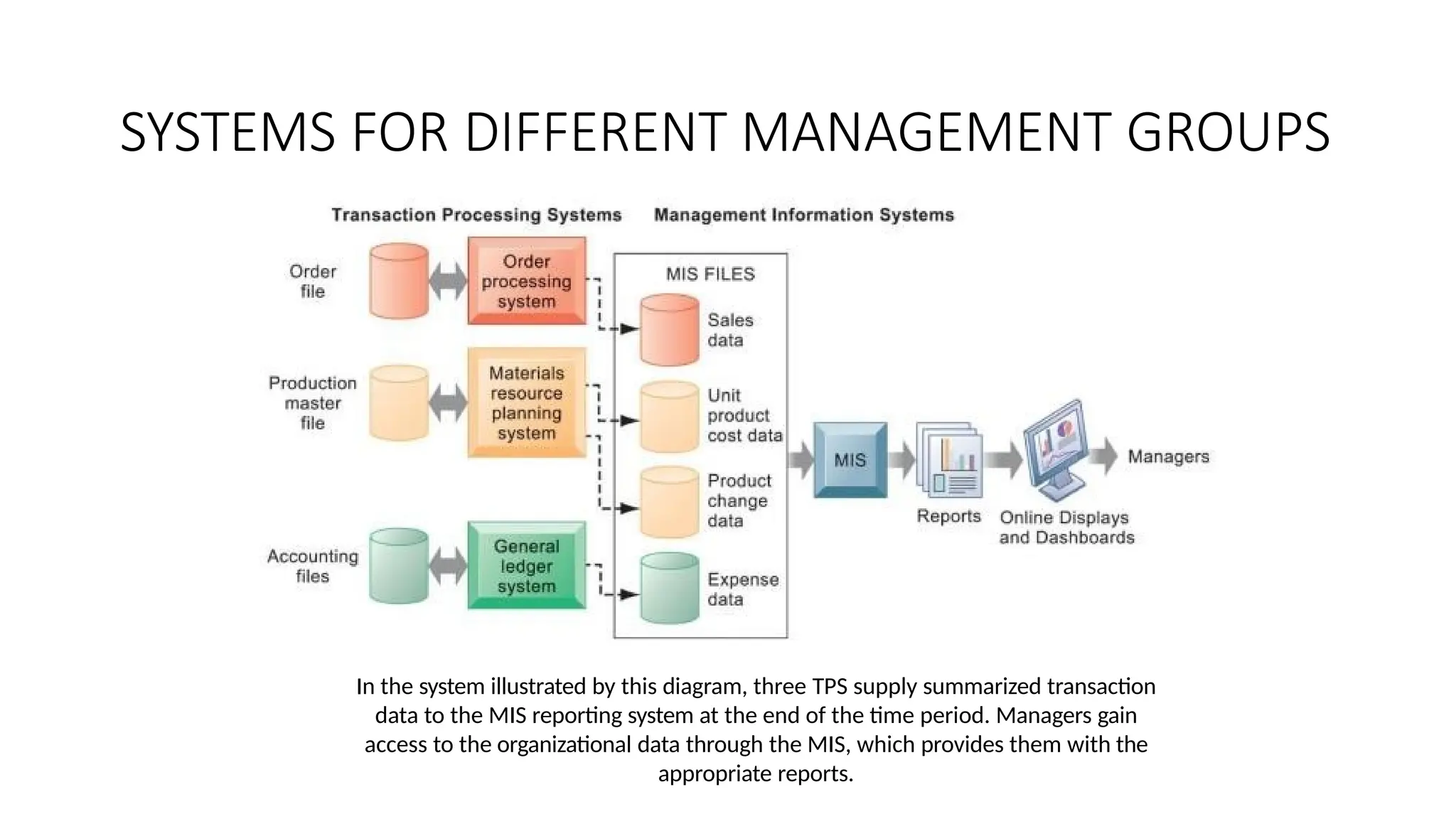
In the system illustrated by this diagram, three TPS supply summarized transaction
data to the MIS reporting system at the end of the time period. Managers gain
access to the organizational data through the MIS, which provides them with the
appropriate reports.
SYSTEMS FOR DIFFERENT MANAGEMENT GROUPS
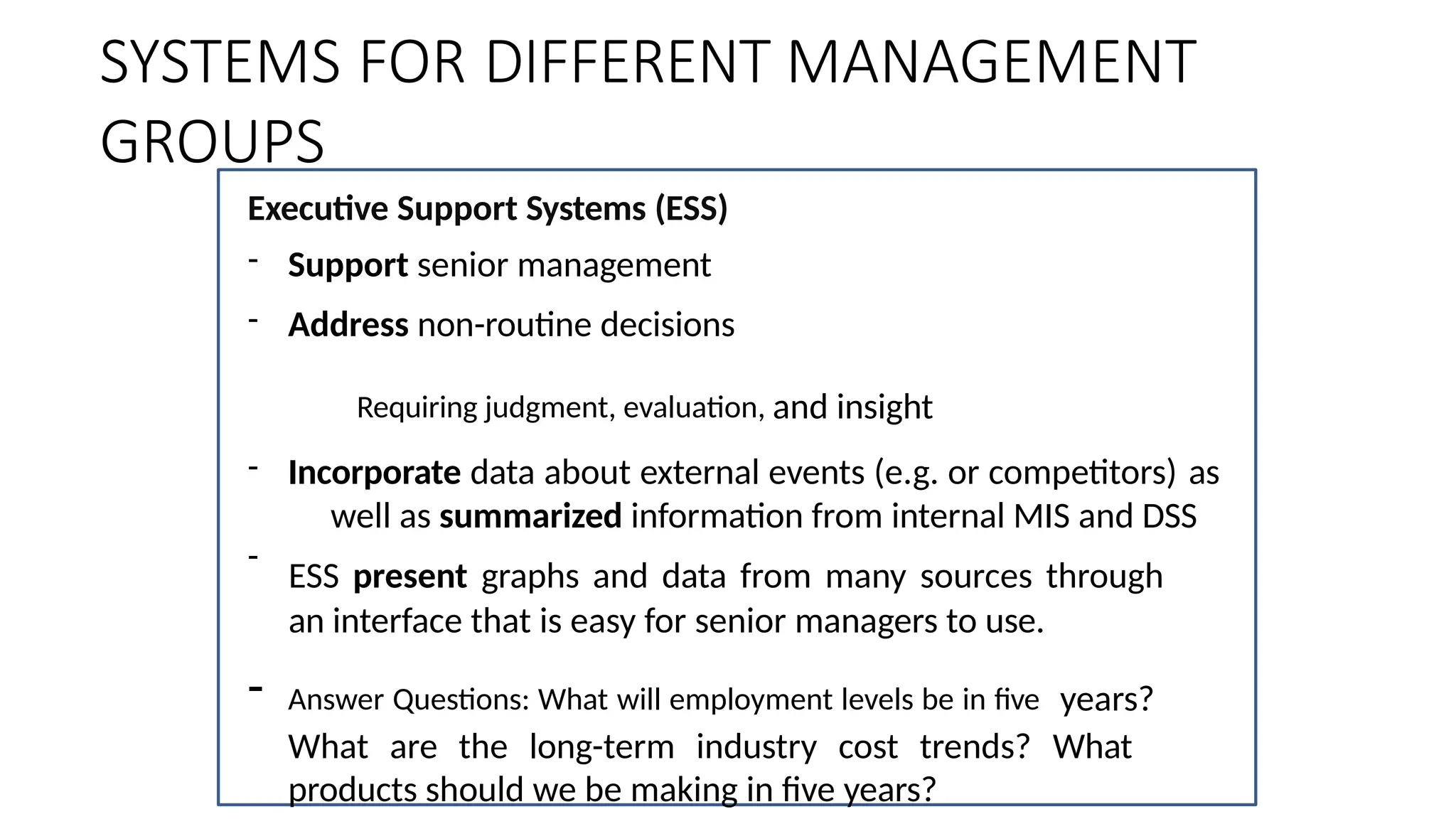
Executive Support Systems (ESS)
-
- Support senior management
- Address non-routine decisions
Requiring judgment, evaluation, and insight
- Incorporate data about external events (e.g. or competitors) as
well as summarized information from internal MIS and DSS
ESS present graphs and data from many sources through
an interface that is easy for senior managers to use.
- Answer Questions: What will employment levels be in five years?
What are the long-term industry cost trends? What
products should we be making in five years?
SYSTEMS FOR DIFFERENT MANAGEMENT
GROUPS
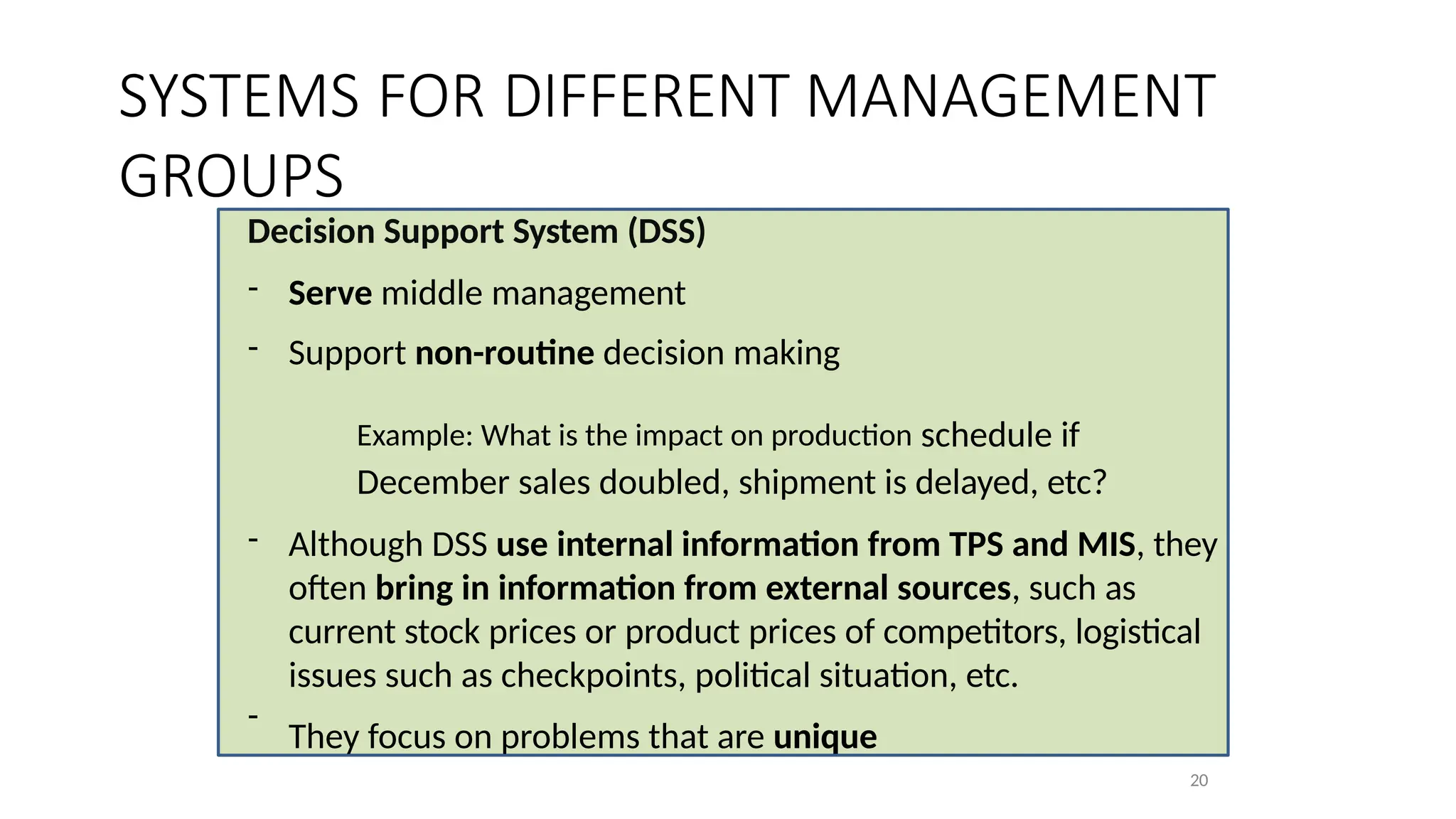
Decision Support System (DSS)
20
- Serve middle management
- Support non-routine decision making
Example: What is the impact on production schedule if
December sales doubled, shipment is delayed, etc?
- Although DSS use internal information from TPS and MIS, they
often bring in information from external sources, such as
current stock prices or product prices of competitors, logistical
issues such as checkpoints, political situation, etc.
They focus on problems that are unique
-
SYSTEMS FOR DIFFERENT MANAGEMENT
GROUPS
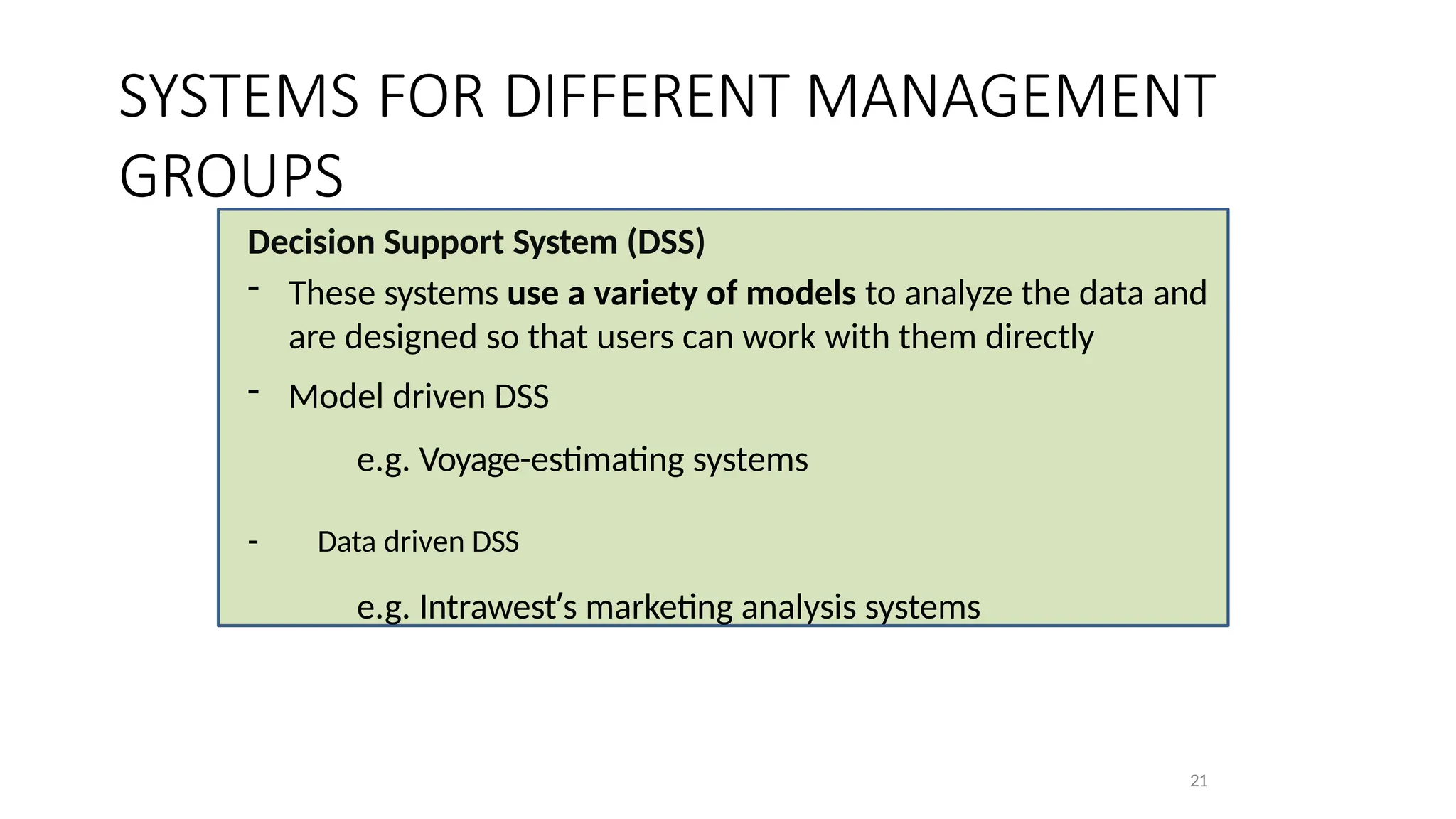
Decision Support System (DSS)
- These systems use a variety of models to analyze the data and
are designed so that users can work with them directly
- Model driven DSS
e.g. Voyage-estimating systems
- Data driven DSS
e.g. Intrawest’s marketing analysis systems
21
SYSTEMS FOR DIFFERENT MANAGEMENT
GROUPS
SYSTEMS FOR DIFFERENT MANAGEMENT
GROUPS
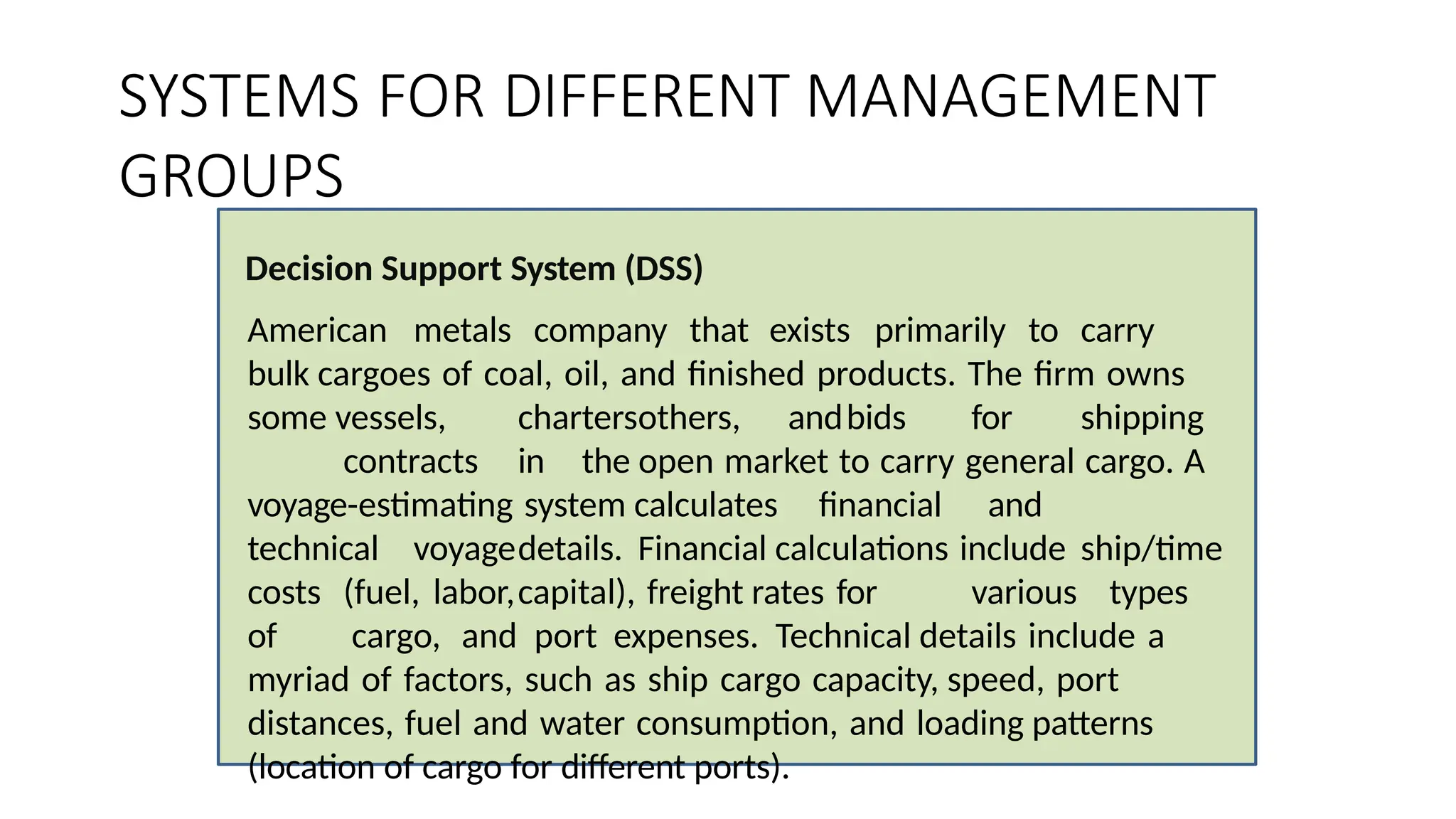
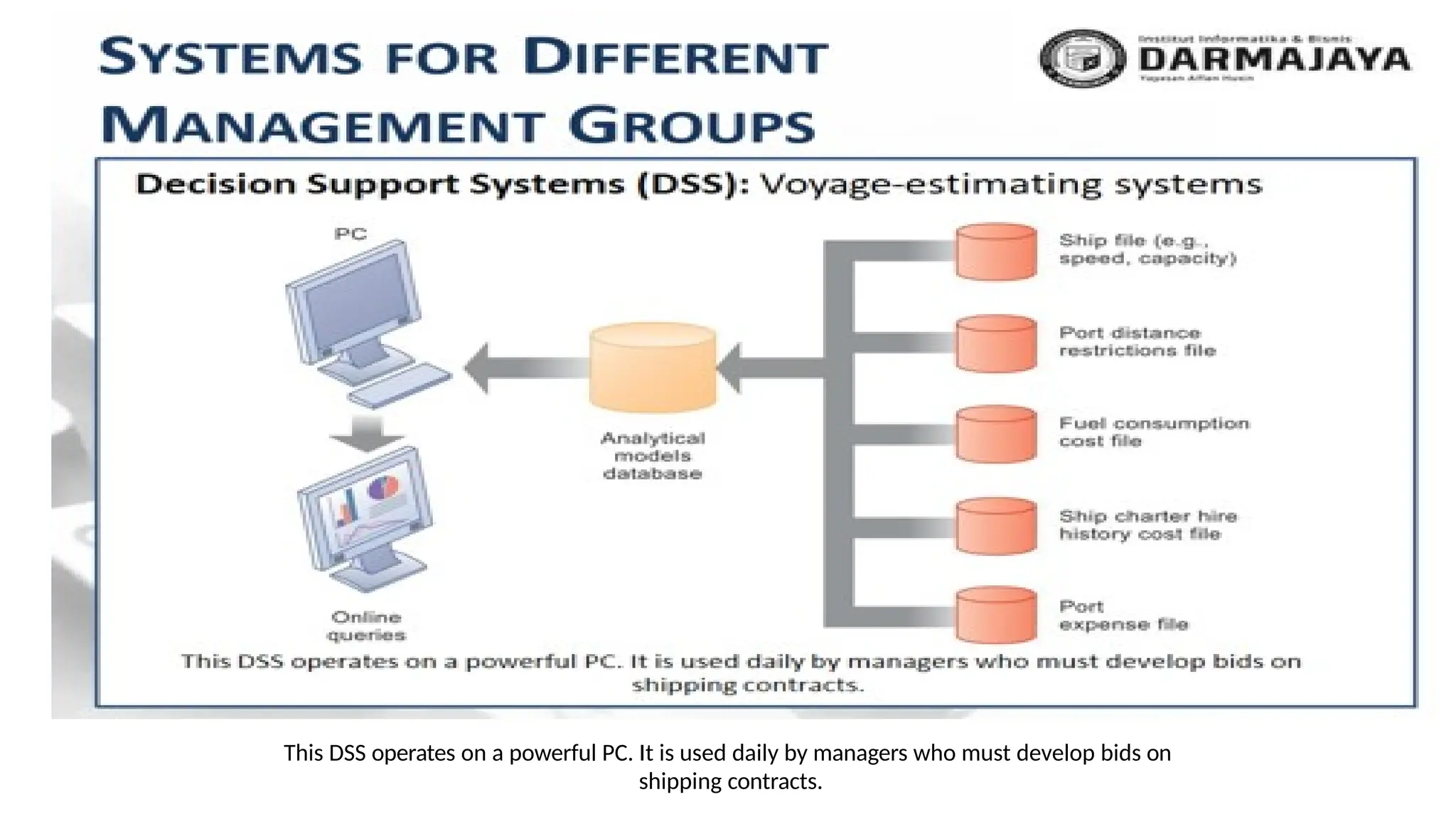
Decision Support System (DSS)
American metals company that exists primarily to carry
bulk cargoes of coal, oil, and finished products. The firm owns
some vessels, chartersothers, andbids for shipping
contracts in the open market to carry general cargo. A
voyage-estimating system calculates financial and
technical voyagedetails. Financial calculations include ship/time
costs (fuel, labor,capital), freight rates for various types
of cargo, and port expenses. Technical details include a
myriad of factors, such as ship cargo capacity, speed, port
distances, fuel and water consumption, and loading patterns
(location of cargo for different ports).
Decision Support Systems (DSS): Voyage-estimating systems
This DSS operates on a powerful PC. It is used daily by managers who must develop bids on
shipping contracts.
SYSTEMS FOR DIFFERENT
MANAGEMENT GROUPS
ENTERPRISE APPLICATIONS
The challenge is to make all these systems work together
Solution: is to implement enterprise applications, which are
systems that span functional areas, focus on executing business
processes across the business firm, and include all levels of
management.
Enterprise applications are used to ensure that TPS, MIS, DSS, and
ESS work together smoothly. Enterprise applications are used to
manage the information used in the systems discussed previously
Four major applications:
• Enterprise systems
• Supply chain management systems
• Customer relationship management Systems
• Knowledge management systems
Each of these enterprise applications integrates a related set of
functions and business processes to enhance the performance
of the organization as a whole.
27
ENTERPRISE APPLICATIONS
E-business, E-commerce, and
E-government
Systems and technologies we have just described are transforming
firms’ relationships with customers, employees, and suppliers into
digital relationships using networks and the Internet. Businesses
are
now enabled by or based upon digital networks, i.e. e-businesses.
- E-business:
Use of digital technology and Internet to drive major business
processes
- E-commerce:
Subset of e-business.
Buying and selling goods and services through Internet
- E-government:
Governments use internet technology to deliver information
and
Business benefits of collaboration and
teamwork
 Investments in collaboration technology can bring organization
improvements, returning high ROI
 Benefits:
• Productivity
• Quality
• Innovation
• Customer service
• Financial performance
– Profitability, sales, sales growth
SYSTEMS FOR COLLABORATION AND
SOCIAL BUSINESS
Tools for collaboration and teamwork
– E mail
‐ and instant messaging
– Wikis
– Virtual worlds
– Collaboration and social business platforms
• Virtual meeting systems (telepresence)
• Cloud collaboration services (Google Tools, cyberlockers)
• Microsoft SharePoint
• IBM Notes
• Enterprise social networking tools
SYSTEMS FOR COLLABORATION AND
SOCIAL BUSINESS
• Two dimensions of collaboration technologies
– Space (or location)—remote or co-located
– Time—synchronous or asynchronous
• Six steps in evaluating software tools
1. What are your firm’s collaboration challenges?
2. What kinds of solutions are available?
3. Analyze available products’ cost and benefits.
4. Evaluate security risks.
5. Consult users for implementation and training issues.
6. Evaluate product vendors.
SYSTEMS FOR COLLABORATION AND
SOCIAL BUSINESS
Collaboration technologies can be classified in terms of whether they support
interactions at the same or different time or place or whether these
interactions are remote or co-located.
SYSTEMS FOR COLLABORATION AND
SOCIAL BUSINESS
The Information Systems Department
Information systems department:
• Formal organizational unit responsible for information
technology services
• Often headed by chief information officer (CIO)
• Other senior positions include chief security officer
(CSO), chief privacy officer (CPO)
• Programmers
• Systems analysts
• Information systems managers
End users
 Representatives of other departments for whom applications
are developed
 Increasing role in system design, development
IT Governance:
 Strategies and policies for using IT in the organization
 Decision rights
 Accountability
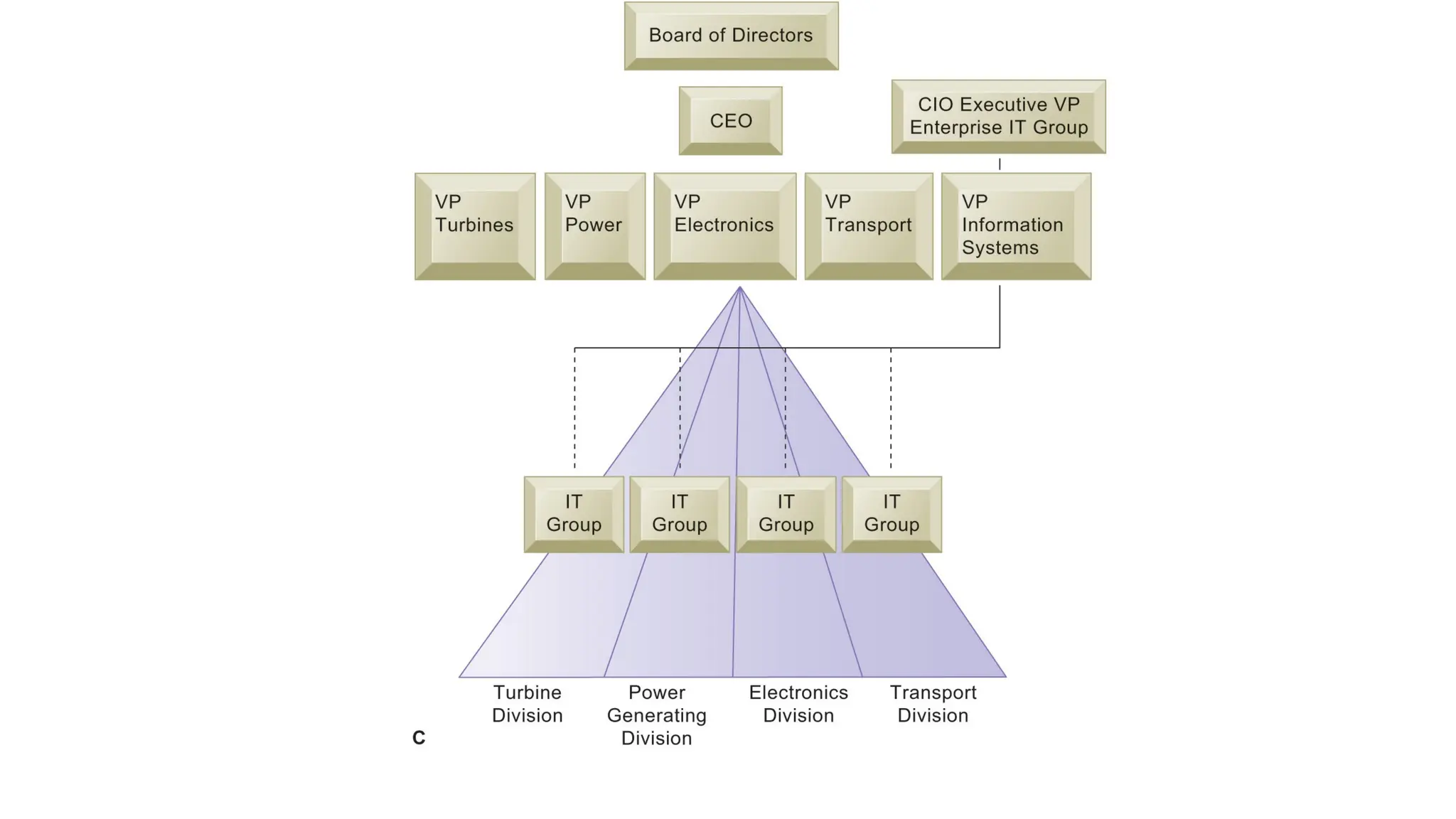
 Organization of information systems function
• Centralized, decentralized, and so on
The Information Systems Department
Case Study Questions
• Identify the key business processes within LTU that can be streamlined using information systems.
How do these processes relate to academic and administrative functions?
• What types of information systems should be implemented at the operational, management, and
strategic levels to support LTU’s growth and collaboration goals?
• Discuss the tools and technologies LTU can use to build a collaborative culture among departments,
faculty, and students, especially in multi-campus or remote learning contexts.
• Explain how e-business, e-government, and social business tools can benefit LTU in delivering
services to students, faculty, and external stakeholders.
• Propose a suitable organizational structure for the Information Systems Function at LTU. How
should responsibilities be distributed to ensure successful implementation and ongoing
management?
Management information System Unit 2 notes

  • 1.
  • 2.
    LEARNING OBJECTIVES • Defineand describe business processes and their relationship to information systems. • Describe the information systems supporting the major business functions: sales and marketing, manufacturing and production, finance and accounting, and human resources. • Evaluate the role played by systems serving the various levels of management in a business and their relationship to each other.
  • 3.
    • Explain howenterprise applications and intranets promote business process integration and improve organizational performance. • Assess the role of the information systems function in a business. LEARNING OBJECTIVES (Continued)
  • 4.
    Business Processes andInformation Systems • Business processes • How information technology enhances business processes: efficiency and transformation
  • 5.
    The Order FulfillmentProcess Figure 2-1 Fulfilling a customer order involves a complex set of steps that requires the close coordination of the sales, accounting, and manufacturing functions. Business Processes and Information Systems
  • 6.
    • Systems froma functional perspective • Sales and marketing systems • Manufacturing and production systems • Finance and accounting systems • Human resources systems • Systems from a constituency perspective • Transaction processing systems • Management information systems and decision-support systems • Executive support systems • Relationship of systems to one another Types of Business Information Systems
  • 7.
    Overview of anInventory System Figure 2-3 This system provides information about the number of items available in inventory to support manufacturing and production activities. Types of Business Information Systems
  • 8.
    Interrelationships Among Systems Thevarious types of systems in the organization have interdependencies. TPS are major producers of information that is required by many other systems in the firm, which, in turn, produce information for other systems. These different types of systems are loosely coupled in most business firms, but increasingly firms are using new technologies to integrate information that resides in many different systems. Types of Business Information Systems
  • 9.
    • Enterprise applications •Enterprise systems • Supply chain management systems • Customer relationship management systems • Knowledge management systems • Intranets and extranets • E-business, e-commerce, and e-government Systems That Span the Enterprise
  • 10.
    Enterprise Application Architecture Figure2-11 Enterprise applications automate processes that span multiple business functions and organizational levels and may extend outside the organization. Systems That Span the Enterprise
  • 12.
    Example of SupplyChain Management System Figure 2-13 Systems That Span the Enterprise Customer orders, shipping notifications, optimized shipping plans, and other supply chain information flow among Haworth’s Warehouse Management System (WMS), Transportation Management System (TMS), and its back-end corporate systems.
  • 13.
    • The informationsystems department • Organizing the information systems function The Information Systems Function in Business
  • 16.
    • Because there aredifferent interests, specialties, and levels in an organization, there are different kinds of systems. • •A typical firm has different systems supporting the decision- making needs of each of the main management groups , i.e. operational management, middle management, and senior management • Therefore, no single system can provide all the information an organization needs. 11 SYSTEMS FOR DIFFERENT MANAGEMENT GROUPS
  • 17.
    SYSTEMS FOR DIFFERENT MANAGEMENTGROUPS Management information systems (MISs) as the study of information systems in business and management, two types: • Transaction Processing Systems • Business Intelligence Systems • Management Information Systems • Decision-support Systems • Executive Support Systems 12
  • 18.
    Transaction Processing Systems(TPS) • Perform and record daily routine transactions necessary to conduct business (e.g. sales, payroll, flow of materials in a factory, shipping, number of parts in inventory, Ahmad’s payment status, etc.) • Serve operational managers and staff by monitoring the status of internal operations 13 SYSTEMS FOR DIFFERENT MANAGEMENT GROUPS
  • 19.
    Transaction Processing Systems(TPS) • Major producer of information for other systems, (e.g. the payroll system, along with other accounting TPS, supplies data to the company’s general ledger system, which is responsible for maintaining records of the firm’s income and expenses and for producing reports such as income statements and balance sheets. It also supplies employee payment history data for insurance, pension, etc.) • Structured goals and decision making based on a predefined criteria (e.g. assigning a credit to a customer follows a predefined criteria) SYSTEMS FOR DIFFERENT MANAGEMENT GROUPS
  • 20.
    Transaction Processing Systems(TPS) A TPS for payroll processing captures employee payment transaction data (such as a time card). System outputs include online and hard-copy reports for management and employee paychecks. 5 1 SYSTEMS FOR DIFFERENT MANAGEMENT GROUPS
  • 21.
    Business intelligence - Softwarefor organizing and analyzing data - Used to help managers and users make improved decisions Business intelligence systems - Management information systems - Decision support systems - Executive support systems 16 SYSTEMS FOR DIFFERENT MANAGEMENT GROUPS
  • 22.
    Management information systems Serve middle management  Provide reports on firm’s current performance, based on data from TPS  Provide answers to routine questions with predefined procedure for answering them  Typically have little analytic capability SYSTEMS FOR DIFFERENT MANAGEMENT GROUPS
  • 23.
    In the systemillustrated by this diagram, three TPS supply summarized transaction data to the MIS reporting system at the end of the time period. Managers gain access to the organizational data through the MIS, which provides them with the appropriate reports. SYSTEMS FOR DIFFERENT MANAGEMENT GROUPS
  • 24.
    Executive Support Systems(ESS) - - Support senior management - Address non-routine decisions Requiring judgment, evaluation, and insight - Incorporate data about external events (e.g. or competitors) as well as summarized information from internal MIS and DSS ESS present graphs and data from many sources through an interface that is easy for senior managers to use. - Answer Questions: What will employment levels be in five years? What are the long-term industry cost trends? What products should we be making in five years? SYSTEMS FOR DIFFERENT MANAGEMENT GROUPS
  • 25.
    Decision Support System(DSS) 20 - Serve middle management - Support non-routine decision making Example: What is the impact on production schedule if December sales doubled, shipment is delayed, etc? - Although DSS use internal information from TPS and MIS, they often bring in information from external sources, such as current stock prices or product prices of competitors, logistical issues such as checkpoints, political situation, etc. They focus on problems that are unique - SYSTEMS FOR DIFFERENT MANAGEMENT GROUPS
  • 26.
    Decision Support System(DSS) - These systems use a variety of models to analyze the data and are designed so that users can work with them directly - Model driven DSS e.g. Voyage-estimating systems - Data driven DSS e.g. Intrawest’s marketing analysis systems 21 SYSTEMS FOR DIFFERENT MANAGEMENT GROUPS
  • 27.
    SYSTEMS FOR DIFFERENTMANAGEMENT GROUPS Decision Support System (DSS) American metals company that exists primarily to carry bulk cargoes of coal, oil, and finished products. The firm owns some vessels, chartersothers, andbids for shipping contracts in the open market to carry general cargo. A voyage-estimating system calculates financial and technical voyagedetails. Financial calculations include ship/time costs (fuel, labor,capital), freight rates for various types of cargo, and port expenses. Technical details include a myriad of factors, such as ship cargo capacity, speed, port distances, fuel and water consumption, and loading patterns (location of cargo for different ports).
  • 28.
    Decision Support Systems(DSS): Voyage-estimating systems This DSS operates on a powerful PC. It is used daily by managers who must develop bids on shipping contracts. SYSTEMS FOR DIFFERENT MANAGEMENT GROUPS
  • 29.
    ENTERPRISE APPLICATIONS The challengeis to make all these systems work together Solution: is to implement enterprise applications, which are systems that span functional areas, focus on executing business processes across the business firm, and include all levels of management. Enterprise applications are used to ensure that TPS, MIS, DSS, and ESS work together smoothly. Enterprise applications are used to manage the information used in the systems discussed previously
  • 30.
    Four major applications: •Enterprise systems • Supply chain management systems • Customer relationship management Systems • Knowledge management systems Each of these enterprise applications integrates a related set of functions and business processes to enhance the performance of the organization as a whole. 27 ENTERPRISE APPLICATIONS
  • 31.
    E-business, E-commerce, and E-government Systemsand technologies we have just described are transforming firms’ relationships with customers, employees, and suppliers into digital relationships using networks and the Internet. Businesses are now enabled by or based upon digital networks, i.e. e-businesses. - E-business: Use of digital technology and Internet to drive major business processes - E-commerce: Subset of e-business. Buying and selling goods and services through Internet - E-government: Governments use internet technology to deliver information and
  • 32.
    Business benefits ofcollaboration and teamwork  Investments in collaboration technology can bring organization improvements, returning high ROI  Benefits: • Productivity • Quality • Innovation • Customer service • Financial performance – Profitability, sales, sales growth SYSTEMS FOR COLLABORATION AND SOCIAL BUSINESS
  • 33.
    Tools for collaborationand teamwork – E mail ‐ and instant messaging – Wikis – Virtual worlds – Collaboration and social business platforms • Virtual meeting systems (telepresence) • Cloud collaboration services (Google Tools, cyberlockers) • Microsoft SharePoint • IBM Notes • Enterprise social networking tools SYSTEMS FOR COLLABORATION AND SOCIAL BUSINESS
  • 34.
    • Two dimensionsof collaboration technologies – Space (or location)—remote or co-located – Time—synchronous or asynchronous • Six steps in evaluating software tools 1. What are your firm’s collaboration challenges? 2. What kinds of solutions are available? 3. Analyze available products’ cost and benefits. 4. Evaluate security risks. 5. Consult users for implementation and training issues. 6. Evaluate product vendors. SYSTEMS FOR COLLABORATION AND SOCIAL BUSINESS
  • 35.
    Collaboration technologies canbe classified in terms of whether they support interactions at the same or different time or place or whether these interactions are remote or co-located. SYSTEMS FOR COLLABORATION AND SOCIAL BUSINESS
  • 36.
    The Information SystemsDepartment Information systems department: • Formal organizational unit responsible for information technology services • Often headed by chief information officer (CIO) • Other senior positions include chief security officer (CSO), chief privacy officer (CPO) • Programmers • Systems analysts • Information systems managers
  • 37.
    End users  Representativesof other departments for whom applications are developed  Increasing role in system design, development IT Governance:  Strategies and policies for using IT in the organization  Decision rights  Accountability  Organization of information systems function • Centralized, decentralized, and so on The Information Systems Department
  • 38.
    Case Study Questions •Identify the key business processes within LTU that can be streamlined using information systems. How do these processes relate to academic and administrative functions? • What types of information systems should be implemented at the operational, management, and strategic levels to support LTU’s growth and collaboration goals? • Discuss the tools and technologies LTU can use to build a collaborative culture among departments, faculty, and students, especially in multi-campus or remote learning contexts. • Explain how e-business, e-government, and social business tools can benefit LTU in delivering services to students, faculty, and external stakeholders. • Propose a suitable organizational structure for the Information Systems Function at LTU. How should responsibilities be distributed to ensure successful implementation and ongoing management?