Management Information Systems,
        Sixth Edition


          Chapter 8:
   The Web-Enabled Enterprise
Objectives
• Describe how the Web and high-speed Internet
  connections are changing business operations
• Explain the functionality of various Web
  technologies
• Compare and contrast options for Web servers
• Explain basic business-to-business and
  business-to-consumer practices on the Web
• Explain the relationship between Web
  technologies and supply chain management

Management Information Systems, Sixth Edition    2
Objectives (continued)

• Give examples of features and services that
  successful business Web sites offer
• Learn about online annoyances such as spam
  and adware, and how to protect against online
  identity theft


Management Information Systems, Sixth Edition     3
Web Business: Growing and Changing

• DLA Piper LLP is the second largest law firm in
  the world
   – 3200 lawyers in 24 countries and 63 offices
     around the world
   – Uses eRoom, a Web-based collaboration and
     document-sharing tool from EMC Corp.
   – Saves 15,000 labor hours annually, uses and
     mails significantly fewer paper documents, and
     reduces redundant work


Management Information Systems, Sixth Edition         4
Web Technologies: A Review
• Several standards and technologies enable the
  Web to deliver rich information, including:
   –   HTTP, HTML, XML
   –   File Transfer
   –   RSS
   –   Blogs
   –   Wikis
   –   Podcasting
   –   IM
   –   Cookies

Management Information Systems, Sixth Edition     5
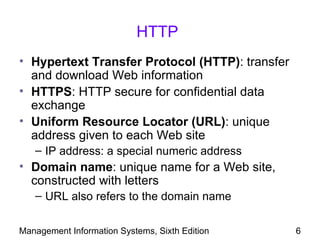
HTTP
• Hypertext Transfer Protocol (HTTP): transfer
  and download Web information
• HTTPS: HTTP secure for confidential data
  exchange
• Uniform Resource Locator (URL): unique
  address given to each Web site
   – IP address: a special numeric address
• Domain name: unique name for a Web site,
  constructed with letters
   – URL also refers to the domain name

Management Information Systems, Sixth Edition    6
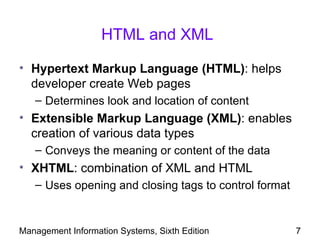
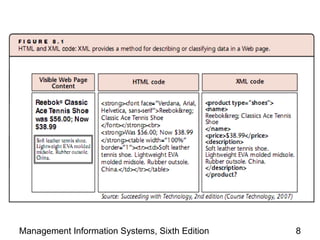
HTML and XML

• Hypertext Markup Language (HTML): helps
  developer create Web pages
   – Determines look and location of content
• Extensible Markup Language (XML): enables
  creation of various data types
   – Conveys the meaning or content of the data
• XHTML: combination of XML and HTML
   – Uses opening and closing tags to control format


Management Information Systems, Sixth Edition          7
Management Information Systems, Sixth Edition   8
File Transfer

• File Transfer Protocol (FTP): used to transmit
  whole files
   –   Used in all downloads from Web sites
   –   Any type of file can be transferred
   –   Can place files on a server for shared use
   –   Often used to deliver purchased software
       products on Web sites


Management Information Systems, Sixth Edition       9
RSS
• Really Simple Syndication (RSS): family of
  XML file formats that allow automatic downloads
  of content on a subscription basis
   –   Helps users check for updates
   –   Communicates short descriptions of content
   –   Allows transmittal of new information
   –   Useful on news Web sites
   –   Also called Rich Site Summary


Management Information Systems, Sixth Edition       10
Blogs
• Blog: contraction of “Web log”
   – Invites surfers to post opinions and art
   – Focuses on a topic or set of topics
   – Trackback: a tool that notifies bloggers when
     their posts have been mentioned elsewhere on
     the Web
• Blogs are often used by businesses
• Importance of blogs to commercial organizations
  is to find out what blog participants think and say
  about the organization

Management Information Systems, Sixth Edition        11
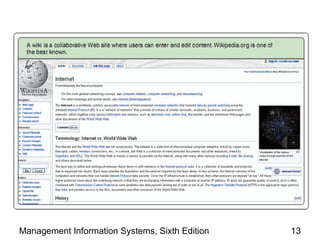
Wikis

• Wiki (from Hawaiian, meaning “quick”): Web
  application that enables users to add to and edit
  the contents of Web pages
   – All the software required to edit the Web pages is
     embedded in the pages themselves
• Wikipedia: a popular online encyclopedia
• Wiki technology is a popular ingredient in
  groupware (software used for collaboration)


Management Information Systems, Sixth Edition        12
Management Information Systems, Sixth Edition   13
Podcasting
• Podcast: publishing sound and video on the
  Web for download
   – Usually on a subscription basis
• Uses include:
   – “Time-shifted” broadcast of radio station
     programs for later listening
   – Audio tours in museums
   – Lectures in distance learning courses
   – Garageband.com
       • Allows aspiring musicians to post music tracks

Management Information Systems, Sixth Edition             14
Instant Messaging
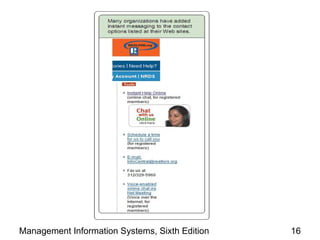
• Instant messaging (IM): real-time chat
   – Form of synchronized e-mail
   – Chat room: communicate with a group
   – Free applications for IM include:
       •   AIM: AOL instant Messenger
       •   Yahoo Messenger
       •   MSN Messenger
       •   ICQ
       •   Trillian
   – Business uses
       • Customers can chat with sales or support reps
Management Information Systems, Sixth Edition            15
Management Information Systems, Sixth Edition   16
Cookies

• Cookie: small file that stores information about a
  Web site visitor, stored on the visitor’s computer
   –   Usually records the surfer’s ID
   –   Often stores the surfer’s preferences
   –   Provides convenience to consumers
   –   Can be temporary (single session) or permanent
   –   Potential for intrusion into surfer privacy
• Clickstream tracking: tracks a surfer’s clicking
  activities
• Spyware: traces and reports online behavior
Management Information Systems, Sixth Edition       17
Proprietary Technologies

• Proprietary technology: intellectual property of
  developer, not free for all to use
• Examples:
   –   Local search engine
   –   Shopping cart applications
   –   Wish lists
   –   Video streaming tools
   –   Tools to analyze and predict Web visitor
       behavior, especially shopper behavior

Management Information Systems, Sixth Edition     18
Web-Enabled Business

• Web-enabled business are classified according
  to the interacting parties:
   –   Business-to-business (B2B)
   –   Business-to-consumer (B2C)
   –   Government-to-business
   –   Government-to-consumer


Management Information Systems, Sixth Edition   19
B2B Trading
• Business-to-business (B2B): trading between
  businesses only
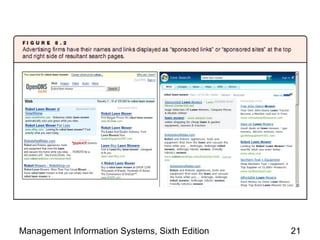
• B2B forms include advertising through:
   – Search advertising: advertisements placed on a
     search site result page
   – Banners: images placed on Web sites that link to
     a company site selling a product or service
• Impression: occurs when a page with a banner
  is downloaded
• Reach percentage: the percentage of Web
  users who visited a site in the past month
Management Information Systems, Sixth Edition      20
Management Information Systems, Sixth Edition   21
B2B Trading (continued)
• Exchanges and auctions act as online
  marketplaces
• Intranet: network used only by employees of an
  organization
• Extranet: network shared by employees of
  different organizations, usually business partners
• Exchange: extranet for organizations that deal in
  products and services of a particular type
   – Exchange operator profits from transaction fees
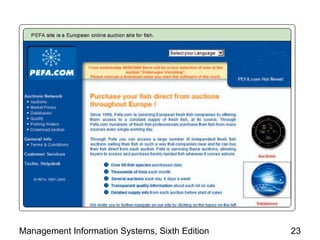
• Auction: sells a great variety of items
Management Information Systems, Sixth Edition          22
Management Information Systems, Sixth Edition   23
B2B Trading (continued)

• Online business alliances: collaboration
  between businesses in establishing a Web site
   – Site operator works for the allied companies
   – Suppliers are invited to sell through the site and
     compete among themselves, driving prices down


Management Information Systems, Sixth Edition         24
B2C Trading

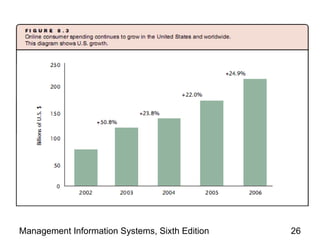
• Business-to-consumer (B2C): trading with the
  general public
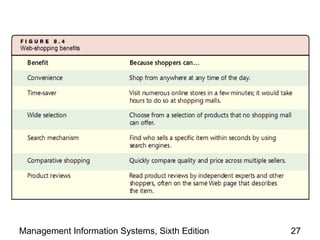
• E-Tailing: online retailing to consumers
• Fulfillment activities: picking, packing, shipping
• Consumer profiling: know customers better by
  gathering information about their online activities
   – Some consider this a violation of privacy
• Conversion rate: the proportion of site visitors
  who make a purchase


Management Information Systems, Sixth Edition        25
Management Information Systems, Sixth Edition   26
Management Information Systems, Sixth Edition   27
B2C Trading (continued)
• Auction sites serve as a hub for consumers to
  buy and sell
• Reverse auction: customers name their own
  price for desired goods and services
• Content providers: offer information, artistic
  work, classified ads, and video
• Electronic bill presentment and payment
  (EBBP): provides online bills and payment
  options for customers
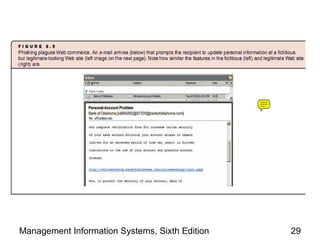
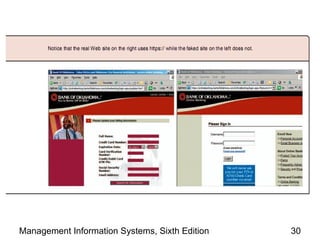
• Phishing: type of fraud involving a fake Web
  site
Management Information Systems, Sixth Edition      28
Management Information Systems, Sixth Edition   29
Management Information Systems, Sixth Edition   30
B2C Trading (continued)
• Extra-organizational workforce:
   – Companies purchase labor from a larger pool
• Mobile commerce, or M-commerce:
   – Business conducted on mobile devices
• Many experts believe that information delivery is
  the main mobile application, not commerce
   – Exceptions are Japan and South Korea
   – Japan’s DoCoMo’s i-mode service allows users
     of smart cell phones to purchase canned soda
     from vending machines, fast food

Management Information Systems, Sixth Edition       31
B2C Trading (continued)
• M-commerce also raises privacy concerns
   – GPS provides location tracking
• New top-level domain names with .mobi
  available for mobile applications
   – Sites should use special technologies to optimize
     content for easy viewing on mobile devices
• Virtual world: a combination of images, video,
  sound, and avatars that resemble the real world
   – Accessible for interaction by subscribers
• Avatar: 3D graphical character that represents a
  user in a virtual world
Management Information Systems, Sixth Edition       32
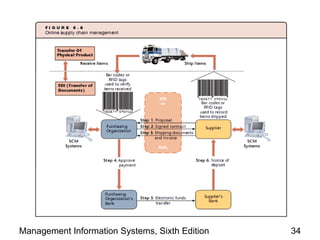
Supply Chains on the Web
• Supply chain management (SCM) systems may
  be connected to the Web to allow suppliers to
  participate directly
   – Use of XML allows companies to set standards
     for data exchange
• Electronic Data Interchange (EDI): a system
  used prior to the Web to exchange documents
  electronically
   – Set standards for data formats
   – EDI networks are owned and managed by value-
     added network (VAN) companies

Management Information Systems, Sixth Edition       33
Management Information Systems, Sixth Edition   34
Options in Establishing a Web Site

• Web site: Web pages that make up information
  and links
• Internet server: a computer connected to the
  Internet backbone
• Businesses have two choices for a Web site:
   – Installing and maintaining their own Web servers
   – Contracting with a Web hosting service


Management Information Systems, Sixth Edition       35
Owning and Maintaining a Server
• Owning and maintaining Web servers is costly
   – Provides the greatest degree of control, but
     requires expertise to set up and maintain
   – Must obtain a high-speed link to the Web
• Load balancing: transfer data requests from a
  busy server to a less busy server
• Mirror servers: servers with duplicated content
• Pure-play: company whose entire business is
  online
• Brick-and-mortar: company that owns physical
  stores and a Web site
Management Information Systems, Sixth Edition       36
Using a Hosting Service
• Web hosting: Web server managing service
• Several types of Web hosting:
   – Shared hosting: stores the client’s Web site on
     the same physical server as other clients
   – Virtual private hosting: simulates a single server,
     allowing a client to have its own domain name
   – Dedicated hosting: client has exclusive use of an
     entire physical Web server
   – Co-location: server owned and managed by a
     client is co-located with other clients’ servers in a
     secure physical location
Management Information Systems, Sixth Edition          37
Considerations in Selecting
                a Web Host
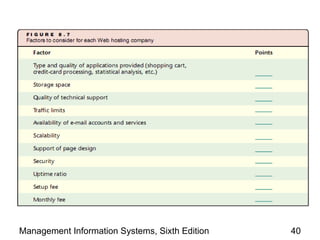
• Compare host vendors using a point system
• Dynamic Web pages: enable communication
  between browser and database
• Factors to consider when selecting Web host:
   –   Allows use of database management system
   –   Storage space capacity
   –   Technical and Web site design support
   –   Scalability
   –   Security: physical and virtual

Management Information Systems, Sixth Edition     38
Considerations in Selecting
          a Web Host (continued)
• Factors to consider when selecting Web host
  (continued):
   – Availability: minimize downtime
   – Costs, including:
       • Setup fees
       • Traffic-based fees
       • Monthly fees


Management Information Systems, Sixth Edition   39
Management Information Systems, Sixth Edition   40
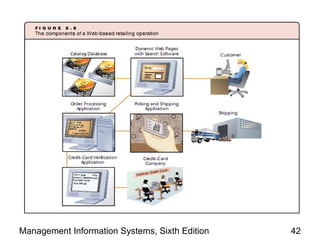
More Than Meets the Eye

• Several elements are essential to conducting
  business on the Web:
   – Inquiry interface: connects to database to allow
     user to search a catalog of products or services
   – Order processing application, including:
       • Credit-card verification application
   – Order-fulfillment system: picks, packs, and ships


Management Information Systems, Sixth Edition           41
Management Information Systems, Sixth Edition   42
Rules for Successful
              Web-Based Business
• Business success depends on availability and
  use of software
• Elements needed to support B2C commerce:
   –   Targeting customers
   –   Capturing the customer’s complete experience
   –   Personalizing the service
   –   Shortening the business cycle
   –   Let customers help themselves
   –   Be proactive and de-commoditize

Management Information Systems, Sixth Edition         43
Target the Right Customers

• Target customers needing your products and
  services
   – Most important effort of marketing
• Involves identifying the sites that your audience
  frequently visits
• Consider blogs and podcasting sites for
  advertisement placement


Management Information Systems, Sixth Edition     44
Capture the Customer’s Total
                Experience
• Use cookies to record shopper’s movements
  within the site
• Use CRM software to create consumer profiles
• Shopper experience becomes an asset of
  business, allowing:
   – Fine-tuning of the product portfolio
   – Tailoring of Web pages to individual customers
   – Individual e-mails to shopper offering products of
     interest

Management Information Systems, Sixth Edition         45
Personalize the Service

• CRM software and Web page customization
  software can be combined to:
   – Personalize Web pages shown to a customer
   – Allow the customer to select the type of e-mail
     content desired
   – Respect visitor privacy by offering opt-in rather
     than opt-out
   – Allow the customer to tailor products to be
     purchased


Management Information Systems, Sixth Edition            46
Shorten the Business Cycle
• Business on the Web saves time for customers
• Fulfillment is a major challenge for businesses
   – Activities after customer places order
• Fast shipping is desired because:
   – It produces higher customer satisfaction
   – Business collects payments faster
• Can outsource the entire fulfillment task to
  fulfillment organizations such as:
   – UPS’s e-Logistics
   – FedEx’s Supply Chain Services

Management Information Systems, Sixth Edition    47
Let Customers Help Themselves

• Customers need information from organization:
   –   Status of order
   –   Status of shipped item
   –   Installation instructions
   –   Troubleshooting
• E-mail messages sent to customers with
  information about orders and how to track them
• FAQs online allow customers to find answers to
  common questions

Management Information Systems, Sixth Edition   48
Be Proactive and De-Commoditize
• Prompt e-mail replies expected
• Proactive alerts expected for changes in orders
  or services, or product recalls
• Automatic reordering features are desirable
• Must take initiatives to de-commoditize products
   – Commodity: a product sold at roughly the same
     price by many vendors (no differentiation)
   – Addition of features or services prevents a
     product from becoming a commodity by creating
     differentiation

Management Information Systems, Sixth Edition    49
E-Commerce is Every Commerce

• Web technologies have been highly integrated
  into the business world
   – Difficult to identify which business activities are
     on the Internet and which are not
• Web has been highly integrated into daily
  activities of customers also
• Commerce and e-commerce generally have the
  same meaning today


Management Information Systems, Sixth Edition              50
Summary

• Some industries have changed drastically
  because of the Web
• HTTP is an Internet standard controlling Web
  server addresses
• HTTPS is a security version of HTTP
• XML is a standard for description of data
• Blogs enable people to create discussion Web
  pages


Management Information Systems, Sixth Edition    51
Summary (continued)

• Cookies help Web sites personalize the visitor’s
  experience
• Many Web technologies are proprietary
• A business can maintain its own Web server or
  use a Web hosting service
• Organizations should consider several factors
  when selecting a Web host
• Web-enabled commerce is classified into B2B
  and B2C

Management Information Systems, Sixth Edition    52
Summary (continued)
• B2B trading relies on electronic data interchange
  (EDI) and XML
• Wireless handheld computers allow mobile
  commerce, called m-commerce
• Online businesses must adhere to several factors
  to be successful
• Virtual worlds provide a means to meet and
  conduct business and social activities on the Web
• Spam and spyware are online annoyances
• Phishing is a pervasive fraud crime

Management Information Systems, Sixth Edition   53

Week 8

  • 1.
    Management Information Systems, Sixth Edition Chapter 8: The Web-Enabled Enterprise
  • 2.
    Objectives • Describe howthe Web and high-speed Internet connections are changing business operations • Explain the functionality of various Web technologies • Compare and contrast options for Web servers • Explain basic business-to-business and business-to-consumer practices on the Web • Explain the relationship between Web technologies and supply chain management Management Information Systems, Sixth Edition 2
  • 3.
    Objectives (continued) • Giveexamples of features and services that successful business Web sites offer • Learn about online annoyances such as spam and adware, and how to protect against online identity theft Management Information Systems, Sixth Edition 3
  • 4.
    Web Business: Growingand Changing • DLA Piper LLP is the second largest law firm in the world – 3200 lawyers in 24 countries and 63 offices around the world – Uses eRoom, a Web-based collaboration and document-sharing tool from EMC Corp. – Saves 15,000 labor hours annually, uses and mails significantly fewer paper documents, and reduces redundant work Management Information Systems, Sixth Edition 4
  • 5.
    Web Technologies: AReview • Several standards and technologies enable the Web to deliver rich information, including: – HTTP, HTML, XML – File Transfer – RSS – Blogs – Wikis – Podcasting – IM – Cookies Management Information Systems, Sixth Edition 5
  • 6.
    HTTP • Hypertext TransferProtocol (HTTP): transfer and download Web information • HTTPS: HTTP secure for confidential data exchange • Uniform Resource Locator (URL): unique address given to each Web site – IP address: a special numeric address • Domain name: unique name for a Web site, constructed with letters – URL also refers to the domain name Management Information Systems, Sixth Edition 6
  • 7.
    HTML and XML •Hypertext Markup Language (HTML): helps developer create Web pages – Determines look and location of content • Extensible Markup Language (XML): enables creation of various data types – Conveys the meaning or content of the data • XHTML: combination of XML and HTML – Uses opening and closing tags to control format Management Information Systems, Sixth Edition 7
  • 8.
  • 9.
    File Transfer • FileTransfer Protocol (FTP): used to transmit whole files – Used in all downloads from Web sites – Any type of file can be transferred – Can place files on a server for shared use – Often used to deliver purchased software products on Web sites Management Information Systems, Sixth Edition 9
  • 10.
    RSS • Really SimpleSyndication (RSS): family of XML file formats that allow automatic downloads of content on a subscription basis – Helps users check for updates – Communicates short descriptions of content – Allows transmittal of new information – Useful on news Web sites – Also called Rich Site Summary Management Information Systems, Sixth Edition 10
  • 11.
    Blogs • Blog: contractionof “Web log” – Invites surfers to post opinions and art – Focuses on a topic or set of topics – Trackback: a tool that notifies bloggers when their posts have been mentioned elsewhere on the Web • Blogs are often used by businesses • Importance of blogs to commercial organizations is to find out what blog participants think and say about the organization Management Information Systems, Sixth Edition 11
  • 12.
    Wikis • Wiki (fromHawaiian, meaning “quick”): Web application that enables users to add to and edit the contents of Web pages – All the software required to edit the Web pages is embedded in the pages themselves • Wikipedia: a popular online encyclopedia • Wiki technology is a popular ingredient in groupware (software used for collaboration) Management Information Systems, Sixth Edition 12
  • 13.
  • 14.
    Podcasting • Podcast: publishingsound and video on the Web for download – Usually on a subscription basis • Uses include: – “Time-shifted” broadcast of radio station programs for later listening – Audio tours in museums – Lectures in distance learning courses – Garageband.com • Allows aspiring musicians to post music tracks Management Information Systems, Sixth Edition 14
  • 15.
    Instant Messaging • Instantmessaging (IM): real-time chat – Form of synchronized e-mail – Chat room: communicate with a group – Free applications for IM include: • AIM: AOL instant Messenger • Yahoo Messenger • MSN Messenger • ICQ • Trillian – Business uses • Customers can chat with sales or support reps Management Information Systems, Sixth Edition 15
  • 16.
  • 17.
    Cookies • Cookie: smallfile that stores information about a Web site visitor, stored on the visitor’s computer – Usually records the surfer’s ID – Often stores the surfer’s preferences – Provides convenience to consumers – Can be temporary (single session) or permanent – Potential for intrusion into surfer privacy • Clickstream tracking: tracks a surfer’s clicking activities • Spyware: traces and reports online behavior Management Information Systems, Sixth Edition 17
  • 18.
    Proprietary Technologies • Proprietarytechnology: intellectual property of developer, not free for all to use • Examples: – Local search engine – Shopping cart applications – Wish lists – Video streaming tools – Tools to analyze and predict Web visitor behavior, especially shopper behavior Management Information Systems, Sixth Edition 18
  • 19.
    Web-Enabled Business • Web-enabledbusiness are classified according to the interacting parties: – Business-to-business (B2B) – Business-to-consumer (B2C) – Government-to-business – Government-to-consumer Management Information Systems, Sixth Edition 19
  • 20.
    B2B Trading • Business-to-business(B2B): trading between businesses only • B2B forms include advertising through: – Search advertising: advertisements placed on a search site result page – Banners: images placed on Web sites that link to a company site selling a product or service • Impression: occurs when a page with a banner is downloaded • Reach percentage: the percentage of Web users who visited a site in the past month Management Information Systems, Sixth Edition 20
  • 21.
  • 22.
    B2B Trading (continued) •Exchanges and auctions act as online marketplaces • Intranet: network used only by employees of an organization • Extranet: network shared by employees of different organizations, usually business partners • Exchange: extranet for organizations that deal in products and services of a particular type – Exchange operator profits from transaction fees • Auction: sells a great variety of items Management Information Systems, Sixth Edition 22
  • 23.
  • 24.
    B2B Trading (continued) •Online business alliances: collaboration between businesses in establishing a Web site – Site operator works for the allied companies – Suppliers are invited to sell through the site and compete among themselves, driving prices down Management Information Systems, Sixth Edition 24
  • 25.
    B2C Trading • Business-to-consumer(B2C): trading with the general public • E-Tailing: online retailing to consumers • Fulfillment activities: picking, packing, shipping • Consumer profiling: know customers better by gathering information about their online activities – Some consider this a violation of privacy • Conversion rate: the proportion of site visitors who make a purchase Management Information Systems, Sixth Edition 25
  • 26.
  • 27.
  • 28.
    B2C Trading (continued) •Auction sites serve as a hub for consumers to buy and sell • Reverse auction: customers name their own price for desired goods and services • Content providers: offer information, artistic work, classified ads, and video • Electronic bill presentment and payment (EBBP): provides online bills and payment options for customers • Phishing: type of fraud involving a fake Web site Management Information Systems, Sixth Edition 28
  • 29.
  • 30.
  • 31.
    B2C Trading (continued) •Extra-organizational workforce: – Companies purchase labor from a larger pool • Mobile commerce, or M-commerce: – Business conducted on mobile devices • Many experts believe that information delivery is the main mobile application, not commerce – Exceptions are Japan and South Korea – Japan’s DoCoMo’s i-mode service allows users of smart cell phones to purchase canned soda from vending machines, fast food Management Information Systems, Sixth Edition 31
  • 32.
    B2C Trading (continued) •M-commerce also raises privacy concerns – GPS provides location tracking • New top-level domain names with .mobi available for mobile applications – Sites should use special technologies to optimize content for easy viewing on mobile devices • Virtual world: a combination of images, video, sound, and avatars that resemble the real world – Accessible for interaction by subscribers • Avatar: 3D graphical character that represents a user in a virtual world Management Information Systems, Sixth Edition 32
  • 33.
    Supply Chains onthe Web • Supply chain management (SCM) systems may be connected to the Web to allow suppliers to participate directly – Use of XML allows companies to set standards for data exchange • Electronic Data Interchange (EDI): a system used prior to the Web to exchange documents electronically – Set standards for data formats – EDI networks are owned and managed by value- added network (VAN) companies Management Information Systems, Sixth Edition 33
  • 34.
  • 35.
    Options in Establishinga Web Site • Web site: Web pages that make up information and links • Internet server: a computer connected to the Internet backbone • Businesses have two choices for a Web site: – Installing and maintaining their own Web servers – Contracting with a Web hosting service Management Information Systems, Sixth Edition 35
  • 36.
    Owning and Maintaininga Server • Owning and maintaining Web servers is costly – Provides the greatest degree of control, but requires expertise to set up and maintain – Must obtain a high-speed link to the Web • Load balancing: transfer data requests from a busy server to a less busy server • Mirror servers: servers with duplicated content • Pure-play: company whose entire business is online • Brick-and-mortar: company that owns physical stores and a Web site Management Information Systems, Sixth Edition 36
  • 37.
    Using a HostingService • Web hosting: Web server managing service • Several types of Web hosting: – Shared hosting: stores the client’s Web site on the same physical server as other clients – Virtual private hosting: simulates a single server, allowing a client to have its own domain name – Dedicated hosting: client has exclusive use of an entire physical Web server – Co-location: server owned and managed by a client is co-located with other clients’ servers in a secure physical location Management Information Systems, Sixth Edition 37
  • 38.
    Considerations in Selecting a Web Host • Compare host vendors using a point system • Dynamic Web pages: enable communication between browser and database • Factors to consider when selecting Web host: – Allows use of database management system – Storage space capacity – Technical and Web site design support – Scalability – Security: physical and virtual Management Information Systems, Sixth Edition 38
  • 39.
    Considerations in Selecting a Web Host (continued) • Factors to consider when selecting Web host (continued): – Availability: minimize downtime – Costs, including: • Setup fees • Traffic-based fees • Monthly fees Management Information Systems, Sixth Edition 39
  • 40.
  • 41.
    More Than Meetsthe Eye • Several elements are essential to conducting business on the Web: – Inquiry interface: connects to database to allow user to search a catalog of products or services – Order processing application, including: • Credit-card verification application – Order-fulfillment system: picks, packs, and ships Management Information Systems, Sixth Edition 41
  • 42.
  • 43.
    Rules for Successful Web-Based Business • Business success depends on availability and use of software • Elements needed to support B2C commerce: – Targeting customers – Capturing the customer’s complete experience – Personalizing the service – Shortening the business cycle – Let customers help themselves – Be proactive and de-commoditize Management Information Systems, Sixth Edition 43
  • 44.
    Target the RightCustomers • Target customers needing your products and services – Most important effort of marketing • Involves identifying the sites that your audience frequently visits • Consider blogs and podcasting sites for advertisement placement Management Information Systems, Sixth Edition 44
  • 45.
    Capture the Customer’sTotal Experience • Use cookies to record shopper’s movements within the site • Use CRM software to create consumer profiles • Shopper experience becomes an asset of business, allowing: – Fine-tuning of the product portfolio – Tailoring of Web pages to individual customers – Individual e-mails to shopper offering products of interest Management Information Systems, Sixth Edition 45
  • 46.
    Personalize the Service •CRM software and Web page customization software can be combined to: – Personalize Web pages shown to a customer – Allow the customer to select the type of e-mail content desired – Respect visitor privacy by offering opt-in rather than opt-out – Allow the customer to tailor products to be purchased Management Information Systems, Sixth Edition 46
  • 47.
    Shorten the BusinessCycle • Business on the Web saves time for customers • Fulfillment is a major challenge for businesses – Activities after customer places order • Fast shipping is desired because: – It produces higher customer satisfaction – Business collects payments faster • Can outsource the entire fulfillment task to fulfillment organizations such as: – UPS’s e-Logistics – FedEx’s Supply Chain Services Management Information Systems, Sixth Edition 47
  • 48.
    Let Customers HelpThemselves • Customers need information from organization: – Status of order – Status of shipped item – Installation instructions – Troubleshooting • E-mail messages sent to customers with information about orders and how to track them • FAQs online allow customers to find answers to common questions Management Information Systems, Sixth Edition 48
  • 49.
    Be Proactive andDe-Commoditize • Prompt e-mail replies expected • Proactive alerts expected for changes in orders or services, or product recalls • Automatic reordering features are desirable • Must take initiatives to de-commoditize products – Commodity: a product sold at roughly the same price by many vendors (no differentiation) – Addition of features or services prevents a product from becoming a commodity by creating differentiation Management Information Systems, Sixth Edition 49
  • 50.
    E-Commerce is EveryCommerce • Web technologies have been highly integrated into the business world – Difficult to identify which business activities are on the Internet and which are not • Web has been highly integrated into daily activities of customers also • Commerce and e-commerce generally have the same meaning today Management Information Systems, Sixth Edition 50
  • 51.
    Summary • Some industrieshave changed drastically because of the Web • HTTP is an Internet standard controlling Web server addresses • HTTPS is a security version of HTTP • XML is a standard for description of data • Blogs enable people to create discussion Web pages Management Information Systems, Sixth Edition 51
  • 52.
    Summary (continued) • Cookieshelp Web sites personalize the visitor’s experience • Many Web technologies are proprietary • A business can maintain its own Web server or use a Web hosting service • Organizations should consider several factors when selecting a Web host • Web-enabled commerce is classified into B2B and B2C Management Information Systems, Sixth Edition 52
  • 53.
    Summary (continued) • B2Btrading relies on electronic data interchange (EDI) and XML • Wireless handheld computers allow mobile commerce, called m-commerce • Online businesses must adhere to several factors to be successful • Virtual worlds provide a means to meet and conduct business and social activities on the Web • Spam and spyware are online annoyances • Phishing is a pervasive fraud crime Management Information Systems, Sixth Edition 53