Where Search Meets Machine Learning
Diana Hu @sdianahu — Data Science Lead, Verizon
Joaquin Delgado @joaquind — Director of Engineering, Verizon
Disclaimer
2
The content of this presentation are of the authors’
personal statements and does not officially represent their
employer’s view in anyway. Included content is especially
not intended to convey the views of OnCue or Verizon
01
Index
1.  Introduction
2.  Search and Information Retrieval
3.  ML problems as Search-based Systems
4.  ML Meets Search!
Introduction
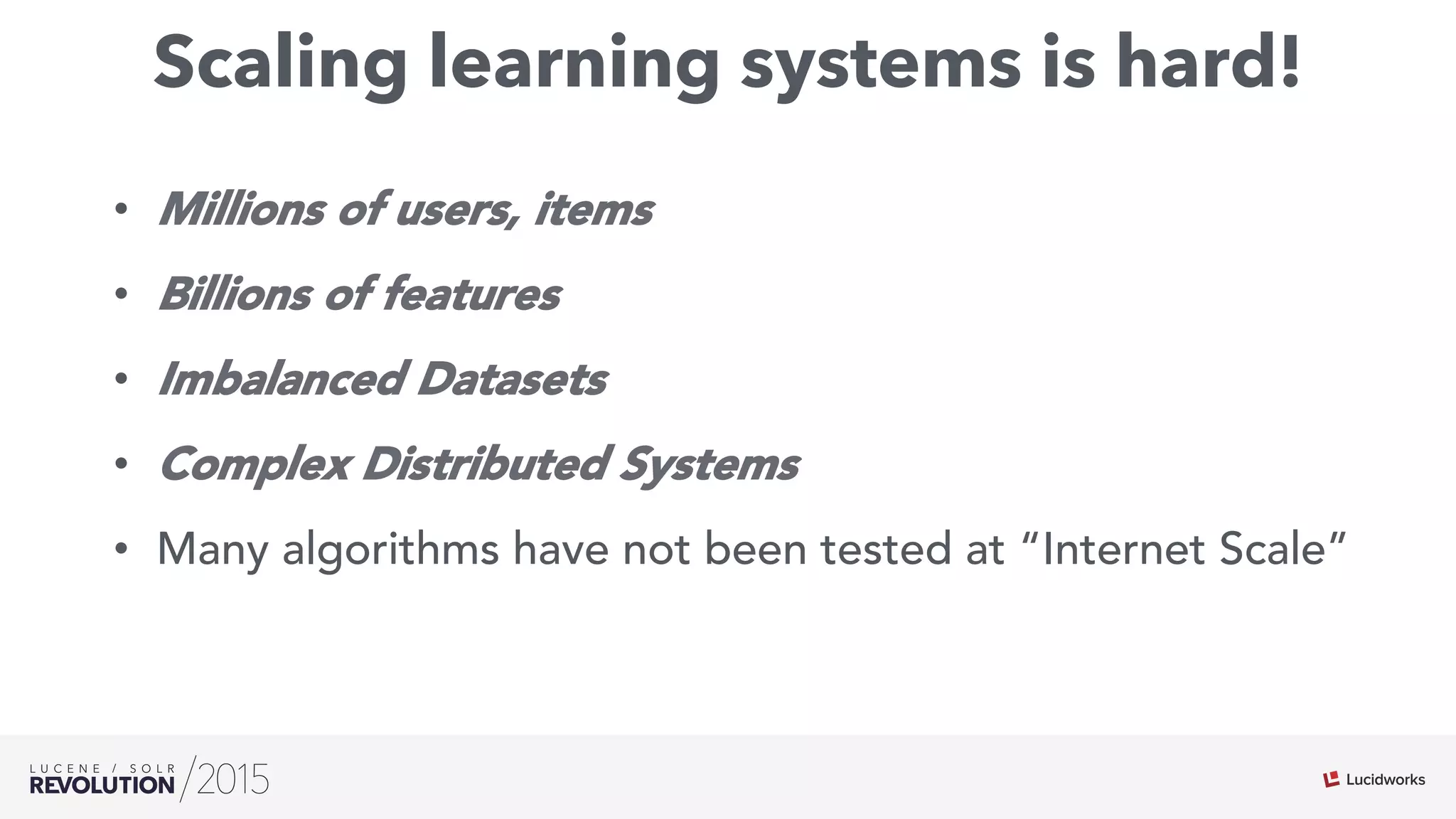
Scaling learning systems is hard!
•  Millions of users, items
•  Billions of features
•  Imbalanced Datasets
•  Complex Distributed Systems
•  Many algorithms have not been tested at “Internet Scale”
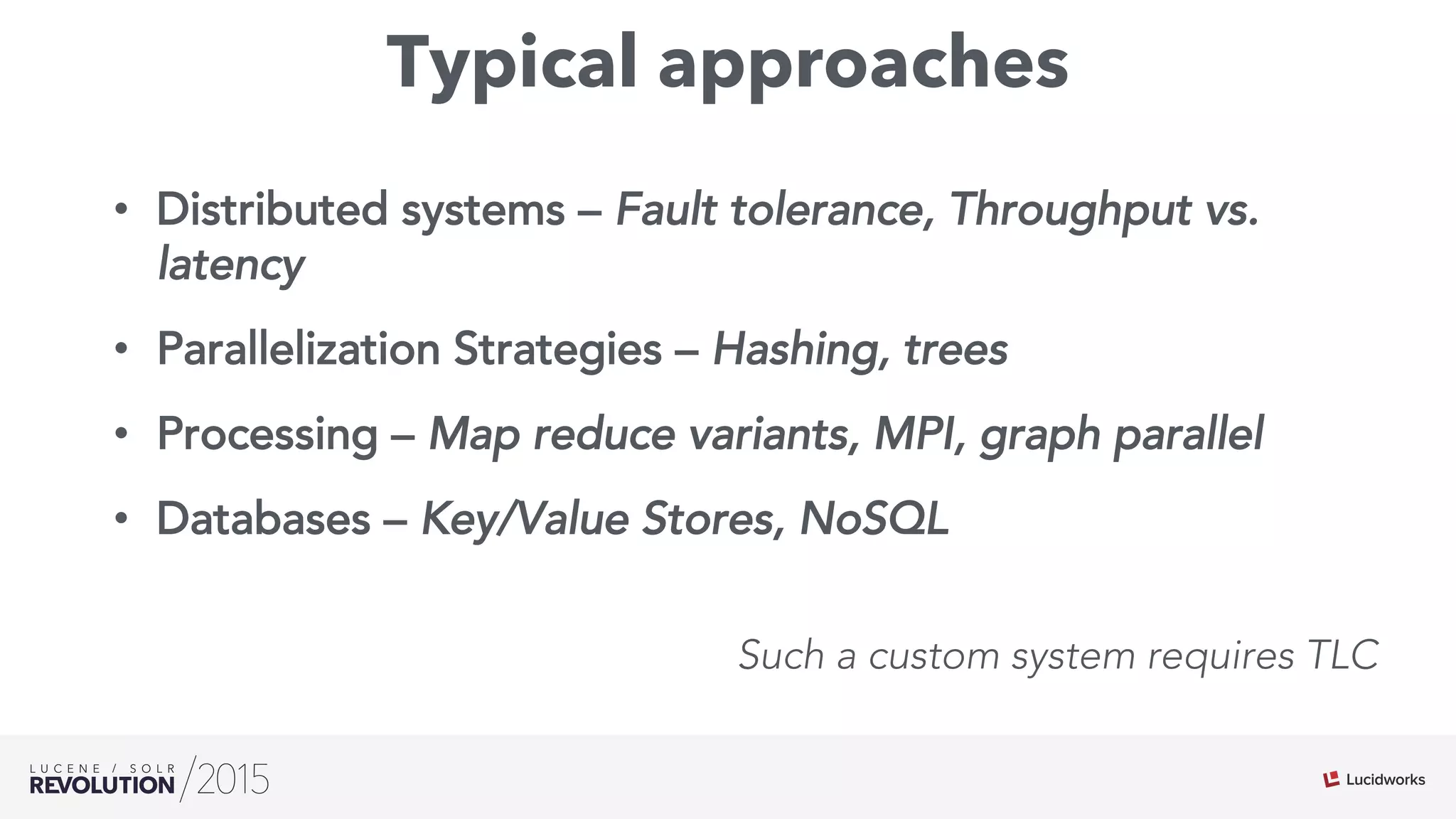
Typical approaches
•  Distributed systems – Fault tolerance, Throughput vs.
latency
•  Parallelization Strategies – Hashing, trees
•  Processing – Map reduce variants, MPI, graph parallel
•  Databases – Key/Value Stores, NoSQL
Such a custom system requires TLC
Search and
Information Retrieval
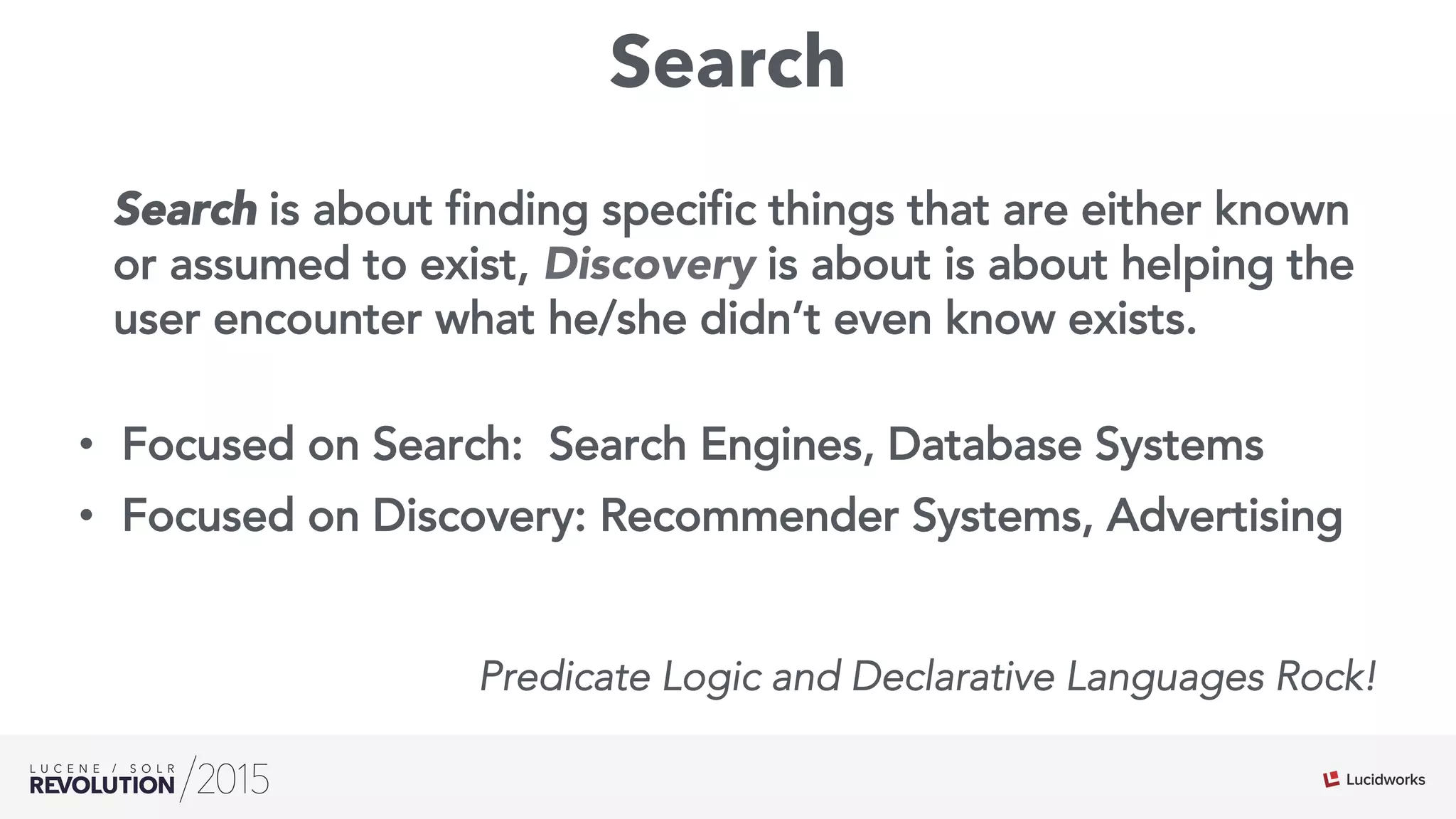
Search
Search is about finding specific things that are either known
or assumed to exist, Discovery is about is about helping the
user encounter what he/she didn’t even know exists.
•  Focused on Search: Search Engines, Database Systems
•  Focused on Discovery: Recommender Systems, Advertising
Predicate Logic and Declarative Languages Rock!
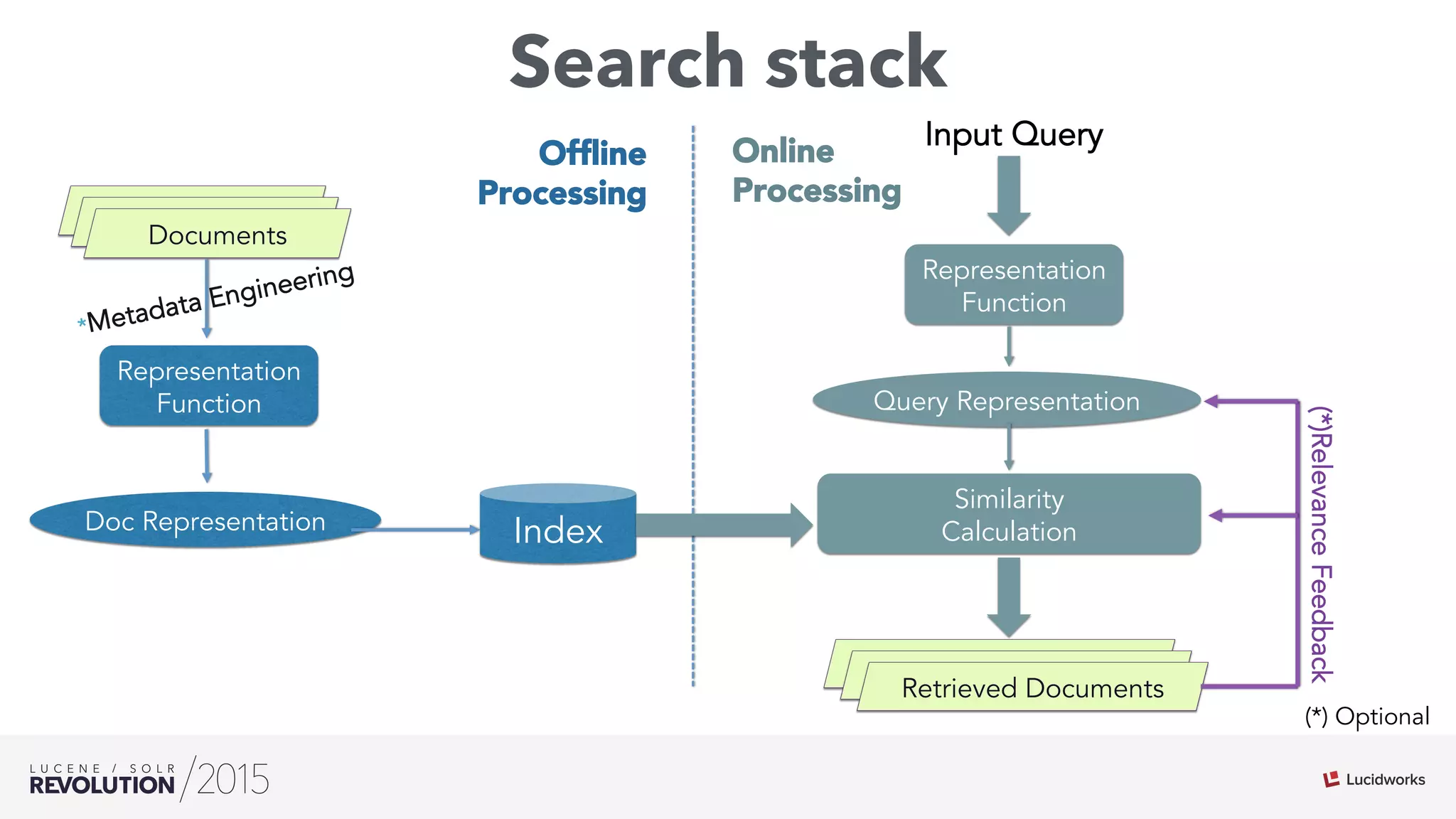
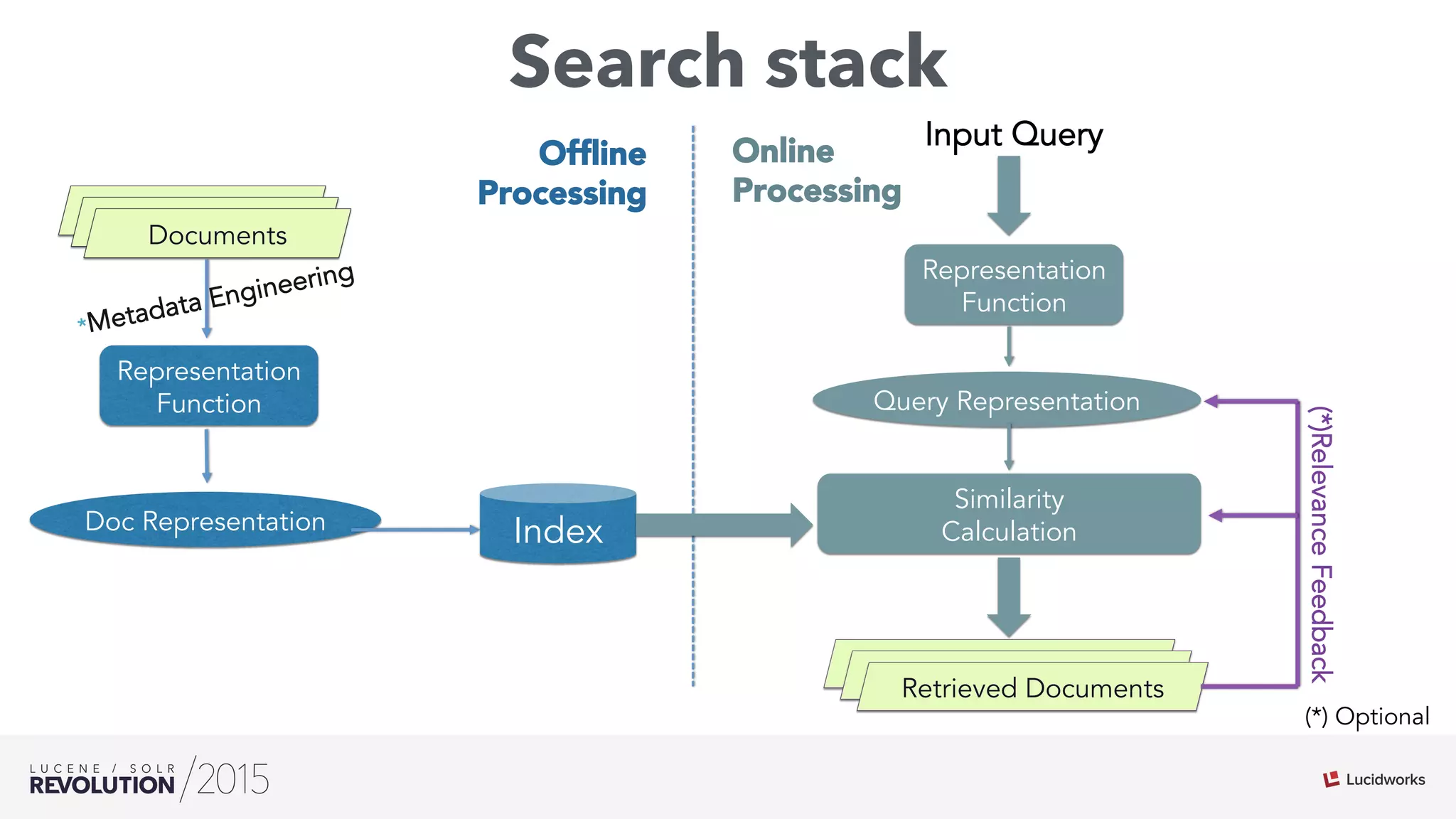
Search stack
Matched Hits
Representation
Function
Similarity
Calculation
Matched HitsDocuments
Representation
Function
Input Query
Matched HitsMatched HitsRetrieved Documents
Online
Processing
Offline
Processing
(*)RelevanceFeedback
Query Representation
Doc Representation Index
*Metadata Engineering
(*) Optional
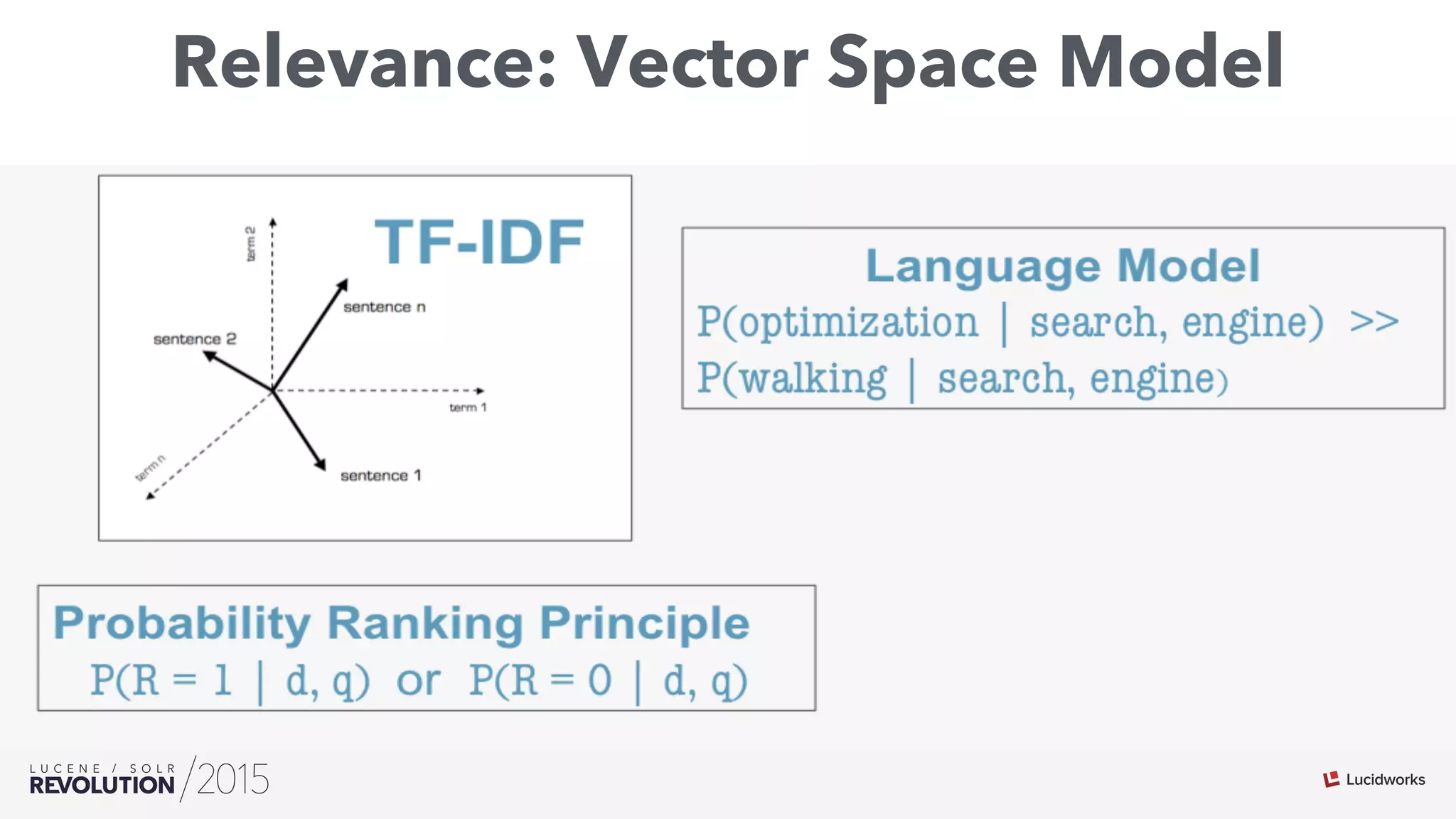
Relevance: Vector Space Model
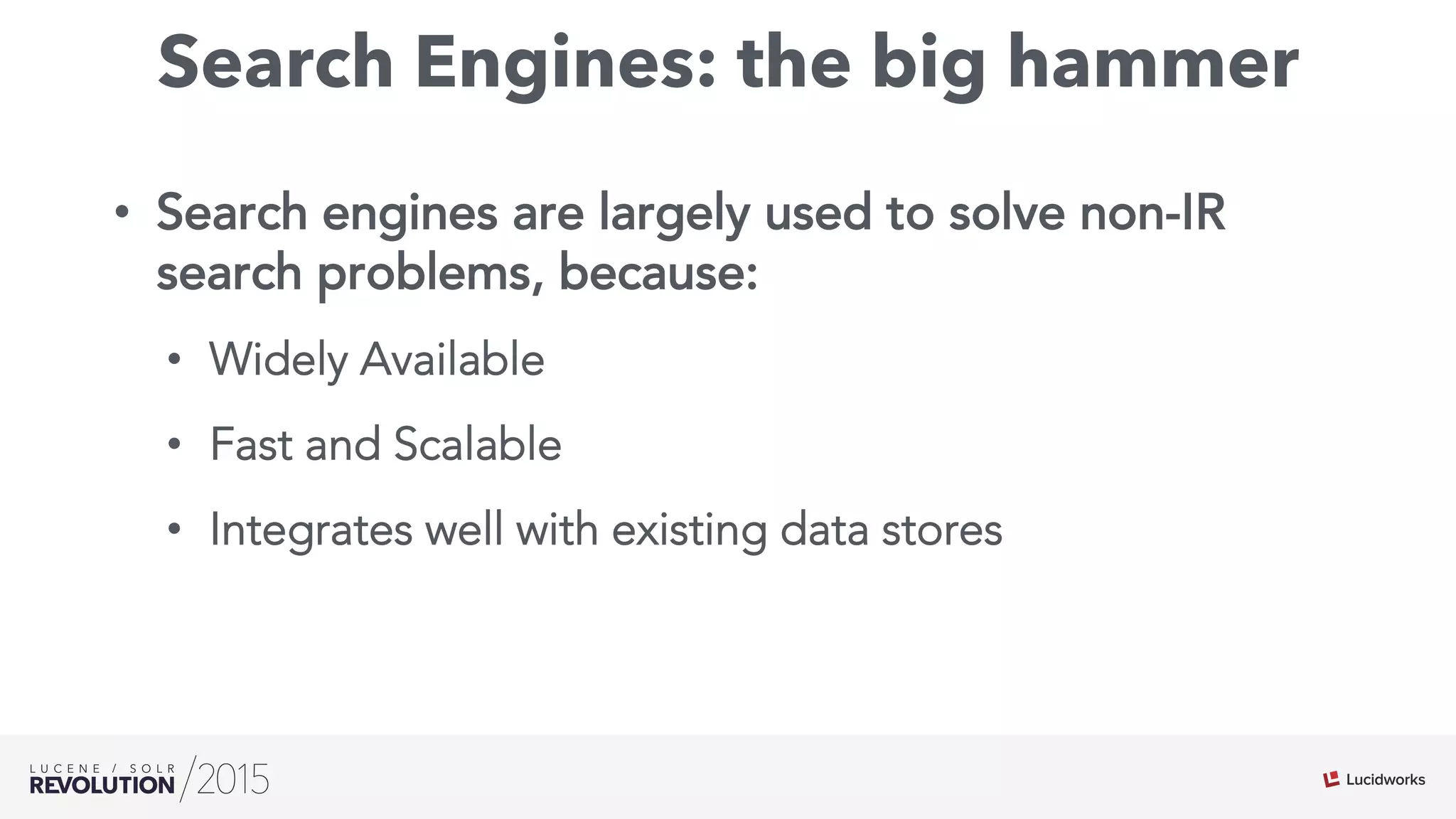
Search Engines: the big hammer
•  Search engines are largely used to solve non-IR
search problems, because:
•  Widely Available
•  Fast and Scalable
•  Integrates well with existing data stores
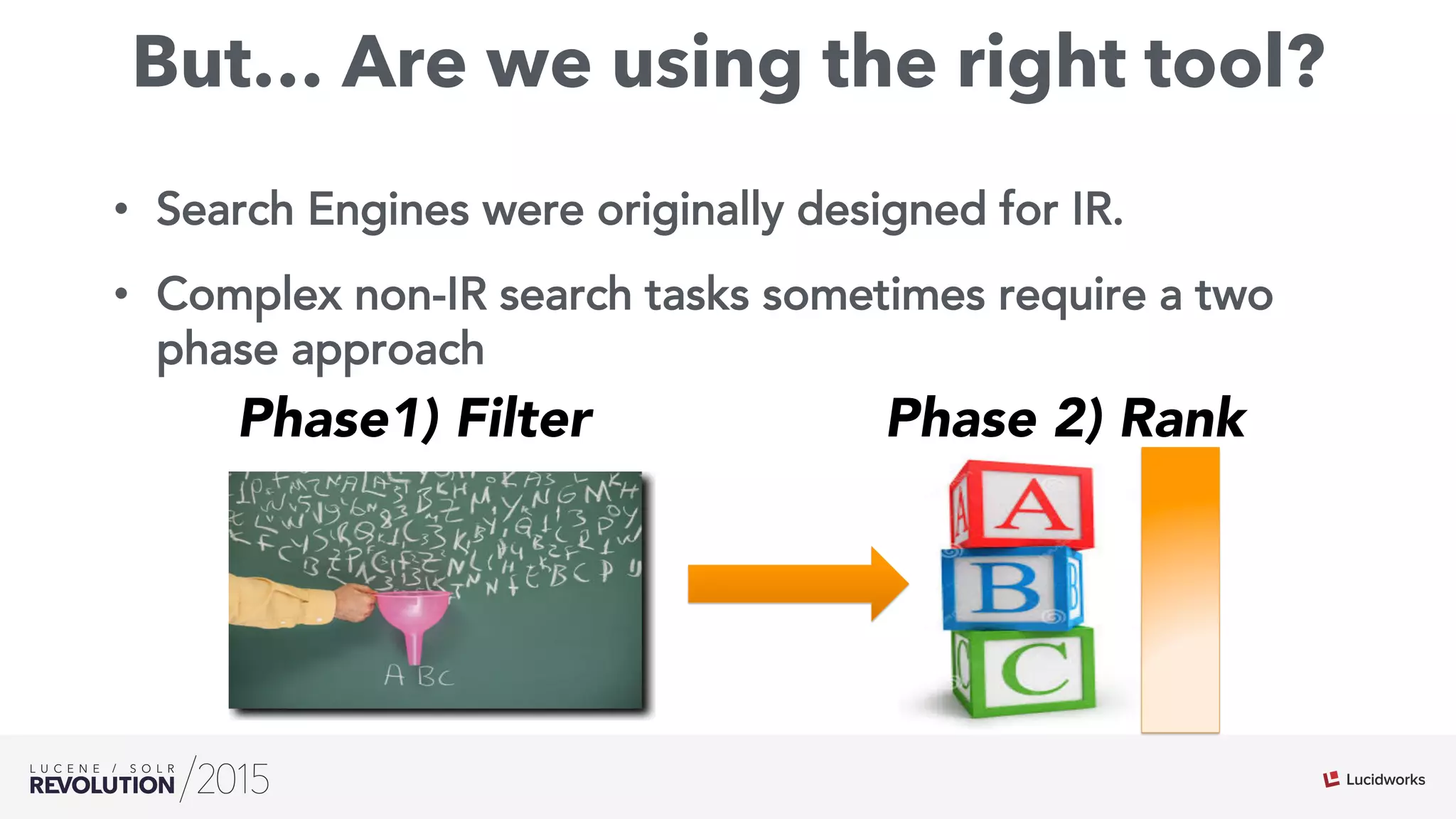
But… Are we using the right tool?
•  Search Engines were originally designed for IR.
•  Complex non-IR search tasks sometimes require a two
phase approach
Phase1) Filter Phase 2) Rank
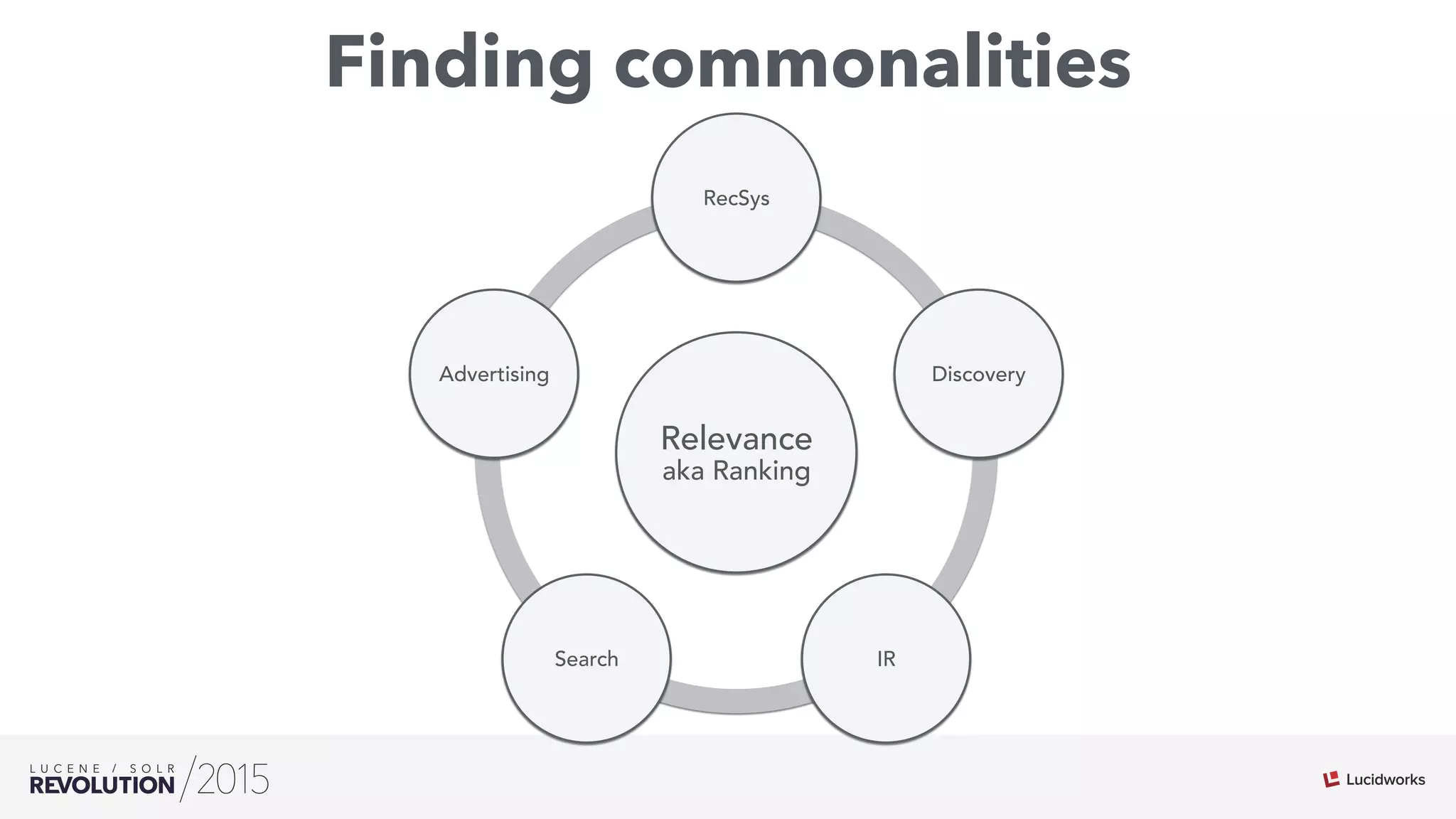
Finding commonalities
Relevance
aka Ranking
RecSys
Discovery
IRSearch
Advertising
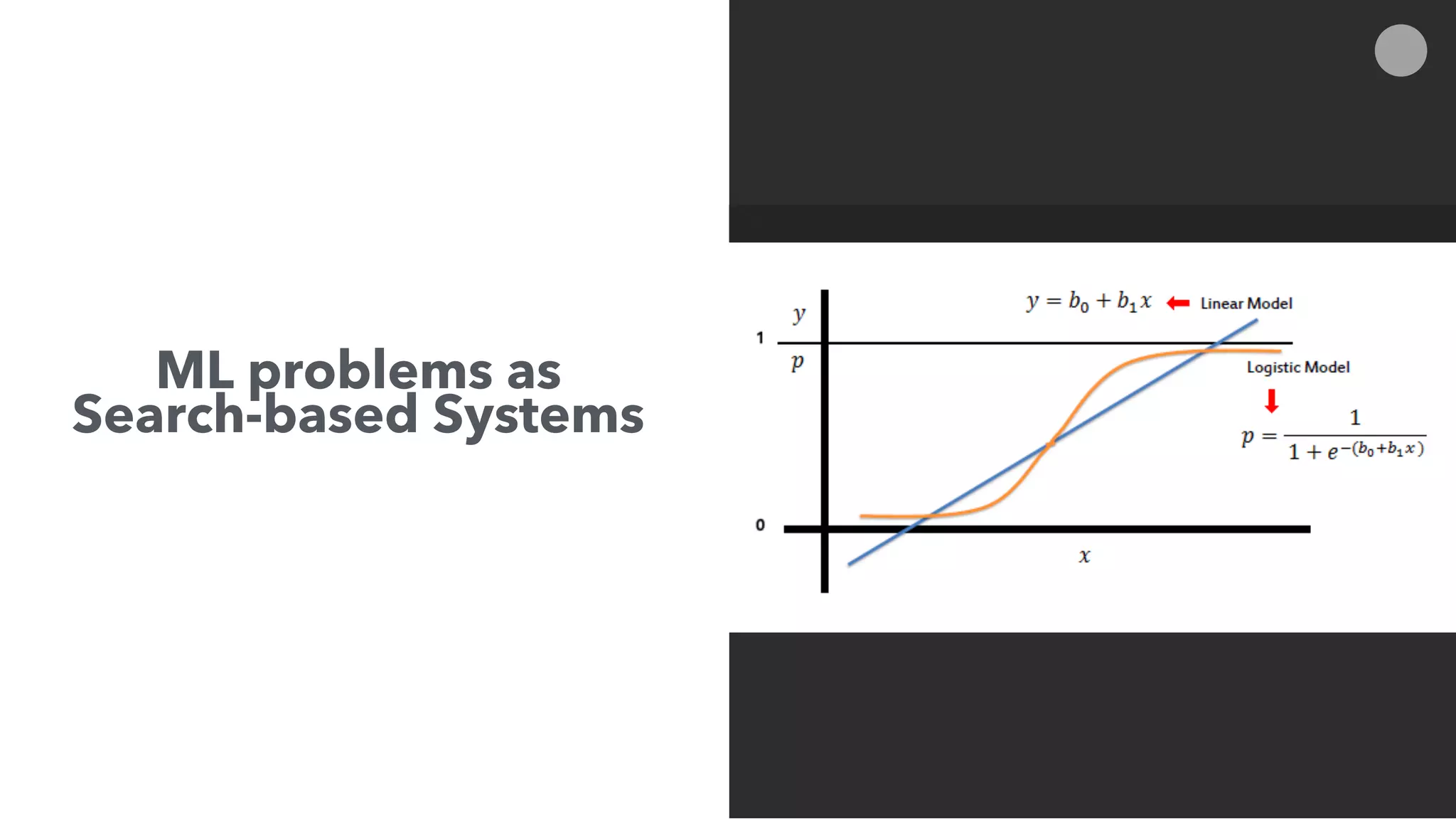
ML problems as
Search-based Systems
Machine Learning
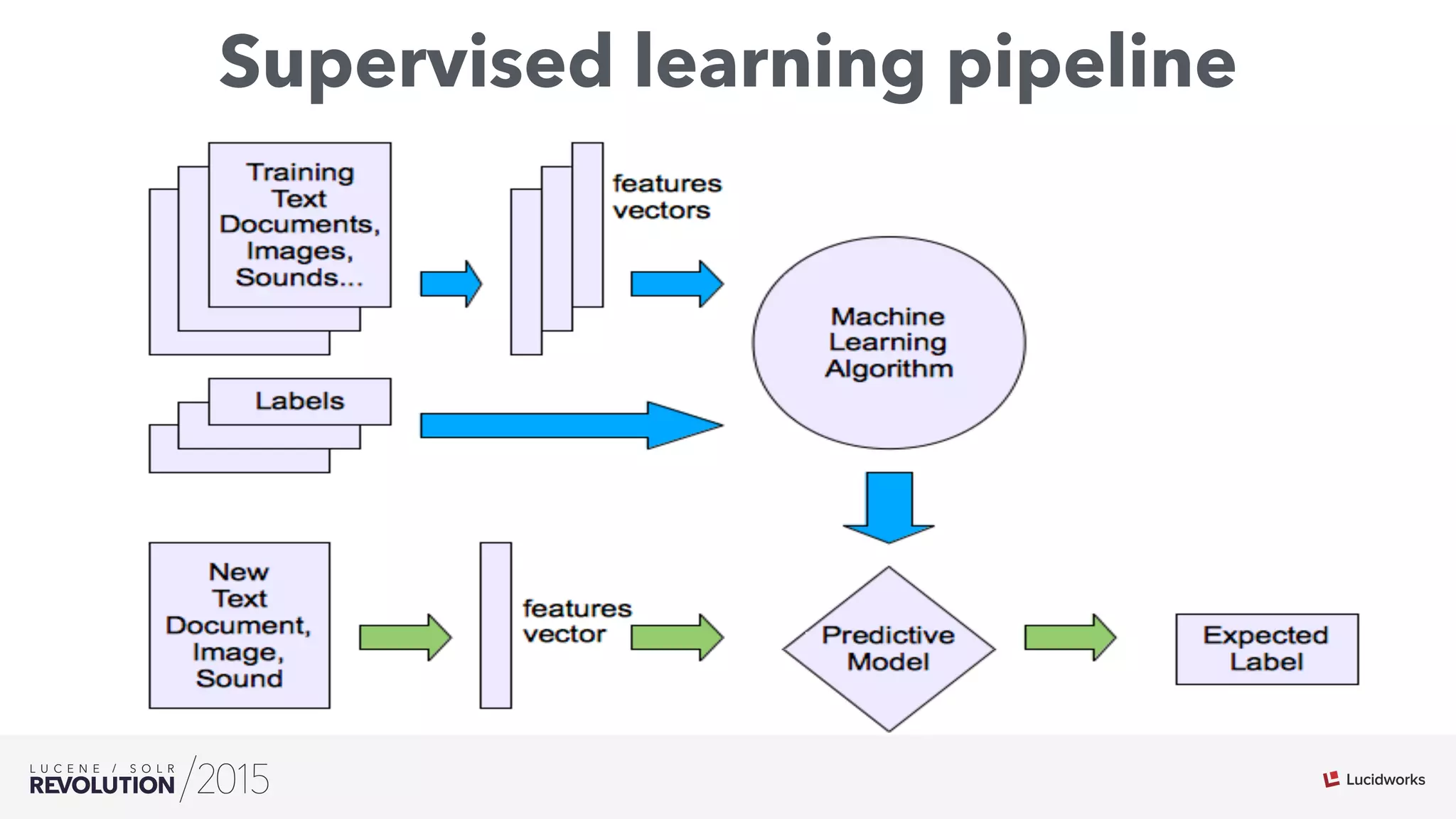
Machine Learning in particular supervised learning refer to
techniques used to learn how to classify or score previously
unseen objects based on a training dataset
Inference and Generalization are the Key!
Supervised learning pipeline
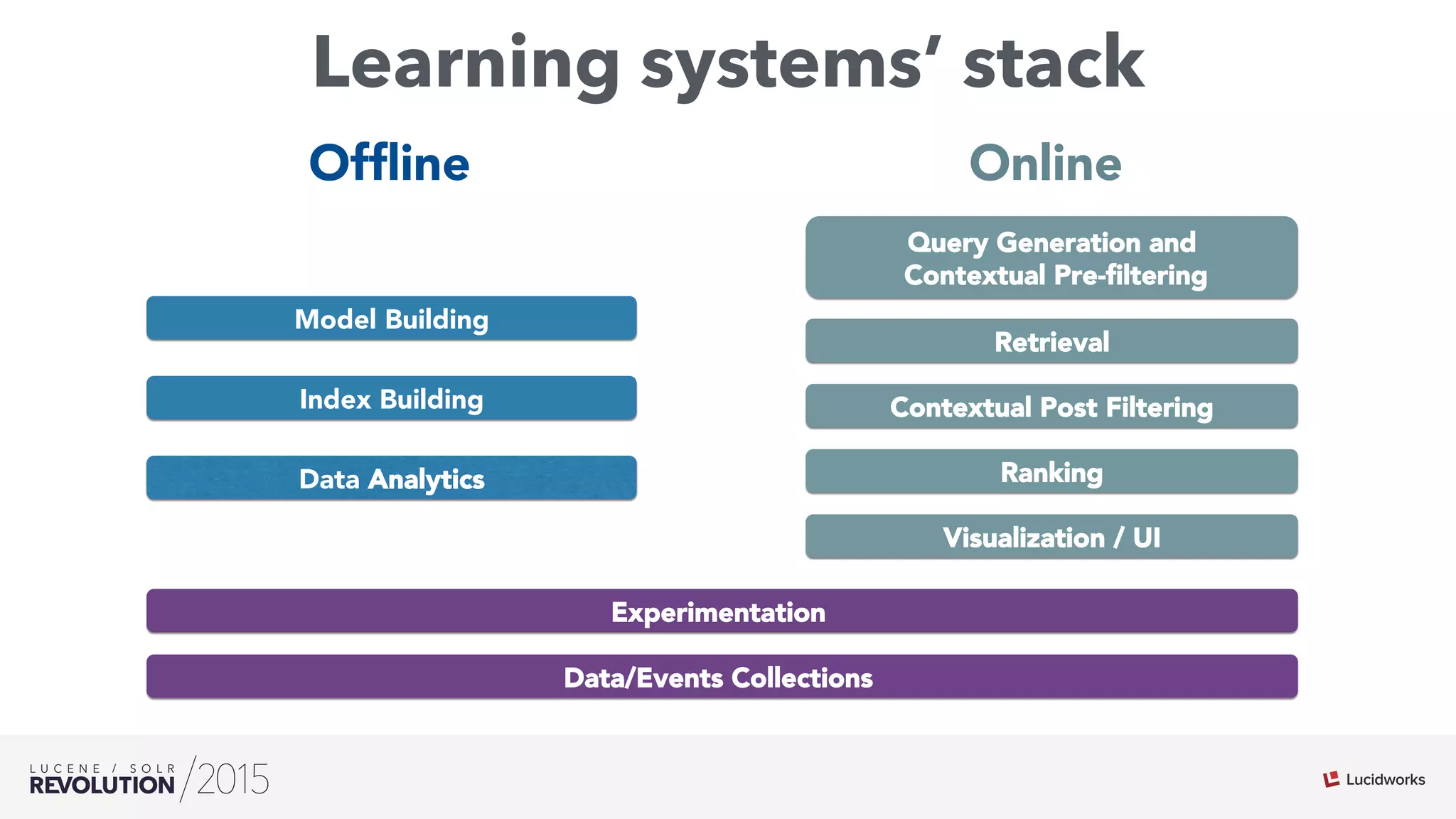
Learning systems’ stack
Visualization / UI
Retrieval
Ranking
Query Generation and
Contextual Pre-filtering
Model Building
Index Building
Data/Events Collections
Data Analytics
Contextual Post Filtering
OnlineOffline
Experimentation
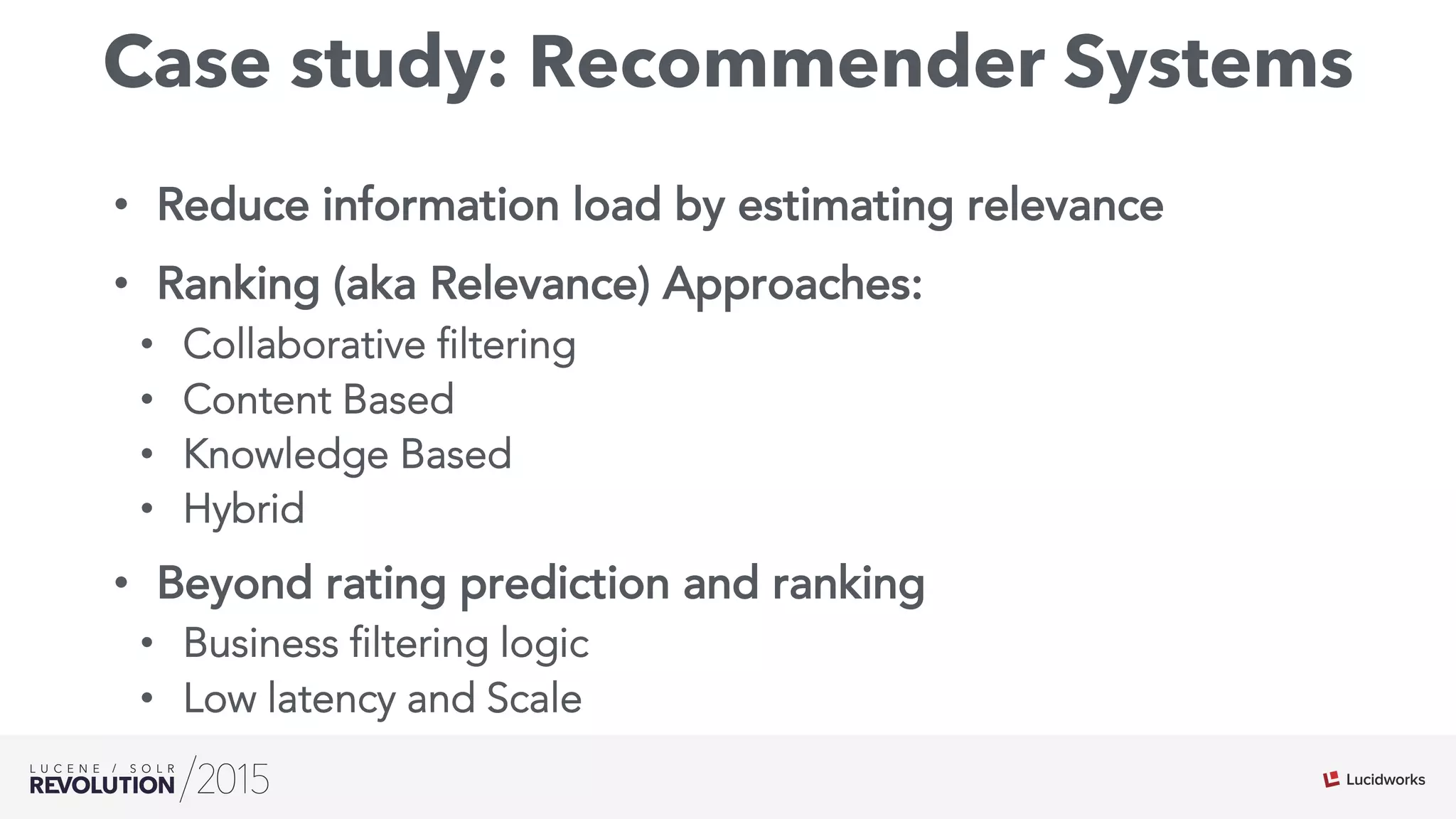
Case study: Recommender Systems
•  Reduce information load by estimating relevance
•  Ranking (aka Relevance) Approaches:
•  Collaborative filtering
•  Content Based
•  Knowledge Based
•  Hybrid
•  Beyond rating prediction and ranking
•  Business filtering logic
•  Low latency and Scale
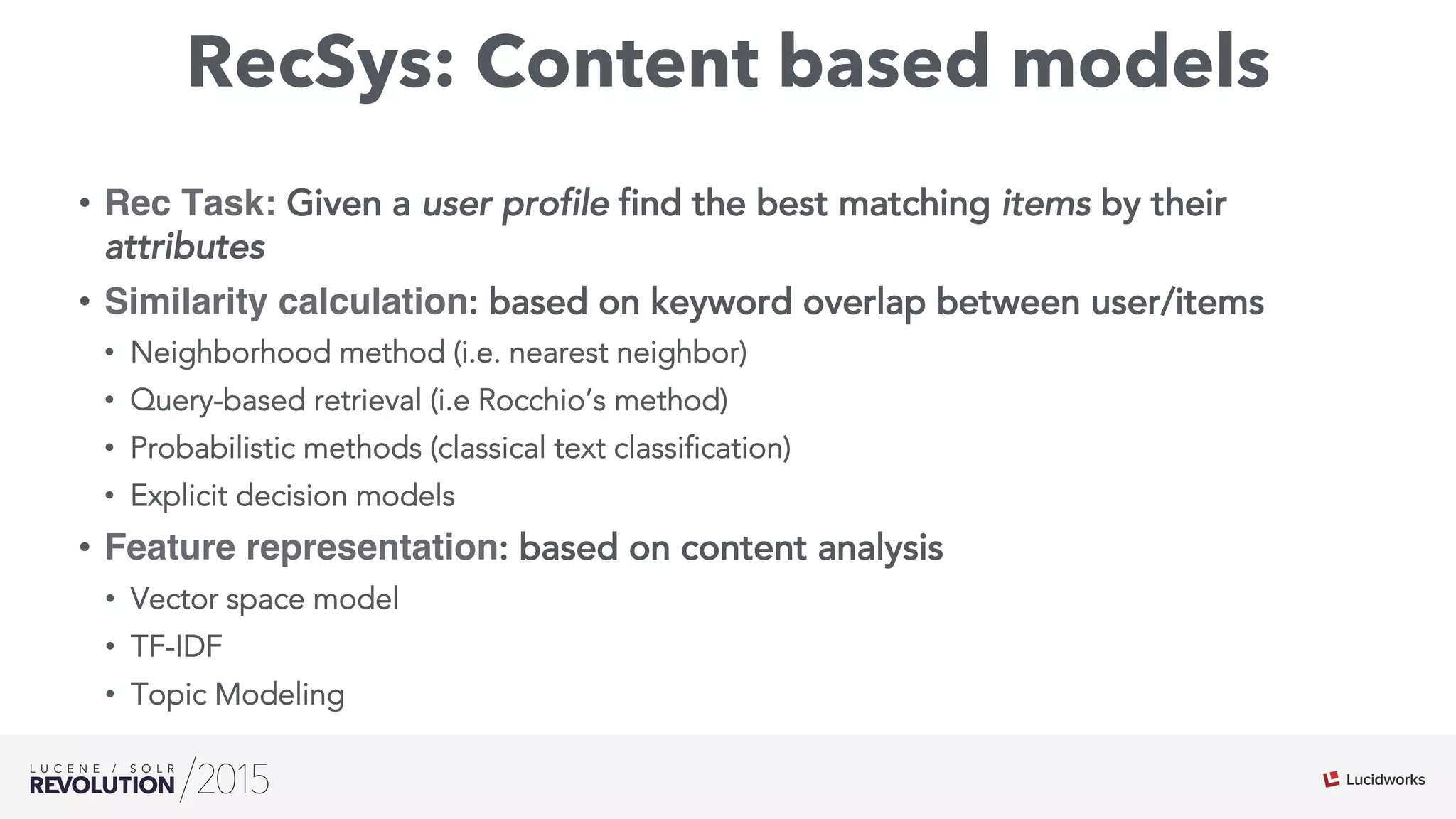
RecSys: Content based models
•  Rec Task: Given a user profile find the best matching items by their
attributes
•  Similarity calculation: based on keyword overlap between user/items
•  Neighborhood method (i.e. nearest neighbor)
•  Query-based retrieval (i.e Rocchio’s method)
•  Probabilistic methods (classical text classification)
•  Explicit decision models
•  Feature representation: based on content analysis
•  Vector space model
•  TF-IDF
•  Topic Modeling
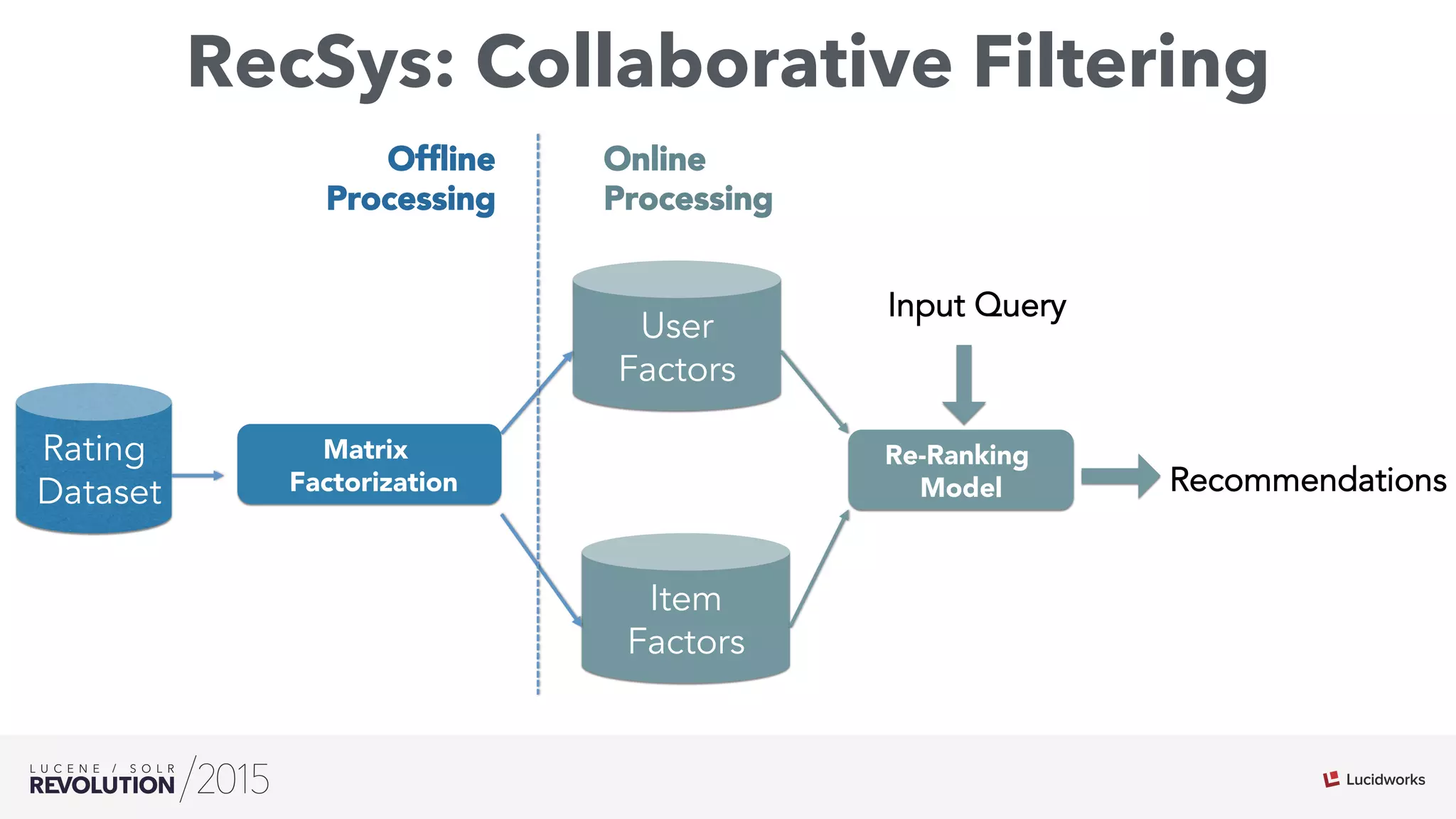
RecSys: Collaborative Filtering
Matrix
Factorization
Rating
Dataset
User
Factors
Item
Factors
Re-Ranking
Model
Input Query
Online
Processing
Offline
Processing
Recommendations
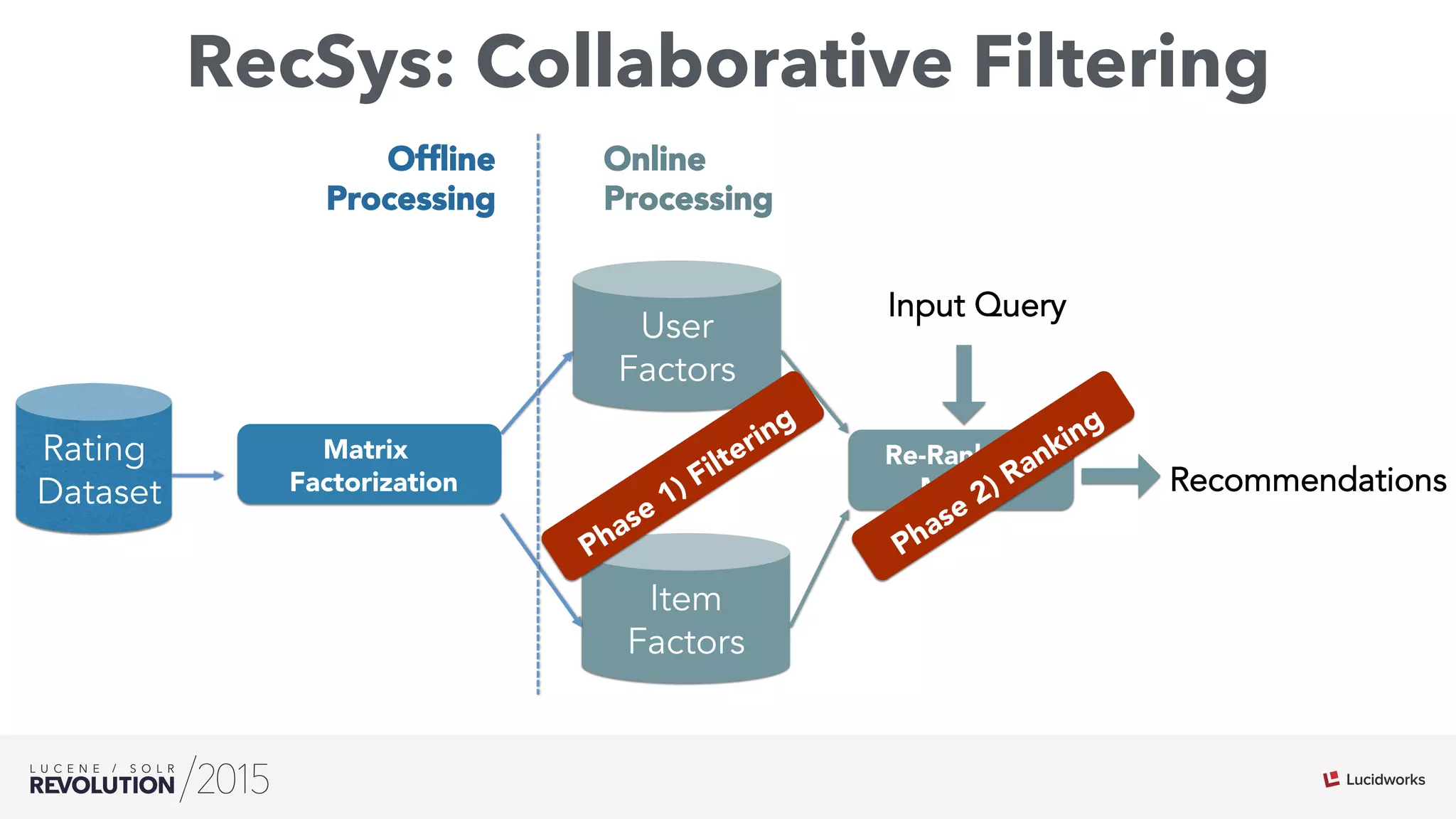
RecSys: Collaborative Filtering
Matrix
Factorization
Rating
Dataset
User
Factors
Item
Factors
Re-Ranking
Model
Input Query
Online
Processing
Offline
Processing
Recommendations
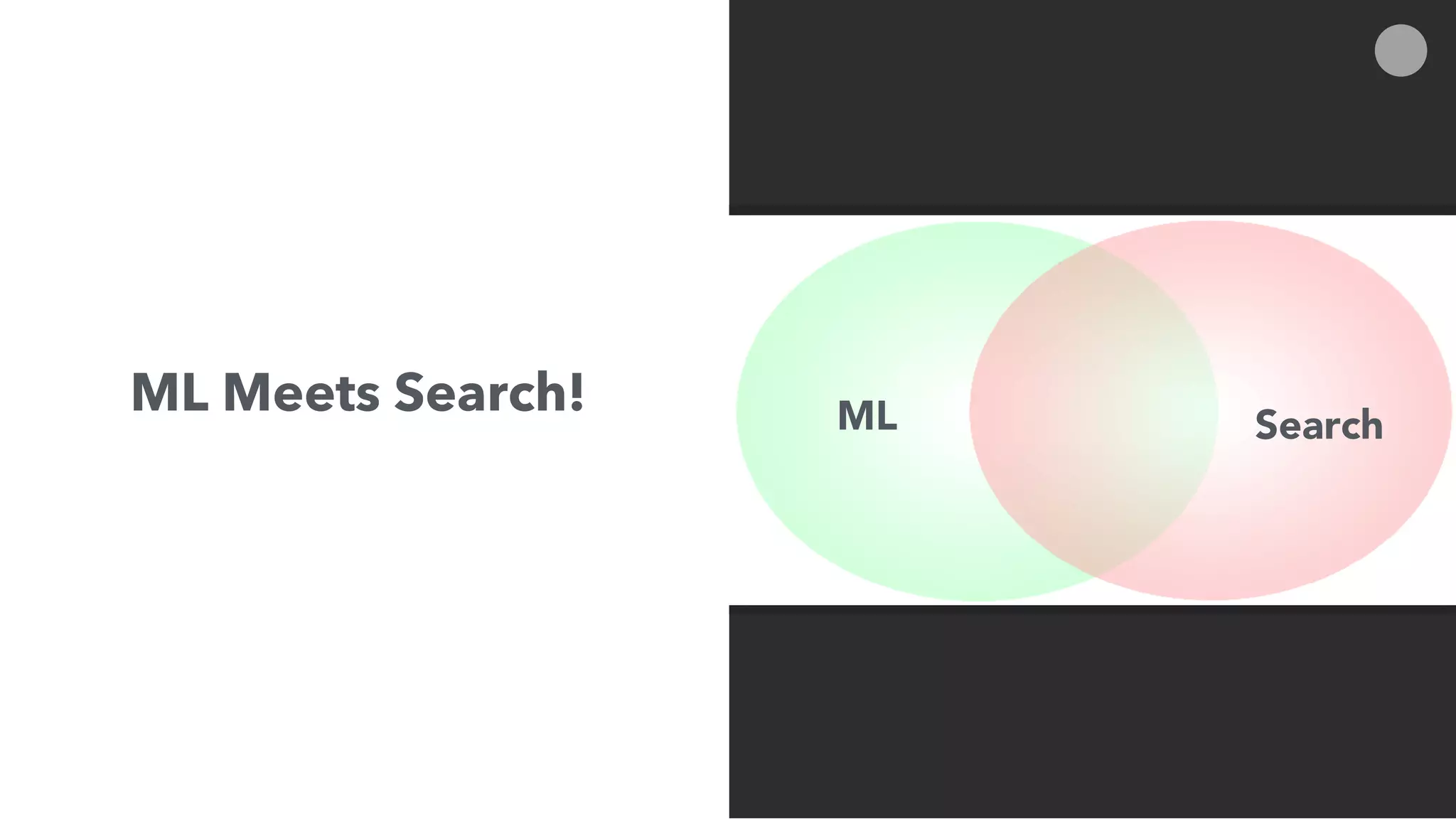
ML Meets Search! ML Search
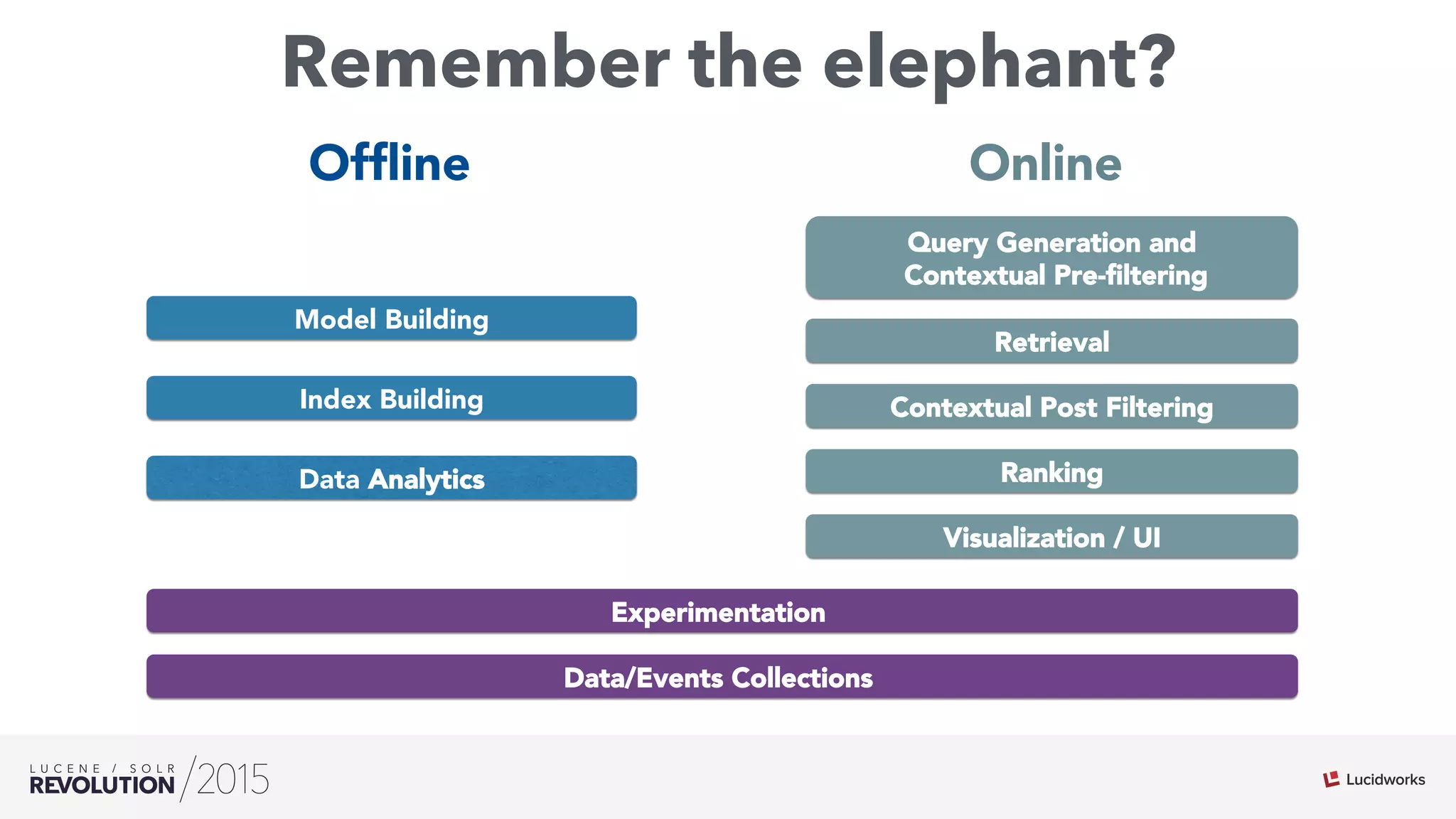
Remember the elephant?
Visualization / UI
Retrieval
Ranking
Query Generation and
Contextual Pre-filtering
Model Building
Index Building
Data/Events Collections
Data Analytics
Contextual Post Filtering
OnlineOffline
Experimentation
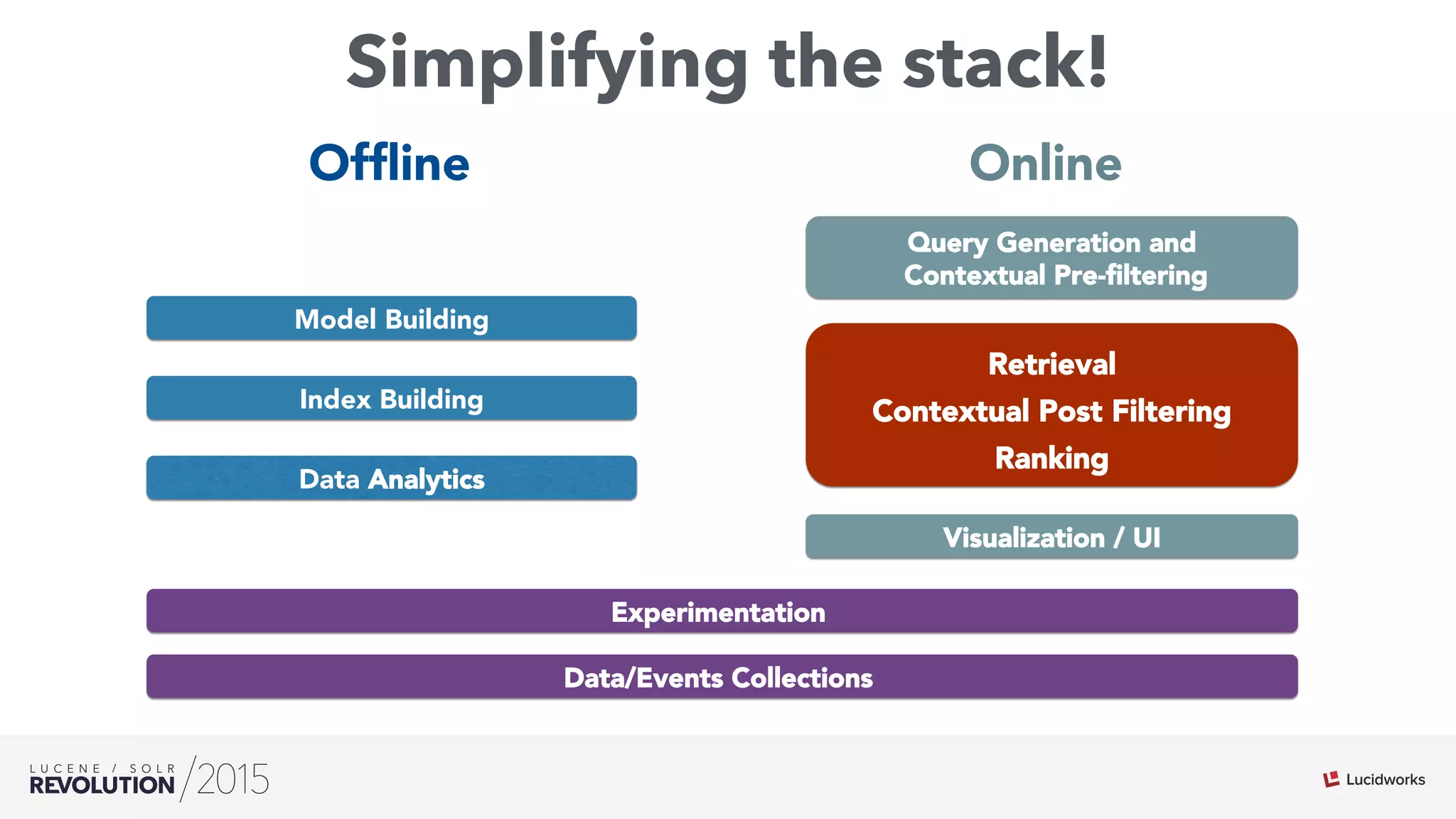
Simplifying the stack!
Visualization / UI
Query Generation and
Contextual Pre-filtering
Model Building
Index Building
Data/Events Collections
Data Analytics
OnlineOffline
Experimentation
Retrieval
Contextual Post Filtering
Ranking
Search stack
Matched Hits
Representation
Function
Similarity
Calculation
Matched HitsDocuments
Representation
Function
Input Query
Matched HitsMatched HitsRetrieved Documents
Online
Processing
Offline
Processing
(*)RelevanceFeedback
Query Representation
Doc Representation Index
*Metadata Engineering
(*) Optional
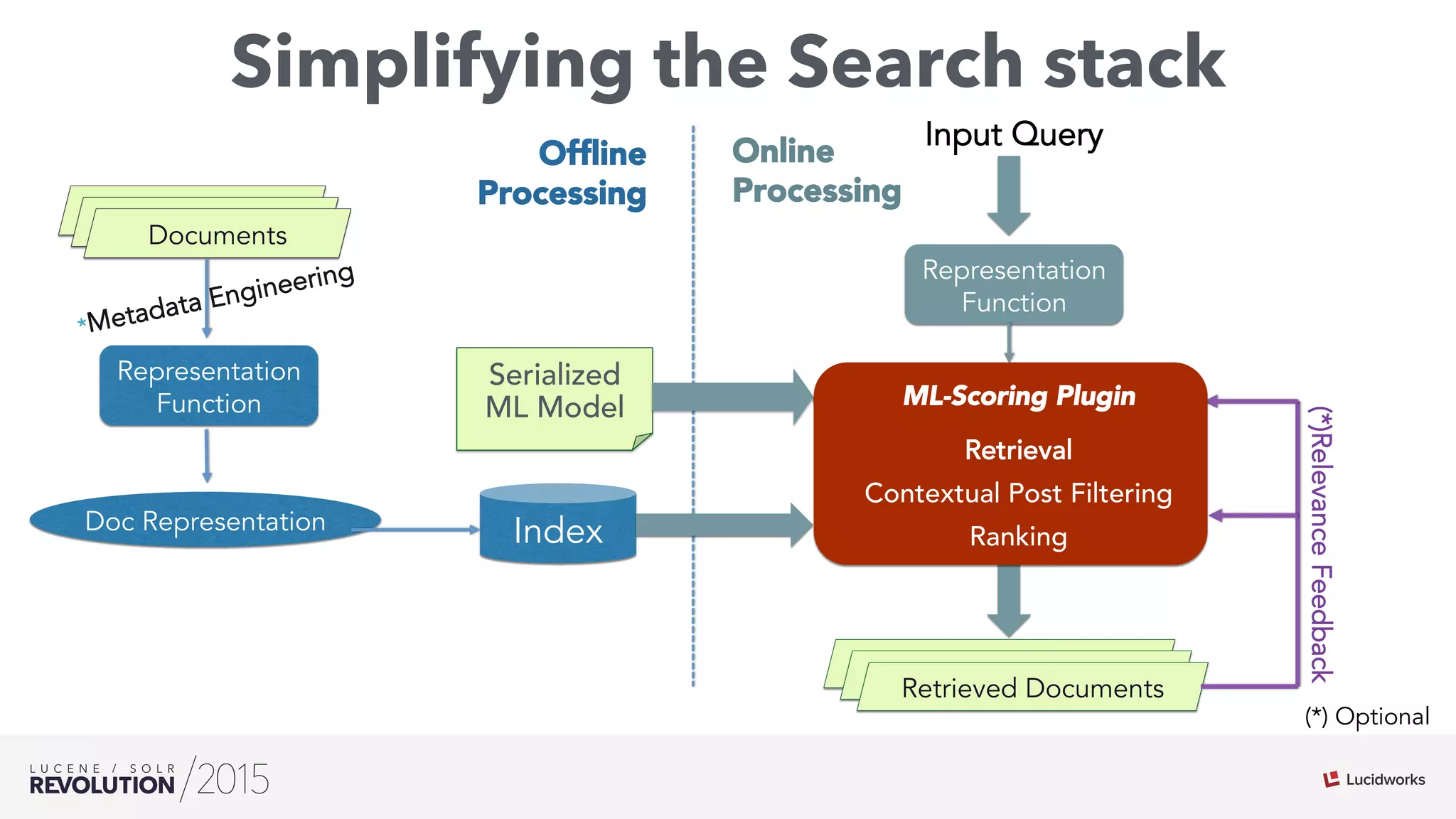
Simplifying the Search stack
Matched Hits
Representation
Function
Similarity
Calculation
Matched HitsDocuments
Representation
Function
Input Query
Matched HitsMatched HitsRetrieved Documents
Online
Processing
Offline
Processing
(*)RelevanceFeedback
Query Representation
Doc Representation Index
*Metadata Engineering
(*) Optional
Retrieval
Contextual Post Filtering
Ranking
ML-Scoring Plugin
Serialized
ML Model
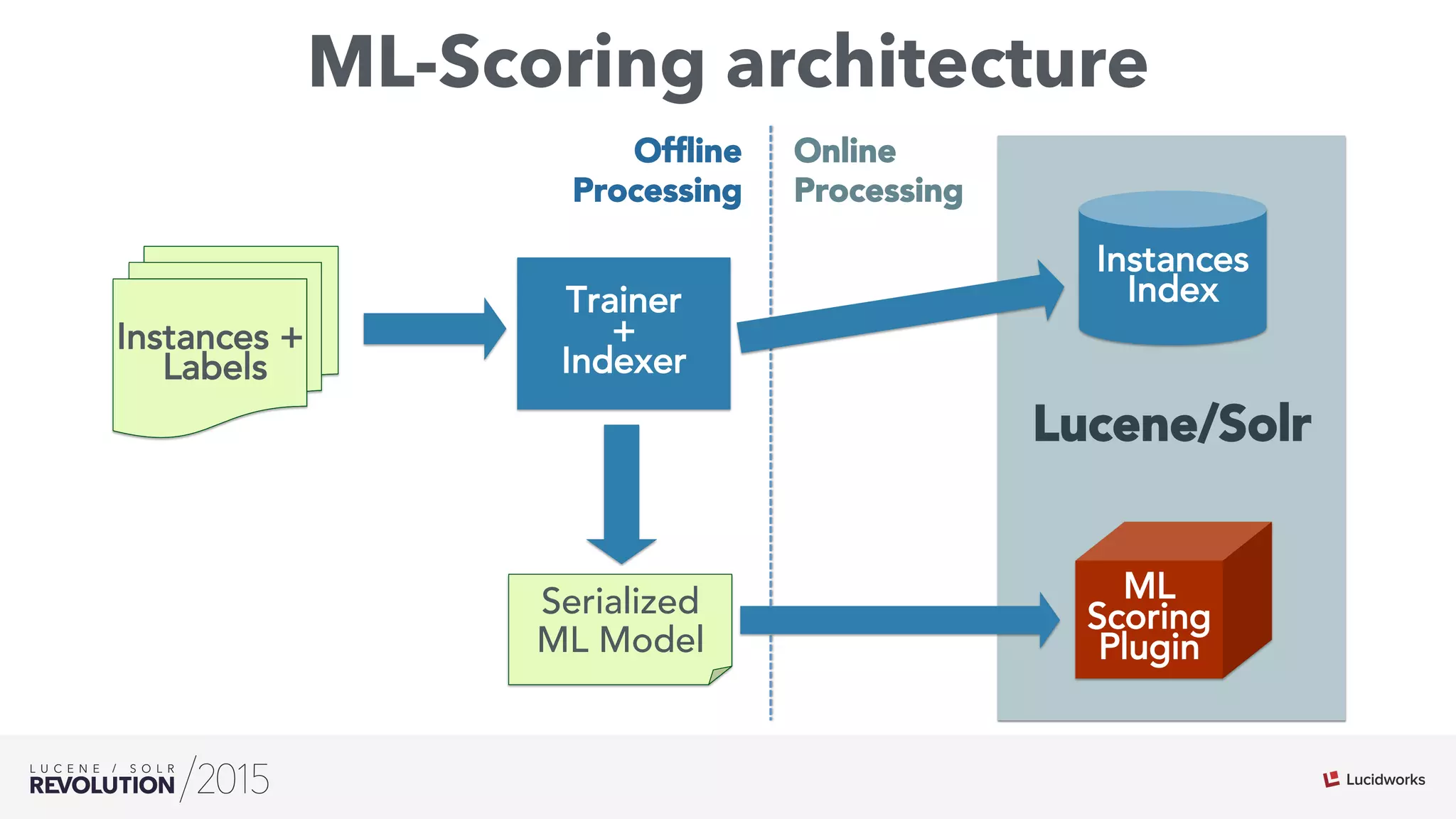
ML-Scoring architecture
Lucene/Solr
Instances +
Labels
Instances
Index
ML
Scoring
Plugin
Serialized
ML Model
Online
Processing
Offline
Processing
Trainer
+
Indexer
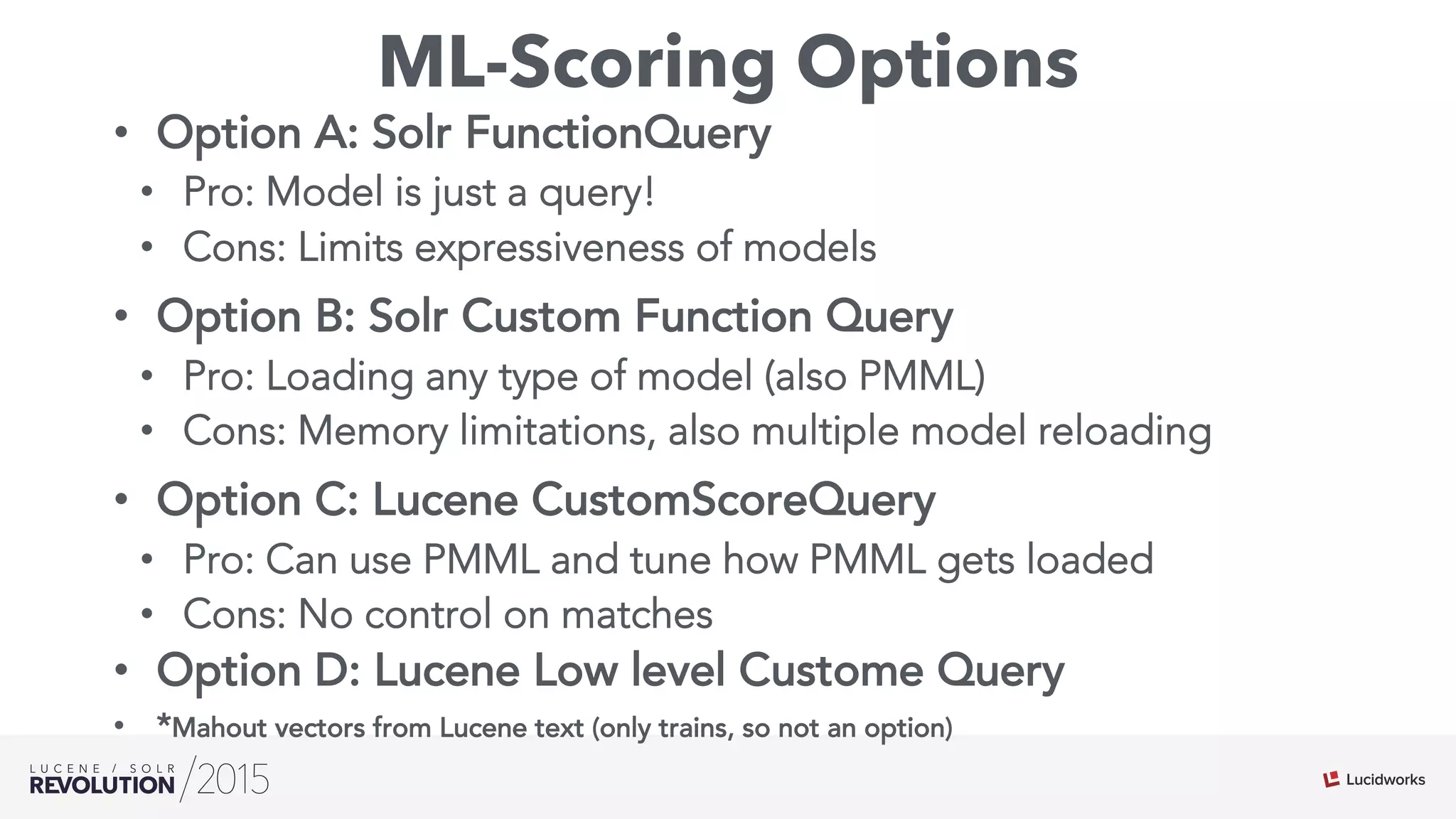
ML-Scoring Options
•  Option A: Solr FunctionQuery
•  Pro: Model is just a query!
•  Cons: Limits expressiveness of models
•  Option B: Solr Custom Function Query
•  Pro: Loading any type of model (also PMML)
•  Cons: Memory limitations, also multiple model reloading
•  Option C: Lucene CustomScoreQuery
•  Pro: Can use PMML and tune how PMML gets loaded
•  Cons: No control on matches
•  Option D: Lucene Low level Custome Query
•  *Mahout vectors from Lucene text (only trains, so not an option)
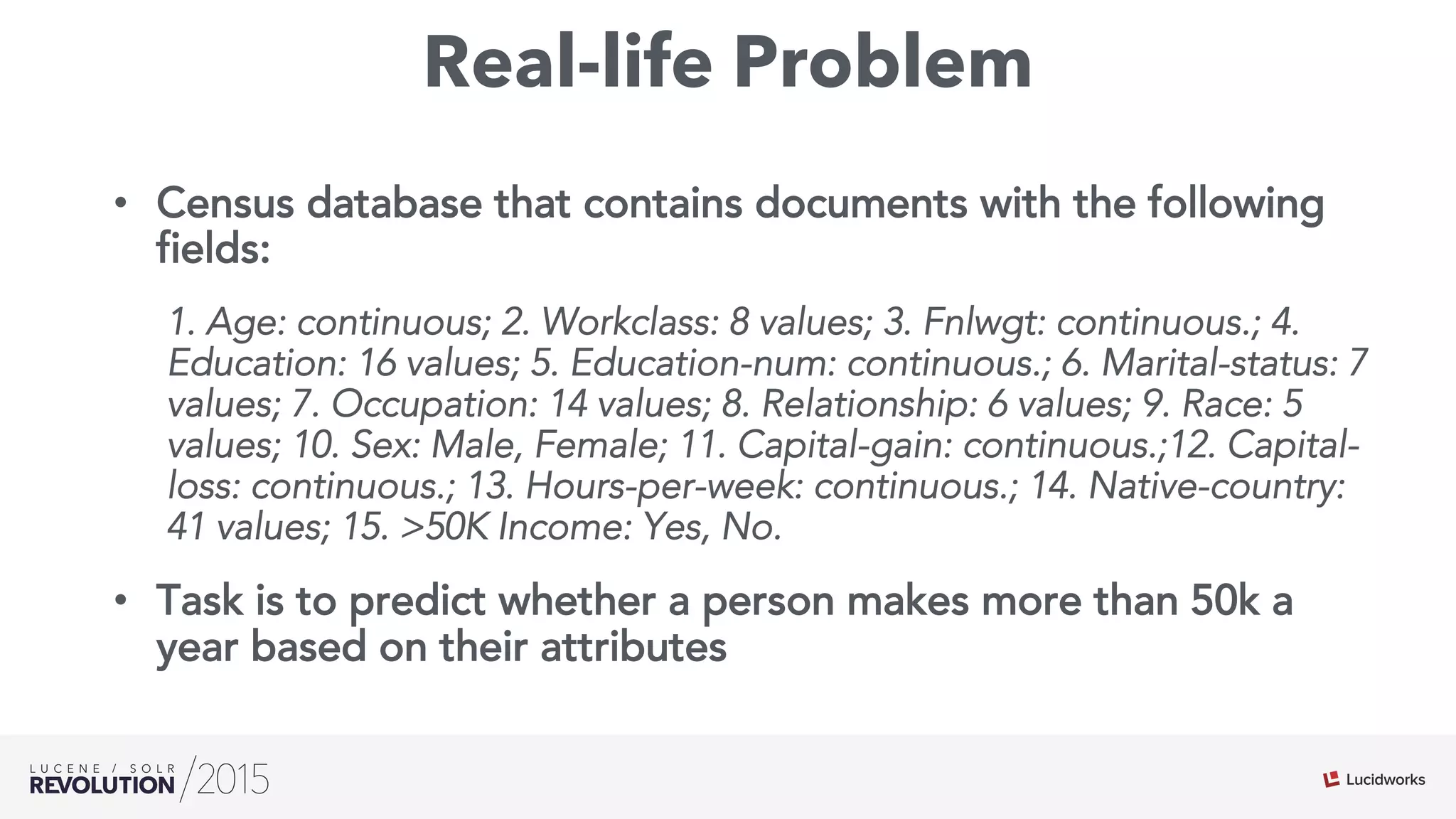
Real-life Problem
•  Census database that contains documents with the following
fields:
1. Age: continuous; 2. Workclass: 8 values; 3. Fnlwgt: continuous.; 4.
Education: 16 values; 5. Education-num: continuous.; 6. Marital-status: 7
values; 7. Occupation: 14 values; 8. Relationship: 6 values; 9. Race: 5
values; 10. Sex: Male, Female; 11. Capital-gain: continuous.;12. Capital-
loss: continuous.; 13. Hours-per-week: continuous.; 14. Native-country:
41 values; 15. >50K Income: Yes, No.
•  Task is to predict whether a person makes more than 50k a
year based on their attributes
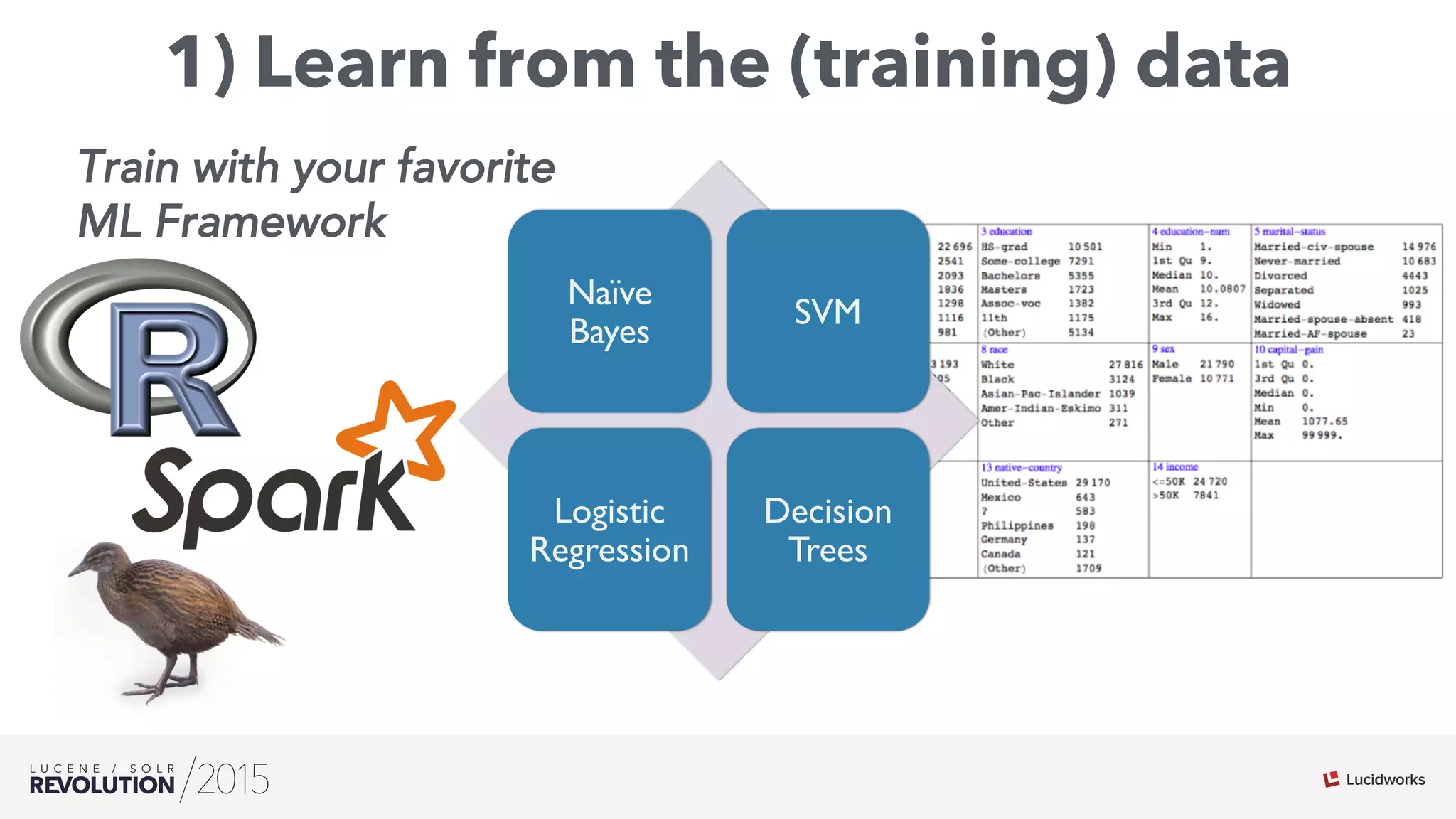
1) Learn from the (training) data
Naïve
Bayes
SVM
Logistic
Regression
Decision
Trees
Train with your favorite
ML Framework
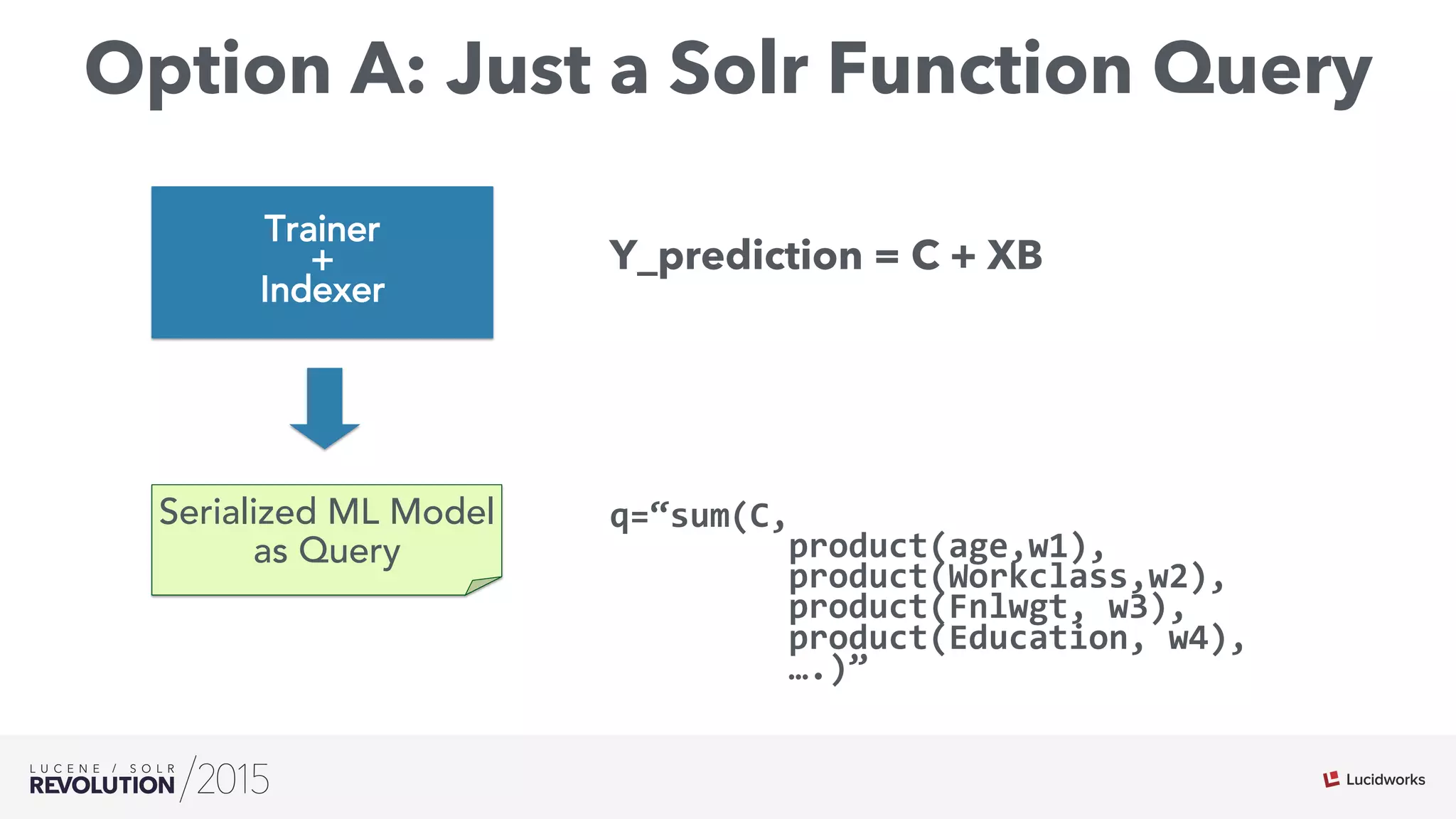
Option A: Just a Solr Function Query
q=“sum(C,	


  product(age,w1),	


  product(Workclass,w2),	


  product(Fnlwgt,	
  w3),	


  product(Education,	
  w4),	


  ….)”	
  
Serialized ML Model
as Query
Trainer
+
Indexer
Y_prediction = C + XB
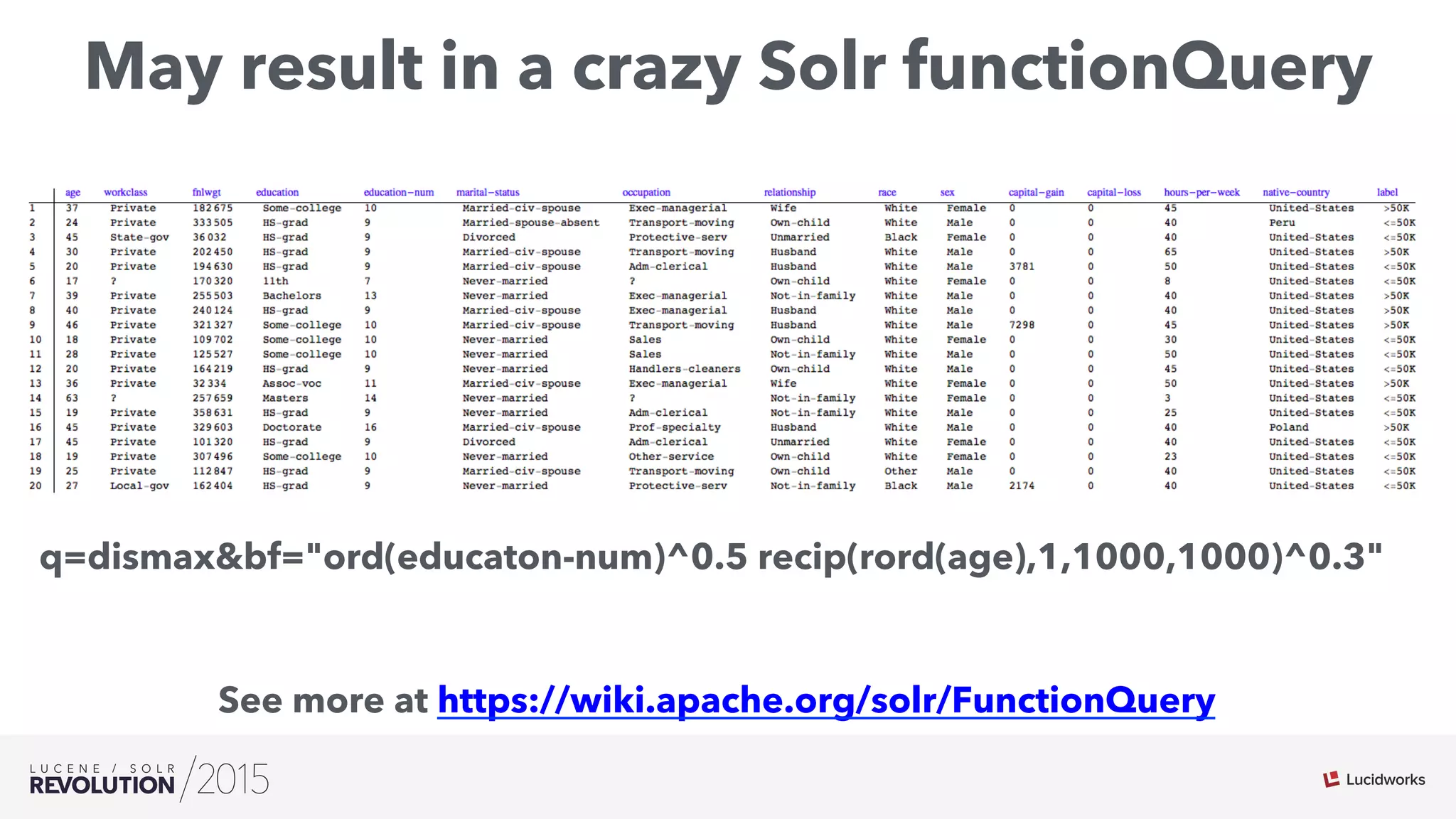
May result in a crazy Solr functionQuery
See more at https://wiki.apache.org/solr/FunctionQuery
q=dismax&bf="ord(educaton-num)^0.5 recip(rord(age),1,1000,1000)^0.3"
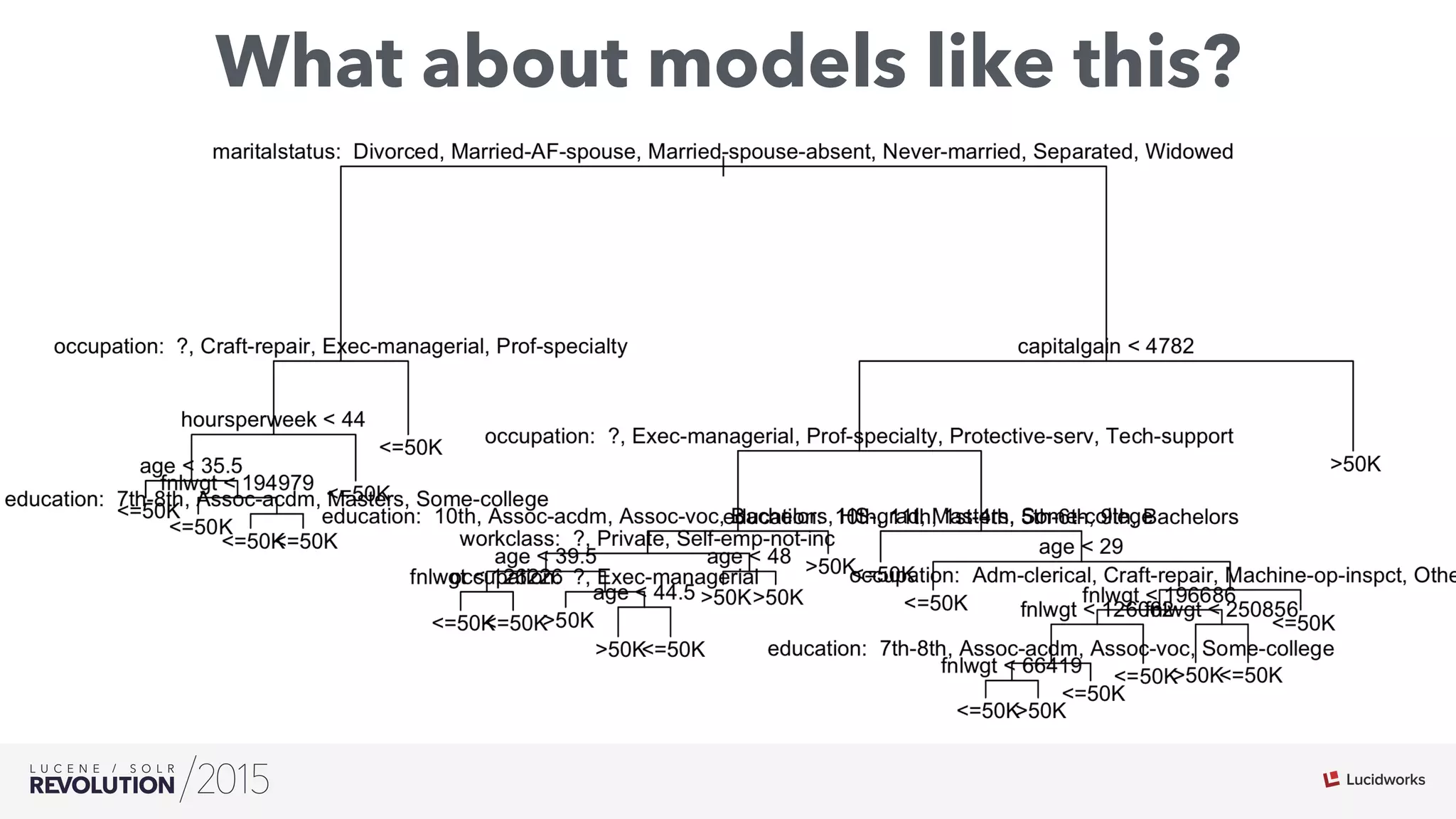
What about models like this?
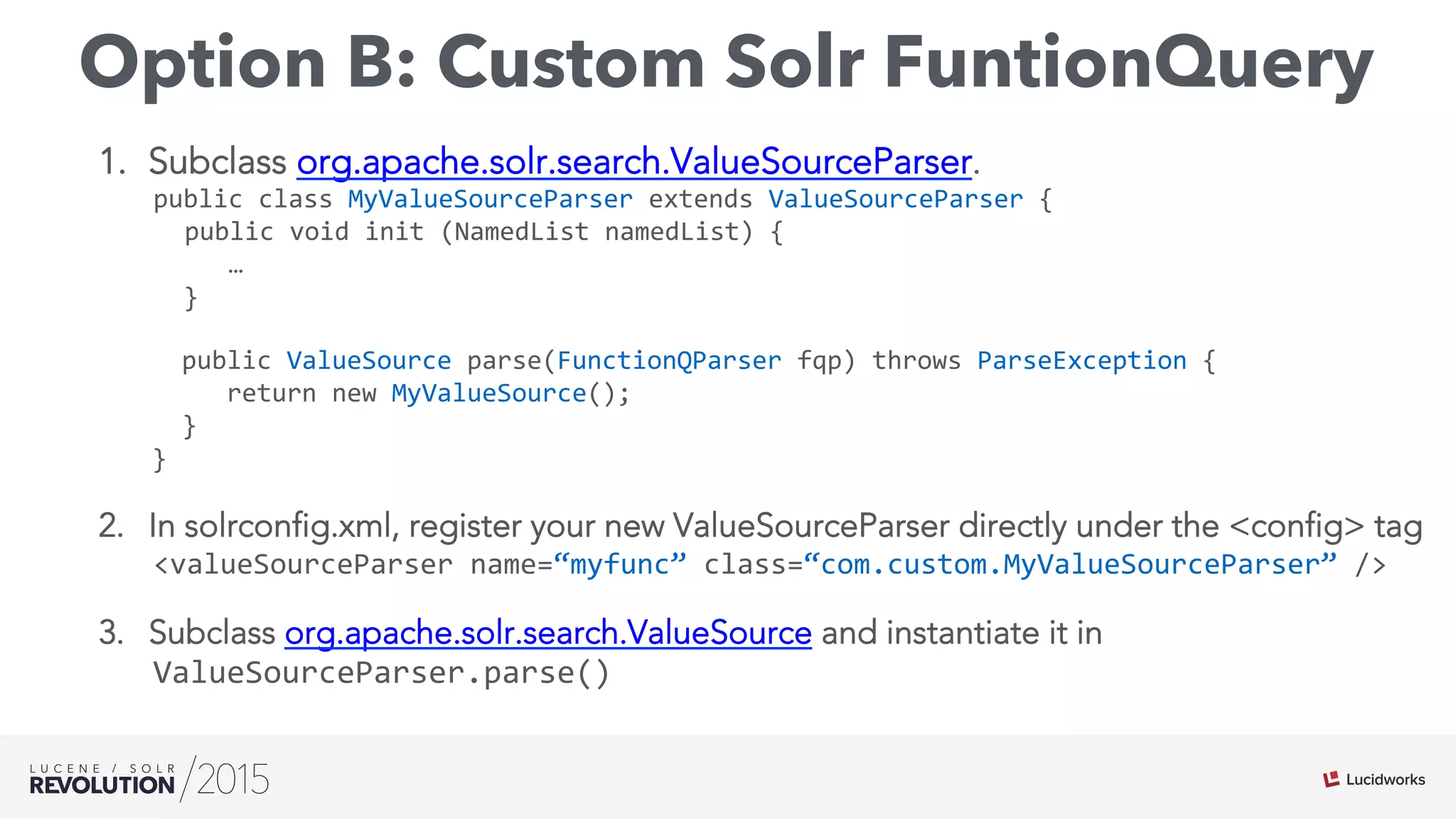
Option B: Custom Solr FuntionQuery
1.  Subclass org.apache.solr.search.ValueSourceParser.
public	
  class	
  MyValueSourceParser	
  extends	
  ValueSourceParser	
  {	
  
	
  public	
  void	
  init	
  (NamedList	
  namedList)	
  {	


  …	


  }	


  public	
  ValueSource	
  parse(FunctionQParser	
  fqp)	
  throws	
  ParseException	
  {	


  return	
  new	
  MyValueSource();	


  }	
  
}
2.  In solrconfig.xml, register your new ValueSourceParser directly under the <config> tag
<valueSourceParser	
  name=“myfunc”	
  class=“com.custom.MyValueSourceParser”	
  />	
  
3.  Subclass org.apache.solr.search.ValueSource and instantiate it in
ValueSourceParser.parse()
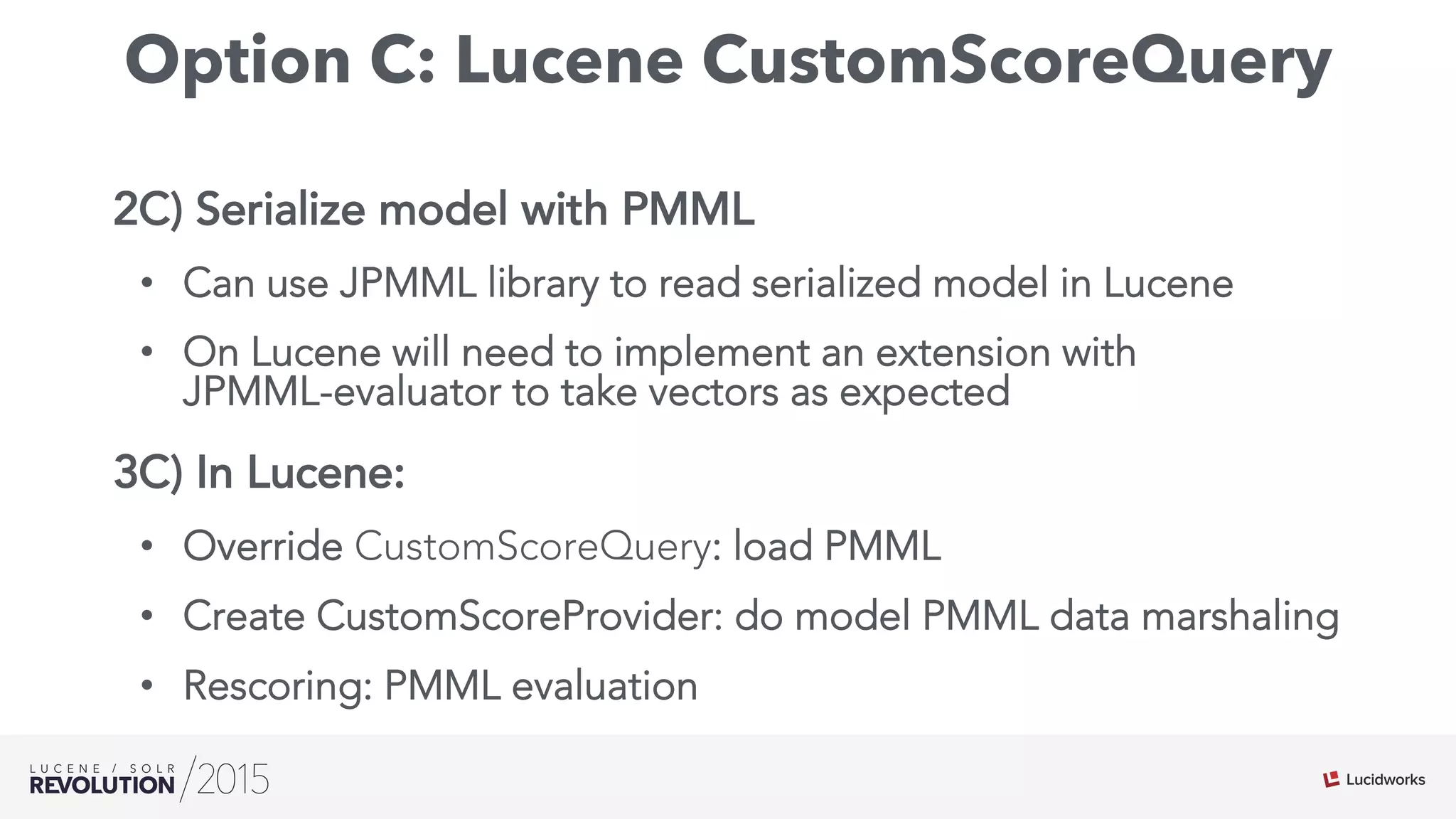
Option C: Lucene CustomScoreQuery
2C) Serialize model with PMML
•  Can use JPMML library to read serialized model in Lucene
•  On Lucene will need to implement an extension with
JPMML-evaluator to take vectors as expected
3C) In Lucene:
•  Override CustomScoreQuery: load PMML
•  Create CustomScoreProvider: do model PMML data marshaling
•  Rescoring: PMML evaluation
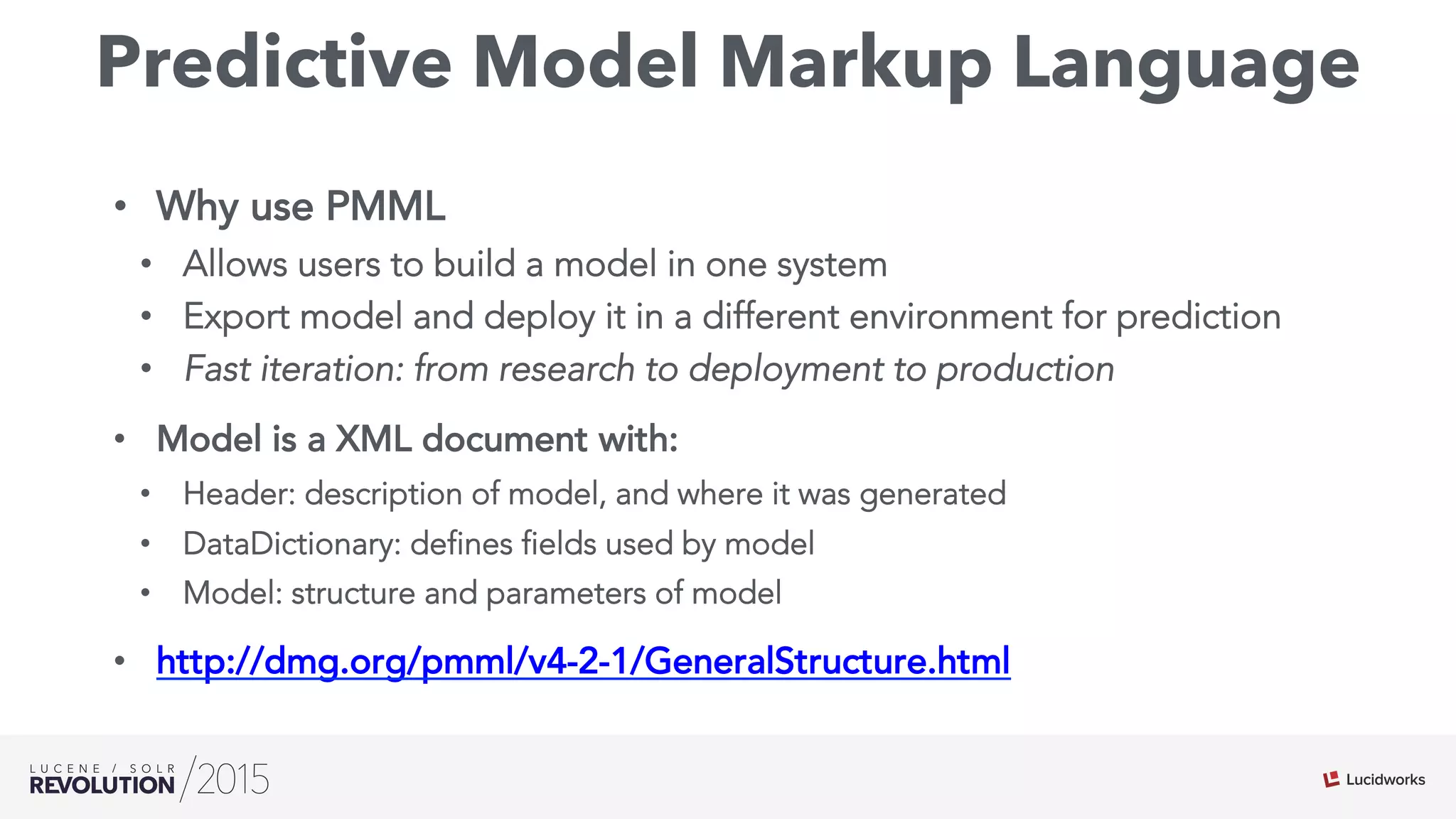
Predictive Model Markup Language
•  Why use PMML
•  Allows users to build a model in one system
•  Export model and deploy it in a different environment for prediction
•  Fast iteration: from research to deployment to production
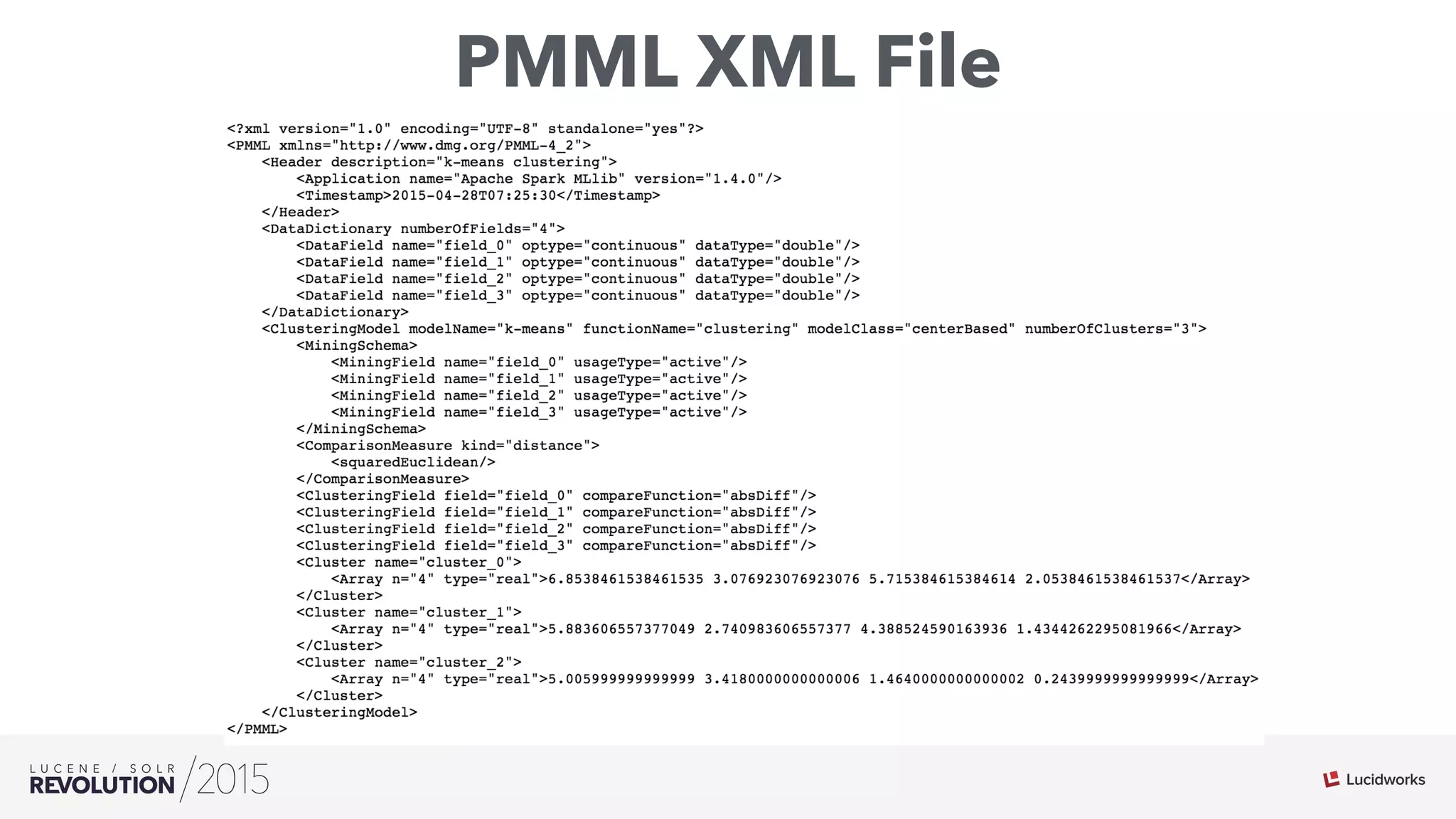
•  Model is a XML document with:
•  Header: description of model, and where it was generated
•  DataDictionary: defines fields used by model
•  Model: structure and parameters of model
•  http://dmg.org/pmml/v4-2-1/GeneralStructure.html
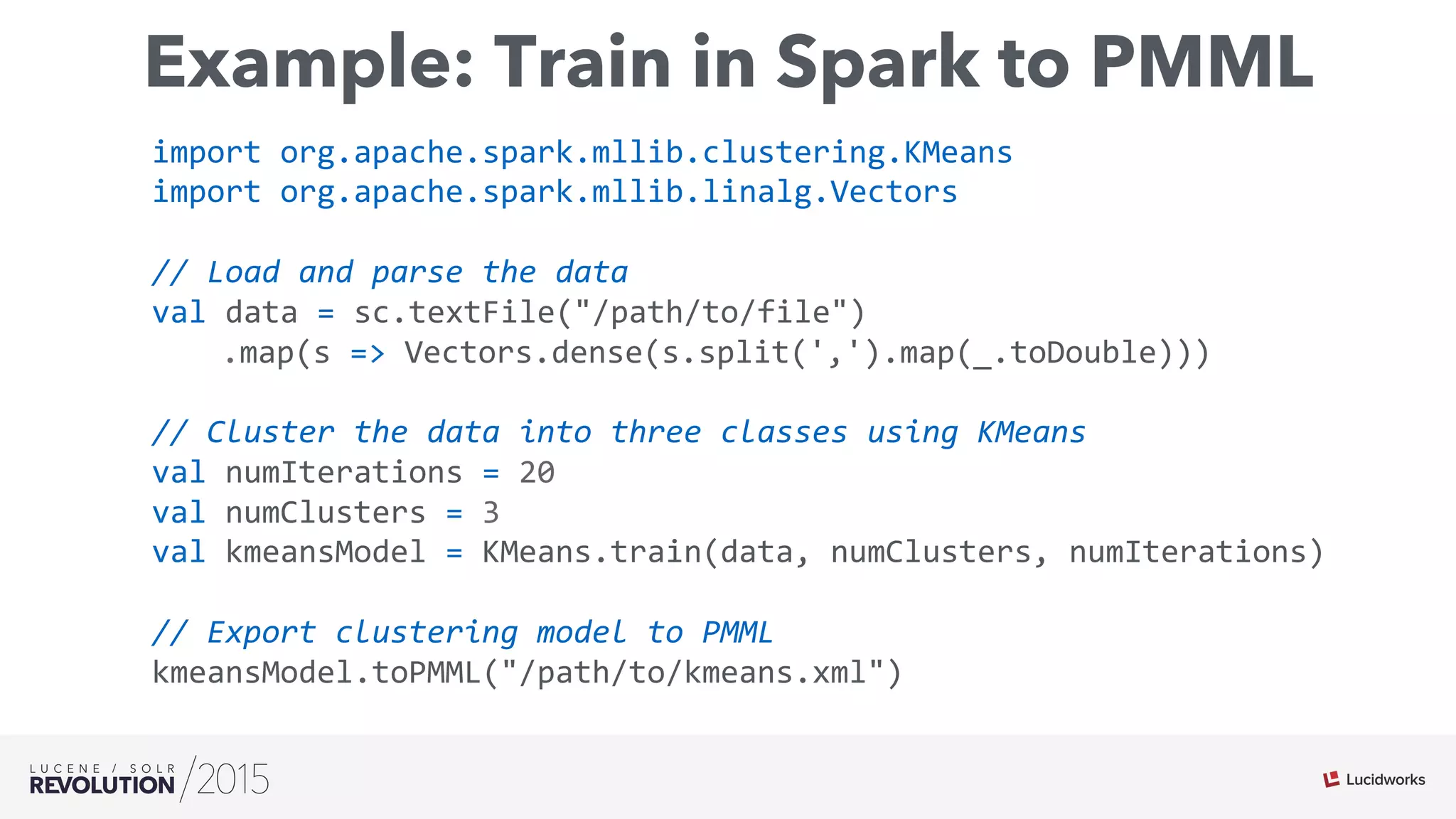
Example: Train in Spark to PMML
import	
  org.apache.spark.mllib.clustering.KMeans	
  	
  
import	
  org.apache.spark.mllib.linalg.Vectors	


//	
  Load	
  and	
  parse	
  the	
  data	
  	
  
val	
  data	
  =	
  sc.textFile("/path/to/file")	


  .map(s	
  =>	
  Vectors.dense(s.split(',').map(_.toDouble)))	


//	
  Cluster	
  the	
  data	
  into	
  three	
  classes	
  using	
  KMeans	
  	
  
val	
  numIterations	
  =	
  20	
  	
  
val	
  numClusters	
  =	
  3	
  	
  
val	
  kmeansModel	
  =	
  KMeans.train(data,	
  numClusters,	
  numIterations)	


//	
  Export	
  clustering	
  model	
  to	
  PMML	
  	
  
kmeansModel.toPMML("/path/to/kmeans.xml")	
  
PMML XML File
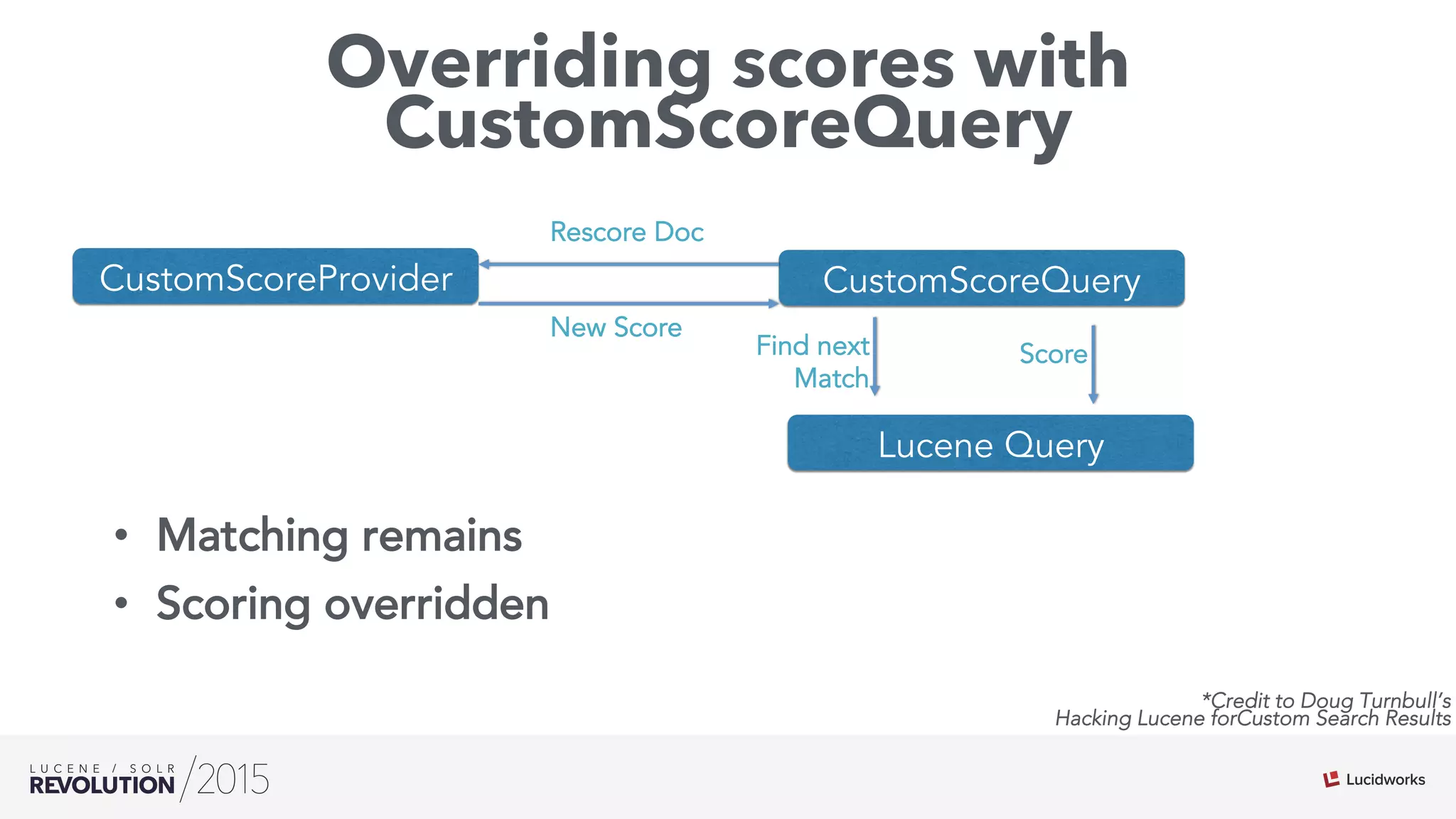
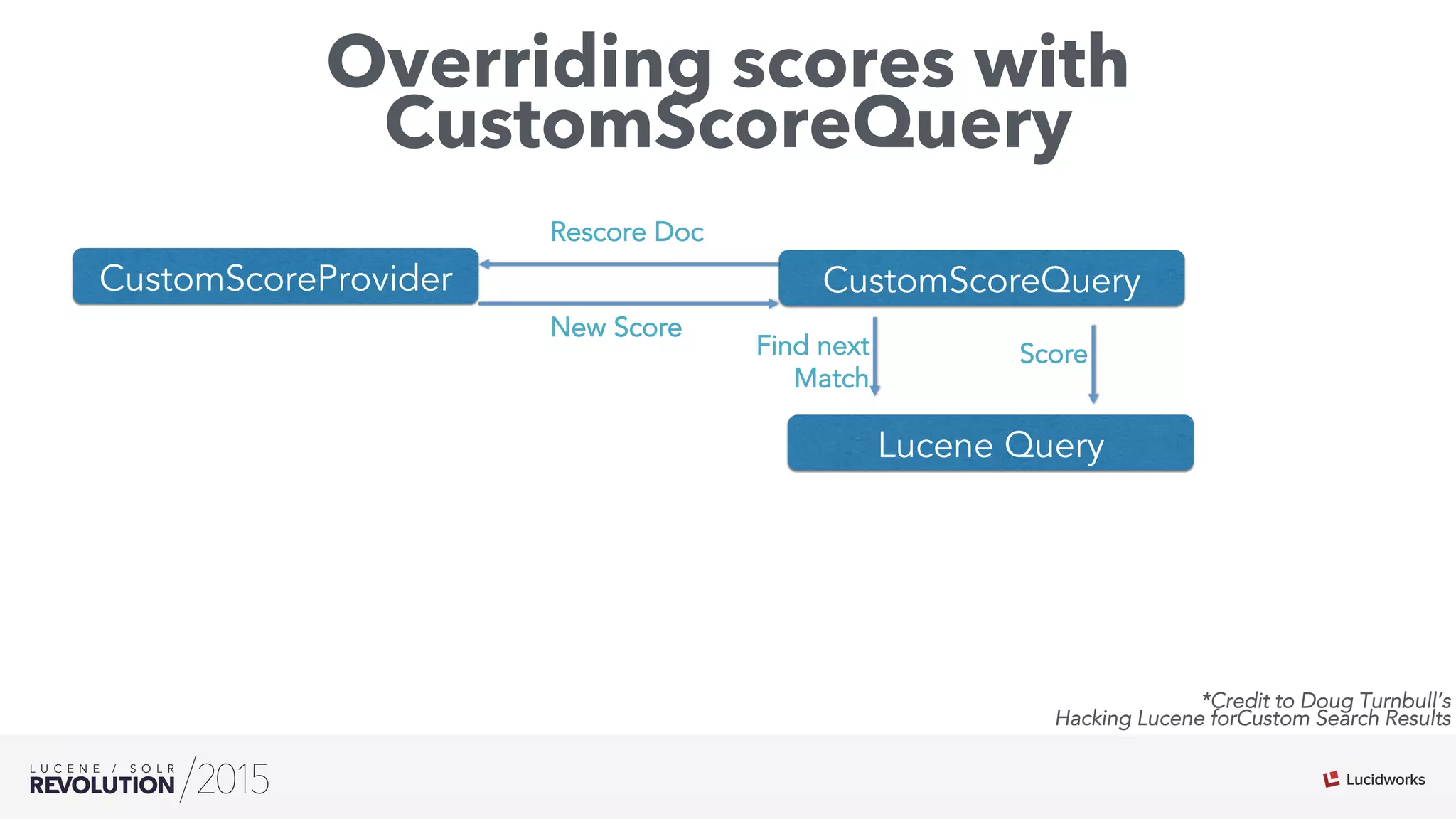
Overriding scores with
CustomScoreQuery
CustomScoreProvider CustomScoreQuery
Lucene Query
Find next
Match
Score
Rescore Doc
New Score
*Credit to Doug Turnbull’s
Hacking Lucene forCustom Search Results
Overriding scores with
CustomScoreQuery
•  Matching remains
•  Scoring overridden
CustomScoreProvider CustomScoreQuery
Lucene Query
Find next
Match
Score
Rescore Doc
New Score
*Credit to Doug Turnbull’s
Hacking Lucene forCustom Search Results
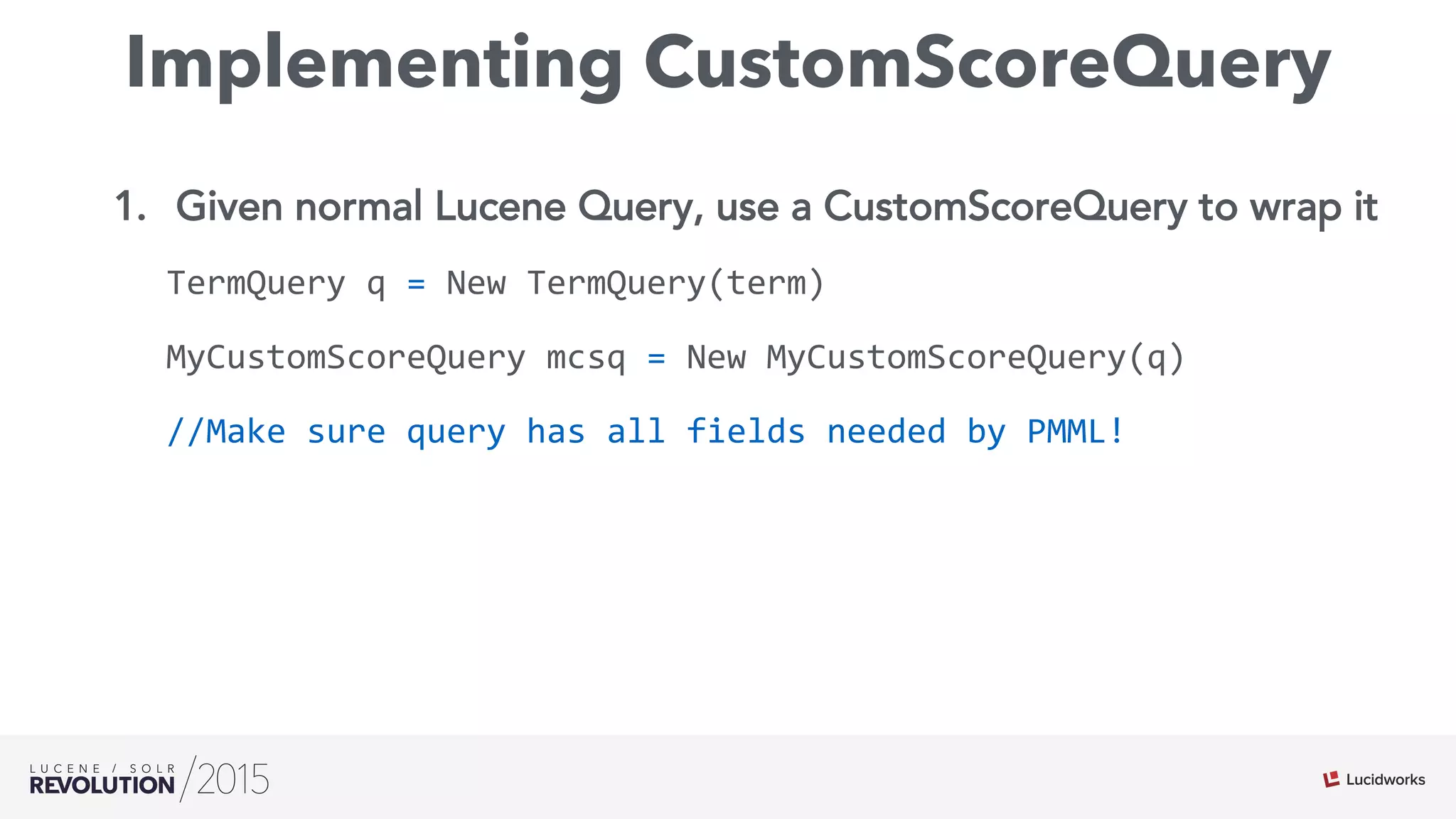
Implementing CustomScoreQuery
1.  Given normal Lucene Query, use a CustomScoreQuery to wrap it
TermQuery	
  q	
  =	
  New	
  TermQuery(term)	
  
MyCustomScoreQuery	
  mcsq	
  =	
  New	
  MyCustomScoreQuery(q)	
  
//Make	
  sure	
  query	
  has	
  all	
  fields	
  needed	
  by	
  PMML!
Implementing CustomScoreQuery
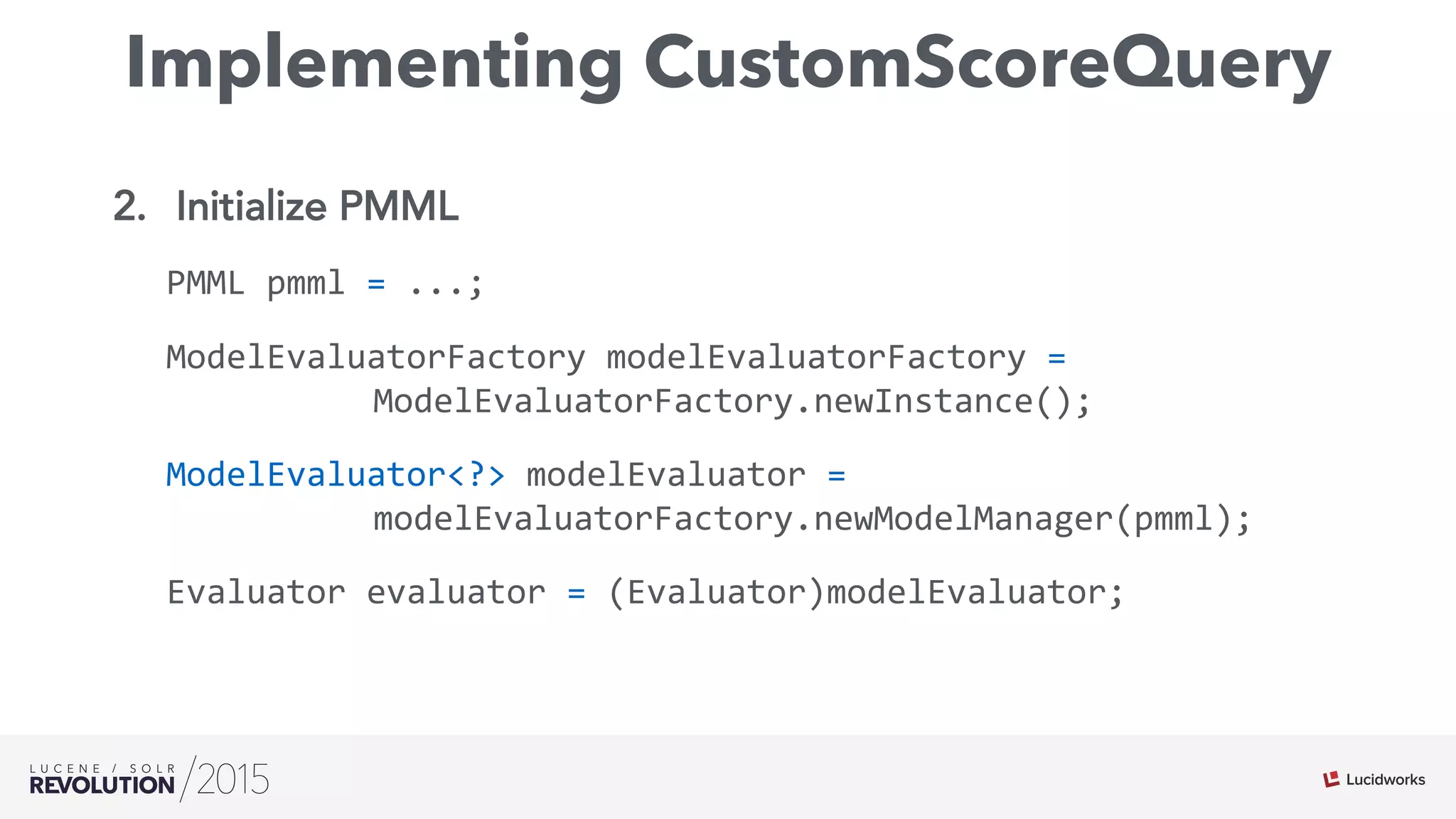
2.  Initialize PMML
PMML	
  pmml	
  =	
  ...;	
  
ModelEvaluatorFactory	
  modelEvaluatorFactory	
  =	


  ModelEvaluatorFactory.newInstance();	
  
ModelEvaluator<?>	
  modelEvaluator	
  =	


  modelEvaluatorFactory.newModelManager(pmml);	
  
Evaluator	
  evaluator	
  =	
  (Evaluator)modelEvaluator;	


Implementing CustomScoreQuery
2.  Rescore each doc with IndexReader and docID
public	
  float	
  customScore(int	
  doc,	
  float	
  subQueryScore,	
  float	
  
valSrcScores[])	
  throws	
  IOException	
  {	
  
//Lucene	
  reader	
  
IndexReader	
  r	
  =	
  context.reader();	
  
Terms	
  tv	
  =	
  r.getTermVector(doc,	
  _field);	
  
TermsEnum	
  tenum	
  =	
  null;	
  
tenum	
  =	
  tv.iterator(tenum);	


//convert	
  the	
  iterator	
  order	
  to	
  fields	
  needed	
  by	
  model	
  
TermsEnum	
  tenumPMML	
  =	
  tenum2PMML(tenum,	


  evaluator.getActiveFields());	


Implementing CustomScoreQuery
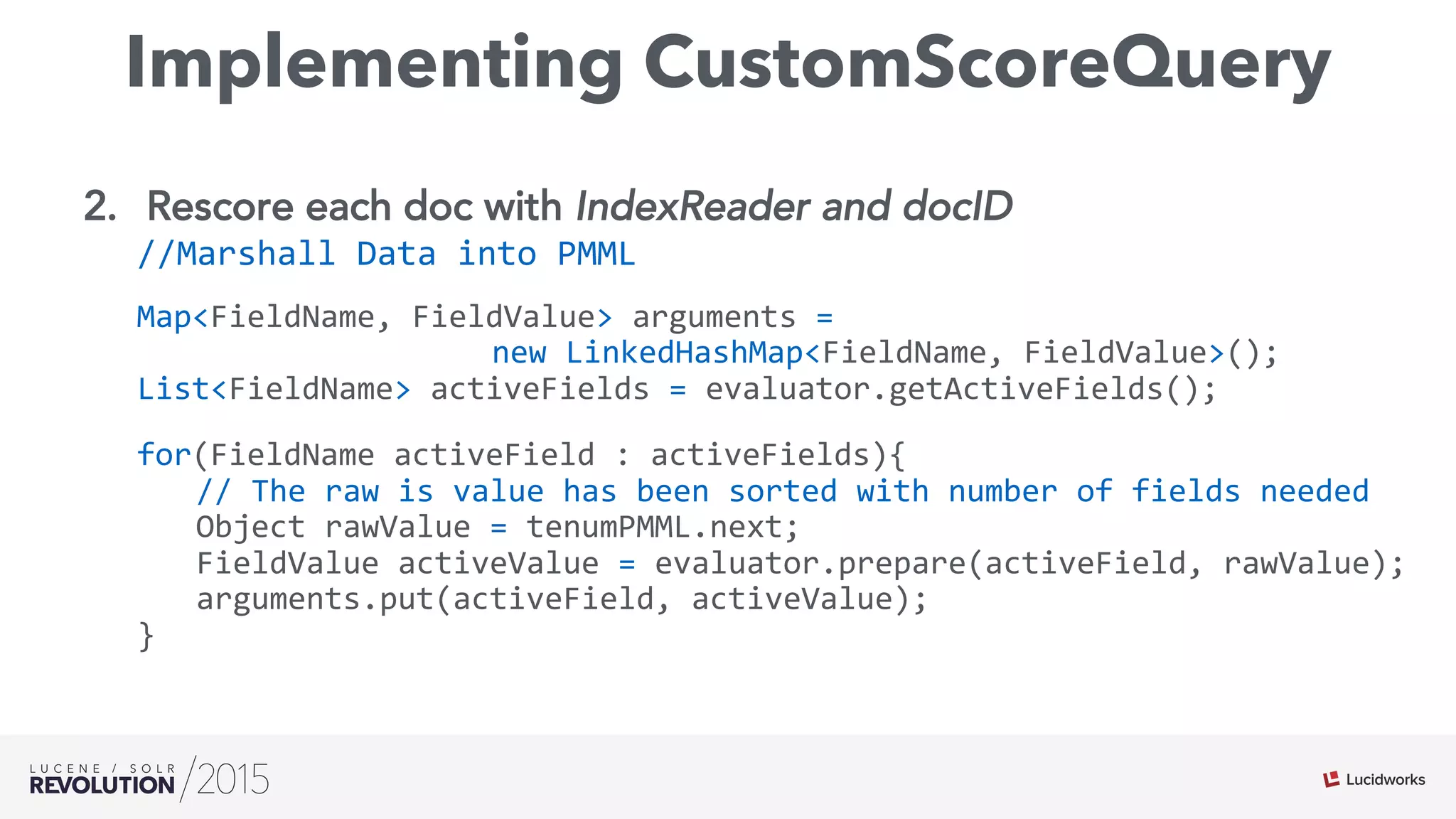
2.  Rescore each doc with IndexReader and docID
//Marshall	
  Data	
  into	
  PMML	
  
Map<FieldName,	
  FieldValue>	
  arguments	
  =	


  new	
  LinkedHashMap<FieldName,	
  FieldValue>();	
  
List<FieldName>	
  activeFields	
  =	
  evaluator.getActiveFields();	
  
for(FieldName	
  activeField	
  :	
  activeFields){	


  //	
  The	
  raw	
  is	
  value	
  has	
  been	
  sorted	
  with	
  number	
  of	
  fields	
  needed	


  Object	
  rawValue	
  =	
  tenumPMML.next;	


  FieldValue	
  activeValue	
  =	
  evaluator.prepare(activeField,	
  rawValue);	


  arguments.put(activeField,	
  activeValue);	
  
}	


Implementing CustomScoreQuery
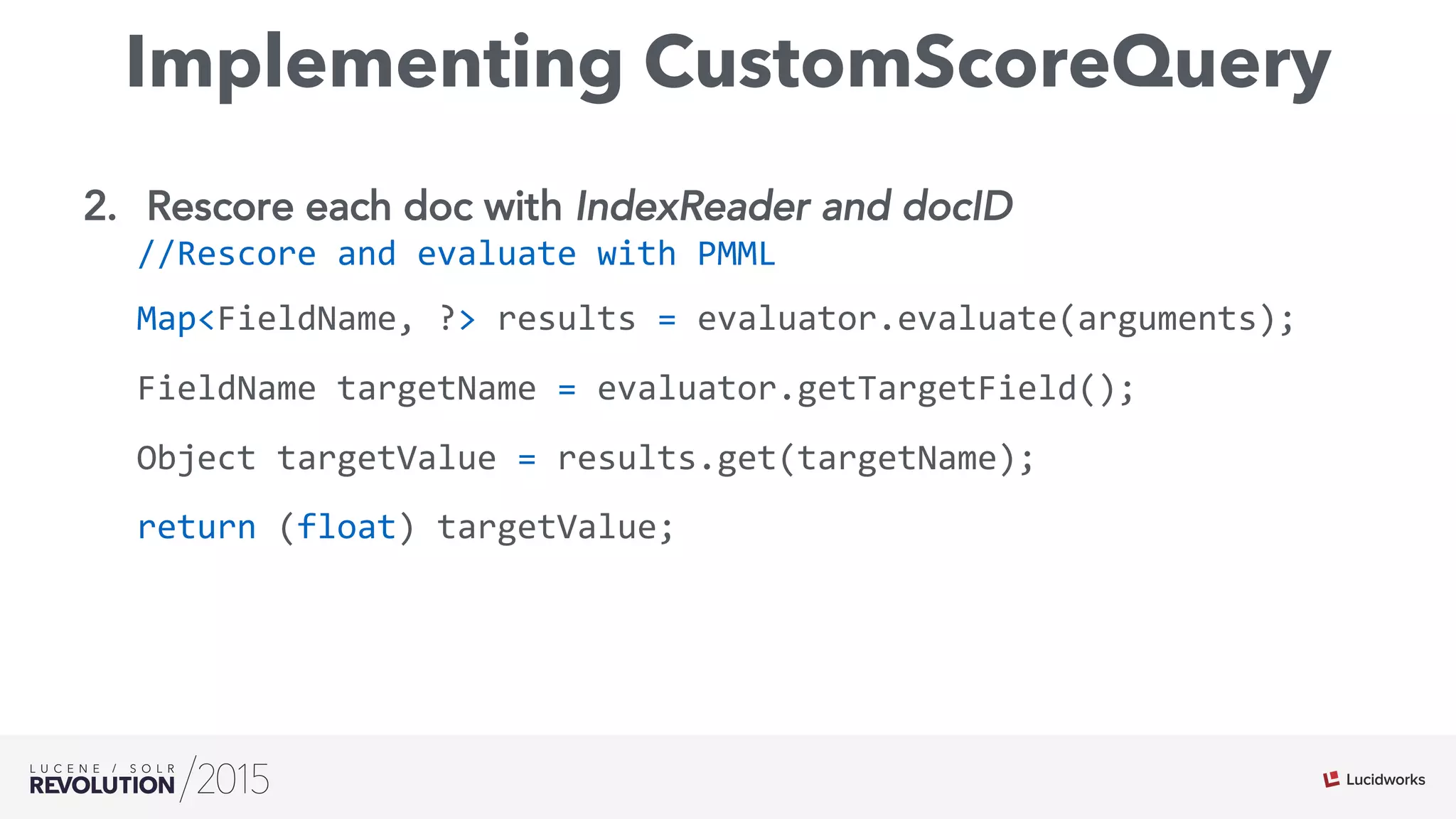
2.  Rescore each doc with IndexReader and docID
//Rescore	
  and	
  evaluate	
  with	
  PMML	
  
Map<FieldName,	
  ?>	
  results	
  =	
  evaluator.evaluate(arguments);	
  
FieldName	
  targetName	
  =	
  evaluator.getTargetField();	
  
Object	
  targetValue	
  =	
  results.get(targetName);	
  
return	
  (float)	
  targetValue;	


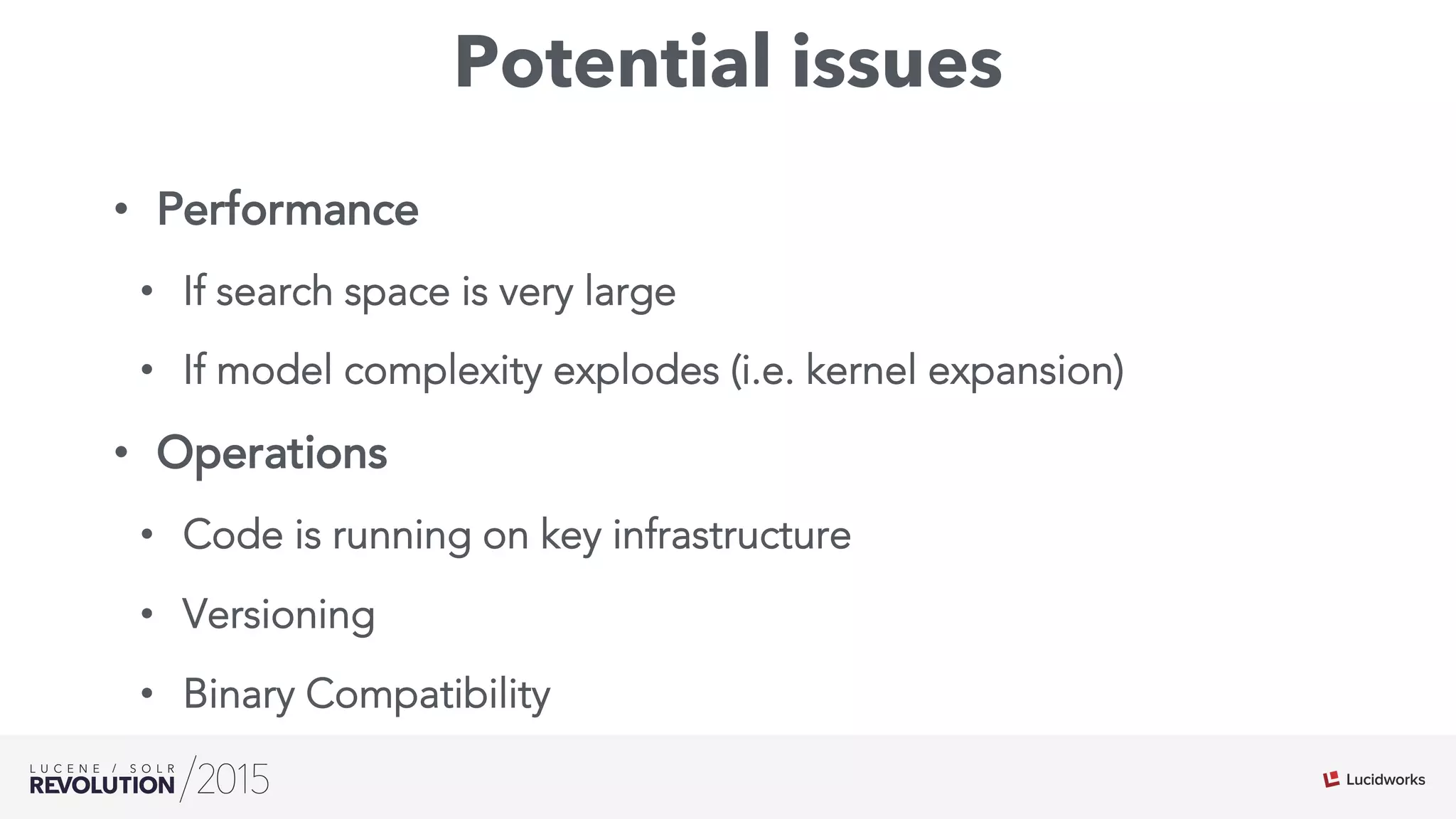
Potential issues
•  Performance
•  If search space is very large
•  If model complexity explodes (i.e. kernel expansion)
•  Operations
•  Code is running on key infrastructure
•  Versioning
•  Binary Compatibility
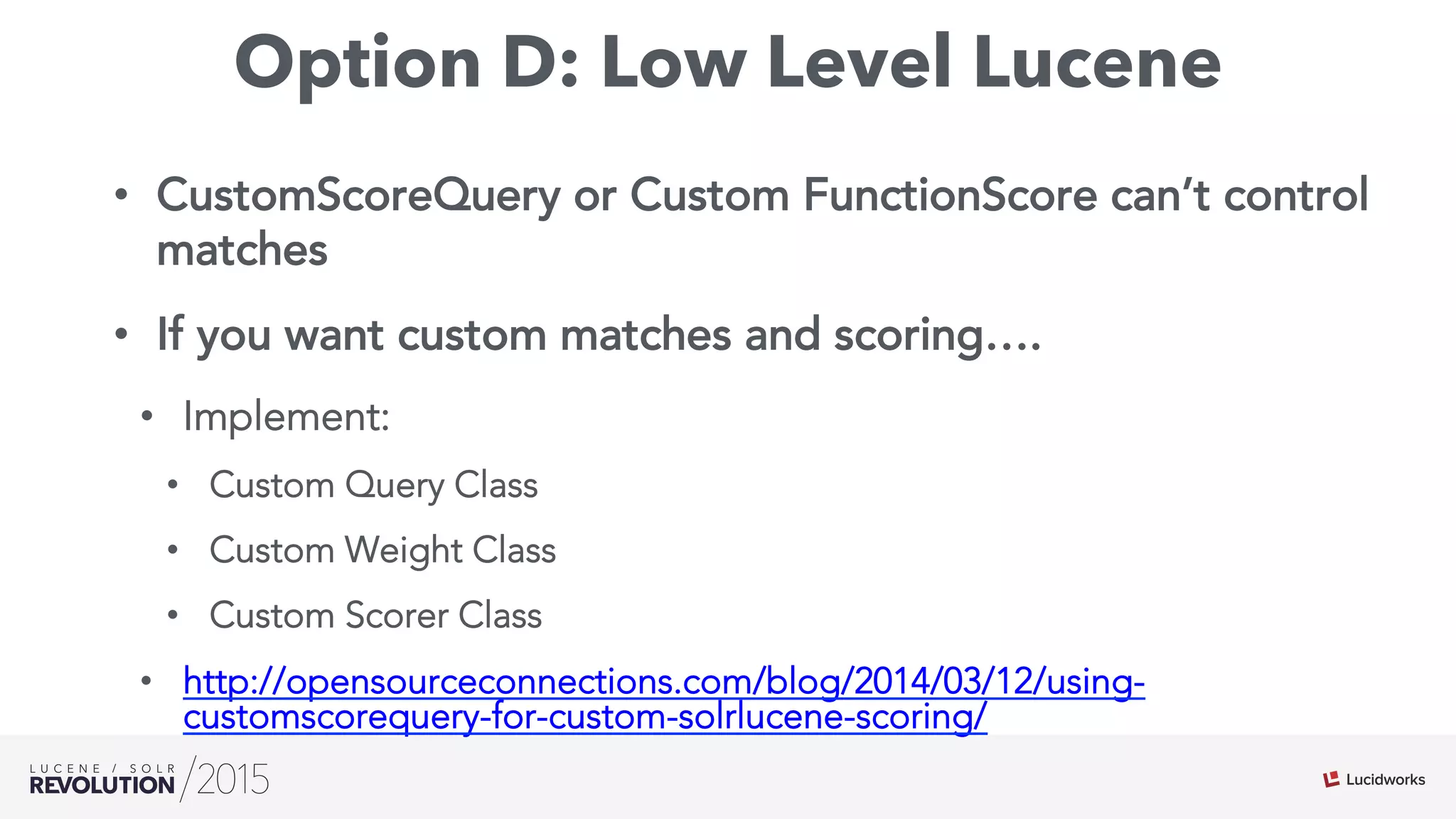
Option D: Low Level Lucene
•  CustomScoreQuery or Custom FunctionScore can’t control
matches
•  If you want custom matches and scoring….
•  Implement:
•  Custom Query Class
•  Custom Weight Class
•  Custom Scorer Class
•  http://opensourceconnections.com/blog/2014/03/12/using-
customscorequery-for-custom-solrlucene-scoring/
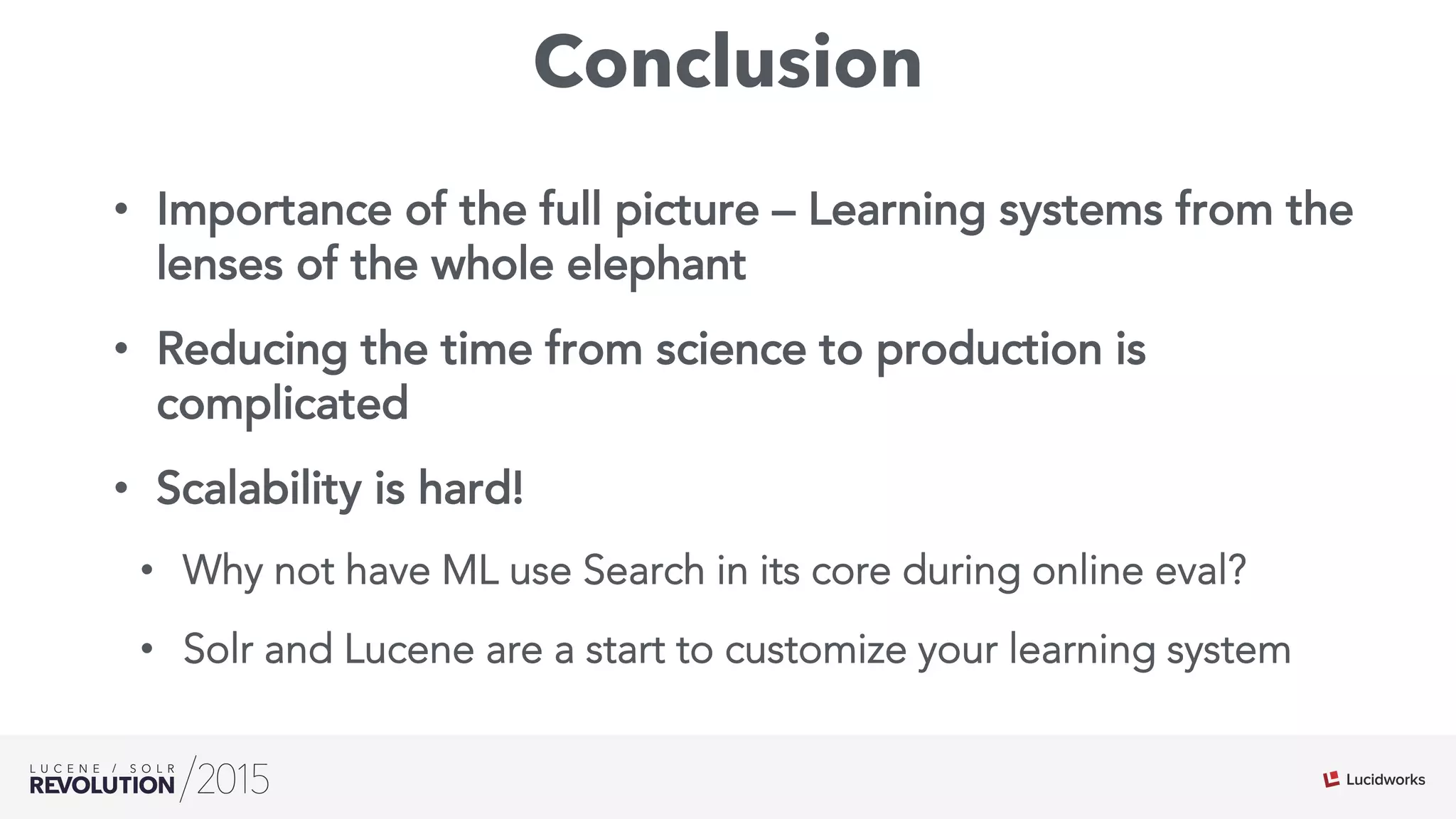
Conclusion
•  Importance of the full picture – Learning systems from the
lenses of the whole elephant
•  Reducing the time from science to production is
complicated
•  Scalability is hard!
•  Why not have ML use Search in its core during online eval?
•  Solr and Lucene are a start to customize your learning system
We are Hiring!
Contact me at
diana.hu@verizon.com
@sdianahu
Q&A
O C T O B E R 1 3 - 1 6 , 2 0 1 6 • A U S T I N , T X
Lucene/Solr Revolution 2015: Where Search Meets Machine Learning

Lucene/Solr Revolution 2015: Where Search Meets Machine Learning

  • 1.
    Where Search MeetsMachine Learning Diana Hu @sdianahu — Data Science Lead, Verizon Joaquin Delgado @joaquind — Director of Engineering, Verizon
  • 2.
    Disclaimer 2 The content ofthis presentation are of the authors’ personal statements and does not officially represent their employer’s view in anyway. Included content is especially not intended to convey the views of OnCue or Verizon 01
  • 3.
    Index 1.  Introduction 2.  Searchand Information Retrieval 3.  ML problems as Search-based Systems 4.  ML Meets Search!
  • 4.
  • 5.
    Scaling learning systemsis hard! •  Millions of users, items •  Billions of features •  Imbalanced Datasets •  Complex Distributed Systems •  Many algorithms have not been tested at “Internet Scale”
  • 6.
    Typical approaches •  Distributedsystems – Fault tolerance, Throughput vs. latency •  Parallelization Strategies – Hashing, trees •  Processing – Map reduce variants, MPI, graph parallel •  Databases – Key/Value Stores, NoSQL Such a custom system requires TLC
  • 7.
  • 8.
    Search Search is aboutfinding specific things that are either known or assumed to exist, Discovery is about is about helping the user encounter what he/she didn’t even know exists. •  Focused on Search: Search Engines, Database Systems •  Focused on Discovery: Recommender Systems, Advertising Predicate Logic and Declarative Languages Rock!
  • 9.
    Search stack Matched Hits Representation Function Similarity Calculation MatchedHitsDocuments Representation Function Input Query Matched HitsMatched HitsRetrieved Documents Online Processing Offline Processing (*)RelevanceFeedback Query Representation Doc Representation Index *Metadata Engineering (*) Optional
  • 10.
  • 11.
    Search Engines: thebig hammer •  Search engines are largely used to solve non-IR search problems, because: •  Widely Available •  Fast and Scalable •  Integrates well with existing data stores
  • 12.
    But… Are weusing the right tool? •  Search Engines were originally designed for IR. •  Complex non-IR search tasks sometimes require a two phase approach Phase1) Filter Phase 2) Rank
  • 13.
  • 14.
  • 15.
    Machine Learning Machine Learningin particular supervised learning refer to techniques used to learn how to classify or score previously unseen objects based on a training dataset Inference and Generalization are the Key!
  • 16.
  • 17.
    Learning systems’ stack Visualization/ UI Retrieval Ranking Query Generation and Contextual Pre-filtering Model Building Index Building Data/Events Collections Data Analytics Contextual Post Filtering OnlineOffline Experimentation
  • 18.
    Case study: RecommenderSystems •  Reduce information load by estimating relevance •  Ranking (aka Relevance) Approaches: •  Collaborative filtering •  Content Based •  Knowledge Based •  Hybrid •  Beyond rating prediction and ranking •  Business filtering logic •  Low latency and Scale
  • 19.
    RecSys: Content basedmodels •  Rec Task: Given a user profile find the best matching items by their attributes •  Similarity calculation: based on keyword overlap between user/items •  Neighborhood method (i.e. nearest neighbor) •  Query-based retrieval (i.e Rocchio’s method) •  Probabilistic methods (classical text classification) •  Explicit decision models •  Feature representation: based on content analysis •  Vector space model •  TF-IDF •  Topic Modeling
  • 20.
  • 21.
  • 22.
  • 23.
    Remember the elephant? Visualization/ UI Retrieval Ranking Query Generation and Contextual Pre-filtering Model Building Index Building Data/Events Collections Data Analytics Contextual Post Filtering OnlineOffline Experimentation
  • 24.
    Simplifying the stack! Visualization/ UI Query Generation and Contextual Pre-filtering Model Building Index Building Data/Events Collections Data Analytics OnlineOffline Experimentation Retrieval Contextual Post Filtering Ranking
  • 25.
    Search stack Matched Hits Representation Function Similarity Calculation MatchedHitsDocuments Representation Function Input Query Matched HitsMatched HitsRetrieved Documents Online Processing Offline Processing (*)RelevanceFeedback Query Representation Doc Representation Index *Metadata Engineering (*) Optional
  • 26.
    Simplifying the Searchstack Matched Hits Representation Function Similarity Calculation Matched HitsDocuments Representation Function Input Query Matched HitsMatched HitsRetrieved Documents Online Processing Offline Processing (*)RelevanceFeedback Query Representation Doc Representation Index *Metadata Engineering (*) Optional Retrieval Contextual Post Filtering Ranking ML-Scoring Plugin Serialized ML Model
  • 27.
  • 28.
    ML-Scoring Options •  OptionA: Solr FunctionQuery •  Pro: Model is just a query! •  Cons: Limits expressiveness of models •  Option B: Solr Custom Function Query •  Pro: Loading any type of model (also PMML) •  Cons: Memory limitations, also multiple model reloading •  Option C: Lucene CustomScoreQuery •  Pro: Can use PMML and tune how PMML gets loaded •  Cons: No control on matches •  Option D: Lucene Low level Custome Query •  *Mahout vectors from Lucene text (only trains, so not an option)
  • 29.
    Real-life Problem •  Censusdatabase that contains documents with the following fields: 1. Age: continuous; 2. Workclass: 8 values; 3. Fnlwgt: continuous.; 4. Education: 16 values; 5. Education-num: continuous.; 6. Marital-status: 7 values; 7. Occupation: 14 values; 8. Relationship: 6 values; 9. Race: 5 values; 10. Sex: Male, Female; 11. Capital-gain: continuous.;12. Capital- loss: continuous.; 13. Hours-per-week: continuous.; 14. Native-country: 41 values; 15. >50K Income: Yes, No. •  Task is to predict whether a person makes more than 50k a year based on their attributes
  • 30.
    1) Learn fromthe (training) data Naïve Bayes SVM Logistic Regression Decision Trees Train with your favorite ML Framework
  • 31.
    Option A: Justa Solr Function Query q=“sum(C,              product(age,w1),              product(Workclass,w2),              product(Fnlwgt,  w3),              product(Education,  w4),              ….)”   Serialized ML Model as Query Trainer + Indexer Y_prediction = C + XB
  • 32.
    May result ina crazy Solr functionQuery See more at https://wiki.apache.org/solr/FunctionQuery q=dismax&bf="ord(educaton-num)^0.5 recip(rord(age),1,1000,1000)^0.3"
  • 33.
  • 34.
    Option B: CustomSolr FuntionQuery 1.  Subclass org.apache.solr.search.ValueSourceParser. public  class  MyValueSourceParser  extends  ValueSourceParser  {    public  void  init  (NamedList  namedList)  {            …      }      public  ValueSource  parse(FunctionQParser  fqp)  throws  ParseException  {            return  new  MyValueSource();      }   } 2.  In solrconfig.xml, register your new ValueSourceParser directly under the <config> tag <valueSourceParser  name=“myfunc”  class=“com.custom.MyValueSourceParser”  />   3.  Subclass org.apache.solr.search.ValueSource and instantiate it in ValueSourceParser.parse()
  • 35.
    Option C: LuceneCustomScoreQuery 2C) Serialize model with PMML •  Can use JPMML library to read serialized model in Lucene •  On Lucene will need to implement an extension with JPMML-evaluator to take vectors as expected 3C) In Lucene: •  Override CustomScoreQuery: load PMML •  Create CustomScoreProvider: do model PMML data marshaling •  Rescoring: PMML evaluation
  • 36.
    Predictive Model MarkupLanguage •  Why use PMML •  Allows users to build a model in one system •  Export model and deploy it in a different environment for prediction •  Fast iteration: from research to deployment to production •  Model is a XML document with: •  Header: description of model, and where it was generated •  DataDictionary: defines fields used by model •  Model: structure and parameters of model •  http://dmg.org/pmml/v4-2-1/GeneralStructure.html
  • 37.
    Example: Train inSpark to PMML import  org.apache.spark.mllib.clustering.KMeans     import  org.apache.spark.mllib.linalg.Vectors         //  Load  and  parse  the  data     val  data  =  sc.textFile("/path/to/file")            .map(s  =>  Vectors.dense(s.split(',').map(_.toDouble)))           //  Cluster  the  data  into  three  classes  using  KMeans     val  numIterations  =  20     val  numClusters  =  3     val  kmeansModel  =  KMeans.train(data,  numClusters,  numIterations)           //  Export  clustering  model  to  PMML     kmeansModel.toPMML("/path/to/kmeans.xml")  
  • 38.
  • 39.
    Overriding scores with CustomScoreQuery CustomScoreProviderCustomScoreQuery Lucene Query Find next Match Score Rescore Doc New Score *Credit to Doug Turnbull’s Hacking Lucene forCustom Search Results
  • 40.
    Overriding scores with CustomScoreQuery • Matching remains •  Scoring overridden CustomScoreProvider CustomScoreQuery Lucene Query Find next Match Score Rescore Doc New Score *Credit to Doug Turnbull’s Hacking Lucene forCustom Search Results
  • 41.
    Implementing CustomScoreQuery 1.  Givennormal Lucene Query, use a CustomScoreQuery to wrap it TermQuery  q  =  New  TermQuery(term)   MyCustomScoreQuery  mcsq  =  New  MyCustomScoreQuery(q)   //Make  sure  query  has  all  fields  needed  by  PMML!
  • 42.
    Implementing CustomScoreQuery 2.  InitializePMML PMML  pmml  =  ...;   ModelEvaluatorFactory  modelEvaluatorFactory  =              ModelEvaluatorFactory.newInstance();   ModelEvaluator<?>  modelEvaluator  =              modelEvaluatorFactory.newModelManager(pmml);   Evaluator  evaluator  =  (Evaluator)modelEvaluator;        
  • 43.
    Implementing CustomScoreQuery 2.  Rescoreeach doc with IndexReader and docID public  float  customScore(int  doc,  float  subQueryScore,  float   valSrcScores[])  throws  IOException  {   //Lucene  reader   IndexReader  r  =  context.reader();   Terms  tv  =  r.getTermVector(doc,  _field);   TermsEnum  tenum  =  null;   tenum  =  tv.iterator(tenum);           //convert  the  iterator  order  to  fields  needed  by  model   TermsEnum  tenumPMML  =  tenum2PMML(tenum,                        evaluator.getActiveFields());        
  • 44.
    Implementing CustomScoreQuery 2.  Rescoreeach doc with IndexReader and docID //Marshall  Data  into  PMML   Map<FieldName,  FieldValue>  arguments  =                    new  LinkedHashMap<FieldName,  FieldValue>();   List<FieldName>  activeFields  =  evaluator.getActiveFields();   for(FieldName  activeField  :  activeFields){      //  The  raw  is  value  has  been  sorted  with  number  of  fields  needed      Object  rawValue  =  tenumPMML.next;      FieldValue  activeValue  =  evaluator.prepare(activeField,  rawValue);      arguments.put(activeField,  activeValue);   }        
  • 45.
    Implementing CustomScoreQuery 2.  Rescoreeach doc with IndexReader and docID //Rescore  and  evaluate  with  PMML   Map<FieldName,  ?>  results  =  evaluator.evaluate(arguments);   FieldName  targetName  =  evaluator.getTargetField();   Object  targetValue  =  results.get(targetName);   return  (float)  targetValue;      
  • 46.
    Potential issues •  Performance • If search space is very large •  If model complexity explodes (i.e. kernel expansion) •  Operations •  Code is running on key infrastructure •  Versioning •  Binary Compatibility
  • 47.
    Option D: LowLevel Lucene •  CustomScoreQuery or Custom FunctionScore can’t control matches •  If you want custom matches and scoring…. •  Implement: •  Custom Query Class •  Custom Weight Class •  Custom Scorer Class •  http://opensourceconnections.com/blog/2014/03/12/using- customscorequery-for-custom-solrlucene-scoring/
  • 48.
    Conclusion •  Importance ofthe full picture – Learning systems from the lenses of the whole elephant •  Reducing the time from science to production is complicated •  Scalability is hard! •  Why not have ML use Search in its core during online eval? •  Solr and Lucene are a start to customize your learning system
  • 49.
    We are Hiring! Contactme at diana.hu@verizon.com @sdianahu Q&A
  • 50.
    O C TO B E R 1 3 - 1 6 , 2 0 1 6 • A U S T I N , T X