Information Retrieval : 6
IR Models
Prof Neeraj Bhargava
Vaibhav Khanna
Department of Computer Science
School of Engineering and Systems Sciences
Maharshi Dayanand Saraswati University Ajmer
IR Models
• Modeling in IR is a complex process aimed at
producing a ranking function
• Ranking function: a function that assigns scores
to documents with regard to a given query
• This process consists of two main tasks:
– The conception of a logical framework for
representing documents and queries
– The definition of a ranking function that allows
quantifying the similarities among documents and
queries
Modelling and Ranking
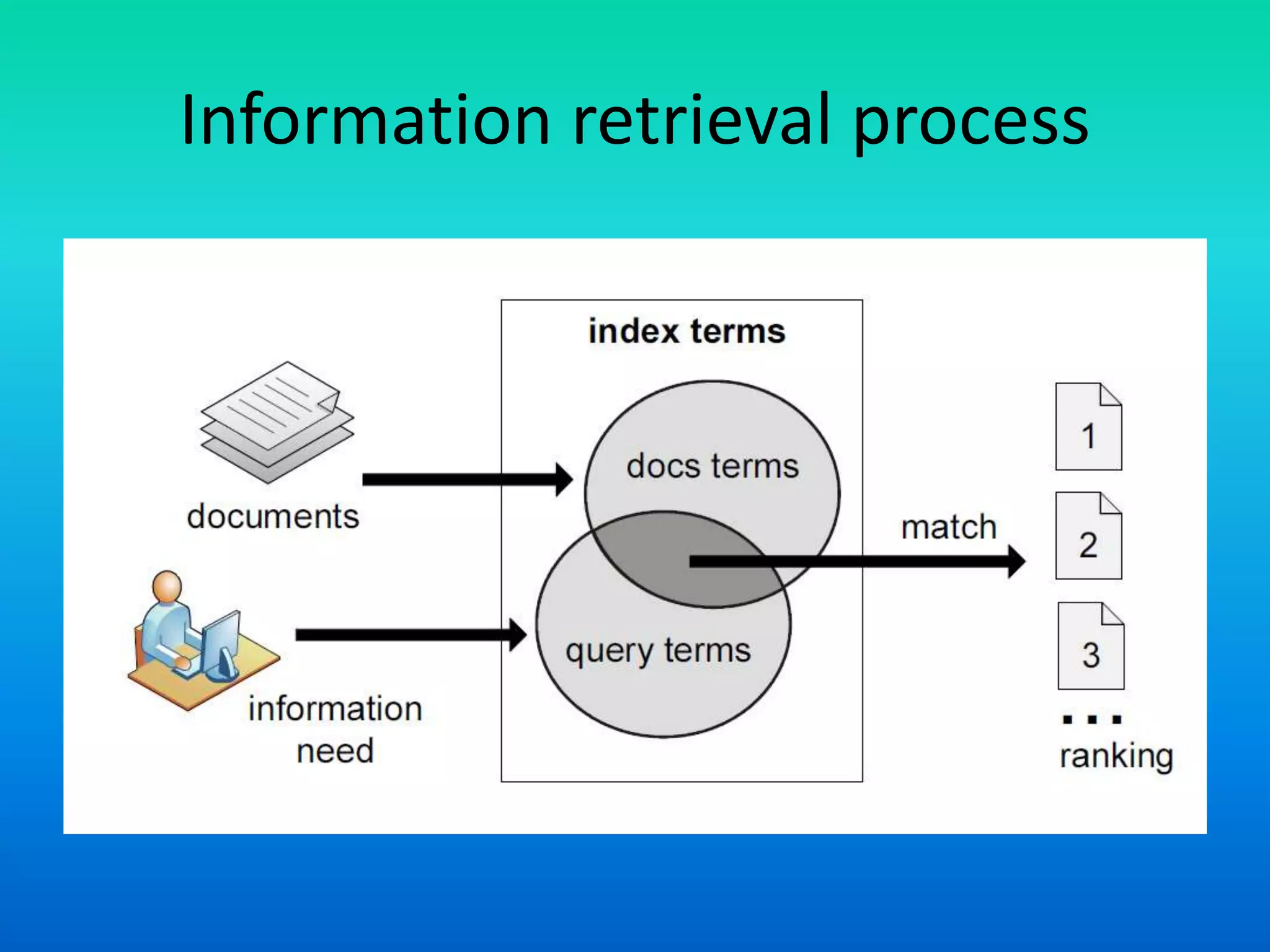
• IR systems usually adopt index terms to index and
retrieve documents
• Index term:
– In a restricted sense: it is a keyword that has some
meaning on its own; usually plays the role of a noun
– In a more general form: it is any word that appears in a
document
• Retrieval based on index terms can be implemented
efficiently
• Also, index terms are simple to refer to in a query
• Simplicity is important because it reduces the effort of
query formulation
Information retrieval process
Ranking
• A ranking is an ordering of the documents
that (hopefully) reflects their relevance to a
user query
• Thus, any IR system has to deal with the
problem of predicting which documents the
users will find relevant
• This problem naturally embodies a degree of
uncertainty, or vagueness
IR model
• An IR model is a quadruple [D, Q, F, R(qi, dj)] where
• 1. D is a set of logical views for the documents in the collection
• 2. Q is a set of logical views for the user queries
• 3. F is a framework for modeling documents and queries
• 4. R(qi, dj) is a ranking function
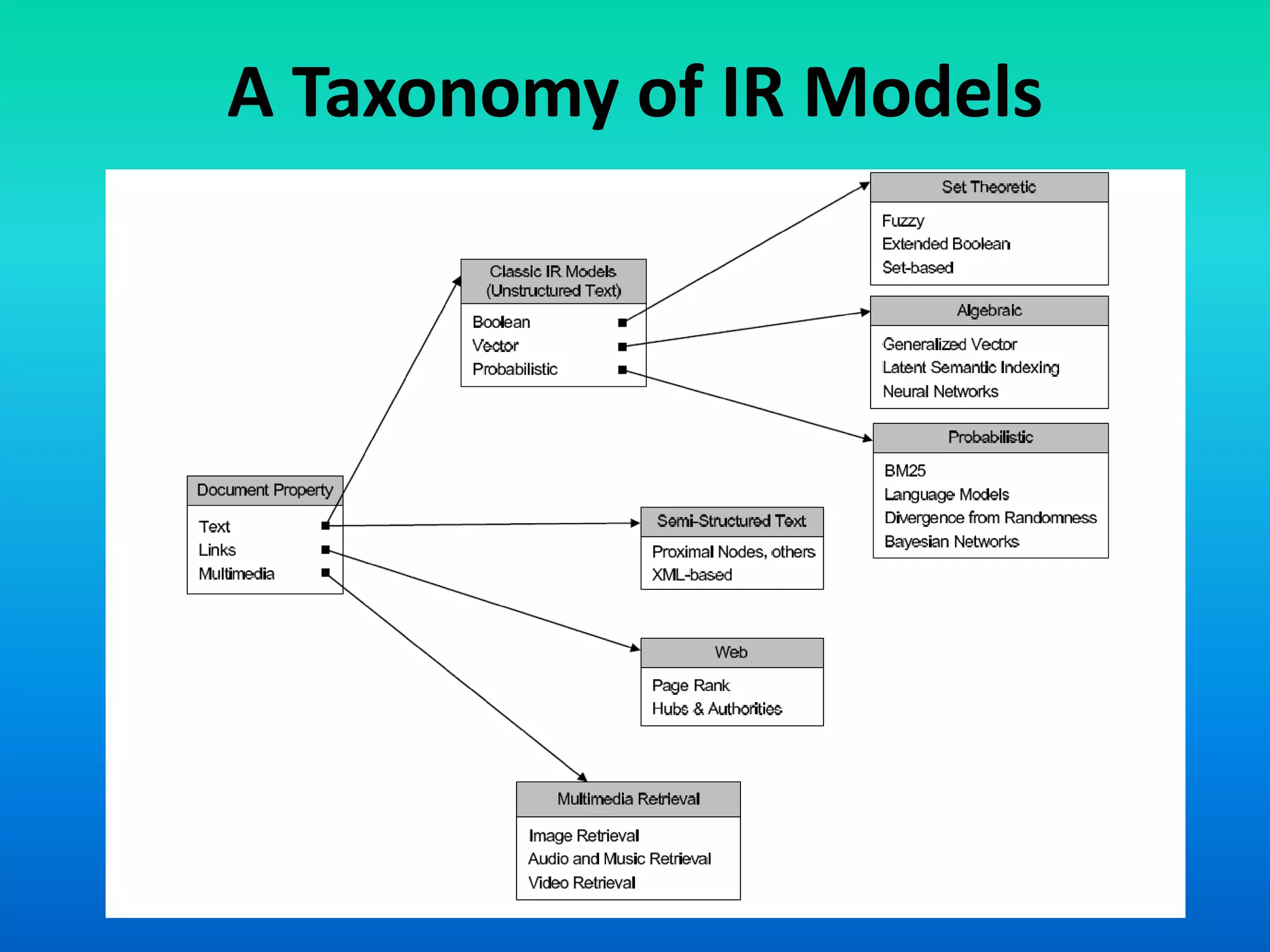
A Taxonomy of IR Models
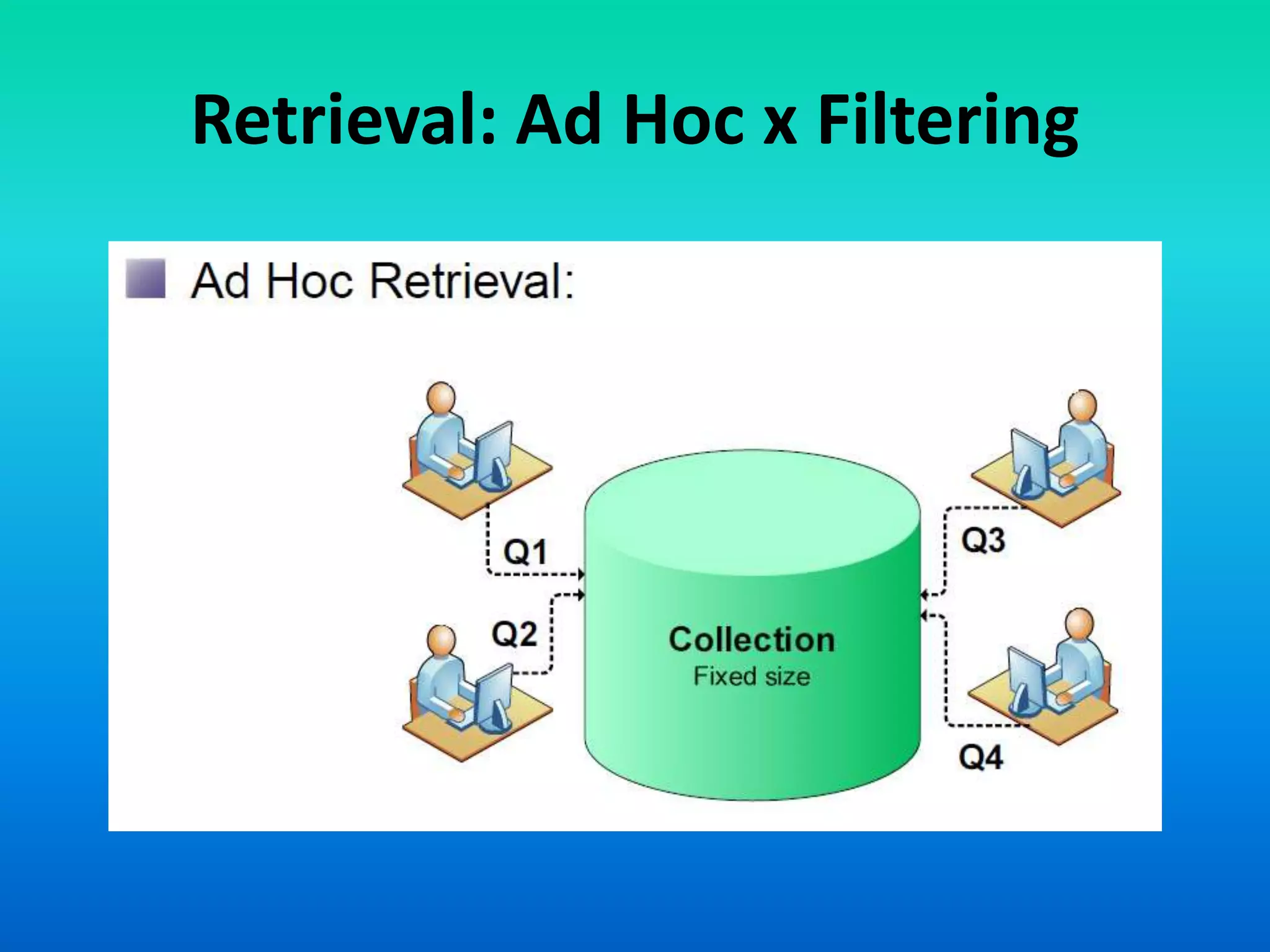
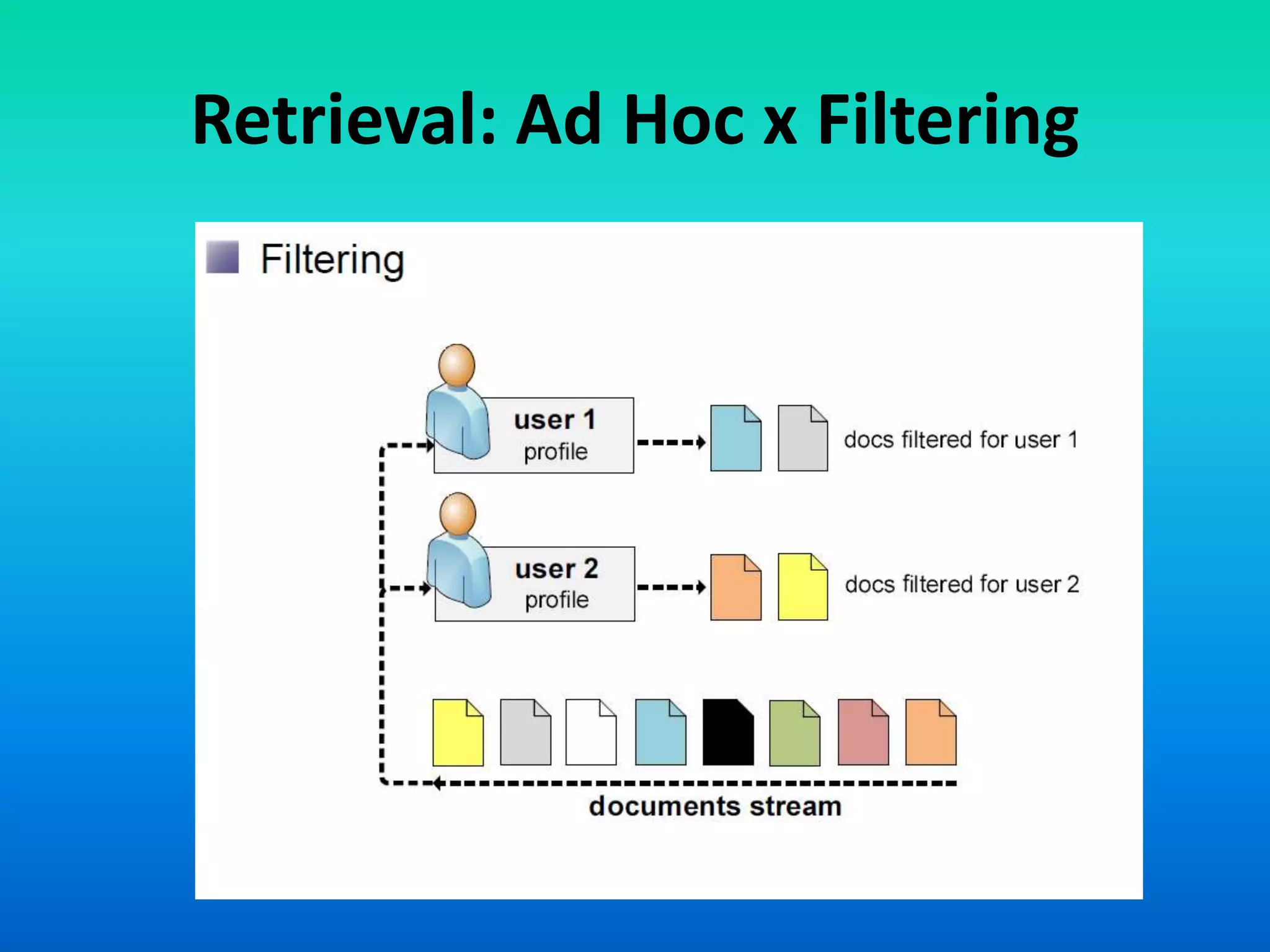
Retrieval: Ad Hoc x Filtering
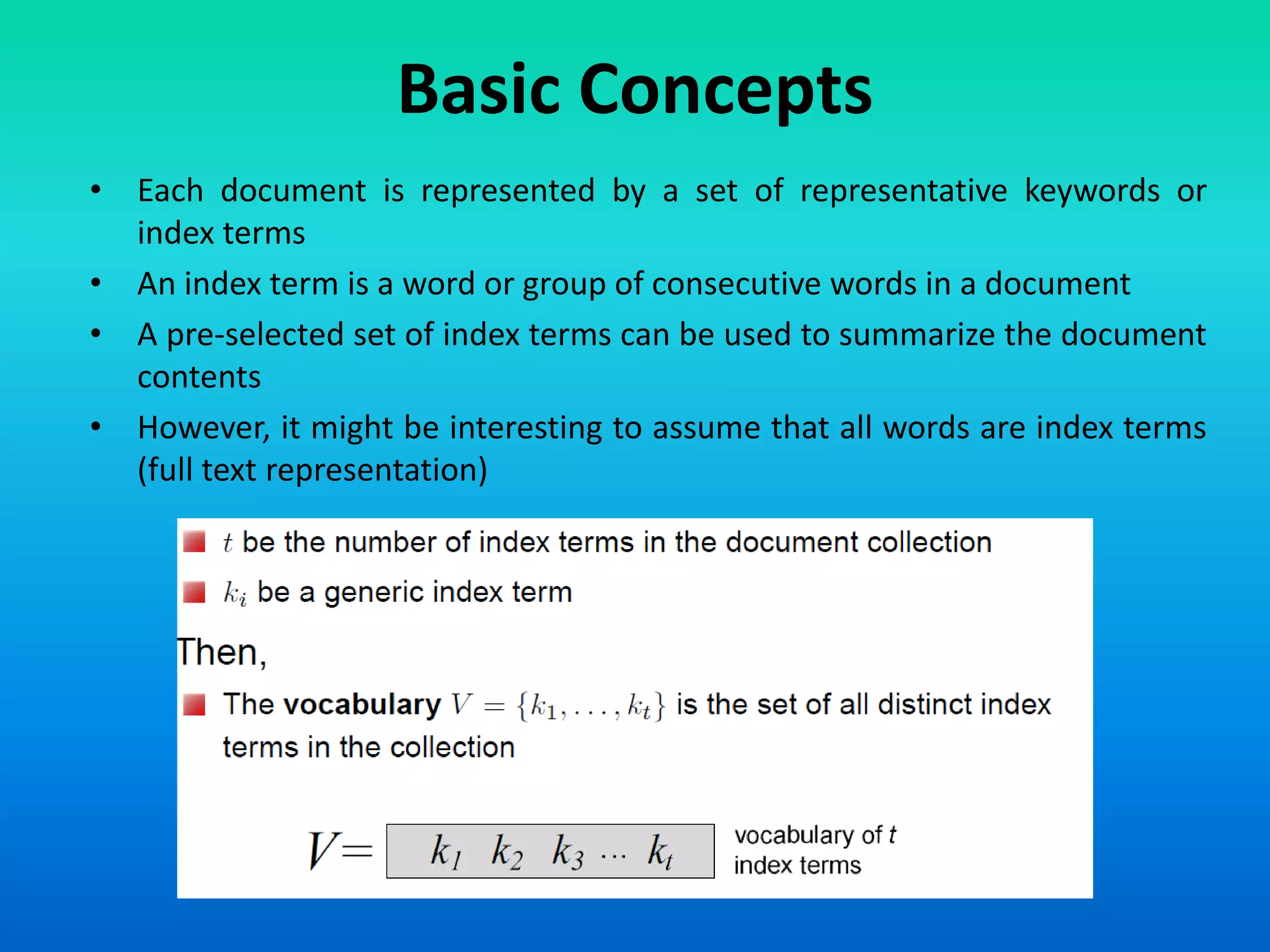
Basic Concepts
• Each document is represented by a set of representative keywords or
index terms
• An index term is a word or group of consecutive words in a document
• A pre-selected set of index terms can be used to summarize the document
contents
• However, it might be interesting to assume that all words are index terms
(full text representation)
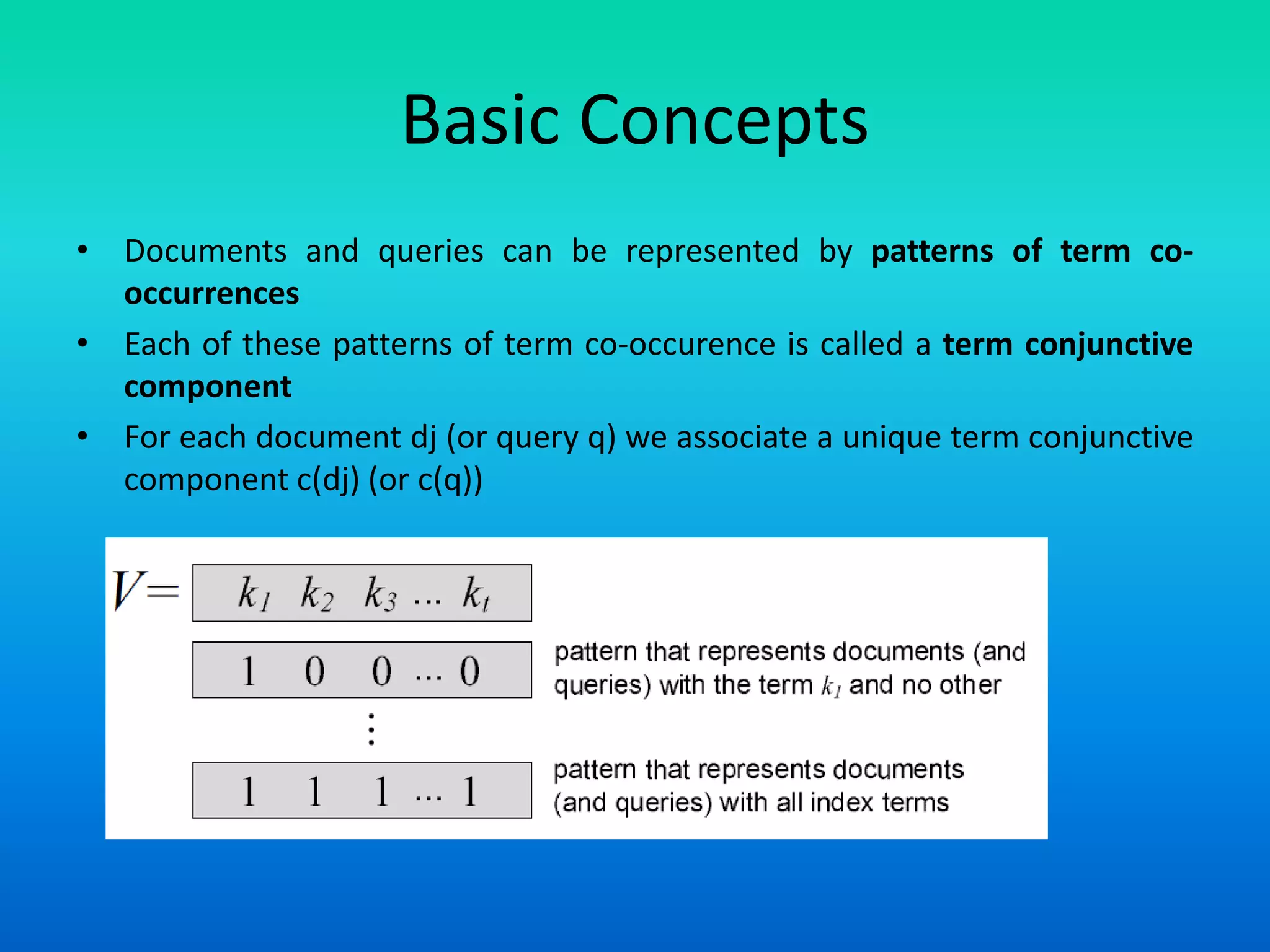
Basic Concepts
• Documents and queries can be represented by patterns of term co-
occurrences
• Each of these patterns of term co-occurence is called a term conjunctive
component
• For each document dj (or query q) we associate a unique term conjunctive
component c(dj) (or c(q))
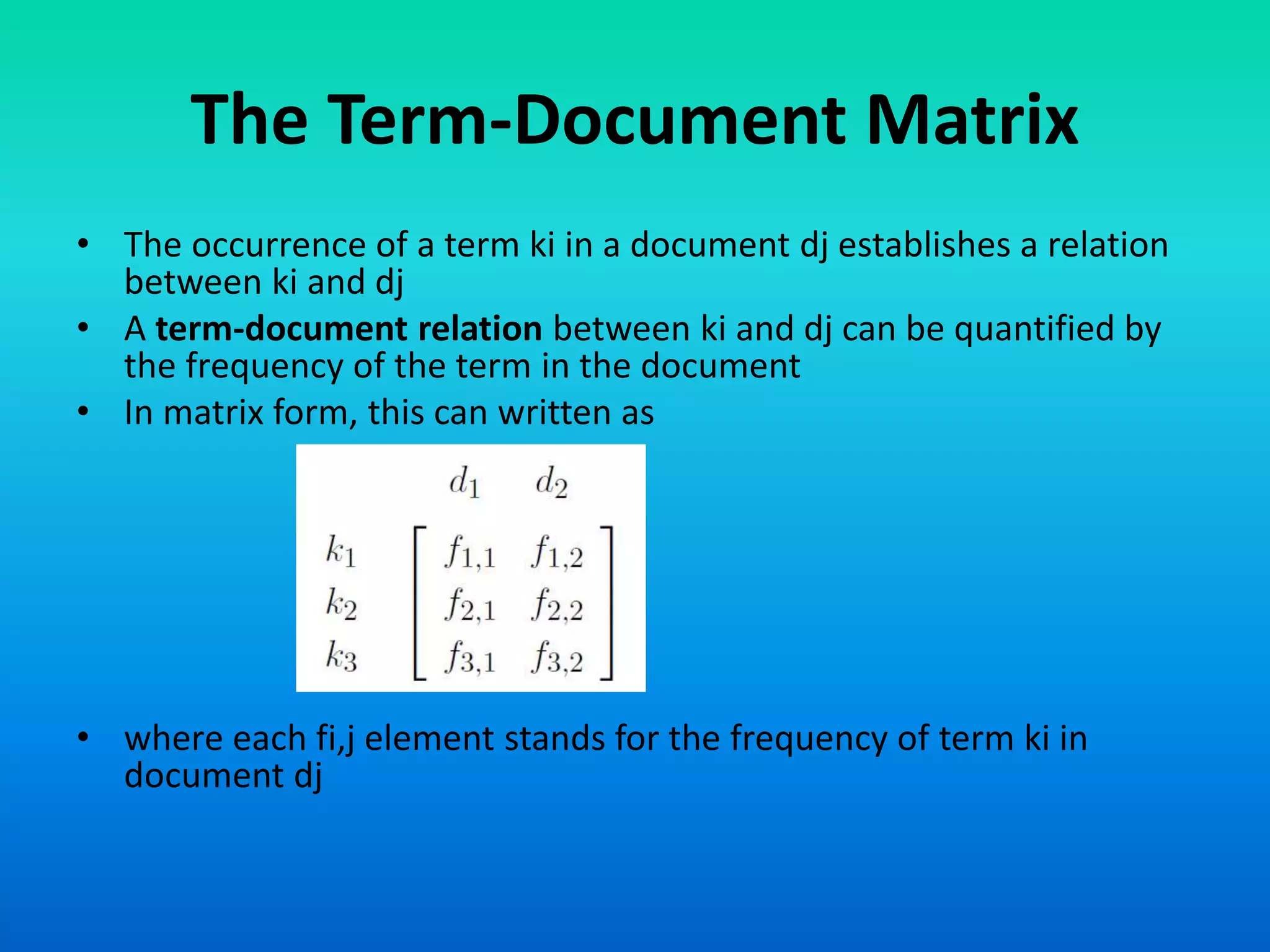
The Term-Document Matrix
• The occurrence of a term ki in a document dj establishes a relation
between ki and dj
• A term-document relation between ki and dj can be quantified by
the frequency of the term in the document
• In matrix form, this can written as
• where each fi,j element stands for the frequency of term ki in
document dj
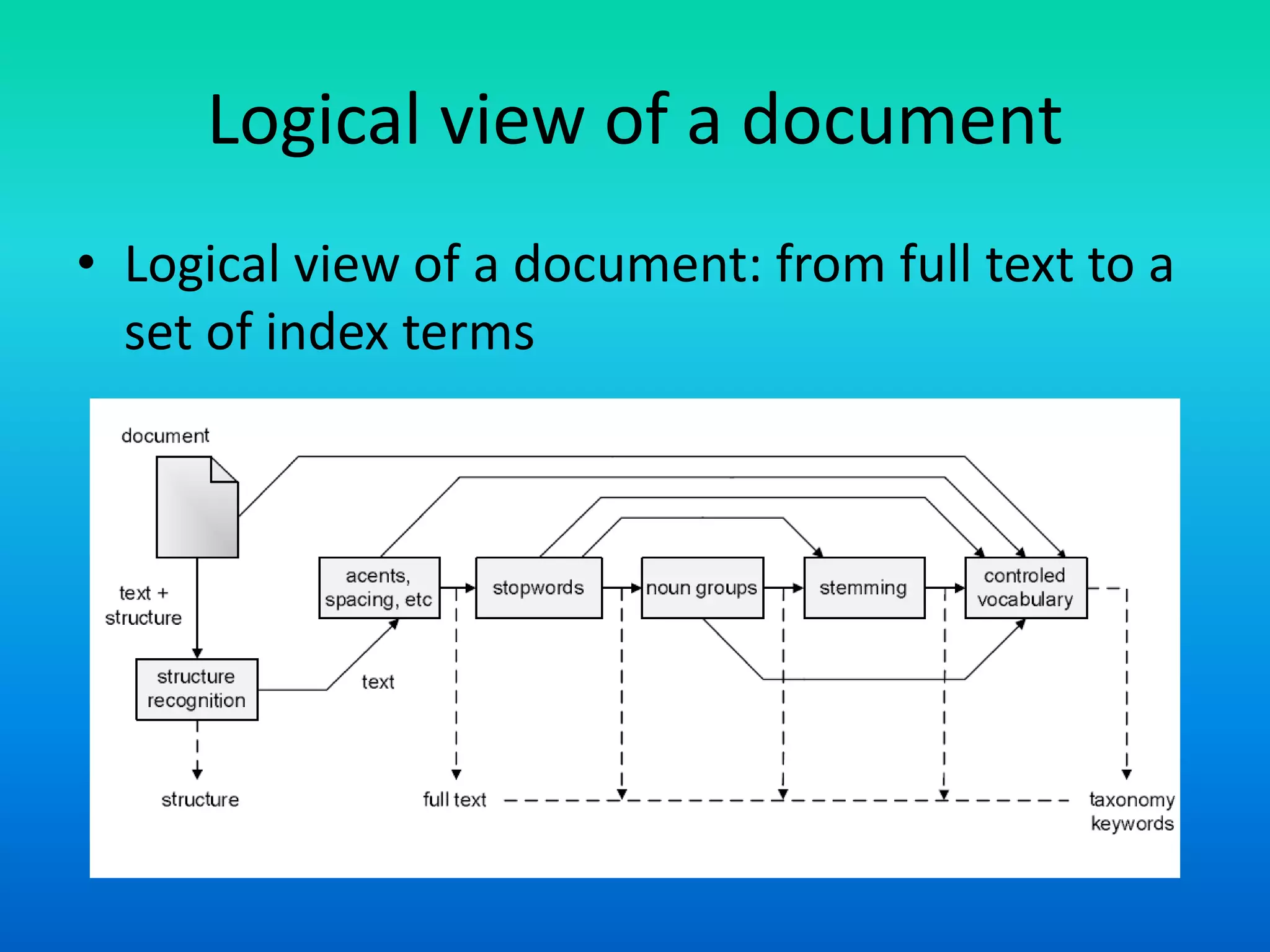
Logical view of a document
• Logical view of a document: from full text to a
set of index terms
Assignment
• What do you understand by IR modelling
• Draw and briefly discuss the taxonomy of IR
models

Information retrieval 6 ir models

  • 1.
    Information Retrieval :6 IR Models Prof Neeraj Bhargava Vaibhav Khanna Department of Computer Science School of Engineering and Systems Sciences Maharshi Dayanand Saraswati University Ajmer
  • 2.
    IR Models • Modelingin IR is a complex process aimed at producing a ranking function • Ranking function: a function that assigns scores to documents with regard to a given query • This process consists of two main tasks: – The conception of a logical framework for representing documents and queries – The definition of a ranking function that allows quantifying the similarities among documents and queries
  • 3.
    Modelling and Ranking •IR systems usually adopt index terms to index and retrieve documents • Index term: – In a restricted sense: it is a keyword that has some meaning on its own; usually plays the role of a noun – In a more general form: it is any word that appears in a document • Retrieval based on index terms can be implemented efficiently • Also, index terms are simple to refer to in a query • Simplicity is important because it reduces the effort of query formulation
  • 4.
  • 5.
    Ranking • A rankingis an ordering of the documents that (hopefully) reflects their relevance to a user query • Thus, any IR system has to deal with the problem of predicting which documents the users will find relevant • This problem naturally embodies a degree of uncertainty, or vagueness
  • 6.
    IR model • AnIR model is a quadruple [D, Q, F, R(qi, dj)] where • 1. D is a set of logical views for the documents in the collection • 2. Q is a set of logical views for the user queries • 3. F is a framework for modeling documents and queries • 4. R(qi, dj) is a ranking function
  • 7.
    A Taxonomy ofIR Models
  • 8.
    Retrieval: Ad Hocx Filtering
  • 9.
    Retrieval: Ad Hocx Filtering
  • 10.
    Basic Concepts • Eachdocument is represented by a set of representative keywords or index terms • An index term is a word or group of consecutive words in a document • A pre-selected set of index terms can be used to summarize the document contents • However, it might be interesting to assume that all words are index terms (full text representation)
  • 11.
    Basic Concepts • Documentsand queries can be represented by patterns of term co- occurrences • Each of these patterns of term co-occurence is called a term conjunctive component • For each document dj (or query q) we associate a unique term conjunctive component c(dj) (or c(q))
  • 12.
    The Term-Document Matrix •The occurrence of a term ki in a document dj establishes a relation between ki and dj • A term-document relation between ki and dj can be quantified by the frequency of the term in the document • In matrix form, this can written as • where each fi,j element stands for the frequency of term ki in document dj
  • 13.
    Logical view ofa document • Logical view of a document: from full text to a set of index terms
  • 14.
    Assignment • What doyou understand by IR modelling • Draw and briefly discuss the taxonomy of IR models