Information retrieval 13 alternative set theoretic models
The document discusses alternative set theoretic models in information retrieval, focusing on the extended boolean model which integrates features of vector models with boolean algebra through partial matching and term weighting. It highlights the limitations of the traditional boolean model, proposing a more nuanced approach that accounts for relevance ranking by considering normalized tf-idf factors and generalizing query representations in a multi-dimensional space. The document also touches on the flexibility of the model, indicating its ability to behave as various types of distance-based models by adjusting parameters.
Information retrieval 13 alternative set theoretic models
1.
Information Retrieval :13
Alternative Set Theoretic Models
Prof Neeraj Bhargava
Vaibhav Khanna
Department of Computer Science
School of Engineering and Systems Sciences
Maharshi Dayanand Saraswati University Ajmer
Extended Boolean Model
•In the Boolean model, no ranking of the
answer set is generated
• One alternative is to extend the Boolean
model with the notions of partial matching
and term weighting
• This strategy allows one to combine
characteristics of the Vector model with
properties of Boolean algebra
4.
The Idea
• Considera conjunctive Boolean query given by
q = kx ^ ky
• For the boolean model, a doc that contains a
single term of q is as irrelevant as a doc that
contains none
• However, this binary decision criteria frequently
is not in accordance with common sense
• An analogous reasoning applies when one
considers purely disjunctive queries
5.
The Idea
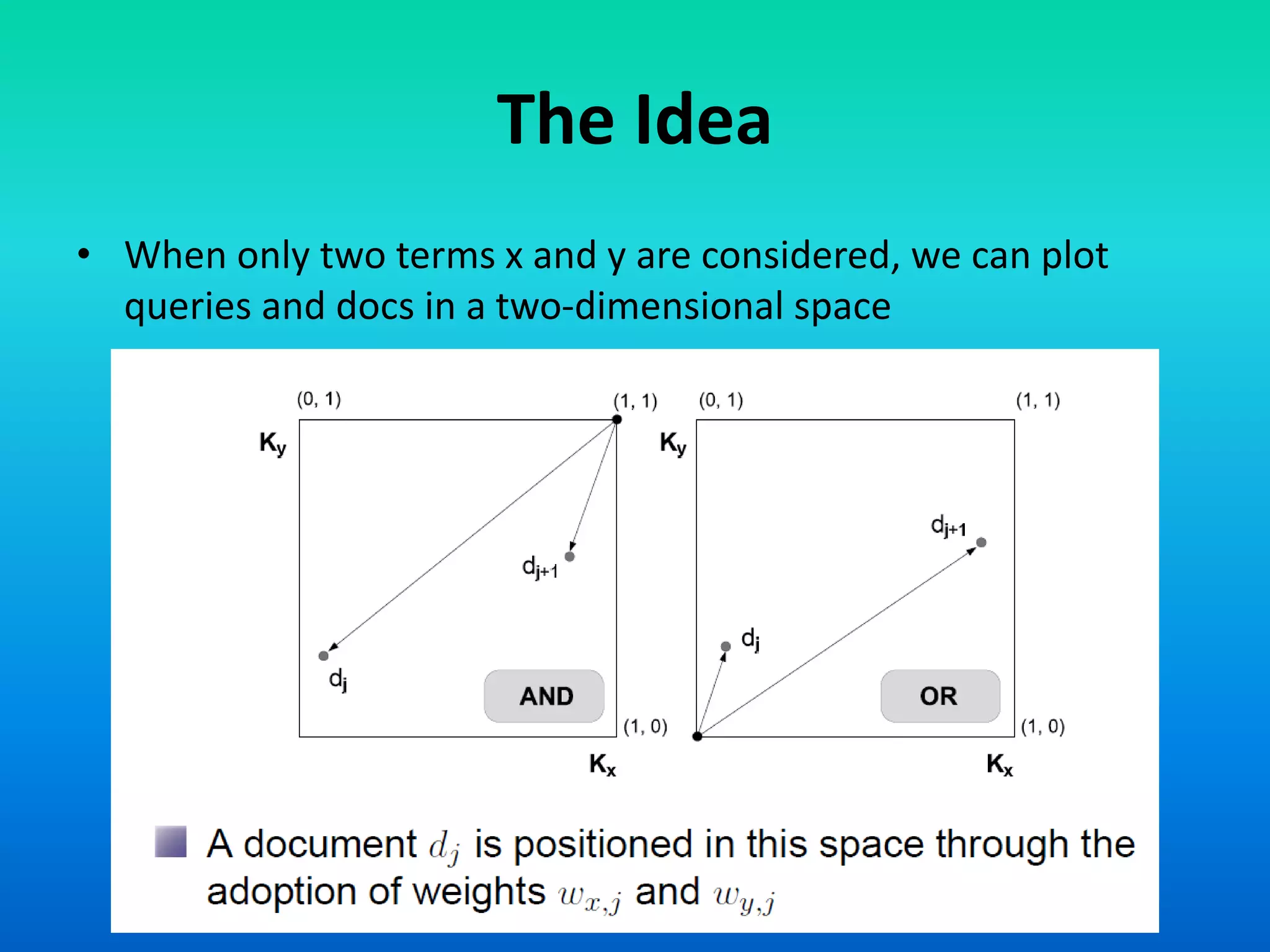
• Whenonly two terms x and y are considered, we can plot
queries and docs in a two-dimensional space
6.
The Idea
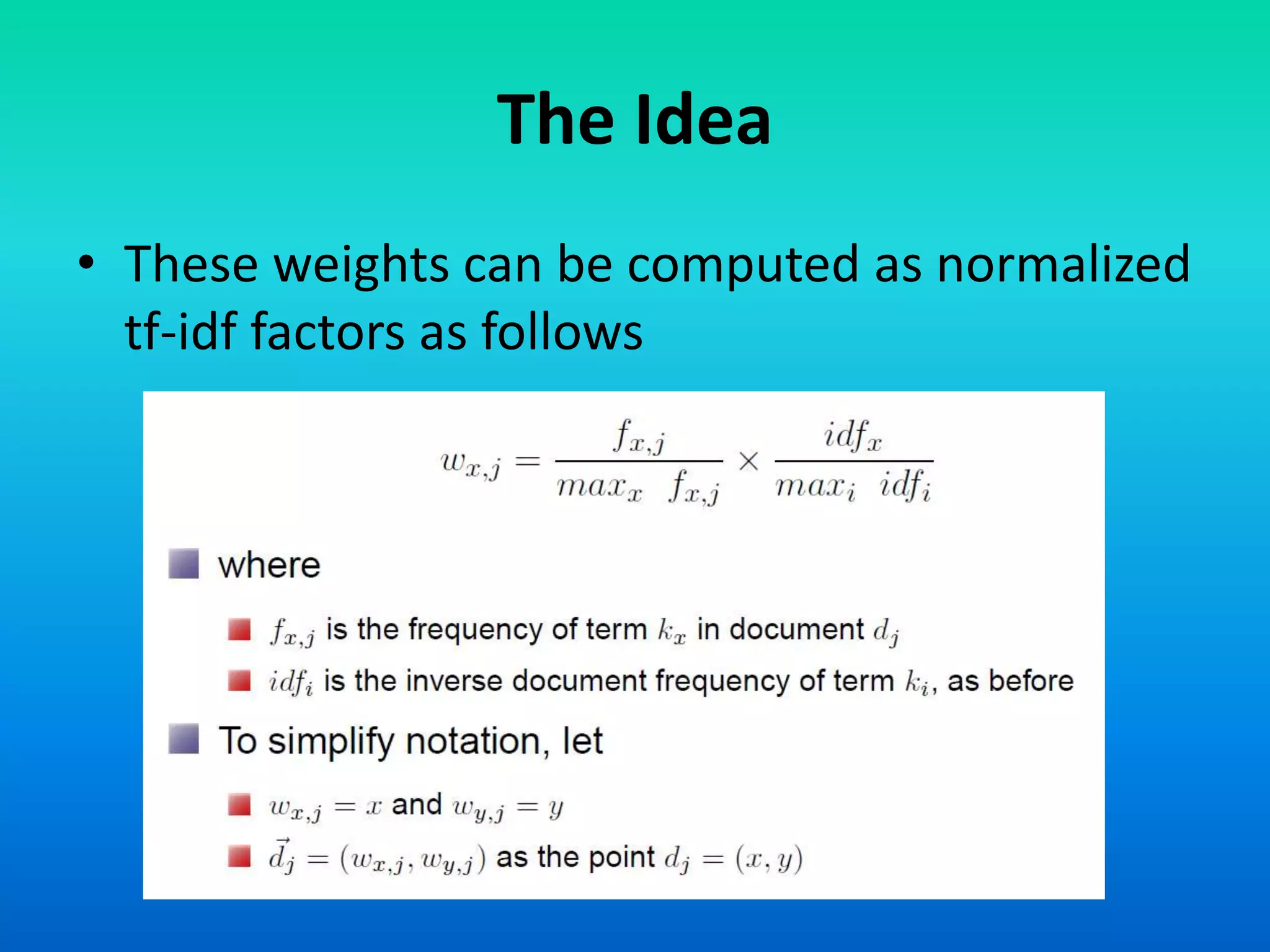
• Theseweights can be computed as normalized
tf-idf factors as follows
7.
Generalizing the Idea
•We can extend the previous model to consider
• Euclidean distances in a t-dimensional space
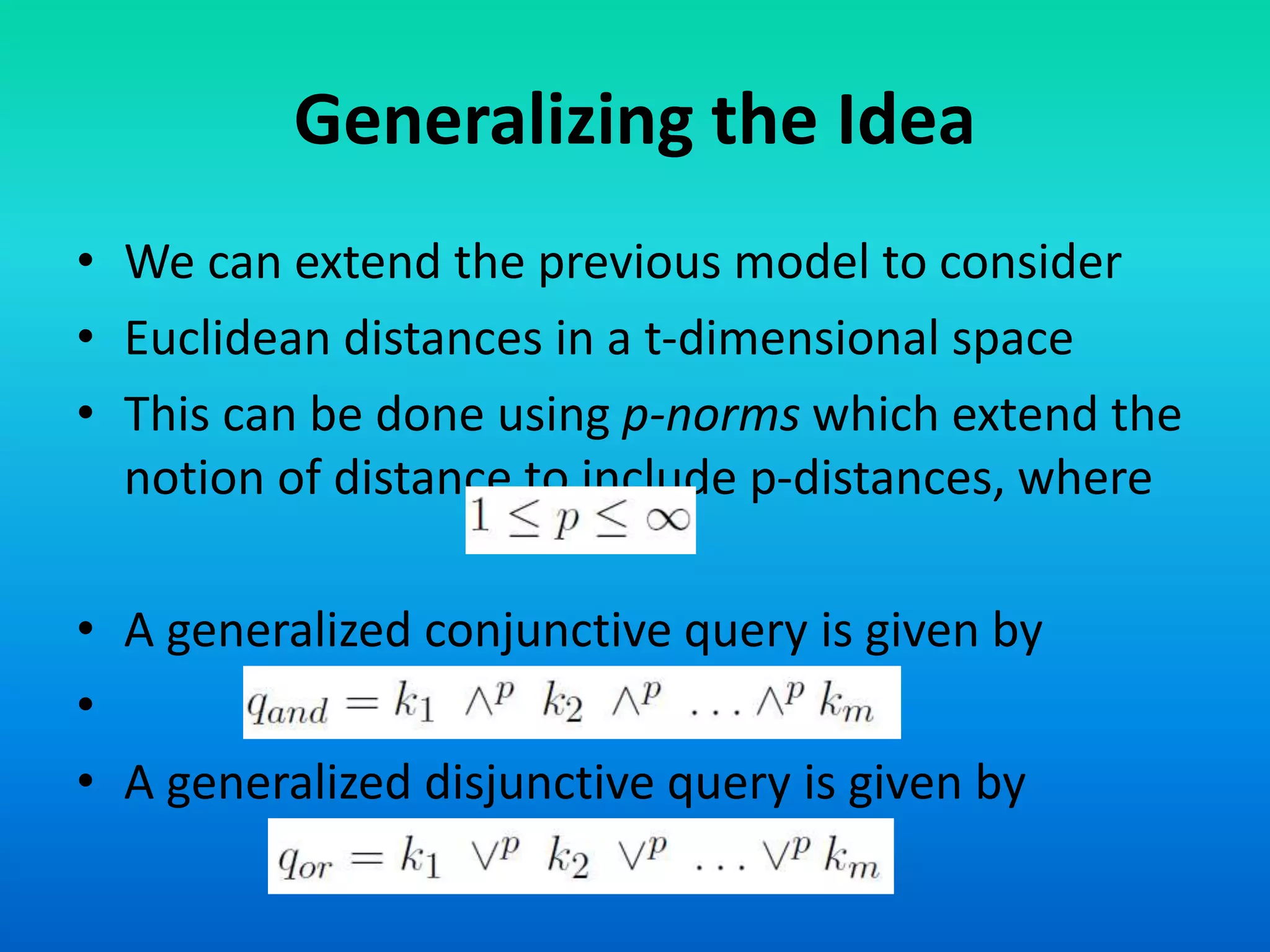
• This can be done using p-norms which extend the
notion of distance to include p-distances, where
• A generalized conjunctive query is given by
•
• A generalized disjunctive query is given by
8.
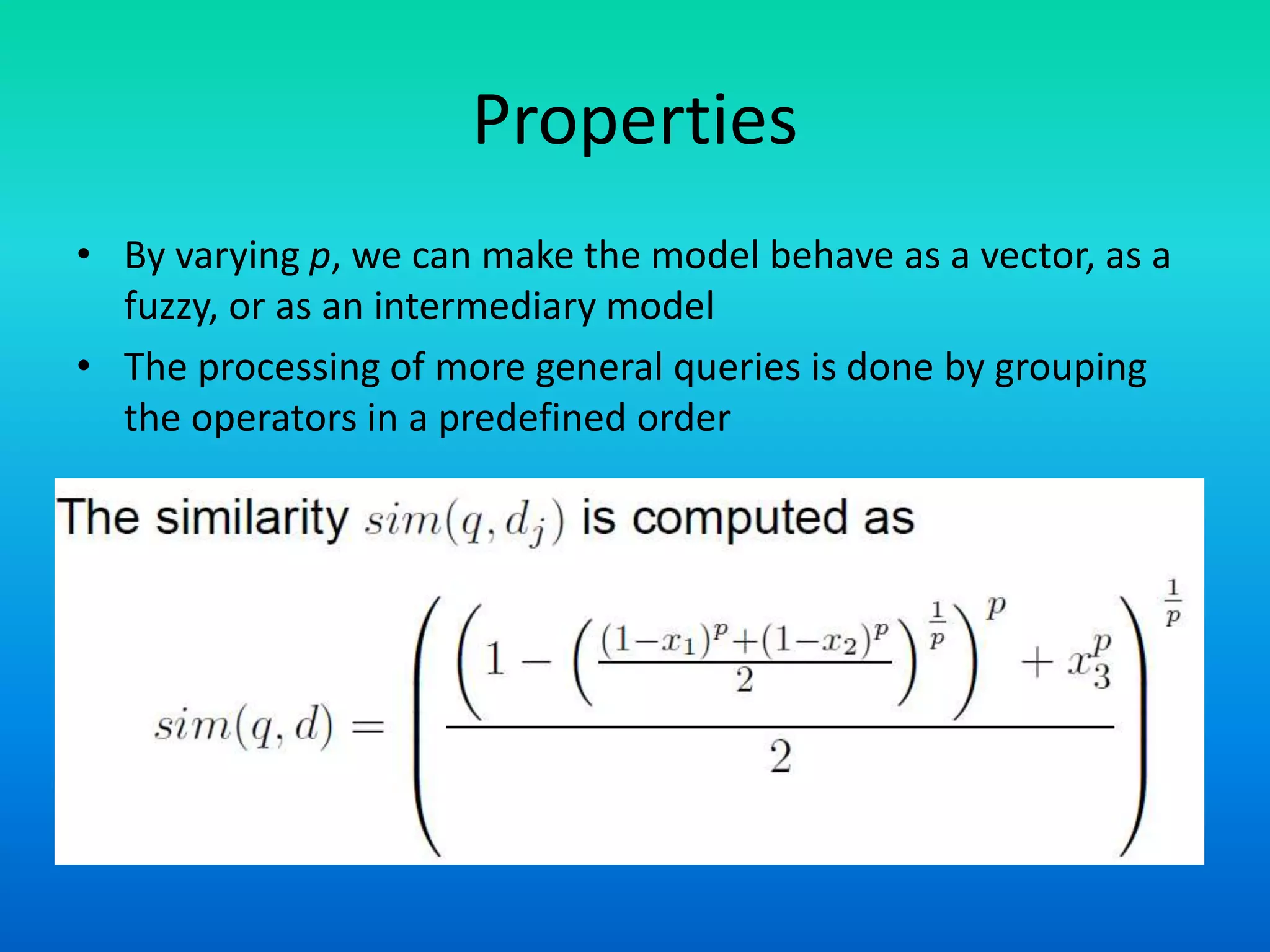
Properties
• By varyingp, we can make the model behave as a vector, as a
fuzzy, or as an intermediary model
• The processing of more general queries is done by grouping
the operators in a predefined order