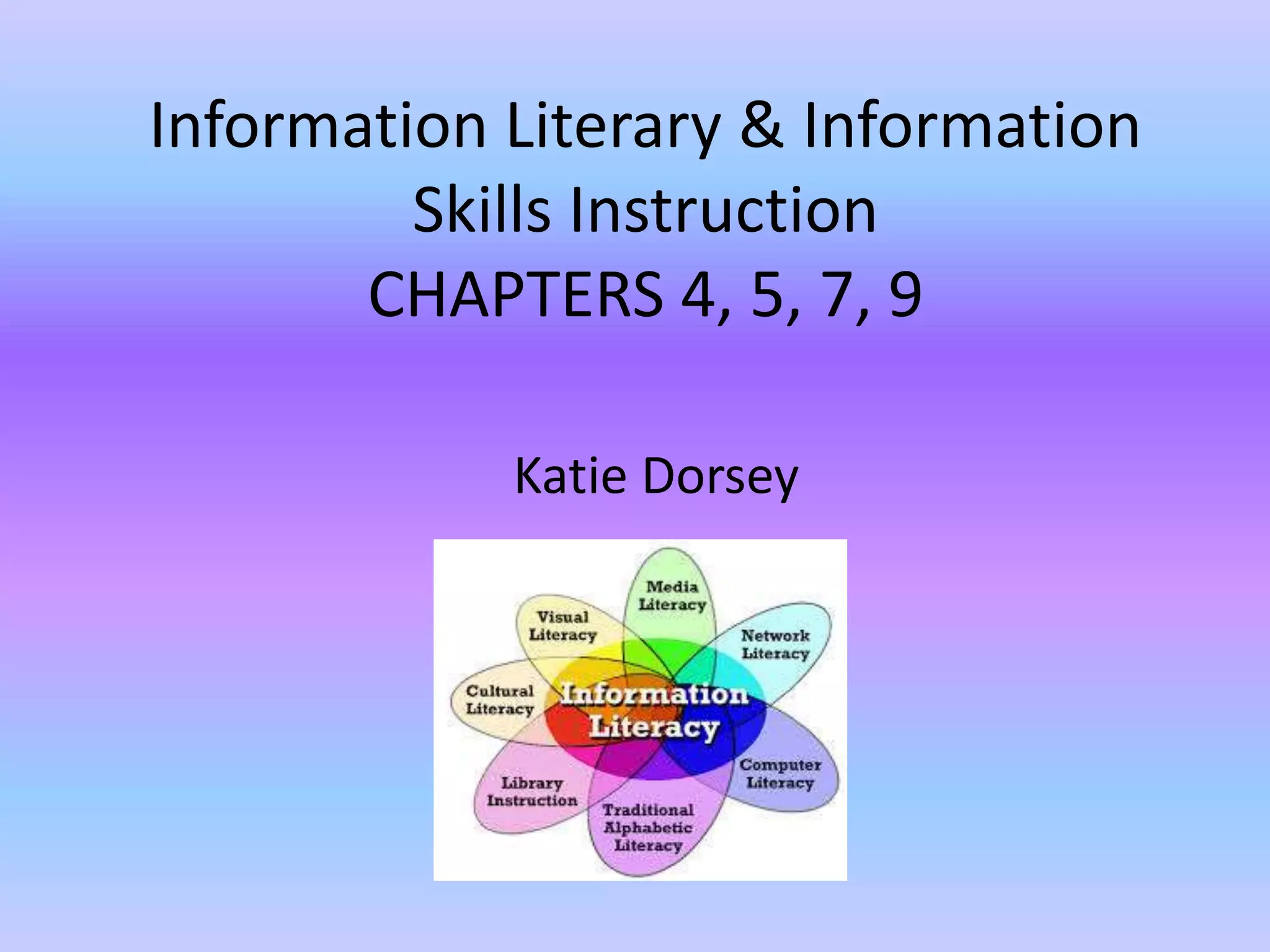
Information Literary & Information 
Skills Instruction 
CHAPTERS 4, 5, 7, 9 
Katie Dorsey
Chapter 4: Alternative Frameworks for Process 
Instruction 
• Step 1: Defining Tasks- A thinking stage which acknowledges the 
importance of understanding the nature of the assignment and the 
criteria used to evaluate it. 
• Step 2: Considering Sources: Finding the best resources appropriate for 
the task and putting them to best use. 
• Step 3: Finding Resources: Use knowledge of classification schemes to find 
appropriate information sources 
• Step 4: Making Selections: Select appropriate resources by taking into 
account their scope, suitability, reliability and level 
• Step 5: Reading, viewing, listening, & understanding 
• Step 6: Making Records: Thinking, understanding, and identifying 
elements in selected resources that are important
Chapter 4: Alternative Frameworks for Process 
Instruction (Cont’d) 
• Step 7: Making Sense: Organize notes in a way that aids learning by 
interpreting it, reflecting upon it, analyzing it, and synthesizing it 
• Step 8: Presenting Work: Use creative ways to show/represent information 
• Step 9: Assessing Progress: Evaluate each project or performance by the 
teacher, student, and other classmates
Chapter 5: Evolving Contexts for 
Teaching & Learning 
• Constructivists argue that to be effective, learning 
activities must not only connect to prior knowledge but 
they must have meaning to the learner 
• Learning activities involve understanding at a deep level 
(Bloom’s Taxonomy) 
• A librarian’s main responsibility is to provide structure 
and opportunities for learning & support/guidance 
(constructivist view) 
• A “coaching role” gives the instructor the opportunity to 
provide feedback and stimulate student questions
Chapter 5: Evolving Contexts for 
Teaching & Learning (Cont’d) 
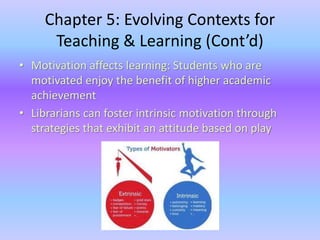
• Motivation affects learning: Students who are 
motivated enjoy the benefit of higher academic 
achievement 
• Librarians can foster intrinsic motivation through 
strategies that exhibit an attitude based on play
Chapter 7: Building Information 
Competence 
5 Things to help produce competent students 
1. Freedom to express themselves creatively and 
individually 
2. Making the library a place where they feel 
supported and encouraged 
3. Focusing on meaningful research and 
information seeking activities 
4. Relatable lessons and participation exercises 
5. Opportunities to express what they’ve learned 
in unique ways

Information literary & information skills instruction

  • 1.
    Information Literary &Information Skills Instruction CHAPTERS 4, 5, 7, 9 Katie Dorsey
  • 2.
    Chapter 4: AlternativeFrameworks for Process Instruction • Step 1: Defining Tasks- A thinking stage which acknowledges the importance of understanding the nature of the assignment and the criteria used to evaluate it. • Step 2: Considering Sources: Finding the best resources appropriate for the task and putting them to best use. • Step 3: Finding Resources: Use knowledge of classification schemes to find appropriate information sources • Step 4: Making Selections: Select appropriate resources by taking into account their scope, suitability, reliability and level • Step 5: Reading, viewing, listening, & understanding • Step 6: Making Records: Thinking, understanding, and identifying elements in selected resources that are important
  • 3.
    Chapter 4: AlternativeFrameworks for Process Instruction (Cont’d) • Step 7: Making Sense: Organize notes in a way that aids learning by interpreting it, reflecting upon it, analyzing it, and synthesizing it • Step 8: Presenting Work: Use creative ways to show/represent information • Step 9: Assessing Progress: Evaluate each project or performance by the teacher, student, and other classmates
  • 4.
    Chapter 5: EvolvingContexts for Teaching & Learning • Constructivists argue that to be effective, learning activities must not only connect to prior knowledge but they must have meaning to the learner • Learning activities involve understanding at a deep level (Bloom’s Taxonomy) • A librarian’s main responsibility is to provide structure and opportunities for learning & support/guidance (constructivist view) • A “coaching role” gives the instructor the opportunity to provide feedback and stimulate student questions
  • 5.
    Chapter 5: EvolvingContexts for Teaching & Learning (Cont’d) • Motivation affects learning: Students who are motivated enjoy the benefit of higher academic achievement • Librarians can foster intrinsic motivation through strategies that exhibit an attitude based on play
  • 6.
    Chapter 7: BuildingInformation Competence 5 Things to help produce competent students 1. Freedom to express themselves creatively and individually 2. Making the library a place where they feel supported and encouraged 3. Focusing on meaningful research and information seeking activities 4. Relatable lessons and participation exercises 5. Opportunities to express what they’ve learned in unique ways