Overarching Goals/Outcomes 
O Librarians will understand some of the 
primary principles and theories involved in 
instruction. 
O Librarians will gain some new ideas and 
help regarding classroom management.
Objectives 
O Librarians will recognize teaching 
methods and techniques in videos. 
O Librarians will identify ways that teaching 
methods and techniques are used and/or 
could be used in HCC Library’s info lit 
instruction program. 
O Librarians will share ideas, examples, and 
anecdotes about their own teaching.
Answer the following question 
on a piece of paper: 
O“What makes you most nervous, 
anxious, uncertain, or confused about 
teaching?” 
OCrumple up the pieces of paper and 
throw them around the room (to one 
another) until Gina says stop! 
OOpen up the paper you end up with and 
read aloud what is written on it.
Instructional Design
Instructional Design (ID) 
O “A method and profession for developing 
solutions to learning-related problems.” 
O “Instructional systems design” developed 
during WWII – training large industrial 
workforce. 
O Draws on communication studies, systems 
design, psychology, information technology, 
and educational theory. 
(--Char Booth, Reflective Teaching, Effective 
Learning.)
ID Methods 
O ADDIE: Analyze user needs; Design strategy to address 
needs; Develop product; Implement; Evaluate 
O USER: Understand the problem & scenario; Structure 
goals, objectives, outcomes; Engage [create instruction 
materials and deliver instruction]; Reflect [assess and 
revise] 
O “Backwards Design”: Start with “desired results,” and how 
they will be assessed, then determine what activities will 
lead to those results. 
O What should students understand and be able to do 
(outcomes)? What evidence will show that goals are met? 
O What instruction activities will lead to this assessment 
(objectives)?
Understanding: Your 
topic/research need 
determines the kinds of 
sources you will need 
Obj. 1. Students will develop a 
research topic and search terms 
(Research Planning Worksheet) 
Obj. 2. Students will determine what 
sources are needed for background 
and in-depth information (Research 
Planning Worksheet) 
Obj. 3. Students will describe the 
differences between scholarly and 
popular periodicals (In-class 
exercise in groups of 2 or 3) 
Understanding: Different 
kinds of sources require 
different search tools/ 
resources to find them. 
Obj. 4. Students will identify what kinds 
of sources can be found using 
Google/Web search engines (Orally in 
class, Quiz question? ) 
Obj. 5. Students will select and use 
periodical databases to find journal 
articles. (Research Planning Worksheet) 
Obj. 6. Students will use the Library 
Catalog to find books available at HCC 
Library (Research Planning Worksheet)
Pedagogy
Active/Problem-Based 
Learning 
OInstead of “show and tell” – “facilitate and 
question” (see pink handout) 
OThe activity leads to the concepts – not the 
other way around
Constructivism/Discovery 
Learning 
O Stems from Piaget: 
O Learners construct their own meaning. 
O New learning builds on prior knowledge 
(scaffolding). 
O Learning is enhanced by social interaction. 
O Meaningful learning through “authentic” tasks. 
O Learning depends on cognitive activity – 
students “discover” the answer. 
O Questions, problems, exercises 
(--Cooperstein & Kocevar- 
Weidinger)
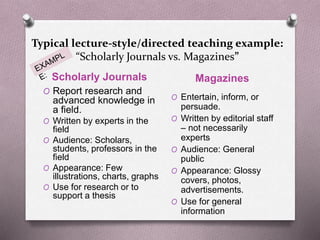
Typical lecture-style/directed teaching example: 
“Scholarly Journals vs. Magazines” 
Scholarly Journals Magazines 
O Report research and 
advanced knowledge in 
a field. 
O Written by experts in the 
field 
O Audience: Scholars, 
students, professors in the 
field 
O Appearance: Few 
illustrations, charts, graphs 
O Use for research or to 
support a thesis 
O Entertain, inform, or 
persuade. 
O Written by editorial staff 
– not necessarily 
experts 
O Audience: General 
public 
O Appearance: Glossy 
covers, photos, 
advertisements. 
O Use for general 
information
Active/Constructive Learning Alternative: 
“Scholarly Journals vs. Magazines” 
O Exercise: 
O In groups of three, look at the copy of the 
journal and the copy of the magazine. 
O Identify three characteristics that 
distinguish the magazine from the journal.
Typical lecture-style/directed teaching example: 
“Evaluating Websites” 
O Evaluation Criteria: 
O Relevance: Does the source contribute to answering 
my research question? 
O Currency: Is there a publication date? Is the date 
appropriate for my topic? 
O Credibility: Who is the author? Does he/she qualified 
to write on this topic? 
O Objectivity: What is the purpose of this source? Is 
the information biased or objective 
O Quality: Do you trust the accuracy of this source? 
Did the authors provide evidence to back their 
claims?
Active/Constructive Learning Alternative: 
“Evaluating Websites” 
O In groups of three, look at these three sites. 
Which one would be most reliable for a college 
paper? Why? 
Ohttp://www.globalissues.org/issue/178/cli 
mate-change-and-global-warming 
Ohttp://earthobservatory.nasa.gov/Feature 
s/GlobalWarming/page6.php 
Ohttp://www.buzzle.com/articles/global-warming- 
and-water-cycle.html
Learner-Centered Teaching (LCT) 
O Not a set of methods or techniques, but a set of 
beliefs/philosophy about teaching and interacting with 
learners. 
O Collaboration, Participation, shared Responsibility 
(CPR) 
O Focus on helping learners become self-sufficient, self-directed, 
life-long learners. 
O Listen to, engage, and inspire learners 
O “Less is more” as opposed to “coverage” 
O Shifting balance of power; providing choices in how 
students interact with material; belief in learner 
potential 
(--Joan R. Kaplowitz, Transforming Information Literacy 
Instruction Using Learner-Centered Teaching)
Traditional Teaching v. LCT 
Traditional teachers 
use words like 
Learner-centered 
teachers 
use words like 
O Teaching 
O Cover 
O Inform 
O Present/deliver 
O Learning 
O Investigate/explore 
O Facilitate 
O Experience/interact
“Flipped Classroom” 
O Instructor as “facilitator of learning” 
O http://www.youtube.com/watch?v=r2b7GeuqkPc
Differentiated Instruction 
OAccommodating learning differences 
OFormats 
OModes of delivery 
OOptions/flexibility in learning activities 
O“Reading” your audience, meeting 
them where they are 
OHaving a place for students to refer 
back to
Is this an effective teaching 
style? 
O http://www.youtube.com/watch?v=uhiCFd 
WeQfA 
O Why or why not? 
O http://www.youtube.com/watch?v=xpxd3p 
ZAVHI 
(start at :50)
Assessment/Reflecti 
on
Reflective Teaching 
OSelf-evaluation of effectiveness 
O“Metacognition” – awareness of what 
skills/strategies/information you have, 
and when and how to use them 
Do you already use reflective or 
metacognitive thinking in instruction? 
If so, how?
Formative Assessment 
O “Understand and react to a learning dynamic as 
you teach.” 
O “Read” audience – observe body language and 
facial expressions for comprehension and 
engagement. Assess level of students. 
O Can use worksheets, think-aloud exercises, 
questioning, observing group work, polls, etc. 
O Re-focus lesson and make changes based on 
student feedback. 
(--Char Booth, Reflective Teaching, Effective 
Learning.)
Summative Exercise 
O Think of some examples where our IL 
lessons use any of the methods or 
strategies talked about today. 
O In what other specific ways could you 
use any of the methods or strategies 
talked about that you are not currently 
doing right now?
Classroom 
Management
What’s wrong with this 
classroom management style? 
O http://www.youtube.com/watch?v=X54qDd 
aACh4
Classroom Management 
OTeaching to a range of abilities 
OKeep lesson moving/read audience 
OResponding to “incorrect” answers. 
ODealing with “bad behavior.” 
O“Pitch and persona,” showing 
authority 
OHave high expectations, but treat 
students with respect.
Shared Techniques, 
Examples, Anecdotes

Instructional design

  • 2.
    Overarching Goals/Outcomes OLibrarians will understand some of the primary principles and theories involved in instruction. O Librarians will gain some new ideas and help regarding classroom management.
  • 3.
    Objectives O Librarianswill recognize teaching methods and techniques in videos. O Librarians will identify ways that teaching methods and techniques are used and/or could be used in HCC Library’s info lit instruction program. O Librarians will share ideas, examples, and anecdotes about their own teaching.
  • 4.
    Answer the followingquestion on a piece of paper: O“What makes you most nervous, anxious, uncertain, or confused about teaching?” OCrumple up the pieces of paper and throw them around the room (to one another) until Gina says stop! OOpen up the paper you end up with and read aloud what is written on it.
  • 5.
  • 6.
    Instructional Design (ID) O “A method and profession for developing solutions to learning-related problems.” O “Instructional systems design” developed during WWII – training large industrial workforce. O Draws on communication studies, systems design, psychology, information technology, and educational theory. (--Char Booth, Reflective Teaching, Effective Learning.)
  • 7.
    ID Methods OADDIE: Analyze user needs; Design strategy to address needs; Develop product; Implement; Evaluate O USER: Understand the problem & scenario; Structure goals, objectives, outcomes; Engage [create instruction materials and deliver instruction]; Reflect [assess and revise] O “Backwards Design”: Start with “desired results,” and how they will be assessed, then determine what activities will lead to those results. O What should students understand and be able to do (outcomes)? What evidence will show that goals are met? O What instruction activities will lead to this assessment (objectives)?
  • 8.
    Understanding: Your topic/researchneed determines the kinds of sources you will need Obj. 1. Students will develop a research topic and search terms (Research Planning Worksheet) Obj. 2. Students will determine what sources are needed for background and in-depth information (Research Planning Worksheet) Obj. 3. Students will describe the differences between scholarly and popular periodicals (In-class exercise in groups of 2 or 3) Understanding: Different kinds of sources require different search tools/ resources to find them. Obj. 4. Students will identify what kinds of sources can be found using Google/Web search engines (Orally in class, Quiz question? ) Obj. 5. Students will select and use periodical databases to find journal articles. (Research Planning Worksheet) Obj. 6. Students will use the Library Catalog to find books available at HCC Library (Research Planning Worksheet)
  • 9.
  • 10.
    Active/Problem-Based Learning OInsteadof “show and tell” – “facilitate and question” (see pink handout) OThe activity leads to the concepts – not the other way around
  • 11.
    Constructivism/Discovery Learning OStems from Piaget: O Learners construct their own meaning. O New learning builds on prior knowledge (scaffolding). O Learning is enhanced by social interaction. O Meaningful learning through “authentic” tasks. O Learning depends on cognitive activity – students “discover” the answer. O Questions, problems, exercises (--Cooperstein & Kocevar- Weidinger)
  • 12.
    Typical lecture-style/directed teachingexample: “Scholarly Journals vs. Magazines” Scholarly Journals Magazines O Report research and advanced knowledge in a field. O Written by experts in the field O Audience: Scholars, students, professors in the field O Appearance: Few illustrations, charts, graphs O Use for research or to support a thesis O Entertain, inform, or persuade. O Written by editorial staff – not necessarily experts O Audience: General public O Appearance: Glossy covers, photos, advertisements. O Use for general information
  • 13.
    Active/Constructive Learning Alternative: “Scholarly Journals vs. Magazines” O Exercise: O In groups of three, look at the copy of the journal and the copy of the magazine. O Identify three characteristics that distinguish the magazine from the journal.
  • 14.
    Typical lecture-style/directed teachingexample: “Evaluating Websites” O Evaluation Criteria: O Relevance: Does the source contribute to answering my research question? O Currency: Is there a publication date? Is the date appropriate for my topic? O Credibility: Who is the author? Does he/she qualified to write on this topic? O Objectivity: What is the purpose of this source? Is the information biased or objective O Quality: Do you trust the accuracy of this source? Did the authors provide evidence to back their claims?
  • 15.
    Active/Constructive Learning Alternative: “Evaluating Websites” O In groups of three, look at these three sites. Which one would be most reliable for a college paper? Why? Ohttp://www.globalissues.org/issue/178/cli mate-change-and-global-warming Ohttp://earthobservatory.nasa.gov/Feature s/GlobalWarming/page6.php Ohttp://www.buzzle.com/articles/global-warming- and-water-cycle.html
  • 16.
    Learner-Centered Teaching (LCT) O Not a set of methods or techniques, but a set of beliefs/philosophy about teaching and interacting with learners. O Collaboration, Participation, shared Responsibility (CPR) O Focus on helping learners become self-sufficient, self-directed, life-long learners. O Listen to, engage, and inspire learners O “Less is more” as opposed to “coverage” O Shifting balance of power; providing choices in how students interact with material; belief in learner potential (--Joan R. Kaplowitz, Transforming Information Literacy Instruction Using Learner-Centered Teaching)
  • 17.
    Traditional Teaching v.LCT Traditional teachers use words like Learner-centered teachers use words like O Teaching O Cover O Inform O Present/deliver O Learning O Investigate/explore O Facilitate O Experience/interact
  • 18.
    “Flipped Classroom” OInstructor as “facilitator of learning” O http://www.youtube.com/watch?v=r2b7GeuqkPc
  • 19.
    Differentiated Instruction OAccommodatinglearning differences OFormats OModes of delivery OOptions/flexibility in learning activities O“Reading” your audience, meeting them where they are OHaving a place for students to refer back to
  • 20.
    Is this aneffective teaching style? O http://www.youtube.com/watch?v=uhiCFd WeQfA O Why or why not? O http://www.youtube.com/watch?v=xpxd3p ZAVHI (start at :50)
  • 21.
  • 22.
    Reflective Teaching OSelf-evaluationof effectiveness O“Metacognition” – awareness of what skills/strategies/information you have, and when and how to use them Do you already use reflective or metacognitive thinking in instruction? If so, how?
  • 23.
    Formative Assessment O“Understand and react to a learning dynamic as you teach.” O “Read” audience – observe body language and facial expressions for comprehension and engagement. Assess level of students. O Can use worksheets, think-aloud exercises, questioning, observing group work, polls, etc. O Re-focus lesson and make changes based on student feedback. (--Char Booth, Reflective Teaching, Effective Learning.)
  • 24.
    Summative Exercise OThink of some examples where our IL lessons use any of the methods or strategies talked about today. O In what other specific ways could you use any of the methods or strategies talked about that you are not currently doing right now?
  • 25.
  • 26.
    What’s wrong withthis classroom management style? O http://www.youtube.com/watch?v=X54qDd aACh4
  • 27.
    Classroom Management OTeachingto a range of abilities OKeep lesson moving/read audience OResponding to “incorrect” answers. ODealing with “bad behavior.” O“Pitch and persona,” showing authority OHave high expectations, but treat students with respect.
  • 28.