FINDING & USING
SCHOLARLY (OR
ACADEMIC (OR
JOURNAL)) ARTICLES
LINC Session | Fall „13 | Ms Hazzard
Some terminology



Scholarly = Academic = Journal
NOT magazine or newspaper articles
What are scholarly articles?




Report original research
Authored by specialists
Published in academic journals
How to determine if a source is
scholarly…











Formal language
Formal presentation
Author background / experience
Proper citation and bibliography
Original research and interpretation
Not just a summary
Use of primary sources
Use of research methodology
Why do we use them?





To find out more about a specific topic
EXPECTED in academic work: gives you
credibility.
Authors undergo rigorous process of
submission and peer-editing, often working for
more than one year on a single article: gives
author / research credibility.
Different types of scholarly
articles
Research
 Review
 Theoretical
 Clinical
 Brief report
 Book review
Qualitative v Quantitative research

A typical scholarly article
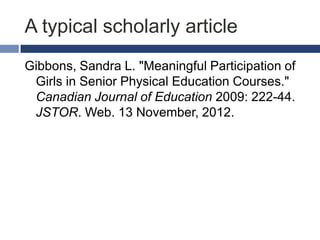
Gibbons, Sandra L. "Meaningful Participation of
Girls in Senior Physical Education Courses."
Canadian Journal of Education 2009: 222-44.
JSTOR. Web. 13 November, 2012.
A typical scholarly article
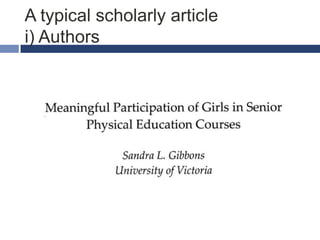
i) Authors
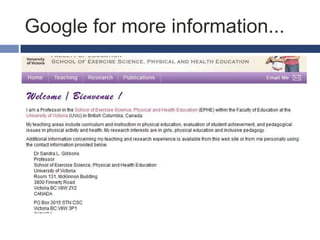
Google for more information...
A typical scholarly article
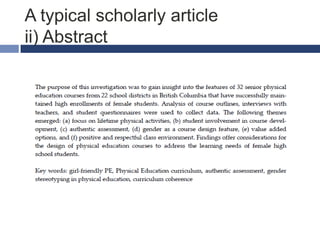
ii) Abstract
A typical scholarly article
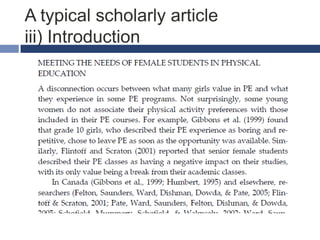
iii) Introduction
A typical scholarly article
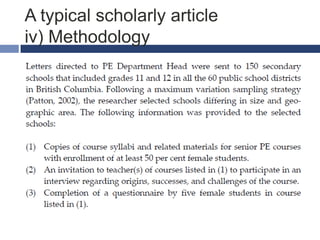
iv) Methodology
A typical scholarly article
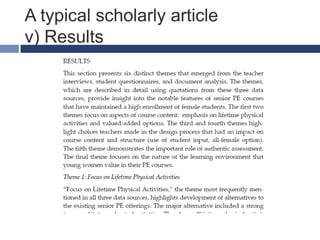
v) Results
A typical scholarly article
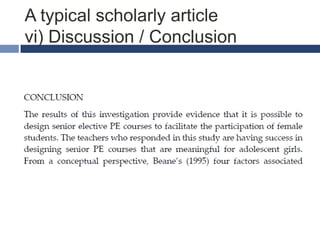
vi) Discussion / Conclusion
A typical scholarly article
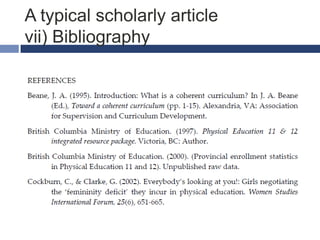
vii) Bibliography
Skimming / 1







Think about WHO / WHAT / WHERE / WHEN /
WHY / HOW as you read
Look for important facts, key vocabulary words
and terms, and words that are clues to
relationships e.g. therefore, because, until,
instead
Look up definitions!
Key sections: ABSTRACT / INTRODUCTION /
RESULTS / CONCLUSION / FIGURES
Skimming / 2






What is the author trying to say, and how are
they trying to say it
Why is the author‟s point important?
What is the social context of the work?
Highlight / circle / underline!
Skimming / 3: Look at the
bibliography





Which sources were used to write this paper?
Even if article is of no use, bibliography can be
very helpful
Can help you narrow your focus
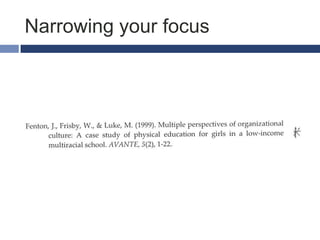
Narrowing your focus
Evaluating your article




Authors
Date
Publication information
Accessing scholarly articles





Not „google-able‟: $$$
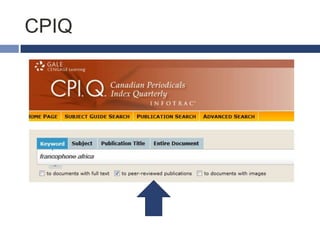
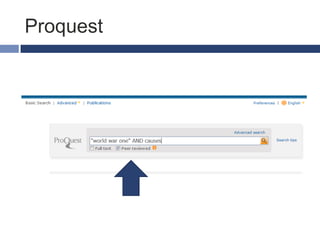
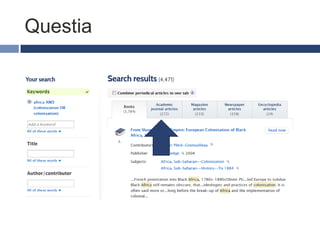
Via CPIQ / Proquest / Questia / databases at
the Toronto Public Library
Choose peer-reviewed / academic journals tab
CPIQ
Proquest
Questia
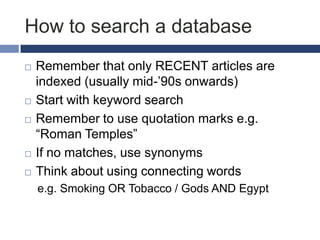
How to search a database








Remember that only RECENT articles are
indexed (usually mid-‟90s onwards)
Start with keyword search
Remember to use quotation marks e.g.
“Roman Temples”
If no matches, use synonyms
Think about using connecting words
e.g. Smoking OR Tobacco / Gods AND Egypt
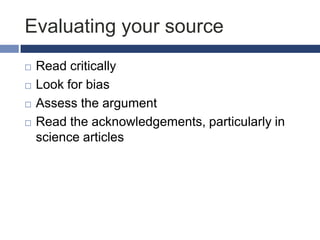
Evaluating your source





Read critically
Look for bias
Assess the argument
Read the acknowledgements, particularly in
science articles
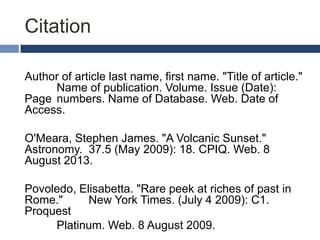
Citation
Author of article last name, first name. "Title of article."
Name of publication. Volume. Issue (Date):
Page numbers. Name of Database. Web. Date of
Access.

O'Meara, Stephen James. "A Volcanic Sunset."
Astronomy. 37.5 (May 2009): 18. CPIQ. Web. 8
August 2013.
Povoledo, Elisabetta. "Rare peek at riches of past in
Rome."
New York Times. (July 4 2009): C1.
Proquest
Platinum. Web. 8 August 2009.
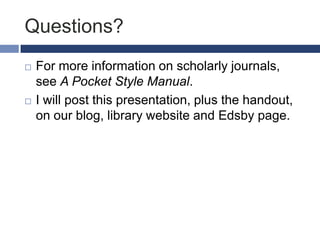
Questions?




For more information on scholarly journals,
see A Pocket Style Manual.
I will post this presentation, plus the handout,
on our blog, library website and Edsby page.

Finding & Using Scholarly Articles

  • 1.
    FINDING & USING SCHOLARLY(OR ACADEMIC (OR JOURNAL)) ARTICLES LINC Session | Fall „13 | Ms Hazzard
  • 2.
    Some terminology   Scholarly =Academic = Journal NOT magazine or newspaper articles
  • 3.
    What are scholarlyarticles?    Report original research Authored by specialists Published in academic journals
  • 4.
    How to determineif a source is scholarly…         Formal language Formal presentation Author background / experience Proper citation and bibliography Original research and interpretation Not just a summary Use of primary sources Use of research methodology
  • 5.
    Why do weuse them?    To find out more about a specific topic EXPECTED in academic work: gives you credibility. Authors undergo rigorous process of submission and peer-editing, often working for more than one year on a single article: gives author / research credibility.
  • 6.
    Different types ofscholarly articles Research  Review  Theoretical  Clinical  Brief report  Book review Qualitative v Quantitative research 
  • 7.
    A typical scholarlyarticle Gibbons, Sandra L. "Meaningful Participation of Girls in Senior Physical Education Courses." Canadian Journal of Education 2009: 222-44. JSTOR. Web. 13 November, 2012.
  • 8.
    A typical scholarlyarticle i) Authors
  • 9.
    Google for moreinformation...
  • 10.
    A typical scholarlyarticle ii) Abstract
  • 11.
    A typical scholarlyarticle iii) Introduction
  • 12.
    A typical scholarlyarticle iv) Methodology
  • 13.
    A typical scholarlyarticle v) Results
  • 14.
    A typical scholarlyarticle vi) Discussion / Conclusion
  • 15.
    A typical scholarlyarticle vii) Bibliography
  • 16.
    Skimming / 1     Thinkabout WHO / WHAT / WHERE / WHEN / WHY / HOW as you read Look for important facts, key vocabulary words and terms, and words that are clues to relationships e.g. therefore, because, until, instead Look up definitions! Key sections: ABSTRACT / INTRODUCTION / RESULTS / CONCLUSION / FIGURES
  • 17.
    Skimming / 2     Whatis the author trying to say, and how are they trying to say it Why is the author‟s point important? What is the social context of the work? Highlight / circle / underline!
  • 18.
    Skimming / 3:Look at the bibliography    Which sources were used to write this paper? Even if article is of no use, bibliography can be very helpful Can help you narrow your focus
  • 19.
  • 20.
  • 21.
    Accessing scholarly articles    Not„google-able‟: $$$ Via CPIQ / Proquest / Questia / databases at the Toronto Public Library Choose peer-reviewed / academic journals tab
  • 22.
  • 23.
  • 24.
  • 25.
    How to searcha database      Remember that only RECENT articles are indexed (usually mid-‟90s onwards) Start with keyword search Remember to use quotation marks e.g. “Roman Temples” If no matches, use synonyms Think about using connecting words e.g. Smoking OR Tobacco / Gods AND Egypt
  • 26.
    Evaluating your source     Readcritically Look for bias Assess the argument Read the acknowledgements, particularly in science articles
  • 27.
    Citation Author of articlelast name, first name. "Title of article." Name of publication. Volume. Issue (Date): Page numbers. Name of Database. Web. Date of Access. O'Meara, Stephen James. "A Volcanic Sunset." Astronomy. 37.5 (May 2009): 18. CPIQ. Web. 8 August 2013. Povoledo, Elisabetta. "Rare peek at riches of past in Rome." New York Times. (July 4 2009): C1. Proquest Platinum. Web. 8 August 2009.
  • 28.
    Questions?   For more informationon scholarly journals, see A Pocket Style Manual. I will post this presentation, plus the handout, on our blog, library website and Edsby page.