Creation and Distribution of 
an Open Access e-Journal 
Dr. Stacy Creel 
stacy.creel@usm.edu 
Dr. Teresa S. Welsh 
teresa.welsh@usm.edu
Digital Commons 
10/28/14 2 
2 
1. Planned for an e-newsletter 
2. Expanded to an e-journal 
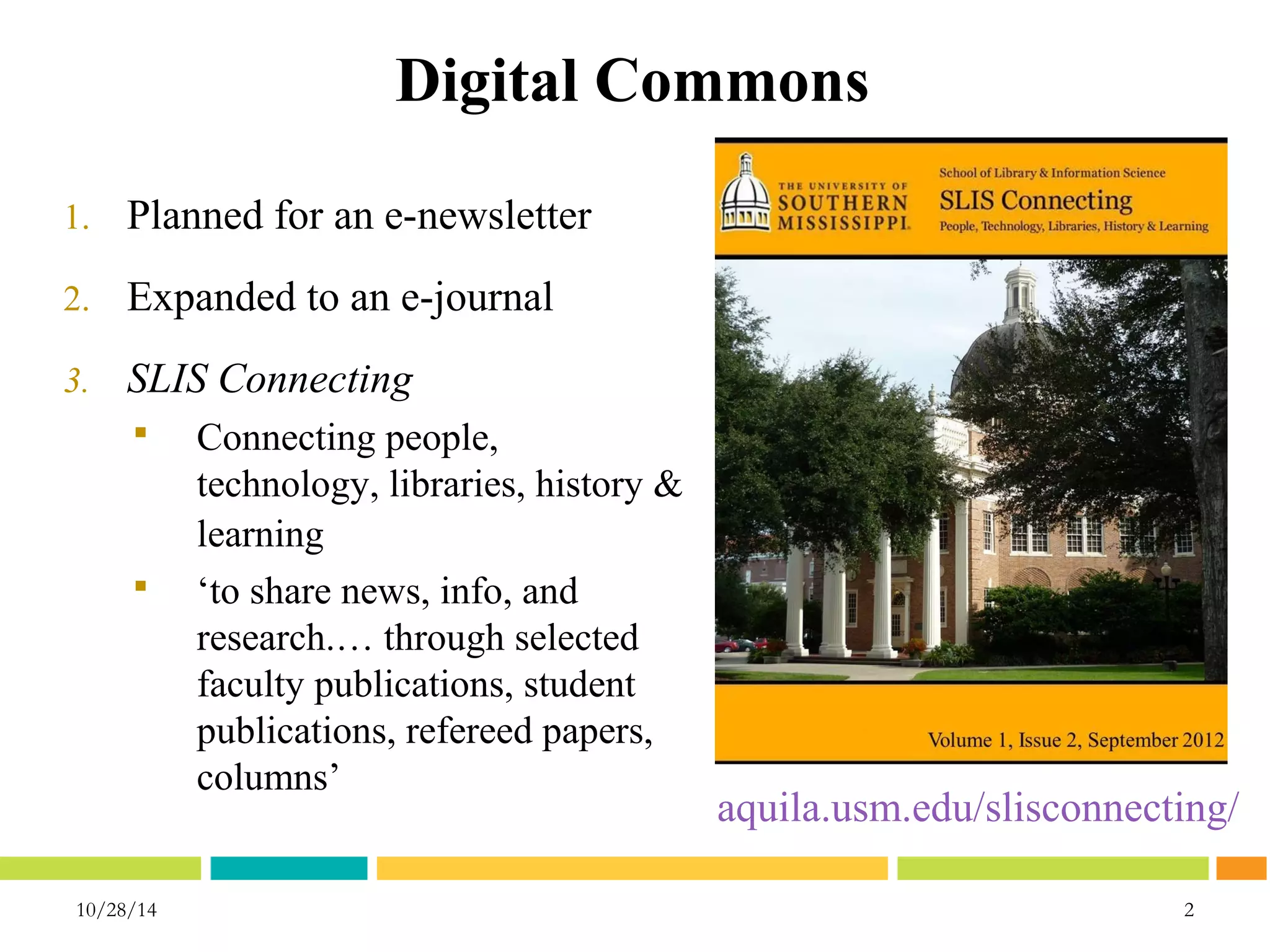
3. SLIS Connecting 
 Connecting people, 
technology, libraries, history & 
learning 
 ‘to share news, info, and 
research.… through selected 
faculty publications, student 
publications, refereed papers, 
columns’ 
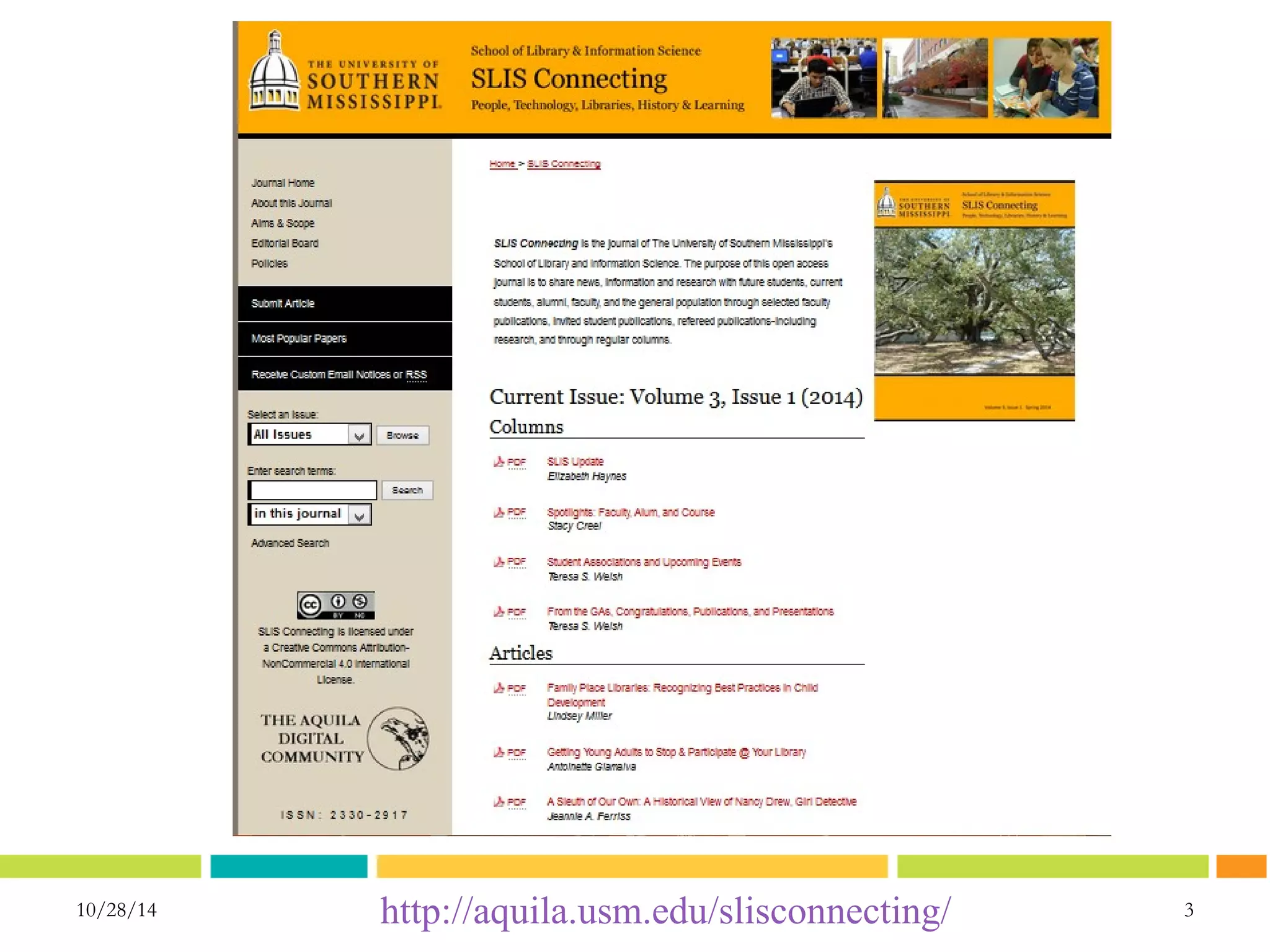
aquila.usm.edu/slisconnecting/
10/28/14 http://aquila.usm.edu/slisconnecting/ 3
Literature: Print to Digital 
 ‘The transformation from print to digital media for scientific 
communication, driven in part by the growth of the Internet 
and the tremendous explosion in the amount of information 
now available to everybody, is creating fundamental changes 
in institutions such as publishers, libraries, and universities’ 
(Davidson, 2005) 
 ‘Web has changed the way academics share, promote, and 
locate information’ (Calise et al., 2010) 
 ‘In the use of electronic journals by academics, convenience, 
including free access, is important’ (Tenopir & Wolverton, 
2005) 
10/28/14 4
Bepress 
 Founded in 1999 because…. 
 ‘academic journals were plagued by slow turnaround 
times, limited access, and unreasonable 
prices’(bepress.com ) 
 Developed online editorial management system that supports 
peer-review process 
 Developed Digital Commons for institutional repositories to... 
 ‘support faculty in creating and editing sustainable 
scholarly journals, as well as a variety of other publishing 
initiatives like e-only press imprints, conference 
proceedings, student research, and more’ (bepress.com) 
10/28/14 5
Bepress (cont’d) 
 License w/Digital Commons entitles institution to: 
 Setup, training, technical support, upgrades, hosting 
 5 free e-journals, includes set-up design 
 Digital Commons 
 Includes EdiKit™ professional-grade , peer-review/ 
editorial management system 
 Supports social networking: Facebook, Linkedin, Twitter, 
StumbleUpon, Pinterest, RSS, etc. 
 Tracks usage data including page views and downloads by 
geographic location 
10/28/14 6
SLIS Connecting 
10/28/14 7 
7 
 First e-journal in USM Aquila Digital Community 
 1st issue – February 2012 
 Most downloaded Aquila e-journal 
 (Online Journal of Health Ethics is second) 
 Top Digital Commons e-journal in archival science
10/28/14 88 
8 
Downloads 
How many items have been downloaded since spring 2012? 
 24,723 downloads 
Which items were downloaded most? 
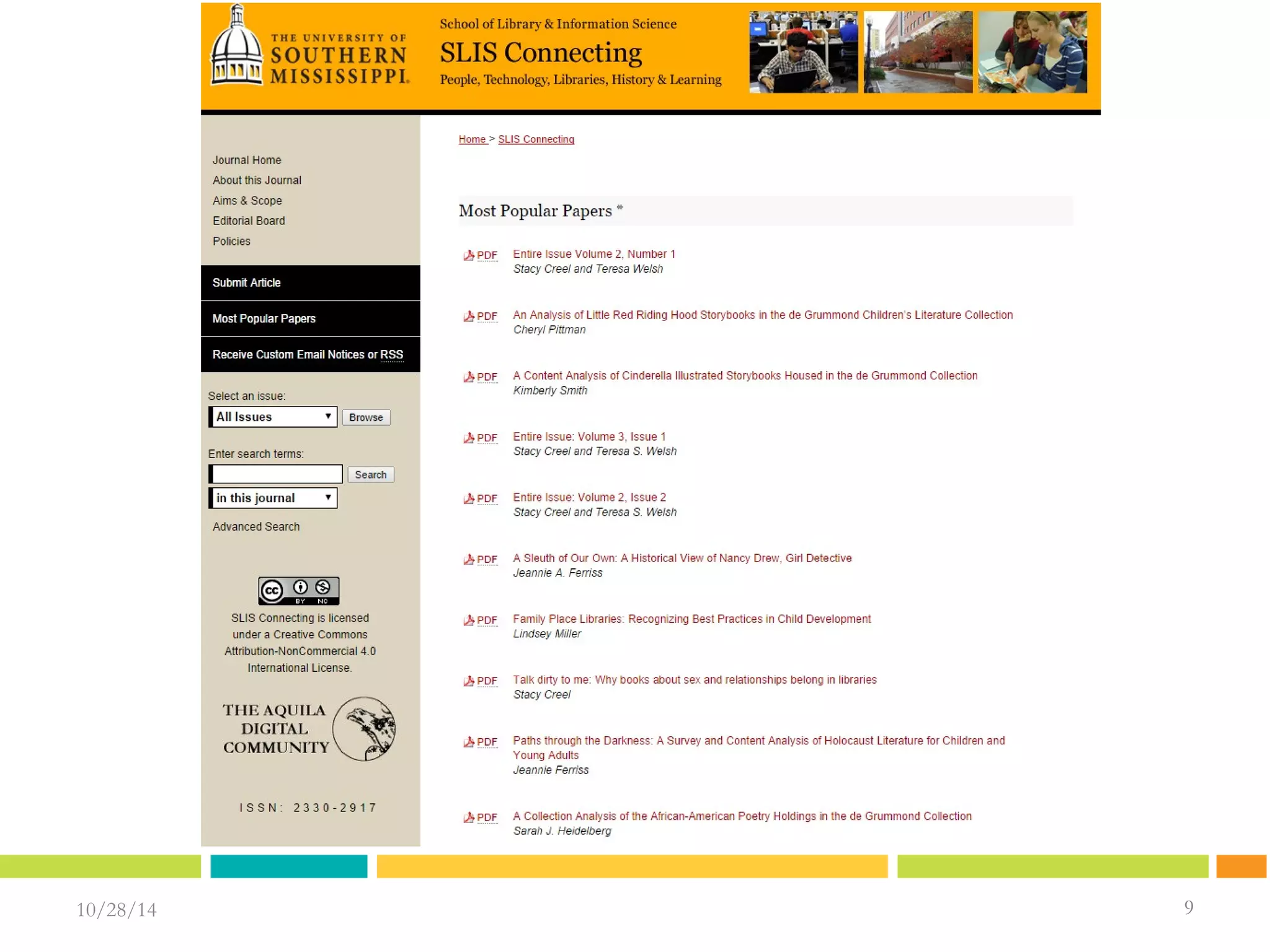
 ‘An Analysis of Little Red Riding Hood Storybooks in 
the de Grummond Collection’ by Cheryl Pittman, 
(Issue 2), 4,395 downloads (18%) 
 ‘A Content Analysis of Cinderella Illustrated 
StorybooksHoused in the de Grummond Collection’ by 
Kimberly Smith (Issue 1), 3,354 downloads (14%)
10/28/14 99 
9
SLIS Connecting is licensed under a 
Creative Commons Attribution-NonCommercial 4.0 International . 
10/28/14 1100 
10
ISSN: 2330-2917 
 International Standard Serial Number 
 8-digit code used to identify newspapers, 
journals, magazines and periodicals of all kinds 
(worldwide) and on all media–print and 
electronic. 
 http://www.issn.org/services/requesting-an-issn/ 
10/28/14 1111 
11 
http://www.issn.org/understanding-the-issn/what-is-an-issn/#
 Increase the visibility 
 Increase ease of use of open access scientific 
and scholarly journals 
 Comprehensive and cover all open access 
scientific and scholarly journals 
 Standard of quality to guarantee the content 
10/28/14 1122 
12
 Open Access Journal: right to "read, 
download, copy, distribute, print, search, or link 
to the full texts of these articles" 
 Quality Control: peer-review or editorial 
quality control 
 Research Journal: report primary results or 
overviews of research 
 Periodical: regular interval serial without end 
10/28/14 1133 
13
 56 questions from the simple (like your name) to 
more complex (like digital archiving policy) 
 Can take 3 to 6 months 
 Journal's ISSN(s) number(s), country of 
publisher, and title registered at issn.org matches 
the application 
 An editorial board with identifiable members 
(plus their contacts). 
10/28/14 1144 
14
 Full text of articles is free and immediately 
available upon publication (no embargo) 
 Open Access policy is clearly stated and easily 
findable on Web site 
 Uses some form of peer review 
 Is open access according to BOAI definition ( 
http://www.budapestopenaccessinitiative.org/) 
 No charges or explicitly described charges 
10/28/14 1155 
15
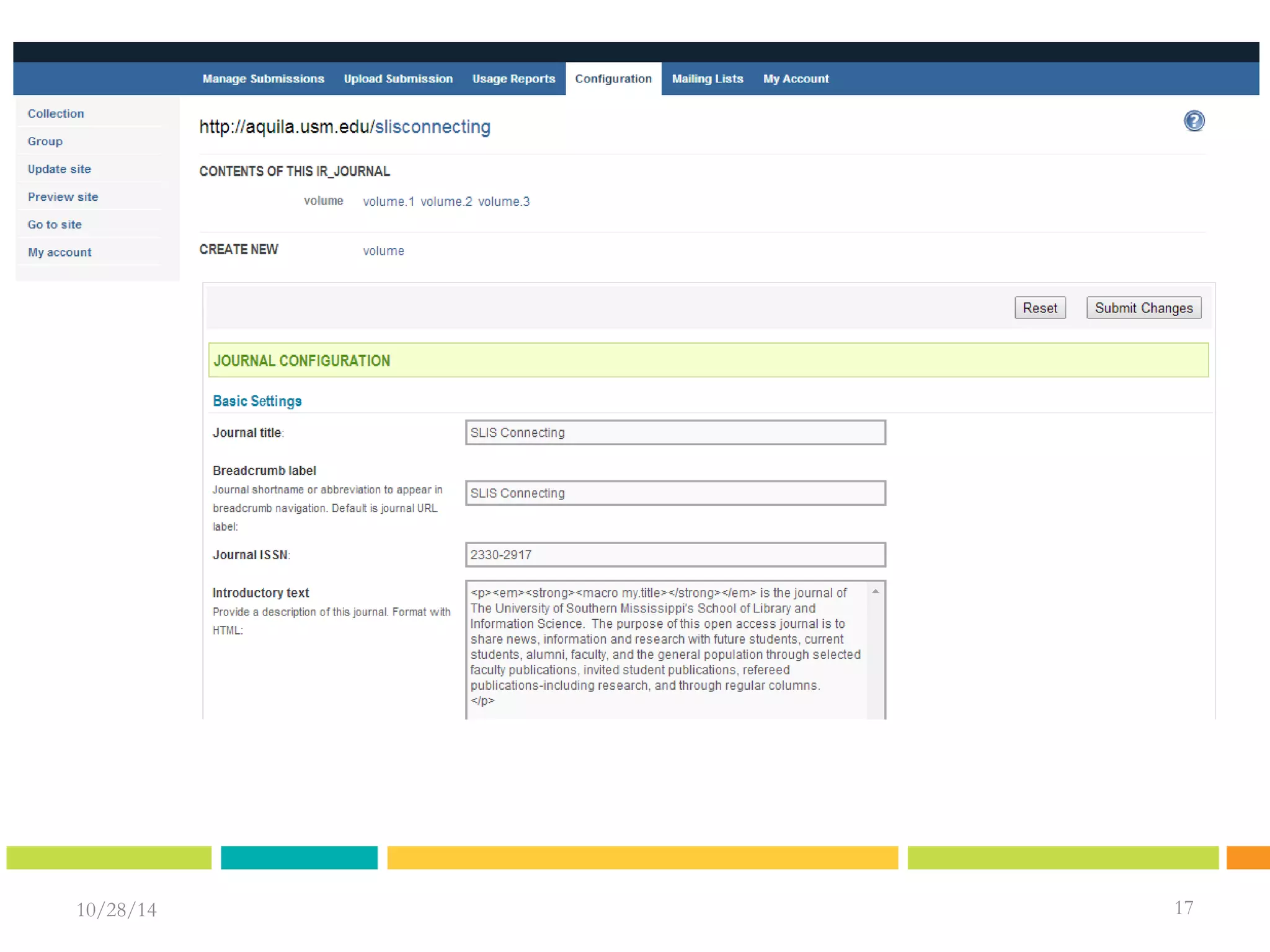
10/28/14 16
10/28/14 17
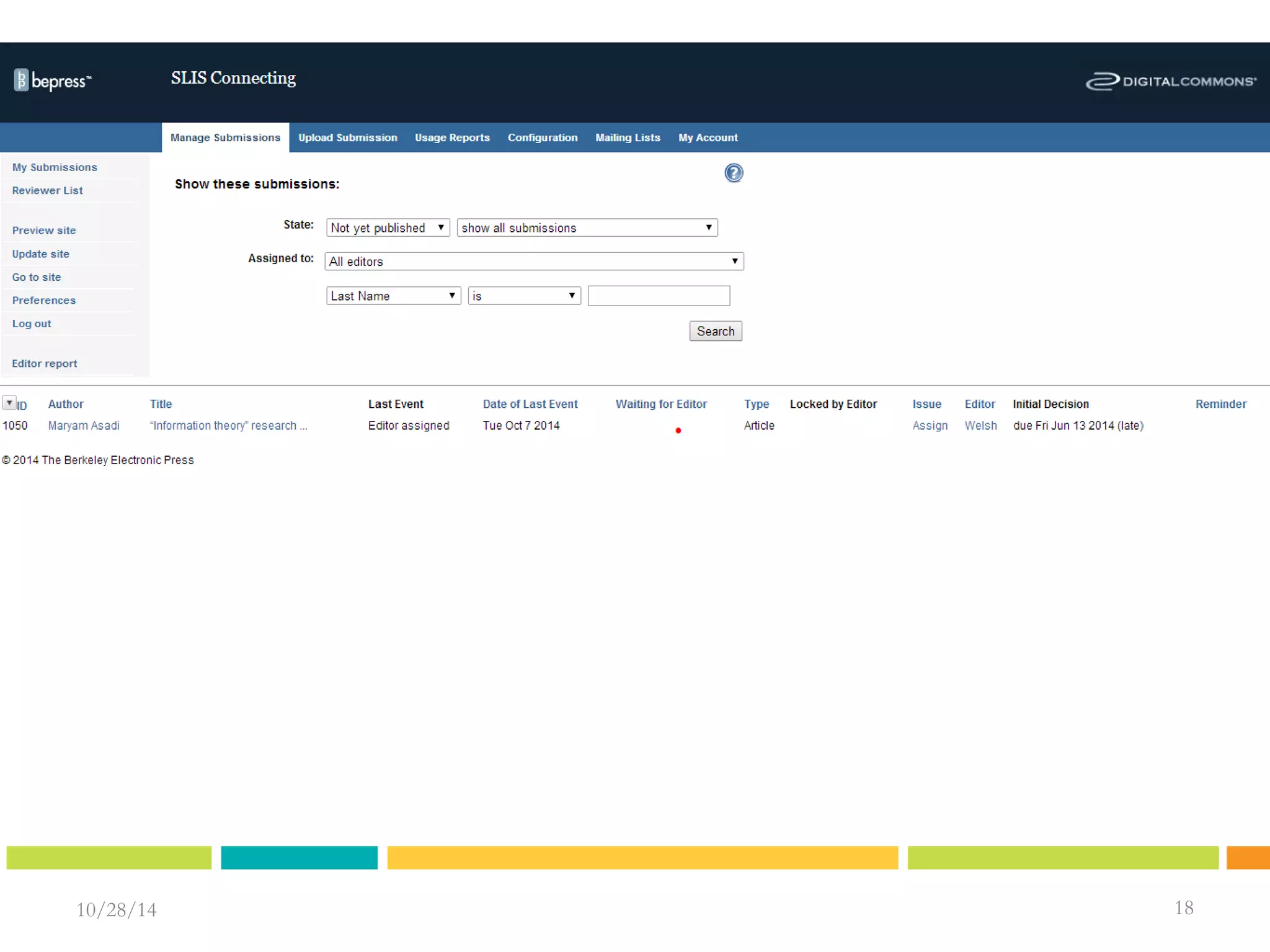
10/28/14 18
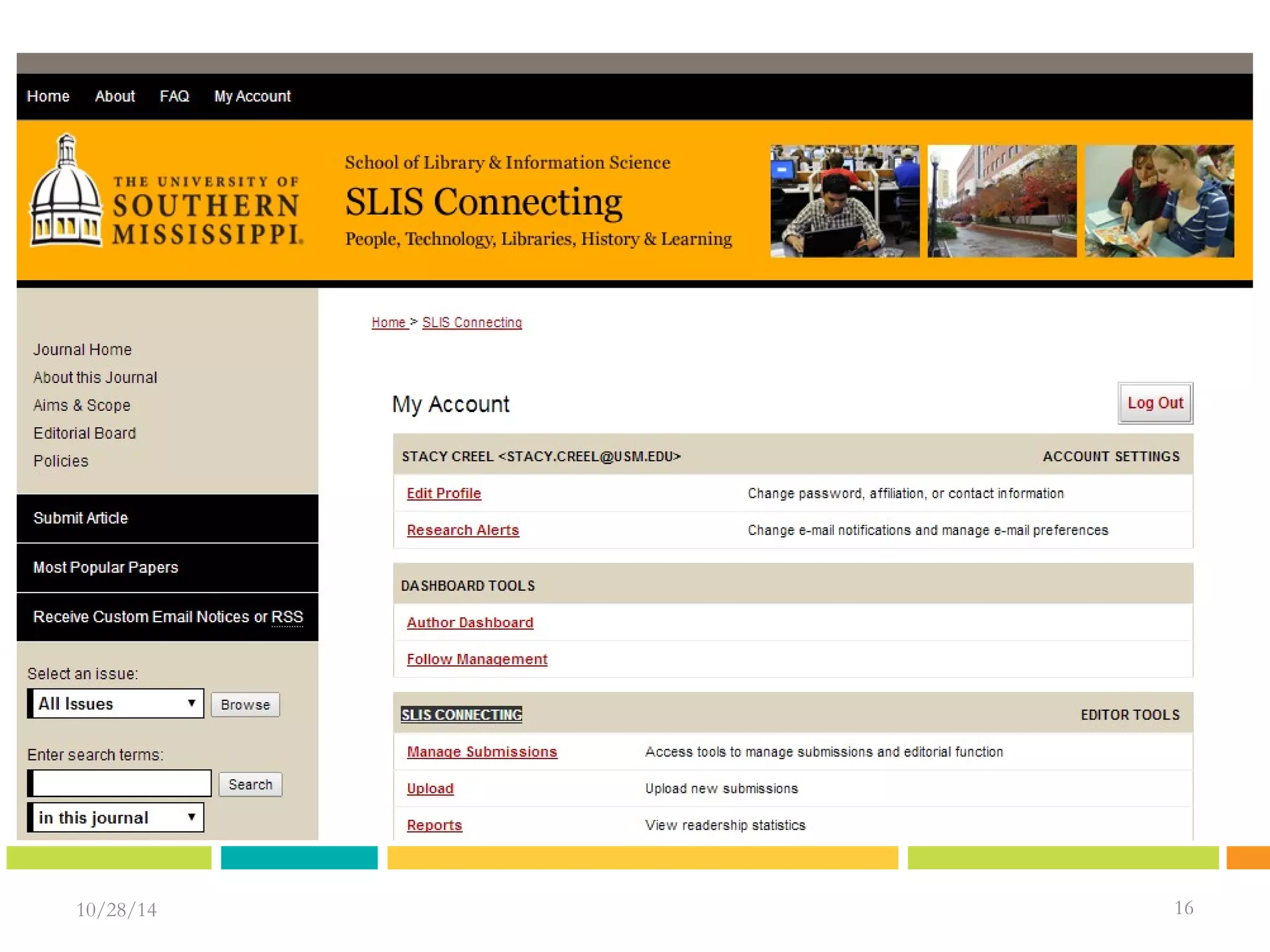
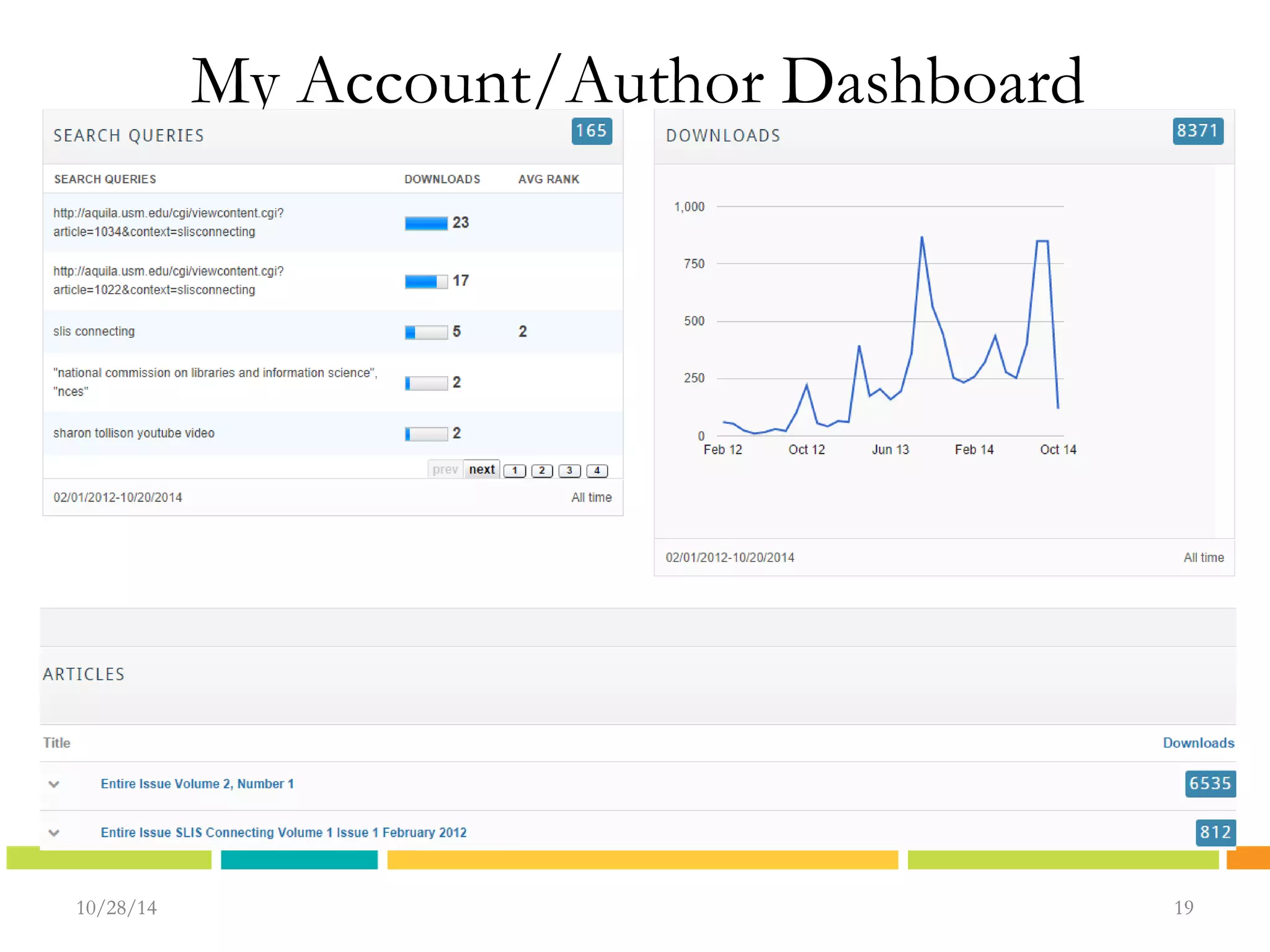
My Account/Author Dashboard 
1100//2288//1144 1199 
19
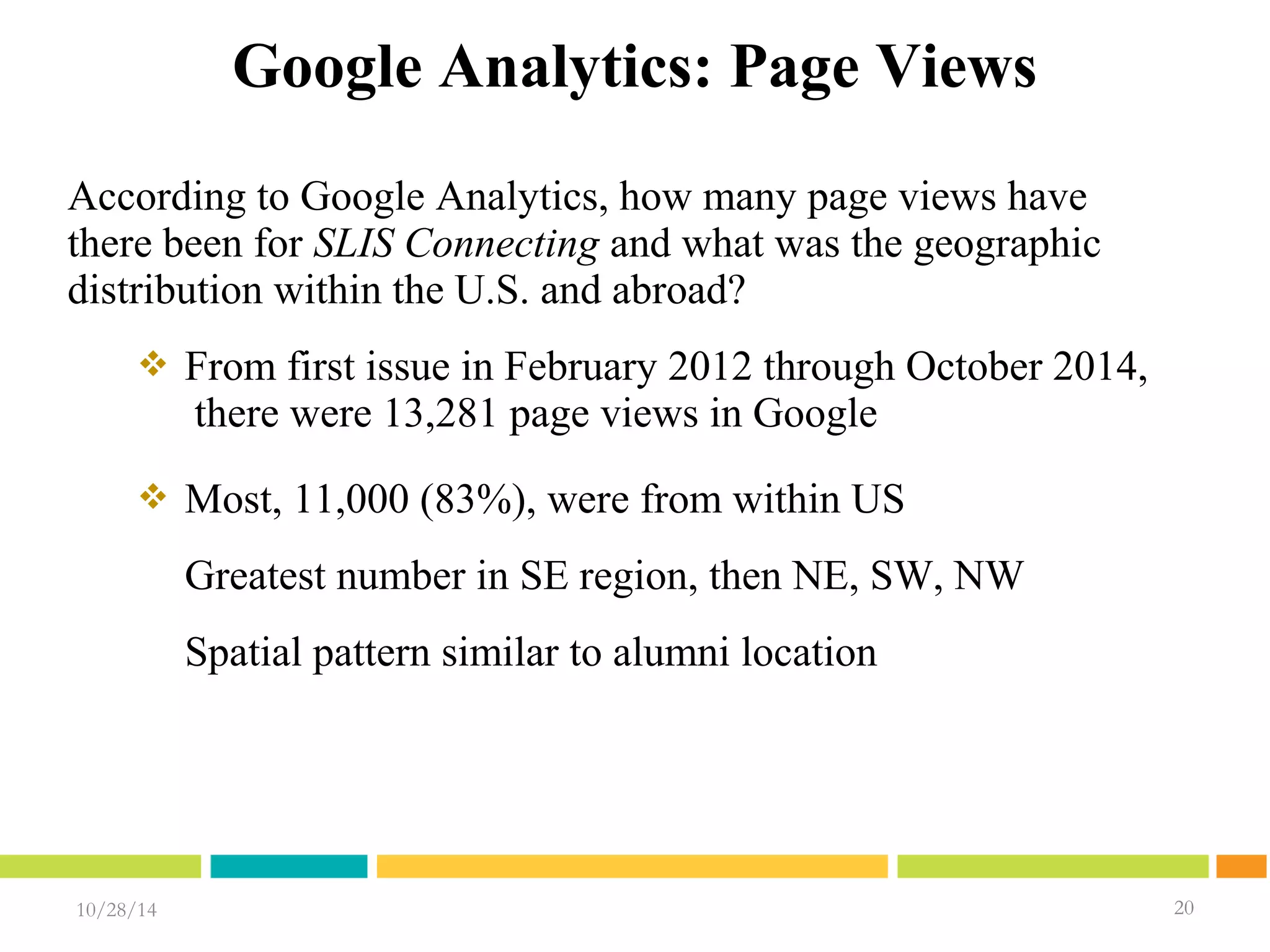
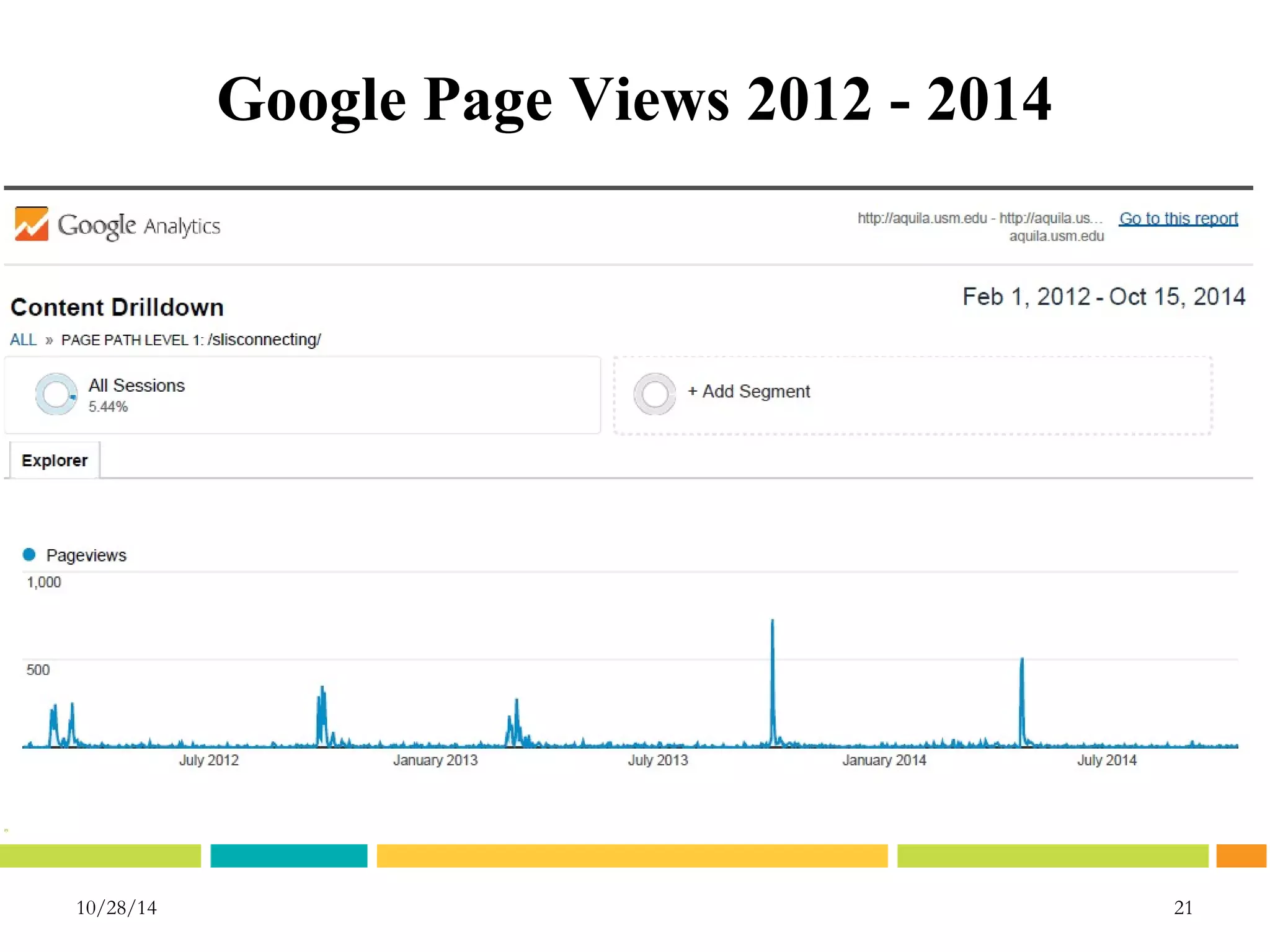
Google Analytics: Page Views 
10/28/14 2200 
20 
According to Google Analytics, how many page views have 
there been for SLIS Connecting and what was the geographic 
distribution within the U.S. and abroad? 
 From first issue in February 2012 through October 2014, 
there were 13,281 page views in Google 
 Most, 11,000 (83%), were from within US 
Greatest number in SE region, then NE, SW, NW 
Spatial pattern similar to alumni location
10/28/14 21 
21 
Google Page Views 2012 - 2014
10/28/14 2222 
22 
Page Views outside U.S. 
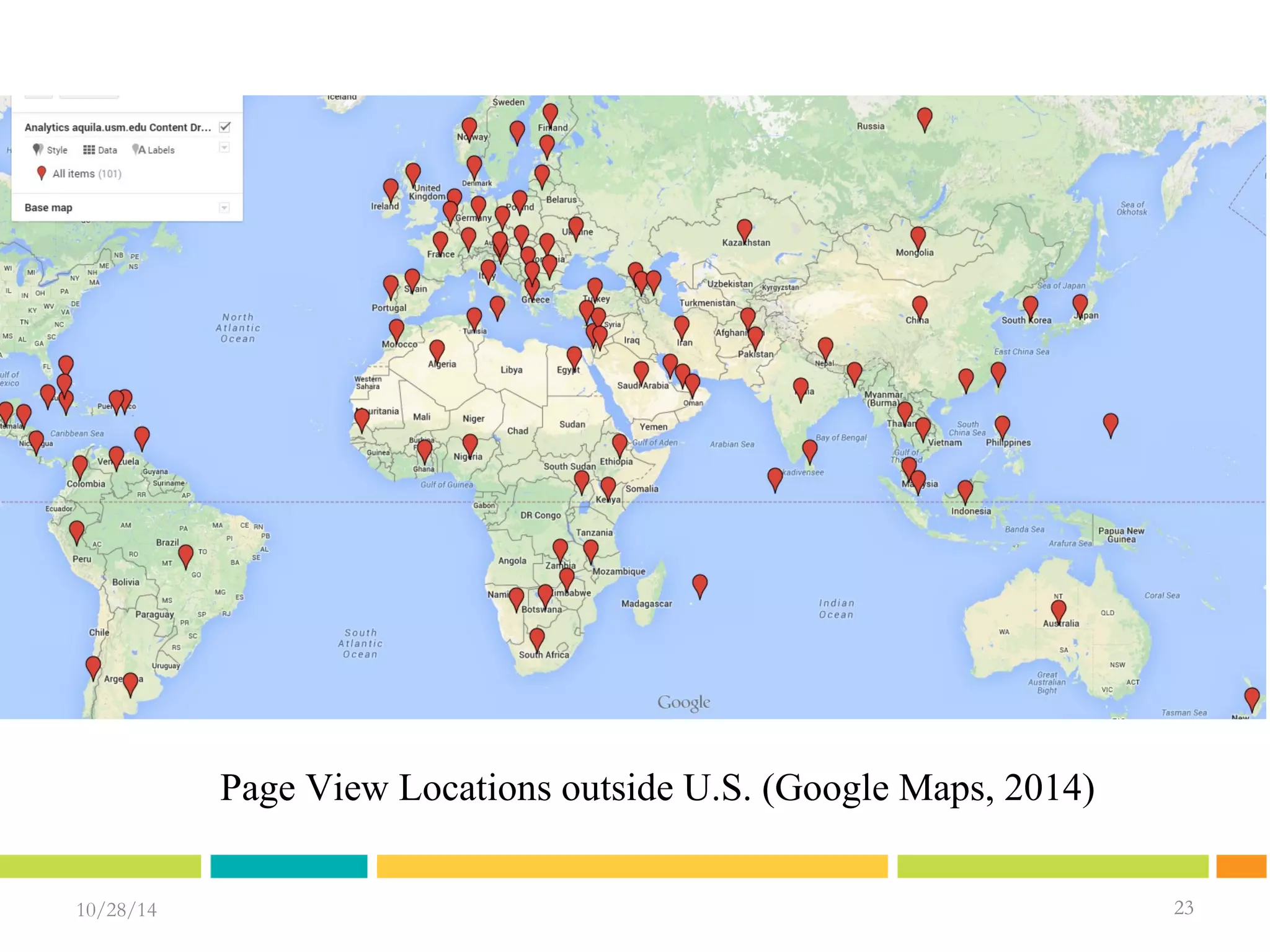
What was the geographic distribution of page views 
internationally, outside the U.S.? 
 2,201 (Google) page views in 101 countries 
 Top 7 countries: Iran (283), UK (232), Canada (216), 
Nigeria (134), India (127), Australia (117), China (82) 
 Greatest number to least by continent: North America, 
Europe, Asia, Africa, South America 
 Spatial pattern indicates much wider audience than 
SLIS students and alums
10/28/14 2233 
23 
Page View Locations outside U.S. (Google Maps, 2014)
10/28/14 2244 
24 
Discussion 
 Patterns in U.S. similar to alumni distribution 
 Unexpected international reach: 
 Open-access 
 Indexed in Google and Google Scholar 
 Announcements of new issues posted on listservs, 
Facebook, Twitter, LinkedIn 
 Mix of refereed student research, essays, and columns 
with news of SLIS courses, faculty, alums, students 
 Great tool for recruitment, outreach to students and alums 
 Promotes connectivity and community-building among SLIS 
faculty, students, alums.
10/28/14 2255 
25 
References 
 Davidson, L.A. (2005). The end of print: Digitization and its 
consequence – revolutionary changes in scholarly and social 
communication in scientific research. International Journal of 
Toxicology 24, 25-34. 
 Calise, M, de Rosa, R., & Fernandez i Marin, X (2010). Electronic 
publishing, knowledge sharing and open access: A new environment 
for political science, European Political Science 9, S50-S60. 
 Tenopir, C. & Wolverton, R.E. (2005). Conference report: 
Discovering the magic: Faculty and student use of electronic journals, 
The Serials Librarian 49, 159-164. 
 Welsh, T.S. & Creel, S. (2013). Geographic distribution of an open 
access e-journal. Information Services & Use 33(3/4), 103-111.
Thank you for your attention…. 
Questions? 
Dr. Stacy Creel 
stacy.creel@usm.edu 
Dr. Teresa S. Welsh 
aquila.usm.edu/slisconnecting/ teresa.welsh@usm.edu

Creation and Distribution of an Open-Access e-Journal

  • 1.
    Creation and Distributionof an Open Access e-Journal Dr. Stacy Creel stacy.creel@usm.edu Dr. Teresa S. Welsh teresa.welsh@usm.edu
  • 2.
    Digital Commons 10/28/142 2 1. Planned for an e-newsletter 2. Expanded to an e-journal 3. SLIS Connecting  Connecting people, technology, libraries, history & learning  ‘to share news, info, and research.… through selected faculty publications, student publications, refereed papers, columns’ aquila.usm.edu/slisconnecting/
  • 3.
  • 4.
    Literature: Print toDigital  ‘The transformation from print to digital media for scientific communication, driven in part by the growth of the Internet and the tremendous explosion in the amount of information now available to everybody, is creating fundamental changes in institutions such as publishers, libraries, and universities’ (Davidson, 2005)  ‘Web has changed the way academics share, promote, and locate information’ (Calise et al., 2010)  ‘In the use of electronic journals by academics, convenience, including free access, is important’ (Tenopir & Wolverton, 2005) 10/28/14 4
  • 5.
    Bepress  Foundedin 1999 because….  ‘academic journals were plagued by slow turnaround times, limited access, and unreasonable prices’(bepress.com )  Developed online editorial management system that supports peer-review process  Developed Digital Commons for institutional repositories to...  ‘support faculty in creating and editing sustainable scholarly journals, as well as a variety of other publishing initiatives like e-only press imprints, conference proceedings, student research, and more’ (bepress.com) 10/28/14 5
  • 6.
    Bepress (cont’d) License w/Digital Commons entitles institution to:  Setup, training, technical support, upgrades, hosting  5 free e-journals, includes set-up design  Digital Commons  Includes EdiKit™ professional-grade , peer-review/ editorial management system  Supports social networking: Facebook, Linkedin, Twitter, StumbleUpon, Pinterest, RSS, etc.  Tracks usage data including page views and downloads by geographic location 10/28/14 6
  • 7.
    SLIS Connecting 10/28/147 7  First e-journal in USM Aquila Digital Community  1st issue – February 2012  Most downloaded Aquila e-journal  (Online Journal of Health Ethics is second)  Top Digital Commons e-journal in archival science
  • 8.
    10/28/14 88 8 Downloads How many items have been downloaded since spring 2012?  24,723 downloads Which items were downloaded most?  ‘An Analysis of Little Red Riding Hood Storybooks in the de Grummond Collection’ by Cheryl Pittman, (Issue 2), 4,395 downloads (18%)  ‘A Content Analysis of Cinderella Illustrated StorybooksHoused in the de Grummond Collection’ by Kimberly Smith (Issue 1), 3,354 downloads (14%)
  • 9.
  • 10.
    SLIS Connecting islicensed under a Creative Commons Attribution-NonCommercial 4.0 International . 10/28/14 1100 10
  • 11.
    ISSN: 2330-2917 International Standard Serial Number  8-digit code used to identify newspapers, journals, magazines and periodicals of all kinds (worldwide) and on all media–print and electronic.  http://www.issn.org/services/requesting-an-issn/ 10/28/14 1111 11 http://www.issn.org/understanding-the-issn/what-is-an-issn/#
  • 12.
     Increase thevisibility  Increase ease of use of open access scientific and scholarly journals  Comprehensive and cover all open access scientific and scholarly journals  Standard of quality to guarantee the content 10/28/14 1122 12
  • 13.
     Open AccessJournal: right to "read, download, copy, distribute, print, search, or link to the full texts of these articles"  Quality Control: peer-review or editorial quality control  Research Journal: report primary results or overviews of research  Periodical: regular interval serial without end 10/28/14 1133 13
  • 14.
     56 questionsfrom the simple (like your name) to more complex (like digital archiving policy)  Can take 3 to 6 months  Journal's ISSN(s) number(s), country of publisher, and title registered at issn.org matches the application  An editorial board with identifiable members (plus their contacts). 10/28/14 1144 14
  • 15.
     Full textof articles is free and immediately available upon publication (no embargo)  Open Access policy is clearly stated and easily findable on Web site  Uses some form of peer review  Is open access according to BOAI definition ( http://www.budapestopenaccessinitiative.org/)  No charges or explicitly described charges 10/28/14 1155 15
  • 16.
  • 17.
  • 18.
  • 19.
    My Account/Author Dashboard 1100//2288//1144 1199 19
  • 20.
    Google Analytics: PageViews 10/28/14 2200 20 According to Google Analytics, how many page views have there been for SLIS Connecting and what was the geographic distribution within the U.S. and abroad?  From first issue in February 2012 through October 2014, there were 13,281 page views in Google  Most, 11,000 (83%), were from within US Greatest number in SE region, then NE, SW, NW Spatial pattern similar to alumni location
  • 21.
    10/28/14 21 21 Google Page Views 2012 - 2014
  • 22.
    10/28/14 2222 22 Page Views outside U.S. What was the geographic distribution of page views internationally, outside the U.S.?  2,201 (Google) page views in 101 countries  Top 7 countries: Iran (283), UK (232), Canada (216), Nigeria (134), India (127), Australia (117), China (82)  Greatest number to least by continent: North America, Europe, Asia, Africa, South America  Spatial pattern indicates much wider audience than SLIS students and alums
  • 23.
    10/28/14 2233 23 Page View Locations outside U.S. (Google Maps, 2014)
  • 24.
    10/28/14 2244 24 Discussion  Patterns in U.S. similar to alumni distribution  Unexpected international reach:  Open-access  Indexed in Google and Google Scholar  Announcements of new issues posted on listservs, Facebook, Twitter, LinkedIn  Mix of refereed student research, essays, and columns with news of SLIS courses, faculty, alums, students  Great tool for recruitment, outreach to students and alums  Promotes connectivity and community-building among SLIS faculty, students, alums.
  • 25.
    10/28/14 2255 25 References  Davidson, L.A. (2005). The end of print: Digitization and its consequence – revolutionary changes in scholarly and social communication in scientific research. International Journal of Toxicology 24, 25-34.  Calise, M, de Rosa, R., & Fernandez i Marin, X (2010). Electronic publishing, knowledge sharing and open access: A new environment for political science, European Political Science 9, S50-S60.  Tenopir, C. & Wolverton, R.E. (2005). Conference report: Discovering the magic: Faculty and student use of electronic journals, The Serials Librarian 49, 159-164.  Welsh, T.S. & Creel, S. (2013). Geographic distribution of an open access e-journal. Information Services & Use 33(3/4), 103-111.
  • 26.
    Thank you foryour attention…. Questions? Dr. Stacy Creel stacy.creel@usm.edu Dr. Teresa S. Welsh aquila.usm.edu/slisconnecting/ teresa.welsh@usm.edu

Editor's Notes

  • #7 SLIS co-sponsors the prestigious Kay B. Kaigler Children’s Book Festival with the de Grummond Children’s Literature Collection, an internationally-recognized collection of primary-source materials related to children’s literature. http://www.usm.edu/bookfest/
  • #8 One of the courses offered through the Southern Miss British Studies Program is LIS 580/587, British Libraries and Information Centers, a 6 credit-hour course. In summer 2010, 32 students from 17 different universities across the U.S. participated in the course, which is based in King’s College, near the South Bank of the Thames in London, and Dalkeith Estate near Edinburgh, Scotland. Distinguished British archivists and information specialists generously shared their knowledge and expertise on the history and preservation of their historic collections via behind-the-scenes guided tours and lectures at repositories such as the British Library Preservation Studio and Sir John Ritblat Gallery, Greenwich Maritime Museum Library, London Library Preservation Department, British National Art Library at the Victoria & Albert Museum, National Archives of Scotland, Dunfermline Carnegie Library Special Collections, and King’s College Maughan Library Special Collections. Students had the opportunity to examine some rare, historic treasures at each site, such as three different, original copies of Shakespeare’s First Folio. They learned about the history and content of the collections they visited, about archival conservation and preservation standards and practices, and about efforts to increase public access to primary-source materials through unique digitization initiatives such as British Library’s Turning the Pages virtual exhibit.
  • #11 You are free to: Share — copy and redistribute the material in any medium or format Adapt — remix, transform, and build upon the material The licensor cannot revoke these freedoms as long as you follow the license terms. Under the following terms: Attribution — You must give appropriate credit, provide a link to the license, andindicate if changes were made. You may do so in any reasonable manner, but not in any way that suggests the licensor endorses you or your use. NonCommercial — You may not use the material for commercial purposes. No additional restrictions — You may not apply legal terms or technological measures that legally restrict others from doing anything the license permits.
  • #12 We wanted an ISSN to boost the legitimacy of the journal and for our application with DOAJ
  • #13 Aims & Scope The aim of the DOAJ is to increase the visibility and ease of use of open access scientific and scholarly journals, thereby promoting their increased usage and impact. The DOAJ aims to be comprehensive and cover all open access scientific and scholarly journals that use a quality control system to guarantee the content. In short, the DOAJ aims to be the one-stop shop for users of open access journals.
  • #14 Aims & Scope The aim of the DOAJ is to increase the visibility and ease of use of open access scientific and scholarly journals, thereby promoting their increased usage and impact. The DOAJ aims to be comprehensive and cover all open access scientific and scholarly journals that use a quality control system to guarantee the content. In short, the DOAJ aims to be the one-stop shop for users of open access journals. Definitions Open Access Journal: We define open access journals as journals that use a funding model that does not charge readers or their institutions for access. From the BOAI definition [1] of "open access", we support the rights of users to "read, download, copy, distribute, print, search, or link to the full texts of these articles" as mandatory for a journal to be included in the directory. [1] http://www.earlham.edu/~peters/fos/boaifaq.htm#openaccess Quality Control: The journal must exercise peer-review or editorial quality control to be included. Research Journal: Journals that report primary results of research or overviews of research results to a scholarly community. Periodical: A serial appearing, or intending to appear, indefinitely at regular intervals and generally more frequently than annually, each issue of which is numbered or dated consecutively and normally contains separate articles, stories, or other writings.
  • #15 example of some of the things that we will check: That the journal's ISSN(s) number(s) is registered at issn.org and matches the application; That the title in the application matches what that registered at issn.org; That the country of the publisher in the application matches that registered at issn.org; That the journal has an editorial board with identifiable members; we will ask for members' contact details as part of the application review process. These will not be made publicly available.
  • #16 That the full text of articles is free and immediately available upon publication; That there is no embargo (delay) on the content being made freely available; That the journal's Open Access policy is clearly stated and easily findable on the web site; That the journal executes some form of peer review, that it is clearly stated on the web site and it matches that which is stated in the application form; That the journal is Open Access according to the BOAI definition. By this we mean that the journal's articles have "free availability on the public internet, permitting any users to read, download, copy, distribute, print, search, or link to the full texts of these articles, crawl them for indexing, pass them as data to software, or use them for any other lawful purpose, without financial, legal, or technical barriers other than those inseparable from gaining access to the internet itself." That if the journal has article processing charges (APCs), they are clearly stated and easily findable on the web site; That if the journal has any other kind of author charges, they are clearly stated and easily findable on the web site; That the language of the full text articles match the language stated in the application.