Who’s citing whom? An introduction to citation searching and journal citation reports. Prepared by Kara Jones & Suzanne White Library & Learning Centre University of Bath March 2007
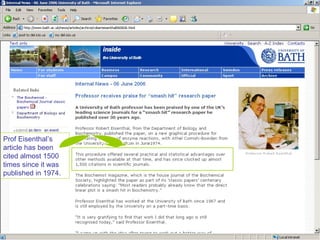
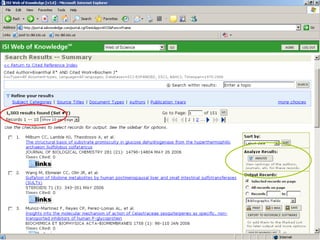
Prof Eisenthal’s article has been cited almost 1500 times since it was published in 1974.
Goals By the end of today’s session you will be able to: Find highly cited articles or authors Find who has cited your articles Find out who is writing on the same topic Learn which scholarly journals are the most popular and the ‘hottest’!
Outline Cited reference searching Using Web of Knowledge Overview of topic – as a search technique and as a data gathering tool Other citation search tools Journal impact factors Overview of topic Using JCR for impact factors, immediacy index
Cited Reference Searching Cited reference searching enables you to find articles that have cited a previously published work.  Through a cited reference search, you can discover how a known idea or innovation has been confirmed, applied, improved, extended or corrected.  http://wos.isiknowledge.com/help/hcr_lookup.htm#crlookup#crlookup Citation searching is useful to see how much your own work has been cited by others.  This will give an idea of your work on the broader research community.
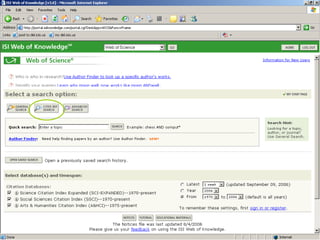
Web of Knowledge Web of Science ISI Proceedings Biosis Previews Web Citation Index Journal Citation Reports Who has used any of these?  Which databases do you usually search?
Using Web of Science The Web of Science is a respected and comprehensive index, composed of three large databases: Arts and Humanities Index (1975 -  ) Social Science Citation Index (1970 -  ) Science Citation Index (1970 -  )
Cited Reference Searching What is cited reference searching? Example:  Bartsch, R.A. & Cobern, K.M., 2003.  Effectiveness of PowerPoint presentations in lectures .  Computers & Education, 41(7), pp. 77-86.
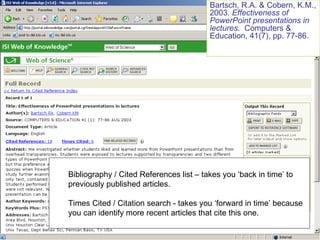
Bibliography / Cited References list – takes you ‘back in time’ to previously published articles. Times Cited / Citation search - takes you ‘forward in time’ because you can identify more recent articles that cite this one. Bartsch, R.A. & Cobern, K.M., 2003.  Effectiveness of PowerPoint presentations in lectures .  Computers & Education, 41(7), pp. 77-86.
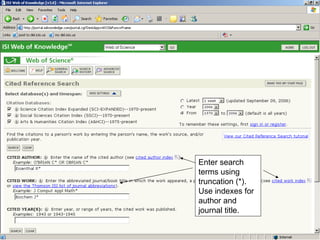
Cited reference searching Cited reference search - WoS Can only search for author, journal title and year. Use truncation (*) Use the indexes provided
 
Enter search terms using truncation (*). Use indexes for author and journal title.
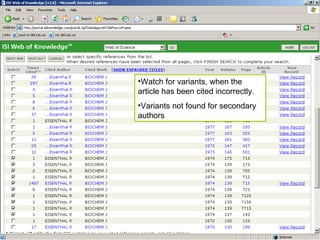
Watch for variants, when the article has been cited incorrectly. Variants not found for secondary authors
 
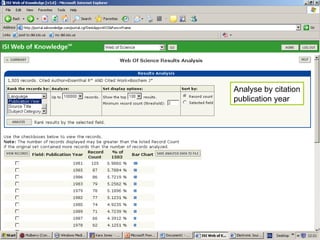
Analyse by citation publication year
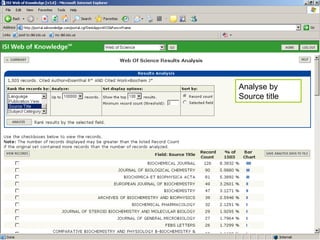
Analyse by Source title
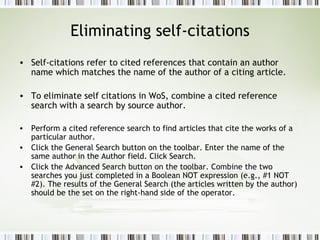
Eliminating self-citations Self-citations refer to cited references that contain an author name which matches the name of the author of a citing article.  To eliminate self citations in WoS, combine a cited reference search with a search by source author. Perform a cited reference search to find articles that cite the works of a particular author.  Click the General Search button on the toolbar. Enter the name of the same author in the Author field. Click Search.  Click the Advanced Search button on the toolbar. Combine the two searches you just completed in a Boolean NOT expression (e.g., #1 NOT #2). The results of the General Search (the articles written by the author) should be the set on the right-hand side of the operator.
Example / experiment Access the cited reference search in Web of Science. Search for a journal article you / a colleague has published. Practice searching using the examples on your handout. Tutorial available at bottom of cited ref page!
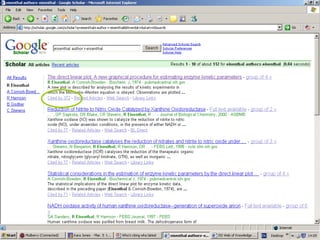
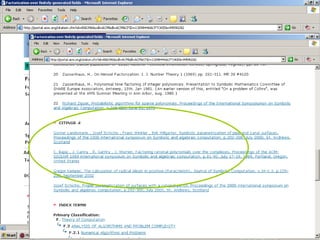
Cited Reference Searching Elsewhere Google Scholar – scholar.google.com Many journal indexes, ie. ACM Digital Library, Emerald, etc…


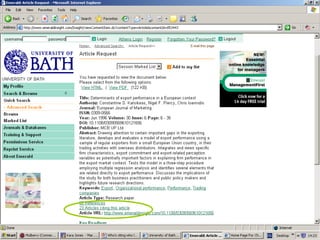
Practice time Use this example for cited reference searching, or choose your own example.
The best measure? Professor Frank Jackson from the Australian National University was chosen as a ‘citation laureate’ by Thomson ISI (publisher of Web of Science).  He wrote two much discussed papers setting out an argument in the philosophy of mind – an argument he has since repudiated. “ These later papers get cited a fair bit but not as much as those that presented the views I no longer accept… but that’s life,” Professor Jackson said.* Lane, Bernard.  2006 ‘Over-citation puts integrity under cloud’.  The Australian [online].  Available:  http://www.theaustralian.news.com.au/story/0,20867,20063447-12332,00.html.  [Accessed: 9 Aug 2006]. Can you foresee any other difficulties with this method?
Where to publish? Journal impact factors using ISI Journal Citation Reports A tool to show characteristics of a particular journal or journals within a certain subject area. May provide information to help decide which journals to publish in.
Journal Citation Reports Most frequently cited journals in a field Hottest journals in a field (immediacy index) Allows a comparison between different journals in the same field JCR – 7600 journals from more than 3300 publishers. Science edition:  5900 journals Social Science edition:  1700 journals ‘ JCR year’ – The year the report data was collected 1997 - 2005
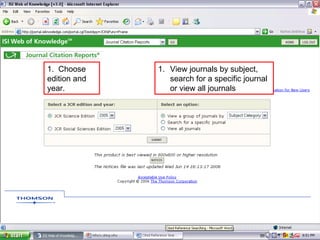
1.  Choose edition and year. View journals by subject, search for a specific journal or view all journals
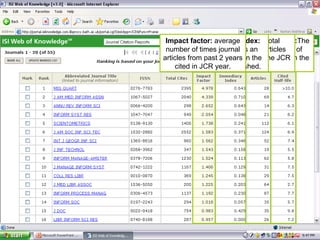
Cited half-life: The median age of articles cited in the JCR year. Articles: Total number of articles published in the JCR year. Immediacy index:  average times an article is cited in the year it is published. Impact factor:  average number of times journal articles from past 2 years cited in JCR year.
Journal impact factor The journal impact factor is the average number of times articles from the journal published in the past two years have been cited in the JCR year.  Calculated by dividing the number of citations in the JCR year by the total number of articles published in the previous two years.
Immediacy index The average number of times a article is cited in the year it is published. Calculated by dividing the number of citations to articles published in a given year by the number of articles published in that year.  For comparing journals specializing in cutting-edge research, the immediacy index can provide a useful perspective.  Frequently issued journals have the advantage.
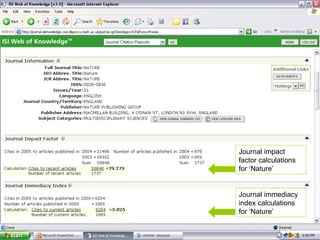
Journal impact factor calculations for ‘Nature’ Journal immediacy index calculations for ‘Nature’
Practice time Search either the Science / Social Science edition of JCR for a particular journal, or compare journals in a subject area.
Controversy! Caution: Citations do not indicate quality – people may be citing an article to dispute its findings Not all research work is published An impact factor is an average of articles in a journal, not an individual article. New journals and title changes may fare badly Citation bias – people may cite their own work Bias in favour of English language material
Questions? Presenter: Kara Jones University of Bath  Library and Learning Centre Claverton Down Bath  BA2 7AY UK

Who's citing whom?

  • 1.
    Who’s citing whom?An introduction to citation searching and journal citation reports. Prepared by Kara Jones & Suzanne White Library & Learning Centre University of Bath March 2007
  • 2.
    Prof Eisenthal’s articlehas been cited almost 1500 times since it was published in 1974.
  • 3.
    Goals By theend of today’s session you will be able to: Find highly cited articles or authors Find who has cited your articles Find out who is writing on the same topic Learn which scholarly journals are the most popular and the ‘hottest’!
  • 4.
    Outline Cited referencesearching Using Web of Knowledge Overview of topic – as a search technique and as a data gathering tool Other citation search tools Journal impact factors Overview of topic Using JCR for impact factors, immediacy index
  • 5.
    Cited Reference SearchingCited reference searching enables you to find articles that have cited a previously published work. Through a cited reference search, you can discover how a known idea or innovation has been confirmed, applied, improved, extended or corrected. http://wos.isiknowledge.com/help/hcr_lookup.htm#crlookup#crlookup Citation searching is useful to see how much your own work has been cited by others. This will give an idea of your work on the broader research community.
  • 6.
    Web of KnowledgeWeb of Science ISI Proceedings Biosis Previews Web Citation Index Journal Citation Reports Who has used any of these? Which databases do you usually search?
  • 7.
    Using Web ofScience The Web of Science is a respected and comprehensive index, composed of three large databases: Arts and Humanities Index (1975 - ) Social Science Citation Index (1970 - ) Science Citation Index (1970 - )
  • 8.
    Cited Reference SearchingWhat is cited reference searching? Example: Bartsch, R.A. & Cobern, K.M., 2003. Effectiveness of PowerPoint presentations in lectures . Computers & Education, 41(7), pp. 77-86.
  • 9.
    Bibliography / CitedReferences list – takes you ‘back in time’ to previously published articles. Times Cited / Citation search - takes you ‘forward in time’ because you can identify more recent articles that cite this one. Bartsch, R.A. & Cobern, K.M., 2003. Effectiveness of PowerPoint presentations in lectures . Computers & Education, 41(7), pp. 77-86.
  • 10.
    Cited reference searchingCited reference search - WoS Can only search for author, journal title and year. Use truncation (*) Use the indexes provided
  • 11.
  • 12.
    Enter search termsusing truncation (*). Use indexes for author and journal title.
  • 13.
    Watch for variants,when the article has been cited incorrectly. Variants not found for secondary authors
  • 14.
  • 15.
    Analyse by citationpublication year
  • 16.
  • 17.
    Eliminating self-citations Self-citationsrefer to cited references that contain an author name which matches the name of the author of a citing article. To eliminate self citations in WoS, combine a cited reference search with a search by source author. Perform a cited reference search to find articles that cite the works of a particular author. Click the General Search button on the toolbar. Enter the name of the same author in the Author field. Click Search. Click the Advanced Search button on the toolbar. Combine the two searches you just completed in a Boolean NOT expression (e.g., #1 NOT #2). The results of the General Search (the articles written by the author) should be the set on the right-hand side of the operator.
  • 18.
    Example / experimentAccess the cited reference search in Web of Science. Search for a journal article you / a colleague has published. Practice searching using the examples on your handout. Tutorial available at bottom of cited ref page!
  • 19.
    Cited Reference SearchingElsewhere Google Scholar – scholar.google.com Many journal indexes, ie. ACM Digital Library, Emerald, etc…
  • 20.
  • 21.
  • 22.
  • 23.
    Practice time Usethis example for cited reference searching, or choose your own example.
  • 24.
    The best measure?Professor Frank Jackson from the Australian National University was chosen as a ‘citation laureate’ by Thomson ISI (publisher of Web of Science). He wrote two much discussed papers setting out an argument in the philosophy of mind – an argument he has since repudiated. “ These later papers get cited a fair bit but not as much as those that presented the views I no longer accept… but that’s life,” Professor Jackson said.* Lane, Bernard. 2006 ‘Over-citation puts integrity under cloud’. The Australian [online]. Available: http://www.theaustralian.news.com.au/story/0,20867,20063447-12332,00.html. [Accessed: 9 Aug 2006]. Can you foresee any other difficulties with this method?
  • 25.
    Where to publish?Journal impact factors using ISI Journal Citation Reports A tool to show characteristics of a particular journal or journals within a certain subject area. May provide information to help decide which journals to publish in.
  • 26.
    Journal Citation ReportsMost frequently cited journals in a field Hottest journals in a field (immediacy index) Allows a comparison between different journals in the same field JCR – 7600 journals from more than 3300 publishers. Science edition: 5900 journals Social Science edition: 1700 journals ‘ JCR year’ – The year the report data was collected 1997 - 2005
  • 27.
    1. Chooseedition and year. View journals by subject, search for a specific journal or view all journals
  • 28.
    Cited half-life: Themedian age of articles cited in the JCR year. Articles: Total number of articles published in the JCR year. Immediacy index: average times an article is cited in the year it is published. Impact factor: average number of times journal articles from past 2 years cited in JCR year.
  • 29.
    Journal impact factorThe journal impact factor is the average number of times articles from the journal published in the past two years have been cited in the JCR year. Calculated by dividing the number of citations in the JCR year by the total number of articles published in the previous two years.
  • 30.
    Immediacy index Theaverage number of times a article is cited in the year it is published. Calculated by dividing the number of citations to articles published in a given year by the number of articles published in that year. For comparing journals specializing in cutting-edge research, the immediacy index can provide a useful perspective. Frequently issued journals have the advantage.
  • 31.
    Journal impact factorcalculations for ‘Nature’ Journal immediacy index calculations for ‘Nature’
  • 32.
    Practice time Searcheither the Science / Social Science edition of JCR for a particular journal, or compare journals in a subject area.
  • 33.
    Controversy! Caution: Citationsdo not indicate quality – people may be citing an article to dispute its findings Not all research work is published An impact factor is an average of articles in a journal, not an individual article. New journals and title changes may fare badly Citation bias – people may cite their own work Bias in favour of English language material
  • 34.
    Questions? Presenter: KaraJones University of Bath Library and Learning Centre Claverton Down Bath BA2 7AY UK

Editor's Notes

  • #2 Welcome. This session will introduce you to cited reference or citation searching as a tool for research. We will focus on using the Web of Science for this, with a brief reference to Scopus. This is followed by journal citation reports, particularly journal impact factors using ISI Journal Citation Reports to identify highly cited journals in a particular field.