
Information Architecture Development By: Zainal A. Hasibuan Magister of Information Technology Faculty of Computer Science, University of Indonesia, Nov 2009
Agenda How to create an effective information architecture? Information architecture (IA) development process Deliverables of IA development process Information architecture and usability Criteria for successful IA
Review Questions Define the meaning of information architecture (IA). Explain why an organization has to have an IA? What is the role of information architect who creates IA? What are the IA components? How these components interact in IA?
How to create an effective information architecture ? An effective information architecture comes from understanding : B usiness objectives Constraints C ontent R equirements of the people that will use the site. (Source: http://www.steptwo.com.au/papers/kmc_whatisinfoarch
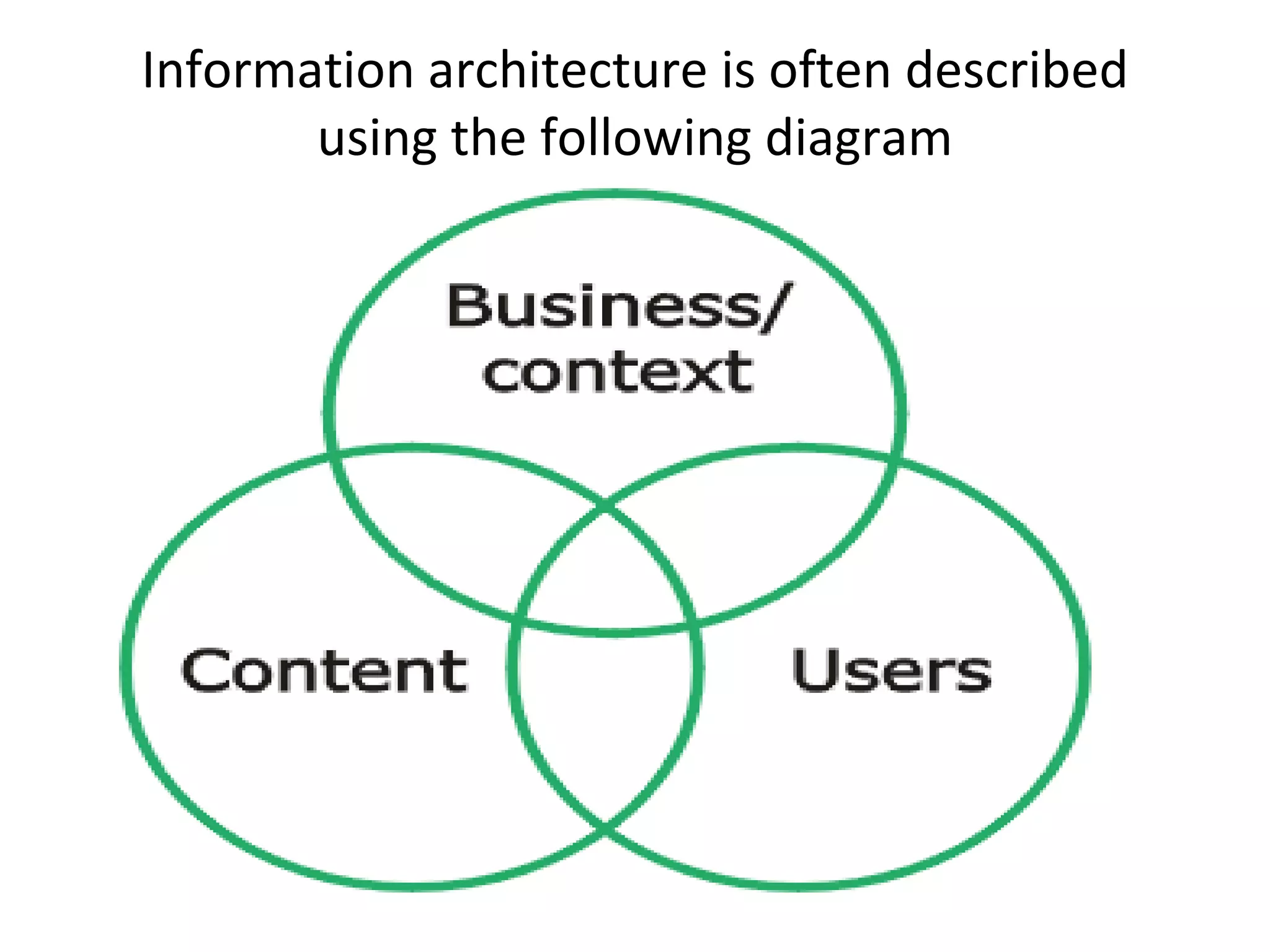
Information architecture is often described using the following diagram
Business/Context Understanding an organisations’ business objectives, politics, culture, technology, resources and constraints is essential before considering development of the information architecture. Techniques for understanding context include: Reading existing documentation  Mission statements, organisation charts, previous research and vision documents are a quick way of building up an understanding of the context in which the system must work.  Stakeholder interviews  Speaking to stakeholders provides valuable insight into business context and can unearth previously unknown objectives and issues.  For further information about stakeholder interviews, see our article “ Selecting staff for stakeholder interviews ”
Content The most effective method for understanding the quantity and quality of content (i.e. functionality and information) proposed for a system is to conduct a content inventory. Content inventories identify all of the proposed content for a system, where the content currently resides, who owns it and any existing relationships between content. Content inventories are also commonly used to aid the process of migrating content between the old and new systems. Effective IA must reflect the way people think
USERS An effective information architecture must reflect the way people think about the subject matter. Techniques for getting users involved in the creation of an information architecture include: Card sorting Card sorting involves representative users sorting a series of cards, each labelled with a piece of content or functionality, into groups that make sense to them. Card sorting generates ideas for how information could be grouped and labelled. Card-based classification evaluation Card-based classification evaluation is a technique for testing an information architecture before it has been implemented. The technique involves writing each level of an information architecture on a large card, and developing a set of information-seeking tasks for people to perform using the architecture.
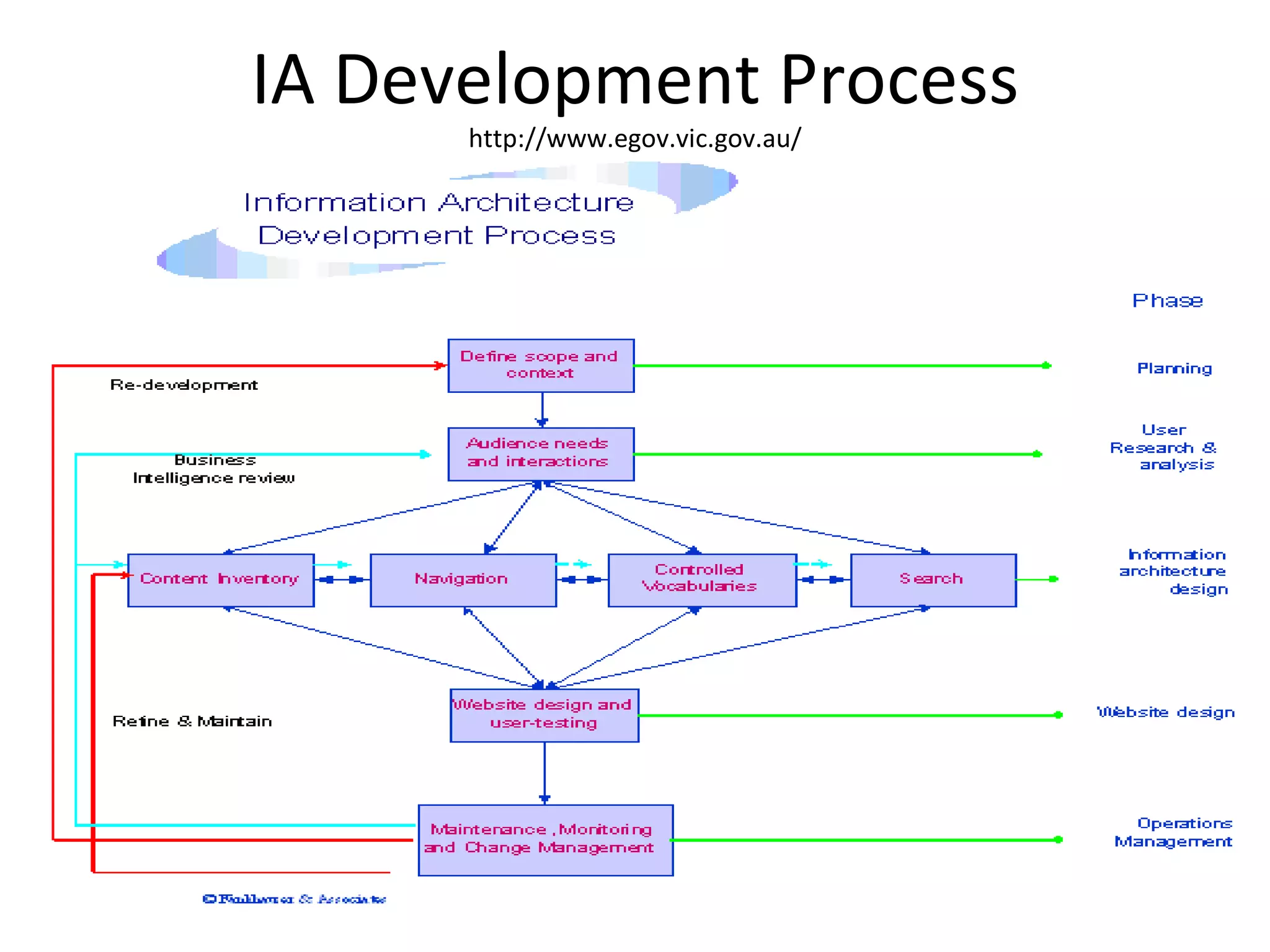
IA Development Process http://www.egov.vic.gov.au/
Approaches to Define IA Top-down information architecture .   This involves developing a broad understanding of the business strategies and user needs, before defining the high level structure of site, and finally the detailed relationships between content. Bottom-up information architecture .   This involves understanding the detailed relationships between content, creating walkthroughs (or storyboards) to show how the system could support specific user requirements and then considering the higher level structure that will be required to support these requirements.  Take a structured approach to creat e  an effective IA
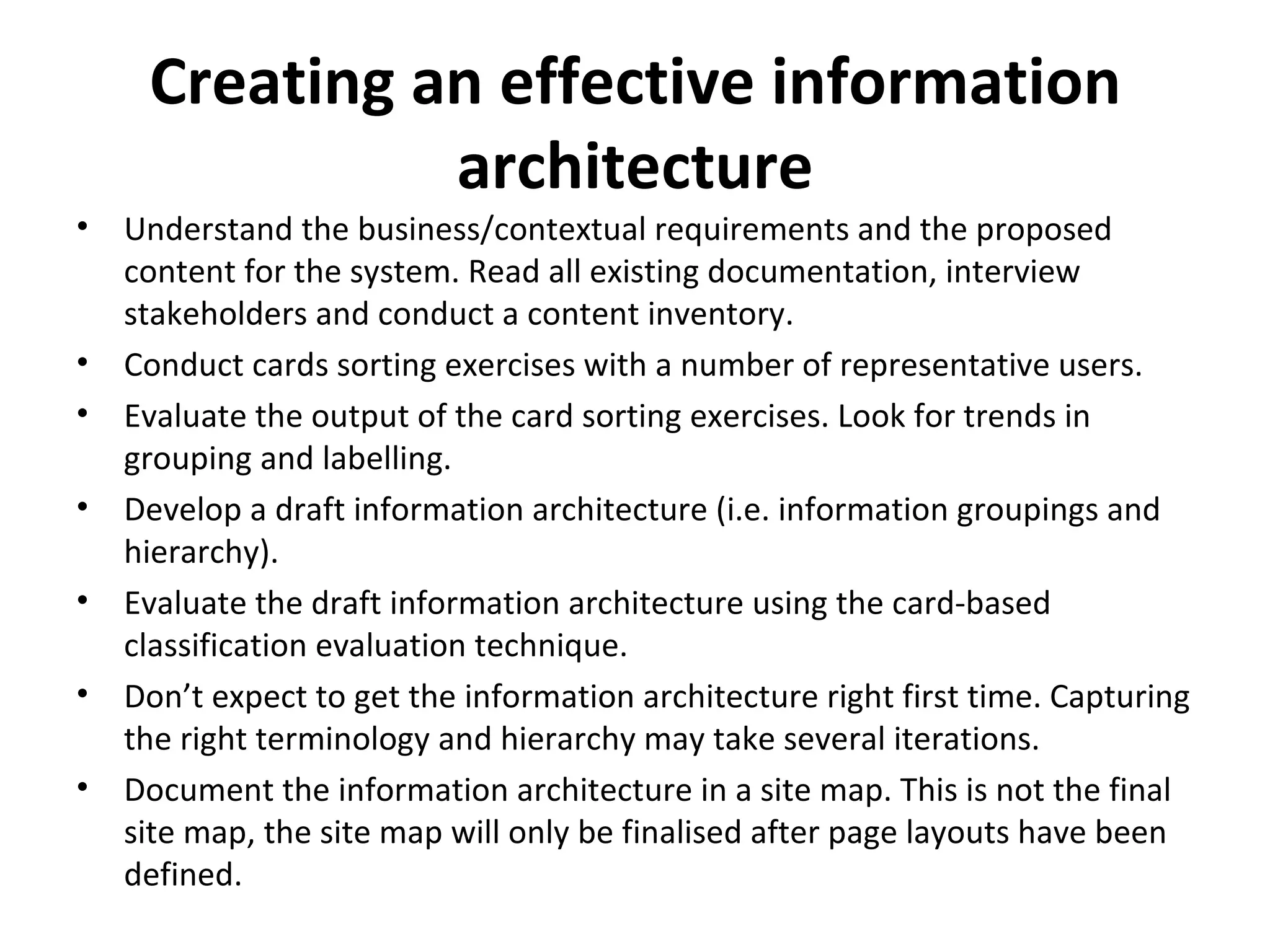
Creating an effective information architecture Understand the business/contextual requirements and the proposed content for the system. Read all existing documentation, interview stakeholders and conduct a content inventory.  Conduct cards sorting exercises with a number of representative users.  Evaluate the output of the card sorting exercises. Look for trends in grouping and labelling.  Develop a draft information architecture (i.e. information groupings and hierarchy).  Evaluate the draft information architecture using the card-based classification evaluation technique.  Don’t expect to get the information architecture right first time. Capturing the right terminology and hierarchy may take several iterations.  Document the information architecture in a site map. This is not the final site map, the site map will only be finalised after page layouts have been defined.
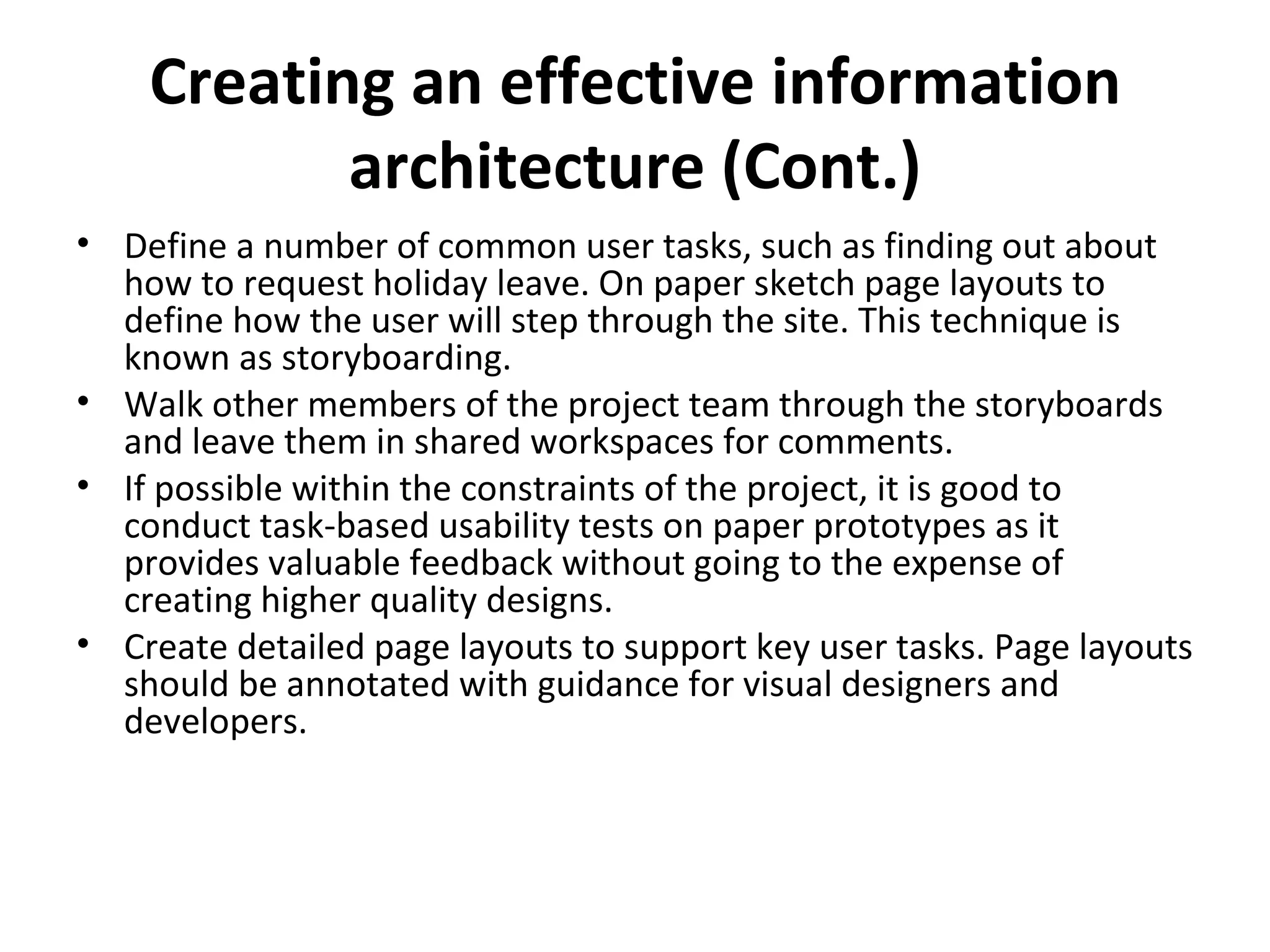
Creating an effective information architecture  (Cont.) Define a number of common user tasks, such as finding out about how to request holiday leave. On paper sketch page layouts to define how the user will step through the site. This technique is known as storyboarding.  Walk other members of the project team through the storyboards and leave them in shared workspaces for comments.  If possible within the constraints of the project, it is good to conduct task-based usability tests on paper prototypes as it provides valuable feedback without going to the expense of creating higher quality designs.  Create detailed page layouts to support key user tasks. Page layouts should be annotated with guidance for visual designers and developers.
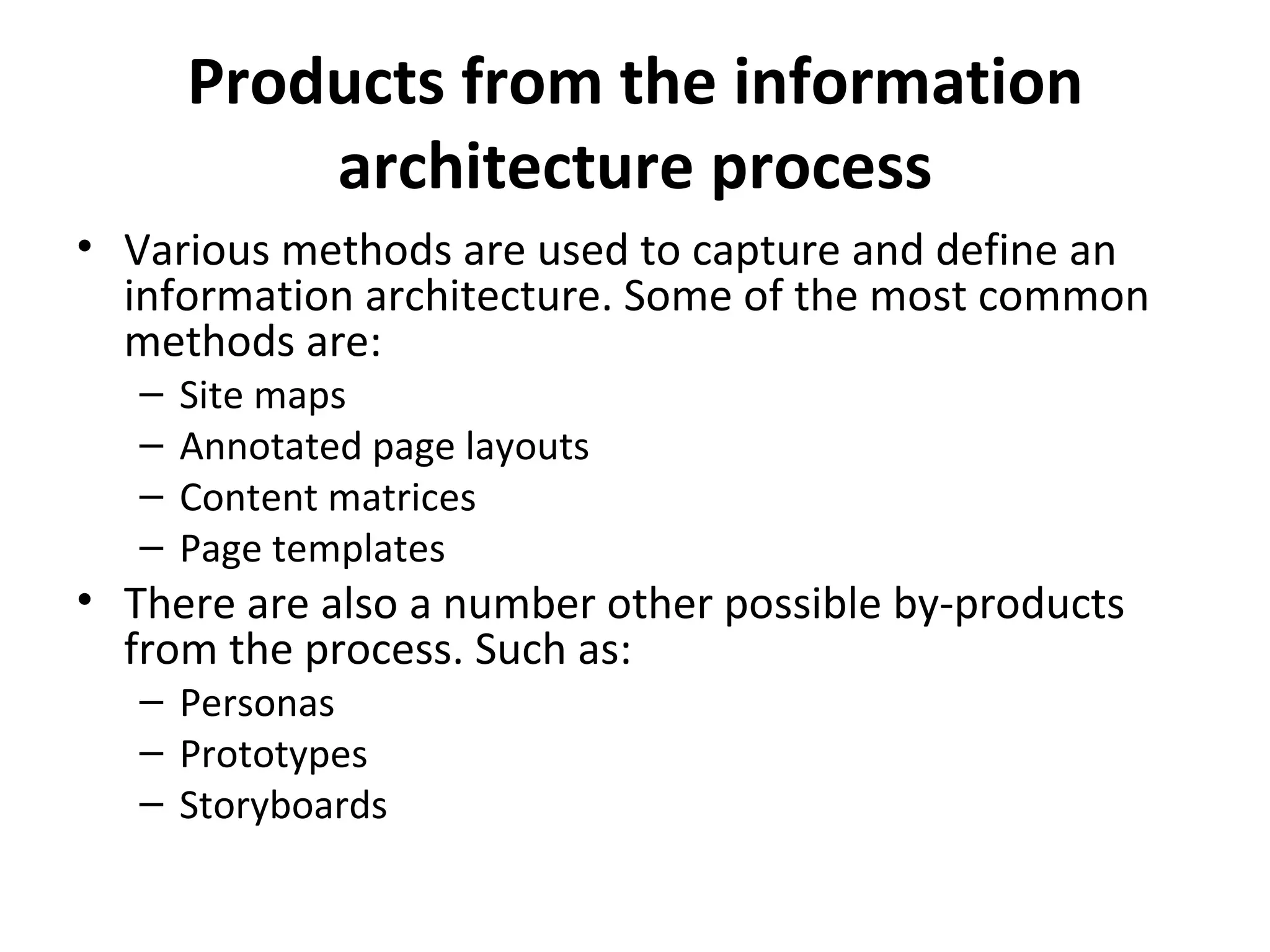
Products from the information architecture process Various methods are used to capture and define an information architecture. Some of the most common methods are: Site maps  Annotated page layouts  Content matrices  Page templates  There are also a number other possible by-products from the process. Such as: Personas  Prototypes  Storyboards
Site maps Site maps are perhaps the most widely known and understood deliverable from the process of defining an information architecture. A site map is a high level diagram showing the hierarchy of a system. Site maps reflect the information structure, but are not necessarily indicative of the navigation structure.
Annotated page layouts Page layouts define page level navigation, content types and functional elements. Annotations are used to provide guidance for the visual designers and developers who will use the page layouts to build the site. Page layouts are alternatively known as wireframes, blue prints or screen details.
Content matrix A content matrix lists each page in the system and identifies the content that will appear on that page. Page templates Page templates may be required when defining large-scale websites and intranets. Page templates define the layout of common page elements, such as global navigation, content and local navigation. Page templates are commonly used when developing content management systems. Personas Personas are a technique for defining archetypical users of the system. Personas are a cheap technique for evaluating the information architecture without conducting user research.
Prototypes Prototypes are models of the system. Prototypes can be as simple as paper-based sketches, or as complex as fully interactive systems. Research shows that paper-based prototypes are just as effective for identifying issues as fully interactive systems. Prototypes are often developed to bring the information architecture to life. Thus enabling users and other members of the project team to comment on the architecture before the system is built. Storyboards Storyboards are another technique for bringing the information architecture to life without building it. Storyboards are sketches showing how a user would interact with a system to complete a common task. Storyboards enable other members of the project team to understand the proposed information architecture before the system is built.
Information architecture and usability Some people find the relationship and distinction between information architecture and usability unclear. Information architecture is not the same as usability, but the two are closely related. As described in a previous KM Column (’ What is usability ‘, November 2004), usability encompasses two related concepts: Usability is an attribute of the quality of a system: “we need to create a usable intranet” Usability is a process or set of techniques used during a design and development project: “we need to include usability activities in this project” In both cases usability is a broader concept, whereas information architecture is far more specific.
Information architecture as an attribute of the quality of a system An effective information architecture is one of a number of attributes of a usable system. Other factors involving the usability of a system include: visual design  interaction design  functionality  content writing.
Information architecture as a process The process for creating an effective information architecture is a sub-set of the usability activities involved in a project. Although weighted to the beginning of the project, usability activities should continue throughout a project and evaluate issues beyond simply the information architecture.
Criteria for Successful IA Thousand products  –>  user only wants one specific product  <–  IA’s responsibility is to bring or give that specific product.  While it is important to minimize the number of “clicks” a user will need to make before finding the information he/she was looking for, it is just important to instill a sense of confidence that there is a coherent structure to the information. The more clearly the user understands the structure itself, the more likely the user is to stay for as long as necessary
End of presentatio

Information Architecture Development

  • 1.
    Information Architecture DevelopmentBy: Zainal A. Hasibuan Magister of Information Technology Faculty of Computer Science, University of Indonesia, Nov 2009
  • 2.
    Agenda How tocreate an effective information architecture? Information architecture (IA) development process Deliverables of IA development process Information architecture and usability Criteria for successful IA
  • 3.
    Review Questions Definethe meaning of information architecture (IA). Explain why an organization has to have an IA? What is the role of information architect who creates IA? What are the IA components? How these components interact in IA?
  • 4.
    How to createan effective information architecture ? An effective information architecture comes from understanding : B usiness objectives Constraints C ontent R equirements of the people that will use the site. (Source: http://www.steptwo.com.au/papers/kmc_whatisinfoarch
  • 5.
    Information architecture isoften described using the following diagram
  • 6.
    Business/Context Understanding anorganisations’ business objectives, politics, culture, technology, resources and constraints is essential before considering development of the information architecture. Techniques for understanding context include: Reading existing documentation Mission statements, organisation charts, previous research and vision documents are a quick way of building up an understanding of the context in which the system must work. Stakeholder interviews Speaking to stakeholders provides valuable insight into business context and can unearth previously unknown objectives and issues. For further information about stakeholder interviews, see our article “ Selecting staff for stakeholder interviews ”
  • 7.
    Content The mosteffective method for understanding the quantity and quality of content (i.e. functionality and information) proposed for a system is to conduct a content inventory. Content inventories identify all of the proposed content for a system, where the content currently resides, who owns it and any existing relationships between content. Content inventories are also commonly used to aid the process of migrating content between the old and new systems. Effective IA must reflect the way people think
  • 8.
    USERS An effectiveinformation architecture must reflect the way people think about the subject matter. Techniques for getting users involved in the creation of an information architecture include: Card sorting Card sorting involves representative users sorting a series of cards, each labelled with a piece of content or functionality, into groups that make sense to them. Card sorting generates ideas for how information could be grouped and labelled. Card-based classification evaluation Card-based classification evaluation is a technique for testing an information architecture before it has been implemented. The technique involves writing each level of an information architecture on a large card, and developing a set of information-seeking tasks for people to perform using the architecture.
  • 9.
    IA Development Processhttp://www.egov.vic.gov.au/
  • 10.
    Approaches to DefineIA Top-down information architecture . This involves developing a broad understanding of the business strategies and user needs, before defining the high level structure of site, and finally the detailed relationships between content. Bottom-up information architecture . This involves understanding the detailed relationships between content, creating walkthroughs (or storyboards) to show how the system could support specific user requirements and then considering the higher level structure that will be required to support these requirements. Take a structured approach to creat e an effective IA
  • 11.
    Creating an effectiveinformation architecture Understand the business/contextual requirements and the proposed content for the system. Read all existing documentation, interview stakeholders and conduct a content inventory. Conduct cards sorting exercises with a number of representative users. Evaluate the output of the card sorting exercises. Look for trends in grouping and labelling. Develop a draft information architecture (i.e. information groupings and hierarchy). Evaluate the draft information architecture using the card-based classification evaluation technique. Don’t expect to get the information architecture right first time. Capturing the right terminology and hierarchy may take several iterations. Document the information architecture in a site map. This is not the final site map, the site map will only be finalised after page layouts have been defined.
  • 12.
    Creating an effectiveinformation architecture (Cont.) Define a number of common user tasks, such as finding out about how to request holiday leave. On paper sketch page layouts to define how the user will step through the site. This technique is known as storyboarding. Walk other members of the project team through the storyboards and leave them in shared workspaces for comments. If possible within the constraints of the project, it is good to conduct task-based usability tests on paper prototypes as it provides valuable feedback without going to the expense of creating higher quality designs. Create detailed page layouts to support key user tasks. Page layouts should be annotated with guidance for visual designers and developers.
  • 13.
    Products from theinformation architecture process Various methods are used to capture and define an information architecture. Some of the most common methods are: Site maps Annotated page layouts Content matrices Page templates There are also a number other possible by-products from the process. Such as: Personas Prototypes Storyboards
  • 14.
    Site maps Sitemaps are perhaps the most widely known and understood deliverable from the process of defining an information architecture. A site map is a high level diagram showing the hierarchy of a system. Site maps reflect the information structure, but are not necessarily indicative of the navigation structure.
  • 15.
    Annotated page layoutsPage layouts define page level navigation, content types and functional elements. Annotations are used to provide guidance for the visual designers and developers who will use the page layouts to build the site. Page layouts are alternatively known as wireframes, blue prints or screen details.
  • 16.
    Content matrix Acontent matrix lists each page in the system and identifies the content that will appear on that page. Page templates Page templates may be required when defining large-scale websites and intranets. Page templates define the layout of common page elements, such as global navigation, content and local navigation. Page templates are commonly used when developing content management systems. Personas Personas are a technique for defining archetypical users of the system. Personas are a cheap technique for evaluating the information architecture without conducting user research.
  • 17.
    Prototypes Prototypes aremodels of the system. Prototypes can be as simple as paper-based sketches, or as complex as fully interactive systems. Research shows that paper-based prototypes are just as effective for identifying issues as fully interactive systems. Prototypes are often developed to bring the information architecture to life. Thus enabling users and other members of the project team to comment on the architecture before the system is built. Storyboards Storyboards are another technique for bringing the information architecture to life without building it. Storyboards are sketches showing how a user would interact with a system to complete a common task. Storyboards enable other members of the project team to understand the proposed information architecture before the system is built.
  • 18.
    Information architecture andusability Some people find the relationship and distinction between information architecture and usability unclear. Information architecture is not the same as usability, but the two are closely related. As described in a previous KM Column (’ What is usability ‘, November 2004), usability encompasses two related concepts: Usability is an attribute of the quality of a system: “we need to create a usable intranet” Usability is a process or set of techniques used during a design and development project: “we need to include usability activities in this project” In both cases usability is a broader concept, whereas information architecture is far more specific.
  • 19.
    Information architecture asan attribute of the quality of a system An effective information architecture is one of a number of attributes of a usable system. Other factors involving the usability of a system include: visual design interaction design functionality content writing.
  • 20.
    Information architecture asa process The process for creating an effective information architecture is a sub-set of the usability activities involved in a project. Although weighted to the beginning of the project, usability activities should continue throughout a project and evaluate issues beyond simply the information architecture.
  • 21.
    Criteria for SuccessfulIA Thousand products –> user only wants one specific product <– IA’s responsibility is to bring or give that specific product. While it is important to minimize the number of “clicks” a user will need to make before finding the information he/she was looking for, it is just important to instill a sense of confidence that there is a coherent structure to the information. The more clearly the user understands the structure itself, the more likely the user is to stay for as long as necessary
  • 22.