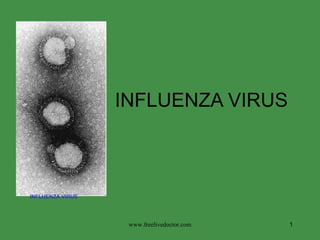
INFLUENZA VIRUS INFLUENZA VIRUS www.freelivedoctor.com
‘ FLU’ True influenza influenza virus A or influenza virus B  (or influenza virus C infections - much milder) Febrile respiratory disease with systemic symptoms caused by a variety of other organisms often inaccurately called ‘flu’  www.freelivedoctor.com
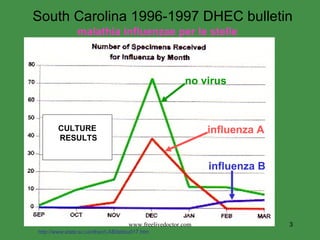
South Carolina 1996-1997 DHEC bulletin http://www.state.sc.us/dhec/LAB/labbu017.htm no virus influenza A influenza   B CULTURE RESULTS malathia influenzae per le stelle www.freelivedoctor.com
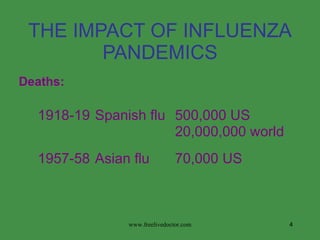
THE IMPACT OF INFLUENZA PANDEMICS Deaths: www.freelivedoctor.com
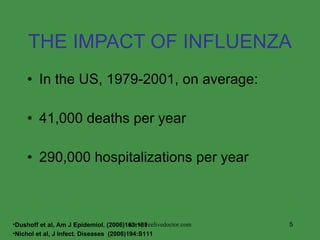
THE IMPACT OF INFLUENZA In the US, 1979-2001, on average: 41,000 deaths per year 290,000 hospitalizations per year Dushoff et al, Am J Epidemiol. (2006)163:181 Nichol et al, J Infect. Diseases  (2006)194:S111 www.freelivedoctor.com
THE IMPACT OF INFLUENZA recently some increase in morbidity and mortality - possible factors? more elderly people CF patients live longer more high risk neonates more immunosuppressed patients www.freelivedoctor.com
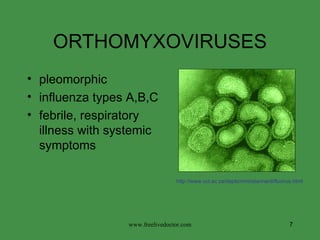
ORTHOMYXOVIRUSES http://www.uct.ac.za/depts/mmi/stannard/fluvirus.html pleomorphic influenza types A,B,C febrile, respiratory illness with systemic symptoms www.freelivedoctor.com
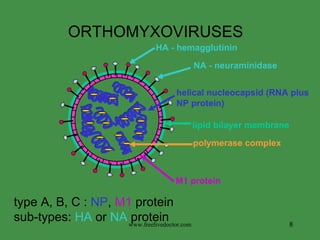
ORTHOMYXOVIRUSES type A, B, C :  NP ,  M1  protein  sub-types:  HA  or  NA  protein www.freelivedoctor.com M1 protein helical nucleocapsid (RNA plus  NP protein)  HA - hemagglutinin  polymerase complex lipid bilayer membrane  NA - neuraminidase
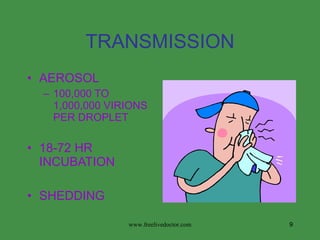
TRANSMISSION AEROSOL 100,000 TO 1,000,000 VIRIONS PER DROPLET 18-72 HR INCUBATION SHEDDING www.freelivedoctor.com
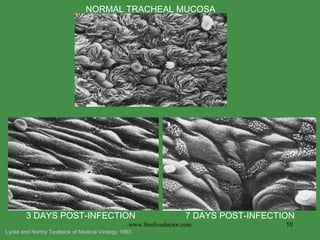
NORMAL TRACHEAL MUCOSA 3 DAYS POST-INFECTION 7 DAYS POST-INFECTION Lycke and Norrby Textbook of Medical Virology 1983 www.freelivedoctor.com
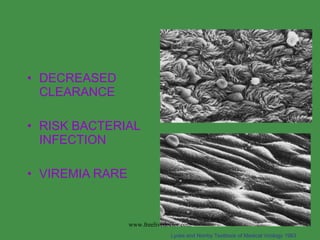
DECREASED CLEARANCE RISK BACTERIAL INFECTION VIREMIA RARE Lycke and Norrby Textbook of Medical Virology 1983 www.freelivedoctor.com
RECOVERY INTERFERON - SIDE EFFECTS INCLUDE: FEVER, MYALGIA, FATIGUE, MALAISE CELL-MEDIATED IMMUNE RESPONSE TISSUE REPAIR CAN TAKE SOME TIME www.freelivedoctor.com
An immunological diversion INTERFERON www.freelivedoctor.com
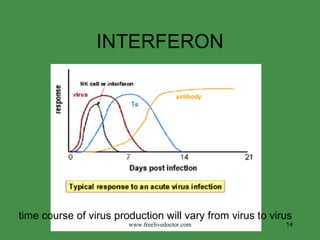
INTERFERON time course of virus production will vary from virus to virus www.freelivedoctor.com
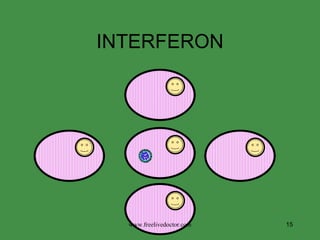
INTERFERON www.freelivedoctor.com
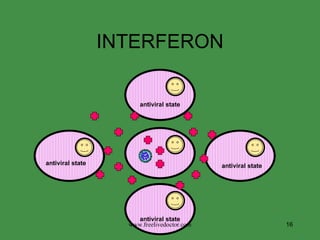
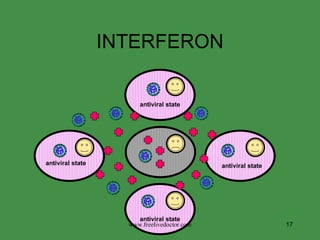
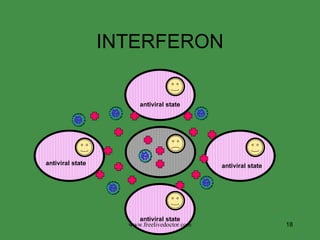
INTERFERON www.freelivedoctor.com antiviral state antiviral state antiviral state antiviral state
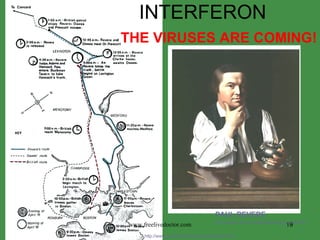
INTERFERON THE VIRUSES ARE COMING! http://www.paulreverehouse.org/midnight.html PAUL REVERE http://www.mfa.org/collections/one_hour/6.htm www.freelivedoctor.com
TYPES OF INTERFERON TYPE I Interferon-alpha  (leukocyte interferon, about 20  related proteins) - leukocytes, etc Interferon-beta  (fibroblast interferon) - fibroblasts, epithelial cells, etc TYPE II Interferon-gamma  (immune interferon) - certain activated T-cells, NK cells  www.freelivedoctor.com
INDUCTION OF INTERFERON interferon-alpha and interferon-beta induced by  viral infection (especially RNA viruses) double stranded RNA certain bacterial components - strong anti-viral properties interferon-gamma   - antigens, mitogenic stimulation of lymphocytes www.freelivedoctor.com
INTERFERON induces variety of proteins in target cells many consequences, not all fully understood www.freelivedoctor.com
INTERFERON-ALPHA AND INTERFERON-BETA www.freelivedoctor.com
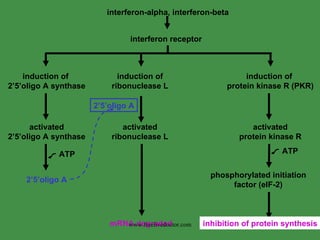
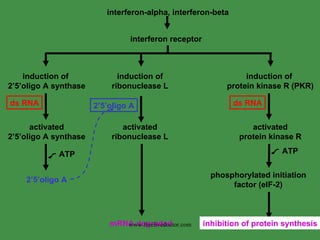
interferon-alpha, interferon-beta interferon receptor  induction of  2’5’oligo A synthase induction of  protein kinase R (PKR) 2’5’oligo A induction of  ribonuclease L  activated  ribonuclease L  ATP activated protein kinase R activated 2’5’oligo A synthase ATP 2’5’oligo A mRNA degraded  phosphorylated initiation factor (eIF-2) inhibition of protein synthesis  www.freelivedoctor.com
interferon-alpha, interferon-beta interferon receptor  induction of  2’5’oligo A synthase induction of  protein kinase R (PKR) 2’5’oligo A induction of  ribonuclease L  activated  ribonuclease L  ATP ds RNA ds RNA activated protein kinase R activated 2’5’oligo A synthase ATP 2’5’oligo A mRNA degraded  phosphorylated initiation factor (eIF-2) inhibition of protein synthesis  www.freelivedoctor.com
interferons only made when needed www.freelivedoctor.com
OTHER EFFECTS OF INTERFERONS ALL TYPES INCREASE MHC I EXPRESSION CYTOTOXIC T-CELLS ACTIVATE NK CELLS CAN KILL VIRALLY INFECTED CELLS www.freelivedoctor.com
OTHER EFFECTS OF INTERFERONS INTERFERON-GAMMA INCREASES MHC II EXPRESSION ON APC HELPER T-CELLS INCREASES ANTIVIRAL POTENTIAL OF MACROPHAGES  INTRINSIC EXTRINSIC www.freelivedoctor.com
THERAPEUTIC USES OF INTERFERONS ANTI-VIRAL  e.g. interferon-alpha is currently approved for certain cases of acute and chronic HCV and chronic HBV MACROPHAGE ACTIVATION interferon-gamma has been tried for e.g. lepromatous leprosy, leishmaniasis, toxoplasmosis ANTI-TUMOR have been used in e.g. melanoma, Kaposi’s sarcoma, CML MULTIPLE SCLEROSIS interferon-beta www.freelivedoctor.com
Viral response to host immune system Viruses may : block interferon binding inhibit function of interferon-induced proteins inhibit NK function interfere with MHC I or MHC II expression block complement activation inhibit apoptosis etc! www.freelivedoctor.com
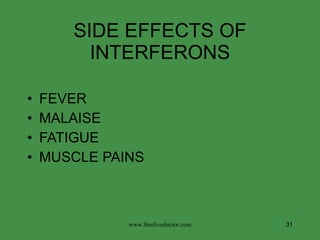
SIDE EFFECTS OF INTERFERONS FEVER MALAISE FATIGUE MUSCLE PAINS www.freelivedoctor.com
BACK TO INFLUENZA www.freelivedoctor.com
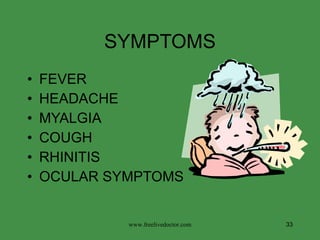
SYMPTOMS FEVER HEADACHE MYALGIA COUGH RHINITIS OCULAR SYMPTOMS www.freelivedoctor.com
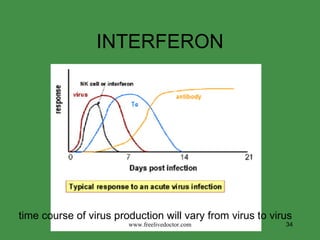
INTERFERON time course of virus production will vary from virus to virus www.freelivedoctor.com
PROTECTION AGAINST  RE-INFECTION IgG and IgA IgG less efficient but lasts longer antibodies to both HA and NA important antibody to HA more important (can neutralize) www.freelivedoctor.com
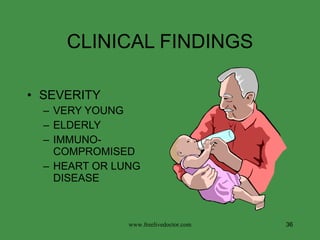
CLINICAL FINDINGS SEVERITY VERY YOUNG ELDERLY IMMUNO-COMPROMISED HEART OR LUNG DISEASE www.freelivedoctor.com
PULMONARY COMPLICATIONS CROUP (YOUNG CHILDREN) PRIMARY INFLUENZA VIRUS PNEUMONIA SECONDARY BACTERIAL INFECTION Streptococcus pneumoniae Staphlyococcus aureus Hemophilus influenzae www.freelivedoctor.com
NON-PULMONARY COMPLICATIONS myositis (rare, > in children, > with type B) cardiac complications recent studies report encephalopathy 2002/2003 season studies of patients  younger than 21 yrs in Michigan - 8 cases (2 deaths) liver and CNS Reye’s syndrome peripheral nervous system Guillian-Barré syndrome www.freelivedoctor.com
Reye’s syndrome liver - fatty deposits brain - edema vomiting, lethargy, coma risk factors youth certain viral infections (influenza, chicken pox) aspirin www.freelivedoctor.com
Guillian-Barré syndrome peripheral nervous system involved 1976/77 swine flu vaccine 35,000,000 doses 354 cases of GBS 28 GBS-associated deaths recent vaccines much lower risk www.freelivedoctor.com
MORTALITY MAJOR CAUSES OF INFLUENZA VIRUS- ASSOCIATED DEATH BACTERIAL PNEUMONIA CARDIAC FAILURE 90% OF DEATHS IN THOSE OVER 65 YEARS OF AGE www.freelivedoctor.com
DIAGNOSIS ISOLATION NOSE, THROAT SWAB GROW IN TISSUE CULTURE OR EGGS SEROLOGY PCR RAPID TESTS   provisional - clinical picture + outbreak www.freelivedoctor.com
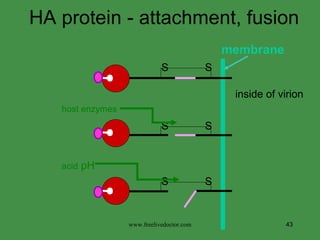
HA protein - attachment, fusion  inside of virion membrane www.freelivedoctor.com S S S S S S host enzymes acid  pH
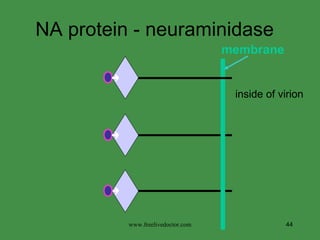
NA protein - neuraminidase  inside of virion membrane www.freelivedoctor.com
ANTIGENIC DRIFT HA and NA accumulate mutations RNA virus immune response no longer protects fully sporadic outbreaks, limited epidemics www.freelivedoctor.com
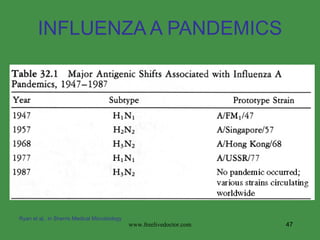
ANTIGENIC SHIFT “ new” HA or NA proteins pre-existing antibodies do not protect may get pandemics www.freelivedoctor.com
INFLUENZA A PANDEMICS Ryan et al., in Sherris Medical Microbiology  www.freelivedoctor.com
where do “new” HA and NA come from? ~16 types HA ~9 types NA all circulate in birds pigs can be infected by avian and human influenza viruses www.freelivedoctor.com
Where do “new” HA and NA come from? www.freelivedoctor.com
H5N1 – in birds Avian H5N1 has spread to humans  So far human cases in Asia and Africa 331 cases (12-1-03 through 10-17-07) 203 (61%) fatal Have been a few instances where may have  spread human-to-human So far no sustained spread in humans Surveillance continues www.freelivedoctor.com
VACCINE ‘ BEST GUESS’ OF MAIN ANTIGENIC TYPES CURRENTLY TRIVALENT type A - H1N1 type A - H3N2 type B each year choose which strain of each subtype is the best to use for optimal protection www.freelivedoctor.com
VACCINE inactivated (trivalent inactivated influenza vaccine, TIV) egg grown some formulations licensed for children reassortant, trivalent live vaccine approved 2003 (live attenuated vaccine, LAIV) for healthy persons (those not at risk for complications from influenza infection) ages 5-49 years September 2007 also approved for healthy children 24-59 months old without a history of recurrent wheezing  www.freelivedoctor.com
RECOMMENDATIONS Annual vaccine is recommended for persons at increased risk for influenza-related complications, including Persons aged 50 years and older  from public health point of view, easier to target by age than by high-risk condition (which may not have been discovered) Children aged 6-59 months Women who will be pregnant during the influenza season Adults and children with chronic medical conditions (e.g., asthma, diabetes, heart disease, kidney failure, hemoglobinopathies or weakened immune system) Adults and children who have any condition which can compromise respiratory function or the handling of respiratory secretions than can increase the risk for aspiration.  Residents of nursing homes and other chronic care facilities Children and adolescents on long-term aspirin therapy adults and children who have immunosuppression (including immunosuppression caused by medications or by HIV)  www.freelivedoctor.com
RECOMMENDATIONS Persons Who Can Transmit Influenza to Those at High Risk Persons who are clinically or  subclinically  infected can transmit influenza virus to persons at high risk for complications from influenza.  www.freelivedoctor.com
RECOMMENDATIONS Annual vaccine is recommended for contacts of persons at increased risk for influenza-related complications, including Household contacts of persons at high risk, including children aged less than 5 years, particularly contacts of children aged 0–5 mths (no approved vaccine for this age group) Health-care workers Employees of assisted living or other types of residences for persons in groups at high risk for the above groups, LAIV can be used to vaccinate healthy persons aged 5-49 years (and healthy children ages 24-59 months old without a history of recurrent wheezing) who are not contacts of severely immunosuppressed persons. www.freelivedoctor.com
RECOMMENDATIONS others, including travellers and the general population may wish to be vaccinated www.freelivedoctor.com
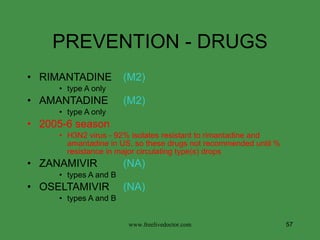
PREVENTION - DRUGS RIMANTADINE  (M2) type A only AMANTADINE  (M2) type A only 2005-6 season H3N2 virus - 92% isolates resistant to rimantadine and amantadine in US, so these drugs not recommended until % resistance in major circulating type(s) drops ZANAMIVIR  (NA) types A and B OSELTAMIVIR  (NA) types A and B www.freelivedoctor.com
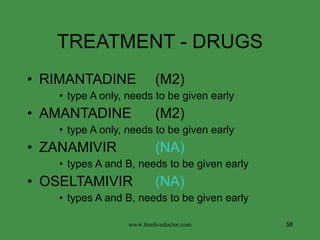
TREATMENT - DRUGS RIMANTADINE  (M2) type A only, needs to be given early AMANTADINE  (M2) type A only, needs to be given early ZANAMIVIR  (NA) types A and B, needs to be given early OSELTAMIVIR  (NA) types A and B, needs to be given early www.freelivedoctor.com
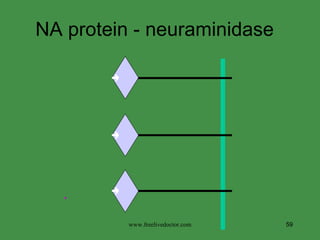
NA protein - neuraminidase  . . . . . . . . . . . . . . . . . . . www.freelivedoctor.com
OTHER TREATMENT REST, LIQUIDS, ANTI-FEBRILE AGENTS  (NO ASPIRIN FOR AGES 6MTHS-18YRS) BE AWARE OF COMPLICATIONS AND TREAT APPROPRIATELY www.freelivedoctor.com
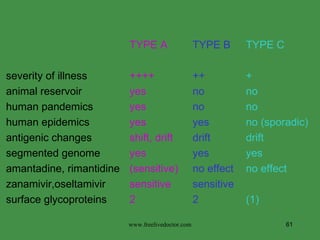
TYPE A ++++ yes yes yes shift, drift yes (sensitive) sensitive 2 severity of illness animal reservoir human pandemics human epidemics antigenic changes segmented genome amantadine, rimantidine zanamivir,oseltamivir surface glycoproteins TYPE B ++ no no yes drift yes no effect sensitive 2 TYPE C + no no no (sporadic) drift yes no effect (1) www.freelivedoctor.com

Influenza Virus

  • 1.
    INFLUENZA VIRUS INFLUENZAVIRUS www.freelivedoctor.com
  • 2.
    ‘ FLU’ Trueinfluenza influenza virus A or influenza virus B (or influenza virus C infections - much milder) Febrile respiratory disease with systemic symptoms caused by a variety of other organisms often inaccurately called ‘flu’ www.freelivedoctor.com
  • 3.
    South Carolina 1996-1997DHEC bulletin http://www.state.sc.us/dhec/LAB/labbu017.htm no virus influenza A influenza B CULTURE RESULTS malathia influenzae per le stelle www.freelivedoctor.com
  • 4.
    THE IMPACT OFINFLUENZA PANDEMICS Deaths: www.freelivedoctor.com
  • 5.
    THE IMPACT OFINFLUENZA In the US, 1979-2001, on average: 41,000 deaths per year 290,000 hospitalizations per year Dushoff et al, Am J Epidemiol. (2006)163:181 Nichol et al, J Infect. Diseases (2006)194:S111 www.freelivedoctor.com
  • 6.
    THE IMPACT OFINFLUENZA recently some increase in morbidity and mortality - possible factors? more elderly people CF patients live longer more high risk neonates more immunosuppressed patients www.freelivedoctor.com
  • 7.
    ORTHOMYXOVIRUSES http://www.uct.ac.za/depts/mmi/stannard/fluvirus.html pleomorphicinfluenza types A,B,C febrile, respiratory illness with systemic symptoms www.freelivedoctor.com
  • 8.
    ORTHOMYXOVIRUSES type A,B, C : NP , M1 protein sub-types: HA or NA protein www.freelivedoctor.com M1 protein helical nucleocapsid (RNA plus NP protein) HA - hemagglutinin polymerase complex lipid bilayer membrane NA - neuraminidase
  • 9.
    TRANSMISSION AEROSOL 100,000TO 1,000,000 VIRIONS PER DROPLET 18-72 HR INCUBATION SHEDDING www.freelivedoctor.com
  • 10.
    NORMAL TRACHEAL MUCOSA3 DAYS POST-INFECTION 7 DAYS POST-INFECTION Lycke and Norrby Textbook of Medical Virology 1983 www.freelivedoctor.com
  • 11.
    DECREASED CLEARANCE RISKBACTERIAL INFECTION VIREMIA RARE Lycke and Norrby Textbook of Medical Virology 1983 www.freelivedoctor.com
  • 12.
    RECOVERY INTERFERON -SIDE EFFECTS INCLUDE: FEVER, MYALGIA, FATIGUE, MALAISE CELL-MEDIATED IMMUNE RESPONSE TISSUE REPAIR CAN TAKE SOME TIME www.freelivedoctor.com
  • 13.
    An immunological diversionINTERFERON www.freelivedoctor.com
  • 14.
    INTERFERON time courseof virus production will vary from virus to virus www.freelivedoctor.com
  • 15.
  • 16.
    INTERFERON www.freelivedoctor.com antiviralstate antiviral state antiviral state antiviral state
  • 17.
    INTERFERON www.freelivedoctor.com antiviralstate antiviral state antiviral state antiviral state
  • 18.
    INTERFERON www.freelivedoctor.com antiviralstate antiviral state antiviral state antiviral state
  • 19.
    INTERFERON THE VIRUSESARE COMING! http://www.paulreverehouse.org/midnight.html PAUL REVERE http://www.mfa.org/collections/one_hour/6.htm www.freelivedoctor.com
  • 20.
    TYPES OF INTERFERONTYPE I Interferon-alpha (leukocyte interferon, about 20 related proteins) - leukocytes, etc Interferon-beta (fibroblast interferon) - fibroblasts, epithelial cells, etc TYPE II Interferon-gamma (immune interferon) - certain activated T-cells, NK cells www.freelivedoctor.com
  • 21.
    INDUCTION OF INTERFERONinterferon-alpha and interferon-beta induced by viral infection (especially RNA viruses) double stranded RNA certain bacterial components - strong anti-viral properties interferon-gamma - antigens, mitogenic stimulation of lymphocytes www.freelivedoctor.com
  • 22.
    INTERFERON induces varietyof proteins in target cells many consequences, not all fully understood www.freelivedoctor.com
  • 23.
  • 24.
    interferon-alpha, interferon-beta interferonreceptor induction of 2’5’oligo A synthase induction of protein kinase R (PKR) 2’5’oligo A induction of ribonuclease L activated ribonuclease L ATP activated protein kinase R activated 2’5’oligo A synthase ATP 2’5’oligo A mRNA degraded phosphorylated initiation factor (eIF-2) inhibition of protein synthesis www.freelivedoctor.com
  • 25.
    interferon-alpha, interferon-beta interferonreceptor induction of 2’5’oligo A synthase induction of protein kinase R (PKR) 2’5’oligo A induction of ribonuclease L activated ribonuclease L ATP ds RNA ds RNA activated protein kinase R activated 2’5’oligo A synthase ATP 2’5’oligo A mRNA degraded phosphorylated initiation factor (eIF-2) inhibition of protein synthesis www.freelivedoctor.com
  • 26.
    interferons only madewhen needed www.freelivedoctor.com
  • 27.
    OTHER EFFECTS OFINTERFERONS ALL TYPES INCREASE MHC I EXPRESSION CYTOTOXIC T-CELLS ACTIVATE NK CELLS CAN KILL VIRALLY INFECTED CELLS www.freelivedoctor.com
  • 28.
    OTHER EFFECTS OFINTERFERONS INTERFERON-GAMMA INCREASES MHC II EXPRESSION ON APC HELPER T-CELLS INCREASES ANTIVIRAL POTENTIAL OF MACROPHAGES INTRINSIC EXTRINSIC www.freelivedoctor.com
  • 29.
    THERAPEUTIC USES OFINTERFERONS ANTI-VIRAL e.g. interferon-alpha is currently approved for certain cases of acute and chronic HCV and chronic HBV MACROPHAGE ACTIVATION interferon-gamma has been tried for e.g. lepromatous leprosy, leishmaniasis, toxoplasmosis ANTI-TUMOR have been used in e.g. melanoma, Kaposi’s sarcoma, CML MULTIPLE SCLEROSIS interferon-beta www.freelivedoctor.com
  • 30.
    Viral response tohost immune system Viruses may : block interferon binding inhibit function of interferon-induced proteins inhibit NK function interfere with MHC I or MHC II expression block complement activation inhibit apoptosis etc! www.freelivedoctor.com
  • 31.
    SIDE EFFECTS OFINTERFERONS FEVER MALAISE FATIGUE MUSCLE PAINS www.freelivedoctor.com
  • 32.
    BACK TO INFLUENZAwww.freelivedoctor.com
  • 33.
    SYMPTOMS FEVER HEADACHEMYALGIA COUGH RHINITIS OCULAR SYMPTOMS www.freelivedoctor.com
  • 34.
    INTERFERON time courseof virus production will vary from virus to virus www.freelivedoctor.com
  • 35.
    PROTECTION AGAINST RE-INFECTION IgG and IgA IgG less efficient but lasts longer antibodies to both HA and NA important antibody to HA more important (can neutralize) www.freelivedoctor.com
  • 36.
    CLINICAL FINDINGS SEVERITYVERY YOUNG ELDERLY IMMUNO-COMPROMISED HEART OR LUNG DISEASE www.freelivedoctor.com
  • 37.
    PULMONARY COMPLICATIONS CROUP(YOUNG CHILDREN) PRIMARY INFLUENZA VIRUS PNEUMONIA SECONDARY BACTERIAL INFECTION Streptococcus pneumoniae Staphlyococcus aureus Hemophilus influenzae www.freelivedoctor.com
  • 38.
    NON-PULMONARY COMPLICATIONS myositis(rare, > in children, > with type B) cardiac complications recent studies report encephalopathy 2002/2003 season studies of patients younger than 21 yrs in Michigan - 8 cases (2 deaths) liver and CNS Reye’s syndrome peripheral nervous system Guillian-Barré syndrome www.freelivedoctor.com
  • 39.
    Reye’s syndrome liver- fatty deposits brain - edema vomiting, lethargy, coma risk factors youth certain viral infections (influenza, chicken pox) aspirin www.freelivedoctor.com
  • 40.
    Guillian-Barré syndrome peripheralnervous system involved 1976/77 swine flu vaccine 35,000,000 doses 354 cases of GBS 28 GBS-associated deaths recent vaccines much lower risk www.freelivedoctor.com
  • 41.
    MORTALITY MAJOR CAUSESOF INFLUENZA VIRUS- ASSOCIATED DEATH BACTERIAL PNEUMONIA CARDIAC FAILURE 90% OF DEATHS IN THOSE OVER 65 YEARS OF AGE www.freelivedoctor.com
  • 42.
    DIAGNOSIS ISOLATION NOSE,THROAT SWAB GROW IN TISSUE CULTURE OR EGGS SEROLOGY PCR RAPID TESTS provisional - clinical picture + outbreak www.freelivedoctor.com
  • 43.
    HA protein -attachment, fusion inside of virion membrane www.freelivedoctor.com S S S S S S host enzymes acid pH
  • 44.
    NA protein -neuraminidase inside of virion membrane www.freelivedoctor.com
  • 45.
    ANTIGENIC DRIFT HAand NA accumulate mutations RNA virus immune response no longer protects fully sporadic outbreaks, limited epidemics www.freelivedoctor.com
  • 46.
    ANTIGENIC SHIFT “new” HA or NA proteins pre-existing antibodies do not protect may get pandemics www.freelivedoctor.com
  • 47.
    INFLUENZA A PANDEMICSRyan et al., in Sherris Medical Microbiology www.freelivedoctor.com
  • 48.
    where do “new”HA and NA come from? ~16 types HA ~9 types NA all circulate in birds pigs can be infected by avian and human influenza viruses www.freelivedoctor.com
  • 49.
    Where do “new”HA and NA come from? www.freelivedoctor.com
  • 50.
    H5N1 – inbirds Avian H5N1 has spread to humans So far human cases in Asia and Africa 331 cases (12-1-03 through 10-17-07) 203 (61%) fatal Have been a few instances where may have spread human-to-human So far no sustained spread in humans Surveillance continues www.freelivedoctor.com
  • 51.
    VACCINE ‘ BESTGUESS’ OF MAIN ANTIGENIC TYPES CURRENTLY TRIVALENT type A - H1N1 type A - H3N2 type B each year choose which strain of each subtype is the best to use for optimal protection www.freelivedoctor.com
  • 52.
    VACCINE inactivated (trivalentinactivated influenza vaccine, TIV) egg grown some formulations licensed for children reassortant, trivalent live vaccine approved 2003 (live attenuated vaccine, LAIV) for healthy persons (those not at risk for complications from influenza infection) ages 5-49 years September 2007 also approved for healthy children 24-59 months old without a history of recurrent wheezing www.freelivedoctor.com
  • 53.
    RECOMMENDATIONS Annual vaccineis recommended for persons at increased risk for influenza-related complications, including Persons aged 50 years and older from public health point of view, easier to target by age than by high-risk condition (which may not have been discovered) Children aged 6-59 months Women who will be pregnant during the influenza season Adults and children with chronic medical conditions (e.g., asthma, diabetes, heart disease, kidney failure, hemoglobinopathies or weakened immune system) Adults and children who have any condition which can compromise respiratory function or the handling of respiratory secretions than can increase the risk for aspiration. Residents of nursing homes and other chronic care facilities Children and adolescents on long-term aspirin therapy adults and children who have immunosuppression (including immunosuppression caused by medications or by HIV) www.freelivedoctor.com
  • 54.
    RECOMMENDATIONS Persons WhoCan Transmit Influenza to Those at High Risk Persons who are clinically or subclinically infected can transmit influenza virus to persons at high risk for complications from influenza. www.freelivedoctor.com
  • 55.
    RECOMMENDATIONS Annual vaccineis recommended for contacts of persons at increased risk for influenza-related complications, including Household contacts of persons at high risk, including children aged less than 5 years, particularly contacts of children aged 0–5 mths (no approved vaccine for this age group) Health-care workers Employees of assisted living or other types of residences for persons in groups at high risk for the above groups, LAIV can be used to vaccinate healthy persons aged 5-49 years (and healthy children ages 24-59 months old without a history of recurrent wheezing) who are not contacts of severely immunosuppressed persons. www.freelivedoctor.com
  • 56.
    RECOMMENDATIONS others, includingtravellers and the general population may wish to be vaccinated www.freelivedoctor.com
  • 57.
    PREVENTION - DRUGSRIMANTADINE (M2) type A only AMANTADINE (M2) type A only 2005-6 season H3N2 virus - 92% isolates resistant to rimantadine and amantadine in US, so these drugs not recommended until % resistance in major circulating type(s) drops ZANAMIVIR (NA) types A and B OSELTAMIVIR (NA) types A and B www.freelivedoctor.com
  • 58.
    TREATMENT - DRUGSRIMANTADINE (M2) type A only, needs to be given early AMANTADINE (M2) type A only, needs to be given early ZANAMIVIR (NA) types A and B, needs to be given early OSELTAMIVIR (NA) types A and B, needs to be given early www.freelivedoctor.com
  • 59.
    NA protein -neuraminidase . . . . . . . . . . . . . . . . . . . www.freelivedoctor.com
  • 60.
    OTHER TREATMENT REST,LIQUIDS, ANTI-FEBRILE AGENTS (NO ASPIRIN FOR AGES 6MTHS-18YRS) BE AWARE OF COMPLICATIONS AND TREAT APPROPRIATELY www.freelivedoctor.com
  • 61.
    TYPE A ++++yes yes yes shift, drift yes (sensitive) sensitive 2 severity of illness animal reservoir human pandemics human epidemics antigenic changes segmented genome amantadine, rimantidine zanamivir,oseltamivir surface glycoproteins TYPE B ++ no no yes drift yes no effect sensitive 2 TYPE C + no no no (sporadic) drift yes no effect (1) www.freelivedoctor.com

Editor's Notes

  • #6 Figures have tended to increase recently - in part due to aging of population?
  • #43 Rapid tests - signifcance in ascertaining whether the infection is influenza and which type it is since now have therapeutic agents (some of which are type specific) - signifcance in differential diagnosis - eg if need to determine if Flu v. SARS - advent of rapid easy tests may increase diagnosis - may realise that flu involved in more illnesses than realised (eg enhanced surveillance of patients <21 at low risk for complications who were admitted to hospital for a variety of symptoms revealed that more severe morbitity and mortality assoc with influenza that was realised -2003).