



Influencing
Policy
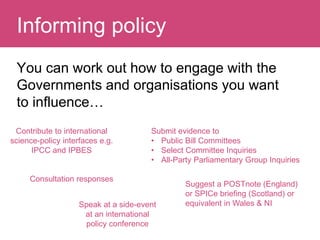
You can work out how to engage with the
Governments and organisations you want
to influence…
Question:Informing policy
Submit evidence to
• Public Bill Committees
• Select Committee Inquiries
• All-Party Parliamentary Group Inquiries
Suggest a POSTnote (England)
or SPICe briefing (Scotland) or
equivalent in Wales & NI
Consultation responses
Contribute to international
science-policy interfaces e.g.
IPCC and IPBES
Speak at a side-event
at an international
policy conference
Question:Informing policy
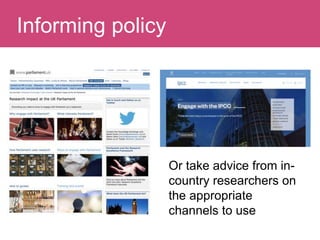
Or take advice from in-
country researchers on
the appropriate
channels to use
We need to use the established channels,
but it is hard to know if your evidence
made a difference (my last consultation
response was 1 of 40,000)
 Is our job simply to inform policy (make
evidence available when requested)?
 Should we try and influence policy (pro-
actively target and clearly communicate
evidence to relevant teams)?
Question:Why influence?
Why inform?
Question:Why influence?
Why influence?
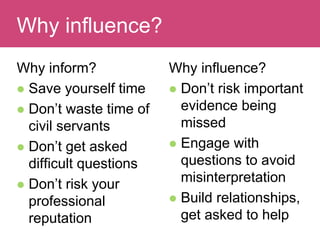
Why inform?
 Save yourself time
 Don’t waste time of
civil servants
 Don’t get asked
difficult questions
 Don’t risk your
professional
reputation
Question:Why influence?
Why influence?
 Don’t risk important
evidence being
missed
 Engage with
questions to avoid
misinterpretation
 Build relationships,
get asked to help
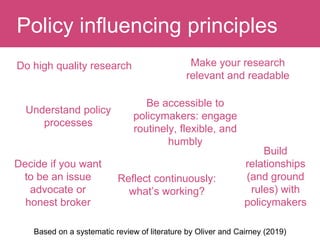
Do high quality research
Question:Policy influencing principles
Make your research
relevant and readable
Understand policy
processes
Be accessible to
policymakers: engage
routinely, flexible, and
humbly
Decide if you want
to be an issue
advocate or
honest broker
Build
relationships
(and ground
rules) with
policymakers
Reflect continuously:
what’s working?
Based on a systematic review of literature by Oliver and Cairney (2019)
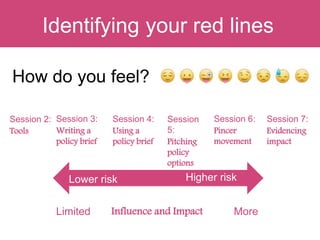
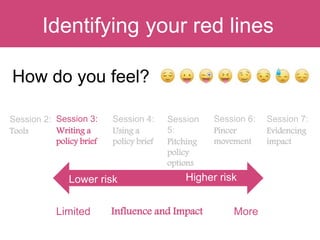
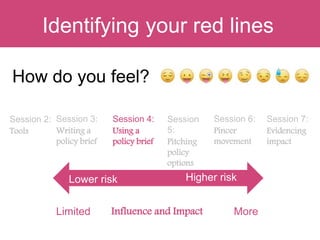
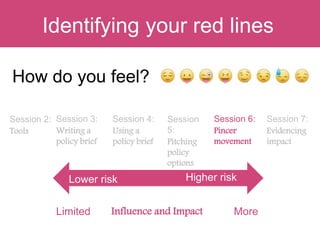
How do you feel?
Question:Identifying your red lines
Limited Influence and Impact More
Lower risk Higher risk
Session 2:
Tools
Session 3:
Writing a
policy brief
Session 4:
Using a
policy brief
Session
5:
Pitching
policy
options
Session 6:
Pincer
movement
Session 7:
Evidencing
impact
5 WAYS
to Fast Track your
Research Impact
Impact
tools
Question:Defining policy impact
What is the difference between
Policy-relevant
applied research
Policy engagement
Policy impact
?
Question:What is policy impact?
benefit
Question:What is policy impact?
Who benefits?
The good that
researchers do
in the world
Question:A definition of research impact
The good that
researchers do
in the world
Question:Types of policy impact
Types of impacts from
good policies
implemented well, for
example:
• Health/wellbeing
Interim/initial impacts you might see on the pathway
to policy impacts, for example:
• Increased awareness or understanding of an issue
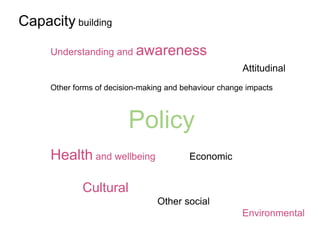
Capacity building
Understanding and awareness
Attitudinal
Other forms of decision-making and behaviour change impacts
Policy
Health and wellbeing Economic
Cultural
Other social
Environmental
 Attribution is the causal link between claimed
impacts and underpinning research
 Significance is the degree to which the impact
has enriched, influence, informed or changed
policies, practices, products, opportunities or
perceptions of individuals, communities or
organisations
 Reach is the extent and diversity of the
communities, environments, individuals,
organisations or any other beneficiaries that may
have been impacted by the research
Evaluating ImpactPolicy impacts that matter
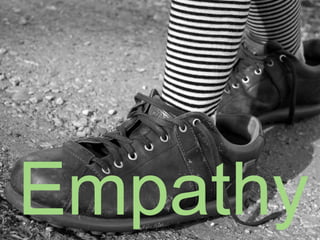
Empathy
5 WAYS
to Fast Track your
Research Impact
Practical
tools
Who has a stake in my research?What works?
Empathy
Who has a stake in my research?
1. Stakeholder analysis
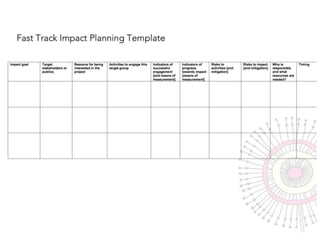
2. Impact planning
Two Tools
Who has a stake in my research?
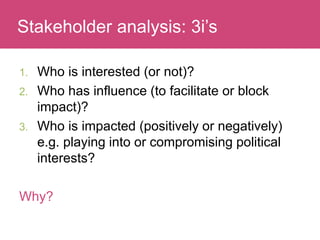
1. Who is interested (or not)?
2. Who has influence (to facilitate or block
impact)?
3. Who is impacted (positively or negatively)
e.g. playing into or compromising political
interests?
Why?
Stakeholder analysis: 3i’s
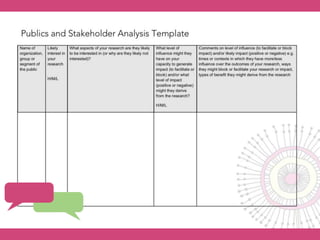
...adapt to your own needs
Stakeholder/publics analysis
Writing a
policy brief
that has real impact
Who has a stake in my research?
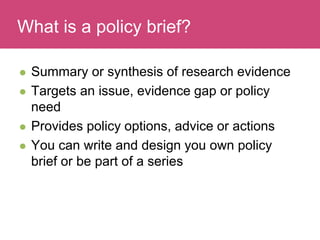
 Summary or synthesis of research evidence
 Targets an issue, evidence gap or policy
need
 Provides policy options, advice or actions
 You can write and design you own policy
brief or be part of a series
What is a policy brief?
Who has a stake in my research?
 When you’ve submitted evidence to a
consultation or inquiry that you also want to
get to specific people or teams
 As a visual aid for a talk or meeting to leave
with participants for follow-up
 When your research is only part of the
picture – integrate with other projects or
evidence synthesis
When is a policy brief useful?
Who has a stake in my research?
 Choose a policy brief
 Explain what you like or dislike?
What makes a good policy brief?
Who has a stake in my research?
Getting your focus right:
 Use your stakeholder analysis to identify
warm contacts from relevant policy networks
(e.g. engaged researchers, third sector,
consultants, agency staff, civil servants,
MPs)
 Tailored email based on intersection between
your interests and theirs
 Meet to discuss evidence gaps, policy needs
and other questions
Co-producing a policy brief
Who has a stake in my research?
Getting your content right:
 Get their help to identify keywords that will
resonate with your audience
 Get their feedback on draft text and design
(including photos and infographics)
 Stress-test drafts with stakeholders
Co-producing a policy brief
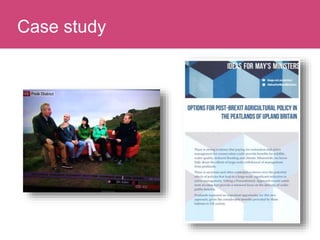
Who has a stake in my research?Case study
How do you feel?
Question:Identifying your red lines
Limited Influence and Impact More
Lower risk Higher risk
Session 2:
Tools
Session 3:
Writing a
policy brief
Session 4:
Using a
policy brief
Session
5:
Pitching
policy
options
Session 6:
Pincer
movement
Session 7:
Evidencing
impact
Using your policy brief
in
meetings and
policy
seminars
Who has a stake in my research?
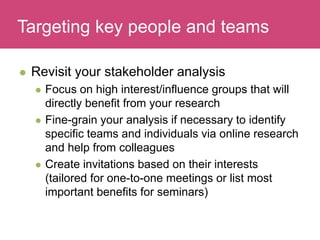
 Revisit your stakeholder analysis
 Focus on high interest/influence groups that will
directly benefit from your research
 Fine-grain your analysis if necessary to identify
specific teams and individuals via online research
and help from colleagues
 Create invitations based on their interests
(tailored for one-to-one meetings or list most
important benefits for seminars)
Targeting key people and teams
Who has a stake in my research?
Options to consider:
 Single issue/presenter versus curating a
programme
 Joining a seminar series versus creating a
stand-alone event
 In-house or a nearby venue with a nice lunch
 Presentation/questions or participatory
format
 Feedback questionnaire or post-card to your
future self
Policy seminars
Who has a stake in my research?
Options to consider:
 Cold call or be introduced via a trusted
intermediary
 Send key messages and policy brief via
intermediary, visit with them or go yourself
 Come in listening mode or with key
messages
 Their office or a coffee shop
One-to-one meetings
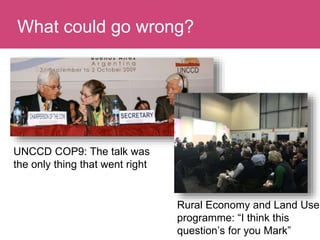
Who has a stake in my research?What could go wrong?
UNCCD COP9: The talk was
the only thing that went right
Rural Economy and Land Use
programme: “I think this
question’s for you Mark”
Who has a stake in my research?
 What is the difference between influence and
manipulation?
 How might researchers inadvertently cross
their own red lines?
Discussion exercise
How do you feel?
Question:Identifying your red lines
Limited Influence and Impact More
Lower risk Higher risk
Session 2:
Tools
Session 3:
Writing a
policy brief
Session 4:
Using a
policy brief
Session
5:
Pitching
policy
options
Session 6:
Pincer
movement
Session 7:
Evidencing
impact
Pitching
policy options in
meetings and seminars
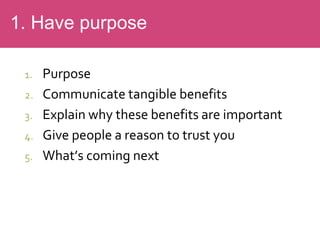
1. Purpose
2. Communicate tangible benefits
3. Explain why these benefits are important
4. Give people a reason to trust you
5. What’s coming next
1. Have purpose
 The best speakers empathise with their
audiences, and their audiences identify with
them
 How can you empathise and connect with
an audience?
2. Connect
 Know your audience
 If you don’t, start off getting to know them
 What concerns and motivates them most?
 The power of stories
 Stories with impact are personal, unexpected,
visual, visceral
 Use your body language:
 Open & approachable; positive & energised
 Your audience will mirror you emotionally
2. Connect
 Authoritative ≠ intimidating
 Posture: be aware of your feet
 Start/end at “home” position and use different
stage positions for different points
 Use emphasis to make every word and
sentence count:
 Slow down and spell out key points
 Use volume
 Vary intonation
 Pause/silence
3. Be authoritative and passionate
 Identify one, memorable key message
 Repeat it in different ways, coming at it
from different angles to communicate your
secondary messages
 People will forget the detail, so use the
detail to build and convey your key message
 Use stories, images and metaphors to make
your message stick
4. Keep it simple
 Practice and practice again
 Record yourself, get feedback, identify bad
habits and practice breaking them
 Speaking too fast, pacing, verbal fillers
 Use your visual aids to add impact to your
message, not as your notes
5. Polish
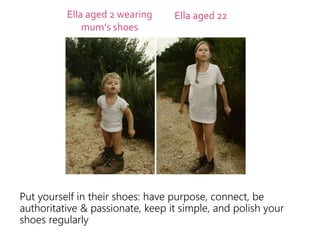
Ella aged 2 wearing
mum’s shoes
Ella aged 22
Put yourself in their shoes: have purpose, connect, be
authoritative & passionate, keep it simple, and polish your
shoes regularly
The bottom-up and top-
down pincer movement
Who has a stake in my research?
Which do you feel more comfortable with and
why?
 Issue advocate
 Honest broker
Bottom-up: the trusted advisor
Who has a stake in my research?
You don’t have to be the world expert to become
the “go to” person:
 Identify junior civil servants who work with
evidence in your field
 Offer targeted help based on their
interests/remit, asking what else you can do
 Work in the public interest, not just to get your
research used
 Deliver useful, understandable and on time, via
your network if outside your expertise
 Wait for them to connect you to their teams
Bottom-up: the trusted advisor
Who has a stake in my research?
 Identify influential stakeholder organisations and
decide if you can work with them (considering
risks to your values and reputation)
 Offer help to junior staff who work with evidence,
build trust and get to know their teams
 Provide evidence for them to use in high-level
meetings, if possible briefing and de-briefing
before/after
 The risk: they cherry-pick or distort the evidence
to lobby using your name and credibility
Top-down: intermediaries
Who has a stake in my research?
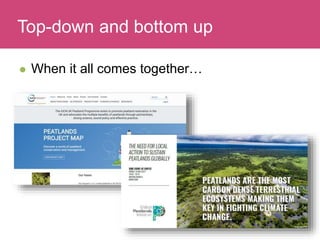
 When it all comes together…
Top-down and bottom up
How do you feel?
Question:Identifying your red lines
Limited Influence and Impact More
Lower risk Higher risk
Session 2:
Tools
Session 3:
Writing a
policy brief
Session 4:
Using a
policy brief
Session
5:
Pitching
policy
options
Session 6:
Pincer
movement
Session 7:
Evidencing
impact
Evidencing
policy impacts
Read and discuss
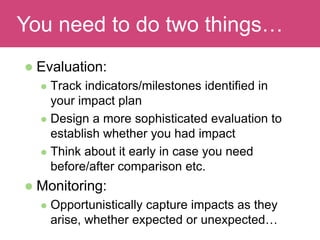
 Evaluation:
 Track indicators/milestones identified in
your impact plan
 Design a more sophisticated evaluation to
establish whether you had impact
 Think about it early in case you need
before/after comparison etc.
 Monitoring:
 Opportunistically capture impacts as they
arise, whether expected or unexpected…
You need to do two things…
Read and discuss
 Do you systematically track the impact of
your research?
Monitoring impact
Read and discussMonitoring impact
 Find a way to continually track your
impacts easily to take the pain out of
reporting:
 Email impacts/evidence to yourself and file
 Ring binder/scrap book
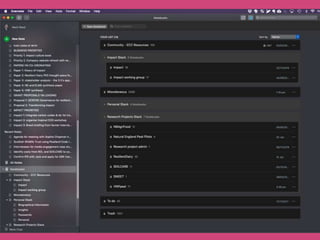
 Evernote: enable team members from any
institution to collate impacts in a shared
notebook without having to log into
anything…
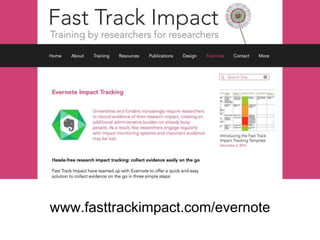
www.fasttrackimpact.com/evernote
 The process of assessing the significance and
reach of both positive and negative effects of
research
 Your task is to identify causal links between:
 Research (cause)
 Impact (effect)
 To create an evidence-based argument that
your research was sufficient or necessary to
generate the claimed impact
Evaluating ImpactWhat is impact evaluation?
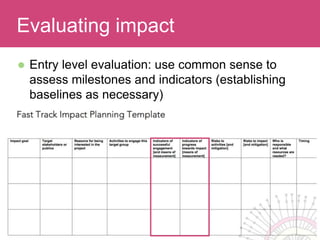
 Entry level evaluation: use common sense to
assess milestones and indicators (establishing
baselines as necessary)
Evaluating ImpactEvaluating impact
 Evaluation design = research design
 Get win-wins for your research by asking “what’s
my impact” as a research question and identifying
methods already in your toolkit
 Get targeted help when there’s a tool missing
 Be proportionate
 Do parts of your design e.g. online survey,
interview
 Rigour from triangulation
 Get feedback, plugging gaps till it is believable
Evaluating ImpactEvaluating impact
 What are you claiming?
 Whole or part of policy?
 Why is the component you influenced important?
 Ideal situation: policy citation
 Likely situation:
 Policy reflects research findings or
recommendations
 Evidence of significant engagement and uptake in
policy processes
 Testimonial interview: significance, reach,
attribution and ethics
Evaluating ImpactEvaluating policy impacts
Conclusions
 The Eureka moment
 The concept paper
 The Guardian
 It was just an idea
 The funding
 Reaching scientific consensus with IUCN
 The Peatland Code
 Keeping new Governments on side
 Evidence to justify peatland spend in austerity
 Private investment, significant new public spend
 UN interest, IUCN and UN resolutions, Global
Peatland Assessment
Evaluating ImpactCase study
Next steps
 What will I do to take a step towards a more
relational approach that could generate more
impact from my evidence?
 How can I mitigate risks? Where do I draw the
line?
Evaluating ImpactPaired discussion
www.fasttrackimpact.com/resources
Influencing
Policy

Influencing policy

  • 1.
  • 2.
    You can workout how to engage with the Governments and organisations you want to influence… Question:Informing policy Submit evidence to • Public Bill Committees • Select Committee Inquiries • All-Party Parliamentary Group Inquiries Suggest a POSTnote (England) or SPICe briefing (Scotland) or equivalent in Wales & NI Consultation responses Contribute to international science-policy interfaces e.g. IPCC and IPBES Speak at a side-event at an international policy conference
  • 3.
    Question:Informing policy Or takeadvice from in- country researchers on the appropriate channels to use
  • 4.
    We need touse the established channels, but it is hard to know if your evidence made a difference (my last consultation response was 1 of 40,000)  Is our job simply to inform policy (make evidence available when requested)?  Should we try and influence policy (pro- actively target and clearly communicate evidence to relevant teams)? Question:Why influence?
  • 5.
  • 6.
    Why inform?  Saveyourself time  Don’t waste time of civil servants  Don’t get asked difficult questions  Don’t risk your professional reputation Question:Why influence? Why influence?  Don’t risk important evidence being missed  Engage with questions to avoid misinterpretation  Build relationships, get asked to help
  • 7.
    Do high qualityresearch Question:Policy influencing principles Make your research relevant and readable Understand policy processes Be accessible to policymakers: engage routinely, flexible, and humbly Decide if you want to be an issue advocate or honest broker Build relationships (and ground rules) with policymakers Reflect continuously: what’s working? Based on a systematic review of literature by Oliver and Cairney (2019)
  • 8.
    How do youfeel? Question:Identifying your red lines Limited Influence and Impact More Lower risk Higher risk Session 2: Tools Session 3: Writing a policy brief Session 4: Using a policy brief Session 5: Pitching policy options Session 6: Pincer movement Session 7: Evidencing impact
  • 9.
    5 WAYS to FastTrack your Research Impact Impact tools
  • 10.
    Question:Defining policy impact Whatis the difference between Policy-relevant applied research Policy engagement Policy impact ?
  • 11.
    Question:What is policyimpact? benefit
  • 12.
    Question:What is policyimpact? Who benefits?
  • 13.
    The good that researchersdo in the world Question:A definition of research impact
  • 14.
    The good that researchersdo in the world Question:Types of policy impact Types of impacts from good policies implemented well, for example: • Health/wellbeing Interim/initial impacts you might see on the pathway to policy impacts, for example: • Increased awareness or understanding of an issue
  • 15.
    Capacity building Understanding andawareness Attitudinal Other forms of decision-making and behaviour change impacts Policy Health and wellbeing Economic Cultural Other social Environmental
  • 16.
     Attribution isthe causal link between claimed impacts and underpinning research  Significance is the degree to which the impact has enriched, influence, informed or changed policies, practices, products, opportunities or perceptions of individuals, communities or organisations  Reach is the extent and diversity of the communities, environments, individuals, organisations or any other beneficiaries that may have been impacted by the research Evaluating ImpactPolicy impacts that matter
  • 17.
  • 18.
    5 WAYS to FastTrack your Research Impact Practical tools
  • 19.
    Who has astake in my research?What works?
  • 20.
  • 21.
    Who has astake in my research? 1. Stakeholder analysis 2. Impact planning Two Tools
  • 22.
    Who has astake in my research? 1. Who is interested (or not)? 2. Who has influence (to facilitate or block impact)? 3. Who is impacted (positively or negatively) e.g. playing into or compromising political interests? Why? Stakeholder analysis: 3i’s
  • 23.
    ...adapt to yourown needs Stakeholder/publics analysis
  • 25.
  • 26.
    Who has astake in my research?  Summary or synthesis of research evidence  Targets an issue, evidence gap or policy need  Provides policy options, advice or actions  You can write and design you own policy brief or be part of a series What is a policy brief?
  • 27.
    Who has astake in my research?  When you’ve submitted evidence to a consultation or inquiry that you also want to get to specific people or teams  As a visual aid for a talk or meeting to leave with participants for follow-up  When your research is only part of the picture – integrate with other projects or evidence synthesis When is a policy brief useful?
  • 28.
    Who has astake in my research?  Choose a policy brief  Explain what you like or dislike? What makes a good policy brief?
  • 29.
    Who has astake in my research? Getting your focus right:  Use your stakeholder analysis to identify warm contacts from relevant policy networks (e.g. engaged researchers, third sector, consultants, agency staff, civil servants, MPs)  Tailored email based on intersection between your interests and theirs  Meet to discuss evidence gaps, policy needs and other questions Co-producing a policy brief
  • 30.
    Who has astake in my research? Getting your content right:  Get their help to identify keywords that will resonate with your audience  Get their feedback on draft text and design (including photos and infographics)  Stress-test drafts with stakeholders Co-producing a policy brief
  • 31.
    Who has astake in my research?Case study
  • 32.
    How do youfeel? Question:Identifying your red lines Limited Influence and Impact More Lower risk Higher risk Session 2: Tools Session 3: Writing a policy brief Session 4: Using a policy brief Session 5: Pitching policy options Session 6: Pincer movement Session 7: Evidencing impact
  • 33.
    Using your policybrief in meetings and policy seminars
  • 34.
    Who has astake in my research?  Revisit your stakeholder analysis  Focus on high interest/influence groups that will directly benefit from your research  Fine-grain your analysis if necessary to identify specific teams and individuals via online research and help from colleagues  Create invitations based on their interests (tailored for one-to-one meetings or list most important benefits for seminars) Targeting key people and teams
  • 35.
    Who has astake in my research? Options to consider:  Single issue/presenter versus curating a programme  Joining a seminar series versus creating a stand-alone event  In-house or a nearby venue with a nice lunch  Presentation/questions or participatory format  Feedback questionnaire or post-card to your future self Policy seminars
  • 36.
    Who has astake in my research? Options to consider:  Cold call or be introduced via a trusted intermediary  Send key messages and policy brief via intermediary, visit with them or go yourself  Come in listening mode or with key messages  Their office or a coffee shop One-to-one meetings
  • 37.
    Who has astake in my research?What could go wrong? UNCCD COP9: The talk was the only thing that went right Rural Economy and Land Use programme: “I think this question’s for you Mark”
  • 38.
    Who has astake in my research?  What is the difference between influence and manipulation?  How might researchers inadvertently cross their own red lines? Discussion exercise
  • 39.
    How do youfeel? Question:Identifying your red lines Limited Influence and Impact More Lower risk Higher risk Session 2: Tools Session 3: Writing a policy brief Session 4: Using a policy brief Session 5: Pitching policy options Session 6: Pincer movement Session 7: Evidencing impact
  • 40.
  • 41.
    1. Purpose 2. Communicatetangible benefits 3. Explain why these benefits are important 4. Give people a reason to trust you 5. What’s coming next 1. Have purpose
  • 42.
     The bestspeakers empathise with their audiences, and their audiences identify with them  How can you empathise and connect with an audience? 2. Connect
  • 43.
     Know youraudience  If you don’t, start off getting to know them  What concerns and motivates them most?  The power of stories  Stories with impact are personal, unexpected, visual, visceral  Use your body language:  Open & approachable; positive & energised  Your audience will mirror you emotionally 2. Connect
  • 44.
     Authoritative ≠intimidating  Posture: be aware of your feet  Start/end at “home” position and use different stage positions for different points  Use emphasis to make every word and sentence count:  Slow down and spell out key points  Use volume  Vary intonation  Pause/silence 3. Be authoritative and passionate
  • 45.
     Identify one,memorable key message  Repeat it in different ways, coming at it from different angles to communicate your secondary messages  People will forget the detail, so use the detail to build and convey your key message  Use stories, images and metaphors to make your message stick 4. Keep it simple
  • 46.
     Practice andpractice again  Record yourself, get feedback, identify bad habits and practice breaking them  Speaking too fast, pacing, verbal fillers  Use your visual aids to add impact to your message, not as your notes 5. Polish
  • 47.
    Ella aged 2wearing mum’s shoes Ella aged 22 Put yourself in their shoes: have purpose, connect, be authoritative & passionate, keep it simple, and polish your shoes regularly
  • 48.
    The bottom-up andtop- down pincer movement
  • 49.
    Who has astake in my research? Which do you feel more comfortable with and why?  Issue advocate  Honest broker Bottom-up: the trusted advisor
  • 50.
    Who has astake in my research? You don’t have to be the world expert to become the “go to” person:  Identify junior civil servants who work with evidence in your field  Offer targeted help based on their interests/remit, asking what else you can do  Work in the public interest, not just to get your research used  Deliver useful, understandable and on time, via your network if outside your expertise  Wait for them to connect you to their teams Bottom-up: the trusted advisor
  • 51.
    Who has astake in my research?  Identify influential stakeholder organisations and decide if you can work with them (considering risks to your values and reputation)  Offer help to junior staff who work with evidence, build trust and get to know their teams  Provide evidence for them to use in high-level meetings, if possible briefing and de-briefing before/after  The risk: they cherry-pick or distort the evidence to lobby using your name and credibility Top-down: intermediaries
  • 52.
    Who has astake in my research?  When it all comes together… Top-down and bottom up
  • 53.
    How do youfeel? Question:Identifying your red lines Limited Influence and Impact More Lower risk Higher risk Session 2: Tools Session 3: Writing a policy brief Session 4: Using a policy brief Session 5: Pitching policy options Session 6: Pincer movement Session 7: Evidencing impact
  • 54.
  • 55.
    Read and discuss Evaluation:  Track indicators/milestones identified in your impact plan  Design a more sophisticated evaluation to establish whether you had impact  Think about it early in case you need before/after comparison etc.  Monitoring:  Opportunistically capture impacts as they arise, whether expected or unexpected… You need to do two things…
  • 56.
    Read and discuss Do you systematically track the impact of your research? Monitoring impact
  • 57.
    Read and discussMonitoringimpact  Find a way to continually track your impacts easily to take the pain out of reporting:  Email impacts/evidence to yourself and file  Ring binder/scrap book  Evernote: enable team members from any institution to collate impacts in a shared notebook without having to log into anything…
  • 60.
  • 61.
     The processof assessing the significance and reach of both positive and negative effects of research  Your task is to identify causal links between:  Research (cause)  Impact (effect)  To create an evidence-based argument that your research was sufficient or necessary to generate the claimed impact Evaluating ImpactWhat is impact evaluation?
  • 62.
     Entry levelevaluation: use common sense to assess milestones and indicators (establishing baselines as necessary) Evaluating ImpactEvaluating impact
  • 63.
     Evaluation design= research design  Get win-wins for your research by asking “what’s my impact” as a research question and identifying methods already in your toolkit  Get targeted help when there’s a tool missing  Be proportionate  Do parts of your design e.g. online survey, interview  Rigour from triangulation  Get feedback, plugging gaps till it is believable Evaluating ImpactEvaluating impact
  • 64.
     What areyou claiming?  Whole or part of policy?  Why is the component you influenced important?  Ideal situation: policy citation  Likely situation:  Policy reflects research findings or recommendations  Evidence of significant engagement and uptake in policy processes  Testimonial interview: significance, reach, attribution and ethics Evaluating ImpactEvaluating policy impacts
  • 65.
  • 66.
     The Eurekamoment  The concept paper  The Guardian  It was just an idea  The funding  Reaching scientific consensus with IUCN  The Peatland Code  Keeping new Governments on side  Evidence to justify peatland spend in austerity  Private investment, significant new public spend  UN interest, IUCN and UN resolutions, Global Peatland Assessment Evaluating ImpactCase study
  • 67.
  • 68.
     What willI do to take a step towards a more relational approach that could generate more impact from my evidence?  How can I mitigate risks? Where do I draw the line? Evaluating ImpactPaired discussion
  • 69.
  • 70.