
POLICY SCIENCE
MPA
INTRODUCTIONINTRODUCTION
a mood more than a science, a loosely
organized body of precepts and positions
rather than a tightly integrated body of
systematic knowledge, more art and craft
than a genuine ‘science’
WHAT IS POLICYWHAT IS POLICY
SCIENCE?SCIENCE?
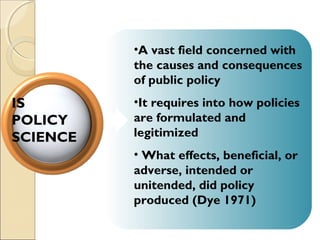
•A vast field concerned with
the causes and consequences
of public policy
•It requires into how policies
are formulated and
legitimized
• What effects, beneficial, or
adverse, intended or
unitended, did policy
produced (Dye 1971)
IS
POLICY
SCIENCE
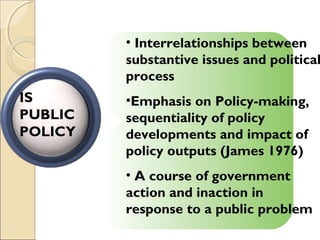
• Interrelationships between
substantive issues and political
process
•Emphasis on Policy-making,
sequentiality of policy
developments and impact of
policy outputs (James 1976)
• A course of government
action and inaction in
response to a public problem
IS
PUBLIC
POLICY
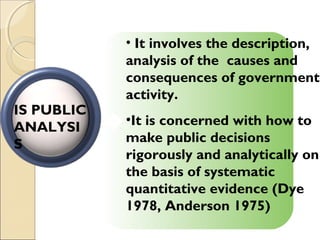
• It involves the description,
analysis of the causes and
consequences of government
activity.
•It is concerned with how to
make public decisions
rigorously and analytically on
the basis of systematic
quantitative evidence (Dye
1978, Anderson 1975)
IS PUBLIC
ANALYSI
S
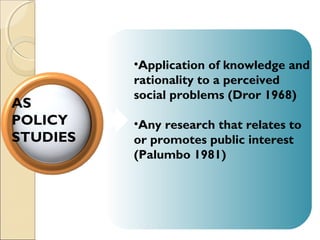
•Application of knowledge and
rationality to a perceived
social problems (Dror 1968)
•Any research that relates to
or promotes public interest
(Palumbo 1981)
AS
POLICY
STUDIES
So Policy Science isSo Policy Science is
It is a dynamic concerned with
knowledge of and in the decision
processes of the public and civic order
Consists of both policy studies and policy
analysis
Policy Studies examines the content of
public policies, the policy processes and
outputs, as well as does some evaluation
of the impacts of public policies
WHO ARE THE POLICY SCIENTIST?WHO ARE THE POLICY SCIENTIST?
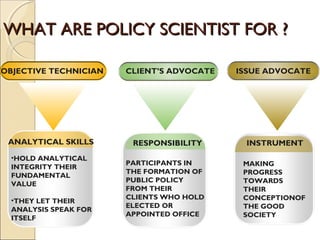
WHAT ARE POLICY SCIENTIST FOR ?WHAT ARE POLICY SCIENTIST FOR ?
ANALYTICAL SKILLS
•HOLD ANALYTICAL
INTEGRITY THEIR
FUNDAMENTAL
VALUE
•THEY LET THEIR
ANALYSIS SPEAK FOR
ITSELF
RESPONSIBILITY
PARTICIPANTS IN
THE FORMATION OF
PUBLIC POLICY
FROM THEIR
CLIENTS WHO HOLD
ELECTED OR
APPOINTED OFFICE
INSTRUMENT
MAKING
PROGRESS
TOWARDS
THEIR
CONCEPTIONOF
THE GOOD
SOCIETY
CLIENT’S ADVOCATE ISSUE ADVOCATEOBJECTIVE TECHNICIAN
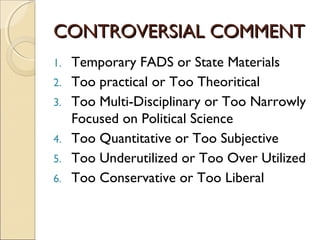
CONTROVERSIAL COMMENTCONTROVERSIAL COMMENT
1. Temporary FADS or State Materials
2. Too practical or Too Theoritical
3. Too Multi-Disciplinary or Too Narrowly
Focused on Political Science
4. Too Quantitative or Too Subjective
5. Too Underutilized or Too Over Utilized
6. Too Conservative or Too Liberal
POLICY SCIENCE IN THE PHIL.POLICY SCIENCE IN THE PHIL.
Started in late 70’s
Under the Martial Law it was agitated to
accelerate national development
It also gave rise to technocrats
Mark of recognition
Sadly did not experience the same
intensity like in the West
19781978
Creation of a Policy Studies Program in
the College of Public Ad in the UP and
graduate program
19891989
PSP was reorganized and expanded its
function to include administrative
development, research and policy.
Policy Institution
FUTURE AND PROSPECTFUTURE AND PROSPECT
Limited Reach of the Academic Discipline
Long Gestation period
Newness of Policy Research Insitution
Disjoined Incrementalism and
Individualism
Policy science..

Policy science..

  • 1.
  • 2.
    INTRODUCTIONINTRODUCTION a mood morethan a science, a loosely organized body of precepts and positions rather than a tightly integrated body of systematic knowledge, more art and craft than a genuine ‘science’
  • 3.
    WHAT IS POLICYWHATIS POLICY SCIENCE?SCIENCE?
  • 4.
    •A vast fieldconcerned with the causes and consequences of public policy •It requires into how policies are formulated and legitimized • What effects, beneficial, or adverse, intended or unitended, did policy produced (Dye 1971) IS POLICY SCIENCE
  • 5.
    • Interrelationships between substantiveissues and political process •Emphasis on Policy-making, sequentiality of policy developments and impact of policy outputs (James 1976) • A course of government action and inaction in response to a public problem IS PUBLIC POLICY
  • 6.
    • It involvesthe description, analysis of the causes and consequences of government activity. •It is concerned with how to make public decisions rigorously and analytically on the basis of systematic quantitative evidence (Dye 1978, Anderson 1975) IS PUBLIC ANALYSI S
  • 7.
    •Application of knowledgeand rationality to a perceived social problems (Dror 1968) •Any research that relates to or promotes public interest (Palumbo 1981) AS POLICY STUDIES
  • 8.
    So Policy ScienceisSo Policy Science is It is a dynamic concerned with knowledge of and in the decision processes of the public and civic order Consists of both policy studies and policy analysis Policy Studies examines the content of public policies, the policy processes and outputs, as well as does some evaluation of the impacts of public policies
  • 9.
    WHO ARE THEPOLICY SCIENTIST?WHO ARE THE POLICY SCIENTIST?
  • 10.
    WHAT ARE POLICYSCIENTIST FOR ?WHAT ARE POLICY SCIENTIST FOR ? ANALYTICAL SKILLS •HOLD ANALYTICAL INTEGRITY THEIR FUNDAMENTAL VALUE •THEY LET THEIR ANALYSIS SPEAK FOR ITSELF RESPONSIBILITY PARTICIPANTS IN THE FORMATION OF PUBLIC POLICY FROM THEIR CLIENTS WHO HOLD ELECTED OR APPOINTED OFFICE INSTRUMENT MAKING PROGRESS TOWARDS THEIR CONCEPTIONOF THE GOOD SOCIETY CLIENT’S ADVOCATE ISSUE ADVOCATEOBJECTIVE TECHNICIAN
  • 11.
    CONTROVERSIAL COMMENTCONTROVERSIAL COMMENT 1.Temporary FADS or State Materials 2. Too practical or Too Theoritical 3. Too Multi-Disciplinary or Too Narrowly Focused on Political Science 4. Too Quantitative or Too Subjective 5. Too Underutilized or Too Over Utilized 6. Too Conservative or Too Liberal
  • 12.
    POLICY SCIENCE INTHE PHIL.POLICY SCIENCE IN THE PHIL. Started in late 70’s Under the Martial Law it was agitated to accelerate national development It also gave rise to technocrats Mark of recognition Sadly did not experience the same intensity like in the West
  • 13.
    19781978 Creation of aPolicy Studies Program in the College of Public Ad in the UP and graduate program
  • 14.
    19891989 PSP was reorganizedand expanded its function to include administrative development, research and policy. Policy Institution
  • 15.
    FUTURE AND PROSPECTFUTUREAND PROSPECT Limited Reach of the Academic Discipline Long Gestation period Newness of Policy Research Insitution Disjoined Incrementalism and Individualism