Welcome
Smitha
D G
4
2
3
1
5
1
6
7
Inflorescence
Flowers are the organs of sexual reproduction in higher plants.
They are in fact modified shoots
 They may occur either singly (solitary flowers) or in bunches
on a common axis.
 Solitary flowers may be axillary or terminal.
 Axillary flower is a modified axillary bud, and terminal flower is
a modified terminal bud.
 An axis, bearing a bunch of flowers is known as inflorescence.
 Inflorescence may be axillary or terminal in position.
 The axial stalk or the main axis of the inflorescence is
called rachis or peduncle.
 The individual flowers of an inflorescence are attached
to the peduncle by stalks of their own, known as the
pedicels.
 In some cases, flowers are stalkless and are sessile
flowers, e.g., Achyranthes.
 In some plants like Lotus, and Onion, a long peduncle
arises from the underground stem and bears flowers.
 Such a peduncle is called scape. It may bear a single
flower as in Lotus, or a cluster of flowers as in Onion.
 In Agave, it is branched and the branches bear flowers.
 In most plants, pedicel arise from the axil of a very small greenish, or
brownish leaf-like structure on the peduncle, called bract.
 Bracts are highly reduced and modified leaves and their arrangement on
the peduncle is the same as that of leaves on a vegetative shoot.
 When the peduncle is branched, the branches arise from the axils of
similar bracts.
 res are absent, then the flowers are said to be ebracteate and
ebracteolate.
 Bracts differ from leaves in some respects, such as colour, size and
shape.
 Besides these bracts, there may be one or two still further reduced bract-
like structures on the pedicel, known as the bracteoles.
 Flowers having bracts and bracteoles are described as bracteate and
brocteolate respectively.
 If these structuare absent, then the flowers are said to be ebracteate and
ebracteolate.
 Based on the nature of the peduncle and the arrangement of flowers three
main types of inflorescence can be recognized, namely
Racemose,
Cymose
 and Special.
A. Racemose inflorescence
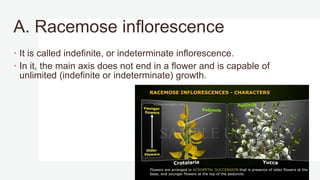
 It is called indefinite, or indeterminate inflorescence.
 In it, the main axis does not end in a flower and is capable of
unlimited (indefinite or indeterminate) growth.
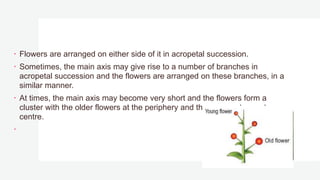
 Flowers are arranged on either side of it in acropetal succession.
 Sometimes, the main axis may give rise to a number of branches in
acropetal succession and the flowers are arranged on these branches, in a
similar manner.
 At times, the main axis may become very short and the flowers form a
cluster with the older flowers at the periphery and the youngest one at
centre.

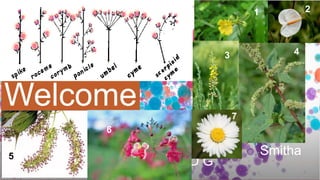
Racemose inflorescence is of several
kinds.
 The commonest ones among them
are
 raceme,
 panicle,
 corymb,
 spike,
 spadix,
 umbel,
 capitulum and catkin.
I. Raceme
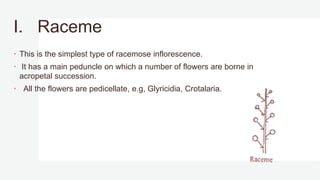
 This is the simplest type of racemose inflorescence.
 It has a main peduncle on which a number of flowers are borne in
acropetal succession.
 All the flowers are pedicellate, e.g, Glyricidia, Crotalaria.
II. Panicle
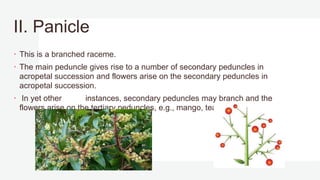
 This is a branched raceme.
 The main peduncle gives rise to a number of secondary peduncles in
acropetal succession and flowers arise on the secondary peduncles in
acropetal succession.
 In yet other instances, secondary peduncles may branch and the
flowers arise on the tertiary peduncles, e.g., mango, teak.
III. Corymb
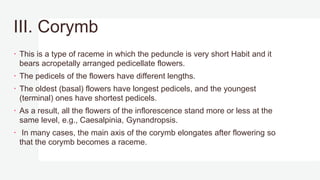
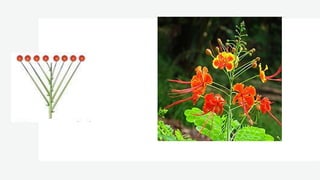
 This is a type of raceme in which the peduncle is very short Habit and it
bears acropetally arranged pedicellate flowers.
 The pedicels of the flowers have different lengths.
 The oldest (basal) flowers have longest pedicels, and the youngest
(terminal) ones have shortest pedicels.
 As a result, all the flowers of the inflorescence stand more or less at the
same level, e.g., Caesalpinia, Gynandropsis.
 In many cases, the main axis of the corymb elongates after flowering so
that the corymb becomes a raceme.
III Spike
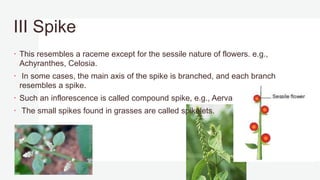
 This resembles a raceme except for the sessile nature of flowers. e.g.,
Achyranthes, Celosia.
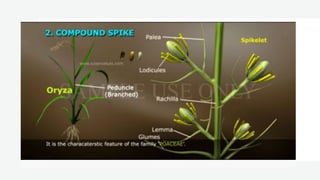
 In some cases, the main axis of the spike is branched, and each branch
resembles a spike.
 Such an inflorescence is called compound spike, e.g., Aerva.
 The small spikes found in grasses are called spikelets.
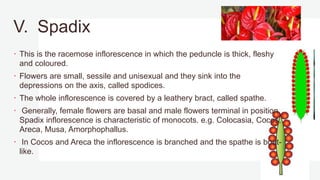
V. Spadix
 This is the racemose inflorescence in which the peduncle is thick, fleshy
and coloured.
 Flowers are small, sessile and unisexual and they sink into the
depressions on the axis, called spodices.
 The whole inflorescence is covered by a leathery bract, called spathe.
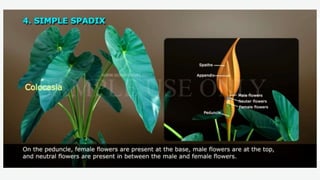
 Generally, female flowers are basal and male flowers terminal in position.
Spadix inflorescence is characteristic of monocots. e.g. Colocasia, Cocos,
Areca, Musa, Amorphophallus.
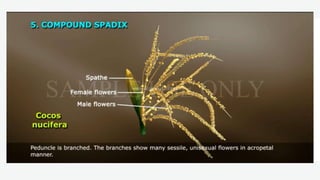
 In Cocos and Areca the inflorescence is branched and the spathe is boat-
like.
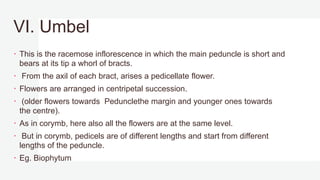
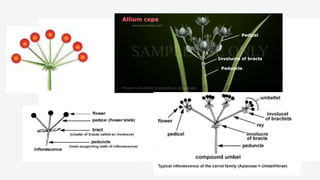
VI. Umbel
 This is the racemose inflorescence in which the main peduncle is short and
bears at its tip a whorl of bracts.
 From the axil of each bract, arises a pedicellate flower.
 Flowers are arranged in centripetal succession.
 (older flowers towards Pedunclethe margin and younger ones towards
the centre).
 As in corymb, here also all the flowers are at the same level.
 But in corymb, pedicels are of different lengths and start from different
lengths of the peduncle.
 Eg. Biophytum
 In umbel, all the pedicels are of equal length and all of them start from the
apex of the peduncle.
 The racemose nature of the inflorescence is evident from the centripetal
arrangement of flowers.
 The main peduncle may be simple, or it may bear a cluster of flowers at
the apex as in onion.
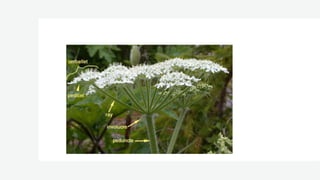
 In compound umbel, the main peduncle may give rise to secondary
peduncles, and pedicels start their tips in an umbellate manner as in
coriander and carrot
 . The whorl of bracts below the cluster of pedicels forms an involucre.
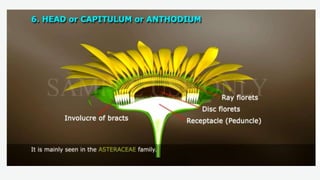
VII. Capitulum or head
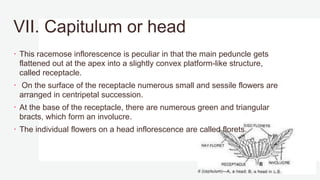
 This racemose inflorescence is peculiar in that the main peduncle gets
flattened out at the apex into a slightly convex platform-like structure,
called receptacle.
 On the surface of the receptacle numerous small and sessile flowers are
arranged in centripetal succession.
 At the base of the receptacle, there are numerous green and triangular
bracts, which form an involucre.
 The individual flowers on a head inflorescence are called florets.
 The florets arranged along the periphery of the receptacle are called ray
florets and those arranged along the centre are called disc florets.
 Ray florets are usually zygomorphic and female, whereas disc florets are
actinomorphic and bisexual.
 In some plants, such as Mimosa, Gomphrena, etc., the receptacle is not
flat, but is a swollen and spherical structure and the flowers are arranged
all over it.
 The whole inflorescence looks like a small badminton ball, and is known as
a globose head.
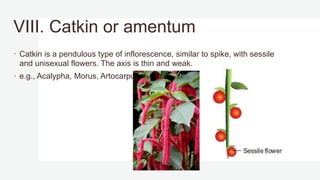
VIII. Catkin or amentum
 Catkin is a pendulous type of inflorescence, similar to spike, with sessile
and unisexual flowers. The axis is thin and weak.
 e.g., Acalypha, Morus, Artocarpus.
3
1
2
4

Inflorescence1

  • 1.
  • 2.
    Inflorescence Flowers are theorgans of sexual reproduction in higher plants. They are in fact modified shoots  They may occur either singly (solitary flowers) or in bunches on a common axis.  Solitary flowers may be axillary or terminal.  Axillary flower is a modified axillary bud, and terminal flower is a modified terminal bud.  An axis, bearing a bunch of flowers is known as inflorescence.
  • 3.
     Inflorescence maybe axillary or terminal in position.  The axial stalk or the main axis of the inflorescence is called rachis or peduncle.  The individual flowers of an inflorescence are attached to the peduncle by stalks of their own, known as the pedicels.
  • 4.
     In somecases, flowers are stalkless and are sessile flowers, e.g., Achyranthes.  In some plants like Lotus, and Onion, a long peduncle arises from the underground stem and bears flowers.  Such a peduncle is called scape. It may bear a single flower as in Lotus, or a cluster of flowers as in Onion.  In Agave, it is branched and the branches bear flowers.
  • 5.
     In mostplants, pedicel arise from the axil of a very small greenish, or brownish leaf-like structure on the peduncle, called bract.  Bracts are highly reduced and modified leaves and their arrangement on the peduncle is the same as that of leaves on a vegetative shoot.  When the peduncle is branched, the branches arise from the axils of similar bracts.  res are absent, then the flowers are said to be ebracteate and ebracteolate.
  • 6.
     Bracts differfrom leaves in some respects, such as colour, size and shape.  Besides these bracts, there may be one or two still further reduced bract- like structures on the pedicel, known as the bracteoles.  Flowers having bracts and bracteoles are described as bracteate and brocteolate respectively.  If these structuare absent, then the flowers are said to be ebracteate and ebracteolate.
  • 7.
     Based onthe nature of the peduncle and the arrangement of flowers three main types of inflorescence can be recognized, namely Racemose, Cymose  and Special.
  • 8.
    A. Racemose inflorescence It is called indefinite, or indeterminate inflorescence.  In it, the main axis does not end in a flower and is capable of unlimited (indefinite or indeterminate) growth.
  • 9.
     Flowers arearranged on either side of it in acropetal succession.  Sometimes, the main axis may give rise to a number of branches in acropetal succession and the flowers are arranged on these branches, in a similar manner.  At times, the main axis may become very short and the flowers form a cluster with the older flowers at the periphery and the youngest one at centre. 
  • 10.
    Racemose inflorescence isof several kinds.  The commonest ones among them are  raceme,  panicle,  corymb,  spike,  spadix,  umbel,  capitulum and catkin.
  • 11.
    I. Raceme  Thisis the simplest type of racemose inflorescence.  It has a main peduncle on which a number of flowers are borne in acropetal succession.  All the flowers are pedicellate, e.g, Glyricidia, Crotalaria.
  • 12.
    II. Panicle  Thisis a branched raceme.  The main peduncle gives rise to a number of secondary peduncles in acropetal succession and flowers arise on the secondary peduncles in acropetal succession.  In yet other instances, secondary peduncles may branch and the flowers arise on the tertiary peduncles, e.g., mango, teak.
  • 13.
    III. Corymb  Thisis a type of raceme in which the peduncle is very short Habit and it bears acropetally arranged pedicellate flowers.  The pedicels of the flowers have different lengths.  The oldest (basal) flowers have longest pedicels, and the youngest (terminal) ones have shortest pedicels.  As a result, all the flowers of the inflorescence stand more or less at the same level, e.g., Caesalpinia, Gynandropsis.  In many cases, the main axis of the corymb elongates after flowering so that the corymb becomes a raceme.
  • 15.
    III Spike  Thisresembles a raceme except for the sessile nature of flowers. e.g., Achyranthes, Celosia.  In some cases, the main axis of the spike is branched, and each branch resembles a spike.  Such an inflorescence is called compound spike, e.g., Aerva.  The small spikes found in grasses are called spikelets.
  • 17.
    V. Spadix  Thisis the racemose inflorescence in which the peduncle is thick, fleshy and coloured.  Flowers are small, sessile and unisexual and they sink into the depressions on the axis, called spodices.  The whole inflorescence is covered by a leathery bract, called spathe.  Generally, female flowers are basal and male flowers terminal in position. Spadix inflorescence is characteristic of monocots. e.g. Colocasia, Cocos, Areca, Musa, Amorphophallus.  In Cocos and Areca the inflorescence is branched and the spathe is boat- like.
  • 20.
    VI. Umbel  Thisis the racemose inflorescence in which the main peduncle is short and bears at its tip a whorl of bracts.  From the axil of each bract, arises a pedicellate flower.  Flowers are arranged in centripetal succession.  (older flowers towards Pedunclethe margin and younger ones towards the centre).  As in corymb, here also all the flowers are at the same level.  But in corymb, pedicels are of different lengths and start from different lengths of the peduncle.  Eg. Biophytum
  • 23.
     In umbel,all the pedicels are of equal length and all of them start from the apex of the peduncle.  The racemose nature of the inflorescence is evident from the centripetal arrangement of flowers.  The main peduncle may be simple, or it may bear a cluster of flowers at the apex as in onion.  In compound umbel, the main peduncle may give rise to secondary peduncles, and pedicels start their tips in an umbellate manner as in coriander and carrot  . The whorl of bracts below the cluster of pedicels forms an involucre.
  • 24.
    VII. Capitulum orhead  This racemose inflorescence is peculiar in that the main peduncle gets flattened out at the apex into a slightly convex platform-like structure, called receptacle.  On the surface of the receptacle numerous small and sessile flowers are arranged in centripetal succession.  At the base of the receptacle, there are numerous green and triangular bracts, which form an involucre.  The individual flowers on a head inflorescence are called florets.
  • 25.
     The floretsarranged along the periphery of the receptacle are called ray florets and those arranged along the centre are called disc florets.  Ray florets are usually zygomorphic and female, whereas disc florets are actinomorphic and bisexual.  In some plants, such as Mimosa, Gomphrena, etc., the receptacle is not flat, but is a swollen and spherical structure and the flowers are arranged all over it.  The whole inflorescence looks like a small badminton ball, and is known as a globose head.
  • 27.
    VIII. Catkin oramentum  Catkin is a pendulous type of inflorescence, similar to spike, with sessile and unisexual flowers. The axis is thin and weak.  e.g., Acalypha, Morus, Artocarpus.
  • 28.