1
2
Inflorescence:
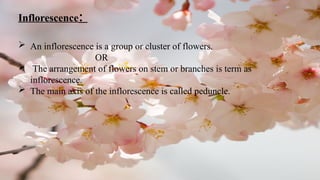
 An inflorescence is a group or cluster of flowers.
OR
 The arrangement of flowers on stem or branches is term as
inflorescence.
 The main axis of the inflorescence is called peduncle.
3
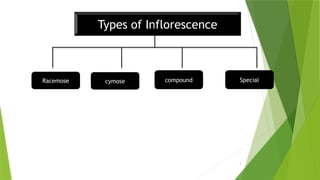
Types of Inflorescence
Racemose compound Special
cymose
4
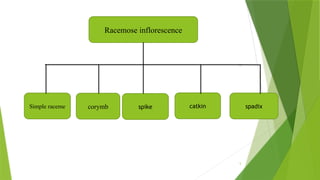
Racemose inflorescence.
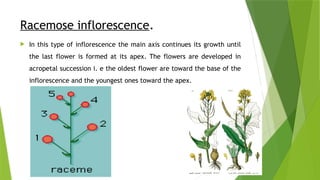
 In this type of inflorescence the main axis continues its growth until
the last flower is formed at its apex. The flowers are developed in
acropetal succession i. e the oldest flower are toward the base of the
inflorescence and the youngest ones toward the apex.
5
Racemose inflorescence
Simple raceme corymb spike catkin spadix
6
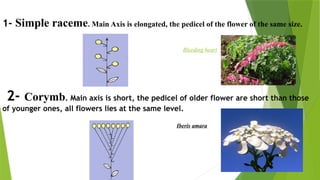
1- Simple raceme. Main Axis is elongated, the pedicel of the flower of the same size.
Bleeding heart
2- Corymb. Main axis is short, the pedicel of older flower are short than those
of younger ones, all flowers lies at the same level.
Iberis amara
7
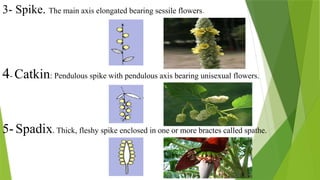
3- Spike. The main axis elongated bearing sessile flowers.
4- Catkin: Pendulous spike with pendulous axis bearing unisexual flowers.
5- Spadix. Thick, fleshy spike enclosed in one or more bractes called spathe.
8
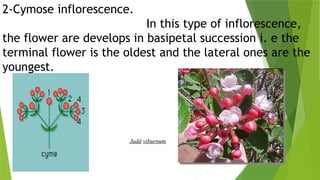
2-Cymose inflorescence.
In this type of inflorescence,
the flower are develops in basipetal succession i. e the
terminal flower is the oldest and the lateral ones are the
youngest.
Judd viburnum
9
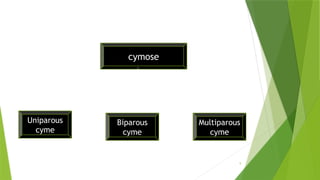
Uniparous
cyme
cymose
Multiparous
cyme
Biparous
cyme
10
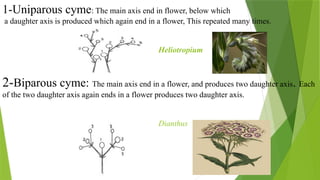
1-Uniparous cyme: The main axis end in flower, below which
a daughter axis is produced which again end in a flower, This repeated many times.
Heliotropium
2-Biparous cyme: The main axis end in a flower, and produces two daughter axis. Each
of the two daughter axis again ends in a flower produces two daughter axis.
Dianthus
11
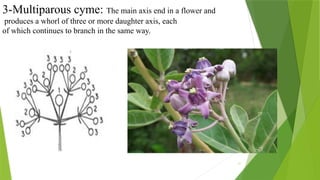
3-Multiparous cyme: The main axis end in a flower and
produces a whorl of three or more daughter axis, each
of which continues to branch in the same way.
12
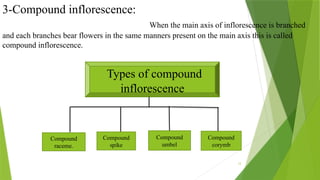
3-Compound inflorescence:
When the main axis of inflorescence is branched
and each branches bear flowers in the same manners present on the main axis this is called
compound inflorescence.
Types of compound
inflorescence
Compound
raceme.
Compound
spike
Compound
umbel
Compound
corymb
13
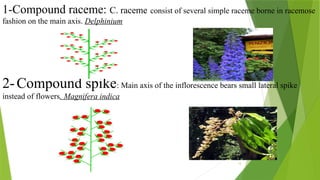
1-Compound raceme: C. raceme consist of several simple raceme borne in racemose
fashion on the main axis. Delphinium
2-Compound spike: Main axis of the inflorescence bears small lateral spike
instead of flowers. Magnifera indica
14
3- Compound umbel: A number of umbles borne in an umbellate manner on the tip of the main axis Coriandrum
sativum.
4-Compound corymb: The main axis branched in corymbos manner and each branch is a simple corymb,
Brassica compestris
15
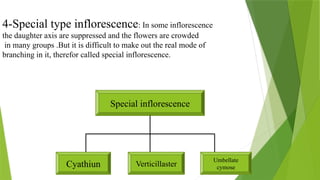
4-Special type inflorescence: In some inflorescence
the daughter axis are suppressed and the flowers are crowded
in many groups .But it is difficult to make out the real mode of
branching in it, therefor called special inflorescence.
Special inflorescence
Umbellate
cymose
Cyathiun Verticillaster
16
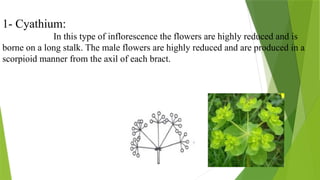
1- Cyathium:
In this type of inflorescence the flowers are highly reduced and is
borne on a long stalk. The male flowers are highly reduced and are produced in a
scorpioid manner from the axil of each bract.
17
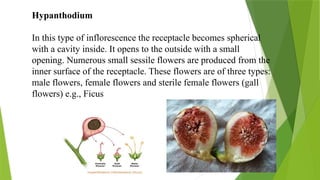
Hypanthodium
In this type of inflorescence the receptacle becomes spherical
with a cavity inside. It opens to the outside with a small
opening. Numerous small sessile flowers are produced from the
inner surface of the receptacle. These flowers are of three types:
male flowers, female flowers and sterile female flowers (gall
flowers) e.g., Ficus
18
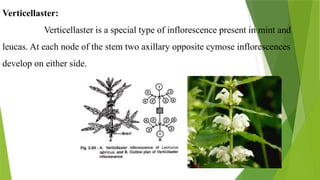
Verticellaster:
Verticellaster is a special type of inflorescence present in mint and
leucas. At each node of the stem two axillary opposite cymose inflorescences
develop on either side.
19
Thanks

asif khan presentation.pptx.............

  • 1.
  • 2.
    2 Inflorescence:  An inflorescenceis a group or cluster of flowers. OR  The arrangement of flowers on stem or branches is term as inflorescence.  The main axis of the inflorescence is called peduncle.
  • 3.
    3 Types of Inflorescence Racemosecompound Special cymose
  • 4.
    4 Racemose inflorescence.  Inthis type of inflorescence the main axis continues its growth until the last flower is formed at its apex. The flowers are developed in acropetal succession i. e the oldest flower are toward the base of the inflorescence and the youngest ones toward the apex.
  • 5.
    5 Racemose inflorescence Simple racemecorymb spike catkin spadix
  • 6.
    6 1- Simple raceme.Main Axis is elongated, the pedicel of the flower of the same size. Bleeding heart 2- Corymb. Main axis is short, the pedicel of older flower are short than those of younger ones, all flowers lies at the same level. Iberis amara
  • 7.
    7 3- Spike. Themain axis elongated bearing sessile flowers. 4- Catkin: Pendulous spike with pendulous axis bearing unisexual flowers. 5- Spadix. Thick, fleshy spike enclosed in one or more bractes called spathe.
  • 8.
    8 2-Cymose inflorescence. In thistype of inflorescence, the flower are develops in basipetal succession i. e the terminal flower is the oldest and the lateral ones are the youngest. Judd viburnum
  • 9.
  • 10.
    10 1-Uniparous cyme: Themain axis end in flower, below which a daughter axis is produced which again end in a flower, This repeated many times. Heliotropium 2-Biparous cyme: The main axis end in a flower, and produces two daughter axis. Each of the two daughter axis again ends in a flower produces two daughter axis. Dianthus
  • 11.
    11 3-Multiparous cyme: Themain axis end in a flower and produces a whorl of three or more daughter axis, each of which continues to branch in the same way.
  • 12.
    12 3-Compound inflorescence: When themain axis of inflorescence is branched and each branches bear flowers in the same manners present on the main axis this is called compound inflorescence. Types of compound inflorescence Compound raceme. Compound spike Compound umbel Compound corymb
  • 13.
    13 1-Compound raceme: C.raceme consist of several simple raceme borne in racemose fashion on the main axis. Delphinium 2-Compound spike: Main axis of the inflorescence bears small lateral spike instead of flowers. Magnifera indica
  • 14.
    14 3- Compound umbel:A number of umbles borne in an umbellate manner on the tip of the main axis Coriandrum sativum. 4-Compound corymb: The main axis branched in corymbos manner and each branch is a simple corymb, Brassica compestris
  • 15.
    15 4-Special type inflorescence:In some inflorescence the daughter axis are suppressed and the flowers are crowded in many groups .But it is difficult to make out the real mode of branching in it, therefor called special inflorescence. Special inflorescence Umbellate cymose Cyathiun Verticillaster
  • 16.
    16 1- Cyathium: In thistype of inflorescence the flowers are highly reduced and is borne on a long stalk. The male flowers are highly reduced and are produced in a scorpioid manner from the axil of each bract.
  • 17.
    17 Hypanthodium In this typeof inflorescence the receptacle becomes spherical with a cavity inside. It opens to the outside with a small opening. Numerous small sessile flowers are produced from the inner surface of the receptacle. These flowers are of three types: male flowers, female flowers and sterile female flowers (gall flowers) e.g., Ficus
  • 18.
    18 Verticellaster: Verticellaster is aspecial type of inflorescence present in mint and leucas. At each node of the stem two axillary opposite cymose inflorescences develop on either side.
  • 19.