Introduction
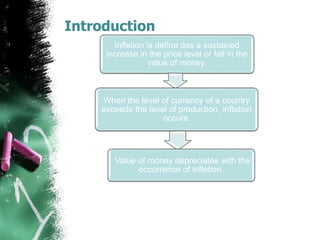
Inflation is define das a sustained
increase in the price level or fall in the
value of money.
When the level of currency of a country
exceeds the level of production, inflation
occurs.
Value of money depreciates with the
occurrence of inflation.
DEFINITION
• According to C. Crowther, “Inflation is state in
which the value of money is falling and the
Prices are rising.”
• In Economics, the word “Inflation” refers to
General rise in prices measured against a
standard level of purchasing power.
Types of Inflation
Open Inflation
Suppressed Inflation
Galloping Inflation
Creeping Inflation
Hyper Inflation
Causes Of Inflation
 Increase in money supply
 Increase in disposable income
 Deficit financing
 Foreign exchange reserves
FACTORS ON DEMAND SIDE :
 Rise in administered prices
Erratic agriculture growth
Agricultural price policy
Inadequate industrial growth
FACTORS ON SUPPLY SIDE :
Effects of Inflation :
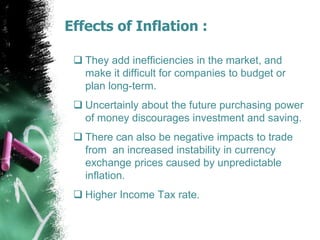
 They add inefficiencies in the market, and
make it difficult for companies to budget or
plan long-term.
 Uncertainly about the future purchasing power
of money discourages investment and saving.
 There can also be negative impacts to trade
from an increased instability in currency
exchange prices caused by unpredictable
inflation.
 Higher Income Tax rate.
How is Inflation measured ?
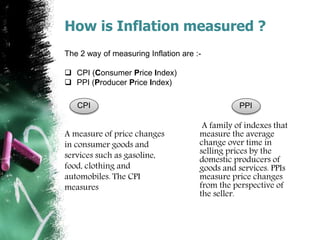
A measure of price changes
in consumer goods and
services such as gasoline,
food, clothing and
automobiles. The CPI
measures
The 2 way of measuring Inflation are :-
 CPI (Consumer Price Index)
 PPI (Producer Price Index)
CPI PPI
A family of indexes that
measure the average
change over time in
selling prices by the
domestic producers of
goods and services. PPIs
measure price changes
from the perspective of
the seller.
Consequences of Inflation
 Adverse effect on production.
 Adverse effect on distribution of income.
 Obstacle to development.
 Changes in relative prices.
 Adverse effect on the B.O.P.
Measures of Inflation
1. Monetary Policy
• Credit Control
• Demonetization of currency
• Issue of New Currency
2. Fiscal Policy
• Reduction in Unnecessary Expenditure
• Increase in taxes
• Increase in savings
• Surplus Budget
• Public debts
3. Other Measures
• To Increase production
• Rational Wage Policy
• Price Control
THANK YOU

Inflation

  • 2.
    Introduction Inflation is definedas a sustained increase in the price level or fall in the value of money. When the level of currency of a country exceeds the level of production, inflation occurs. Value of money depreciates with the occurrence of inflation.
  • 3.
    DEFINITION • According toC. Crowther, “Inflation is state in which the value of money is falling and the Prices are rising.” • In Economics, the word “Inflation” refers to General rise in prices measured against a standard level of purchasing power.
  • 4.
    Types of Inflation OpenInflation Suppressed Inflation Galloping Inflation Creeping Inflation Hyper Inflation
  • 5.
    Causes Of Inflation Increase in money supply  Increase in disposable income  Deficit financing  Foreign exchange reserves FACTORS ON DEMAND SIDE :
  • 6.
     Rise inadministered prices Erratic agriculture growth Agricultural price policy Inadequate industrial growth FACTORS ON SUPPLY SIDE :
  • 7.
    Effects of Inflation:  They add inefficiencies in the market, and make it difficult for companies to budget or plan long-term.  Uncertainly about the future purchasing power of money discourages investment and saving.  There can also be negative impacts to trade from an increased instability in currency exchange prices caused by unpredictable inflation.  Higher Income Tax rate.
  • 8.
    How is Inflationmeasured ? A measure of price changes in consumer goods and services such as gasoline, food, clothing and automobiles. The CPI measures The 2 way of measuring Inflation are :-  CPI (Consumer Price Index)  PPI (Producer Price Index) CPI PPI A family of indexes that measure the average change over time in selling prices by the domestic producers of goods and services. PPIs measure price changes from the perspective of the seller.
  • 9.
    Consequences of Inflation Adverse effect on production.  Adverse effect on distribution of income.  Obstacle to development.  Changes in relative prices.  Adverse effect on the B.O.P.
  • 10.
    Measures of Inflation 1.Monetary Policy • Credit Control • Demonetization of currency • Issue of New Currency 2. Fiscal Policy • Reduction in Unnecessary Expenditure • Increase in taxes • Increase in savings • Surplus Budget • Public debts 3. Other Measures • To Increase production • Rational Wage Policy • Price Control
  • 11.