Presented By:
Mamta
Vamsi
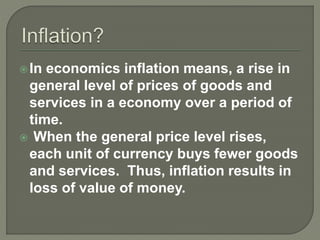
In economics inflation means, a rise in
general level of prices of goods and
services in a economy over a period of
time.
 When the general price level rises,
each unit of currency buys fewer goods
and services. Thus, inflation results in
loss of value of money.
 DEMAND - PULL INFLATION:
In this type of inflation prices increase results from an excess
of demand over supply for the economy as a whole.
Demand inflation occurs when supply cannot expand any
more to meet demand; that is, when critical production factors
are being fully utilized, also called Demand inflation.
 COST - PUSH INFLATION:
This type of inflation occurs when general price levels rise
owing to rising input costs.
In general, there are three factors that could contribute to
Cost-Push inflation: rising wages, increases in corporate
taxes, and imported inflation. [imported raw or partly-finished
goods may become expensive due to rise in international
costs or as a result of depreciation of local currency ]
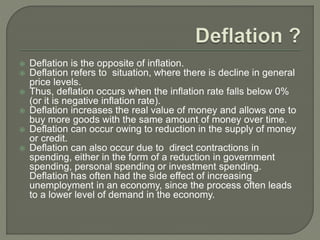
 Deflation is the opposite of inflation.
 Deflation refers to situation, where there is decline in general
price levels.
 Thus, deflation occurs when the inflation rate falls below 0%
(or it is negative inflation rate).
 Deflation increases the real value of money and allows one to
buy more goods with the same amount of money over time.
 Deflation can occur owing to reduction in the supply of money
or credit.
 Deflation can also occur due to direct contractions in
spending, either in the form of a reduction in government
spending, personal spending or investment spending.
Deflation has often had the side effect of increasing
unemployment in an economy, since the process often leads
to a lower level of demand in the economy.
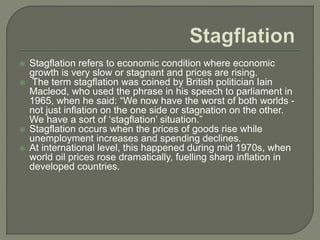
 Stagflation refers to economic condition where economic
growth is very slow or stagnant and prices are rising.
 The term stagflation was coined by British politician Iain
Macleod, who used the phrase in his speech to parliament in
1965, when he said: “We now have the worst of both worlds -
not just inflation on the one side or stagnation on the other.
We have a sort of ‘stagflation’ situation.”
 Stagflation occurs when the prices of goods rise while
unemployment increases and spending declines.
 At international level, this happened during mid 1970s, when
world oil prices rose dramatically, fuelling sharp inflation in
developed countries.
 Hyperinflation is a situation where the price
increases are too sharp.
 Hyperinflation often occurs when there is a
large increase in the money supply, which
is not supported by growth in Gross
Domestic Product (GDP).
 Such a situation results in an imbalance in
the supply and demand for the money.
 In this this remains unchecked; it results into
sharp increase in prices and depreciation of
the domestic currency.
 Main measures:
 Monitory policy
Monetary policy consists of the actions of a central bank, currency board or
other regulatory committee that determine the size and rate of growth of
the money supply, which in turn affects interest rates.
 Fiscal policy
Fiscal policy involves the decisions that a government makes regarding
collection of revenue, through taxation and about spending that
revenue. It is often administered by an executive under laws of a
legislature.
 Direct measures and other measures
Direct controls refer to the regulatory measures undertaken with objectives
of converting an open inflation into a suppressed one. Direct control on
prices and rationing of scarce goods are the two such regulatory
measures.
Other measures:
 Increase in output
-increase the supply of goods
 Control of smuggling
-check and punish
 Industrial peace
-to maintain the supply of goods and avoid the danger of
scarcity.
 Control of money supply
-Volume of credit and money supply should be control. This can
be done if tight monitory policy is followed.
 No deficit financing

Inflation

  • 1.
  • 2.
    In economics inflationmeans, a rise in general level of prices of goods and services in a economy over a period of time.  When the general price level rises, each unit of currency buys fewer goods and services. Thus, inflation results in loss of value of money.
  • 3.
     DEMAND -PULL INFLATION: In this type of inflation prices increase results from an excess of demand over supply for the economy as a whole. Demand inflation occurs when supply cannot expand any more to meet demand; that is, when critical production factors are being fully utilized, also called Demand inflation.  COST - PUSH INFLATION: This type of inflation occurs when general price levels rise owing to rising input costs. In general, there are three factors that could contribute to Cost-Push inflation: rising wages, increases in corporate taxes, and imported inflation. [imported raw or partly-finished goods may become expensive due to rise in international costs or as a result of depreciation of local currency ]
  • 4.
     Deflation isthe opposite of inflation.  Deflation refers to situation, where there is decline in general price levels.  Thus, deflation occurs when the inflation rate falls below 0% (or it is negative inflation rate).  Deflation increases the real value of money and allows one to buy more goods with the same amount of money over time.  Deflation can occur owing to reduction in the supply of money or credit.  Deflation can also occur due to direct contractions in spending, either in the form of a reduction in government spending, personal spending or investment spending. Deflation has often had the side effect of increasing unemployment in an economy, since the process often leads to a lower level of demand in the economy.
  • 5.
     Stagflation refersto economic condition where economic growth is very slow or stagnant and prices are rising.  The term stagflation was coined by British politician Iain Macleod, who used the phrase in his speech to parliament in 1965, when he said: “We now have the worst of both worlds - not just inflation on the one side or stagnation on the other. We have a sort of ‘stagflation’ situation.”  Stagflation occurs when the prices of goods rise while unemployment increases and spending declines.  At international level, this happened during mid 1970s, when world oil prices rose dramatically, fuelling sharp inflation in developed countries.
  • 6.
     Hyperinflation isa situation where the price increases are too sharp.  Hyperinflation often occurs when there is a large increase in the money supply, which is not supported by growth in Gross Domestic Product (GDP).  Such a situation results in an imbalance in the supply and demand for the money.  In this this remains unchecked; it results into sharp increase in prices and depreciation of the domestic currency.
  • 7.
     Main measures: Monitory policy Monetary policy consists of the actions of a central bank, currency board or other regulatory committee that determine the size and rate of growth of the money supply, which in turn affects interest rates.  Fiscal policy Fiscal policy involves the decisions that a government makes regarding collection of revenue, through taxation and about spending that revenue. It is often administered by an executive under laws of a legislature.  Direct measures and other measures Direct controls refer to the regulatory measures undertaken with objectives of converting an open inflation into a suppressed one. Direct control on prices and rationing of scarce goods are the two such regulatory measures.
  • 8.
    Other measures:  Increasein output -increase the supply of goods  Control of smuggling -check and punish  Industrial peace -to maintain the supply of goods and avoid the danger of scarcity.  Control of money supply -Volume of credit and money supply should be control. This can be done if tight monitory policy is followed.  No deficit financing