INFLATION & ITS CONCEPTS
Presentation By:
Prachi
INDEX:
Topics Slide No.
About Inflation
Kinds Of Inflation
Causes Of Inflation
Concepts Of Deflation , Stagflation,
Disinflation And Reinflation
Recession
ABOUT INFLATION:
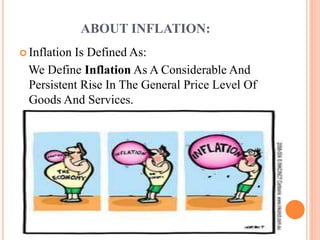
 Inflation Is Defined As:
We Define Inflation As A Considerable And
Persistent Rise In The General Price Level Of
Goods And Services.
CONTINUATION:
 Note:
 This does not mean that all prices must be rising
during a period of inflation –some prices may
even be falling; but the general trend must be
upward
 It is a process of rising prices & not a state of
high prices
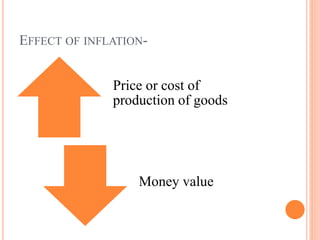
EFFECT OF INFLATION-
Price or cost of
production of goods
Money value
METHODS OF MEASURING INFLATION-
 Government statisticians use price indexes
and the GDP Deflator to measure inflation.
 Two of these price indexes are:
The CPI or Consumer Price Index, and
The WPI or wholesale price index.
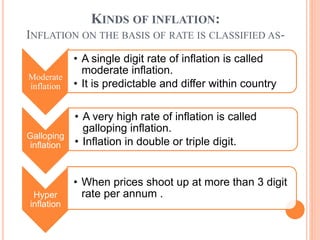
KINDS OF INFLATION:
INFLATION ON THE BASIS OF RATE IS CLASSIFIED AS-
Moderate
inflation
• A single digit rate of inflation is called
moderate inflation.
• It is predictable and differ within country
Galloping
inflation
• A very high rate of inflation is called
galloping inflation.
• Inflation in double or triple digit.
Hyper
inflation
• When prices shoot up at more than 3 digit
rate per annum .
INFLATION ON THE BASIS OF GOVERNMENT
REACTION-
Open
Inflation
• Government does not attempt to
prevent price rise.
• Free market mechanism
Repressed
Inflation
• Government interrupts the rise in
price.
• Through price control and rationing
prevents price rise.
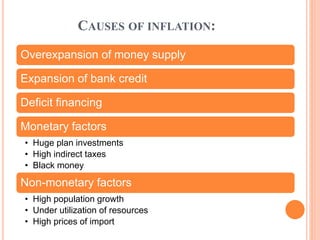
CAUSES OF INFLATION:
Overexpansion of money supply
Expansion of bank credit
Deficit financing
Monetary factors
• Huge plan investments
• High indirect taxes
• Black money
Non-monetary factors
• High population growth
• Under utilization of resources
• High prices of import
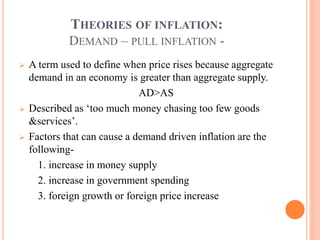
THEORIES OF INFLATION:
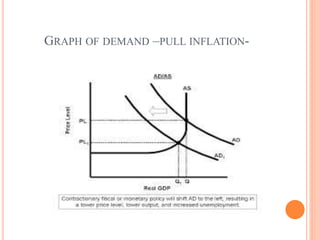
DEMAND – PULL INFLATION -
 A term used to define when price rises because aggregate
demand in an economy is greater than aggregate supply.
AD>AS
 Described as ‘too much money chasing too few goods
&services’.
 Factors that can cause a demand driven inflation are the
following-
1. increase in money supply
2. increase in government spending
3. foreign growth or foreign price increase
GRAPH OF DEMAND –PULL INFLATION-
COST – PUSH INFLATION -
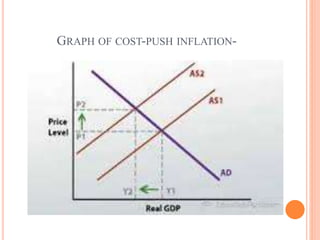
 When there is increase in aggregate supply
of goods and services stemming from an
increase in cost of production , we have cost
– push inflation.
 Caused by monopolistic groups of society
like , labour, unions & firms.
 Types of cost-push inflation:
1. Wage –push inflation
2. Profit –push inflation
3. Supply –shock inflation
GRAPH OF COST-PUSH INFLATION-
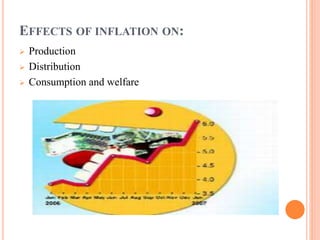
EFFECTS OF INFLATION ON:
 Production
 Distribution
 Consumption and welfare
CONCEPTS OF DEFLATION, DISINFLATION ,
REFLATION & STAGFLATION
 Deflation – is a condition of falling prices
on account of insufficient effective
demand. Results in a continuous fall in
level of economic activity & growing
unemployment
 Disinflation – it is a process of lowering
costs & prices when they are excessively
high. Brings down inflationary trend in
prices without causing unemployment
CONCEPTS OF DEFLATION, DISINFLATION ,
REFLATION & STAGFLATION
 Reflation – is a moderate degree of
inflation that is deliberately undertaken to
relieve depression
 Stagflation – a situation in which a high
rate of inflation prevails simultaneously
with a high rate of unemployment or
stagnant economic condition. It is a
combination of inflation & stagnation
RECESSION:
 The usual dictionary definition is ‘a period
of reduced economic activity’.
 In macroeconomics , a recession is a
decline in a country's gross domestic
product (GDP), or negative real economic
growth, for two or more successive
quarters of a year .
CAUSES OF INFLATION -
 A currency crisis , which is also called a
balance-of-payments crisis , occurs when
the value of a currency changes quickly,
undermining its ability to serve as a
medium of exchange or a store of value .
 An energy crisis is any great bottleneck (or
price rise ) in the supply of energy
resources to an economy . An energy crisis
may be referred to as an oil crisis ,
petroleum crisis , energy shortage ,
electricity shortage or electricity crisis.
CONTINUATION-
 In under consumption , recessions and
stagnation arise due to inadequate
consumer demand >the amount produced .
 In economics , overproduction refers to
supply > demand of products in market .
This leads to lower prices and / or unsold
goods .
CONCLUSION:
25 YEARS ANNUAL 2% INFLATION RATE
$ 3.50 $5.74
SET ASSIDE MONEY TO GROW YOUR SAVINGS FASTER
THAN THE RATE OF INFLATION
0
200
400
600
800
1000
1200
1400
1600
1800
TODAY 10 20
$1600
$1231
$1009
Inflation affects the value of our savings
Inflation

Inflation

  • 1.
    INFLATION & ITSCONCEPTS Presentation By: Prachi
  • 2.
    INDEX: Topics Slide No. AboutInflation Kinds Of Inflation Causes Of Inflation Concepts Of Deflation , Stagflation, Disinflation And Reinflation Recession
  • 3.
    ABOUT INFLATION:  InflationIs Defined As: We Define Inflation As A Considerable And Persistent Rise In The General Price Level Of Goods And Services.
  • 4.
    CONTINUATION:  Note:  Thisdoes not mean that all prices must be rising during a period of inflation –some prices may even be falling; but the general trend must be upward  It is a process of rising prices & not a state of high prices
  • 5.
    EFFECT OF INFLATION- Priceor cost of production of goods Money value
  • 6.
    METHODS OF MEASURINGINFLATION-  Government statisticians use price indexes and the GDP Deflator to measure inflation.  Two of these price indexes are: The CPI or Consumer Price Index, and The WPI or wholesale price index.
  • 7.
    KINDS OF INFLATION: INFLATIONON THE BASIS OF RATE IS CLASSIFIED AS- Moderate inflation • A single digit rate of inflation is called moderate inflation. • It is predictable and differ within country Galloping inflation • A very high rate of inflation is called galloping inflation. • Inflation in double or triple digit. Hyper inflation • When prices shoot up at more than 3 digit rate per annum .
  • 8.
    INFLATION ON THEBASIS OF GOVERNMENT REACTION- Open Inflation • Government does not attempt to prevent price rise. • Free market mechanism Repressed Inflation • Government interrupts the rise in price. • Through price control and rationing prevents price rise.
  • 9.
    CAUSES OF INFLATION: Overexpansionof money supply Expansion of bank credit Deficit financing Monetary factors • Huge plan investments • High indirect taxes • Black money Non-monetary factors • High population growth • Under utilization of resources • High prices of import
  • 10.
    THEORIES OF INFLATION: DEMAND– PULL INFLATION -  A term used to define when price rises because aggregate demand in an economy is greater than aggregate supply. AD>AS  Described as ‘too much money chasing too few goods &services’.  Factors that can cause a demand driven inflation are the following- 1. increase in money supply 2. increase in government spending 3. foreign growth or foreign price increase
  • 11.
    GRAPH OF DEMAND–PULL INFLATION-
  • 12.
    COST – PUSHINFLATION -  When there is increase in aggregate supply of goods and services stemming from an increase in cost of production , we have cost – push inflation.  Caused by monopolistic groups of society like , labour, unions & firms.  Types of cost-push inflation: 1. Wage –push inflation 2. Profit –push inflation 3. Supply –shock inflation
  • 13.
  • 14.
    EFFECTS OF INFLATIONON:  Production  Distribution  Consumption and welfare
  • 15.
    CONCEPTS OF DEFLATION,DISINFLATION , REFLATION & STAGFLATION  Deflation – is a condition of falling prices on account of insufficient effective demand. Results in a continuous fall in level of economic activity & growing unemployment  Disinflation – it is a process of lowering costs & prices when they are excessively high. Brings down inflationary trend in prices without causing unemployment
  • 16.
    CONCEPTS OF DEFLATION,DISINFLATION , REFLATION & STAGFLATION  Reflation – is a moderate degree of inflation that is deliberately undertaken to relieve depression  Stagflation – a situation in which a high rate of inflation prevails simultaneously with a high rate of unemployment or stagnant economic condition. It is a combination of inflation & stagnation
  • 17.
    RECESSION:  The usualdictionary definition is ‘a period of reduced economic activity’.  In macroeconomics , a recession is a decline in a country's gross domestic product (GDP), or negative real economic growth, for two or more successive quarters of a year .
  • 18.
    CAUSES OF INFLATION-  A currency crisis , which is also called a balance-of-payments crisis , occurs when the value of a currency changes quickly, undermining its ability to serve as a medium of exchange or a store of value .  An energy crisis is any great bottleneck (or price rise ) in the supply of energy resources to an economy . An energy crisis may be referred to as an oil crisis , petroleum crisis , energy shortage , electricity shortage or electricity crisis.
  • 19.
    CONTINUATION-  In underconsumption , recessions and stagnation arise due to inadequate consumer demand >the amount produced .  In economics , overproduction refers to supply > demand of products in market . This leads to lower prices and / or unsold goods .
  • 20.
    CONCLUSION: 25 YEARS ANNUAL2% INFLATION RATE $ 3.50 $5.74
  • 21.
    SET ASSIDE MONEYTO GROW YOUR SAVINGS FASTER THAN THE RATE OF INFLATION 0 200 400 600 800 1000 1200 1400 1600 1800 TODAY 10 20 $1600 $1231 $1009 Inflation affects the value of our savings