THE FEMALE GENITAL TRACT CRISBERT I. CUALTEROS,M.D. http://crisbertcualteros.page.tl


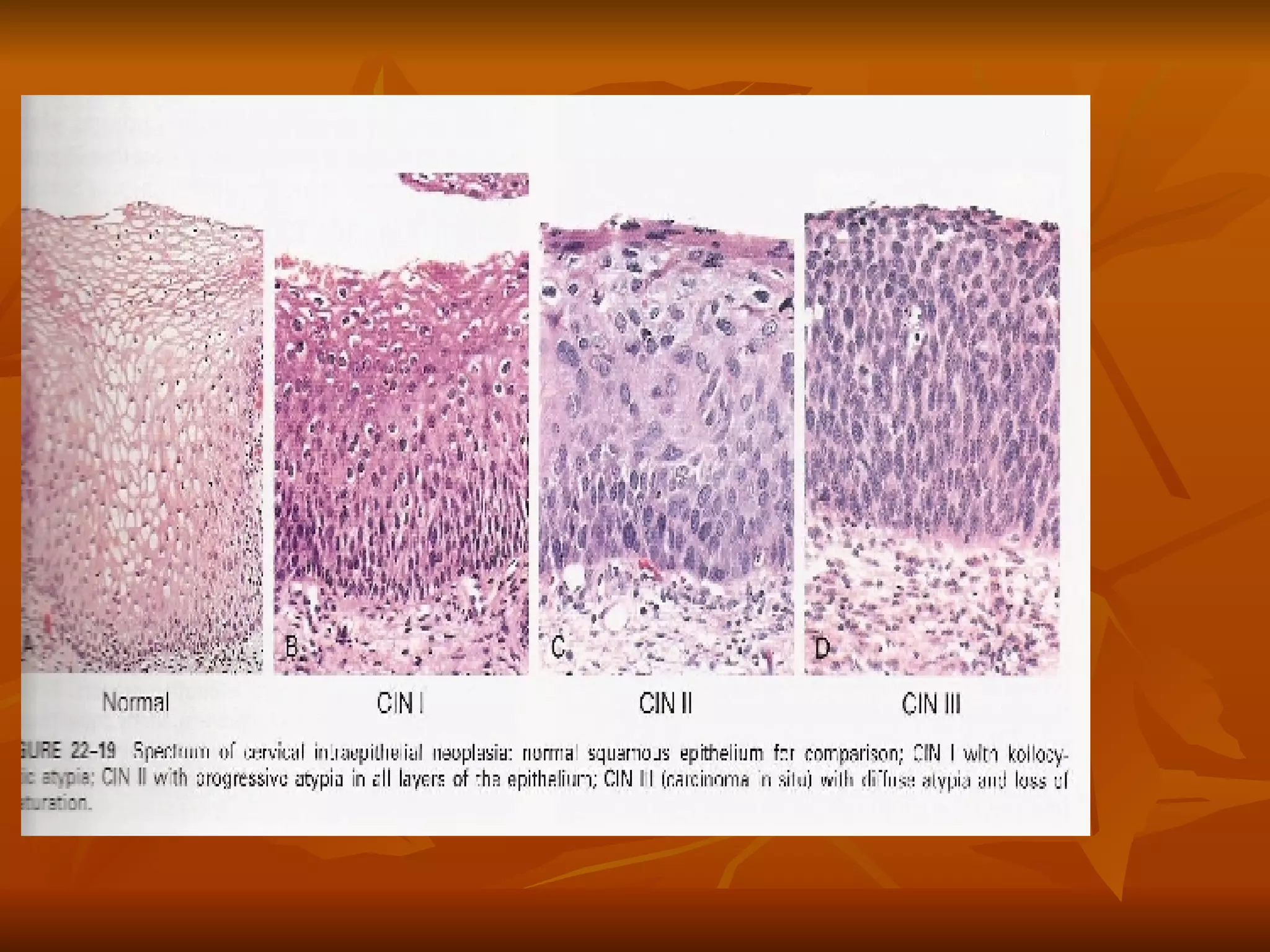
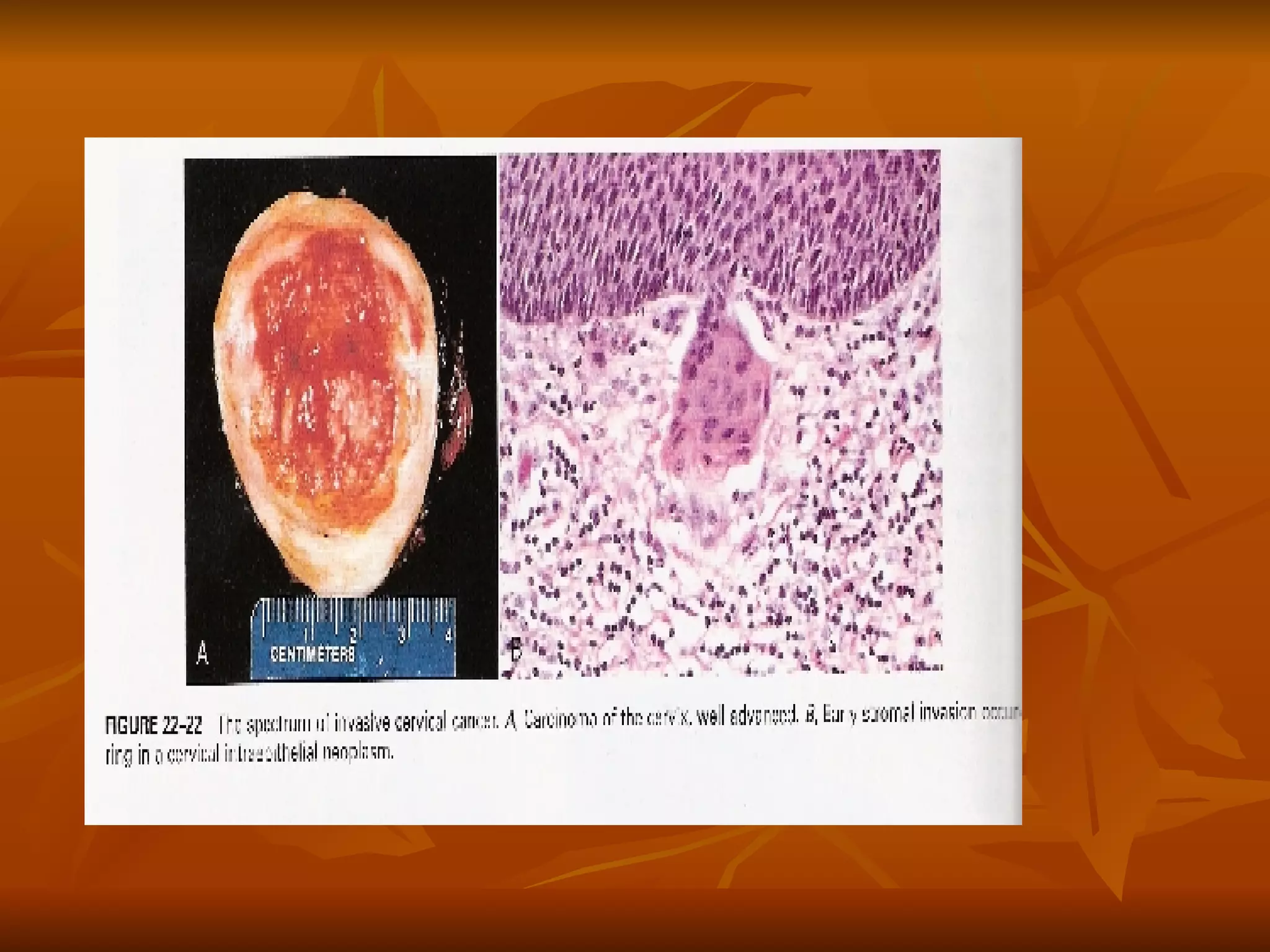
CERVICAL CANCER clinical course and management Cytologic screening  Papanicolaou smear  HPV testing Histologic diagnosis and removal of precancers Surgical removal of invasive cancers with adjunctive radiation and chemotherapy Vaccines for preventing of HPV infection or treating existing disease


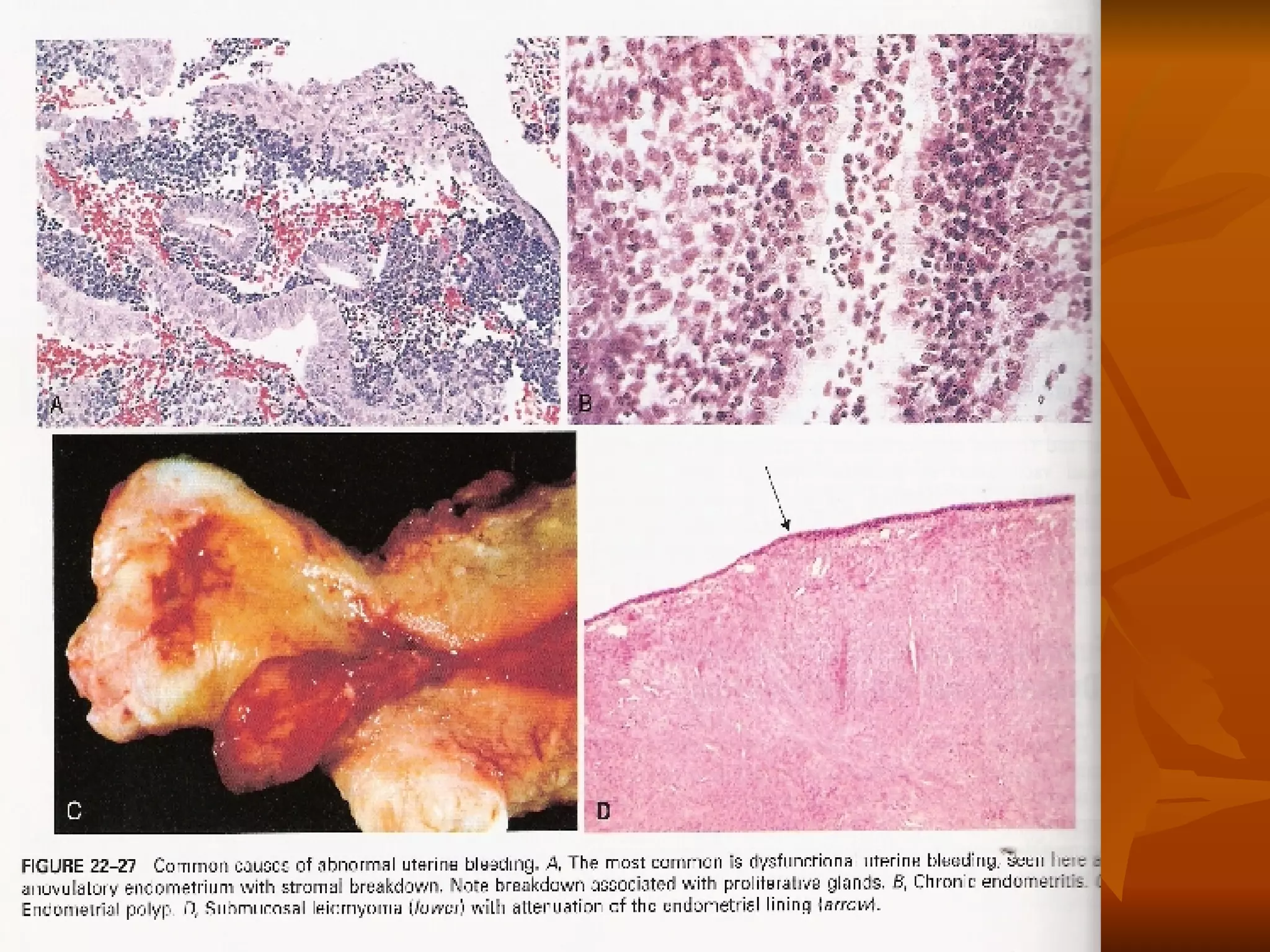
DYSFUNCTIONAL UTERINE BLEEDING ANOVULATORY CYCLE Results in excessive and prolonged estrogenic stimulation without the development of the progestational phase that regularly follows ovulation Most common at menarche and perimenopausal period  INADEQUATE LUTEAL PHASE Occurrence of inadequate corpus luteum function and low progesterone output, with an irregularly ovulatory cycle  ENDOMETRIAL CHANGES ENDUCED BY ORAL CONTRACEPTIVES Common response pattern is a discordant appearance between glands and stroma, usually with inactive glands amid a stroma showing large cells with abundant cytoplasm reminiscent of the decidua of pregnancy MENOPAUSAL & POSTMENOPAUSAL CHANGES Anovulatory cycle    ovarian failure and atrophy of the endometrium Mild hyperplasia with cystic dilation of glands    cystic atrophy


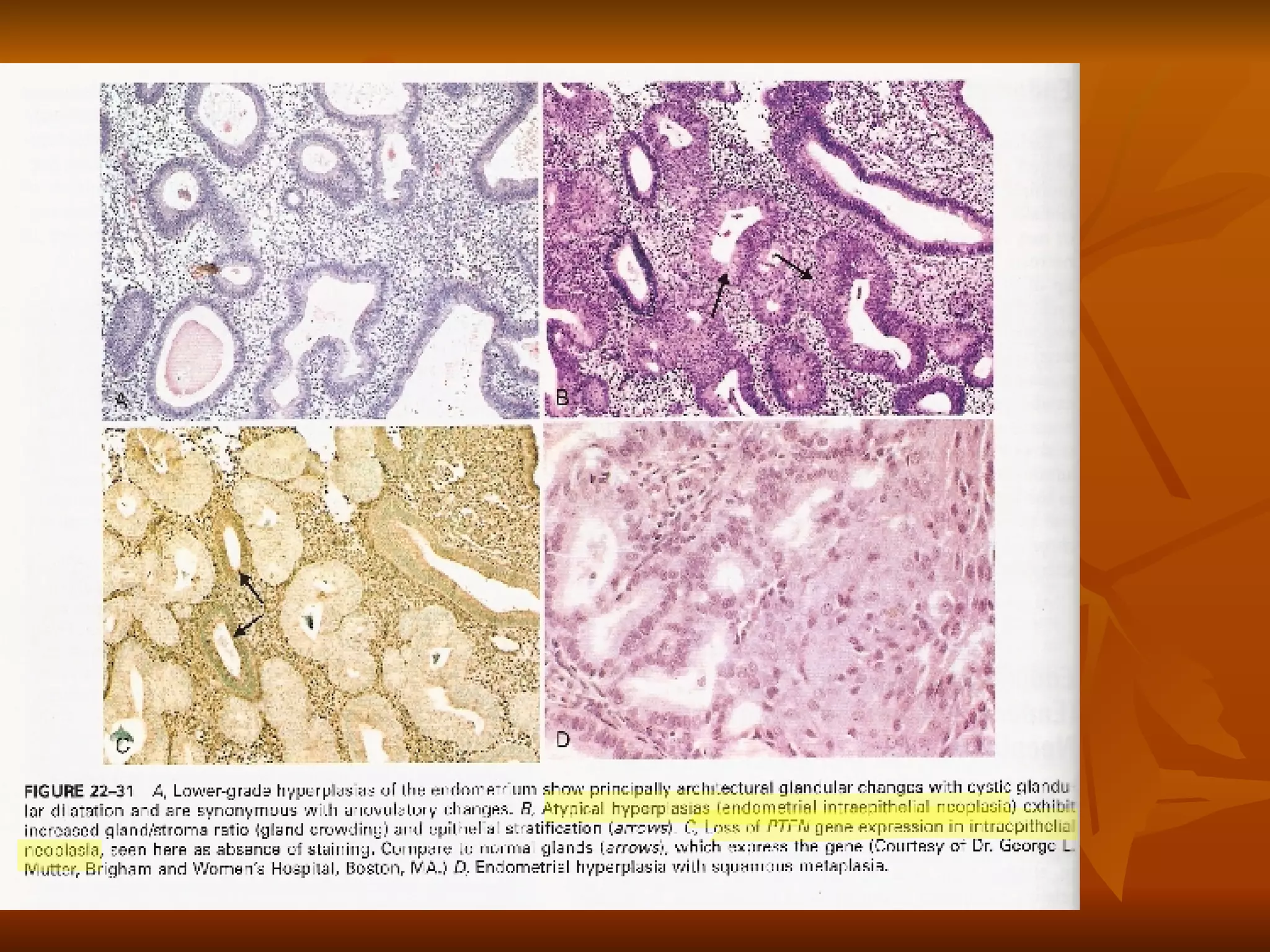
PTEN Tumor suppressor gene  Deletion/inactivation Encodes a phosphatase with dual lipid and protein specificity Most impt fxn: lipid phosphatase blocking Akt phosphorylation in the P13K pathway If absent, endometrial cells become more sensitive to stimulation by estrogens    may be integral--hyperplasia & cancer Inactivation is seen:  63% - premalignant endometrial hyperplasia 50-80% - endometrial carcinoma 43% - premenopausal women Loss of PTEN expression may be an early step in endometrial carcinogenesis
CARCINOMA OF THE ENDOMETRIUM 55-65 yo Higher frequency is seen with: Obesity Diabetes (abn. glucose tolerance >60%) Hypertension Infertility ( single, nulliparous, history of functional menstrual irregularities consistent with anovulatory cycles) Infrequently, both endometrial & breast CA arise in the same patient.
 
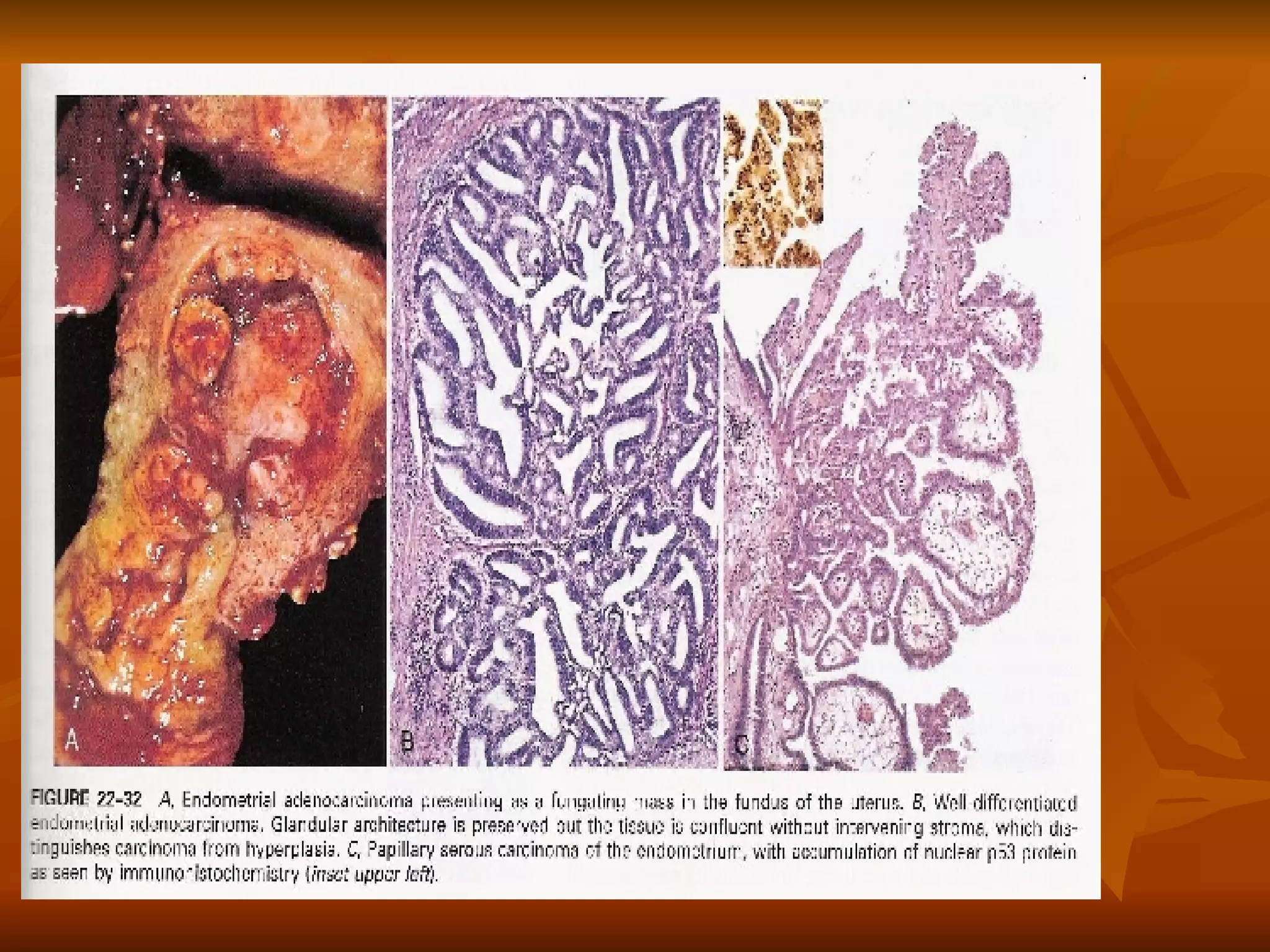
ENDOMETRIAL CANCER 85% are adenocarcinomas characterized by more or less well-defined gland patterns closely resembling normal endometrial epithelium (endometrioid tumors) 3-step grading system Grade 1 – well-differentiated, with easily recognizable glandular patterns Grade 2 – moderately differentiated, showing well-formed glands mixed with solid sheets of malignant cells Grade 3 – poorly differentiated, char. by solid sheets of cells with barely recognizable glands and a greater degree of nuclear atypia and mitotic activity Papillary serous carcinomas and clear cell carcinomas are managed as grade 3 carcinomas irrespective of histologic pattern.
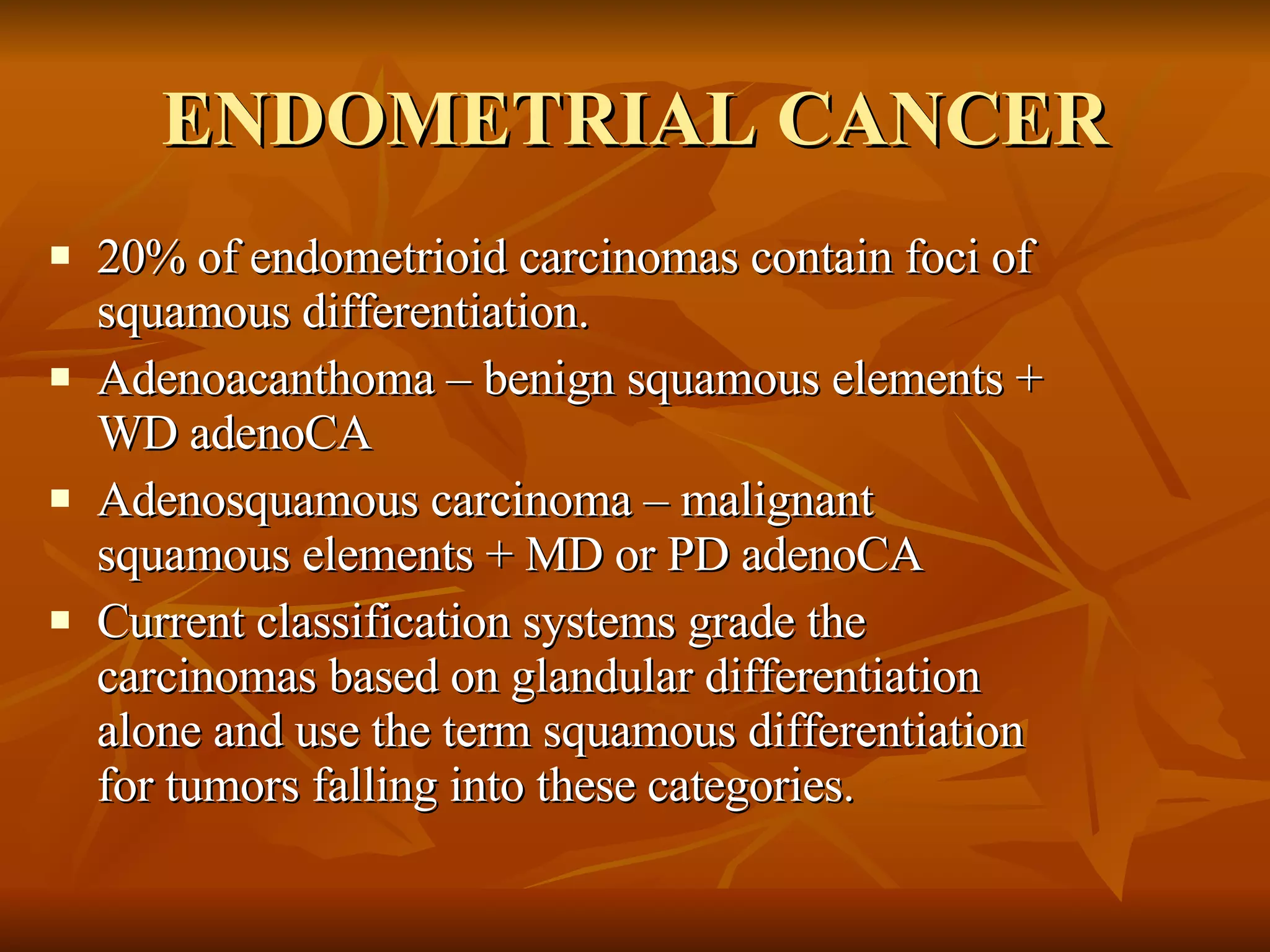
ENDOMETRIAL CANCER 20% of endometrioid carcinomas contain foci of squamous differentiation. Adenoacanthoma – benign squamous elements + WD adenoCA Adenosquamous carcinoma – malignant squamous elements + MD or PD adenoCA  Current classification systems grade the carcinomas based on glandular differentiation alone and use the term squamous differentiation for tumors falling into these categories.


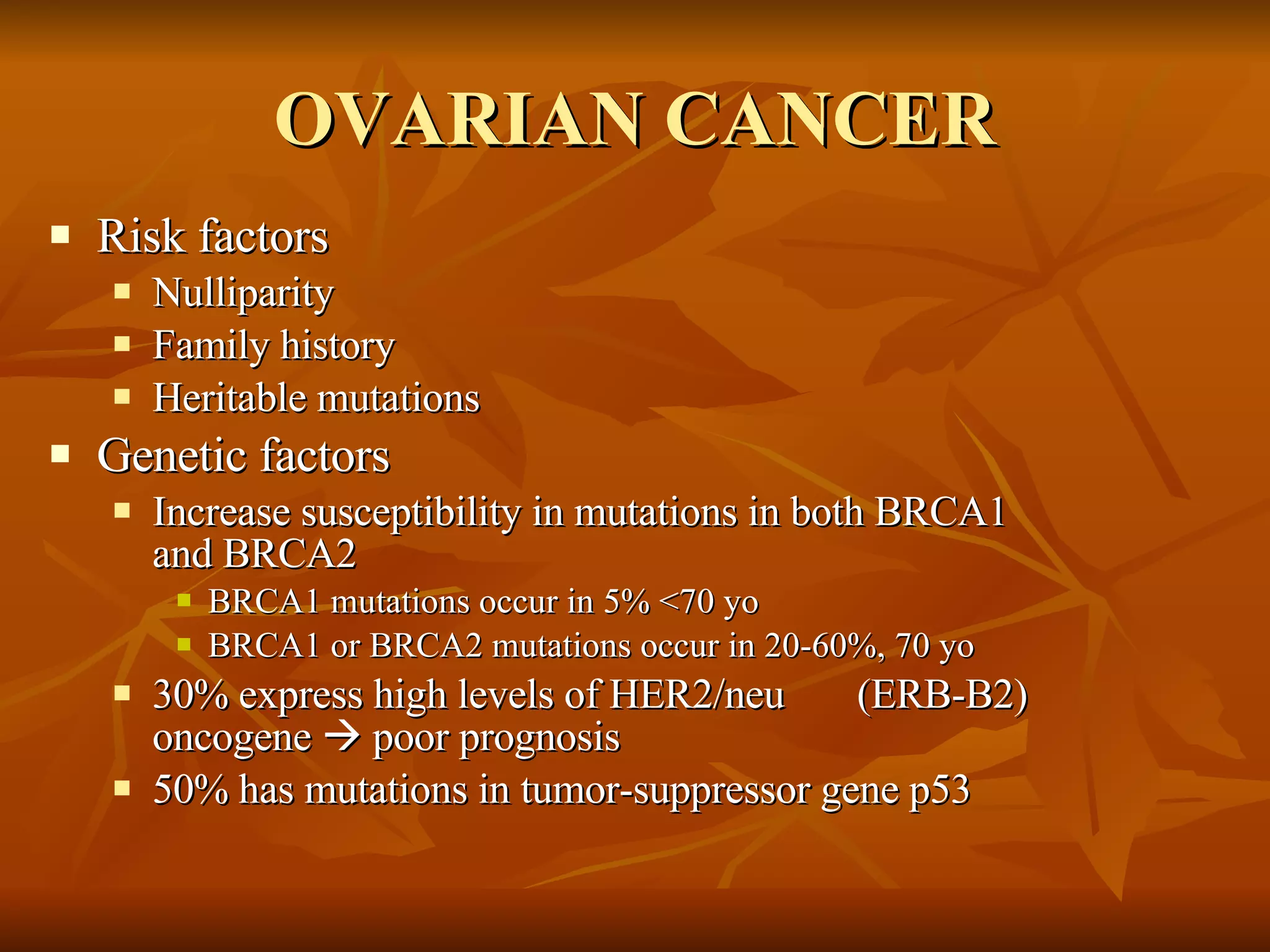
OVARIAN CANCER Risk factors Nulliparity Family history Heritable mutations Genetic factors Increase susceptibility in mutations in both BRCA1 and BRCA2  BRCA1 mutations occur in 5% <70 yo BRCA1 or BRCA2 mutations occur in 20-60%, 70 yo  30% express high levels of HER2/neu  (ERB-B2) oncogene    poor prognosis 50% has mutations in tumor-suppressor gene p53


ENDOMETRIOID TUMORS (OVARY) Presence of tubular glands bearing a close resemblance to benign or malignant endometrium 15-30% of endometrioid CA of the ovary are accompanied by a CA of the endometrium, and the relatively good prognosis in such cases suggests that the two may arise independently rather than by metastatic spread from one another.


CHORIOCARCINOMA Rapidly invasive, widely metastasizing malignant neoplasm: Lungs (50%) Vagina (30-40%) Brain, liver, kidney Responds well to chemotherapy – 100% cure or remission By contrast, nongestational chorioCA are much more resistant to therapy Preceded by: 50% - hydatidiform mole 25% - previous abortion 22% - normal pregnancy Ectopic pregnancy, genital & extragenital teratomas Does not produce chorionic villi Abnormal proliferation of both cytotrophoblast & syncytiotrophoblast Titers of HCG are elevated to levels above those encountered in H. moles
 
 
THANK YOU

Female Genital Tract Pathology

  • 1.
    THE FEMALE GENITALTRACT CRISBERT I. CUALTEROS,M.D. http://crisbertcualteros.page.tl
  • 2.
  • 3.
  • 4.
  • 5.
  • 6.
  • 7.
  • 8.
  • 9.
  • 10.
  • 11.
  • 12.
  • 13.
  • 14.
  • 15.
  • 16.
  • 17.
  • 18.
  • 19.
  • 20.
  • 21.
  • 22.
  • 23.
  • 24.
    CERVICAL CANCER clinicalcourse and management Cytologic screening Papanicolaou smear HPV testing Histologic diagnosis and removal of precancers Surgical removal of invasive cancers with adjunctive radiation and chemotherapy Vaccines for preventing of HPV infection or treating existing disease
  • 25.
  • 26.
  • 27.
  • 28.
    DYSFUNCTIONAL UTERINE BLEEDINGANOVULATORY CYCLE Results in excessive and prolonged estrogenic stimulation without the development of the progestational phase that regularly follows ovulation Most common at menarche and perimenopausal period INADEQUATE LUTEAL PHASE Occurrence of inadequate corpus luteum function and low progesterone output, with an irregularly ovulatory cycle ENDOMETRIAL CHANGES ENDUCED BY ORAL CONTRACEPTIVES Common response pattern is a discordant appearance between glands and stroma, usually with inactive glands amid a stroma showing large cells with abundant cytoplasm reminiscent of the decidua of pregnancy MENOPAUSAL & POSTMENOPAUSAL CHANGES Anovulatory cycle  ovarian failure and atrophy of the endometrium Mild hyperplasia with cystic dilation of glands  cystic atrophy
  • 29.
  • 30.
  • 31.
  • 32.
  • 33.
  • 34.
    PTEN Tumor suppressorgene Deletion/inactivation Encodes a phosphatase with dual lipid and protein specificity Most impt fxn: lipid phosphatase blocking Akt phosphorylation in the P13K pathway If absent, endometrial cells become more sensitive to stimulation by estrogens  may be integral--hyperplasia & cancer Inactivation is seen: 63% - premalignant endometrial hyperplasia 50-80% - endometrial carcinoma 43% - premenopausal women Loss of PTEN expression may be an early step in endometrial carcinogenesis
  • 35.
    CARCINOMA OF THEENDOMETRIUM 55-65 yo Higher frequency is seen with: Obesity Diabetes (abn. glucose tolerance >60%) Hypertension Infertility ( single, nulliparous, history of functional menstrual irregularities consistent with anovulatory cycles) Infrequently, both endometrial & breast CA arise in the same patient.
  • 36.
  • 37.
    ENDOMETRIAL CANCER 85%are adenocarcinomas characterized by more or less well-defined gland patterns closely resembling normal endometrial epithelium (endometrioid tumors) 3-step grading system Grade 1 – well-differentiated, with easily recognizable glandular patterns Grade 2 – moderately differentiated, showing well-formed glands mixed with solid sheets of malignant cells Grade 3 – poorly differentiated, char. by solid sheets of cells with barely recognizable glands and a greater degree of nuclear atypia and mitotic activity Papillary serous carcinomas and clear cell carcinomas are managed as grade 3 carcinomas irrespective of histologic pattern.
  • 38.
    ENDOMETRIAL CANCER 20%of endometrioid carcinomas contain foci of squamous differentiation. Adenoacanthoma – benign squamous elements + WD adenoCA Adenosquamous carcinoma – malignant squamous elements + MD or PD adenoCA Current classification systems grade the carcinomas based on glandular differentiation alone and use the term squamous differentiation for tumors falling into these categories.
  • 39.
  • 40.
  • 41.
  • 42.
  • 43.
    OVARIAN CANCER Riskfactors Nulliparity Family history Heritable mutations Genetic factors Increase susceptibility in mutations in both BRCA1 and BRCA2 BRCA1 mutations occur in 5% <70 yo BRCA1 or BRCA2 mutations occur in 20-60%, 70 yo 30% express high levels of HER2/neu (ERB-B2) oncogene  poor prognosis 50% has mutations in tumor-suppressor gene p53
  • 44.
  • 45.
  • 46.
  • 47.
  • 48.
  • 49.
    ENDOMETRIOID TUMORS (OVARY)Presence of tubular glands bearing a close resemblance to benign or malignant endometrium 15-30% of endometrioid CA of the ovary are accompanied by a CA of the endometrium, and the relatively good prognosis in such cases suggests that the two may arise independently rather than by metastatic spread from one another.
  • 50.
  • 51.
  • 52.
  • 53.
  • 54.
  • 55.
  • 56.
  • 57.
  • 58.
  • 59.
  • 60.
  • 61.
  • 62.
  • 63.
  • 64.
  • 65.
  • 66.
  • 67.
    CHORIOCARCINOMA Rapidly invasive,widely metastasizing malignant neoplasm: Lungs (50%) Vagina (30-40%) Brain, liver, kidney Responds well to chemotherapy – 100% cure or remission By contrast, nongestational chorioCA are much more resistant to therapy Preceded by: 50% - hydatidiform mole 25% - previous abortion 22% - normal pregnancy Ectopic pregnancy, genital & extragenital teratomas Does not produce chorionic villi Abnormal proliferation of both cytotrophoblast & syncytiotrophoblast Titers of HCG are elevated to levels above those encountered in H. moles
  • 68.
  • 69.
  • 70.