Inflammation
Dr. Abuobieda
INFLAMMATION
Literally: inflammation means "burnout".
Scientifically: it is a physiological response to cell injury, associated with cellular,
vascular humoral events
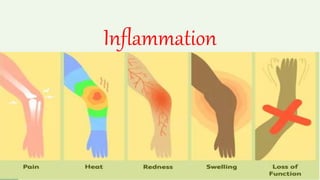
Cardinal Signs of inflammation
Rubor (redness), Color (heat), Dolar (pain), Tumor (swelling), Functio laesa (loss
of function).
1- Redness (Rubor): due to dilatation of small blood vessels and increased blood
supply (hyperemia).
2- Swelling (Tumor): due to accumulation of inflammatory fluid in the
extravascular space + the inflammatory cells accumulated in the area. (Exudate)
3- Heat (Color): due to increased blood flow (hyperemia), from vascular dilation
and delivery of warm blood to the area.
4- Pain (Dolor): due to the stretching of tissues due to inflammatory
edema and the chemical mediators of acute inflammation, especially
bradykinin and prostaglandins.
5- Loss of Function (Functio laesa): due to restricted movement of an
inflamed organ by pain reflexes, and swelling may physically
immobilize the affected area.
What are the Purposes of the Inflammatory Process:
-To localize the injury in a specific area,
-To get rid of the cause of the injury
-To repair the damaged area.
General Features of Inflammation:
- Inflammation is a complicated process in which you will
see one mediator with different functions on different
tissues, also you can see different mediators that have the same
function.
- Duration of inflammation can be long or short, hence there
is acute, chronic, or sub-chronic (different stages),
- If acute inflammation does not heal it becomes chronic.
Effects of Inflammation: local or systemic, also can be useful,
or harmful
• local effects: for example, the killing of invading
microorganisms, swelling, and loss of function
• Systemic effects: like fever, malaise, and leukocytosis
Systemic Effect of Inflammation:
a. Leukocytosis: ( high white blood cells), increased neutrophils
indicate acute inflammation special bacterial infection, whereas
increased lymphocytes occur in viral infections or chronic
inflammation.
b.Fever: (elevation of body temperature) is the commonest systemic
effect of inflammation. associated with an infectious inflammation,
produced by cytokines and interleukins.
What is the function of fever? It improves the efficiency
of leukocyte killing and impairs the replication of the invading
organisms.
c. Increased Acute Phase Reactant & ESR:
Both are due to an increased level of IL1, IL6, TNF…etc. and
other proteins produced from the liver in association with
inflammation
Beneficial Effect of Inflammation:
a. Dilution effect: results in removal and washout of the bacterial toxins
through the lymphatic system away from the inflammatory areas.
b. promoting the immunity: by enhancing immune response after bringing
microorganism to the adjacent lymph node,
c. Provides WBCs. Antibodies. and proteins provide cells and different
proteins like fibrinogen, complement system, and nutrition to the sick cells to
the site of inflammation.
Harmful Effects of Inflammation:
a. Swelling: resulting in obstruction of organs with lumen as in acute, like
laryngitis, or increased intracranial pressure in encephalitis, and ischemic
injury if obstruction of blood supply takes place.
b. Loss of Organ Function: inflamed organs lose their function, for example,
hepatitis (inflammation of the liver ) is associated with impaired liver function
tests.
Nomenclature of the Inflamed Tissue:
The rule of nomenclature is to add the suffix (itis) at the end of the name
of the organ or tissue, for example:
 Appendix: Appendicitis
 Gastric tissue: Gastritis
 Colon: Colitis
 Ovary: Ovaritis
 Mammary tissue: Mastitis
Exceptional Rule:
 Pulmonary: pneumonia,
 pleural: Pleurisy
 Veins: Phlebitis
 Testis: Orchitis
 Fallopian tube: Salpingitis
Classification of Inflammation:
Inflammation can be classified as acute inflammation,
inflammation & chronic inflammation sub-chronic inflammation
Comparison: Acute and Chronic Inflammation:
Acute inflammation occurs during a short period of time, days or
weeks, in the presence of all cardinal signs of inflammation and
infiltration of neutrophils. While, chronic inflammation occurs over
a long period of time, months or years, and is infiltrated with
lymphocytes, plasma cells, and macrophages and forming of
fibrous tissue in the periphery of the inflamed tissue.
Features Acute inflammation Chronic inflammation
Duration Days or weeks Months or years
Types of
cells
Mainly neutrophils Mainly lymphocytes, and
plasma cells, macrophages
and monocyte.
Cardinal
signs
All are present Some of them
Healing
process
Complete resolution By fibrosis

INFLAMMATION 1.pptx

  • 1.
  • 2.
    INFLAMMATION Literally: inflammation means"burnout". Scientifically: it is a physiological response to cell injury, associated with cellular, vascular humoral events Cardinal Signs of inflammation Rubor (redness), Color (heat), Dolar (pain), Tumor (swelling), Functio laesa (loss of function). 1- Redness (Rubor): due to dilatation of small blood vessels and increased blood supply (hyperemia). 2- Swelling (Tumor): due to accumulation of inflammatory fluid in the extravascular space + the inflammatory cells accumulated in the area. (Exudate) 3- Heat (Color): due to increased blood flow (hyperemia), from vascular dilation and delivery of warm blood to the area.
  • 3.
    4- Pain (Dolor):due to the stretching of tissues due to inflammatory edema and the chemical mediators of acute inflammation, especially bradykinin and prostaglandins. 5- Loss of Function (Functio laesa): due to restricted movement of an inflamed organ by pain reflexes, and swelling may physically immobilize the affected area. What are the Purposes of the Inflammatory Process: -To localize the injury in a specific area, -To get rid of the cause of the injury -To repair the damaged area.
  • 4.
    General Features ofInflammation: - Inflammation is a complicated process in which you will see one mediator with different functions on different tissues, also you can see different mediators that have the same function. - Duration of inflammation can be long or short, hence there is acute, chronic, or sub-chronic (different stages), - If acute inflammation does not heal it becomes chronic.
  • 5.
    Effects of Inflammation:local or systemic, also can be useful, or harmful • local effects: for example, the killing of invading microorganisms, swelling, and loss of function • Systemic effects: like fever, malaise, and leukocytosis Systemic Effect of Inflammation: a. Leukocytosis: ( high white blood cells), increased neutrophils indicate acute inflammation special bacterial infection, whereas increased lymphocytes occur in viral infections or chronic inflammation. b.Fever: (elevation of body temperature) is the commonest systemic effect of inflammation. associated with an infectious inflammation, produced by cytokines and interleukins.
  • 6.
    What is thefunction of fever? It improves the efficiency of leukocyte killing and impairs the replication of the invading organisms. c. Increased Acute Phase Reactant & ESR: Both are due to an increased level of IL1, IL6, TNF…etc. and other proteins produced from the liver in association with inflammation
  • 7.
    Beneficial Effect ofInflammation: a. Dilution effect: results in removal and washout of the bacterial toxins through the lymphatic system away from the inflammatory areas. b. promoting the immunity: by enhancing immune response after bringing microorganism to the adjacent lymph node, c. Provides WBCs. Antibodies. and proteins provide cells and different proteins like fibrinogen, complement system, and nutrition to the sick cells to the site of inflammation. Harmful Effects of Inflammation: a. Swelling: resulting in obstruction of organs with lumen as in acute, like laryngitis, or increased intracranial pressure in encephalitis, and ischemic injury if obstruction of blood supply takes place. b. Loss of Organ Function: inflamed organs lose their function, for example, hepatitis (inflammation of the liver ) is associated with impaired liver function tests.
  • 8.
    Nomenclature of theInflamed Tissue: The rule of nomenclature is to add the suffix (itis) at the end of the name of the organ or tissue, for example:  Appendix: Appendicitis  Gastric tissue: Gastritis  Colon: Colitis  Ovary: Ovaritis  Mammary tissue: Mastitis Exceptional Rule:  Pulmonary: pneumonia,  pleural: Pleurisy  Veins: Phlebitis  Testis: Orchitis  Fallopian tube: Salpingitis
  • 9.
    Classification of Inflammation: Inflammationcan be classified as acute inflammation, inflammation & chronic inflammation sub-chronic inflammation Comparison: Acute and Chronic Inflammation: Acute inflammation occurs during a short period of time, days or weeks, in the presence of all cardinal signs of inflammation and infiltration of neutrophils. While, chronic inflammation occurs over a long period of time, months or years, and is infiltrated with lymphocytes, plasma cells, and macrophages and forming of fibrous tissue in the periphery of the inflamed tissue.
  • 10.
    Features Acute inflammationChronic inflammation Duration Days or weeks Months or years Types of cells Mainly neutrophils Mainly lymphocytes, and plasma cells, macrophages and monocyte. Cardinal signs All are present Some of them Healing process Complete resolution By fibrosis